Thursday, January 8, 2015

Station Master, by Mayfair Games

A few weeks ago my friends and I celebrated our second annual Krinsmas, our own little Christmas celebration which centers around a White Elephant gift exchange. At our first Krinsmas all of the gifts ended up being able to be classified as either Books, Booze, or Board Games. (Well, sort of. Listen, the games come in a box, okay?) So we decided to make the BBB theme official and do it again. In the ensuing anarchy there were a lot of really neat games, including Station Master, a game which I stole from Carvan at the first opportunity. Interestingly enough, no one attempted to steal Station Master from me for the rest of the night. Possibly because I kept it out of view, but I like to think it was because everyone was afraid of what would happen if they tried taking it away from me. After all, I like trains. Anyway, as my review of the game Imperial currently remains my most popular post ever on the Arsenal, I decided to go ahead and make another board...er...card game review.

Station Master is a fairly simple game that can be learned in a few minutes, a definite advantage when you're debating which game you should try playing after you finish unwrapping presents. In terms of plot, the players are all station masters at a train station who are attempting to get as many passengers as possible onto trains and out of the station. Mechanically you're trying to get as many points as possible by assigning your passenger tokens to the most advantageous trains and then getting those trains out of the station.The game contains thirty-six passenger tokens, and two decks of cards, one of locomotives, and one of station master cards. Each player begins the game with six passenger tokens and three station master cards. During your turn you may choose to place a passenger token on a train, or play a station master card, drawing a replacement card at the end of your turn. Once a train containing your passenger tokens leaves the station, you get those tokens back and you can put more passengers on more trains. Once the deck of locomotives is depleted the total score is tallied and whoever got the most ridiculous amount of points wins.

The locomotive cards, as you can imagine, have locomotives on them, and are helpfully colored blue. Each locomotive has a maximum number of passenger tokens it can carry on it, as well as a maximum number of carriages it can pull. Once the maximum number of carriages has been reached the train departs the station, however it can depart with less than a full compliment of passengers. The station master deck is divided into four types of cards, green, red, green/red, and yellow. The green cards are passenger cars and you want to add them to your train because they'll increase the train's overall score. Red cards are freight cars and have negative value, so they'll decrease the train's score. (Unless they're attached to the one freight train.) Green/red cards are special luxury cars that are a positive value if they're attached to an express train, but negative value if they're attached to any other train. Because one percenters get mad if they have to ride with common people, I guess. Yellow cards have instructions on them and let you change up gameplay to your advantage. The game really only gets complicated when you have to keep score because the value of the train cars is multiplied by the value of your passengers, resulting in some ridiculously high scores if you pull off a decent train combo. Just keep a calculator, pencil, and some paper handy and you should be fine.

What we found really interesting about this game is that it can be simultaneously competitive, and yet cooperative at the same time. Obviously you want to get more points than your opponents, however sometimes the best way to get a lot of points is through cooperation. If everyone has passengers on a specific train, everyone has a motivation to make sure the train gets as many points as possible. You just have to look out for the people who didn't get any of their passengers on the train and now are motivated to do anything to keep everyone else from getting a ton of points. There's still a motivation to get more points than the guy next to you, but you can work together to an extent as well.

I do kind of wish there was more than one freight train, considering how many freight cars there are, but that may actually upset the game balance so I'm happy to accept the game how it is. Really, the only difficulty we had playing this game was the massive calculations we had to do when someone got a really good combo train out of the station. The limited options during your turn also mean the game takes forty-five minutes to maybe an hour to play, that includes going over the rules, and the game actually has some built-in mechanics to keep the game from dragging out indefinitely.

Overall, it's a short and very fun game, which may actually be a little better for my blood pressure than Ticket to Ride. (Anyone who's played Ticket to Ride can tell you that game can get super-intense, especially towards the end.) Because there's still opportunities for collaboration rather than confrontation in Station Master, it definitely feels less stressful. I for one look forward to forcing more people into playing trains with me in the future.

- Kalpar

Thursday, January 1, 2015

The Forever War, by Joe Haldeman

This week I'm reviewing The Forever War, a sort of vintage book at this point since it was first published in 1974 and apparently has since become part of the pulp sci-fi canon. In some respects I will say this book has not aged particularly gracefully, yet at the same time it remains rather valid because it talks about a war that is highly divided from civilian life, much like the wars in Iraq and Afghanistan have been for the past decade. I'd definitely recommend that fans of sci-fi check this book out, but be aware that it hasn't aged as well as it could have.

Plot wise, The Forever War talks about an interstellar war between humanity and a race known as the Taurans. Humanity initially knows very little about the Taurans, in fact we don't even know what they look like. As if this wasn't complicated enough, the war is made even more difficult by the interstellar distances involved and the time dilation caused by near-light-speed travel. Although the soldiers involved in an engagement have only spent a few months getting to the front and fighting, as they have traveled decades or even centuries have passed back at home on earth. The result is an inability for returning veterans (what few there are) to integrate back into civilian society who will then spend what looks like the rest of eternity involved in an endless and eventually futile war.

The parallel with Vietnam and the inability of veterans to successfully integrate back into civilian life is of course fairly obvious, and the author states this explicitly in the introduction about how his book's based on his own experiences in Vietnam. However, it is still applicable today since the United States is still involved in a conflict in Afghanistan and recent developments (As of September 2014) heavily suggest that there will be some U.S. involvement back in Iraq for time yet to come. But aside from vague news reports, the war has become background chatter in the American consciousness. We may know friends or family members who have served in Iraq or Afghanistan, but it's an experience totally divorced from our own with little to no impact on civilian life. The Forever War is in some ways an accurate prediction. Obviously the U.S. economy is not totally centered around the military, (Not yet, at least, anyway.) but the war seems to stretch with no end except that of sheer fatigue. The goals and objectives, so clear in the beginning, have become muddled and in some cases barely understood.

The one thing in specific that I noticed didn't age well with this book was homosexuality. I will say the book had a fairly tolerant attitude towards it, the main character didn't quite understand it, but it could have been a much worse attitude for the time period this was written in. There was an unfortunate implication that homosexuality is just a switch in the brain that can be flipped on or off with the correct conditioning, which I believe is largely incorrect based on our current understanding of human sexuality. (And this of course blatantly ignores bisexuality, yet another issue common in many works of fiction) Again, that might be just sort of a side effect of the times more than anything else.

The other big thing with the book is that it just sort of ends abruptly. We're given a vague explanation as to why, but for me it wasn't a terribly satisfying pay-off for the novel's build-up. It does make an interesting parallel to the real-life Iraq and Afghanistan conflicts as the U.S. left Iraq because of a shift in policy, with an equal dissatisfaction with the progress achieved. Overall, the book's rather good and I definitely recommend it if you haven't read it already.

- Kalpar

Thursday, December 25, 2014

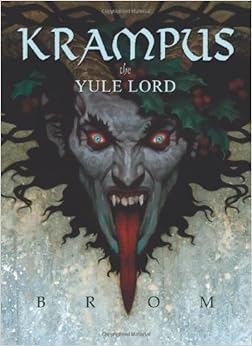
Krampus the Yule Lord, by Brom

You better watch out, you better not cry, you better not pout, because hoo boy does Krampus have a temper. This week in the spirit of Christmas I’m reviewing another book by Brom, Krampus, the Yule Lord. For those of you unfamiliar with the demon Krampus, (Which I suspect will be only a handful) Krampus is one of many spooky traditions found in European countries around the Winter Solstice because goddamn it is cold and dark out, we need to do something to distract ourselves from that. Krampus in particular is found in and around the Alps, specifically northern Italy, Switzerland, Austria, and some areas of southern Germany. Although the exact nature of Krampus varies from region to region, he always appears as a horned monster who brandishes switches to thrash naughty children, and on occasion eats the very worst of them. Having dealt with a few bratty children during Christmas time myself, I understand the appeal of creatures such as Krampus.

Krampus the Yule Lord, however, is a creative re-telling of the Krampus legend, mixing in various Christmas traditions from across Northern Europe, including some Norse mythology, and the characteristic slightly creepy touch of Brom. Our main protagonist is Jesse Walker, a struggling country musician living in Boone County, West Virginia. Things have been pretty rough for Jesse, but when Santa’s sack lands in the bedroom of his trailer, things start to become even more complicated. Before he knows it, Jesse gets tied up in a war between Santa Claus and Krampus, a centuries-old war over the very nature of Christmas itself. Initially I didn’t much care for Jesse because he wasn’t a character I could really get behind, but that actually left room for a good character development arc and Jesse improved considerably towards the end. Hooray character development!

The biggest weakness of this book is that I never really found myself rooting for Krampus until towards the very end of the book. Krampus informs us of Santa’s treachery and how the kind, gentle, and gift-giving aspects of Santa’s nature are all an act for a much more nefarious purpose. Although we’re told this by Krampus, most of what we see of Santa is a very earnest, generous, and sometimes very troubled soul who’s trying to make the world a better place. Granted, Santa wields a sword like a badass as well, but considering I’m a huge fan of Santa as depicted in Rise of the Guardians, I’m definitely okay with Santa knocking a few heads together if he needs to. By contrast, through much of the book Krampus works through fear and intimidation, in some ways a walking manifestation of the things that go bump in the night around this time of year. It just brings Krampus’s allegations of Santa’s hidden wickedness into question and I found myself rooting more for the man in red.

The reason I bring this up is the book is titled Krampus after all, and reading the book jacket blurb I was left with the impression we were supposed to be rooting for Krampus. There is some development towards the end and I ended up feeling a little more sympathetic towards Krampus, but not by a lot. It just makes me wonder if we were supposed to like Krampus at all until he stops being such an enormous jerk. Wanting to punish the wicked is one thing, but holding a grudge against Santa is something else entirely. So if you’re going to read this book, just be aware that you may not find yourself agreeing with Krampus much during the book.

Another shame was that there were several characters who weren’t terribly well developed in the course of the novel. We did get to see some really good development with Jesse and Krampus, but other characters like Perchta and Krampus’s Shawnee buddies are little more than background pieces who got their own illustrations in the book. There were possibly a dozen different, incredibly interesting stories about all the different side characters that could have been told, even just a little bit, which would have better satisfied my curiosity. It is, however, probably to the book’s benefit that they remained background characters because I’ve seen far too many books wander off into multiple directions and suffer because they tried to tell six stories instead of telling one well. 

I definitely will also say that this is a book for adults. I mentioned in my review of The Plucker that although Brom does a lot of illustrated work, this should not be confused with kid friendly work at all. The typical spooky, creepy feel that Brom brings to his work aside, the language alone is enough to merit parents looking first before letting the kids read. (Of course, I grew up in a house where I wasn’t allowed to swear at all until I was eighteen.) However, I leave that judgment in the hands of parents and recommend they read the book first themselves.

My final nitpick comes, of course, with Brom’s afterword detailing a little bit about the history of Santa and different Christmas traditions across the globe. Brom mentions a very common myth that Coca-cola helped spread the image of Santa Claus in red and white in the 1930’s, a popular myth because of Coca-cola’s own red and white color scheme and because it takes a playful jab at the commercialization of Christmas that’s been going on for nearly a century at this point. I would like to point out that our modern image of Santa can be traced back to famed cartoonist Thomas Nast, who originally portrayed Santa Claus in a red and white suit in 1881, well before Coca-cola began using Santa for their advertising campaigns. This lesson in pedantic historical trivia brought to you by The Kalpar.


Issues aside, I rather enjoyed this book and I think it’s a great addition to the collection of holiday tales. Creepy, scary, and yet exciting, Brom delivered another excellent tale with his own idiosyncratic twist.

- Kalpar 

Thursday, December 18, 2014

The Left Hand of Darkness, by Ursula K. LeGuin

This week I've read another book from Ursula K. LeGuin, in this case on of her science-fiction novels, The Left Hand of Darkness. As much as I enjoyed some of LeGuin's other works, like the Earthsea series, I was left rather frustrated with this book because it either has fallen far short of the mark or simply has not aged well in the past forty years. Perhaps both. In either case the book seems almost a relic of a bygone era and what was once ground-breaking seems almost trivial in hindsight.

The Left Hand of Darkness is set on the planet Gethen, also referred to by outsiders as Winter because it is currently going through an ice age and a day over sixty degrees Fahrenheit is considered broiling. The story centers around an off-world visitor, Genly Ai, a representative of the Ekumen, an interstellar confederation of human-inhabited worlds united by FTL ansible communications. Ai has been sent to Gethen to invite the countries of that world to join in the shared knowledge and cooperation of the Ekumen. Understandably, the Gethans are fairly suspicious of Ai and the Ekumen's intentions, fearing his arrival merely a front for a far more nefarious scheme. Ai's efforts center around trying to get the people of Gethen to trust and accept him, and gradually enter an alliance with the Ekumen.

What is more remarkable, though, is that the human beings that inhabit Gethen are all one sex. For most of the month Gethans are in what they refer to as somer, where they simply possess no sex, have no sexual urges or desires, and live their life comfortably neuter. Once a month, however, each Gethan will undergo kemmer, and begin to develop sexual characteristics and hormones. During kemmer a Gethen can become what we would define as either male or female, sometimes adapting to compliment a partner who is already in kemmer. Biologically a Gethan can become either sex and can both sire and bear children in their lifetime. As a result, the Gethans are a largely mono-gendered society as well; child-rearing is a largely shared task, and as anyone can become male or female next kemmer, there are no widespread assumptions or stereotypes attached to sex.

It's an interesting thought experiment and could definitely be used to challenge assumptions regarding gender, but the implementation just feels fairly hollow forty years later. Ai definitely expresses frustration at being unable to classify Gethans into familiar male or female categories and finds them rather alien, just as they find him, but he also finds aspects of their cultures, such as a preference for speaking indirectly and obsession with personal honor, to be strange and confusing as well. I guess I didn't find it very odd that an alien culture would seem weird to an observer and that the Gethans reacted with suspicion when an interstellar visitor arrives claiming to want only their friendship.

But more importantly, I felt that the main thrust of LeGuin's thought experiment was to explore stereotypes and assumptions about sex and gender by simply removing them and providing a contrast. The result I am unhappy to say is not terribly convincing, and perhaps a little refinement of terminology (which may have occurred in the past forty years) will help clarify my frustration. Specifically sex and gender do not mean the same things, although people often assume that they do. Sex is biological and the overwhelming majority of people fall into either one category or another: male or female. Sex is defined by what set of organs you have in your pants and the predominate hormones in your bloodstream. Gender, however, is a social construct which is far more complicated. In mainstream Western society we tend to assume there are two genders which also go with the two sexes, male and female. In this dichotomy men like to talk about sports and beer and fix things with their tools and trucks and what not, while women by contrast like to talk about their feelings and like to bake and knit and what have you. We see this dichotomy every day from its use in sitcom humor, to advertising, to the rows of pink toys designed specifically for girls. However, a bi-gendered society which assumes that someone will fall neatly into the corresponding category because of their reproductive organs is restrictive for everyone and leads to sexism and all the horrible awfulness that comes part and parcel with that.

Furthermore, people do not always associate with the gender that is attached to their sex. Some people are transgender and identify as the gender opposite of their biological sex, while other people's preferred gender may vary from day to day, depending on their mood. In fact, some cultures even have three or more genders, creating a host of opportunities for people to develop their identity. The point of this little tirade is that throughout Left Hand of Darkness, Ai attributes peculiarities of Gethan culture, such as the absence of war, to their lack of distinct sexes and genders. Because Gethans are both man and woman, their naturally violent tendencies are mellowed by the kind, nurturing aspects. Although this might have held up in 1969 when the book was first published, it's definitely an outdated idea today in 2014. Continued developmental research has shown, just for sake of example, that boys and girls have just as much capacity for violence. The only difference is that in culturally defined gender roles violence is more tolerated, and even encouraged, among boys while it comes with strict repercussions for girls. While in American culture gender is still very strongly attached to sex, and we are still engaged in a struggle to break down gender stereotypes, what sex you are with does not determine your gender. A culture like the Gethans, which lacks defined sexes may lack defined genders and gender roles, but this doesn't mean they'll be any different from the other mess of humanity.

Other than the blurring between sex and gender, which may have not been as well-defined in 1969 as it is today, this book is okay at best. There's an opportunity to explore new ideas and break down assumptions about sex and gender, but it certainly doesn't get developed to its full potential. There's some exploration of religion, LeGuin's fascination with duality (a consistent theme in her works), and other odds and ends, but the brevity of the work means it lacks depth. I think this could be safely passed by for other works, as highly acclaimed as it is.

- Kalpar

Thursday, December 11, 2014

A Modern History of Japan: From Tokugawa Times to the Present, by Andrew Gordon

As some of my readers may be aware, my training as a historian has definitely been fairly Eurocentric, a definite focus of history over the past four hundred years or so. After all, the field of history in the United States has been dominated by white men who are often most interested in...white men. As a result I can sing a song listing in order all the monarchs of England from 1066, but I can't name off the top of my head more than perhaps three important Japanese people in all of Japan's fifteen hundred year history. Aware of this particular gap in my knowledge I found this book at my used-book store that was a general overview of Japanese history from the creation of the last shogunate in Tokugawa times to the year 2000. This proved to be a very good resource for giving me a basic grounding in information about Japan and hopefully will help further readings into Japanese history in the future.

This book operates in a very big-picture and broad-strokes perspective, which I find very helpful for two reasons. First of all, knowing only a few hazy generalities about Japanese history a very broad and general history providing more specific details about this country was an excellent way to being reading and learning about history. Very often history texts tend to have a very narrow focus and may not talk fully about various other events that tie into the focus of the text. A broad view is very good for an introduction to new material and can help facilitate research into other areas. Secondly, I myself tend to be a very big-picture sort of historian, liking to look at large events and ideologies shaped over decades, rather than focusing on the day-to-day drama that often becomes very popular in biographies. So overall I found this book rather useful for my purposes in learning more about Japan.

On the flip side, because this book is a very general history of Japan it does not spend terribly much time talking about any one subject. The book is rather ambitious in its scope, going from the Sengoku Jidai, or Warring States Period, of the 1500's and the rise of the Tokugawa Shogunate in 1603 to the year 2000 in only a little over three hundred pages. Obviously libraries have been filled with texts delving into the complexities of these five hundred years of history, but to cover it all in one smaller text results in quite a lot of detail being left out. This definitely should be expected in such a general work and while unfortunate, is a necessity of the very big-picture approach of this sort of text.

I will say that there was one point where Gordon started interjecting into the text with the personal pronoun "I", offering personal opinions on historical events. I was of course a little frustrated because in doing historical research and writing you should never make personal statements or assertions like that. If nothing else it violates the ideal of detached historical research. The goal of a historian is to research primary and secondary sources, and then construct and defend an interpretation of events based around those sources. Historians ideally refrain from passing judgement, as tempting as it is, but this is very complicated issue which remains a subject of debate even today. I personally suspect it was just a slip-up on the part of Gordon or his editors in some part of the process from transferring notes to manuscript because it was only that one forgivable instance and the text remains historically sound throughout.

If you know little to nothing about Japan and seek to learn more about a nation that has so greatly influenced the twentieth century then A Modern History of Japan is a good place to start reading. I recommend it as general material to become more familiar with the course of Japanese history and offer inspiration for other topics which you may seek to learn more about.

- Kalpar

Thursday, December 4, 2014

Bolo Brigade, by William H. Keith Jr.

This week I've returned to my perennial favorite series, the Bolos, with a full-length novel Bolo Brigade. When I initially began this series I sought to read it in chronological order. However, in the helpful guide of books located on Wikipedia I only recently noticed that the full-length Bolo novels were published concurrently with many of the Bolo short story anthologies, which I've already reviewed. However, I'm very happy to be going into the full-length novels and look forward to the opportunities provided by additional space.

This particular book deals with an area of space out on the galactic rim that is independent of the Concordiat of Man, but still strongly affiliated and protected by ancient Bolos against the remote possibility of a threat. Of course, we know that since the focus of the book is on this particular galactic backwater, the Bolos are going to have to save the day. In this case a race known as the Malach, very similar to raptor-like dinosaurs in many respects, have invaded the human worlds. The humans are no match for the hunter-warriors of the Malach, and some of the Bolos are simply insufficient as well. But hope lies in Freddy and Ferdy, two ancient (and perhaps most importantly self-aware) Mark XXIV Bolos, defenders of the sector's capital.

If you asked me my opinion on this particular book, I'd say it's okay. I wouldn't say it's going to win any awards, but it's a worthwhile contribution to the Bolo canon. As I've said before with other books, you usually go into Bolo books expecting some crazy awesome tank goodness and the book seldom fail to deliver on that promise. It's probably not going to change the world, but sometimes it's fun to kick back and read some pulp adventures. And honestly it has a giant tank on the cover, what did you expect? I will say that the Bolo books in the past have been able to raise the question of what makes someone, or something, human, and while this book sort of touches on that, it doesn't go into terribly great detail, focusing instead on the pulp action.

I will say that the book sort of makes an attempt to contrast the Malach and their societal values with human values, which are definitely alien to say the least. I do wonder if it was entirely fair for humans to judge Malach by human values, simply because the Malach are so alien. But at the same time, when people are determined to kill all of you and take all your land and resources, you kind of want to focus on killing them right back and morality can be damned. The book also does work in people who want to make peace with the Malach, assuming that they can be reasoned with as you would with other humans and a peaceful resolution to the current conflict can be achieved. I will admit that this peace faction comes across as little more than straw men because we know that the Malach terms, if the Malach bothered to offer them, would be completely unacceptable to any humans. So it sort of turns out the military people are right, but it doesn't feel terribly heavy-handed in this instance. I will also say it was kind of funny to find another species that is expanding from a solitary world and simply cannot believe that humanity is in control of more than a handful of planets. Although the Concordiat's resources aren't brought to bear in this novel, it definitely leaves the Malach in for a very rude awakening when a true Bolo Brigade arrives in the sector.

Simply put if you like Bolos, you'll like this book, and if you're new to Bolos then this book is also a good choice. (Although you might not catch all the references.) Definitely worth the read if you want some sci-fi action.

- Kalpar

Thursday, November 20, 2014

Field of Dishonor, by David Weber

Kalpar's Warning: Attention dear and gentle readers, as I have progressed with the Honor Harrington series I have worked very hard in my reviews to keep them largely spoiler-free so that the books may remain enjoyable for you. However, as the plot has continued to build I am finding it more and more difficult to properly talk about the book without having to go into some spoiler territory. I will try to keep it to a minimum but please keep that in mind before reading this review. 

Having become a very strong fan of David Weber's Honor Harrington series, I finally got around to reading the fourth book, Field of Dishonor and was rather satisfied with it, although I'm a little concerned about Honor's development as a character As this is the only book in the series that doesn't feature space combat, its focus is definitely more on Honor as a person and her own development, rather than the larger political and military struggles that are going on between Manticore and Haven. Although some people might be upset by the lack of space battles, I actually welcome it as a change of pace in the series.

The book is very strongly dominated by Pavel Young's vendetta against Honor Harrington and his quest for revenge. After his disgraceful behavior at the Battle of Hancock, Young is finally cashiered from the naval service in disgrace and to top it off his father, tenth Earl of North Hollow, dies in shock. With his newfound power as the eleventh Earl of North Hollow, Pavel Young seeks to get revenge against not just Honor but eventually the entire naval establishment. I will say that the first fourth or so of the book is dominated by a lot of conversations between characters over essentially the same thing: Young's upcoming court martial and the political fallout from any decision made by the navy. The parliamentary government of Manticore needs a majority to officially declare war against Haven and continue offensive operations, but spiteful factions of the House of Lords threaten to break with the majority government and block legislation dependent on the outcome of Young's trial. It creates a lot of build-up before the trial and when the political fallout fails to appear (at least for that reason) it's sort of like everyone worried for nothing.

The other thing that kind of bothered me was certain really important things happened "off-camera" which I feel really should have been on-screen. Paul's duel with Denver Summervale, for example, as well as some of the political shenanigans that went on in the House of Lords. These events feel really important to the story and influence its development, but we're only told about them second-hand from characters rather than experiencing them ourselves. I'm wondering if Weber was trying to condense the amount of stuff going on in this particular novel by leaving this stuff out, but it feels like a case where you want to shout, "Show! Don't tell!"

As I said, I'm a little worried about Honor's development as a character in this particular novel. Of course, Honor does go through a lot of emotional turmoil in this book, but at the end of the book there's a lovely little speech about how everything Honor did was totally justified and while people may judge her now for her behavior, in the end she'll be proven right. It smacks a little of her being "special" and therefore right because of her specialness. (Which is something that irritated the hell out of me in the Harry Potter books.) I will say that Honor at least accepts the consequences of her actions and I think we all know she's going to be back in command of a starship soon enough. I think the most important development for Honor in this book was the realization that there were people who care about her and want the very best for her. Honor has been a very solitary sort of person in previous books. Yes, she has friends, but she basically relies on her bond with Nimitz to fulfill her emotional needs and sees herself as essentially alone. When Honor sees her friends going to great lengths to help her during her personal crisis and worrying about what will happen to her, she realizes there are plenty of people who care about her and who she can rely upon in trouble. Which I think is really important and will go a long way towards developing Honor beyond the stoic, lonely space captain she's been.

Really, with all that character development for Honor I'm really glad Weber's managed to make Honor interesting again as a character. As I said in my review of The Short Victorious War Honor and her career doesn't seem terribly interesting compared to the larger political and military events which Honor is only a very small part of. By focusing on Honor and letting the large plot take a rest, we get to know Honor a lot better and I think it definitely helped to make her more interesting. I'm certainly interested to see how she develops in her role as Steadholder in Grayson, which promises to be the focus of the next novel.

- Kalpar