Thursday, July 9, 2015

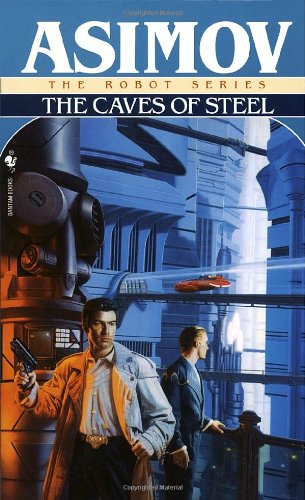
The Caves of Steel, by Isaac Asimov

This week I'm reviewing just one of Isaac Asimov's books, in this case going to the robots series with the first book, The Caves of Steel. This book follows the adventures of detective Lije Baley and his robot partner, R. Daneel Olivlaw as they try to solve a murder. Ostensibly this book is supposed to be a murder mystery story, but personally I didn't find it to be a terribly good mystery novel and it seems to exist more to set up a later story more than anything else. Which is weird considering I didn't think that was Asimov's intention when writing it in the first place. At least, not according to the introduction from him anyway.

Time-line wise this book is set hundreds of years after humanity has sent colonists to the fifty Outer Worlds, but well before humanity has expanded in a second wave of emigration and colonization, which will ultimately result in the First Empire. Earth is currently inhabited by eight billion people, with the population slowly inching upwards, and all of humanity is packed in great hive Cities across the globe. To the point Earth-born humans have forgotten life outside the Cities and many find the prospect of life in an uncontrolled environment terrifying. The fifty Outer Worlds, although technologically superior to Earth, amount to only about five and a half billion people, and are incredibly vulnerable to disease due to generations of people with no exposure to earth-borne pathogens. The result is two cultures that do not understand each other, and don't really tolerate each other as well. A small delegation of Spacers maintain a presence on Earth, but this delegation is tenuous at best. The situation becomes much worse when a prominent Spacer gets murdered and the Spacers are convinced an Earth conspiracy is to blame.

The biggest issue I have with this murder mystery is that there are no clues, no evidence, and only one possible suspect. However the only suspect is dismissed because of a sci-fi technobabble test that proves he doesn't have the personality to commit murder, which leaves Lije and Daneel with basically no clues or anything to work on. The result is that Lije and Daneel just kind of stumble around through most of the book trying to make any connection whatsoever. Left with no possible solutions, Lije and Daneel consider half a dozen impossible solutions which prove, eventually, to be impossible. I feel like it's unfair to the reader to make a mystery with absolutely no clues, because that makes it impossible to solve the mystery. It seems like a deliberately low trick.
But as I said earlier, the mystery also feels secondary to the story, which is kind of weird if this is meant to be a detective story. For quite a lot of this novel, although you get a lot of this in science-fiction novels, it's just the technological exposition. Look at all the things that are different in this future I've created! Most humans eat yeast! How weird is that? That's not really the most annoying part, though, because I'm just used to that in science-fiction books and the exposition has to go in somewhere. The problem is that this book sets up its society, shows what's wrong with it, and then proposes a solution to fix it, to the detriment of the detective story. I feel like this book could have either been a science-fiction commentary on overpopulation and humans' fear of technology, or it could have been a science-fiction detective novel, but by attempting to do both the book suffers. And while I don't doubt that Asimov has the writing skills to make a story, for whatever reason it just doesn't work out in this novel.

I am going to read the next book in the robot series at some later point and if it improves any I'll probably look into reading the other ones, but I've got a guarded opinion at the moment. While some of my favorite stories come from Asimov, he also produced a book I ended up throwing against the wall so clearly his work can range from very good to very bad. I'll just have to see where it goes.

- Kalpar

Thursday, July 2, 2015

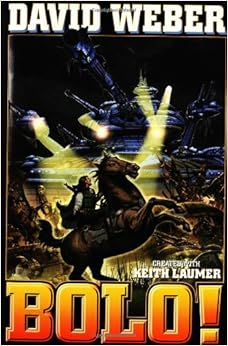
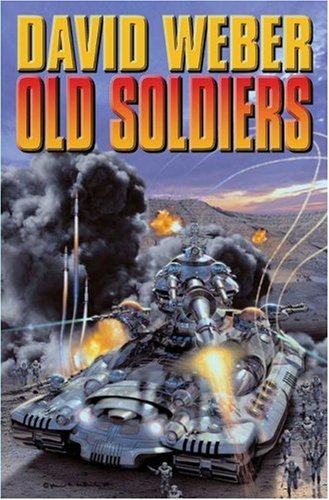
Bolo! and Old Soldiers, by David Weber

This week I'm knocking out two books at once and have come at last to the end of the Bolo series. So alas there will no longer be any more posts with me squealing about giant robot tanks and how awesome I think they are. Technically there is one more book, Their Finest Hour: Best of the Bolos, but that is an anthology of previous stories which I have already read and so I probably am not going to be reviewing it here. The reason I'm tackling two books today is that Bolo! specifically is a collection of four short stories written by David Weber, and three of them have been published before in other Bolo anthologies. The only new story is With Your Shield, which actually is sort of a prologue for the full-length novel Old Soldiers, and gives backstory for the main human character, Maneka Trevor. I'm also aware that I already talked about the other main work of Weber's that I've been reading last week, but I assure my readers that this blog isn't going to turn into just another David Weber fan club. ...I hope.
Anyway, the plot of both of these books is set during the Final War, an event that looms large in more than a few of these books. For anyone who hasn't read any of my other reviews of these books: the Concordiat of Man and the Melconian Empire, through a failure of diplomacy and a battle where neither side was sure who shot first, get engaged in a galaxy-spanning war. The Concordiat has a technological edge, including the mighty Bolos, but the Melconians aren't too far behind and have sheer numbers which more than offset humanity's edge. As the war continues, it escalate into a genocidal campaign known as Operation Ragnarok, where both humans and Melconians begin burning each other's planets to cinders, both sides hoping that the enemy will run out of planets before they do. As the war drags on the Concordiat realizes they've grossly underestimated the size of the Melconian Empire and there's a very good chance humanity is going to lose, even with the Bolos on their side. This begins plans for Operation Seed Corn, an attempt by the Concordiat to send human colonization fleets beyond the explored edges of the galaxy to ensure that humanity, in some form at least, will continue to exist.

Included in this expedition are an aging Mark XXVIII Bolo, named Lazarus, and his commander, Maneka Trevore, both the only survivors of their unit from a Melconian attack on Chartes. Both are suffering from survivor's guilt and will have to work together so they can protect one of humanity's attempt to ensure something survives beyond the Final War.

I will admit that I'm not as huge a fan of Final War stories because it ultimately results in the fall of the Concordiat and the Melconian Empire in a final maelstrom of destruction. Granted, there are stories showing at least fragments of both sides surviving afterwards, but it's small comfort considering what we lose in the process. The writing is fairly good and at least in this one I didn't notice too much extraneous exposition, but that may just be me and my usual love for exposition. What I liked about both these stories the most, though, is that Weber was able to answer a question which had been raised in earlier books and had never really been answered to my satisfaction. Previous books had raised the question is it really right for humanity to create sentient beings that exist merely to fight and die on our behalf? The Bolos are fully-developed people. They have personalities, idiosyncrasies, they make jokes, they have friends, and in a way they can also know fear. Is it truly just for humanity to create a race that you could very well call slaves to do all our fighting for us?

Previous books had raised this question before and had sort of glossed over it or not really looked into it very deeply. And it made me wonder if maybe the Bolos actually resented us for making them our warriors. However, in this book Weber actually manages to answer the question to my satisfaction through the voice of Lazarus. See, Bolos are aware that they exist to fight and die on the behalf of their creators, but they don't see that as a bad thing. Bolos respect humans because humans created them far better than humans could ever hope to be. A Bolo after all is a building-sized weapons platform capable of standing up to fusion warheads and an ability to make decisions in milliseconds. No human could ever hope to out-perform a Bolo on the battlefield. But more importantly, humans made Bolos the epitome of honor, duty, obligation, and other ideals that humanity constantly strive and often falls short of achieving. Bolos believe that humanity has made Bolos better than humanity could ever hope to become, and they feel not only honored by this decision, but an obligation to protect their creators. And the humans have not failed to appreciate this, either. Even though a human commander will probably have very little they can accomplish from the cockpit of a Bolo, humans still ride in Bolos out of an obligation to share the risk with their armored protectors and ensure they do not fight alone.

Although this book has some really sad parts, it has what I thought was a very touching and appropriate ending for the Bolo series as a whole, with hope for the future of mankind. As much as I hate to have finished this series, I'm also very glad I read it as well.

- Kalpar

Thursday, June 25, 2015

Honor Among Enemies, by David Weber

Once again I venture into the space-opera awesomeness that is David Weber's Honor Harrington series. As I picked this book up (and was doing a little refreshing on some of the characters, because man are there a lot of them) I suddenly realized that I'm actually six books into this series. I suppose the fact that I'm reading these books on my kindle instead of letting them take up more and more of my diminishing shelf-space has kept me unaware of how far I've ended up delving into this series, but I guess I have no choice but to say that I'm a fan. Anyway, I read the sixth book, Honor Among Enemies and I'll be going into it. As I mentioned in my review of the previous book, Flag in Exile it's getting kind of hard to avoid spoilers at this point. I'll try to do the best I can to avoid them but I'm afraid they're just going to have to slip through at this point.

WARNING TO ALL MY READERS: SPOILERS MAY BE CONTAINED WITHIN THIS REVIEW. READER DISCRETION ADVISED.

Before I get into the plot portions of this review I do want to make a mention to something that has tragically changed how I perceive Honor Harrington books. Well, maybe not tragically. It's definitely brought something to my attention at least. You see a while back I was stumbling across the internet, as I do, and I came across the videos of a lady who goes by the handle Sursum Ursa. I watched a few and I thought, "I rather like the cut of this lady's gib. I should watch more of her stuff." Anyway, it turns out that Ursa is also a fan of the Honor Harrington books and made a video talking about them. However, she also pointed out something that I had only kind of noticed recently: Weber really loves shoving in his exposition. To the point that Ursa parodied it with an "Ode to Exposition" in her review. And I laughed a little and said to myself, "Yeah, that sounds about right." And then I started reading this book and I realized, oh man. It's true. I hadn't realized it before, but it's true! And now I can't stop seeing all the times Weber clumsily shoves in technical details! Aaaaaaaaaahhh!

All joking aside, for the most part I don't really mind exposition. I find it's necessary to the plot, especially when you're establishing something like a science-fiction universe as complex as Weber's working on in this series. You might have to shove it in sort of clumsily, but it's better to have it then have readers going, "Wait, hold on. That doesn't make sense." The problem I'm noticing in these books, though, is that characters will think over expository material in their heads in the middle of a conversation. You might read it and think that five minutes have passed while the characters have had long reminisces about technological, military, economic, or political history, but they're still in the middle of a conversation. It's probably the weakest part of Weber's writing, but as I said, it's better to have exposition rather than leave stuff unexplained. Well, for the most part anyway.

Plot wise this book goes a little further into the economic and political details of the setting, which I think is really cool because it adds depth to the series and makes this feel far more realistic. Well, as realistic as space operas get anyway. (Although I did find the willingness of the large business owners to shoulder a greater tax burden a little unrealistic. Zing!) Basically much of the Star Kingdom of Manticore's income is a by-product of the interstellar trade which utilizes the Manticore wormhole, as well as the technological products which Manticore produces. The Silesian Confederacy is an important market for Manticore but due to a weak central government piracy has always been a problem in that region, but the Royal Manticore Navy is no longer able to spare as many ships for anti-piracy patrols and convoy escorts as they'd like and as a result piracy and commerce raiding is back on the rise. Utilizing what resources they have left, the RMN decides to send a handful of Q-ships, armed ships disguised as helpless merchantmen, under the command of Honor Harrington into the sector. This is important for Honor specifically because while it's not a plumb assignment, it gets her back into Manticore uniform and opens opportunities for her to get back into the war effort of her home country.

Overall it's a really good plot and I liked seeing Honor and her Q-ships take the fight to the pirates, and as always there's a lot going on in this book. Especially with the loads and loads of characters. Personally I was happiest with the arrival of the Anderman Empire, or as I'm personally calling them (and I think other people will too) the Space Prussians. Like, to the point the founder of the Anderman Empire was convinced he was the reincarnation of Frederick the Great and walked around in eighteenth century clothing. (And was shockingly competent as an emperor as well.) I'm sure we'll see more of the Space Prussians as the series progresses, which makes me more than a little happy.

I will say I thought Dave was getting a little too cute again with his readers by having Honor read one of the Horatio Hornblower books in her cabin and having her identify with the main character. Especially seeing as Honor Harrington is unabashedly Horatio Hornblower IN SPACE!!! Yes, Dave, we get it, you're very clever.

I did have one other issue, and considering this book was written nearly twenty years ago in the nineties, I'm actually not surprised to see that it has this problem once again. As I've mentioned before I kind of take issue with rape being used just to up the drama or make someone more vile in a setting. Like Honor's issues with Pavel Young, it could have easily been limited to just class differences and the fact he's a spoiled dandy rather than adding on an attempted sexual assault as well. In this case, some of the pirates are also rapists and it really doesn't add anything but an attempt to make them more evil as a threat. They're not even characters, they're a threat that Honor and the other characters have to eliminate in the book. Going into detail about how they rape female crewmembers of merchant ships they capture is just off-putting and seems like an unnecessary attempt to increase how despicable they are. Honestly, Weber could have left them just as pirates who capture ships, kill the crew, and are just general nasty people. I don't think anyone was on the pirates' side reading the book so it just felt like an unnecessary attempt at vilifying them further. Fortunately that wasn't a terribly large part of the book and we were able to move on to other things.

I guess really my only big issues with this book were the rape thing, as I discussed, and my realizing how clumsy the exposition can get, but I'm sure that's true of Weber's other books as well. We are sort of taking a break from the main war because we're off with Honor fighting pirates, but that doesn't make it any less interesting. And we get to see Honor kick some serious ass as the extremely competent starship captain we all know her to be. I guess I have no choice but to see this series through to the ultimate end now.

-Kalpar

Thursday, June 18, 2015

As You Wish: Inconceivable Tales from the Making of the Princess Bride, by Cary Elwes with Joe Layden

This week I finally getting around to reading the book that I'm sure everyone else has already read at this point: As You Wish. For those of you not already in the know, As You Wish is an autobiography by Cary Elwes talking about his experiences in filming The Princess Bride and his role as Westley. This gives book gives a lot of really cool behind-the-scenes looks at the movie, and includes little snippets from every other cast member in the movie as well as the writer, William Goldman, the director, Rob Reiner, and Andrew Scheinman, one of the producers. The result, although largely (and understandably) slanted to Elwes's view on the making of The Princess Bride, still provides a ton of background detail for any fan of this movie.

As my readers are probably already aware, I'm a huge fan of The Princess Bride, both the movie and the original book. (Although truth be told I was never a solid fan. When I was a young and kid I always thought of it as that weird movie that mom always liked. Fortunately the movie grew on me as I got older.) So it took very little convincing to get me to pick this particular book up. As I said it follows Elwes's own experiences with the movie, starting from the fortunate opportunity he had that Rob Reiner and Andrew Scheinman were willing to talk to him about taking the role of Westley. (And much to Elwes's surprise they gave it to him.) To the weeks of filming in England and extensive fencing practice which led up to the fantastic duel between Westley and Inigo, filmed last to give Elwes and Mandy Patinkin enough time to become competent fencers. As a former casual fencer myself, I was very impressed to learn about how Elwes and Patinkin practiced for forty hours a week before filming began just to get the basics down and practiced at almost every opportunity to achieve a degree of competence by the time they had to shoot the duel scene. That fantastic duel scene atop the Cliffs of Insanity in The Princess Bride? Aside from a couple of shots that's all Elwes and Patinkin, and they had to improvise a good part of it because they got so good at the choreographed fight it lasted for about a minute. It's the result of an insane amount of practice on the part of the two actors, with the help of two of the greatest fencers in Hollywood, and the result is pretty awesome.

Which isn't to say there isn't good and interesting stuff about the other parts of the movie either. Like how Elwes had to go stand in another room so his laughter wouldn't ruin the take while Billy Crystal was improvising his dialogue as Miracle Max. Or the fact that Wallace Shaw, who I personally can never see as anything other than Vizzini the Sicilian, was constantly terrified that they'd replace him with someone else. There's also quite a few passages which talk about André the Giant in loving detail, who everyone involved with the project describes as a kind, generous, and gentle soul who sought to give his absolute best to the world despite a life riddled with health issues and constant pain. In a way I found them to be a very touching and fitting tribute to someone who clearly touched the lives of so many people in a positive way.

The book finally ends with a little bit of information about what happened to The Princess Bride after filming was finished. Despite receiving excellent reviews and thunderous applause at its initial screenings, Fox was uncertain how to market this film which certainly straddles genre, making it hard to categorize. At its release it was a very modest box office success, but certainly no blockbuster. However, time has been very kind to The Princess Bride and it's now a film that straddles generations as well as genres and is a well-beloved classic by many people. (Including, according to Elwes, the late Pope John Paul II.) And I think it really has been such a success because it was a labor of love for everyone involved in the process, as this book reveals. The actors aren't just trying to be funny, they're also trying to be earnest, and somehow it all comes together and makes a timeless classic.

A definite must-read for any Princess Bride fans out there.

- Kalpar

Thursday, June 11, 2015

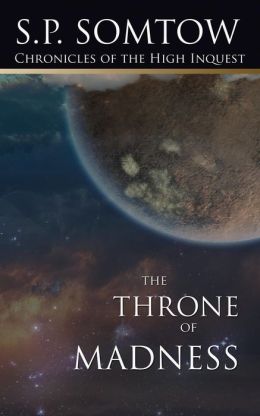
The Throne of Madness, by S.P. Somtow

This week I'm reviewing the second book in the Chronicles of the High Inquest, titled The Throne of Madness. And if it seems that it's a little early for me to be going into the second book of this series, as I usually tend to stretch a series out over time, well after I had revealed I'd hunted down a copy of Light on the Sound, my friend foisted the second book upon me and I hate borrowing books longer than necessary so here we are.

I realize in my last review I didn't really talk about the overarching plot, and in a way we hadn't quite gotten to the plot itself yet. Make no mistake, Light on the Sound has its own plot, but I feel that as a book it serves more to introduce us to characters and establishing events, which set a further series of events in motion in The Throne of Madness. But to provide some context for my dear and gentle readers, here goes: At some point in the distant future humanity discovers an artificial world towards the center of the galaxy surrounding a black hole. By feeding stars into the black hole, the planet is able to tap tremendous energy, including the ability to create tachyon bubbles, which I think are the only means of instantaneous interstellar flight. I'm a little fuzzy on the details because it's certainly not the only method, and the characters talk about time dilation during travel between planets to it's all a little vague. However, with the power of this planet, as well as the tachyon bubbles, a group known as the High Inquest is able to establish a sort of government over the millions of worlds inhabited by the Dispersal of Man and the Inquest has ruled for twenty thousand years. It's only in The Throne of Madness that we begin learning more about the Inquest and their methods, which were fairly ambiguous in Light on the Sound.

Central to the Inquest's is the tenet that stagnation is bad for humanity and it is the Inquest's duty to stir the pot every now and then to make sure things change. This manifests itself in two main activities that Inquestors concern themselves with, utopia-hunting and makrúgh. The Inquest believes that utopias can only lead to stagnation and decay so they should be hunted out and destroyed to prevent such stagnation from occurring. Makrúgh, however, appears to be a board game where Inquestors play over the fates of planets which results in real interstellar wars being fought and planets being torched to cinders. Just to keep things from getting too boring. (Again, this isn't very clear and it seems that anything Inquestors do can become part of a game of makrúgh. Somtow seems to vacillate between the frustratingly ambiguous and the refreshingly direct.) The plot revolves around a growing rejection of this predominate ideology and the weaknesses that it entails. So it's a philosophical work, but with spaceships and winged cats and whatnot.

There's actually quite a lot going on in this book and for a work this grand in scope you might expect it to be considerably longer. However it's only about 250 pages long, making it actually a bit of a lightweight. Somtow certainly could have expanded his story into something like the thousand-page tomes that Song of Ice and Fire has become, but by keeping it short we certainly never lose track of the action either. And as I said in my review of Light on the Sound, Somtow sometimes devolves into passages of the prettiest purple prose which can be a little annoying, but he also can be straight and to the point. Throw in some really creative and at times disturbing imagination on the part of Somtow, and you end up with a book with a fairly high WTF? factor. But at least it isn't boring!

I will say that The Throne of Madness was a little more interesting for me than Light on the Sound because it went into more expositionary information. And boy do I love exposition. I'm sure I'll have the other two books thrown upon me as well, so look out for the reviews. If nothing else, it's definitely different and memorable.

- Kalpar

Thursday, June 4, 2015

Channel A, the Anime Pitch Party Game, by Asmadi Games

Taken from: http://asmadigames.com/detail_channela.php
This week I'm taking a break from the book reviews to talk about a board game. Well, okay, it's a card game, but a tabletop still helps with playing it so therefore it counts. Also it's my blog. Anyway, the game I'm talking about is Channel A: The Anime Pitch Party Game, which I stumbled across at a convention I attended some time ago. This game is a fairly simple card-based party game, akin to the already famous Apples to Apples and Cards Against Humanity. It has very few rules, has almost no setup time whatosver, and it's very easy to introduce to new players. However it also has the opportunity for very long and entertaining games which can be quite memorable for everyone.

Channel A comes in a very small box that contains two decks of cards. One deck, called Title Cards, contain words like Doctor, Task Force, Boyfriend, Police, Ninja, Ultimate, and so on. The second, much smaller deck, is called the Premise Cards which contain ideas for shows like Giant Robots Fighting, Psychological Horror, Space Opera, Cooking, so on and so forth. Everyone begins the game by drawing a hand of ten Title Cards. One person is selected to go first as the Producer, who then draws five Premise Cards and selects two to be the premise for the next anime show the network is going to launch. Everyone else then selects title cards from their hand to create a title for a show and takes turns delivering a short pitch of what the show will be about. Once everyone's delivered their pitch then everyone votes on whose pitch they liked best and the winner gets the premise cards. Then the next person gets to be the Producer and play continues.

Overall it's a very simple game but it offers a lot of great creativity for coming up with ridiculous off-the-wall stories. And you don't have to be an anime fan to enjoy this game either. I haven't really watched anime in around five or six years, but I was still able to come up with really cool ideas for shows. (Well, I tied with Sarah, so at least some people liked the ideas I came up with!) The rule sheet for the game even suggests that if all else fails then just come up with a show where girls fight monsters because for whatever reason that's an insanely popular theme in anime. And while the game suggests coming up with silly pitches, you can make your shows as serious or as silly as you want them to be, opening up a plethora of opportunities to personalize the game. Heck, the rule sheet even encourages you to roleplay while making your pitches, taking on the personality of the jaded marketing executive who has endless viewer data to back up his projections, or the overly-enthusiastic fangirl that gushes about the show in a breathless rant. There's a lot of opportunities for fun with this game, which I always take to be a good thing.

Furthermore, because this game has very few rules and is very easy to introduce new people to, it makes a really good game for game night parties. Definitely one of the challenges I've run into at the various game nights I've attended is that a complicated rule system for a game makes it more difficult for people to be interested in playing and you spend a lot of time teaching new people to play. Even a game fairly simple for its scope, like Imperial, takes a considerable amount of time to introduce new players. Channel A, by contrast, is designed to make it easy to introduce new people and it can be played in a fairly short amount of time, compared to the at times almost endless strategizing that Imperial can get bogged down in. (Still infinitely better than Diplomacy though.) Personally I also like that Channel A includes a recommendation for when to end the game, because I've been involved in games of Cards Against Humanity that swell to consume the entire night.

Overall this is a very fun, easy game, and considering it sells for about $20 - $25 I think it's well worth the cost and I'm looking forward to unleashing it on my unsuspecting victims next game night. ....I mean friends. Yes. Friends.

- Kalpar

Thursday, May 28, 2015

Agatha H and the Voice of the Castle, by Phil and Kaja Foglio

This week I'm completing my steampunk...month...ish, with reviewing Agatha H and the Voice of the Castle, the latest in an ongoing novelization by the Foglios of their graphic novel series. This particular volume picks up where the previous novel, Agatha H and the Clockwork Princess, left off, starting with volume seven of the comic series, Agatha Heterodyne and the Voice of the Castle, and going up to about halfway through volume ten of the comic series, Agatha Heterodyne and the Guardian Muse. Based on how the comic series has continued, I firmly suspect that the next novel version will go from volume ten up to volume thirteen, Agatha Heterodyne and the Sleeping City, but that's just between you and me and the rest of the internet.

Anyway, for those of you who haven't heard this particular rant before, Girl Genius is by far and away probably one of my most favorite series just because of the sheer amount of awesome packed into it. This is a series that's been going on for fifteen years now and there's still a ton of material we have only the merest inklings about. The thing I really like the most about this series is the fact that the Foglios sat down before they even began this series and planned out their plot and all the different details ahead of time so they have an actual roadmap of where they're planning on taking the series and what's going to happen later on. (Although they've been frustratingly tight-lipped about certain details, much to the irritation of us fans desperate for hints.) This actually makes Girl Genius a pleasure to reread as well because then you start to pick up all the little details and hints that the Foglios scattered through the story that you might not have noticed before. It's really a well-crafted body of literature and it has earned three, consecutive, very well-deserved Hugo Awards in the past. (To the point that the Foglios had to remove themselves from the running because no one else was winning the graphic story category.)

Now I'm sure your question, which was certainly my first question, if the story already exists in a graphic novel form, why do we need a novel form as well. According to the Foglios, the purpose of the novels is to provide more background details and lore that, while not necessarily connected to the main plot, are certainly at least entertaining to fans of the series. Although I can definitely see where the Foglios have also expanded the story a little beyond the original graphic novel, which I'm also in favor of. Aside from the extra world lore, I also really like these novels because it provides an easy way for me to refresh on details. I've been following Girl Genius as a webcomic for something like eight years or so now, at the rate of about three comics a week. Although I've occasionally archive-binged since there's now fifteen years of comics it becomes more and more difficult to go on said binges. Of course, I could buy the graphic novels in print form, and I'm slowly working on doing that, but that's still a long-term work in progress. So the novels, which cover more story material for less initial cost for me are a great way to go through the archives and refresh myself on details which I may have forgotten. (And believe me, there are a ton of details.)

I will admit I haven't gone into any of the plot of this particular book and the reason simply is because of the spoilers. There are just so many spoilers. And I don't want to go into them because this series is so good! And you can go read it! For free if you want! On the internet! And aside from being well-planned out and crafted, this series has a lot of appeal. You like romance? There's romance! I mean, I personally could take it or leave it, but romance! There's mad science! People like mad science, right? Well I certainly do. You like adventure? There's plenty of that and some ridiculous pulp action involved. And boy do I like my pulp. You like strong, well-developed female characters? There's a ton of them in this series! Well, at least more than one. Several, as a matter of fact! It's great! You like fantastic hats? ...oh. No. Just me then? Well there are hats. Hats are important! You...you non-hatted people. If my obsessive fanboy gushing has not convinced you at this point I don't know what short of me poking you with a pointy stick will convince you to go read this series. Whether it be the graphic novels or the print novels or audiobooks. Seriously, it's a great series.

- Kalpar