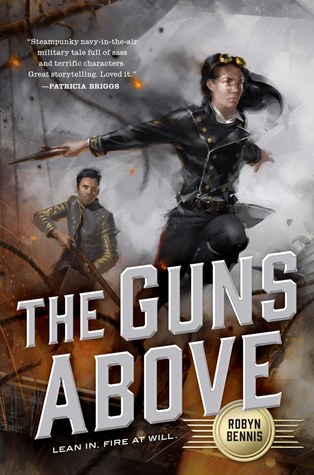
Today I'm looking at a steampunk novel titled The Guns Above, by Robyn Bennis. This book is the first in a planned series chronicling the adventures of Captain Josette Dupre, Lord Bernat, and the crew of the Mistral as they fight to save their nation of Garnia from enemies on all front. This book is good, but I don't think it pushes any envelopes or goes into any new ground which means it fails to stand out among all the other stories that are out for the reader of steampunk fiction.
The book is set in the fictional country of Garnia, a nation that seems to be perpetually at war with its neighbors over territory or other petty reasons. Garnia may have been a military superpower in the past, but the situation has definitely deteriorated to the point Garnia is utilizing women soldiers in ''auxiliary'' capacities, theoretically non combat roles but in reality whatever role they need to fill. This is especially true in the Air Signal Corps, where getting volunteers courageous or insane enough to fly and fight on the incredibly dangerous airships is particularly difficult.
Josette Dupre is one such auxiliary and through the circumstances of everyone above her dying, she ends up in command of her airship and helping to save the Garnian army outside the city of Arle. As a dubious reward for her actions, Dupre is appointed captain of the new, revolutionarily designed airship Mistral. Forced upon her as well is the foppish Lord Bernat, nephew of the commanding Garnian general, and definitely a spy to find Dupre's every weakness and expose it so Bernat's uncle can get rid of Dupre once and for all and ensure the army remains a man's institution.
As I said, this doesn't feel like it's really pushing any envelopes. As I've pointed out before and will probably point out again, it seems almost obligatory for a steampunk work of fiction to have a feisty, female airship captain, scientist, or engineer who defies societal convention by being a woman in a ''traditionally'' male field. And may, horror of horrors, shock and tribulation, wear pants! I'm all for women being captains, scientists, engineers, spies, doctors, stockbrokers, greengrocers, bakers, telegraph operators, locomotive engineers, or any other profession they darn well please. But in 2018 having a woman as captain and it being a shock is quite frankly kind of passe. We've had female captains since the 1990's. Is it accurate for a Victorian society to be surprised at women doing things like being airship captains? Yes. Is it necessary for a fictional steampunk society to have the same surprise at women being captains? No, I don't think so.
So with most of the conflict being ''Dupre's a woman, and women shouldn't be airship captains'' I feel like this book didn't cover ground that hasn't already been covered by who knows how many books before it. Honestly I think an improvement would have been just have Dupre be unpopular with the Garnian high command because she's a commoner and more competent than the nobles are, which is why they send one of their own to spy on her and try to bring her down. Otherwise I thought this book was okay. I could have used a map of the countries to get a better understanding of where everything was geographically, but otherwise it was okay.
If you're looking for a steampunk military adventure, this is a pretty good choice, but don't expect it to bring anything particularly new or innovative to the table. At least, that's my opinion.
- Kalpar
Thursday, January 11, 2018
Tuesday, January 9, 2018
Rogues, edited by George R.R. Martin & Gardner Dozois
Today I'm looking at Rogues, a collection of short stories written by a variety of authors and edited by George R.R. Martin and Gardner Dozois. The idea behind this anthology was that Martin and Dozois would ask famous writers from a variety of genres, not just science fiction and fantasy but horror, thriller, mystery, and romance, to write a short story about a rogue or scoundrel character. The result is a collection of stories ranging from Martin's Westeros and Gaiman's London Below, to somewhat ordinary adventures in Texas. Because I usually stick within the SFF genre this was a nice opportunity for me to break out of my genre constraints and see a couple of stories from authors I might not have otherwise heard about. And there are a couple of stories that leave me thinking maybe I'll want to check up on the authors when I get the chance.
Unfortunately, much like a lot of other short story anthologies which I've reviewed, there isn't a lot that I can say. I liked some of the stories. I thought some of the stories were really good. And some of the stories I didn't care for. But that's ultimately a matter of personal taste and with an anthology you're sometimes going to get things that just don't appeal to you. And that's okay. Although I will say the cunning plan to get back at your brother because he had the nicer sousaphone in high school by stealing the high school marching band he directs's sousaphones so you can then sell them on the black market to Mexican banda groups isn't exactly up there in the top levels of ''cunning criminal master plans''. But really it was just that one story.
Aside from that, I think my only criticism was a couple stories tried to push the rogue element a little too much. Like, ''Hey. Remember the title of this book? This is how it ties back to the theme!'' I especially remember a story about college kids going to a movie theater and having a debate over the definition of rogue and scoundrel and frankly it felt a little forced to me. Otherwise it's an anthology. There're some good stories and I think it's worth your time to check out. Even if, like me, you're not big on rogues in specific.
- Kalpar
Thursday, January 4, 2018
The Oil Kings, by Andrew Scott Cooper
The seventies were a very bad time for America. Vietnam, Richard Nixon, ugly cars, ugly clothes, and the only colors you could get furniture in were avocado green, blaze orange, and harvest gold. On top of all of this there were the problems of a recession, double digit inflation, and a rapid increase in oil prices. In fact the increase in oil prices rocked the global economy, almost causing a financial panic in Europe and leading to unemployment as high as 8% in the United States. But what caused this dramatic increase in oil prices? At least part of the cause can be explained by the odd relationship between the United States and the Shah of Iran.
After World War II, and especially after Operation Ajax, Iran became an important client state for the United States. Its shared border with the Soviet Union made it an ideal location for CIA bases, and it also controlled one side of the strategic mouth of the Persian Gulf, an important waterway for the transport of oil from Saudi Arabia, the United Arab Emirates, Kuwait, and Iraq to Europe and Japan. A blockade of the Strait of Hormuz, the mouth of the Persian Gulf, could strangle the western powers by cutting off their oil. Having Iran as a strong, friendly power in the region was vital to U.S. global security.
As the Vietnam War dragged on, Nixon began pursuing a policy of localization. This policy, known as the Nixon Doctrine, would arm and equip local powers with hardware provided by America and other Western powers so they could handle local security threats and fend off the encroachment of the Soviet Union and other communist powers. Mohammad Reza Shah had always sought newer and better technology for his military, but American policy had put strict limits on what Iran could buy so the Shah didn't wreck his nation's economy on a military spending spree. With the Nixon Doctrine, Nixon and Henry Kissinger chose to let the Shah buy however much military hardware he wanted, including everything but the atomic bomb. This led the Shah to go on a spending spree, buying planes and hardware he simply didn't have the people or infrastructure to maintain, much less use, such as orders for dozens of F-14 fighters. (F-14s incidentally are carrier-based aircraft. Iran had no aircraft carriers at the time so there was no advantage to using F-14s over other aircraft.)
In order to pay for these military toys the Shah had to get revenue from somewhere, which is where another agreement with Nixon and Kissinger became important. The Shah asked Nixon if, with the cooperation of OPEC, he could raise oil prices. Nixon and Kissinger gave their assent, assuming the Shah only meant to raise the price of oil by only a small amount. The Shah, however, meant to raise oil prices to a point where alternate energy methods, such as shale oil and the gasification of coal, became competitive with crude oil, bringing in significantly increased revenues for Iran. On top of his military spending, the Shah intended to launch a massive industrialization program for Iran, turning it into a modern economy. The end result was the price of OPEC oil went up by 400% in the course of one year.
Needless to say, when a basic commodity which is necessary for fuel, as well as dozens if not hundreds of other derivative products, increases by that much in a year there are going to be aftereffects. Especially when Europe, Japan, and the United States relied on oil imported from OPEC. Recession, financial panic, inflation, shifts in international balances of payment, loss of consumer confidence, all this and more threatened to topple the governments of western Europe and the global economy. The situation was only exacerbated when the United States, to help stem the tide of dollars flowing into Iran, increased the prices of its military equipment. This only spawned a spiral of increased oil prices to pay for the more expensive equipment.
Attempts by the United States to get the Shah to stop or at least slow down the oil increases proved unsuccessful and so a gap began growing between the United States and its client state. Eventually the United States shifted its Persian Gulf strategy from Iran to Saudi Arabia, especially after the Saudis broke an OPEC price hike in 1976. Dramatic decreases in Iran's oil revenue meant that the Shah had to drastically cut back not only on his military spending but on his civil spending as well, which in turn caused Iran's own economy to falter. By 1979 the economic troubles in Iran had toppled the Shah and ushered in a new Islamic republic.
I have really only summarized this book, and very poorly at that, because it goes into so much detail and makes use of so many sources, such as transcripts from the Nixon white house, Henry Kissinger's own meetings and phone calls, cables from the Iran embassy, state department papers, treasury department papers, and information from foreign governments as well. Cooper does an excellent job of researching this text and provides a vivid economic picture of the 1970's and U.S. relations with Iran, providing additional explanation as to why the Shah's government was overthrown in 1979 and the tension between the United States and Iran to this day.
If you're interested in Middle Eastern history, twentieth century history, economics, Richard Nixon, Henry Kissinger, or getting a better understanding of Iran this book is definitely a must read. Cooper does make some allusions to the 2007 crisis which saw a spike in oil prices as well, but the comparison gets vaguely mentioned at best so I consider it hardly a major topic for the book. But as history of where economics meets politics this is an excellent read.
- Kalpar
Tuesday, January 2, 2018
The Sun and the Moon, by Matthew Goodman
Today I'm looking at a history of one of the most famous newspaper hoaxes of the nineteenth century, when Richard Adams Locke wrote a series of articles purportedly about discoveries made by Sir John Herschel with a new type of telescope that discovered the existence of life, including sentient life, on the moon. When the story it was widely circulated and reprinted in newspapers across the United States and later the world, with many people arguing over its veracity. However, this book talks about quite a few other subjects beyond the moon story, putting it within historical context.
The early nineteenth century saw developments in printing technology, which had remained fairly unchanged since the fifteenth century. Printing presses could previously only produce about two hundred and fifty copies an hour, but the invention of cylindrical presses and application of steam power meant thousands of copies could be produced cheaply and quickly. By the 1830's the United States saw the development of the penny press, daily newspapers that cost only a penny making them affordable to far more people than the six cent papers at the time. The penny press exploded newspaper readership in the United States and also dramatically changed the content of newspapers. Previously focused towards the upper classes interested in financial and international news, penny papers focused on local news, sports, true crime stories, and the introduction of humorous and not always true anecdotes.
Goodman goes into considerable detail talking about the nineteenth century institution of ''humbugs'', stories or objects that might be real or might not be, the foundation of P.T. Barnum's career. (A biography of Barnum makes up a significant part of this book as well.) And I'm pretty sure society hasn't changed much considering the popularity of urban legends and other stories that may not be true, but have just enough verisimilitude to make their veracity plausible. The thrill then, as of now, is debating whether the story actually is true and so humbugs, both in Barnum's museum and on the pages of newspapers, made endless entertainment fodder for the nineteenth century.
I have a couple of criticisms about this book, but they're fairly minor. The first is that I feel like this book kind of lacked focus. Goodman jumped between talking about Benjamin Day and his creation of The Sun, New York's first successful penny press, talking about Richard Adam Locke's life and career, P.T. Barnum's life and career, and even the life and career of Edgar Allan Poe. Granted, all these subjects are interrelated. It's difficult to talk about Locke's moon story without first talking about the newspaper it was published in. Barnum is a great example of how hoaxes were popular entertainment and how newspapers helped spread them. And Poe himself wrote a story about a voyage to the moon shortly before Locke wrote his own story. The problem is it feels like Goodman had two or three different topics he wanted to write about but he didn't have enough material to make any one of them into a book by itself so he melded them together. So yes, they're connected, but it still feels disjointed to me.
The other issue I had, and this is purely because I'm a trained historian, is that Goodman goes into purple prose territory at times, making grand, literary statements. Really the only reason I take issue with this is because I personally don't think it's proper historical writing, but that's really a personal bugbear of mine. If you're a casual reader of history it probably won't bother you too much.
Finally Goodman tries to argue towards the end of his book that Locke's moon writings were supposed to be from the beginning, as Locke claimed much later, an elaborate satire of religious astronomy. During the early nineteenth century astronomy was the science most in concord with religion and many religious figures argued that other worlds must be inhabited by beings to further increase the glory of God. Some would go on to say that these beings from other worlds would be in a state of natural grace, having never fallen to sin like humanity did, so their worlds would be paradises. The problem I have with this argument is Goodman doesn't devote considerably much time to it in his book. The inclusion of P.T. Barnum and other examples of humbugs, hoaxes, and diddles certainly undermines Goodman's assertion that Locke's work was meant to be a satire and he devotes considerably less time talking about it than the hoaxes.
Overall, I thought this book was interesting. It feels disjointed because it talks about a lot of different things which are related, but it gives a good view of the culture of nineteenth century New York. If any of the topics listed in the (fairly long) title interest you, I think this book is worth taking the time to check out.
- Kalpar
Thursday, December 28, 2017
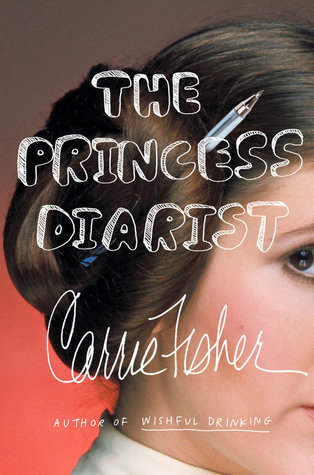
The Princess Diarist, by Carrie Fisher
As I'm sure you all remember, exactly a year ago yesterday, in a tremendous, final ''Fuck you!'' to all of us, the dumpster fire of 2016 took Carrie Fisher from us. It was a final gut-punch to many people, especially the Star Wars fans big and small across the world. The Princess Diarist as a result was the last book Fisher ever published, (at least, none have been published posthumously yet), and I felt that making this book the last review of 2017 would be a fitting tribute to a woman who inspired millions of people.
While filming Star Wars in 1976 for about three months in London, the then barely nineteen year old Carrie Fisher kept a series of diaries recording her emotions and experiences both on and off the set, as well as her affair with costar Harrison Ford. Forty years later Carrie discovered these diaries in a box of old belongings and went through them and decided to publish excerpts, as well as extensive commentary from Fisher looking at the affair forty years later with the benefits of perspective. However, the book does not talk mostly about her experiences filming Star Wars, her first major role and what would become the biggest role ever in her career. Fisher provides some background material such as her own childhood and how she managed to land the part, but the book focuses mostly on her affair with Harrison Ford, and later her emotional relationships with her fans. At times explicit but also intimate, The Princess Diarist provides a look into the mind of a young girl who took a step into a larger world.
Some people have described this book as cringe-worthy regarding the amount of detail that Fisher went into. And while there were parts that I cringed at, it was more out of sympathy for a young Carrie Fisher about to die from embarrassment than from any sordid details. Frankly as far as I'm concerned, the fact that Fisher and Ford had an affair is hardly surprising. Certainly not the most ethical decision considering Ford was married with two children at the time, but I'm hardly one to throw stones when it comes to monogamy and the matter's been over and done with for forty years. It was a young girl who had no idea what she was looking for and an older man who probably should have known better, but to castigate them for a lapse in judgment is hardly worth the effort.
I think what's more important out of this book, than any shocking (or perhaps not so shocking) revelations about who was involved with whom, is the window into the mind of nineteen year old Carrie Fisher. We see a girl trying to be a woman who is troubled, who has had a life filled with emotional turmoil. A girl who wanted to avoid show business because she saw what it had done to her parents, but who had also dropped out of high school and was faced with the possibility that she was unsuited for any work but show business. Although Fisher does not talk about her struggle with bipolar explicitly in this book but you can see elements of that in her recollections and in the excerpts from her diaries. And the issues with drug abuse can be seen starting to creep into her life, but again are not really focused upon.
I think what I like most about this book was how vulnerable Fisher was willing to be with the world. She could have very easily burned the diaries, or hidden them away where they wouldn't be found, or just put them back in the box and forgotten about them again. She certainly didn't have to write a book about it. And while people might say it was cynically a cash grab with another tell-all memoir (the fact that she describes her convention appearances as lapdances certainly doesn't help), I prefer to take a kinder view. Fisher was willing to share with us an emotional time in her life when she was vulnerable and, really like the rest of us, had no idea what the heck she wanted to do with her life. And personally I think that's encouraging. Just knowing there are other people, people like Carrie who were catapulted to stardom by the age of twenty, who still were making it up as they went along, just like the rest of us. Maybe that's a tad too much of a ''they're just like normal people'' argument, but I still find it encouraging.
This book is complex and raunchy, going both high and low and everywhere in between. Maybe Fisher overshared, but I don't feel that she did. It was her story and I'd rather hear it coming from her than from anybody else. And if a sixty-year old woman wants to share the details of her life forty years ago, that's her prerogative. Ultimately I think this is a book you have to read for yourself, but if you felt some connection to our princess I think this book has something for you.
- Kalpar
Tuesday, December 26, 2017
Something Wicked This Way Comes, by Ray Bradbury
Today I'm looking at a full-length novel by Ray Bradbury, Something Wicked This Way Comes. After listening to The Martian Chronicles and remembering how good Fahrenheit 451 was, I decided finding something else by Bradbury was worth listening to. This book follows the adventures of two boys, James Nightshade and William Halloway, neighbors who were born a mere two minutes apart. Will was born a minute to midnight on October 30th and Jim was born a minute after midnight on October 31st, and the boys have been an inseparable team since then. Naturally when a carnival arrives well out of the normal season a mere week before Halloween in their Illinois town, Jim and Will decide to investigate. However, something far more sinister than poorly maintained rides and rigged games is going on at this carnival and Jim and Will have to rely on each other and Will's dad, Charles Halloway, to survive.
There is a lot going on in this book and while personally I really, really liked this book I'm willing to admit it feels a bit rough around the edges. I think the biggest redeeming quality is Bradbury's writing which I think is particularly excellent in this book and manages to keep the story interesting despite him trying to shoehorn multiple things into the book and not really getting to develop all of them. It feels kind of like a Phillip K. Dick novel where he had a ton of ideas and wanted to include them all in the book, but didn't really have the time to develop any of them to their full potential. Of course, this being Bradbury the book feels a lot more put-together than some of Dick's amphetamine-fueled writings, but there are still issues.
Probably the biggest plotline in the book is the topic of aging, which comes across in both subtle and incredibly direct ways through the book. Will and Jim are almost fourteen, leaving childhood but still not quite on the brink of manhood in that frustrating stage of adolescence. We definitely get a sense of that with the ''theater'' that Jim and Will visit, the bedroom window of a house in town where it's all but explicitly stated the boys can view people having sex. Jim finds the theater appealing while it makes Will uncomfortable, which further matches the boys' personalities. Jim is eager to grow older and fully jump into manhood, while Will isn't sure he's ready for that yet. However both boys are aware the best parts of their futures are ahead of them.
This is in direct contrast to Charles Halloway, who's already fifty-four years old. Charles didn't marry until thirty-nine so he feels incredibly old compared to his wife and especially to his son. Charles is still active and healthy, he's not a dottering old man, but the age gap between him and his son feels all the more extreme. An additional side effect of this is Charles has never felt particularly close to his son, because he feels so distantly removed from when he was a boy himself. When the boys find out a carousel at the carnival is capable of altering a person's age the possibilities are tempting not only for them, but for Charles and other people in town as well.
The other main plotline is the sinister elements of the carnival itself, how it feeds on people and twists their hopes and aspirations into empty promises and choices they regret. I feel like this plotline wasn't as well developed and part of that simply was because we don't really see the motivations of the carnival proprietors. I felt a distinct contrast with Johannes Cabal the Necromancer, which contains another evil carnival. In this case we know Cabal's goal is to get a hundred souls by the end of a year in exchange for his own, so we know why the carnival is evil. But in Something Wicked This Way Comes, it's more there's something not quite right about this carnival therefore it is evil. I think Bradbury was trying to develop a deep and complex moral philosophical argument in this book but the opportunity wasn't utilized to its full potential. There is an explanation for the motivations of the carnival shysters but it feels rather vague and nebulous. I honestly feel like Bradbury could have done either the aging plotline or the good vs. evil plotline, but attempting to do both results in both of them being kind of muddied.
And yet, in spite of all this I thought of this book as really good. I don't know if I can quantify it to specific things. Part of it is Bradbury's writing, which manages to create tension throughout the novel and made me interested in what was going to happen next. Part of it is the connection between Will and Charles, a father and son finally getting to bond in spite of the years separating them, which I felt was rather well done. As much of a mess as this book was, I found myself not minding it so much as other books and I'm finding it incredibly difficult to put it into words.
Simply put, I liked this book. It's sinister, it's creepy, it's funny, it's heartwarming, at the end it runs a whole gamut of human emotions. It's a mess, but in some ways it's a good mess. Maybe it just hit me the right way at the right time and I'll always have a fondness for this book as a result. But I definitely think it's worth taking the time to check out on your own.
- Kalpar
Thursday, December 21, 2017
The Scar, by China Mieville
Today I'm looking at another book by China Mieville, The Scar, which is set in the same universe as Perdido Street Station but focuses on events outside the city of New Crobuzon. Specifically the book follows linguist Bellis Coldwine, a former lover of Grimnebulin from the last book who is now wanted by New Crobuzon's Militia for questioning. Bellis decides it would be an extremely wise decision for her to flee to a distant colony halfway around the globe for a few years until the Militia's interest wears off. However the ship she's travelling on, containing a significant number of criminal transportees, gets attacked by pirates and brought back to the floating pirate city of Armada as press-ganged who are never allowed to leave. It looks like Bellis will spend the rest of her life in exile on Armada, but very soon she discovers that the leaders known only as the Lovers have extensive plans for Armada, which she can only begin to guess at.
As I mentioned in my review of Perdido Street Station, there was a lot of Mieville's writing style that just didn't work for me in that book, and unfortunately this seems to remain true. I suspect this is partly because of the narrator, Gildart Jackson; I found his reading of the book to have a downright soporific effect on me making the book that much more difficult to get through. However, Mieville's incredibly Dickens-like writing probably doesn't help much on that score either. I felt like the plot meandered through the book, mostly because our perspective characters had no idea what was truly going on, and at one point we have two connected plots running at once. The result for me was this book felt really bloated and it could have used some editing to make the pace a little more enjoyable.
Obviously there are people who think otherwise, and to Mieville's credit he works on creating an extremely complex world. The problem is I don't know if his bouts of exposition always help develop the plot of the book. I definitely got the feeling that we had long, almost tedious explanations of things that were mostly to show off how neat his world was without advancing the story at all. So personally I think that's a bit of a flaw in his writing, but there are people who greatly enjoy this sort of thing so they probably liked it a lot better than me.
Honestly that's really my big criticism of the book, it's long, it meanders, and as a result it feels boring to me. I think I truly enjoy something with a more direct pace and manages to get to the plot. The world truly is interesting and has a lot of potential, but Mieville's style just fails to grab my interest. If you like the slower, pokier type of book then you might enjoy this, but it certainly takes its time getting to where it's going.
- Kalpar
Subscribe to:
Posts (Atom)