- Kalpar

Analyzing science-fiction, fantasy, and history for your reading pleasure.
Tuesday, April 29, 2014
Kalpar Lectures: Outrageous Facts About Cincinnati
May it never be said that the Kalpar failed to rise to a challenge. Sorry if this video looks weird, I'm fiddling with some controls and things to try and improve it.

Sunday, April 27, 2014
Misadventures of Krinsblag: Exercises in Futility
After having thoroughly looted the surgeon's theater we decided to cut a hole in the floor/wall of the room so that we could scout the next room down and determine our next course of action. We lowered a lantern down to discover that the next room was a very large gun deck with a few cannons and other weapons scattered along the floor. In addition we noticed two carved figureheads which instantly aroused our suspicion. Tidingston and Soma were able to identify them as Ship Sentinels, a sort of magic statue that protects a ship from harm at the direction of the captain. Tidingston decided to attempt posing as the captain and getting the sentinels to assist us in clearing out the ship. The sentinels, however, remained unresponsive to our commands. Acting on a hunch I went back over to the galley and cut a hole into the next chamber, discovering that it too was a gun deck, much like the other one, but lacking any sentinels.
Unsure where to go from here, we somehow inferred that another chamber was located on the ship and managed to punch our way through the decks to it and it turned out to be the captain's cabin. After a brief search of the room we managed to turn up a few odds and ends of varying utility. We also discovered the captain's log which shed no real new light on our predicament. Apparently Corrister was the ship's medic, but instead of healing people with the principles of modern magic, he resorted to the barbaric practice of cutting people open and performing surgery. However, the sheer lack of skill necessary for such a brutal practice left us seriously in doubt that Corrister could even be behind whatever nefarious plot was going on.
Faced with yet another dead end that apparently had done nothing but waste our time we decided to leave the ship and burn it down out of spite and frustration. Surprisingly this task was easily done and we watched the ship burn down to the waterline before heading off into the west away from this forsaken blight. We traveled for much of the day before setting up camp for the night. Unsurprisingly we heard the sounds of someone moving around our campsite in the middle of the night and when I went out to investigate I was rather surprised to discover a band of pirates, or as they prefer to be known, wealth redistribution specialists.
After some very tense, and through my own fault, rather idiotic negotiations we seemed to reach an agreement with the pirates to negotiate passage off of this island on their ship. We then went back to the pirate's base and joined in their frolics and festivities before turning in for the night. Hopefully come morning we'll be able to get off this godsforsaken island and back to some civilization.
- Krinsblag
Thursday, April 24, 2014
The Princess Bride: S. Morgenstern's Classic Tale of True Love and High Adventure, by William Goldman

Now, I'm sure you're asking yourself, "But Kalpar, if I've seen the movie," (Which you undoubtedly have. If you haven't then go, find a copy, and watch it. I'll wait, this review isn't going anywhere.)
...
......
........
(There, see? Wasn't that a good movie? I liked Inigo the best, but Fezzik's pretty cool too. Aren't you glad you watched it? Oh, right, back to the review.)
"If I've already seen the movie, why should I read the book? This isn't like Lord of the Rings where a lot of stuff got cut to make the movies only three hours long or like the Hobbit where a lot of stuff was added to make the movies three hours long, is it?"
Well, dear and gentle reader, the answer is of course more than a little complicated. Yes, things get cut from the movie but they're the extra bits that would have had to be cut to make a movie out of a book anyway, as book version inevitably have far more detail than movies. However, the bits within the book that are not in the movie are so very good that I think it's worth the extra effort of going to read the book. Perhaps most important is that you get more backstory for my two favorite characters: Inigo and Fezzik.
In the movie, Fezzik specifically doesn't get terribly much characterization. He's just the big giant who's really strong and yet nice as well. In the book you learn more about Fezzik as a character and the challenges he faced when he was growing up as the biggest and strongest. It took a character that was just sort of there for me in the movie and gave him more depth and motivation as a person. Inigo, of course, is perhaps more memorable as a character than our ostensible protagonists Westley and Buttercup, and a lot of his character comes across on the screen. What I really liked, however, was we got to see more of Inigo's history and see his motivation to hunt down Count Ruegen from the very beginning. Plus, Inigo is just really freaking cool.
What I really liked the most about the book version of The Princess Bride is there's more about Buttercup which makes you understand her more as a character. In the movie Buttercup even I have to admit that Buttercup doesn't do a whole heck of a lot and constantly needs rescuing. It certainly fits in with the story, but makes for an uninteresting character. In the book it's more explicitly satire because you can see that Buttercup's not exactly the brightest person around and you get the feeling Westley's only attracted to her looks. Now, obviously you can interpret it any way you want, but I feel like it's that little twist on the end of a typical fairy tale that makes you think about all the things in those stories.
The other really big thing about the book is the interjections from the author. You sort of get that in the movie with the interruptions with the grandpa and the kid, but there are far more interruptions in the novel and probably the most important message you get from that is life isn't fair. We know this to be true, of course, but we also desperately pretend it isn't most of the time as well. The book and movie have their own leanings on that issue, especially with the ending, but ultimately you have to decide what to think about it. Personally I agree that life isn't fair, which is why we should work to make it that way, but that's just me.
Ultimately the movie is more of a lighthearted romp while the book has a far darker, more satiric edge to it. Both of them are good, but in different ways and I highly recommend them to you both.
- Kalpar
Monday, April 21, 2014
Kalpar's Terms and Conditions
I recently realized that I probably should write some terms and conditions jargon for my little book review blog here. This document represents the current terms and conditions of my website, as well as any disclosure material necessary.
- Kalpar
- Kalpar seeks to provide honest reviews of books, movies, tv shows, graphic novels, board games, or really anything else Kalpar decides to consume for entertainment and he feels is worthy of writing a review about. (Mostly books though.) That being said, Kalpar will give as honest an assessment as possible for his two readers, and if Kalpar thinks said work is bad he will say so in his review. He will always attempt to articulate why he thinks it's bad and do so in as respectful a manner as possible, but he will always give his honest impressions of a work.
- To preserve Kalpar's independence as a critic, he will only obtain works in a manner available to the public and will not accept free copies or advanced copies from authors, creators or publishers. If the novel is being offered for free to the general public, as is the case with numerous e-books on Amazon, then Kalpar will accept the work for free, but will provide an honest review.
- Although Kalpar is currently employed with the Cincinnati Museum Center at Union Terminal in the Cincinnati History Museum, none of his opinions or historical interpretations are endorsed by CMC. Kalpar's historical opinions and interpretations are his own, separate from his work for CMC, albeit definitely influenced by his work and research for said institution.
- No bullying, trolling, or other uncouth behavior will be tolerated in the comments attached to this blog, and Kalpar reserves the right to ban commentators who cannot maintain a civil discourse, as well as delete their posts.
- Kalpar reserves the right to amend or edit these terms and conditions in the future and shall be effective from April 21st, 2014.
- Kalpar
Thursday, April 17, 2014
Mockingjay, by Suzanne Collins
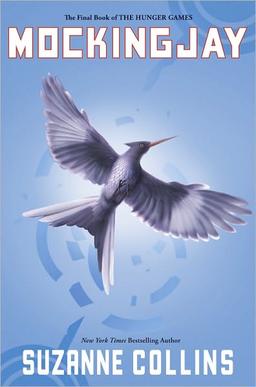
Once again, dear and gentle readers, I must mention spoilers to adequately address this novel. As such you have been advised and utilize your own judgement.
Mockingjay follows the second war between the Districts and the Capitol from its very early stages to its ultimate conclusion, although I find myself asking why such a revolution takes so long in the first place. The reason I say this is because District 11 is the district which focuses on agriculture and is a source of much of Panem's food supply. Granted, District 10 provides meat and District 4 seafood to the bottomless stomachs of the Capitol, but much of the other sustenance seems to come entirely from District 11, one of the first Districts to end up in rebel control. Even with stockpiling and hoarding, the Capitol simply cannot feed itself and would not be able to survive a protracted siege, which by my estimate would make it fall in a matter of weeks, months at the most. Yet, for some reason, the war drags out and the rebels are determined to take the Capitol block by block with a heavy toll in both military and civilian casualties.
This leads into my second point, the fact that you're constantly questioning whether the rebels are really that much better than the people in the Capitol. I feel like this certainly was the point of the author in many respects, showing how both sides in the war aren't all that different, but it left me feeling rather hopeless about the eventual outcome. There was simply no place for free will or individualism in the structured organization of District 13, and if they're left in charge it seems likely they may enforce their lifestyle on everyone else as well. It left me wondering what was the point of this struggle if the new regime is just as bad as the old one? Was it really worth all the bloodshed and sacrifice?
My frustrations with Katniss stem from the fact the book focuses almost entirely on her emotional turmoil, much of which is brought about by the love triangle that ultimately swallows the end of the book. I understand that she's seventeen years old and thrown into this revolution which she's the face of and all this other really emotional stuff, but a lot of it seems to boil down to her debating, "Do I want Gale or Peeta?" There are more important things at stake here! Like the fate of a continent! Plus Katniss realizes she doesn't really believe in anything beyond her own survival and it makes you wonder why you care about a character that isn't motivated beyond something greater than herself. Maybe it's just me but I prefer my heroes having a motivation beyond, "I want to stay alive."
There was a lot of potential here in exploring how the revolution would end and ultimately how it would change the face of Panem and its consequences but we unfortunately don't really get to explore that because the focus remained entirely on just Katniss who realizes she's been little more than a pawn or figurehead in a lot of other people's plans. This book could have been a lot better by widening the focus and exploring the consequences of the war a lot better rather than sticking on just Katniss. Strangely, I find myself saying that perhaps this should have just been one book. The Hunger Games set up a rich world with profound social, economic, and political structures and the sequels could have done a lot more to explore that structure and its frailty. Instead, the focus remains on Katniss, merely one part of a much larger series of events, and as a result we don't get to explore that world on a deeper level. Whatever promise The Hunger Games had for me, it failed to deliver with Catching Fire and Mockingjay.
- Kalpar
Thursday, April 10, 2014
Catching Fire, by Suzanne Collins

Warning to my kind and gentle readers: As this book is, of course, part of a trilogy, I may mention some spoilers during my review. If you're completely adverse to this please just take my word that it's worth your time and go read it. Otherwise you have been warned, but I shall endeavor to avoid spoilers as much as possible.
After the furor over the seventy-fourth Hunger Games, Katniss has returned to District Twelve, trying to return to the life she had before. But, of course, the Games have changed her irrevocably and she simply cannot go back to the way things were, as much as she'd like to. In addition, Katniss's actions inside, as well as outside, the arena have inadvertently provided a spark for the ready tinder of rebellion throughout the districts. (Have you noticed fire gets used a lot as a symbol in this series?) Ultimately Katniss finds herself once again being used as a piece in the power games of Panem's political players and becoming far more important than she could have ever imagined.
What I really liked about this book in the series is that you get a very strong sense of desperation from the political leaders in the Capitol. As I mentioned in last week's post, the socio-economic framework of Panem is incredibly fragile and it doesn't take a lot to threaten its total collapse. The Hunger Games are, of course, an incredibly useful tool for the Capitol in keeping the Districts in line, so long as it remains effective. Katniss's actions, though, have severely undermined the efficacy of the Games and has begun providing a means for the people of the Districts to unite against the Capitol, a truly dangerous prospect. As a result the Capitol resorts to more direct and brutal measures, crushing any sign of rebellion beneath an iron heel, in an attempt to reassert control upon the Districts. While this is certainly bad for the Districts, and creates a great deal of despair and frustration, you get the sense that Capitol can only keep pushing these people around for so long before some of them decide to start pushing back, and hard.
I will admit that the middle to later part of the book becomes a little less interesting because we once again must go through the ritual of a Hunger Games, although in this case there is the change of it being a Quarter Quell with changed rules to remind the Districts of the Capitol's authority, rather than the more regular Games. However, I got the feeling that even the author was tired of writing about the games because the whole thing happens in a very abbreviated fashion. "Twenty-four people, fight to the death, do your best to stay alive, blah blah blah." Somehow something so horrific and terrifying the first time around has become positively mundane. There are at least some new characters to make it more interesting, but it still feels rather tedious.
The biggest weakness of this novel, and again, this is probably part of it being the second in a three-part series, is that it just sort of...ends, rather anticlimactically. There's a lot of emotional buildup and the book gives us quite a few emotional sucker-punches throughout, so you're thinking it's going to end with this really big finish setting up the third act but instead it just peters out. "Oh yes. Important things happened while you were asleep. We'll get to them in the next book." I can see how people could be really frustrated with the ending, especially if they had to wait for the third novel to get written.
Despite its weaknesses, I feel like Catching Fire is worth reading, especially the first third or so that really shows you how desperate things are getting for the Capitol. The other parts are necessary at least for setting up the third novel, which hopefully will provide a meaningful resolution to the series.
- Kalpar
Tuesday, April 8, 2014
Kalpar Lectures: The History of Cincinnati Union Terminal
Guys, hey guys! I made a video! After....almost a year...ish.
- Kalpar
- Kalpar
Subscribe to:
Posts (Atom)