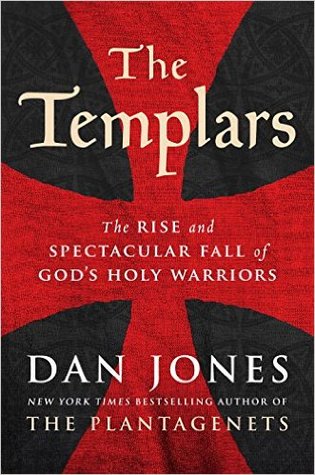
Today I'm looking at another book from Dan Jones about the Knights Templar, one of the crusading orders of knights established in the years after the first Crusade. Although the Templars were not the only international crusading order they are far more well known than the Knights Hospitaller or the Teutonic Knights, and far beyond the smaller orders such as the Livonian Sword Brethren or the Order of Santiago. Jones speculates a little on the enduring popularity of the Templars as an order, but the majority of the book focuses on the history of the Knights Templar from their founding in 1119 to their spectacular downfall starting in 1307 and concluded by 1312.
In hindsight the most surprising thing about the First Crusade is that it succeeded at all considering how poorly organized the entire venture, and most later crusades were. The main advantage of the crusaders was the fact that Jerusalem and much of the Levant existed at the time in a border region between the Fatimid, Shia caliph's capital in Cairo and the Sunni Abbasid caliph in Baghdad. The division between Egypt and Mesopotamia allowed the crusader kingdoms to survive despite their weaknesses and it was largely when both flanks acted in concert that the crusader kingdoms were in most danger.
An inherent problem of the crusader kingdoms was a lack of resources, specifically money and manpower, the two most necessary resources for prosecuting a war. The original mission of the Knights Templar was to provide protection for Christian pilgrims visiting sites such as the Holy Sepulcher in Jerusalem. This original mission quickly grew to the Knights Templar, as well as the Knights Hospitaller, being an elite military force. However the Templars and Hospitallers had significant advantages over the secular rulers of the crusader kingdoms. In their founding charter the papacy granted numerous rights to the holy order which gave them significant benefits. The Templars were made responsible only to the pope, immune from almost all taxation, and granted lucrative rights regarding religious ceremonies and rituals. Coupled with this were the numerous donations of land and resources made by pious Christians in Europe, the Templars became incredibly rich as an organization.
Because the Templars had access to such tremendous resources, they were able to arm and equip a dedicated fighting force of knights and sergeants. Soon the Templars were assigned the garrison of numerous strategic castles in the Levant and Templar contingents made a significant portion of any crusade army. For much of the book Jones focuses on the military history of the Templars and their battles in Egypt and the Levant. There are brief mentions to the more business-aligned aspects of the Templars, such as their involvement in the trade hub of Acre and their fleet of galleys used for both military and commercial uses. I actually would have liked to see more about that because Jones briefly makes the argument that the Templars in many ways were a medieval version of a corporation and NGO rolled into one. I would have appreciated more time on the more economic aspects of the Templar order, but I can see where for the most part their income came from being a major landowner which isn't terribly interesting.
The ultimate irony is that while their wealth enabled the Templars to field major armies against Muslim powers, it also made them a target among Christians at home, especially Philip IV of France. This became especially prominent after the collapse of the crusader kingdoms and the Latins had to fall back to the isle of Cyprus. While the military orders and eastern Latins tried to raise support for renewed Crusading efforts, the European leaders were largely more concerned with local affairs and dynastic struggles. This lack of enthusiasm for continued crusades left the Templars and other military orders at loose ends. While the Teutonic Knights had their own campaigns in the Baltic, the Templars and Hospitallers were faced with the prospect of being merged into a single military order.
Ultimately it was Philip IV of France who ended the Templars, which was fueled by his need for money to perpetuate his military campaigns at home. Jones illustrates that Philip had attacked other targets including churchmen and French Jews to not only cement his power but increase his personal wealth. Jones shows that Philip was initially alone in his persecution of the Templars, and several fellow monarchs were confused at his persecution of the Templar order. Even Edward II only began his persecution of the Templars when it was beneficial for his own personal ends. Most rulers were fairly lax in the persecution and suppression of the Templar order in their own lands when ordered to do so at behest of the pope, so the most significant persecution appears to have occurred solely in France, famously ending with Jacques de Molay, the Grand Master of the Templar Order, and numerous other officials being burned as heretics. Jones argues that a significant part of the allure of the Templars is their dramatic end, compared to the Hospitallers and Teutonic Knights who still exist today albeit in a far smaller and limited form.
This does raise the question of why the Hospitallers, an equally wealthy and powerful organization, wasn't the target of suppression and most of the Templar resources were merged into the Hospitallers. What I've heard about the Teutonic Order is that they were able to play the Holy Roman Emperor and the Pope off each other, ensuring their continued existence, but it leaves me wondering why the Hospitallers were able to survive. Maybe there's another source that will answer these questions but I think it's something Jones could have answered.
Overall I think this book is really interesting because of the history that it covers. Jones is a very dedicated medieval historian so you can really tell he's enjoying his subject matter and it really shows in the book There are some areas where I'd like to have seen more development and historical detail, but otherwise I think this book was pretty good.
- Kalpar
Showing posts with label Dan Jones. Show all posts
Tuesday, October 9, 2018
Thursday, December 1, 2016
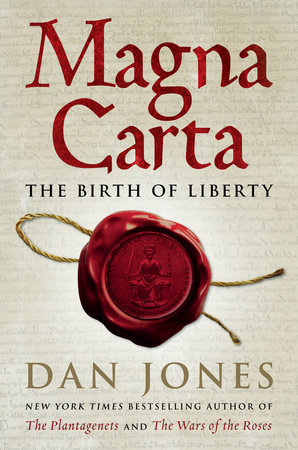
Magna Carta: The Birth of Liberty, by Dan Jones
Today I'm looking at another book from Dan Jones, in this case Magna Carta: The Birth of Liberty, which was written as part of the celebrations last year over the eight-hundredth anniversary of the issuance of Magna Carta by King John of England in 1215. To historians, though, the excitement over Magna Carta seems largely misplaced. Put within the context of the era, it was an attempt at a negotiated peace between King John and his rebelling barons, a peace which did not last a month before John was repudiating Magna Carta and trying to exert his will over his barons once again. Furthermore Magna Carta is overwhelmingly concerned with the rights of the nobility concerning the king and the limited rights it granted freemen, as Jones points out, would have affected maybe twenty percent of England's entire population in 1215. Jones argues rather eloquently that the Fourth Lateran Council, which condemned trial by ordeal, should be more remembered than Magna Carta. And yet somehow this obscure document has earned an almost sacred status.
The majority of the book focuses on putting Magna Carta within the proper historical context. As Jones is a medieval historian this makes a lot of sense because that's the subject that he's studied the most and has the most expertise talking about. Jones does a very good job of explaining the history of heavy-handed governance and taxation, started by Henry II and Richard I to finance their perpetual wars, which finally came to a head under the less successful and less charismatic John. Jones does spend time going into subjects such as medieval siegecraft which give a fuller understanding of the story, but may not entirely relate to Magna Carta specifically. And since I've already listened to The Plantagenets from the same author, who of course covers Magna Carta in that book as well, a lot of the subject matter was review for me.
Ultimately I did find myself wishing that Jones had spent more time talking about the evolution of Magna Carta in the intervening eight hundred years and why it has developed such a significance. When pointing out that it is mostly a medieval document concerned with issues such as scutage and feudal inheritances, it seems very strange indeed that Magna Carta has such significance today. The last chapter of the book very briefly covers how Magna Carta went from an embarrassment best ignored by the sixteenth century, to a key constitutional argument for opponents of Charles I's attempts at absolute royal authority during the English Civil War. Even as the numerous clauses in Magna Carta became obsolete, principles such as trial by jury, due process of law, and a vague notion of representation in exchange for taxation, became part of English tradition, as well as the traditions of numerous countries settled by English colonists. This is a huge subject which could be its own book, or even multiple books, but I think it would be interesting to listen to or read about.
I think if you've already read The Plantagenets or even seen Monarchy with David Starkey (who actually taught Dan Jones!) then you'll find a lot of the stuff in Magna Carta a review because it talks mostly about John's reign more than anything else. It's still very good writing from Jones who is becoming one of my other favorite English historians and if you want a much shorter book focusing just on this subject matter then this is a good choice. But I still recommend The Plantagenets over this one.
- Kalpar
Tuesday, April 12, 2016
The Plantagenets: The Warrior Kings and Queens Who Made England, by Dan Jones
This week I'm talking about a...sort of biography by Dan Jones about the Plantagenets. I say sort of biography because the book actually covers the lives of dozens of people over about a century of history, but it's a narrative driven by the individuals that make up the dynasty referred to as the Plantagenets. Although this is today referred to as the monarchs who ruled England from Henry II to Richard II, who was deposed by his cousin, Henry Bolingbroke who became Henry IV. Really the only person who referred to themselves by the surname Plantagenet was Henry II's father, Geoffrey of Anjou, who never ruled England. However historians love giving names to things so ultimately the name has stuck, and it's much easier than saying ''those guys who were all related to each other and ruled England during that time.''
The Plantagenets are some of the most important kings in English history, both from the development of England today, as well as in the popular imagination. The Plantagenet dynasty included Richard the Lionheart, Bad King John, Edward Longshanks, Edward III, and the Black Prince, all major figures in England's historic folklore. This is no accident as several of these kings, such as Edward I and Edward III understood the power of propaganda and purposely cultivated their images for posterity. So it is no exaggeration for Jones to state that these are the monarchs who made England.
I was already passingly familiar with the history involved, if nothing else than because there are plenty of English-language sources for English history. The most interesting resource I've seen on the subject is the documentary series Monarchy with David Starkey which I highly recommend. (It used to be on Netflix but as of the writing of this post it's been taken down, which is a crying shame.) So of course there's a deal of overlap between what I already knew from Monarchy and Jones's book. There is of course the perennial problem with sources in medieval history, and sifting through to come at something approximating the truth. Chroniclers during the middle ages were hardly impartial recorders and while there are plenty of overt biases, there can be fare more subtle ones as well. How accurate Jones's sifting through sources I'm sure other historians have utilized is I cannot say, but it's still informative and interesting.
The Plantagenets are important for a couple of reasons, most importantly establishing English dominance in the British Isles and the creation of Magna Carta. Although the struggles between England, Scotland, and Ireland would continue for centuries and in some cases remain unresolved to this day, the campaigns of kings such as Henry II and Edward I established English dominance and Edward I's campaigns permanently annexed Wales as part of the English kingdom. The Plantagenet kings were also responsible for alternately extending English holdings in France, such as Henry II and Edward III did, or losing them almost entirely, like John or Richard II. The other major contribution, however, was the Magna Carta and the precedent of parliaments.
If we were to ask the Plantagenet rulers, Magna Carta, the charters that followed, and the parliaments that resulted would not be proud accomplishments. Many rulers attempted to overturn or repeal the charters and act unilaterally without the consent of Parliament. And in a way, the Magna Carta did not affect the ''little people'' when it was sealed in 1215, primarily concerned more with the rights of the barons who had rebelled against John than the commoners. However it has become enshrined in popular imagination and is generally credited today with being the origin of English democracy and the uniquely English tradition of common law. As someone who has grown up in the Anglosphere which carries on the tradition of common law, even I am not immune to the worship of these principles that go back centuries. Truly it's the Plantagenet era where the concept that the monarch rules with the consent of the governed becomes codified in the English tradition.
Overall this is a pretty good book, although it tends to focus more on the narrative and a lot of the gory details of ruling in the middle ages. There was a certain amount of big-picture stuff to keep me satisfied, but when you get to Edward II and especially the misrule of Richard II Jones doesn't hold back on the blood. If you're interested in learning more about the rulers of England during the middle ages, then this is a good resource, but I still recommend Monarchy as well.
- Kalpar
Subscribe to:
Posts (Atom)