Today I'm looking at a short novel by M.H. Boroson, the first in a planned series, The Girl With Ghost Eyes. This book is set in San Francisco's Chinatown in the late 1890s and follows Xian Li-lin, the daughter of a famed Daoist exorcist and a powerful exorcist in her own right. I thought this would be like a typical urban fantasy, someone with magical abilities in a city solves magical problems, but with the twist of using Chinese mythology and the setting. So I thought this was worth the time taking a look and seeing if it was any good.
The book starts with an interesting premise, but I'm left with some hesitations about Boroson's decisions with the book. Chinese mythology is deep and complicated, spanning dozens of ethnic groups, thousands of years, and with no singular religious tradition to unite them. So when it comes to depicting Chinese mythology you have a lot of options you can kind of pick and choose and jumble together, which Boroson does. And quite frankly I don't know enough about Chinese mythology to say whether this is accurate or not, so that's not a huge part of my concern.
The biggest thing I noticed was an emphasis on the concept of ''face'', an obsession with honor, social standing, prestige, and all that comes with it. Again, this is a subject that I don't know a whole lot about but I do know that a lot of what people assume Chinese culture is about tends to rely more on nineteenth century stereotypes about Chinese culture rather than actual representations of Chinese culture. The prevalence of the use of the word ''face'' specifically and emphasis on how gaining and losing face makes me think this wanders into stereotypical territory rather than an accurate representation of Chinese culture.
I also noticed that Boroson tended to repeat concepts or phrases over and over, especially if it was something like the March of a Hundred Devils or the Death of Five Touches. But Boroson also emphasizes how the tongs aren't just criminal organizations but function as support networks for immigrants as well. And these are just a handful of examples throughout the book. This book isn't all that long in the first place and I suspect that if Boroson hadn't repeated himself so much this book might have been significantly shorter.
I was kind of left uncertain on my opinion with Li-ling. She kind of vacillates between hyper-competent in her job as a Daoist exorcist and having to rely on her father or other people to help her out. I've been finding that a lot with various urban fantasy characters in the books so it seems to be a trend within the genre. Long-team readers will know the number of times I've lamented Harry Dresden's decision to leave his brain cell at home or with Thomas for the day. As far as I can see this is the only book in the series as of right now, so I don't know if Li-ling improves in her abilities and that may be determined in future books.
Overall the book is okay. I wouldn't say it's the best book I've read, but at least Boroson is trying something different.
- Kalpar
Showing posts with label E-books. Show all posts
Tuesday, December 4, 2018
Tuesday, October 30, 2018
Skin Folk, by Nalo Hopkinson
Today I'm looking at a collection of short stories written by Nalo Hopkinson. This is another one of those books that I picked up from one of the perpetual sales that Goodreads manages to throw my way, and I'm very, very glad that I did. If you haven't heard of Hopkinson yet, I highly recommend checking her writing out. This book in particular reminded my a lot of Neil Gaiman's writing, especially his short story anthologies like Trigger Warning or Smoke and Mirrors. I'm really glad that I picked up this book and I think everyone else should check it out too.
One of the things I really liked about this book was how Hopkinson incorporated her own cultural heritage into her stories. Hopkinson was born in Jamaica with her parents having roots in Trinidad and Guyana, and later emigrated to Canada. Hopkinson incorporates both Caribbean and Canadian elements into a lot of her stories which gives it a very unique flavor. I always really appreciate it when authors incorporate their own unique locations or cultural heritages in their works rather than seeing yet another story set in New York.
Another thing that I really liked about this book was how Hopkinson took a lot of old fairy tales and retold them in a different way. This is definitely a trick that Gaiman has pulled a number of times with great success. Hopkinson, by her own admission, includes a lot of adult themes (aka sex and violence) in her stories, something that I've noticed Gaiman does a lot in his stories as well. The results are stories that make you sit and really think about the results and can really punch you in the gut. It's really good writing that shows Hopkinson really has talent.
Otherwise, this is an anthology of short stories so there's not a whole lot I can say beyond ''these stories are good, go check them out''. It turns out that I managed to pick up another of Hopkinson's books with another Goodreads deal so I'm looking forward to seeing how a full-length book compares to her short stories. This is definitely worth taking the time to read.
- Kalpar
Tuesday, October 23, 2018
Head On, by John Scalzi
Today I'm looking at a book recommended to me by Angela of the Doubleclicks, Head On, by John Scalzi. This book is a sort of sequel to another of Scalzi's novel, Lock In, however this book is a stand-alone novel so you, much like myself, can read Head On without having read Lock In. The book is set sometime in the near future after a disease known as Haden's has affected approximately 1% of the world population. People affected with Haden's Disease are literally locked inside their own bodies, unable to move and dependent on intensive care for the rest of their life. The only way people with Haden's can interact with the world are through the online community called the Agora or through personal robots transports colloquially known as threeps.
Head On begins with the death of a player in a Hilketa match. Hilketa is a new sport that has developed using the technological improvements created in the wake of the Haden's epidemic. Hilketa is a team sport utilizing threeps who engage in gladiatorial combat, a level of violence that other sports can only dream of. And despite the violence between the threeps, the Haden athletes remain safe in their creches, watched over by their caretakers. At least, until Doug Chapman dies very publicly during a pre-season game. The suspicious suicide of a league commissioner gives FBI agents Leslie Vann and Chris Shane a murder investigation with major implications.
Like most Scalzi novels this book is a really quick read because Scalzi keeps the action running nonstop and his writing is incredibly tight. I think this is Scalzi's greatest strength because it makes his books really easy to read. This is especially true for a murder mystery because it makes time all that much more of the essence. As the bodycount continues to rise, Shane and Vann are in a race against a deeper conspiracy and there's a very good chance that they're the next targets.
I also liked the level of realism that comes with Scalzi's depiction of the future. Like a lot of good sci-fi writers he takes things that already exist and moves the into the realm of possibility. Although I'm not quite up on where robotics are currently (because bipedal motion is actually hard to replicate), usage of drones is becoming far more common. I think it would have been a little more realistic for Scalzi to include a scene where someone loses contact with their threep due to bad wifi, but having it happen a realistic amount of times would get annoying pretty quickly so I can forgive Scalzi just sidestepping that problem.
Another plotline that I thought was interesting was the government's repeal of subsidies and tax credits for Hadens which will make many of them unable to afford a personal threep. This certainly has some real-world parallels with increasing health costs and the issues many people with disabilities face. Scalzi could almost create an entire book talking about this subject alone, although I think that could be either part of Lock In, or perhaps in another novel Scalzi does in this universe. But I think to go too much into it would have taken away from the murder investigation.
Overall, I think this book is a really good choice to read. As usual, Scalzi's writing is tight and accessible, fun to read, and just a good sci-fi novel. I should probably read more of Scalzi in the future because I enjoy his writing so much. But this is definitely a sci-fi murder mystery worth reading.
- Kalpar
Thursday, October 11, 2018
Bismarck, by Alan Palmer
Today I'm looking at a biography of Otto von Bismarck, known to students of European and German history as the Iron Chancellor of Prussia who united the disparate states into the German Empire in the nineteenth century. Bismarck has always been a controversial figure, his focus on militarism and authoritarian rule is seen as a foreshadowing of the atrocities of the Nazi regime half a century later. However, Bismarck also was a firm supporter of modernizing Prussia and Germany and later in his administration he would pass comprehensive social security plans for German workers, hoping it would cut any desire for socialist revolution in Germany. Bismarck is ultimately a figure of contradictions. A reactionary autocrat of the first order who promoted social welfare reform. A man often depicted in military uniform, but only served as a soldier for a year and became a Landwehr reserve lieutenant before pursuing a civil career in the diplomatic corps. A member of the Junker aristocracy and yet always seemingly apart from them. For a man who redrew the map of Europe Bismarck remains a puzzle to historians.
The career of Bismarck almost didn't begin. Evidence from his early days suggest that Bismarck played the role of ''wildman Junker'' to the hilt, followed by a pack of hunting dogs and getting in numerous duels during his time at university. In fact, Bismarck didn't do so well at university, despite his later genius at handling both international relations and managing Wilhelm I of Prussia and later Germany. With the death of his father, Bismarck spent nine years working as a gentleman farmer, trying to manage his estates and actually turning a profit. It's probable that if there was any school where Bismarck learned how to negotiate, how to manage people, and the importance of having multiple plans, it was probably the Frankfurt Diet of the German Confederation. Although his time in the diet was much ridiculed by his opponents, it probably still served an important purpose in his education.
Still, even with his experience in the diet it is surprising that Bismarck became chancellor at all. After making numerous enemies at home with his brash actions, Bismarck was sent as ambassador to Russia, a task he loathed because of the social interactions involved. For someone widely regarded as one of Europe's greatest diplomats, Bismarck had a hatred for social galas or even spending time in the capital. Bismarck was far happier to retire to his country estates in Altmark or Pomerania than among the glittering elite of nineteenth century Europe. In truth, Bismarck was only selected for chancellor and minister-president of Prussia because of an ongoing constitutional crisis.
A handful of reforms had been enacted in Prussia in the nineteenth century, including the creation of a parliamentary body, the Landtag. William I had wanted an increase in expenditure for the vaunted Prussian military which required approval from the Landtag, however a majority of the Landtag wanted a reduction in the compulsory military service from three years to two, something that William I was unwilling to negotiate on. Bismarck, never one to be worried by upsetting parliamentary niceties when it was to his advantage to do so, simply used the previous year's budget and governed without the Landtag under the auspices of a crisis, a constitutional position he had explored some years earlier. The taxes got collected, the troops got equipped, and Bismarck had freedom to rule without parliamentary interference.
The image of Bismarck that emerges from his time as chancellor is a man of extreme moral flexibility. Bismarck will make friends with you one day and then stab you in the back the next if it was beneficial to his plans. Bismarck does not seem to be guided by any political ideology or philosophy and appears to have very little patience for people who do. His goal, as Palmer describes it, seems to be power for himself, and uniting Germany under Prussia was merely a means to expand that power for himself, as exhibited by Bismarck's own frustrations with rampant nationalist ideologues.
Another of Bismarck's strengths was his ability to have an extra plan, or two, or three for him to fall back on if his first plan didn't go through. As Extra History put it in their biographic series of Bismarck, the first rule of being Bismarck was ''Always have a plan''. This fit perfectly with his moral flexibility, and throughout his career Bismarck worked to never be in a position where he was forced to commit definitively to anything he didn't want, something that later leaders of the German Empire did not have the skill or ability to do. Which underlines the biggest weakness of Bismarck's system: it doesn't work without Bismarck.
Bismarck was an autocrat through and through, down to his inability (or perhaps unwillingness) to imagine a system that existed without him. He did try to groom his eldest son Herbert for the position of Chancellor, but Herbert proved unequal to the task and only served in a variety of posts in the diplomatic corps. Bismarck's position as Chancellor of the German Empire was added to the constitution of the empire as an afterthought, rather than as a key part. He existed independent of and unaccountable to the Reichstag, serving only at the pleasure of the emperor and so long as that was the manageable, aged William I, Bismarck had free reign to do as he pleased.
As long as Bismarck remained at the center of the system, the elaborate network of alliances, treaties, and agreements, the ad hoc nature of the machinery of government in Germany, everything worked in spite of its inherent weaknesses. But once the autocrat is gone, the entire machinery falls apart. This is even illustrated during Bismarck's administration by his frequent retreats to his estates, when all major decision making is either put on hold, or people must make the pilgrimage to Bismarck to get decisions. Crises that didn't get his immediate attention soon spun out of control until Bismarck was once again at the helm.
In this way, Bismarck is a quintessentially European figure displaced in time. A moral opportunist and autocrat of the first order in earlier epochs could have become king or established a dynasty. In the industrializing nineteenth century, Bismarck was faced with things he could not control or perhaps understand. A figure of contradictions, Bismarck will remain a person of great interest to historians for years to come.
- Kalpar
Tuesday, October 2, 2018
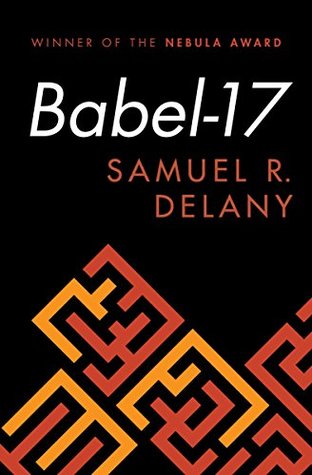
Babel-17, by Sameul R. Delany
Today I'm looking at another older science-fiction novel that I picked up on sale on Amazon. Babel-17 is set in a distant future where the humans of Earth have formed together into an Alliance for mutual defense with three alien species against the Invaders, a splinter group of humans and four other alien races. Recently the Alliance has suffered a series of mysterious sabotage attacks at their most secure facilities. The only clue uniting these attacks are coded messages that they have been unable to identify or crack that they call Babel-17. Out of desperation the military turns to Rydra Wong, the most legendary poet of the age, in the hope that she will be able to decipher Babel-17 and provide some clue as to when and where the next sabotage attempt will be. Wong puts together a crew and heads out into the depths of space to gather more information and decipher the mysteries of Babel-17.
This book has some really interesting ideas but it almost feels like it was necessary flavoring that was thrown into the book because it was a 1960's science-fiction novel and it needed to have some weird stuff in it. For example, cosmetic surgery is incredibly common among the portion of the population that works on spaceships, compared to the tattoos of sailors in previous centuries. There's also a concept of triples where people engage in what we'd call a closed triad, which is seen as unusual but not uncommon. Furthermore humans continue exist beyond death as discorporate entities who can fulfill important jobs on ships that would drive a mortal human insane. All of these are really interesting ideas but they seem to provide flavor to the book more than anything else.
The plot of the book centers around Babel-17 which goes into some territory that I'm not 100% on. Obviously I'm not a linguist so I'm no expert but this book leans pretty heavily on the trope of Language Equals Thought. The more I think about it the more unsure I am. A major point is that Babel-17 as a language has no concept of I and is somehow so insanely precise that it manages to unlock telepathic superpowers. I'm left with the feeling that I just didn't understand the plotline that Delany was trying to create with the language angle. Maybe if people know more about linguistics they might get more enjoyment out of this book but I'm afraid I was left feeling confused more than anything else.
Overall this book has some interesting ideas and I think it's worth checking out but I can't say whether I really understand it or not.
- Kalpar
Tuesday, September 25, 2018
The Rise and Fall of Ancient Egypt, by Toby Wilkinson
Today I'm looking at a history of Ancient Egypt that covers history from the early origins of the Egyptian kingdom in the 3000s BCE up to the first century BCE with the annexation of Egypt by the Roman Empire. When dealing with a history of literally thousands of years obviously this is a very broad overview rather than a detailed history, which is further hampered by the fragmented nature of the information available. Compared to the biography of Hatshepsut which went into the life of not just Hatshepsut but her stepson and heir as well, this book takes a far more general approach. However, Wilkinson does have the advantage of drawing upon the centuries of written records and archaeological evidence to piece together the story of ancient Egypt.
For the most part Wilkinson does a pretty good job of talking about the history of Egypt and it's very obvious that he's spent many years in the field of Egyptology. Wilkinson relies not only on the written record but on artifacts ranging from temples to tombs to grave goods to ordinary items. Based on the fact that someone was able to write an entire book about Hatshepsut while Wilkinson barely mentions her at all, it suggest to me that Wilkinson picked and chose from what he thought were the most significant pharaohs to talk about rather than going into detail about all of them. Even when details are available (which apparently are in some cases) to go into detail about every pharaoh would be a much larger book. Because I know basically nothing about ancient Egypt I'm unable to comment one way or another on Wilkinson's decisions.
I will say that there were some comments that left me a little concerned, especially a comment Wilkinson made about the names of pharaohs sounding juvenile to modern English ears and offhandedly saying that maybe the cosseted lifestyle of the Egyptian royalty created a band of decadent and infantile pharaohs. This argument is so facile that I can't believe it ever made it past the editor, much less was included in the book. Even as a joke this comment is incredibly insensitive and makes me really concerned about Wilkinson. I know this is a really small and specific thing to worry about, but it feels like a really big deal to me.
There were a few other comments that concerned me but not as great as the comment about Egyptian names. Wilkinson placed a large amount of emphasis on the Israelites and their Bronze Age kingdoms. Now because I haven't studied a bunch of ancient history outside of Rome, I don't know the status of the Bible as a historical source but I know that it can't be taken as complete historical fact. However based on what I read Wilkinson seems to take the Bible as historical fact and seems to get downright confused when Egyptian sources don't mention King Solomon. He actually seems to get offended when the first Egyptian source that mentions the tribe of Israel only as a minor enemy. Except for all we know at this time Israel was a minor tribe, not a kingdom receiving ambassadors from the major powers of the ancient world.
I'm assuming that Wilkinson does a good job assessing the Egyptian sources but his comments raise some concerns on my part. Because I know so little about this I'm going to say for now this seems a good general overview but if I get more information I may have to change my analysis.
- Kalpar
Thursday, September 6, 2018
City, by Clifford D. Simak
Today I'm looking at an anthology of short-stories written by Clifford Simak that tell a story through short vignettes over a period of thousands of years. The stories of City follow mankind as technology allows them to abandon cities, then flee to the stars, then disappear, leaving behind sentient dogs and robots as the inheritors of the Earth, who end up taking their own paths. The stories, like so much of forties and fifties science-fiction, was first written for short story magazines before being collected in an anthology. This anthology uses a framing device of dogs in the distant future analyzing eight stories that have been passed down through the generations. Many dogs think that the stories are little more than myth, an origin story crafted by dogs to explain where they came from. Man is dismissed by most dog thinkers as a primitive tribal deity with no basis in fact and probably never existed.
The concept is an interesting one, much in the same vein as stories like Canticle for Leibowitz where we, the readers have knowledge about things in the distant past that other characters only vaguely know about. The dogs, for example, think that it's impossible to travel to another planet such as Jupiter, while we currently send probes to different planets on a regular basis and to forties and fifties readers travel to Jupiter seemed a real possibility. The result is an interesting conflict between the reader and the characters within the book and for whatever reason this is something that I enjoy in books.
There is a fairly melancholy tone throughout the novels and I'm not sure how I feel about it. The moral of the stories all seems to be that no matter how much we, or dogs or robots, advance, there will always be something to hold us back or something to distract us. There is an interesting contrast between the hope for the future and the obstacles that ultimately stumble us. The result is rather bittersweet and leaves the hope for the future in doubt. Which is a lot like real life in a way because our future is always in doubt.
Overall I thought this book was an interesting and short read. Even as a forties and fifties science-fiction anthology I feel like it hasn't aged as badly as some other sci-fi has. I think it's definitely worth taking a look for its unique nature.
- Kalpar
Tuesday, August 28, 2018
A Country of Vast Designs, by Robert W. Merry
Today I'm looking at a biography of the eleventh president of the United States, James K. Polk. For many people, Polk is among many of those nineteenth century presidents that are largely forgotten. Polk may not have been a caretaker president but with the general population he usually gets lumped in with them. As Merry points out, this is somewhat odd because Polk was president during the third-largest expansion of U.S. territory during his administration, surpassed only by the Louisiana Purchase and the Alaska Purchase. Furthermore Polk managed to achieve all four of his major policy objectives within one term: reduction of tariffs, the creation of an independent treasury, negotiation of the Oregon territory, and annexation of Mexican territory. However, the fact that Polk achieved his major objective through an aggressive and blatantly imperialist war against Mexico has significantly tarnished his reputation and left his political legacy in considerable doubt. I will say that Merry is a pretty strong Polk apologist and that leaves me in some doubt.
I will give Polk some credit by managing to achieve his objectives of tariff reduction and the independent treasury. Polk faced stiff opposition from the Whigs as well as members of his own Democratic Party, revealing the deep sectional divisions hiding within the national parties. It was only through using political capital to get his legislative program accomplished. Furthermore he had to spend considerable effort quelling rebellion and insubordination within his own administration, a process that could have been simplified by removal of James Buchanan as Secretary of State. It does reveal that Polk had considerable skill as a negotiator and coordinator which certainly makes him equal with other presidents who faced equal challenges with an opposed Congress.
If Polk has a biggest flaw, it's his refusal to engage in confrontation and deal with subordinates who undermine or actively act against him. The best example of this is the aforementioned James Buchanan. This really comes to the fore with the negotiations over the boundary for Oregon. Polk was elected on a platform of ''54-40 or Fight'', the extreme boundary of the territory. Merry argues, probably correctly, that Polk adopted this extreme measure to force Britain to negotiate over the boundary, especially since previous attempts to negotiate at the 49th parallel had been rejected by the British. Although there was legitimate concern that Polk's stance would provoke war with Great Britain, Buchanan repeatedly undermined Polk's attempts by providing conflicting information to British diplomats. And when Polk managed to finally negotiate a boundary at the 49th parallel Buchanan immediately reversed course and demanded that Polk accept nothing less than 54-40. Buchanan also opposed the treaty ending the Mexican War, even after it accomplished all the goals Polk proposed. It seemed that Buchanan adopted any contrary position just to cover his own ass for his future presidential prospects.
The biggest issue around Polk is of course the Mexican-American War which was provoked through a variety of diplomatic incidents between Mexico and the United States and started Zachary Taylor and a detachment of dragoons were sent into the disputed boundary between the Rio Grande and Nueces Rivers in Texas. Taylor was attacked by Mexican troops which prompted Congress to grant Polk's request of a declaration of war. However even as the war began, Polk's Whig opponents criticized him for starting what they saw as an illegal, unconstitutional, and imperialist war and those criticisms have remained. This is the point where Merry gets most apologist for Polk, arguing in essence that while the United States provoked the war, it was in some ways justified because of Mexico's inability to meet legal reparations, their mishandling of the diplomatic overtures, and their decision to adopt a hostile stance with a larger and more powerful neighbor. I feel like this is almost a case of victim-blaming that Merry adopts, ignoring any notions Mexicans may have had of national honor offended by American treatment of their nation as inferior, just as strong as American indignation at Mexican offense of American honor. While it may have been rational for Mexico to negotiate with the United States and perhaps end up losing less territory than they did after the war, it may not have been the rational choice for a proud, nineteenth century Mexican nationalist who would rather fight than surrender unilaterally.
And if there's one topic Merry definitely avoids as it pertains to Polk it's the issue of slavery. Polk owned twenty-five slaves and was selected as a candidate for the Democratic party because of his willingness to tolerate slavery. While Polk did not take an adamant stance in favor of slavery, such as contemporary John C. Calhoun famously did, he was no abolitionist or even apologist such as Henry Clay who at least went through the motions of saying it was bad and should be removed even if Henry Clay's scheme of colonization never really worked. Merry makes absolutely no mention of Polk's slaves or his relationship with them, and Polk does not seem to have been bothered by the institution in his personal writings. At most Polk's desperate opposition of the slavery debate seems to have been an effort to keep the country united as the regional fault lines between slave and free became more obvious in the 1840s and 1850s. Furthermore, Polk's acquisition of new territory was responsible for the opening of the slavery debate because those territories had not been covered under the Missouri Compromise legislations. While some people, including Polk, supported extending the compromise legislation to the new territories, a growing abolitionist faction made a simple solution to the slavery question impossible and concerns over the status of new territories added further fuel to the flame of sectional strife.
So while I can understand and appreciate the significance of Polk's achievements as a politician and president, I still think that there's quite a lot to critique as well. Regardless of what Merry thinks, I am still of the opinion that the Mexican-American War was a war of imperialist expansion in keeping with the U.S.'s other (undeclared) wars of expansion against Native American Indian tribes. While there are parts of this book that are highly informative, I think it goes to being a little too laudatory for Polk for me to truly appreciate it.
- Kalpar
Tuesday, August 14, 2018
Woman on the Edge of Time, by Marge Piercy
Today I'm looking at a science-fiction book by Marge Piercy, Woman on the Edge of Time. In the introduction, Piercy explained that the book was written during the second-wave feminist revolution of the late 1960's and 1970's and put it within the genre of feminist utopian literature that sought to critique current society and provide alternatives for the future. In this rerelease some forty years later Piercy argues that her book has become even more relevant because of the decreasing resources available for mental health, the increasing wealth inequality, and the threat of environmental destruction. And on some level, I have to agree.
This book focuses on Connie, a Mexican-American woman in her mid thirties, living on welfare in New York. Connie has been abandoned by her family, her daughter taken away by the state, and been in and out of government institutions for a significant part of her adult life. Recently Connie has been seeing an individual who identifies themselves as Luciente. Luciente claims they come from the year 2137, a society that has returned to a closer-knit and more ecologically sound way of living. Connie and Luciente are able to connect mentally across time and communicate, learning about each other's society.
The main conflict comes from a fight Connie had with Geraldo, her niece's pimp. Geraldo knocks Connie out and gets her recommitted to an insane asylum. The rest of the book focuses on Connie trapped within the ruthless institution determined to crush her into a predetermined form of socially acceptable. This is the part where Piercy's research especially shines, she says she got workers to sneak her into mental institutions and did countless interviews with both workers and patients to get insights into the mental health system. Through her writing Piercy manages to capture the tedium, the helplessness, and the desperation of people trapped in a system that sees them as a problem to be fixed, rather than people to be helped. With the evocative portrait Piercy creates, it really shows the deep-seated problems of the mental health system and if not how it needs to be reformed, at least revealing the desperate need for reform.
I will say that in my experience there seems to have been changes for the better in the past forty years, but my experience is far, far different from Connie's. First, I'm a middle-class white man opposed to a poor latinx woman so people are more likely to listen to my thoughts and concerns than Connie's just because of background. Second, I've spent the equivalent of a long weekend in a mental health institution while Connie spends at least one year and probably longer trapped in an institution. So while the glimpse I saw looks a lot better than what Connie experienced, my own experience was very different from Connie's and it's certainly possible that things haven't improved for many other people.
As for the life in the future that we saw, I feel like that's weaker compared to Piercy's commentary on society in the seventies. There are some interesting ideas but a lot of things are left a little too vague and just raise more questions, specifically the practice of defense. The people in the culture of 2137 volunteer to spend part of their time working on defense, fighting against enemies. It's implied that these enemies are last vestiges of the old corporation-dominated way of doing things and we get to see a little bit of that different society, but I would have liked just a little bit more exposition.
Overall I think the time travel and alternate society that Piercy establishes in her book are the less interesting parts of the book. The best parts, for me, were Connie's struggles against the system and revealing just how a woman of color can be disempowered by a system that sees her as a problem rather than a person. If the future society is underdeveloped and maybe a little confusing Connie's own story more than makes up for it. Definitely worth checking out.
- Kalpar
Thursday, July 26, 2018
The Woman Who Would Be King, by Kara Cooney
Today I'm looking at a book about ancient Egypt, specifically a biography of Hatshepsut who ruled as king in Egypt during the 18th Dynasty. The information that we have about Hatshepsut is fragmentary at best due to the loss of records over three thousand years, as well as later destruction of Hatshepsut's monuments. Cooney admits that a good portion of her book is conjecture, however Cooney creates an evocative image of Egyptian society and the life of Hatshepsut within the larger context of the Thutmosid Dynasty.
When Hatshepsut's images and carvings were first discovered by Egyptologists historians (all men, of course) assumed that Hatshepsut was an example of a woman usurping power from a rightful male leader. This was explained because many of her statues and inscriptions were deliberately demolished or defaced, reflecting a backlash during the reign of her successor Thutmose III. Cooney draws upon more recent analysis of Hatshepsut's inscriptions and other existing evidence of her reign to create a more nuanced and ultimately positive understanding of her place in Egyptian history.
Egyptology is a difficult field because the reality of politics and the ideology of politics were almost never separated. Central to Egyptian culture was the idea of the god-king, an aspect of the eternal sun who always had and always would rule over the land of Egypt. Who the king happened to be was largely irrelevant so long as there was a king and in both official and unofficial sources opinions on the king and the royal family were largely reserved. We are unsure about how the Thutmosid dynasty came to power. We know that the previous dynasty failed to produce a viable heir and the mantle of kingship was passed to Thutmose I. Why Thutmose was chosen or any familial connection with the previous dynasty he may have had has been obscured. But we do know among his many children were Hatshepsut who took on the powerful and influential role of God's Wife of Amen, the principle deity of the city of Thebes associated with the sun. The God's Wife was a position traditionally held by a member of the royal family close to the king and came with control of the temple's wealth and influence. We assume that this role gave Hatshepsut sufficient experience to become a political operator in her own right.
Thutmose I was, in his turn, followed by Thutmose II, probably Hatshepsut's half-brother who she married as his Great Wife. Although the couple produced one daughter, Neferure, if they produced any male offspring it does not appear in the record. In fact Thutmose II had trouble producing any offspring and by most accounts appears to have been a sickly individual dying only a few years into his reign. This created yet another succession crisis within perhaps fifteen years of resolving the last crisis. Thutmose II had produced another son, Thutmose III, but he was just an infant and from a low-ranked birth mother, giving him a weaker claim in the complex web of Egyptian royalty we still don't fully understand. With the high child mortality it was questionable Thutmose III would even survive to rule, much less produce an heir of his own. But Hatshepsut stepped into this vacuum and provided much-needed continuity as regent.
It was not uncommon for queen mothers to step in as regents for their sons, and even made good sene because a mother was unlikely to sabotage her own son's reign. Hatshepsut's case, like so much else about her, was unusual. Hatshepsut was not Thutmose III's birth mother, but his own mother Isis was considered too low-ranked to actually serve as regent. Cooney argues, however, the fact that Hatshepsut became regent, and ruled unchallenged for nearly twenty years suggests that the religious and political elites trusted Hatshepsut and supported her role as regent and later king, to ensure that Egypt would continue to prosper while Thutmose III could grow up.
We know that Egypt prospered during Hatshepsut's rule because of several events. First was a series of highly successful campaigns in Nubia to maintain Egyptian hegemony and continue the flow of gold, gems, stone, and slaves which were immense economic boons for Egypt and Hatshepsut was able to channel the wealth to government figures, including new political appointees like Senenmut, ensuring their continued support for her reign. Hatshepsut also launched a successful trading expedition to the Land of Punt (believed to be somewhere around the Horn of Africa) which brought back even more wealth including the all-important incense which was not so much a luxury as a staple for the deeply religious culture of ancient Egypt.
This economic wealth was then channeled into massive construction programs throughout Egypt, resulting in upgrades of many temples from structures of the near-ubiquitous mud brick to worked stone, creating a new permanence to Egyptian life and the temple complex of Luxor at Thebes, making a veritable bonanza for archaeologists and Egyptologists of today. During all of this Hatshepsut continued to accumulate more power to herself and adopting the title of king, tying her legitimacy and right to rule with her descent from her father, the respected Thutmose I. Hatshepsut was formally coronated as a co-ruler in or about year 7 of Thutmose III's rule, and Hatshepsut celebrated the Sed Festival, a celebration of a king's successful rule, in year 16 of her and Thutmose III's ''joint'' rule of Egypt.
We don't know when Hatshepsut died, but evidence suggests it was about year 22 of Thutmose III's reign because that is when he launched his highly successful war into Syria and inscriptions make no mention of his co-ruler. The success of this first campaign made Thutmose III a warrior king who executed multiple successful campaigns to neighboring regions and exacted enormous tributes. But interestingly the evidence suggests that Thutmose III's attacks on his aunt, step-mother, and predecessor's legacy did not begin until fairly late in his reign, some twenty years after Hatshepsut's death. Why Thutmose III began this attack and destruction is unclear, but Cooney thinks the traditional explanation of a usurping woman being put back in her place is not only unconvincing but unsupported by the evidence of the continued respect and support of elites for Hatshepsut even after her death.
Cooney instead argues that perhaps it was the status of Thutmose III's own son, Amenhotep II, whose legacy Thutmose sought to prop up. Cooney suggest that Amenhotep II, much like his father, was born to a lower-ranked wife. Because of this lack of direct links with the dynasty, usually reinforced by brother-sister marriages in the royal family to keep the bloodline concentrated, Cooney argues that Thutmose III was seeking to change the source of legitimacy to a father-son link rather than a larger dynastic link. It wasn't important if the mother wasn't of sufficient background or even within the family group, as long as the next king was son of the previous king. To this end Thutmose III tried to connect his kingship to his father and grandfather, Thutmose I and II, and edited many of Hatshepsut's statues to be dedicated to his father and grandfather. by eliminating or reducing his aunt, Thutmose III shifted the focus from a family dynasty to a male line, reinforcing Amenhotep II's own claim on the throne.
Overall I thought this book was really interesting. Ancient Egypt is an area I have little to no knowledge so a lot of this was new to me and I thought Cooney did an excellent job explaining not just the history but the larger context of Egypt some 3,500 years ago. The image of Hatshepsut that emerges is a queen who is, above all else, successful. It seems her reign enriched and expanded Egypt, to the benefit of at least the elites, if not everyone. It certainly seems unlikely that a cruel and wanton usurper would be able to rule unchallenged, even in Egypt, for twenty years. Even if Cooney has to rely on conjecture to fill in the blanks left by the fairly sparse historical record, I highly recommend people check out this book.
- Kalpar
Thursday, July 5, 2018
A Long Reign, by Victoria L. Szulc
Today I'm looking at A Long Reign, a book I picked up some time ago in one of the numerous kindle book deals that I see on Amazon. The book starts with an interesting premise, the world is ruled by an immortal Queen Victoria whose armies conquered North America after both sides had been exhausted by the Civil War. Lavinia James, a girl from the farmlands of Missouri, joins the Underground resistance to fight the redcoat armies, topple Victoria, and restore the world to its proper timeline.
As I said, the book started with an interesting premise, but unfortunately there is a lot that's wrong with this book. The result is it feels like a very, very rough first draft that desperately needed an editor to go through and help knock off the rough edges and polish it up. The writing just doesn't flow well and sometimes gets downright confusing so it definitely could have used a second set of eyes to improve it. This book also relies heavily on sex as drama and ordinarily am not a huge fan of that being done in fiction. This book has attempted rape, actual rape, and Lavinia having to seduce other people as an agent of the Underground and hates herself for doing it, so sex causes a lot of the drama in this book and because the writing is so rough it makes it very hard for me to read personally.
There are also a lot of plot points that don't make sense which makes this book feel even more like a rough draft. I assume that Dr. Carthage and Ebersol replaced Victoria with a humanoid robot but what they hoped to accomplish by doing this isn't made clear. They seem to be in control of the Empire but what they're planning on doing with the empire doesn't make a lot of sense. It's implied that they're strip-mining the entire earth for resources and creating an army of robots made from human bones and skin, but to what purpose remains unclear. I mean, once you've killed everyone on earth and have your own army of robots and a pile of all the world's resources, now what? Are you going to colonize Mars? If Szulc explained what the villains were trying to accomplish maybe it'd make more sense, but as the book is it's like they're being evil just to be evil.
And this doesn't get on the political and economic situation. At least in Missouri it seems like a large portion of the population has been enslaved to harvest farm produce that gets shipped off...elsewhere for the good of the Empire while they're controlled by the British garrison of soldiers. Now there's a point where they separate the men and women in the slave camps and say the slaves aren't allowed to reproduce anymore because it means more mouths to feed. So the slaves are separated. And then the garrison announces that the men need female companionship so once a year they'll select from the women who have reached maturity to serve as wives or paramours. Which implies that the soldiers will be reproducing because they'll be having sex with the slave women, which therefore defeats the purpose of keeping the slaves from reproducing in the first place. And even before the slaves start being harvested for skin and bones, the British keep working their slaves to death and bringing in more slaves from elsewhere. It just doesn't make sense to me and tells me that this book definitely needed an editor.
The result is a book that desperately needed an editor to help put it into shape. There are some ideas with potential, but the book feels very much like a rough first draft which could be expanded, edited, and improved. As the book is right now, I unfortunately can't say that it's worth reading.
- Kalpar
Thursday, May 31, 2018
The Stepford Wives, by Ira Levin
Today, I'm looking at a classic sci-fi novel The Stepford Wives which has gotten two movie adaptations and has even entered the lexicon as a phrase in and of itself. The book really is more of a novella, clocking in at about 130 pages, but I think that the brevity really works to its strength rather than a weakness.
Because the book has become in many ways part of the cultural zeitgeist you're probably familiar with the generalities of the plotline. A new family moves to the neighborhood of Stepford and the mother, Joanna, notices that something is...off...about their neighbors. The women all seem friendly enough, but they spend all their time on housework and say they're far too busy to spend any time on social activities. Joanna manages to meet a handful of other women who are also recent transplants to Stepford and agree that something is weird about Stepford. And then one by one the members of the group start turning into Stepford wives themselves, their entire old personalities erased.
The book itself is a little vague about what happens to the women after they've been ''Stepford-ized''. It's implied they're replaced by robots, but I personally like the idea of them being brainwashed and reprogrammed better. Either way it's very creepy and the pacing works incredibly well to underscore that.
The book is, of course, about feminism and was published in 1972, putting it solidly within the era of Second Wave Feminism which, among other issues, included a drive by white women to escape the role of housewife that had been created by the post-war American economy. Women fought for opportunities outside the home and equality in the workplace. And yes, I'm grossly oversimplifying a critical movement in United States history, but that's how it's relevant to this work. As this book relates to feminism it's not even subtext, Joanna is a member of the National Organization of Women and is ready to march on the Stepford Men's Association because of their exclusion of women.
The sad thing is that this book, much like Handmaid's Tale, remains incredibly relevant. We are in the middle of a great political struggle in the United States and there are people who seriously suggest that women's natural place is as a wife and mother and women shouldn't work outside the home. Some people go so far as to argue that this is what's undermining ''western civilization'', completely ignoring the fact that women have had to work for most of history to support their families, and even if a woman chooses to take care of her home and children, that is valuable unpaid work that she provides. And yes, women do far more unpaid work than men. Unfortunately we're at a point where we still need feminist propaganda.
Looking at this as a book, as I said the brevity of the book I think actually works to its benefits. As Joanna gradually pieces together what's going on in Stepford, she realizes that time is running out for her and her husband may already have plans to replace her with a submissive, zombified version of herself. As you start physically running out of book, you know that Joanna is running out of time as well and you hope that she can get away and get help before she becomes Stepford's latest victim. It made for a very emotional reading experience.
Overall I'd definitely recommend reading this book. It's a short and easy read and while it's not subtle, it packs a huge emotional punch and remains frustratingly relevant.
- Kalpar
Tuesday, May 29, 2018
The President is a Sick Man, by Matthew Alego
Today I'm looking at a book about Grover Cleveland, a president that most people only know because of his election to two non-consecutive terms, a feat which today remains unrepeated. This book talks about a secret operation that was performed on Grover Cleveland to remove cancerous cells from the president's mouth in the summer of 1893. Because of the impending debate over repeal of the Silver Purchase Act as well as the ongoing economic depression, secrecy of the operation was considered paramount for the good of the country. However word soon leaked about Cleveland's operation and a reporter named E.J. Edwards revealed the information in a fairly tame article, drawing ire from Cleveland and his doctors. Despite his reputation for integrity, Cleveland and his aides categorically denied that Cleveland had anything more than some bad teeth removed and E.J. Edward's article was dismissed as a hoax. It would not be until twenty-five years later that William Keen, the leading surgeon, finally admitted the operation had been performed.
I have some issues with this book, and I think it's mostly because there are points where Algeo goes onto tangents to talk about subjects that really don't contribute to the subject matter and I suspect that was to pad out the length of the book. I think Algeo also blows the secrecy surrounding Cleveland's operation out of proportion by comparing it to conspiracies like Watergate. The result is a book that's adequate from a research perspective but Alego's historical arguments don't really work.
Alego does an adequate job talking about the historical facts and providing relevant historical context, such as including the history of the antiseptic movement which dramatically increased the survival rate of surgery patients after its adoption and which probably helped save Cleveland's life because his doctors followed antiseptic protocol. Alego also talks about the silver debate and the importance attached to repealing the Silver Purchase Act as an attempt to rectify the Panic of 1893. For modern audiences, it can be difficult to understand the importance of the money question and how it caused divisions even within the Democratic and Republican parties. Cleveland's Vice-President, Adlai Stevenson, was a staunch silverite and would never have approved a repeal of the Silver Purchase Act. If word that Cleveland wasn't well it would have significantly undermined his political power and given the silverites the motivation to hold out.
However, Alego spends a significant amount of time talking about other subjects which have little to no relevance to the book and feel obviously used to pad out the length of the book. There are at least a couple of passages that could definitely have been removed without losing anything substantive to the book. Among these was when Alego took time talking about the history of men's facial hair in the late nineteenth and early twentieth century until the development of the safety razor, and going so far as to categorize the facial hair of each president who had facial hair. Alego also blames Cleveland's response to the Pullman Strike (sending in federal troops to violently put down the strike) on the pain Cleveland experienced from his surgery. I would say that completely ignores the trend of the government siding with capital against labor in the nineteenth century. I mean, there are multiple times when troops were sent in to put down strikes so it's hard for me to agree that Cleveland having surgery was the sole reason he put in the Pullman strike.
Ultimately I think this book is a lot longer than it needs to be. When you look at the historical context, it's hardly surprising that Cleveland kept his heath condition a secret. Alego himself writes about how the word cancer couldn't even be published in newspapers, much less talked about. Cleveland wasn't the first president to conceal his actual health and project an image of healthy vigor to assure the nation, and he wasn't the last either. While I agree it was an act of dishonesty, this was hardly and act bringing about a constitutional crisis.
Overall I'd say this book isn't worth your time because it hasn't got a lot to say and it becomes very obvious when Alego is just padding out the book to meet a word count.
- Kalpar
Thursday, May 3, 2018
Fierce Patriot: The Tangled Lives of William Tecumseh Sherman, by Robert O'Connell
Today I'm looking at a biography of William Tecumseh Sherman, who with Ulysses S. Grant made the winning team the United States needed to put down the slaveholders' rebellion. As O'Connell points out, Sherman has been the subject of varying biographies in the years since his death. While some people depict him as a stalwart defender of the United States, proponents of the Lost Cause mythology tend to depict Sherman as a bloodthirsty monster. This is to provide a contrast to the warlord Robert E. Lee, who in the Lost Cause mythology is almost deified. Lee was good and honorable while Sherman pillaged and burned through Georgia. O'Connell counters that this was not the case but I feel like he goes too far in the other direction and almost becomes a hagiography of Sherman instead.
The issue I have with this book is I feel like O'Connell doesn't deliver on the promises which he made in the introduction. O'Connell states he'll talk about Sherman not only as a general, but as an individual in a separate section. O'Connell does do this, but it feels largely inadequate for the promises he made in the opening.
The majority of this book focuses on Sherman's career during the Civil War as well as the development of the Army of the West into a cohesive fighting force. O'Connell goes so far as to say that the Army of the West was the true predecessor of the modern American ground force, capable of undertaking any task, conquering any terrain, and adapting to any situation. O'Connell argues that this created the institutional DNA of later American forces. Personally I don't know how well this argument holds up, but I'm also no expert on military affairs so it's entirely possible that O'Connell is right.
Unfortunately I think O'Connell focuses on the Civil War to the detriment of talking about other parts of Sherman's life, specifically the time when he was General of the Army after Grant's retirement and when he was in charge of Indian policy in the West. Sherman was an avowed American expansionist and vigorously promoted the building of transcontinental railroads, the extermination of buffalo, and the forcing of Indian tribes onto reservations. Sherman may have grown in his opinions on African-Americans due to his experience with escaped slaves, but his opinions on American Indians remained decidedly intolerant. I think Sherman's policy on Indians, more than anything, is the biggest black mark on his record. Personally I think O'Connell skips over Sherman's post-war career in an attempt to burnish Sherman's reputation to the point of becoming hagiographic.
Obviously nobody is perfect, and human beings in positions of power have more opportunities to make bad decisions. Personally I don't blame Sherman for burning Atlanta and other major cities in the South during the war, especially if it was as limited as O'Connell argues it was, then it makes absolute strategic sense from a military perspective. However the systemic genocide of native peoples by the American government to promote white expansion into the American West has no such argument. I feel like O'Connell purposely ignores this problem because it will be too much of a black mark on Sherman.
Overall I think this book has some problems. First are the organizational issues, where despite his attempts to do otherwise O'Connell focuses heavily on Sherman's Civil War career and only briefly talks about the rest of his life. In so doing, O'Connell takes an almost hagiographic approach to Sherman, almost making him the patron saint of the American military. I feel like this is far too simplistic, especially for a twenty-first century audience, and O'Connell probably could have taken a more complicated view.
- Kalpar
Tuesday, April 17, 2018
The Prophecy Con, by Patrick Weekes
Today I'm finally getting around to the second book in the Rogues of the Republic series, The Prophecy Con. (Feel free to check out my review of the first book, The Palace Job here.) Weekes continues to build on his fantasy universe and while having all the traditional fantasy elements including elves, dwarves, and at least one unicorn Weekes manages to make it more than just another fantasy adventure. The last book was definitely more of a heist story and while Loch, Kail, and the team are relying on their special talents there's less heist elements and a lot more grand intrigue in this one. But I still really enjoyed this book.
The Empire and Republic are once again on the brink of war, a prospect that only the most die-hard members of the respective governments remotely relish. Loch and Kail have been sent as advisers with a group of Republic diplomats to hopefully avert another war. Unfortunately for them, the entire meeting is a setup and Loch finds herself being pursued by the Crown Princess Veiled Lightning who's determined to bring Loch to trial for her alleged crimes against the Empire. Fortunately Loch and company are always prepared for a betrayal and manage to make it back to the Republic more or less in one piece. Now their only hope of averting war with the Empire is to recover a certain elven manuscript which Loch has more than a passing familiarity.
Personally I think I ended up enjoying this book more than the previous one, at least if my Goodreads activity is any measure to go by. In the first book Weekes had to spend time establishing the characters and universe, an unfortunate necessity when you're writing a fantasy novel of any sort. Now that the universe has already been established, I feel like we got to see the characters develop beyond when we first met them. Particularly we see Ululenia the unicorn and Desiadora the priestess have their own arcs within the book, as well as Hessler and Tern's relationship that is really, really going well for them. And for whatever reason it makes me happy to see that characters are growing as people or just happy with where their lives are and how they're doing. So I give Weekes kudos for not only expanding and clarifying his universe, but making his characters grow as well.
And then there are some truly enjoyable moments in the book which made me smile while I was reading. Whether it was Desiadora dealing with a young man who doesn't understand why girls ''just don't want to go out with nice guys like me'' or Tern yelling at the clever security features incorporated in a document she's trying to forge, there were a lot of things in this book that made me not only enjoy the book but like the characters as well. And maybe that's the greatest strength of the book, I could totally see myself hanging out with some of the characters shooting the breeze about whatever. As much as I like other characters like Arya Stark or Honor Harrington, I don't know if I could see myself being friends with them. But I feel like I could get along with the team in these books.
I will say that I didn't see the twists coming, again, but I think that's mostly because I'm not the most subtle of people and I can't plot my way out of a paper bag. So that at least gives re-read value to look for whatever clues or hints were in the book for the reveal at the end. However, I am a little concerned by one of Weekes's choices with the backstory of his universe. Loch and Kail are both Urujar, which is this universe's term for black people, which is all well and fine. In the last book it was kind of mentioned but not really explored that there was systemic racism against Urujars within Republic society in a mirror of United States society. The problem is that I don't think this is developed much beyond background fluff.
What concerns me even more is this seems to get even worse in Prophecy Con when it's revealed that the Urujar were literally slaves. Like, at some point in the past the Urujar were systematically enslaved because of the color of their skin, exactly like the African slave trade. Obviously there are ways to talk about racism and slavery within a fantasy novel, usually as a foil of the shortcomings of our own society, but it's very easy for this to be done poorly and if it's going to be done, I think it needs to be done well. When Weekes includes it, we don't get much beyond a dwarf shaking his head and thinking, ''What a shame, what those poor people have gone through.'' Which isn't bad, but it feels inadequate for a really heavy subject material. I'm just not sure Weekes is giving the subject matter the attention and weight it deserves and is using it more as set dressing. I don't know, and there are no easy answers. All this being said, I do appreciate that we have Loch, a woman of color who's also just a fantastic character.
Overall though, I thought this book was really enjoyable. I'd definitely recommend it for people who are looking for a less traditional fantasy novel, although you should definitely start with The Palace Job first.
- Kalpar
Thursday, March 29, 2018
Princesses Behaving Badly by Linda Rodriguez McRobbie
Today I'm looking at a book that provides brief biographies of a variety of royal women throughout history who became famous for a variety of reasons. Rodriguez McRobbie divides the the book into a variety of categories including women who were military leaders, women who seized power in their own right, and women who simply loved to party. Because the historical record doesn't favor women, it's often difficult to get information about these women and in some cases, as Rodriguez McRobbie admits most of what she has to go on is hearsay at best. However this book provides a good starting ground.
Instead of providing detailed biographies about every woman in this book, Rodriguez McRobbie provides vignettes of each woman, briefly covering main events of her life. I will admit that it is a little frustrating to see the lives of influential people summarized to a few pages or sometimes just a few paragraphs, especially when the author herself admits that the figures merit their own full-length biography. However, I choose to look at this book as a starting point rather than a be-all-end-all. Rodriguez McRobbie provides lists for additional reading in the back of the book so I think if a particular individual sounds interesting to you, there are resources available to read more about them.
Ultimately there's not a whole lot I can say about the book beyond that. There are some figures where Rodriguez McRobbie allows conjecture to overtake historical fact but in those cases there are usually too few existing facts for us to say much beyond mere conjecture anyway. Hopefully for people who read these books they'll be able to find information about historical figures who have otherwise often been ignored and do their own research. I'd say it's definitely worth the effort to check out.
- Kalpar
Thursday, March 22, 2018
The Ocean at the End of the Lane, by Neil Gaiman
Today I'm looking at another Neil Gaiman book, The Ocean at the End of the Lane. This is a short novel but as typical of Gaiman's work, it's intensely packed with emotions and philosophy and I thought it was a really good read. If you've read anything else by Gaiman and enjoyed it, this will definitely be worth your time. I don't know if I can really put my finger on why this book, and so much of Gaiman's other writings, make some sort of connection on an emotional level, but it's definitely part of Gaiman's talent and skill as a writer.
The story is set within the framing device of a man returning to his old neighborhood in Sussex, England after a funeral and visiting a farmhouse at the end of the lane inhabited by the mysterious Hempstock women. He hasn't thought of the Hempstocks in years, but slowly the memories come back and we go into events when the main character was seven years old. It all began when an opal miner from South Africa who lodged with his family committed suicide in their car. Afterwards money starts appearing mysteriously all over the neighborhood, including a shilling piece appearing lodged in his throat while he sleeps. So our main character takes a trip down the lane to visit the Hempstocks, who reveal that some...thing from outside our own reality has decided to interfere. With the aid of the Hempstocks, including eleven year old Lettie, the main character discovers exactly what sort of things exist just beyond realms of our understanding.
I will say the scale of this story is very, very small. I'm pretty sure the events take place over the course of a week at most so it's very fast-paced as a novel and a lot smaller in scope than some of the other books that I've read. Despite its brevity I felt like there was something really deep to this book which, as I said, I can't really quantify. Gaiman does do a very good job of encapsulating the fears of childhood, especially the fear that adult authorities won't be willing to listen or believe you when you bring concerns to them. If there's one thing this book does well, it's encapsulate those feelings of fear and powerlessness in childhood.
As short as this book is, I think it's worth the read. If you're familiar with Gaiman's work, this will be more of the same stuff that we've come to love, and if you're unfamiliar this is as good a place to start reading as anywhere else.
- Kalpar
Thursday, March 15, 2018
The Day of the Triffids, by John Wyndham
Today I'm looking at a classic sci-fi book, The Day of the Triffids, written in 1951 and later adapted into a B science-fiction movie, making this one of the old school classics. Since this came up on sale I thought I'd give it a try, expecting some silly B-movie nonsense. I am left with mixed feelings about this book because even for the level of quality I was expecting, it fell pretty short of the standard. Most of the book focused on the apocalypse but the triffids played less of a role than I expected in the book.
This book is written from the perspective of a survivor of a global apocalypse that has mostly wiped out civilization. The crisis begins when the earth passes through the tail of a comet, causing green fireworks to appear in the night sky, visible to all the earth. Because of its uniqueness, much of earth's population turns out to observe this event, only to discover the next morning that they have gone blind. Only a handful of people, who for a variety of reasons didn't see the effects of the comet's tail, survive with their vision intact.
Although bad enough, the crisis is even worse because of the escape of the triffids. The triffids are strange plant creatures that appeared many years before the comet occurred. The triffids are commercially valuable but come with several dangers. They are carnivorous plants, capable of walking, and possessing a deadly venom-filled stinger. If that wasn't bad enough the triffids breed like crazy and are capable of growing pretty much anywhere. It was hard enough to keep the triffids in line when civilization was still operating, but now the triffids are able to run unchecked and attack the surviving humans with impunity.
Despite the triffids being in the title of the book, they don't play as large of a role as I thought they might. They're a constant menace through the book but you get to the point where people treat them as a constant annoyance more than anything else. Just when it gets to the point where the number of triffids presents an actual danger to our characters, the book ends and they move to a triffid-free island. Most of the focus of the book is on trying to figure out what the heck happened and finding a way to survive in a post-apocalyptic world, as well as a love story between the main characters. The fact that the comet which blinded everyone is later blamed on man's hubris just further undermines the triffids as the main threat of the book. And I have to say, as an enemy, deadly garden pests that can be taken out with the proper application of a chainsaw leave something to be desired.
The ending was also rather abrupt. Our main characters spend a significant portion of time working to make a farm habitable, despite being constantly under siege by triffids. Within the last chapter the main characters discover that humans have established a secure base on the Isle of Wight, giving our main characters an opportunity to escape. However, we also discover that a feudal military dictatorship has established itself in southern England and they want to take over the main characters' farm. Within a space of about five pages the main characters learn about the feudal dictators, escape from the feudal dictators, and the book ends. It just...ends. It felt like Wyndham was trying to throw in one final drama before the book ended. It might make more sense if the book was serialized and Wyndham didn't know when it was going to end, but as the ending of a novel it leaves a lot to be desired.
Ultimately this is a B-movie book so the expectations aren't very high for this book. That being said, even for a B-movie level of a book, I felt like the writing left a lot to be desired. It would have been a lot better if the triffids ever felt like more than just a headache for the main characters, and if the ending wasn't as abrupt as it was. But if you like old B-movie quality sci-fi you can't go wrong with this.
- Kalpar
Tuesday, March 6, 2018
The Dungeoneers, by Jeffery Russell
Today I'm looking at another fantasy novel about professional adventurers, The Dungeoneers, by Jeffery Russell. Because this was a suggestion when I read The Palace Job (along with Orconomics) I was a little worried that this might end up being very similar to the other stories. Fortunately I can say that this book definitely has its own niche. On a sliding scale from most serious to most comedic I'd say this falls between the more serious nature of The Palace Job and the more comedic nature of Orconomics, with maybe falling a little further on the serious side. All that being said, this is pretty enjoyable.
The Dungeoneers begins with Durham, a guard who's worked at the sheep gate for the past five years and didn't expect his career to change terribly any time soon. When an order for him to follow a caravan arrives, he assumes it'll be some very boring babysitting for a merchant. Much to his surprise Durham discovers that the caravan he's been assigned to is a band of dwarves who professionally explore and loot dungeons for nobles, as well as retrieve powerful artifacts and keep said artifacts from ending up in the wrong hands. It seems there's been some mixup in the paperwork and Durham will be in far more danger than he possibly could have imagined.
The main thing I liked about this book was the idea of professionals who take out traditional fantasy problems in a manner different from what we're used to. (Although that may be because it bears a striking similarity to the idea for my own book, The Dragonslayer Manuscript) Thud, the leader of the Dungeoneers explicitly tells Durham that they're not adventurers or heroes. Those sorts of people wander into places and usually get themselves killed. The Dungeoneers are professional dungeon-delvers. They avoid risks, they carefully search for traps, they have a variety of equipment to solve problems, and they're willing to pull out gunpowder or a ballista to make sure everything goes smoothly. I like how Russell took the problem of looting a dungeon and took it to an incredibly straightforward and business-like solution.
The book does spend a lot of time on exposition and establishment because it's the first in a series so it's a little lighter on the things-happening parts. I want to say at least half the book was spent on exposition rather than plot, but within the plot we actually saw characters do things and use their skills, rather than just be told about it. Durham actually proves very observant for a guard and his skills come in useful for the party, and every dwarf on the team has their own unique talents. So I think Russell did a pretty good job there.
This is a fairly short read but it's interesting enough that I'm willing to consider getting to the next book in the series. (Although considering I have another thirty books to read that looks incredibly difficult right now) But if you like fantasy with a twist this is a good choice.
- Kalpar
Thursday, March 1, 2018
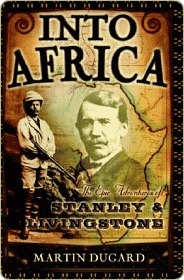
Into Africa: The Epic Adventures of Stanley & Livingstone, by Martin Dugard
Today I'm looking at a history of one of the major news events of the nineteenth century, the hunt for Dr. David Livingstone in central Africa after he had been missing for five years. White explorers going missing was hardly a novel occurrence and Livingstone was not the first, but the stature and fame of Livingstone meant Britain and the larger world knew his name, and the influence of newspapers keeping Africa and Livingstone in the public consciousness ensured a steady interest in the fate of the missionary and explorer. In fact it was a newspaper stunt that eventually found Dr. Livingstone, with reporter Henry Stanley of the New York Herald leading the expedition at the behest of the paper's editor. Stanley's words upon finding Livingstone in the town of Ujiji, ''Dr. Livingstone, I presume.'' have even entered the English lexicon Since I knew basically nothing but the most general details of this period of white men stumbling around and getting themselves lost in swamps in history, I figured this book was worth taking a look.
What precipitated Livingstone's expedition through jungles, swamps, deserts, and savannas was a debate over the source of the White Nile, one of the Nile's main tributaries. (Incidentally just doing a basic Wikipedia search it looks like there's still some debate over what counts as the ''source'' of the Nile) However there were several hypotheses being floated about by people who had actually tramped through Africa. One source that was known for certain was Lake Victoria, a large lake that sprawls across the modern countries of Uganda, Kenya, and Tanzania and which the White Nile definitively drains from. What was (and is) debated is if there was a source further south beyond Lake Victoria. Some hypothesized that a river or series of lakes and rivers connected Lake Tanganyika, further to the south, with Lake Victoria. Livingstone himself believed that lakes further south, such as Lake Malawi, might even be connected to Lake Tanganyika and Lake Victoria. Because of his status and reputation as an explorer, Livingstone set out on an expedition into Central Africa.
The thrill for the people back home was that central Africa was one of the last unknown places to Europeans. Nevermind that other people had been living there quite happily for thousands of years and had even traded with places as far away as China, to Europe it was terra incognita. So there was a great amount of romance of the brave, solitary explorer delving into the unknown, and Livingstone actually had a habit of going on these expeditions only with native porters and assistants. And this was not uncommon. Many expeditions of the time consisted of only a handful of white Europeans and a large train of African, Arab, or Indian porters, soldiers, and assistants. And if the Europeans should die, the hired help had little or no motivation to bring word back to European outposts in locations like Zanzibar. In fact in some cases, the porters and assistants were accused of murdering their employers, which made it even less palatable to report back to authorities. So once Livingstone disappeared into Africa, neither he nor word came back it was very unlikely anyone would hear from him again.
Stanley's was not the first expedition to go in search of Livingstone, but it was the only one to actually find him. A previous expedition had gone to confirm rumors of his death, but after finding convincing proof Livingstone was alive it returned to England. In many ways it was sheer good fortune that Stanley, an absolute neophyte when it came to traveling in Africa, actually met Livingstone at Ujiji. Both Livingstone and Stanley had been extremely ill during their expeditions, suffering from malnutrition, dehydration, and a variety of disease like malaria endemic to the tropics. Either one could have died before reaching the other. Livingstone could have failed to make it to Ujiji, where he hoped relief supplies was waiting for him. Stanley could have arrived before Livingstone, and spent all his dwindling supplies waiting or searching for Livingstone before having to return to the coast. It truly was a tremendous coincidence of good fortune for both men.
Overall I thought this book was interesting, although there's a certain level of crazy to these explorers who decide to go wandering through jungles and suffer all manner of diseases. I certainly would have headed back home at the first opportunity. Or never left home in the first place. I do suspect Dugard stretches or sensationalizes some facts, but I don't see any serious flaws with his methodology, especially considering the copious written material available for Dugard to draw upon for research. It is heavily from the European perspective, but that's hardly surprising. Dugard also tries to put things within the larger context of the nineteenth century, but it's mostly focused on the historical figures than the larger picture. If you're specifically interested in the life and work of Livingstone and Stanley, I think this book is a good opportunity.
- Kalpar
Subscribe to:
Posts (Atom)