Showing posts with label Ender Series. Show all posts

Tuesday, February 14, 2017

Children of the Mind, by Orson Scott Card

Today I'm finishing up the Ender Series with the ''final'' book, Children of the Mind. I put final in quotation marks there because at the end of this audio book Card said he had a final, definitely final for real this time, book planned to wrap up some plot threads that were left open at the end of the book. On the one hand I can understand Card's decision to leave them open, but on the other it feels like the series does need a little more closure.

I'm going to be honest, I didn't care for this book, although I found it fractionally more tolerable than Xenocide. Fractionally, mind you. I had heard some bad things about this book ahead of time so I didn't exactly have high expectations and after the experience of Xenocide I was expecting this to be a bit of a train wreck. Fortunately it's not a train wreck. I still didn't find it enjoyable, but I think it's because Card took the series into a highly philosophical, emotional, and ultimately literary perspective. Which is fine. There are plenty of people who like books like that. But that's just really not what I'm interested in. At least the way that Card wrote it anyhow.

Children of the Mind picks up where Xenocide left off, with the fleet armed with the MD Device still on its way to Lusitania and the threat of annihilation for not only the Hive Queen and the Pequeninos but Jane as well as Starways Congress plans to shut down the ansible network. Most of the work of the main characters is centered around this plot that finally gets a resolution to the satisfaction of everyone involved. Well, almost anyone. And if the book focused mostly around that it would be okay, but a lot of the book involves people getting involved in long talks about their relationships or feelings or what it means to be sentient, and arguing with each other on these topics. And I didn't find myself enjoying the heavy emotional stuff at all. I can't say whether it's Card's writing, the fact that I wasn't emotionally invested in most of the characters, or if I'm just a unsophisticated genre nerd who likes spaceship action but doesn't care about good character development if it hit him over the head with a brick. It could be a combination of those factors, or none of them entirely. It just feels like Children of Dune with lots of people sitting around talking, but instead of events I wish we could actually be seeing they're talking about philosophy, theology, history, and their emotions. It just felt to me like the ratio of action to contemplative navel-gazing was off.

This book also feels like it should be much older than it is. Children of the Mind was published in 1996, but it features a couple of planets that are dominated by national cultures. The world of Path has classical Chinese culture, the world of Divine Wind is Japanese, and Pacifica has Samoan and other Southern Pacific islander cultures (although we just see Samoan in the book). Except I feel like we're not really seeing the true cultures in these books, we're seeing more a theme-park, simplified, almost stereotyped version of complex cultures which have actually been horrifically stereotyped in other media. Now is it as bad as 1940's old-timey racism? Thankfully no. But it feels like an attempt to include diversity while not making an effort to really understand the cultures that you're trying to include. I'm probably overthinking this excessively, but it's another thing that kind of threw me off about this book.

And finally, Card tries to do some world-building in the book but I think it actually backfires because it doesn't make much sense. Although the last book finally got around the hurdle of FTL travel, the majority of humanity still does not, and has not had, access to it. This means that all interstellar travel has to go at relativistic speeds and experiences extreme time dilation. While the passengers may only experience a few weeks or months of travel time, the journey will actually take them decades. So this makes the logistics of interstellar travel fairly difficult and humanity's really only connected through the instantaneous communication of the Ansible. Except in the book Card states that Starways Congress, and I got the feeling this is done on a regular basis, will recruit government administrators from one planet and then transport them to another planet where they're needed. This just seems impractical or downright silly. It'll take government officials decades to get to the planets where they're needed, and by that point it'd be easier to train a local baby from birth to do the job you need them to do in thirty years anyway. Or there are large, interstellar corporations that are involved in finance on all the Hundred Worlds. But that doesn't make sense either because trade between the planets would also be a logistical nightmare. Entire markets could rise and fall in the time it takes to ship goods from one star system to another. In such a case, it would only make sense for each system to be self-sustaining and interstellar travel to be limited to the truly necessary.

 And I could almost understand some planets being monolithic cultures because they're effectively isolated, but Card describes some planets as cosmopolitan with entire communities of off-worlders. Which again, makes no sense. For everyone else, leaving your home planet to travel the stars is described as this horrible experience because with time dilation everyone you know and love will be old or dead by the time you get back and the whole planet will have changed. So I'd think people would be very reluctant to travel between planets except as absolutely necessary, but it feels like a fairly common affair. I appreciate Card's attempts at world-building but it just raises more questions than giving the world answers.

Ultimately I was disappointed in this book, but not as disappointed as I thought I would be. As I said, there seems to be a lot of people sitting around and talking about their feelings. If you like that sort of thing then this is probably a good book for you. But if you prefer something with slightly more of a pace, I think you can safely forego this book.

- Kalpar

Thursday, January 26, 2017

Xenocide, by Orson Scott Card

Today I'm looking at the third book in the Ender series, Xenocide, which in my opinion is almost a complete turn around from its predecessor Speaker for the Dead. Xenocide picks up some of the plot threads that were left dangling at the end of Speaker but the main conflict, the fleet coming armed with the Doctor Device and Starways Congress's declaration of the colony Lusitania being in rebellion is still left unresolved. However I'm not entirely sure I want to bother with the final book, Children of the Mind because of the direction Xenocide ends up taking.

As I mentioned in my review of Speaker, I thought it was a great example of how science-fiction could still deal with important human issues in a meaningful way. Xenocide takes this approach to the eventual extreme with lengthy debates on theology, metaphysics, sociology, and the science of the ansible and...well...souls. There's really no other way to put it if I'm being completely honest. Part of the plot of the book deals with trying to save Jane once Starways Congress has found out that she's in the ansible network and intends to shut the network down to kill her. So in an attempt to save her, Ender and company have to find where Jane's ''soul'', for lack of a better term really resides. And it just gets kind of...dumb.

This isn't to say there aren't good parts to the book. There's several conflicts running at once. Relationships between the humans, pequininos, and buggers on Lusitania has been strained, and they're all facing the very real threat of annihilation in the near future. In addition the humans and buggers are in their own race against time because the descolada virus is adapting to their chemical defenses against it but they can't simply wipe it out entirely because it's necessary for all indigenous life to survive on Lusitania. There are also the events on the planet Path, which I didn't really understand at first because they weren't tied directly into the story but eventually it all meshed together and story-wise it's fairly good overall. It just takes a really dumb turn towards the end.

Basically, among their problems, the humans on Lusitania are trying to develop faster-than-light travel as a means of shuttling people off of Lusitania before the fleet to destroy them arrives. Basically it revolves around these things called philotes, fictional particles that connect to each other and make the ansibles work. Plus apparently philotes are in absolutely everything. Anyway, the humans come upon the idea that philotes come from a place called ''outside'', just waiting for an opportunity to come into the universe in some pattern. They get this idea because apparently when the buggers want to create a new queen they call philotes from Outside to make the...consciousness, soul, whatever you want to call it for the new queen.

Anyway, so the theory goes that you can take a ship, go outside, and then go back inside at a separate point in time, with the philotes in the same arrangement, with no time at all passing. They literally call it travel by wish in the book because Jane has to will the ship and its passengers to go outside, and then will them back inside. It's very...clap your hands if you believe which is more mysticism than science but it gets worse.

Basically the scientists were trying to find a way to solve the descolada virus without harming the pequininos but they couldn't produce what they needed in the lab. But they struck on the idea that if you can think of anything Outside, where anything you can imagine is possible, then if you go Outside and imagine the virus you need, then bring it back inside. I honestly can't see this as anything other than magic or a deus ex machina. Basically, ''Go to a place where anything's possible, imagine a thing, get thing, come back from place.'' It just...it bothers me on some level. One of my friends said it felt like a way for Card to get himself out of a corner he painted himself into and in a way I have to agree.

So the fact that the main characters resolve the story by wishing for things to fix their problem, plus the interminable arguments on theology and metaphysics make the book feel simultaneously pretentious and lazy. There are some good parts in there, for sure, but for me it was drowned out by all the bad parts. The audio book was also kind of hard to listen to because the characters on Path were read with extremely stereotyped Asian accents, which made me feel uncomfortable when the only other characters that got exaggerated accents were aliens. The book also seems to waffle back and forth on whether gods exist in this universe or not and I feel like Card is trying to have it both ways which feels disingenuous.

Overall I feel like this is an example of science-fiction done badly, just as much as Speaker for the Dead is science-fiction done well. The book gets extremely pretentious with its discussions on a number of subjects and ends with sufficiently advanced technology indistinguishable from magic to solve the problem. It was just a really great disappointment.

- Kalpar

Thursday, December 8, 2016

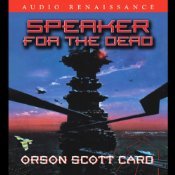
Speaker for the Dead, by Orson Scott Card

This week I'm taking a look at the sort-of sequel to Ender's Game which I reviewed quite some time ago when the movie came out. Speaker for the Dead is, in Card's own words, the book he actually meant to write and Ender's Game was meant sort of as a prologue. Card himself is aware of the irony that Ender's Game is by far the most widely read of his works and Speaker for the Dead is left playing second fiddle.

That being said, I think Speaker for the Dead is a great example of how science-fiction as a genre can be serious literature that talks about serious themes which seem to be relegated to''real'' literary fiction more often than not. This isn't to say that Ender's Game doesn't deal with serious topics as well, but I would say that Speaker for the Dead feels much more serious than its predecessor. An analogy I heard once was that Ender's Game is kind of like The Hobbit to the later three books which are more like The Lord of the Rings. They're all within the same universe and share characters, but there's a definite tonal shift between the two. I'm definitely sensing the tonal shift and I feel like Speaker for the Dead, and most likely its sequels Xenocide and Children of the Mind, are going to be more mature than Ender's Game.

Plot-wise the book is set some three thousand years after the events of Ender's Game and the Third Bugger War where humanity destroyed the buggers for good and humanity has scattered among a hundred colony worlds. Ender is remembered as the Xenocide, the worst monster in all of human history, while the most revered is possibly the first Speaker for the Dead who wrote The Hive Queen and the Hegemon which made humanity realize the barbarity of their extermination of the buggers and led them to repent the act. The irony that these were the same person is not lost on Ender Wiggin, who is only in his mid thirties thanks to the time-dilation of interstellar travel, wandering from world to world with his sister Valentine.

Events on the colony world Lusitania have drawn Ender's attention because humanity has made contact with another sentient species, referred to by humans as the piggies. Conscious of their collective sin of exterminating the buggers, humanity has tried to compensate in the other direction by making very limited contact with the piggies and keeping them safe from human contamination. However when one of the xenographers who has been studying the piggies turns up dead, apparently ritually murdered by the piggies, Ender fears humanity may let their more ruthless instincts get the better of them.

Further complicating this is the existence of Jane, a sentient AI created by the ansible network which links the disparate colonies with instantaneous communication. Jane is very aware that humanity has feared the emergence of an AI and has only revealed herself to Ender, the one individual who wouldn't immediately react with fear to her presence. Jane hopes that someday humanity might be ready for her to come out into the open, but she'll need Ender's help to get humanity to that point.

I have to say, despite the disparate plots going on at once, this book is really good. I was engaged throughout the book and although there are plenty of rough corners, I ended up enjoying it. As I said earlier, this is a great example of how science-fiction can talk about serious topics just as well as ''real'' literature. According to Card he just had the idea of someone telling the truth at a person's funeral, his idea for the Speaker for the Dead. He noticed that so often after someone passes on we tend to lie about the person, in the tradition of never speaking ill of the dead. So he thought it would be interesting, if perhaps painful, to tell the truth instead. From this idea has spawned a book that's about so much more than death and secrets and the lies that come with it. There's humanity, what it means to be human, compassion, empathy, and a whole host of other emotions which make this a really interesting book.

As I said, there are some rough edges around the book. One of the things I found really weird about the book was how dated it felt for a distant space future, especially since the book was written in the 1980's. The Brazilian colonists on Lusitania may strongly represent the Brazilians Card encountered during his missionary work there, but I've no way of knowing if they're indicative of Brazilians today or even thirty years ago. There's a major plot point that revolves around the fact one character can't marry another because then he'd have access to all the information she had because husband and wife are considered legally the same. Even for the eighties this feels outdated since it's well past Second Wave Feminism and much of the fights of First Wave Feminism in the early 1900's was to allow women to maintain a distinct legal identity from their husband. It just feels incredibly weird to me that this would be the case in the space future.

Overall I highly recommend this book, and I can say it is popular for a reason. If you've read Ender's Game but for whatever reason never got around to the sequels, I can say at least Speaker for the Dead is well worth the effort. If you haven't read Ender's Game, I would recommend starting there because it's a pretty short read and it will fill you in on a lot of details before you start Speaker for the Dead.

- Kalpar

Thursday, September 26, 2013

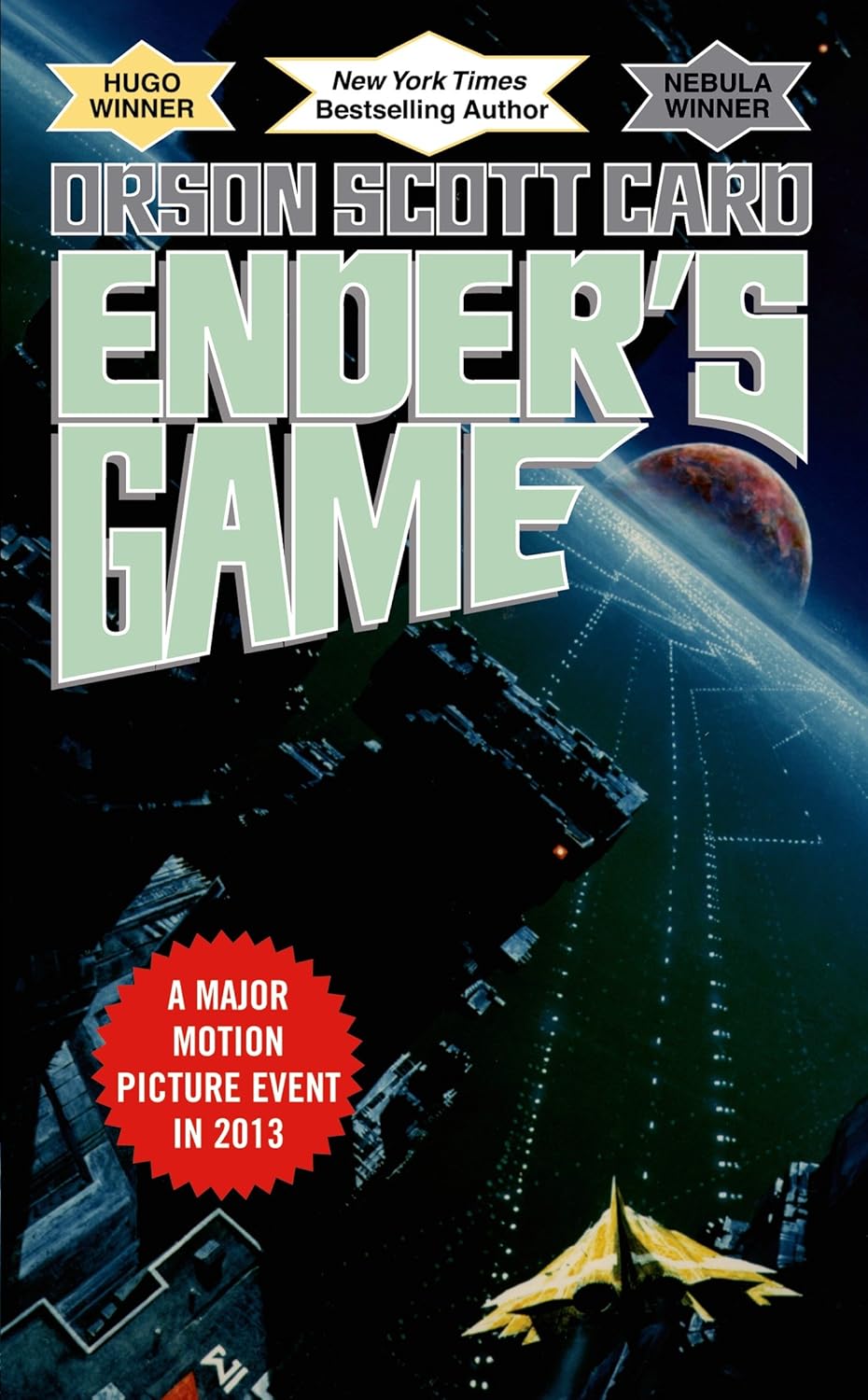
Ender's Game, by Orson Scott Card

Roughly a decade ago I read Ender's Game not by choice, but rather was required reading for my school. Of course, the English teacher I had ignored Ender's Game entirely and chose to focus exclusively on Fahrenheit 451. Of course, both are good books and have excellent points to make, but I remember liking Ender's Game a lot better. Probably because I didn't get as many of the subtle nuances in Fahrenheit 451. The important point of this diatribe is that there is currently an Ender's Game movie due to be released November 1st so I decided to take this as a prime opportunity to go back and re-read Ender's Game and maybe look at the rest of the Ender series at the same time. 

For those of you not already familiar with the story, it follows the education of Ender Wiggin, a child believed to be humanity's last hope in the impending Third War between the humans and the buggers. Ender is taken to Battle School and put through extensive military training and subjected by his instructors to extreme adversity. Throughout the novel the human leaders have strike a delicate balance because if Ender isn't ready for the invasion, humanity will probably be completely wiped out, but if they put too much strain on Ender they may wreck their best chance at survival. It's a very tightly-paced novel and I found myself flying through it. Definitely worth a read before the movie comes out in November. 

To Scott's credit, what I think he can really write well is children, especially dialog between children. As I mentioned in my review of The Lost Gate, for whatever reason Scott is really able to nail down the attitudes and mannerisms of adolescents and put that into word form. Some people would argue that the kids in Ender's Game don't talk like kids normally do, but I counter that it's exactly how kids talk when there are no adults around. As much of a stereotype as it is at this point, you really only need to go onto X-box live to hear thirteen year olds shout racial slurs at each other, and in a way I feel like that's almost exactly the sort of people who would get picked for Battle School. 

As a book, Ender's Game has meant a lot of things to a lot of people, although I only really know this from the introduction. As I'm not a trained literary critic I very seldom go beyond the surface text into all the hidden nuances and shades of meaning. Either that or I'm just thick, take your pick. For me, Ender's Game has always been a really good sci-fi pulp adventure that relies on a lot of familiar, if perhaps a little well-worn tropes. The bug war, which we seem almost destined to have, massive space battles, and a world government formed from the threat of extraterrestrial attack. However, and for reasons I can't really divulge without spoiling the book, Ender's Game still has its own unique charm that makes it stand out from the regular sci-fi pulp. 

I would definitely recommend you all check this book out before going to see the movie. I'm hoping the movie will do the book a great deal of justice, but as always I am wary. 

- Kalpar