Showing posts with label Marie Brennan. Show all posts

Thursday, February 8, 2018

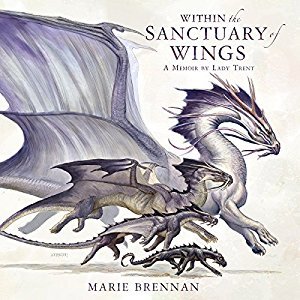
Within the Sanctuary of Wings, by Marie Brennan

Today I'm finally getting to the last book of the Lady Trent Memoirs series, Within the Sanctuary of Wings. On the downside I think this book and the series in general could have used a lot more development because there are still a lot of questions I have that probably should have been answered. Lady Trent assumes that the readers, members of her world, know things which are common knowledge in her world. While this makes sense and avoids a bunch of clunky exposition, it does leave the series with some questions unanswered.

This book focuses on a later and significant chapter of Lady Trent's career when she goes to her world's equivalent of the Himalayas to investigate a potential new and unknown species of dragon. The problem is that Lady Trent's home country, Scirland, is at war with this world's equivalent of China so aside from the remoteness of the location and the difficult terrain, there are numerous political challenges that have to be overcome as well. However the potential to discover a missing link between ancient dragons raised by the Draconian civilization and modern dragons proves too much of a temptation for Isabella and once Lady Trent sets her mind to something it's basically impossible to stop her, especially when dragons are involved.

The main point of this book is a huge spoiler for not only the book but the series as well, which reveals major information about the Draconian civilization. I will say I'm not sure I'm fully satisfied with how the book ends and I would have liked even more information about the Draconians. I will say it's fairly realistic that we don't have a complete picture for civilizations that disappeared thousands of years ago, which makes the universe feel real, but I felt since this was a work of fiction Brennan could have cheated a little bit to bring more info into the book than what we ended up getting.

My other biggest criticism is I felt like Brennan spends a lot of time on stuff like the scenery to build up the anticipation for the major plot twists. Now, I will admit that this makes sense and Brennan does a good job describing things like village life, the mountains, the difficulties in crossing glaciers, and all the other challenges that Lady Trent and company encounter. I'm sure there are lots of people who enjoy this sort of thing and it's definitely good writing on Brennan's part, but I honestly kind of wished that more time had been spent talking about plot developments than talking about say, how gorgeous the mountains were. But I think this is really a matter of personal taste and I'm willing to admit that I probably have bad taste.

Overall I think this was a good ending for the series. Considering how much time had been spent building up anticipation for the reveal about the Draconian civilization I wish there had been more of a payoff. However, I think Brennan does a good job in creating a realistic world in her novels and making it believable that dragons could be part of an ecosystem. If you're a fan of science and fantasy, these books do a great job of combining the two.

- Kalpar

Tuesday, July 25, 2017

In the Labyrinth of Drakes, by Marie Brennan

Today I'm looking at the fourth book in the Lady Trent memoirs and, as of writing, the most current, In the Labyrinth of Drakes. In this book Isabella Camhurst heads with her longtime colleague Tom to manage a Scirling-run dragon breeding program in Akhia.With the secret of preserved dragon bone out, countries are now in a race to acquire sufficient supplies of a material that promises to revolutionize warfare. However, many are also aware that they could acquire a significant short-term gain by slaughtering dragons wholesale, but leave them worse off in the long run with a shortage of dragons. To this end the Scirling Army is trying to breed and domesticate desert drakes so they might have a regular supply of dragonbone. Since Isabella and Tom are Scirling's authorities on dragons, they're the most logical choice to direct this breeding program but it promises to be many years of difficult and possibly fruitless research.

The dragons are of course only part of the story, the titular Labyrinth of Drakes also plays a significant role and is one of the more famous events of Lady Trent's career, as we find out. Akhia is the location of some of the best-preserved ruins of the globe-spanning Draconian civilization. Isabella meets up again with the archaeologist Suhail, a native Akhian, and together they make an absolutely unprecedented discovery.

What concerns me the most in this book is how...incomplete things feel. According to my sources on the internet, this series is scheduled to end with the fifth book, bringing the adventures of Lady Trent to an end. But I feel like there are a great many questions that have yet to be resolved, especially with the Draconian civilization. I will admit it would be very realistic for Brennan to leave some things still unknown. That is, after all, how science works in real life and all the mysteries of the universe never get solved in any one person's lifetime. But there are a lot of things about the Draconians that make me extremely curious. On top of that we did finally get the Rosetta Stone which Isabella discovered in Tropic of Serpents into the hands of Suhail the archaeologist and polyglot who may actually be able to crack the hither-to unknown Draconian script.

So, honestly, my concerns are about how rushed the next, final book may end up being if the Draconian plot is going to be revealed. As I'm by training a historian, and the author herself is an anthropologist, I would have liked and expected far more about this mysterious background civilization which has been a constant theme, as well as dragons, throughout the series. I'm just worried that Brennan hasn't given herself enough space to resolve everything satisfactorily. Even without the Draconian storyline I think there might not be enough space to finish Isabella's story without making it feel rather rushed.

Otherwise, there's not much to write home about. I feel almost like this series is starting to suffer fatigue because it's, ''Isabella goes to foreign location to study dragons. Encounters challenges. Overcomes challenges. Becomes even more famous.'' Not to say that I don't enjoy watching that. Isabella is definitely an interesting character and I quite like following her around. But aside from changes in scenery and tweaks to specifically what challenges Isabella has to overcome, there doesn't seem to be much difference.

Hopefully Brennan can tie everything together satisfactorily in the final book, which is supposed to come out in back in the spring of this year. But until then I'll remain a little reserved about how this series will end.

- Kalpar

Thursday, June 15, 2017

The Voyage of the Basilisk, by Marie Brennan

Today I'm looking at the third book in the Lady Trent Memoirs, The Voyage of the Basilisk, in which Isabella Camhurst undertakes an expedition around the world to study a variety of dragon species, including sea serpents, feathered serpents, and fire lizards. Isabella's goal is to learn more about dragon species in general and try to create a definitive taxonomy of dragon species, which the series has been heavily implying she does by the end of the (as of yet unwritten) fifth and final book. In this case Isabella's mission is very much like Charles Darwin's own expedition around the world on the H.M.S. Beagle which provided him with a variety of data to help him write On the Origin of Species.

Because this book does cover a two-year expedition around the globe it feels a lot more rushed than the earlier books, which is sort of odd considering A Natural History of Dragons covers all of Isabella's early life up to about the age of twenty. But in both of the previous books Isabella was studying dragons in more concentrated locales, and considerably fewer species of dragons as well. It definitely felt like Isabella and her compatriots were getting a ton of data on the subjects they were researching. Because she's studying far more species of dragon over greater areas we don't get quite as much detail about the different species of dragons as we might think. And when the main political non-dragon research plot of the book gets resolved, the rest of the expedition which presumably contained lots of tedious dragon research and little else because it's only briefly mentioned.

I am also a little concerned that the book is raising questions which I'm not entirely sure I can answer with the skillset that I have, and considering there's only two books left in the series I'm wondering of Brennan is leaving herself sufficient time to adequately answer the questions as well. The big ones that get brought up in this book, which have been kind of hiding in previous books, are the Draconian civilization and questions about how dragons evolved. Isabella's biggest and most pressing question is the taxonomy of dragons, which is currently limited to one resource and she is uncertain if it is accurate. And like most good science, the more research Isabella does, she ends up with more questions than answers. However, as a reader I am extremely curious about what the answers are.

The Draconian civilization is also taking on greater and greater proportions. As I said in my review of Tropic of Serpents, Isabella finds what I was subsequently proven correct in assuming was the Rosetta Stone for the Draconian civilization. So hopefully we'll find out what some of these mysterious inscriptions are throughout the world. But we're also presented with the fact the Draconians had settlements truly across the globe as Isabella travels not only to her world's equivalent of China, but also to their equivalent of the Pacific islands, which also have Draconian ruins. The audio book that I listened to contained a brief interview with Brennan at the end where she hinted that the Draconians are going to be super-important, but I'm worried that she's simply not giving herself enough space to give her plots the space they deserve.

Other than my concerns, I did enjoy this book and thought it was interesting. Brennan's universe manages to be very realistic and I appreciate that Isabella approaches dragon taxonomy with all due scientific rigor. I am curious how everything turns out in the last two books so that means she's doing something right.

- Kalpar

Tuesday, June 6, 2017

The Tropic of Serpents, by Marie Brennan

Today I'm looking at the second in the Memoirs of Lady Trent series, Tropic of Serpents, where Lady Trent (Still just Isabella Camherst) finally gets to go on her next expedition to study dragons in their natural habitats in a Scirling colony in Egria. Lady Trent gets to examine not only the dragon species inhabiting the savanna, but eventually gets to explore the dangerous jungle known as the Green Hell and study Mulish swamp wyrms. Despite her desire to stick just to science, Isabella soon finds herself embroiled in politics and the fate of Scirling influence in Egria ends up, much to her dismay, in her hands.

Overall I thought this book was really good. One of the things Brennan does that  I like is the use of real-world cultures to populate her universe. Granted, it's fairly transparent if you know what to look for, but it's definitely an easy way for her to make a universe that feels real and grounded, despite the fact that it has dragons in it. And her study of dragons feels like a realistic, natural science approach to studying dragons and classifying them as species. Furthermore, Isabella is by no means a perfect person. By her own admission she's not a very good parent and she feels emotions like anger, frustration, and jealousy so it makes her feel more three-dimensional as a character than if she was just the consummate biologist.

There are some hints that make me a little concerned about Isabella being just a little too perfect. She keeps saying she has this bad habit of saying the wrong thing to the wrong people which makes her a terrible diplomat, but it always seems to work out for her in the end. Also I think she managed to find the universe's version of the Rosetta stone entirely by accident which feels a little bit too convenient for her. Granted our Rosetta Stone was also found by accident, but it seems just a tad fortunate that Isabella manages to stumble across it. I'm assuming it's the Rosetta stone because it's got at least two languages on it and one of them is unknown and apparently it's now in a museum and is quite famous. Hopefully later books will show us.

But overall, I think this book is pretty good and I look forward to listening to the other books in the series. It feels like a very genuine Victorian-era expedition to study the biology of dragons and I quite enjoy it.

- Kalpar

Tuesday, May 23, 2017

A Natural History of Dragons, by Marie Brennan

Today I'm looking at A Natural History of Dragons, which is the first book in a series that makes up the memoirs of Lady Trent, a famous dragon researcher within the book's universe. The books are set in what appears to be the equivalent of our nineteenth century. Early on steam engines and steam-powered transportation is rare but not unheard of, but it id implied by Lady Trent that such developments such as railroads and steamships become commonplace within the book's universe. It is also an era when great researches into biology and natural history are being undertaken. The most tantalizing, and perhaps most difficult, is the study of dragons.

Dragons are already fierce predators and live in some of the most inhospitable climates in the world. In addition to being large, winged predators, they have fearsome breath weapons which makes just approaching the beasts dangerous. The research of dragons is also hampered by the extreme rate at which dragon bones decay, usually within a matter of days of the death of the dragon, making the collection of specimens for protracted study almost impossible.

Although to be honest the dragons felt mostly like a side-show because most of the focus is on the main character, Isabella, Lady Trent. As I mentioned, this book is the first in a series written from Lady Trent's perspective as memoirs of her career. This book deals with roughly the first twenty years of her life which takes us to the end of her first field expedition, undertaken with her husband and two other researchers. We meet Isabella as a very curious girl who first begins on scientific inquiry by wondering why birds have wishbones, specifically the evolutionary purpose of a wishbone. This leads to her dissecting a dead dove she found in the garden and a lifelong investigation into science. Of course, this sort of scientific inquiry is not seen by her mother as an appropriate interest for young ladies, but her father is far more lenient on the matter and is willing to indulge Isabella to a degree. Eventually she meets Jacob, a gentleman also deeply interested in natural history, and they get married.

Eventually Isabella and Jacob join an expedition to research rock wyrms, a species of dragon. The result is interesting, although I was left with the feeling of it being far more mundane than I hoped. And I'm not sure if that's a good thing or a bad thing. On the one hand, you'd expect dragons and creatures like them such as drakes a wyverns to be exceptional creatures, mostly because we don't have any of them in the real world. On the other hand, the mundanity that Isabella approaches the topic at times seems downright appropriate. Because these books are vaguely steampunkish it makes sense for dragons to be just another species for scientists to observe, dissect, and categorize as they expand the limits of man's biological knowledge. So it's kind of weird to see dragons depicted as just another species to be studied, rather than magical creatures. But I think it's a good kind of different.

Overall I think this book is definitely a starter book for the series because it introduces Isabella and gets her started on her path of scientific research. I'm hoping that later books will expand on her career more and we'll get to see more dragons, especially Isabella interacting with them, than we have in this one.

- Kalpar