Recently I purchased a couple of e-book deals from Amazon that had a little over a dozen fantasy books in one package for $0.99. As that seemed like very little money to risk for a potential plethora of reading material, I of course decided to purchase them. Of course, since most of these books are the first ones in a series I'm sure this is beneficial to the authors as well in introducing new readers to their works. This week's book comes from the Amazon collection titled Epic.
Blades of Magic as you can tell from the cover picture to the right over there, is the first book in the Crown Service Series, but I can safely say that I definitely will not be reading any of the other books in this series just based off of the first book alone. To give a summary of the plot, the book follows Sara Fairchild our tough no-nonsense protagonist who we meet in an alley fight with criminals. Perhaps I should explain. Sara, like her father, is a battle mage, which means that she has magical abilities that make her much better at fighting. Like one-woman apocalypse good at fighting. The downside to this is if she uses too much of her power she threatens to tip over and become a blood-crazed Berserker who will kill everything in her path until someone finally kills her. (And it does remind me a little bit of the manga Claymore in that specific instance so it's a valid idea with a lot of opportunities for development.) Sara's father was also a battle mage who was a commander of mercenaries in the civil war which is apparently going on in the empire. (I say apparently because not a lot of political details are explained in this book.) However Sara's father was executed for desertion and so Sara and her mother are currently living in disgrace. In desperation Sara takes a job guarding a warehouse and the plot sort of lurches around from there.
If you're noticing I'm being kind of negative on this book, well, I didn't enjoy it for a number of reasons. Number one was the fact that I simply found Sara to be utterly unlikable as a character. See, in the book Sara kind-of-sort-of angsts over descending into a berserker rage and the dangers of her powers, but she uses them fairly frequently and actually enjoys killing people. No, I'm not kidding about that, Sara straight up says in her internal monologue that her powers give her a high after she kills someone. Within the first two days that we follow her around she kills half a dozen people, and this is apparently perfectly normal for her. On top of that she has no compunctions about torturing people either, well except when it's the wrong kind of torture, but that hardly gives her the moral high ground. Her go-to solution to solve all her problems is to start killing people and pouts, pouts when she can't resort to this option, and even finds people who don't enjoy killing to be weird. Throw in a few more of Sara's character traits and I'm pretty sure you've got the warning signs for a psychopath. The ultimate irony of course is our heroic little psychopath has the audacity to call one of the other characters a psychopath and evil, despite us never seeing him do anything evil himself.
I think this wasn't the intention of the author of course. I think that Edun meant to write a badass warrior chick who doesn't take anybody's shit (a perfectly valid character type), and has these powers that make her really good at fighting, but also come with a great risk (perfectly valid internal character conflict). The problem is that Edun seems to have taken it so far in one direction that Sara comes off, as I said, as a dangerous psychopath and I can only roll my eyes in derision as she complains about having to walk through the meat market because she hates the smell of blood. That hatred of the smell of blood certainly doesn't seem to keep her from getting absolutely covered in it when she's busy fighting.
Plot wise the book is all over the place. We start off with Sara guarding a warehouse of magical artifacts and wondering why so many people keep trying to break into the place. Seriously, over half the people she kills in the first two days are people trying to steal stuff from this warehouse. That doesn't last too long, though, because Sara and Ezekiel, the artifact curator, go to the Mercenary Guild headquarters to find the records on Sara's father and why he was executed. This then turns into a giant conspiracy where information is missing from her father's file and Sara's mother and pet end up dead and Sara has to go find the truth, which is somewhere near the front lines of this civil war. The civil war isn't explained terribly much but what little we are told about (towards the end of the book) is that there's a collection of distant provinces which are taxed but otherwise ignored by the rest of the empire. So, you know, I kind of understand the provinces wishing to rebel when they're handing over tax money and not getting anything out of it. I just found myself completely and utterly unable to care about any of these plots or what happened to Sara.
Oh, and I almost forgot, over the course of....days...that this book is supposed to take place Sara and Ezekiel form a friendship and eventually feel more for each other. With all those....moments...they had together. Okay, I'm probably just being a crotchety old man with that last bit, but it just seemed like a particularly contrived cherry on top of a particularly stupid ice cream sundae. And the hot fudge is made of psychopathy. I think I've lost the thread of this argument.
Although I managed to finish this book I was pretty much done with it by the halfway point and I was just soldiering through to finish it. I have no intention of reading any more of these books and if any of my readers value my opinion I implore you to do the same.
- Kalpar
Thursday, August 27, 2015
Thursday, August 20, 2015
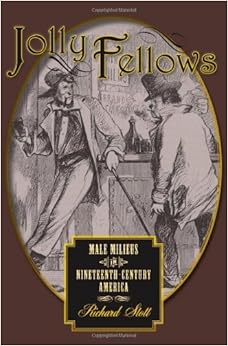
Jolly Fellows: Male Milieus in Nineteenth-Century America, by Richard Stott
This is another one of several books from the pile I picked up when a co-worker was moving, and I had to rely pretty much just on the title. I am, after all, rather interested in nineteenth century history in general so I figured this book would be a useful expansion of my existing knowledge. Jolly Fellows is a largely historiographic text which talks about the titular jolly fellows, a culture of hard-drinking, hard-gambling, hard-fighting men that were extremely commonplace at the beginning of the nineteenth century but were nearly extinct towards the end, existing in a few enclaves. Stott touches upon the reasons for their disappearance but this text mostly talks about the behavior of the jolly fellows and their survival in some respects to the modern day. I did get a feeling that Stott was, in some respects, trying to defend the jolly fellows as a natural outpouring of male enthusiasm, a sort of "boys will be boys" argument, but even Stott seems unconvinced. Overall based on his description I can't say many people would mourn the loss of the jolly fellows.
This book chronicles a male institution that Stott asserts was commonplace into the early years of the nineteenth century. Every city, town, or village would have a group of "jolly fellows", a band of men who spent most of their leisure time drinking, gambling, fighting, carousing, and playing practical jokes, much to the amusement of the other people. Some jokes were fairly tame, such as putting buckets of water on top of doors or in one instance disassembling an entire wagon and placing it on top of someone's barn, but violence also seems to be central to jolly fellowship. Brawls between fellows were common, as well as brawls between fellows and outsiders, which resulted in death on occasion. In addition, blood sports such as dogfighting and cockfighting, bullbaiting, bearbaiting, and badgerbaiting, and in some cases just setting an animal on fire with turpentine were all pastimes of the jolly fellows. In a way they seem to perfectly match Hobbes's description of human life: nasty, short, and brutish.
Stott's chronicle begins towards the end of the eighteenth century with a general description, including the oh so pleasant activities that I described above and states that for centuries this had been seen as normal behavior for men. Again, sort of a "boys will be boys" argument. However people, especially women, became increasingly concerned about jolly fellows' behavior and the early nineteenth century saw the beginning of reform movements, perhaps most importantly temperance, which sought to clamp down on such behavior. Stott doesn't point to one particular cause for the decline, but seems to point to a combination of temperance, religious revivalism, and in frontier areas where women were scarce a simple increase in the number of women which led to a reduction in such behavior. Jolly behavior gets pushed into remaining bastions, such as all-male environments on the frontier like lumber, cattle, and mining camps, and the rough and tumble vice districts of cities such as New York.
Much of the book is dedicated to the permutations of jolly fellowship in various locations, such as small towns and villages, the New York Bowery, and the gold fields of California. Stott emphasizes the consistent nature of jolly fellowship through these disparate locations and the perpetual emphasis on drinking, gambling, and violence. For the most part I have to agree with him that there seems to be a trend where unsupervised men in their late teenage years and twenties seem to get themselves into all sorts of trouble. The sheer prevalence of those three key behaviors in practically any male-dominated environment for at least the first half of the nineteenth century shows that this seems to have deeper cultural connections. (Although personally I feel like Stott doesn't go too deeply into the details and it probably would be mere conjecture at this point anyway.) There are even numerous examples of men who made a career out of being jolly fellows, and there is an abundance of jolly fellow songs, plays, and literature which reached a far wider audience than those who indulged in jolly behavior on a regular basis.
However, the latter half of the nineteenth century saw a triumph of "middle class" values, including increased temperance and anti-gambling legislation, and less and less people participated in jolly behavior. Granted, comedic violence was (and still is) utilized in theater, music, and other forms of entertainment, but pranking became much more mild and jolly behavior became almost nonexistent. Stott actually ends the book by providing examples of people saying that the civilizing of men perhaps has gone too far and to make sure men still have vim and vigour they need to be encouraged to go into properly moderated violence, like boxing and football. Stott does provide some examples of how jolly fellowship has survived, albeit in a much tamer form today, but I feel like we're largely better off without such behavior.
-Kalpar
Thursday, August 13, 2015
The Last Ringbearer, by Kirill Yeskov
This week I'm reviewing a book which was originally published in Russian and has been translated (somewhat unofficially) into English. The Last Ringbearer is a re-telling of the fantasy classic The Lord of the Rings, operating off of the assumption that Tolkien's text is a white-washing, sanitized version of events told from a pro-West viewpoint. The Last Ringbearer seeks to tell the story from the point of view of Mordor and reveals that maybe Gandalf, Elrond, and Aragorn didn't have as pure intentions as we've been led to believe. For the fantasy reader who's grown tired of the monomyth format that so many fantasy stories have followed, as well as the unabashed Tolkien fan, this is definitely a worthwhile book to read, even if there are some struggles with it.
The general principle of The Last Ringbearer is that the War of the Ring was not an epic struggle between Good and Evil, but began as a normal series of diplomatic misunderstandings between countries, which is what more than a few wars have been fought over in the past. Mordor is depicted as going through the early stages of an Industrial Revolution, a pinnacle of scientific achievement and knowledge, while the lords of Rohan and Gondor sit in their little castles and listen to mythical tales of ages long past. However the elves and the wizards, led by Gandalf over the protests of Saruman, seek to strengthen magic's grip on the world, dooming it to medieval stasis, and launch a war of extermination against Mordor. As we know from the traditional narrative, Mordor loses, and a brutal occupation and extermination campaign begins to wipe out all the scientific knowledge and progress that Mordor has made.
Into this is thrust Haladdin, a brilliant physician who volunteered and became a Medic Second Class in Mordor's army during the war. More importantly Haladdin is a rare individual who is immune to magic which means one of the surviving nazgûl charges him with an all-important quest: to rid Middle Earth of magic forever. If Haladdin succeeds, then Mankind will rise with the aid of science and technology and become master of his own universe. But if he fails, then humanity will become the mere pets and playthings of the elves, who seek to make Middle Earth a perfect, immaculately maintained, and stagnant garden. So in some ways, The Last Ringbearer is a re-telling of The Lord of the Rings with an epic quest to save all of Middle Earth, but at the same time it brings something fresh and new to an existing universe and gives it depth as well.
As someone who's bothered to go through and read The Silmarillion, as well as some of Tolkien's appendices, I can tell that Yeskov is a dyed-in-the-wool Tolkien fan as well, which is necessary for a work that seeks to retell and expand upon the original source material. Yeskov makes use of locations and nations that are hardly mentioned in the main stories but Tolkien felt were necessary to "complete" his work. It definitely left me feeling that Yeskov could be trusted with this particular undertaking and he did not fail to disappoint. Granted, there were plenty of times where I felt like I was just reading someone's fan-fiction, but I feel like The Last Ringbearer is an example of how someone can put their own spin on an existing work, to the benefit of the fans.
I will admit that the writing kind of varies throughout the book. There are various awkwardly placed exposition-dumps which have little to no bearing on the story whatsoever. This includes an entire history of the slave trade in Harad and the eventual defeat of the slavers by the Harad emperor with a little help from Mordor advisors, while a Harad prisoner is being whipped in a Gondorian rock quarry. The prisoner soon dies afterwards and the entire expository tract doesn't move the story forwards at all so it probably could have been left out. (However, as one of those weird people that likes exposition I enjoyed reading that passage, but I can see how people wouldn't.) I also found myself wondering how much of it was the translation rather than the author's writing, but ultimately that's hard to tell.
There's even a spy thriller story set in the Middle Earth equivalent of medieval Venice which is related to the major plot, but almost could have been a story on its own. That was the part that dragged the most for me because it felt like the main plot had been put on hold. Although it seems almost fitting at the same time seeing as in The Two Towers and The Return of the King, Tolkien decided to divide the story into Aragorn, Gandalf, and company's plot arcs and Sam and Frodo's plot arcs, which only come back together at the very end of The Return of the King. And if we're being fair, Tolkien does go off on expository rants, page-long songs, and various other things that derail the plot. *cough Tom Bombadil cough* So if The Last Ringbearer isn't perfect, well I'm willing to say neither is The Lord of the Rings.
Overall it's a pretty good story and I enjoyed reading it. I especially liked getting to see a couple of my favorite characters, Faramir and Éowyn again. It was sort of like getting to see some old friends after a long time apart. And I think any Tolkien fan who's managed to trudge their way through the novels will greatly enjoy this work as well. In a way, it almost feels appropriate that The Lord of the Rings is the sanitized and white-washed version. Even the most ardent Tolkien fan will probably admit that Tolkien's take on Easterlings and Southrons contains more than just a smack of racism. And Tolkien is a product of his time, after all, when the British Empire encompassed a quarter of the globe and the superiority of the Nordic races was considered a matter of course. The Last Ringbearer serves as a slightly more politically correct and revisionist take on the same story, which I overall rather liked.
The real shame is that the book isn't available commercially in English. You can download it for free, but the Tolkien estate has blocked any commercial publication of the book in English, and considering how long copyright lasts anymore there's a very good chance that The Last Ringbearer will never get an "official" English release. Because taking other people's ideas (or, okay, okay, downright stealing them) and putting your own twist on them is a fine and noble tradition going back hundreds of years. Heck, Tolkien himself stole elements from Norse mythology and Wagner's Ring cycle to create his own magnum opus. If you're looking for an Exhibit A on why we need to reform copyright law, The Last Ringbearer is it.
If you're a Tolkien fan, especially one who's read the books, and have found that they haven't aged as well since you've gotten older, then I'd definitely recommend The Last Ringbearer.
- Kalpar
Thursday, August 6, 2015
Disenchanted, by Robert Kroese
This week I'm reviewing Disenchanted, a novel that was originally published in serial form on Amazon, but I became aware of it through a weekly deal and purchased it as a complete novel. Disenchanted is described as a humorous fantasy novel in the same vein as The Princess Bride with a somewhat snarky narration, a subversion of usual tropes in fantasy novels, while at the same time utilizing them. I also felt that this book was trying, in some ways, to channel an element of Terry Pratchett as well, but that may just be my own impression as a relentless Pratchett fan. Although there are some humorous bits to this book, by the end I just felt like it didn't work. I almost feel like the author got tired towards the end and wanted to wrap everything up as quickly as possible. It's not a bad book, but it's not terribly good either.
Plot-wise this book follows the adventures of King Boric the Implacable, owner of one of seven magical swords famed throughout the Six Kingdoms. When King Boric dies, however, he discovers that his spirit is unable to leave behind his body, and more specifically his sword. Apparently cursed to become a wraith and serve Lord Bran, who had given Boric the sword twenty years ago, Boric fights against the curse and seeks to break it. The result is a series of misadventures that finally winds its way towards a hurried conclusion. I find myself wondering if maybe the author just ran out of steam on this project and sought to wrap it up in a conclusion before he got fed up with it. I can't really say, but I definitely get that impression.
There is a degree of humor in this novel and a few very good jokes. Some of the chapters also come with footnotes, very akin to The Princess Bride or one of Pratchett's works, but more often than not the jokes unfortunately fall flat. I almost feel like the author is trying to copy the style of other humor-fantasy writers with his own slightly crasser version of humor, but it just doesn't seem to work. I feel like the author's groping towards his own voice and there's elements of something that could become very well-developed with practice, but it just isn't quite there yet. From what research I've been able to find, it seems like the author has only written a few books so far, so this could very easily be a case of Kroese still getting his feet under him as an author. I don't know if I'll be interested in the planned sequels to this novel, but if I can remember I'm willing to give them a shot.
Overall the book isn't awful, it has a lot of ideas and a lot of potential (and some funny jokes), it just is lacking in several places and the author has room for improvement. Hopefully as he writes more books he'll be able to find his own voice as an author and create his own brand of funny, interesting novels, but Disenchanted is still pretty rough around the edges.
- Kalpar
Thursday, July 30, 2015
Anansi Boys, by Neil Gaiman
This week I'm reading another book from Neil Gaiman, Anansi Boys, which some people may see as a sequel or spin-off to American Gods. I read American Gods a few years back, and I may decide to reread it again for the blog at some future point. (Listen, the to-read pile keeps getting bigger and bigger! There's just too many books to read and not enough time!) Anyway, after my introduction to both Terry Pratchett and Neil Gaiman through Good Omens, I have since become a fan of both their works, although Gaiman certainly has less of a library to go through than the voluminous works of Pratchett.
Anansi Boys is set in the modern day and begins with the death of Fat Charlie Nancy's father, the incredibly flamboyant Mr. Nancy. It is eventually revealed that Mr. Nancy was in fact the west African trickster spider god, Anansi, and Charlie has a long lost brother named Spider. Things get a little more complicated as Charlie deals with the loss of his father and reconnects with his brother, throwing Charlie into a world of gods and magic that he had always assumed never existed.
Because it deals with the themes of gods and hidden magic, (although hidden magic is practically a constant in anything Gaiman writes), this book is similar to, and yet at the same time remains distinct from American Gods. Much like American Gods and Neverwhere, we have a fairly normal protagonist who lives an uninteresting life, is suddenly exposed to a secret world filled with magic and belief that tenuously coexists with our own, and then there is some crisis which our hero then has to resolve. Certainly, this could get very boring if the books were all the same, but Gaiman manages to make them all very interesting, and I think it's because he's very good at creating characters. Characters we love, characters we hate, characters we may have run into in our own lives at one point or another, and most importantly characters we remember. The formula may be essentially the same, but the elements that Gaiman includes, and the characters he creates make the stories much more interesting.
I will say that there are some things you have to infer for yourself from the book, although I suppose that's better than having everything explained for you by the author. I rather liked this book, even from the beginning, so it's kind of hard for me to say anything beyond it was good. For whatever reason these sorts of stories really appeal to me and they become my favorites. There's not really much I can do about it.
If you're a fan of Gaiman already and haven't read this, then you'll definitely enjoy it. If you haven't read Gaiman yet, this is just as good a book to start on as any of his others. Although it shares some things in common with American Gods, Anansi Boys stands firmly on its own without having to read anything else.
- Kalpar
Thursday, July 23, 2015
Civic Wars, by Mary P. Ryan
This week I'm reviewing a book by Mary P. Ryan titled Civic Wars, which is an attempt on the part of the author to analyze and make sense of civic life in three American cities between roughly 1825 and 1880. By the author's own admission she also attempts to draw parallels with the era of the book's writing, the mid 1990's, and make predictions about the trajectory of American cities in the twenty-first century. This is certainly an audacious attempt and the result is it comes across as poor history because of its very attempt to predict the future based on events of the past. Although I'm sure every historian has had that temptation, myself included, it ultimately smacks of hubris to try and predict the flow of events. Although in hindsight the worries of the 1990's seem almost trivial compared to the increasingly militarized police state and stagnant economy we've been facing in recent years.
I will confess some initial hesitation in going into my review of this book because I am certainly no expert on American urban history. Well, I'm becoming an expert in one city in the United States, but the development of Cincinnati does not necessarily reflect the development of cities in the rest of the country. Furthermore I do not have any claims to fame such as being published in a peer-reviewed journal. However, I do have some serious issues with Ryan's arguments and the conclusions she draws from her research. Along with an invitation in the introduction for other historians to challenge her arguments, I plan to proceed with at least a raising of serious concerns regarding her book.
As I mentioned, this book focuses on the growth and development of three American cities over about half a century of history. Ryan specifically chose New York, New Orleans, and San Francisco because they provide contrasts in culture and in the case of San Francisco very little history. New York is a northern, mercantile, industrial, and rather "American" city, while New Orleans, despite being an equally important port for the United States, is thoroughly southern and has extensive influences from French and Spanish cultures, as well as until the 1860's the experience of slavery. San Francisco, finally, is little more than a Spanish mission until the gold rush of 1849 and grows explosively as a city, in some level of isolation due to its location on the other side of the continent. Ryan ties all three cities together by similar events and ideologies that take precedence in the cities through the nineteenth century, showing a shared urban development in the increasing industrialization of the 1800's.
The arc of Ryan's narrative talks about how New York and New Orleans, at least, being under an enlightened, Republican patriarchy where wealthy landowners engage in government out of a sense of obligation to provide for the greater good. This smacks very much of Gordon Wood's utopian interpretation of the late colonial and early American period in his Radicalism of the American Revolution. However, Ryan also delights in the expansion of the franchise under Jacksonian Democracy and the emphasis on public meetings and the "common man". As the country enters the 1850's, however, things begin to turn violent and nativist sentiment runs high against immigrants, with some nativists seizing control of local governments through violent coups. This violence continues into the Civil War, and afterwards the effort becomes putting the cities back together. However, increased corruption of machine politicians creates discontent with American politics, spawning reform movements. Increasingly government becomes dominated by secret caucuses of wealthy interest groups. Public meetings increasingly decline, and there even is a movement to restrict the franchise, already secured as the privilege of white men, to once again institute property requirements on voting. Ryan concludes with the gloomy prospect, jumping forward to the 1990's as well, that decreasing participation in the electoral process has lead to a decline in American democracy and only increased public participation can hope to revive it.
To first address her historical conclusions, the first problem I had was her assertion that the nativist struggles of the 1850's were merely a prelude to the American Civil War and they are in fact connected. Personally, I find this assertion patently false because it's trying to draw a connection between two very different phenomenons. The nativist movements of the 1850's, such as the Know-Nothings, were motivated by a large influx of immigrants to the United States in the 1840's and 1850's. This influx was caused by a number of factors, including cheaper oceanic transportation making immigration an option for a wider class of people, the political struggles on the European continent of 1848, increasing industrialization which reduced the demand for traditionally skilled labor, as well as the devastating potato famine in Ireland. This influx of immigrants caused the established Anglo-Protestant majority to become threatened, especially for example in Cincinnati where 40% of the population by 1860 were recent arrivals. The nativist movement is a response by Anglo-Protestants to the threat of being marginalized in a country by immigrants (many of whom are Catholic), and so their actions are focused on maintaining the political and economic superiority of their group.
The American Civil War, by contrast, is essentially about slavery. Now, I'm sure there's plenty of people who just read that and exclaimed. "But, Kalpar! What about states' rights?" Well, yes, the state's right to enslave people based on their skin color. The Civil War is motivated because of a desire by the south to expand their agricultural, slave-based economy, which came into conflict with the northern free-labor, increasingly industrial economy. With the election of Abraham Lincoln in 1860, who did not initially seek to end slavery, merely contain it, the fear that slavery would go extinct with no room to expand precipitated the Civil War. Ryan's assertion that the primarily urban, immigration based nativist struggles are a direct ancestor to the slavery-centric, national struggle of the Civil War is an attempt to draw a causational relationship when no correlation even exists.
After the Civil War there is, of course, the problem about enfranchising black men. Radical Republicans, who had fought so hard for the abolition of slavery, ardently support this expansion of the franchise in the Reconstruction South. This, of course, meets significant opposition from the white population which remains after Reconstruction ends and begins the process of rolling back the reforms of the Radical Republicans. Meanwhile, New York previously had expanded the franchise to black men, but had instituted a property requirement when none had existed for white men, but the franchise remains rather limited in New York. Despite the passage of the Fifteenth Amendment, the right to vote remained highly restricted to non-whites, and even in San Francisco the Chinese population, the focus of much of the racially-based rhetoric in San Francisco, was denied the right to vote. Although there is some rumblings about reducing the right to vote to taxpayers in the 1870's, the right to vote remains the privilege of white men. Ryan asserts that this is a turn away from the Jacksonian efforts of the earlier 1800's, extending the franchise to all white men and removing the property requirements previously attached. However, once the Jacksonians secure the right to vote for white men, they were never interested in expanding the electorate beyond that. The claim seems wholly inadequate considering racial ideology becomes black vs. white rather than native vs. immigrant.
Throughout this book Ryan also includes over forty illustrations to provide further support to her arguments, citing cultural evidence. The problem with this inclusion is that many of the pictures are referenced only obliquely in her arguments and are given no explanation whatsoever. An image taken out of context can be interpreted to mean whatever you want it to mean, so the prime importance in including images in an argument is providing the necessary historical context to support your interpretation. Ryan does succeed in providing adequate context for some of the images, however an equal number are simply thrown in, as if to add flavor, and fail to add any real substance to her historical arguments.
The final thing that really struck me was the inclusion of the Workingmen's Party of California (WPC). By Ryan's own admission the WPC, despite uniting labor from numerous sectors of the economy, and being some of the early clashes of labor and capital in the late nineteenth century, the WPC ultimately focused on a racial agenda and the exclusion of Chinese immigrants. Ryan tries to tie the WPC to later labor movements, specifically because it includes the usage of terms such as labor and capital, but the WPC does not focus on an eight hour day or better wages or increased business regulations. Instead, it focuses on the exclusion of Chinese labor from competition with free white labor, ultimately pushing for the Chinese Exclusion Act. This has very little to anything to do with labor struggles that would come to dominate American economics and politics. The fact that Ryan cuts off at 1880, before the Populist and Progressive movements, further undermines her arguments, especially since they involved considerable grassroots support.
The narrative Ryan presents appeared, at least to me, to be meandering, unfocused, and eclectic in its inclusion of sources for the creation of its arguments. It certainly all comes falling apart at the end when the narrative is abruptly halted at 1880 and then jumped a century forward to 1995 to try and make predictions. In so doing, Ryan blatantly ignores a century of American history, acting as if everything that happened in the intervening hundred years was inconsequential in the development of the culture of the 1990's. If anything, the decline of cities and increasing civic isolation we began to notice at the end of the twentieth century was caused by the growth of suburbia and automobile culture, rather than anything from the nineteenth century. Ryan's argument, as far as I'm concerned, ultimately fails to pass scrutiny as it is built on the flimsiest of evidence. Civic Wars simply doesn't work, especially twenty years later.
- Kalpar
Thursday, July 16, 2015
The Boredom of Suzumiya Haruhi, by Tanigawa Nagaru
This week I'm reviewing another book in the Haruhi series, The Boredom of Suzumiya Haruhi. This particular novel is a collection of four shorter stories rather than being one long story as in the previous novels. In particular this book contains The Boredom of Suzumiya Haruhi, where the SOS Brigade enters a baseball tournament at Suzumiya's insistence; Bamboo Leaf Rhapsody, where Kyon learns a little bit more about the incidents of three years ago; Mysterique Sign, where the SOS Brigade investigates the mysterious disappearance of the Computer Club president; and Remote Island Syndrome, where the SOS Brigade takes a summer vacation trip to a remote island.
Because this is more an anthology of short stories rather than a full-length novel, the book kind of wanders around a bit without purpose. The stories are fairly close together in terms of chronology. (This book is set between the events of Melancholy and Sigh) But each story is fairly self-contained so it feels sort of abrupt jumping from one story to another. As a light novel this book is pretty short and I read all of it in about four hours, which probably made it feel even shorter to me than other books that I've read as well. It just sort of felt like filler until you read the next book in the series to be perfectly honest. On top of that, these are all stories which have also been turned into episodes for the anime adaptation, so having seen that first I'm already familiar with the plot and it's mostly review for me more than anything else. I just don't have a lot to say about this book beyond that.
The stories do expand a little bit on the world and we get a little bit more information about various characters, but at the same time it feels like we're just being made to wait for more important stuff. Like it's a calm before the storm of all hell breaking loose. Granted, I am interested in all hell breaking loose, because that'd result in some conflict, but I feel like we're just waiting for that to happen. Granted, the characters are ostensibly working to keep that exact thing from happening in the first place, but it'd be a little more interesting I think.
Aside from the feeling that this is mostly filler, I do have two issues with this book, which come back to Kyon. The first is the author's choice, and this turns up in the other books as well, to have the other characters respond to Kyon's internal dialog. At least, it looks like he's saying this stuff internally but I have to conclude he's saying these things that are written as if he's thinking them because the other characters respond like it's a normal conversation. If nothing else it's bad editing. The other issue I have is Kyon lusting over Mikuru, which I guess makes sense because he ultimately is a hormone-addled teenager, but it frustrates me at the same time. I realize I'm probably just ranting at this point, but there you are.
Overall I'd say you could probably just skip this one and watch the episodes that adapted this book instead because you're not really going to miss anything by doing that.
- Kalpar
Subscribe to:
Posts (Atom)