This week I'm talking about the landmark book Guns, Germs, and Steel by Jared Diamond which I actually was first exposed to through a documentary I saw on netflix. Although I fully expect the documentary has long since disappeared from that site, the book remains available. I will say that going through the book felt very repetitive for me because the documentary which I remember fairly well covers the exact same ground as the book. So, for me at least, it was kind of repetitive and this book felt very dry, but it's an interesting perspective nonetheless.
In this book Jared Diamond seeks to explain why the world ended up the way it currently is, which is no small question in and of itself. More specifically, Diamond tries to untangle why Europe of all places ended up dominating the globe politically and economically even to this day. Why did Europe develop modern gunpowder weapons, steam engines, railroads, printing presses, and all the other things which generally get lumped into that glorious mess called civilization? For years the accepted answer had been race-based: white people are simply superior to the other people across the globe. More intelligent, more sophisticated, more ''evolved''. In more recent years this has been dismissed for the racist nonsense it is. People in Africa, Asia, and the Americas can adapt to the modern world just as well as Europeans and European descendents so clearly there's nothing about white people that makes them inherently better. But then what precisely was it that allowed Europe to dominate the globe? Surely it must have been something, right? It's a thorny question with no easy answers.
Diamond takes an extremely broad approach, some have argued far too broad, and focuses on biography and geography to take us back to the birth of ''civilization'' thousands of years ago. The main thrust of Diamond's argument is that it all ultimately comes down to agriculture. Diamond operates from the assumption that agriculture is necessary to create the food surpluses required so individuals don't have to focus on growing food and can instead specialize in different areas, such as rulers, bureaucrats, and craftsmen. This allows the development of different technologies which, over thousands of years built up the juggernaut of industrialized Europe. Now, I'll admit I'm not entirely up on modern anthropological research but I believe this view has become challenged in recent times and there may be examples of complex societies with food surpluses that do not rely on agriculture.However, I don't really have the information available nor the faintest inkling where to start looking.
Diamond's argument then continues from the assumption that agriculture is necessary for complex societies and then looks at areas where agriculture has been developed in history, specifically the Fertile Crescent, sub-Saharan Africa, China, Mesoamerica, and South America, each with their own staple crops adapted to the local climates. The bulk of the book focuses on the Fertile Crescent, which is where the most archaeological research has been done, and Diamond concludes that the Fertile Crescent had several distinct advantages, such as a large number of plants and animals suitable for domestication, as well as a large area with similar climates on similar latitudes where the agriculture could expand into new territory, a benefit it shared with Chinese agriculture. Diamond argues that African and American agriculture, however, was hampered by continents that covered a wide number of latitudes, creating environments where previously developed agriculture techniques would not easily adapt and thus hampering their spread. In addition, Diamond says that Africa and the Americas had fewer domesticable species of plants and animals compared to Asia, putting them at a distinct disadvantage.
Diamond's argument makes sense in some areas, but it still raises quite a few questions. The lack of domesticated animals in the Americas certainly explains why as much as ninety percent of the American Indian population was wiped out by smallpox. Smallpox is, after all, a disease we most likely picked up from our domesticated animals. In addition, llamas and alpacas, the only large domesticated animals native to the Americas, were kept in very different conditions from cattle, sheep, horses, and pigs in Europe, Asia, and Africa so the Incas were not as regularly exposed to pathogens from their llamas. The resulting lack of immunity proved catastrophic for Indian populations and did far more for Europeans than any technology probably could.
Diamond's argument goes to great lengths explaining why the inhabitants Australia and its associated islands remained largely stone-age hunter-gatherers or subsistence farmers. There weren't any species suitable for domestication and in the areas where agriculture was imported, they were fairly small. There were fairly complex societies on islands such as Hawaii, but they remained small due to land constraints. If Diamond's dates for domestication of plant and animal species in the Americas are correct as well, it may explain why native societies were just beginning to tinker with copper and bronze working before the Europeans arrived in the sixteenth century.
However, Diamond's argument certainly fails to explain why Europe came to dominate the world. Certainly a large part of Asia and northern Africa, sharing an agricultural and technological base, was equally likely to grow to be a dominant power and for much of history Asian powers were dominant. It wasn't until the sixteenth century that Europe began its long exploration of the rest of the world which finally culminated in the division of the world into European empires by the end of the nineteenth century. Why it was Europe instead of say India or China, that rose to prominence remains unanswered. Africa too, despite its lack of horses, could have been a dominant world power because they had extensive agriculture and steel weapons. Diamond himself even admits the shortcomings of his work and the fact it's far from complete.
There's also a distressing tendency for Diamond to refer to hunter-gatherer cultures as ''primitive'' or ''backwards''. There has been a push recently among anthropologists, sociologists, and historians to avoid utilizing those terms because they carry unfortunate connotations and have been associated far too frequently with the racist, imperialist terminology of the nineteenth century. While Diamond is trying to offer a non-racist alternative explanation, I fear he almost falls into some of the old value judgements he's trying to avoid by accident.
Overall, the book is interesting but far from complete. It's an interesting working hypothesis to explain some of why the world ended up the way it is, but it's far from the be-all-end-all work on the matter. By explaining some things, Diamond raises further questions and ultimately fails to explain why Europe rose to dominance. Certainly they had the advantage of agricultural and other technological improvements made in the Fertile Crescent which diffused elsewhere, but other locations had the exact same advantages. There's debate as to whether Diamond places too much emphasis on geography and environmental determinism but I don't think I know enough to be able to weigh in one way or the other. Clearly the answer as to why the world is the way it is will be a long and complex process which may never be answered.
- Kalpar
Tuesday, March 22, 2016
Thursday, March 17, 2016
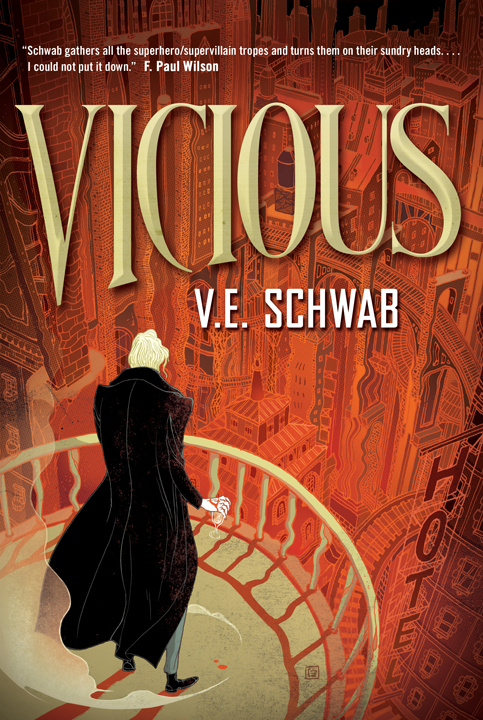
Vicious, by Victoria Schwab
This week I'm reviewing a superhero novel, which is something I've done before, more than once as a matter of fact, and which I'll definitely be doing in the future thanks to some of my kindle purchases. And this is despite my overall reluctance to get involved in superhero comics. I never really read comics when I was a kid so I never got exposed to superheroes like most of the other people in my cohort. And unfortunately every time I try exploring the world of superhero comics I just seem to get confused by the sheer number of crossovers and spin offs and what have yous. So reading novels about superheroes is usually an easier method for me to enjoy the idea of superheroes.
I'll begin by being very honest and saying that I didn't care for Vicious, and it simply came down to the two main characters who I did not like at all through the book. And I'm sure there's people who found these characters fascinating, as the fairly positive reviews of the book suggest, but I did not like them at all. And of course, if you don't like characters in a story it makes it that much harder to enjoy the book overall. And I can see some interesting ideas used in the book, but it just gets buried under how much I hate the characters.
To give a brief overview of the plot, the story takes place in a universe where ExtraOrdinary individuals are alleged to exist. Everyone's heard rumors that they exist, but they're generally accepted to be a legend like bigfoot or the men in black. Relegated to internet discussion boards and late night tv shows. However, two brilliant college students, Victor Vale and Eli Cardale, figure out that if ExtraOrdinaries exist it's the result of a near death experience. And like the stupid and poorly supervised young people they are, they decide to try killing themselves in attempts to give themselves superpowers. Their attempts succeed, although the cost both physical and psychological is incredibly great. And Victor and Eli, two men who weren't entirely there to begin with, are pushed straight over the edge.
All right, so we've got two young men, college roommates, who give themselves superpowers by engaging in suicidal behavior. Not terribly bright, but believable considering some of the people I knew from my own days at university. The problem is that both Victor and Eli weren't very good people and it seems like getting superpowers just amplifies the defects of their personalities. Another character literally says there are no good men in this fight, and that makes it really hard to care about the result when you're trying to choose between two fairly bad options.
Let's begin with Victor, who's more or less our protagonist and competing with or fighting Eli through the book. Victor is an incredibly manipulative personality and uses his skills and intelligence to get what he wants. He sees people as objects to be used rather than as...well...people. He's really only interested in people so far as their useful to him. He doesn't really have friends and the allies he has are only around because they're useful to him and they benefit from sticking around with him. He's interested in controlling people and uses a variety of techniques to do that, and is willing to kill anyone who gets in his way. I may not be a mental health professional, but that sounds a lot like a psychopath to me. And of course the worst part, which is almost minor compared to his psychosis, is his being a Nice Guy TM. It's so small as to be almost irrelevant, but I specifically remember him having a female friend in college who he rescues from bad dates and spends considerable time fantasizing about how he'd treat her infinitely better than the jerks she's dating, which is textbook Nice Guy TM stuff. And this is our, for lack of anyone else, protagonist. Now let's look at Eli.
Eli is in some ways cut from the same cloth as Victor. We don't get as much of his background as most of the story's told from Victor's perspective, but we do get a look into Eli's motivations and it wouldn't surprise me if Eli had a lot of the same problems as Victor. Despite being an ExtraOrdinary himself, Eli comes to the conclusion that EO's are a sin against both god and nature and it is therefore his sacred duty to hunt them down and kill them, one by one. And while there are EOs who are fairly dangerous and use their abilities to rob banks or hurt people, the majority of EOs are people who don't mean anyone else any harm and are just trying to adapt to their changed lives. But Eli believes all of them are a potential threat and need to be eliminated, except for himself, of course. And considering exactly zero people in the book seem comfortable with Eli's conclusions, I don't think any of the readers should be either.
Really it's kind of a shame that the main characters are such horrible people because there is at least one really interesting idea that Schwab puts forward. Because every person who becomes an EO gains an ability based somewhat on their dying wish. So their power becomes a reflection of their personality. Such as the little girl who fell through the ice, wishing she had a second chance, and is given the ability to raise the dead. Or the wounded veteran hit by a landmine who wishes he could escape from the world and the pain, and gains the ability to walk in a shadow world. Exploring how powers are a reflection of a person's psychology and their dying wish could be a whole book and a fascinating look at human nature. Heck, there's three different tropes that you could play around with and subvert to your heart's content with a work like that. Unfortunately we're stuck following around two downright awful people I really rather would not have read about in the first place.
Overall despite some interesting ideas, this book was not enjoyable for me because I absolutely loathed the two main characters. I mean, maybe they're interesting to other people. Maybe people enjoy reading about psychopaths, but quite frankly I don't. There are plenty of other books about superheroes that in my opinion are worth reading before this one.
- Kalpar
Tuesday, March 15, 2016
The Death of Caesar: The Story of History's Most Famous Assassination, by Barry Strauss
This week I'm talking about The Death of Caesar, by Barry Strauss, which seeks to explore the assassination of Gaius Julius Caesar by a group of senators on 15 March 44 BCE. As Strauss himself says, thanks to William Shakespeare Caesar's assassination is one of the most famous in history, perhaps only more recently eclipsed by the sheer amount of morbid curiosity surrounding John F. Kennedy's assassination in 1963. In an event with so much drama surrounding it, it can be extremely difficult getting towards the truth of the matter. Strauss's attempt is to sift through the various sources, which are honestly fairly limited, and also attempts to put the assassination of Caesar within the proper context of the times. However, I feel like Strauss's efforts are rather disorganized and fall somewhat short as a result.
The biggest challenge for any modern historian is figuring out what exactly happened. The very absolute basics are not disputed. Gaius Julius Caesar was assassinated by a group of senators within Pompey's senate house, and the leaders of this plot included Brutus, Cassius, and Decimus who were all connected by various family ties. These senators then were involved in a war with Marcus Antonius (Marc Antony) and Octavian (later Caesar Augustus), which they lost and Marcus Antonius and Octavian divided the empire between them. Beyond these very basic details it becomes increasingly hazy and difficult to understand.
The precise motivations of Brutus, Cassius, and Decimus, what they hoped to accomplish, how exactly Caesar died, and many other details are lost in the fog of classical history. Historians during the era were often not terribly concerned with what was accurate so much as what made a good story and their bias, whether pro- or anti-Caesar is usually very explicit. (In fact the idea of unbiased historiography is a fairly new one, and still a thorny issue.) And of course, many of the surviving reports we have are second hand sources. Cicero, who was present in the senate chamber on that fateful day, wrote only a very brief description. Most of the other writers, such as Plutarch, were writing well after the event and drawing on sources which have since been lost to us. So ultimately any historical interpretation has to be taken with a grain of salt.
Despite this difficulty, Strauss goes to great lengths working to incorporate numerous sources to provide necessary context to explain the associated context but at the same time I feel it is incomplete. Caesar's career (which I'm ashamed to admit I only know the most general details about) is mentioned very briefly and how it may have fueled Caesar's ambitions. But the description is extremely brief and I feel like to provide a better understanding the book may have been better served by a more in-depth exploration of Caesar's life and how he eventually became dictator for life, rather than starting with him already declared dictator. Certainly considering the sheer number of people involved it would be unrealistic to go into detail about everyone's life, but Caesar is the focus of the narrative. Strauss also incorporates some details for further context, but I thought there were still major gaps which only I was able to fill in because of my own knowledge of Roman history. (As rusty as I'll admit it is. Thanks, Sister Georgia!) Obviously there were probably constraints on overall length of the book and including more detail would have made the book go even longer, but I feel like it would have helped make the book feel more cohesive.
I do also find myself disagreeing with the final conclusion of Strauss, that Caesar's assassination ended up being a warning to would-be dictators everywhere and in a way it helped save the Roman Republic for a little bit longer. On the first hand, the most famous assassination which referenced Julius Caesar was John Wilkes Booth's assassination of Abraham Lincoln in 1865, shouting sic semper tyrannus as he fled the theater. Lincoln, however, was a democratically elected leader and although taking several wartime measures to crush the rebellion could hardly be called a tyrant.
Claiming that Augustus's adoption of the title princeps or ''first citizen'' and willingness to work through the senate was a continuation of the Republic with a limited monarchy is hardly a strong example as well. The Republic had already been dominated by strong men such as Marius, Sulla, and Pompey before Caesar with control of military power being the true determinator. Although Strauss doesn't claim it overtly, there's definitely the suggestion that the assassination of Caesar helped keep the spark of government by consent alive in Europe. I find this also rather weak because while the American Founding Fathers may have been inspired by Greek and Roman ideals, being avid readers of the classics, there was also a separate strong tradition of government by consent in England, independent of any Roman tradition and which heavily inspired American systems of government.
Overall I think this book is okay, but a little inadequate. Strauss provides some context, but just simply not enough to my liking to give a full understanding of the assassination of Caesar and why it's such a tipping point in Roman history.
- Kalpar
Thursday, March 10, 2016
Pluto, by Naoki Urasawa and Osamu Tezuka: An Overview
This week I'm giving a sort of overview to a series that some friends have been bugging me to read for some time. As my readers may or may not be aware, I have a bit of a fondness for robots and I'm a sucker for robot stories. Pluto, as you probably guessed, is a manga story about robots contained in eight volumes. Which makes it fairly short by manga standards. I actually was able to read all the stories in about a day. I'm going to try to talk about the series as a whole rather than addressing each volume of the series individually.
Pluto begins with the murder of the Swiss Forestry Reserve robot Mont-Blanc. This is especially tragic as Mont-Blanc was well-loved by thousands of people everywhere and had saved numerous lives in his work in the Alps, which leaves people at a loss as to who could be the suspect. Europol calls in our main character, Gesicht, who is a highly advanced robot and crack detective. As Gesicht continues his initial investigation a second body turns up, in this case a human and prominent activist for robot rights. It appears these murders are linked and it soon comes to light that someone is targeting both human supporters of robots and the seven most powerful robots in the world. Unfortunately, Gesicht happens to be on that list of robots. What follows is almost a wheels within wheels conspiracy and some really poignant moments.
I will say that this story is an unabashed retelling or reimagination of the Greatest Robot in the World story arc from the well-known series Astro Boy. Now I personally have never watched or read anything relating to Astro Boy in my life which leaves me of two minds on this story. On the one hand, I kind of wish that I knew the original story that this was based upon because I feel like it might have given me slightly more insight into the story and what was going on. On the other hand, despite not being familiar with Astro Boy I was able to come to this series and actually enjoyed it quite a bit. There's a deliberate choice to make Gesicht, a rather minor character in the original source material, the main character so you definitely get a very different perspective. So I did enjoy reading this series, even if it's very emotionally draining.
Of course I also really liked Gesicht as a character but he's almost tailor-made for me to like him. I like lawful policemen types like Sam Vimes, and I'm fond of robots. So I'm instantly going to be best friends with a robot policeman. Just stands to reason. And there's a lot of character development that goes on through the series which makes you realize these robots are just as human as the rest of us. They feel happiness, sadness, anger, hatred, grief, an extremely wide range of emotions just like us humans. Of course, this has been done so many times that it's practically the robot story, but I still enjoy it as a story when it's done well. And Pluto does indeed do it well.
I will warn my readers that Pluto is a pretty dark series too. There are a lot of emotional gut-punches throughout the series. Whether it's the death of a main character in the series or something very simple, you get hit a lot of times. I remember very early on in the series seeing a deceased robot policeman's body just being tossed away in the garbage, which just felt very wrong to me. Although personally that might have just been my fondness for robots and belief that sophisticated AIs should have the same rights as us humans. I don't know if that early into the series if people would be as emotionally invested or not. But there are a ton of little things like that in the series as well.
Overall this is a pretty good series, but be prepared to be hurt with all the feelings that have ever existed. And if you like stories about robots with feelings, this is definitely one for you to read.
- Kalpar
Tuesday, March 8, 2016
AC DC: The Savage Tale of the First Standards War, by Tom McNichol
This week I'm reviewing a fairly short book which I listened to in audio format titled AC DC: The Savage Tale of the First Standards War which is ostensibly a history of the conflict between the electrical standards popularly referred to as the War of the Currents in the late nineteenth century. I say ostensibly because the book goes on quite a few tangents both before and after the actual narrative which are tied with electricity or the more nebulous idea of standards wars, but they feel somewhat irrelevant to what's supposed to be the book's core subject matter. The result, considering the relative brevity of the book, is a very general overview of the War of the Currents rather than an in-depth history which left me rather disappointed.
To provide some background for people who don't know anything about the War of the Currents or for that matter electricity, there are basically two systems: direct current, where the electrons move in one direction, and alternating current, where the electrons move in two directions. Direct current is fairly simple and easy to design, but alternating current is far more efficient than direct current and, with the technology available in the late 1800's, the only one able to travel long distances fairly cheaply. Thomas Edison invested heavily in direct current, planning to create a series of small power plants able to service a roughly mile area, but required extremely large copper wires. George Westinghouse invested heavily in alternating current which had a number of cost advantages, most importantly less wire necessary to transmit power and the aforementioned ability to send power over long distances. Edison, having already built a tidy little monopoly based on direct current, was of course not thrilled at this newcomer threatening to undercut him and with the help of Harold Brown launched a propaganda campaign against alternating current, declaring it deadly opposed to the ''entirely harmless'' direct current, culminating in the creation of the electric chair to forever associate alternating current as the deadly current. However, the cost benefits of alternating current over direct current led to alternating current's dominance, at least when it comes to the power that's used in our homes, but both alternating and direct current have their uses.
The problem I have with this book is that it spends considerable time talking about things that actually aren't the War of the Currents which leaves the actual sections about the subject matter fairly weak. I don't mind terribly much about McNichol going into biographies of Edison, Westinghouse, and Tesla, some of the principle actors in the War of the Currents, which helps to humanize and flesh out the narrative. Edison, being the idolized hero that he is, gets the lion's share of the attention, and poor Tesla gets honorable mention at best by comparison, but at least they're all there. The problem I have are the large sections devoted to entirely different and sometimes irrelevant subject matter. For example, the book begins by giving a brief history of humanity's experience with electricity prior to Thomas Edison, going all the way back to prehistory and coming up to the eighteenth century where the experiments of Benjamin Franklin are given a place of prominence. Granted, these are all relevant to humanity's understanding of electricity but scarcely any time is given to the electric telegraph, the invention which made practical use of electricity and perhaps more importantly gave Thomas Edison his early experience working with circuits. It's all very interesting, but it feels like the author didn't do enough research so they had to pad the book.
The other worst examples come near the end of the book. McNichol talks about the electrocution of Topsy the elephant, who had actually killed a few handlers and is perhaps more famous now because of her appearance on Bob's Burgers. I want to say here that according to some other research I've done it's apparently a common misconception that Topsy's execution had anything to do with the War of the Currents. However, one of Edison's many business ventures did film Topsy's death which may be one of the reasons his name's associated with it. The reason I bring this up is that McNichols derails the entire book to then talk about Edison's development of one of his other famous inventions, the motion picture camera. McNichols goes greatly in depth about Edison's development, the creation of the Black Maria, and the growth of the film industry before returning to the execution of Topsy. It's just so weird and utterly irrelevant to the main focus of the Current Wars that I wonder why on earth McNichol brought in the development of the motion picture camera in the first place.
The other main thing is the epilog which devolves into a rant about standards wars past and present. Well, more accurately the recent past as the battle between HD DVD and BLU RAY has ended some time ago with BLU RAY triumphant. I do take issue with calling the War of the Currents the first standards war. There certainly was a great deal of conflict over standardizing basic units of measure such as length and weight, or even the struggle to standardize railroad equipment, which pre-date or were coexistent with the War of the Currents. But that's just my own personal opinion. McNichols spends a good amount of time talking about the Betamax and VHS standards war of the late 1970's and early 1980's with the eventual supremacy of VHS and makes dire predictions of the most recent war between HD DVD and BLU RAY although, as I mentioned, it has become irrelevant today in 2016. While certainly interesting on its own, it feels more like an editorial from the author rather than an avenue of historic argument.
Overall, the book was a fairly big disappointment for me. I learned a few new things, but overall the book was largely a very basic refresher of things I already knew. I might have been convinced to suggest it as a basic primer for information on the War of the Currents, but the book loses focus so much and goes into unproductive avenues that I feel like it really isn't worth the effort of reading and I'm sure there's a better book about this topic somewhere else.
- Kalpar
Thursday, March 3, 2016
Lovecraft's Monsters, edited by Ellen Datlow
This week I'm going with a little more creepy feel and reviewing a Lovecraft anthology. This however isn't an anthology of stories written by Lovecraft himself, rather it's a collection of stories written by a variety of authors which utilizes Lovecraft's mythos and universe. Which is apparently fairly common as much of the popularity of the Lovecraft mythos isn't necessarily because of the writings of the man himself so much as the writings of other people who utilize his ideas. And it's always interesting to see ideas of one author get used by other people to create a larger and more complex universe.
As I mentioned this is an anthology and those always seem to give me a little bit of trouble from a reviewing standpoint. Anthologies are fun because you get to have tastes of different authors and get exposed to things you might not normally run across, but at the same time they can be frustrating. Sometimes I personally run into the problem that either the stories are too short, and leave me wishing for more from the author, or the stories are too long and I'm flipping through the anthology to see how much longer this story is going to take. Very occasionally you get a story that feels just the right length and feels perfect, but those aren't as common.
As I mentioned in my review of actual Lovecraft, I have some issues with reading Lovecraft and I think it might just not be my cup of tea. Definitely part of it is stylistic as Lovecraft and Lovecraft-inspired works seem to go pretty heavy with the purple prose. And that's certainly an aspect of the literature but more often than not for me, personally, it becomes more than a little too much. In addition, the stories where the lesson is more or less humans are tiny dust motes in a vast and uncaring universe and ultimately nothing we do really matters on a cosmic scale, I find that weirdly comforting rather than terrifying. I mean, yes, it's intimidating to be confronted with the vastness of the universe, but it certainly takes quite a lot of pressure off of me to be completely honest. I think the stories I like better are the ones where there are actually malevolent entities, completely beyond our control, who like to mess with humans for fun. And there certainly seem to be more of those in the more modern fiction. It's downright terrifying to have an enemy you can't fight, much less understand, and it wants to eat your soul. Very chilling.
My usual problem with anthologies is it's always a mixed bag. Some stories are good, some stories aren't, it all usually evens out towards the end. Personally I'm left with the feeling that Lovecraft fiction isn't really my thing and I'm better off with my pulp science-fiction novels of space adventure, but if you like Lovecraft it may be worth checking out.
- Kalpar
Tuesday, March 1, 2016
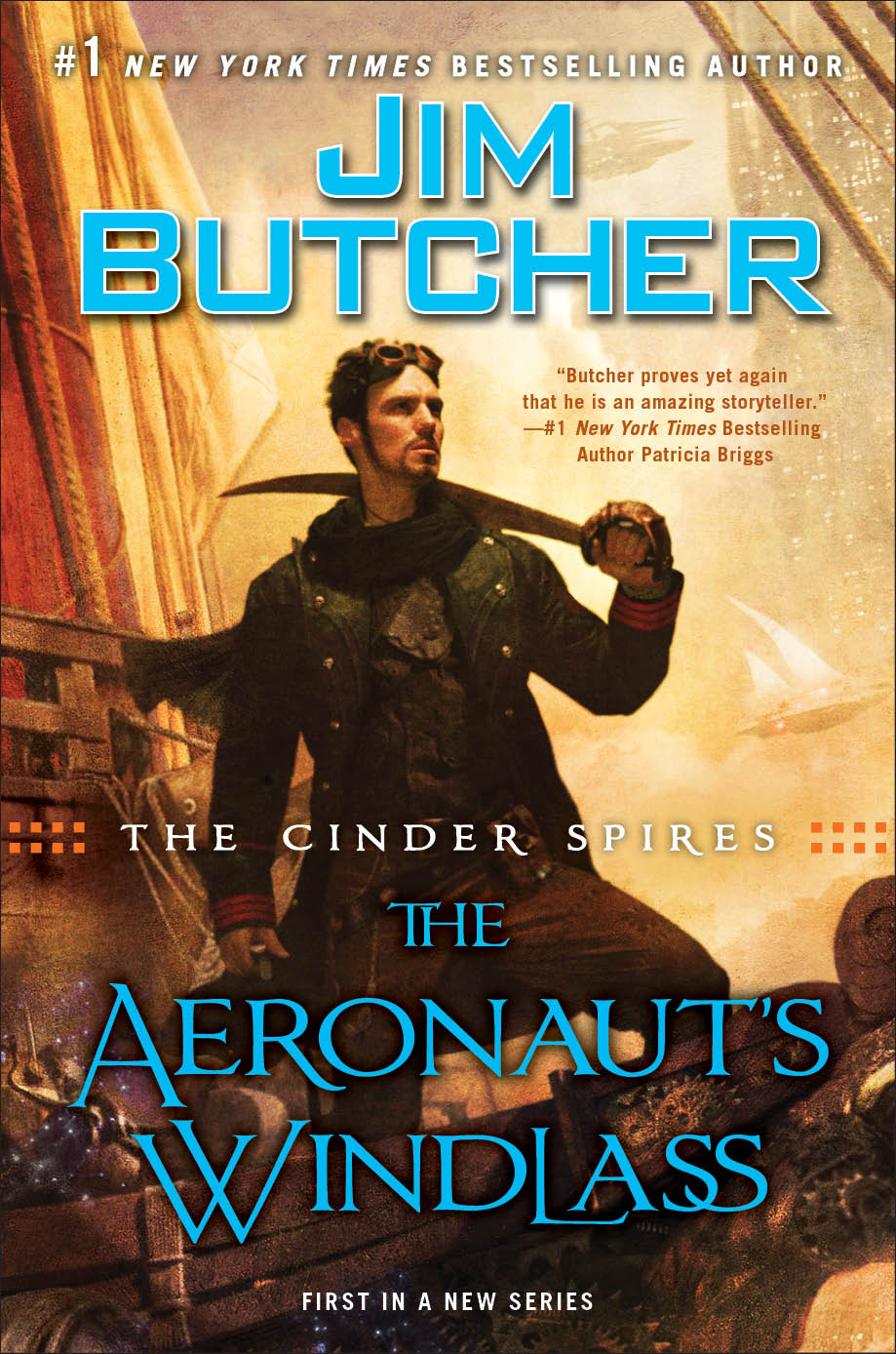
The Aeronaut's Windlass, by Jim Butcher
This week I'm reviewing a newer book by Jim Butcher, whom some of you might remember from when I looked at the first book in his Dresden Files series. The Aeronaut's Windlass, however, is the first in a new series called The Cinder Spires set in a vaguely steampunk world of airships and aetheric crystals. I'm going to say from the beginning, though, that although this book starts off promising I found that its greatest sin was it ended up being boring and I was finally glad when it was over so I could move on to something else. That's of course just my own personal reaction to the book, but it's certainly dampened my interest in the series overall.
I think the biggest problem I had with this book is that it's the first in a series, but it doesn't do a very good job of world-building and setting the stage for the series, which I think is fairly vital if you plan to create an intricate series. The series is set in a world where the majority of humanity lives in enormous spires, roughly two miles wide and two miles tall. The surface can be visited, but it's considered to be extremely dangerous and done so only at great risk. A segment of the population make their living as aeronauts, working on and piloting the fleets of airship powered by crystals that can harness the energy of the aether, carrying out trade between the spires and, more importantly, manning the armed forces of the spires. However aeronauts are considered more than a little odd and the majority of the population spends most if not all of their lives inside the spires.
The main characters of this story are residents of Albion Spire, one of the larger, wealthier, and more powerful of the spires with an excellent navy and an excellent source of the crystals necessary to keep airships aloft and power them. They have been unofficially at war with Aurora Spire for some time and tensions appear to be heating up even more. As for why these two spires are going to war, it's eerily similar to the set up for the Honor Harrington series. Aurora Spire's economy is basically centered around plundering the wealth of other spires, and Albion has become Aurora's next target. This is confirmed when Aurora makes a surprise attack on Albion Spire, inflicting little damage, but it seems the Aurorans had help from inside the spire and the main characters, being individuals the leader of Albion Spire can trust, are sent to investigate.
One of the things that bothered me about this book was there were a lot of things that didn't seem to make sense, even within the universe. I didn't question the aether or the crystals that harness it to make airships fly, but there were other issues that bothered me. For example, as I mentioned, most of humanity live in giant spires two miles tall and almost two miles high, built centuries ago to the point their origins are myth. The source of some basic commodities, such as food or crystals, are explained, with them being grown in numerous vatteries throughout the spire. But other resources are explicitly scarce. Wood is described as an extreme luxury that has to be harvested from the surface, and a house built entirely of wood within the spire is an ostentatious display of wealth. And yet, the majority of airships are made largely of wood and extensive shipyards on the outside of the spire are made from wood as well. So I suppose airships are ridiculously expensive, but it seems a little odd to me. Especially considering how prevalent other materials are. Copper, steel, and ceramics are treated as ordinary, every-day items that can be easily obtained in enormous quantities. Some airships are heavily armored with copper-clad steel plates. (More on that in a minute.) Except all three of those require raw materials which have to be harvested somewhere, presumably outside the spires since they're all artificial structures filled with living spaces and thus don't contain enormous quantities of raw materials. Yet these materials are all apparently more common than wood and therefore less expensive. It just doesn't make sense.
Another thing that bugged the heck out of me, and I'm aware I'm being really nit-picky, is that almost every metal object is described as steel clad in copper. If this was an aesthetic choice, I'd be fine with it. If there had been some sort of nonsense reason tied to aetheric energies, I'd have been fine with it. But the reason given for cladding every piece of steel in copper from battleship armor to personal swords? Rust prevention. Personally this annoyed the hell out of me because it went against everything I knew about metallurgy. (Granted, it's fairly limited and I'm by no means an expert, but I was cursed in this case with knowing too much.) First of all, there are easier ways to prevent rust on steel. Painting steel, utilizing alloys, or just oiling items like swords and firearms, all help to prevent rusting. Granted, galvanizing steel is a method utilized as well, but copper is just a susceptible to corrosion as well. I did do a tiny bit of research and found that in the case of copper oxidation the outer level helps protect lower levels from further oxidation, unlike in steel, but none of these items were described as being green so everything's apparently being polished excessively. Finally, especially in the case of using it to protect swords, copper is slightly softer than steel, being about a 3 on Moh's scale while steel's a 4 or 4.5. So I'd assume after every fight in which swords are used you'd end up recoating your sword in copper to repair all the dings and scrapes in it. It probably wasn't that big of a deal in hindsight, but it just annoyed the hell out of me because it didn't make sense.
The greatest offense this book made, though, was being boring, which I think is the greatest offense a book can make. It's fairly long, being about six hundred pages, which I think was probably about three hundred pages too long for what it covered. I noticed a couple of points where characters were repeating things already said earlier in the book or explaining what was currently happening in the most tedious and time consuming manner possible. There are even points where a challenge one character or group of characters encountered is repeated, only slightly differently, for a separate character or group of characters. And on top of that, almost every character spends some time unconscious for one reason or another. The first time it's a little dramatic. After the third it just gets repetitive. By the end of the book I just found myself wishing the whole thing would be over because it had taken so long and had done so very little with the time it used.
Overall, aside from my incessant complaining about the world not making sense, the book's just boring. The story feels vaguely familiar to other stories I had, without the rich world-building or interesting plotlines and characters. Butcher spends too much time repeating himself which seems to only add padding to the book and slow what should be an exciting adventure into a laborious crawl. Personally I don't think it's worth the effort.
- Kalpar
Subscribe to:
Posts (Atom)