This week I'm talking about a book that deals with the creation of the Federal Reserve Bank, an institution that wields a great deal of influence in the United States, ranging from setting interest rates to issuing the money people carry in their pockets, but a lot of Americans probably don't give it terribly much thought. At least on a day to day basis. The Federal Reserve, being today a vastly powerful organization in its own right, has been the focus of numerous conspiracy theories since before its creation in 1913 and remains a popular target of cranks, goldbugs, and various other nuts. (Lowenstein actually uses some of those terms within the text so I feel rather comfortable using them here.) For whatever reason I have a strange fascination with the machinery of high finance, albeit limited by my layman's understanding of how it all works, so this was a topic I was interested in reading.
The book follows the need in America for a centralized, national bank starting in the late nineteenth century to help modernize America's financial systems. Unlike other major economies such as Britain, France, and Germany, America's banking systems were fairly primitive by comparison and lacked a central authority to manage cash reserves, oversee the manufacture and distribution of banknotes, and set short-term interest rates. Although Salmon P. Chase's National Bank system had been an improvement over the ''wildcat banking'' following Andrew Jackson's closure of the Second National Bank in 1836, it was still a rather ad hoc structure and prone to financial panics which happened with distressing regularity in the late 1800's.
Despite the need for a centralized bank, increasingly supported by the banking establishments on Wall Street, there was still strong American opposition to the idea. The Jacksonian tradition in America had a strong distrust of centralized authority in specific and banks in general, so any combination of the two faced particular opposition. However, the near-implosion of the American economy in 1907, saved only through efforts by J.P. Morgan that can only be described as herculean and terrifying in their scope, emphasized the need for a centralized authority. If for nothing else than to help move cash reserves to where they were needed seasonally in accordance with the more agrarian segments of America's economy.
Considering the amount of opposition faced to creating anything that could even be construed as a central bank, it's amazing the Federal Reserve was created at all. Between the fear of government regulation of business, centralization of banking power, and the more oddball theories, it truly was a struggle to get the Federal Reserve created at all. The fact that the structure of the bank was created in absolute secrecy certainly did not allay the fears of the American public. However as Lowenstein puts it, there were two main benefits to the effort. First, there were a series of congressional inquiries in the wake of 1907 which emphasized how weak the existing financial system was and the need for a reserve bank to maintain liquidity in crisis. Secondly, the drafters of the eventual Federal Reserve system made sure to cultivate bipartisan support for banking reform, which proved instrumental when Democrats took over both houses of Congress and the White House in the bitter election of 1912. Despite the Democratic Party's lingering Jacksonian aversion to centralized authority, with the help of Woodrow Wilson and key party members, the Federal Reserve Act managed to get passed in 1913.
Overall I thought this book was pretty interesting. It kind of gets bogged down in the election of 1912, going over the political bargaining and fractionalism, most famously between Roosevelt and Taft. Although I think it might be because, being a Roosevelt fan myself, I've read so much about 1912 it's all very familiar to me at this point. The book kind of ends at 1913 with the signing of the act and with a very, very brief epilogue about how the Federal Reserve has grown beyond its mandate since then. I kind of wish there was more information about the Federal Reserve and how it's changed, but I guess that just simply wasn't within the purview of this book. It's fairly dry subject matter but if you're interested in finance it's a very interesting read.
- Kalpar
Tuesday, May 10, 2016
Thursday, May 5, 2016
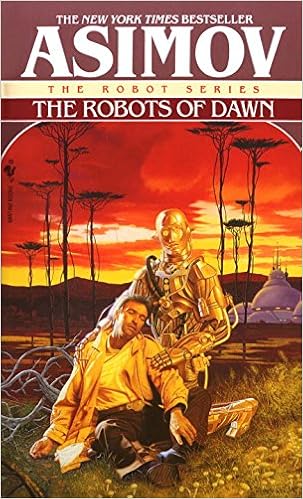
The Robots of Dawn, by Isaac Asimov
This week I'm finishing up the robot series with The Robots of Dawn, the last of the Elijah Baley stories. I am skipping the short story Mirror Image which I know for a fact I've read somewhere else but for the life of me right now I can't remember where I've read it. I'll probably have to dig through the literally hundreds of books to find it, but that's neither here nor there. I have to say that unfortunately I really did not care for this book and it's a combination of factors. I felt really blindsided by the resolution of this novel, as I did in the other ones, but it may be because I don't read detective stories all that much and so I'm not very good at picking up clues as other people. The main issues I have though, are sort of what the book spends a lot of time talking about as the characters engage in their long dialogs which honestly feel kind of stilted. As well as a really unfortunate thing which is going to get its own paragraph because oh boy, is it a doozy.
Once again Earthman Elijah Baley is being called upon to help solve an almost impossible mystery with the help of his friend, the robot Daneel Olivlaw. In this case Baley is being sent to Aurora, the greatest, most populous, and most powerful of the Spacer worlds, however the case is rather unusual. In this instance another humaniform robot like Daneel, Jander, has been rendered inoperative with mental freezeout, making him dead for all intents and purposes. However it's incredibly unlikely this happened at random so Jander's creator, Dr. Fastolfe, is accused of deliberately destroying one of his greatest creations. Tied to the outcome of this case is not only Dr. Fastolfe and Baley's careers, however, but the fate of Earth and the settlement of the galaxy as well.
The Robots of Dawn isn't exactly a direct sequel to its predecessors, The Caves of Steel and The Naked Sun. It was written nearly thirty years later and in a way serves more as a means for Asimov to bridge all of his stories together into one cohesive universe. And I'm willing to go out on a limb and say that Asimov didn't exactly plan for most of his novels to end up part of one cohesive universe so it does feel a little odd to me. How Asimov does this is make references to several other of his works which, as someone who's read them I understand instantly and get the wink and nudge that he's making, even if it isn't terribly subtle. I'm left with the feeling, though, that readers who aren't familiar with his other stories may end up a little confused. And again, it does feel odd. The references to Susan Calvin, the patron saint of robotics and prominent figure in several of Asimov's robot short stories certainly makes sense, even if she's a figure of the distant past by Baley's time. The references, however, to a Galactic Empire and the field of psychohistory which may one day develop to understand the human mind are just downright weird. At least it's weird for me because I know, that's what's going to happen. I've read Foundation after all so the rise and eventual fall of the Galactic Empire, coupled with Seldon's development of psychohistory are absolute certainties. But for the characters in Robots of Dawn to speak of such things as absolute certainties, when ostensibly the fate of humanity's expansion into the stars is still uncertain, feels like they've read ahead in the timeline and they're just going through the motions of protesting.
On some level, I do like the references. They specifically mention the stories Liar! and Bicentennial Man, (the latter of which is probably my favorite Asimov story of all time) not by name of course, but in a general sort of sense and it's good to see that even if they're seen as little more than legend, people remember these stories which touch something fundamentally human in us. And of course, I rather enjoyed at least the very early Foundation novels, before things started getting weird. But as I said, it kind of removes the dramatic tension from the book because we know what happens. The result is the book feels like a device to connect other stories into a larger universe, rather than an important story in its own right.
Now that I've sort of poked around talking about the more general issues I have with the book, I'm going to come to the really big one which makes me really wish I hadn't read it. To make it really short: there are characters who act like incest is no big deal. To provide some context, on Aurora people only get married for the purpose of having children and once the children are born they're usually raised in a communal nursery so the marriage, having no other purpose, is dissolved. Otherwise, people are free to have sex with whomever they want and it's no big deal. However, we're presented with a very specific instance where Dr. Fastolfe, in what on Aurora is a somewhat eccentric act, decided to raise one of his daughters from a baby on his own, living in the same house. So a very traditional father/daughter relationship. However, once his daughter comes of age she decides to make an offer of sex to her father. Now fortunately, Dr. Fastolfe has the very good presence of mind to refuse such an offer but everyone except our "prudish Earthman" Baley thinks Dr. Falstofe acted absolutely abhorrently by doing so and is blamed for stunting his daughter for life because of his behavior.
...I don't even know how to begin to explain how utterly messed up that is.
Like, I understand that this is a small thing, a really, really small thing in a book about robots and spaceships and galactic empires and psychohistory and a robot murder mystery. And I understand that while an author might write certain things in their books they may not in any way, shape, or form support the ideas suggested or supported by what they write. I get it. I really do.
But NO!
I just could not focus on the book after that point. Everything else was getting crowded out by the fact people acted like incest was no big thing. "Without procreation, sex is only a social activity." Well yes, that's technically correct, but still no! There is just something inherently and utterly wrong in people acting like it's perfectly natural for a daughter to want to have sex with her father, a man who has literally raised her from a baby. And this is only made worse by how little a deal it is. It'd at least be something if Baley spent pages and pages arguing about how utterly messed up this is and how degenerate Spacer society has become as a result but no, it's kind of "Haha, stupid Earthman. You and your prudish, monogamous ways! We Spacers have long outgrown such silly superstitions!''
No. No, no, no, no, no, no, no.
NO.
If this wasn't an e-book on my kindle I probably would have thrown this book across the room and contemplated setting it on fire to purge what was wrong with it. And this is why I really can't give an objective review of this book because of that one thing that is wrong on so many levels and is just...ugh.
So I'm sorry, everyone, I really am. Emperor knows I wanted this book to be good like so many of the other robot stories I've read. But unfortunately in this case there's just one thing that I cannot ignore and so I cannot in good conscious tell people to read this book. Without the messed-up bit this would have just been a lackluster book, but with it? Ugh.
- Kalpar
Tuesday, May 3, 2016
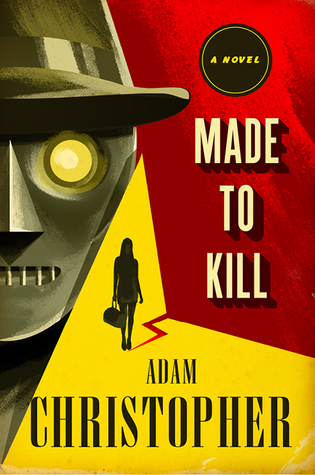
Made to Kill, by Adam Christopher
This week I'm reviewing Made to Kill, a short little novel that's part pulp noir hardboiled detective fiction, and part robot science-fiction adventure. Both of these subjects are stories that I have a fondness for, although robots are certainly far more of a favorite of mine, so it seemed like a good book for me to listen to. My impression of the book though is...more or less mixed. It's not a bad book, and there are parts that I enjoyed quite a bit, but there are parts that also left me scratching my head. I'm not sure if this book is subtly brilliant or just suffers from poor writing, which leaves me not entirely sure what to make of it.
The book follows the adventures of Raymond Electromatic, the very last robot on earth and a private detective who runs a small office with his computer assistant/boss Ada in sunny Los Angeles in the 1960's. At least, that's the official cover story. Secretly Raymond is a highly skilled hitman who can be relied upon to discreetly remove obstacles from this mortal coil for reasonable fees. Raymond is especially useful in this regard because his magnetic tape memory can only record up to twenty-four hours, which means he never has any memory of anyone who's hired him or anyone he's killed. Raymond's life is made far more complicate however, when a woman arrives in his office with a sack filled with gold bars and a request to kill a prominent movie star. There's a catch, however: Raymond has to find the movie star first.
The biggest impression I was left with this story was Raymond is an unreliable narrator and I'm not entirely sure if that was intentional or not. Raymond has some long-term memory storage which gives him his personality, his command of the English language, and knowledge of general facts necessary to navigate day to day life. But, as I said, Raymond only has space for twenty-four hours of short term memory and every day he takes out his memory tape and replaces it with a new one. The result is a lot of things Ray tells us to be true are informed to him from Ada, who's already established as not being entirely honest with Ray. So it just raises questions as to whether what Ray says can be believed or not. If this was intentional it's a brilliant bit of writing, but I'm not left with the impression it necessarily was.
A good example is Raymond's explanation of how he became the last robot on earth. To provide a condensed version here, basically in the 1950's there was a move to develop and build robots to take over a large number of menial jobs and make life for humans better. However a combination of the Uncanny Valley and human fear of change meant that the robots were quickly phased out in a matter of years. Raymond Electromatic is the only robot left on earth as a result. Personally, there's something about this story that doesn't quite add up. First of all, Ray talks about this like it was something in the distant past, saying some people are ''old enough to remember''. But this is something that happened in the past decade. It'd be like someone today saying there are still some people old enough to remember the Invasion of Iraq in 2003. Technically speaking that's true, but I remember the Invasion of Iraq and I'm only 27, I just act like an old geezer. Furthermore we're told that people don't really trust robots and usually stay out of Raymond's way, but for the most part people seem to like Raymond just fine. This includes teenagers at an ice cream parlor. Teenagers, I might add, who may have remembered robots from when they were kids. After all, I can remember things from when I was six or seven.
This leads to another thing that leaves me scratching my head: why a private eye or, for that matter, a hitman? It would make sense of Ray was vaguely human-looking or even close to human looking but he simply isn't. He's described as being six feet ten, an extremely unusual height outside a basketball team and sure to attract notice. Furthermore his body's made up of bronzed steel, which I think would be rather memorable, even if it's covered by a hat and trenchcoat. Furthermore, he's the only robot in the entire world. If Ray was one of hundreds or even thousands of robots that all looked alike, he could easily blend in for undercover snooping or for assasinations. It'd be impossible to pick him out of a line up. But in this case:
Officer: Did you see anything unusual lately?
Witness: You know, I did. There was a robot poking around the other day asking a lot of questions about my neighbor.
Officer: Well, there's only one robot in the world so that narrows our list of suspects to...one.
I mean, I guess Raymond's so good at his job that he's never left any evidence to make someone even suspect a robot's involved, much less foul play, but it feels like his cover could be blown so easily by an errant witness.
One other thing that I noticed was Ray tended to include details in his narration that people wouldn't normally include, like ''I opened the door, got out of the car, and then closed the door.'' If a person was saying that, you could get away with just saying, ''I got out of the car.'' It's assumed you normally will use the door to get out of cars, although if you're jumping out the window or using an ejection seat you usually mention that. There's just little excessive details like that, but I think it may be intentional. Raymond is, after all, a robot with a precise, if somewhat limited memory. So a robot may record details a human being might consider ''insignificant''. If it was a deliberate style choice on the part of the author, it's a very clever idea, but it could also be bad writing.
Overall my feelings are kind of mixed. I don't read or listen to a lot of detective stories so I don't always figure out the plots right away and usually am catching up when everything's revealed at the end. There are elements to this book that could either be really really clever, or just bad writing, and I just don't have enough evidence one way or the other to say which it is. If you like robots and hard boiled detectives, it's a book that has both with some interesting twists. Definitely worth checking out.
- Kalpar
Thursday, April 28, 2016
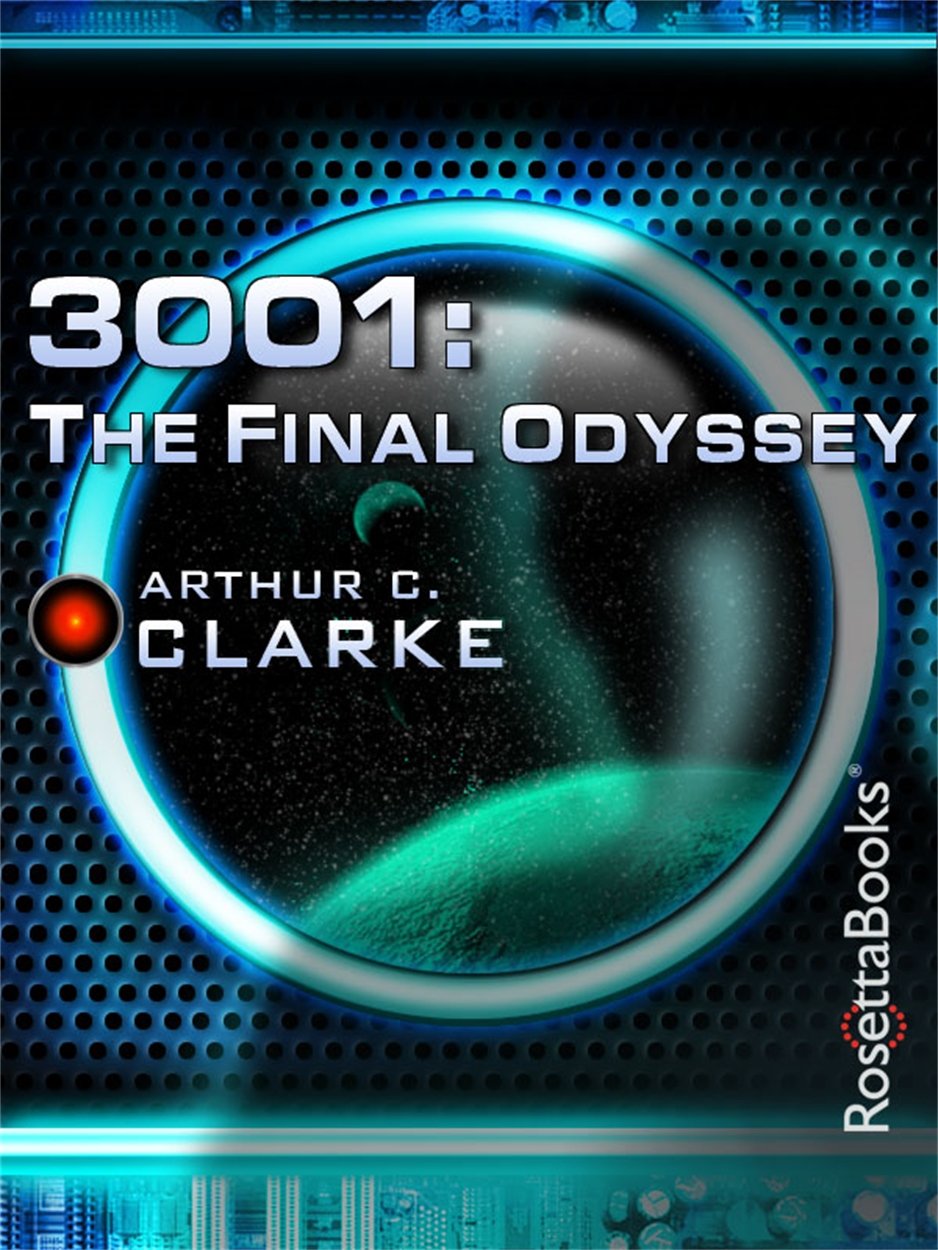
3001: The Final Odyssey, by Arthur C. Clarke
This week we finish up the month with a review of the final book in the Space Odyssey quartet, 3001: The Final Odyssey. And I have to admit, there are some significant changes in the series from the very first book, written in the 1960's, and the very last book written thirty years later. Not only are there differences in technology, scientific knowledge, and cultural references, but the tone and style are changed significantly to the point they almost sound like they weren't written by the same author. And I'm definitely going to say 3001 almost doesn't fit into the series at all, if only because the monolith, so iconic and central to earlier plots, is reduced to the point of being an afterthought. It doesn't make this book bad, just very different from its siblings.
Our story begins as you probably guessed in the distant year of 3001, as humanity is cleaning up celebrations from the end of the third millennium and entering the fourth. A comet-mining expedition out beyond Neptune is informed there's a strange radar signature and they've been asked to go investigate. This mysterious object turns out to be Frank Poole, one of the two crewmen from the original Discovery expedition a thousand years ago. With a little medical treatment and a quick de-thaw Frank finds himself alive, but further from home than he could ever imagine. And certainly, considering the dates involved I was definitely reminded of Futurama, but it seems Clarke came up with the idea first so this may have been one of the inspirations for the tv show. Although the idea of people somehow surviving through a period of time to wake up in a world they don't recognize is a fairly old one with Rip van Winkle and Looking Backwards serving as just two examples.
I said that 3001 is different from its siblings, and I feel it's because in this story you get the biggest dose of ''Hey, it's the future! Check out all these crazy things people are doing, because it's the future! We've got velociraptor gardeners now!'' I mean, if I'm being completely honest there were elements of that as early as the very first book with its extensive descriptions of what ''routine'' space travel from Earth to the Moon might be like, but there's also the plot with the monoliths. In a strange way, I feel like as you go through the series the monoliths end up playing a smaller and smaller role and the fascination with what the space future could be like becomes a much bigger part.
I think I'm only noticing this because it was pointed out to me once what a big deal science-fiction as a genre sometimes makes of fairly mundane activities that wouldn't even be mentioned in other forms of literature. Things such as how people travel, how people eat, what they wear, how their cities are organized, it all becomes part of a writer's picture for what the future might look like according to their own interpretation and imagination. And there are plenty of books like that, some of which are entertaining because of how wrong they ended up being, but it's one of those things where once you notice it you can't stop noticing it. And to an extent I felt that with this novel, the majority of it was showing off Clarke's ideas for where technology and society could go in a thousand years and Frank Poole being amazed by all of it.
One of the main things that ostensibly ties this entire series together is the presence of the monoliths, the mysterious black slabs which act as a catalyst for the evolution of intelligent life, among other manifold and mysterious tasks at the bidding of their masters. But as I said before, in 3001 the monolith almost feels like an afterthought rather than a major part of the story. I'm not really worried about the story being left open-ended, with humanity's fate left uncertain to the future because that's been done elsewhere in other works and it's seen as a generally acceptable way to end a series. What does frustrate me is the fact that something which drove the plot in the very first novel, something which was an absolute mystery and chillingly answered the question are we alone in the universe, becomes little more than a footnote by the end of the series. It's an interesting idea and I personally wish Clarke had developed it more.
Overall I think I'd say this book was okay. It's neat to see some of Clarke's ideas for the future, such as space elevators, the giant orbital ring of shipyards around the earth, genetically modified animals as servants, and direct brain-to-computer interfaces, but I also get the feeling that by the 90's some of those ideas were hardly groundbreaking either and by 2016 they're practically old hat. I think this series as a whole is okay, but it definitely and unsurprisingly goes through quite a few shifts over the years as Clarke came back to it and expanded upon it.
- Kalpar
Tuesday, April 26, 2016
The Better Part of Valor, by Tanya Huff
This week I'm taking a look at The Better Part of Valor, which apparently is the second in a series of science-fiction books written by Tanya Huff. These books, I think, follow the adventures of Staff Sergeant Torin Kerr, a member of the Confederation Marine Corps. I imagined this would be a pretty by the numbers space opera pulp adventure nonsense which I have a special fondness for, but there's something about this book that just doesn't sit right with me for some reason. I'll try to define it in the post, but I think it's a lot of little things that add up in the long run.
The biggest problem, and I'm really trying not to hold this against the book, is that this is actually the second book and this is where I came into the series. This is definitely my fault as a reader and I probably should have started at the beginning rather than jumping in. I say this because I rapidly felt out of my depth as the book continued and I spent a lot of time trying to figure out what exactly was going on and the backstory to the world. Fortunately there was a fair amount of exposition included to make me not completely lost, but I was left with the feeling I should have listened to the first book instead.
The plot basically goes that Sergeant Kerr has been ''recruited'' by a major general for a top-secret reconnaissance mission. A very large and mysterious ship has been discovered floating out in space, which doesn't match any known Confederacy, Alliance, or Other ships. A squad of twelve marines is being put together, along with a hotshot marine captain of a politically important species in the Confederacy parliament, to investigate the ship and find out what the heck it is and who sent it. If you've been around sci-fi as long as I have, you know we're just waiting for something to happen on the ship. Personally I was betting money on horrifying face-eating aliens, but the result was more..subtle.
One of the things I was confused about was whether the author meant for this book to be a parody or not. There are a couple of things that kind of felt like it should be a parody, such as one of the characters totally expecting the big, friendly marine everyone likes to buy the farm on this operation and being super mad about it. It's almost like he can see the red shirts they're wearing. There's also everyone chanting ''Ours is not to reason why'' when confronted with something they don't fully understand. Although personally that saying bothers me because that saying refers to a military disaster that happened because someone failed to reason why. And finally there's the incredibly vain, out of touch, Zapp Brannigan-esque marine captain who butts heads with the competent Sergeant Kerr. I will say I liked the Will Shatner voice the reader affected to read that character's lines, but it also made it feel like a parody even more. The problem is there were a bunch of serious things too that felt like the author was trying to play everything straight.
There are also things that just don't make sense, further made obvious by the characters pointing them out. For example, to put the marine team together for this mission the major general decides to pull twelve different marines from twelve different units on the logic that the media doesn't follow individual marines so it'll help keep this mission a secret. This of course proves entirely wrong as the idiot captain let word slip to the media, who followed Sergeant Kerr to the super secret mission anyway and could have, conceivably, just followed Sergeant Kerr without being tipped off. And as Kerr herself points out, they don't have a lot of time to put twelve different marines into a functioning combat unit, a disadvantage when you're going into a ship possibly infested with face-eating aliens. I think you probably could have pulled a squad of twelve or even a full platoon of about thirty to fifty marines and discreetly shipped them somewhere else via military transport. I mean, the galaxy is a big place and I'm sure the Confederacy military is a fairly large organization with millions of people. The media can't possibly devote their time to following platoon sized units being moved around. It'd be a little odd, sure, but not unusual. Or heck, just move an entire unit like a regiment, and then pull a company or platoon or squad or whatever you need while the regiment's on shore leave or whatever.
Another thing that doesn't make sense is the level of freedom and access the media has to the military in this series. This is explained that the majority of races in the Confederacy are actually pacifists and so they don't understand military needs. Which is why when war broke out with the Others, the Confederacy recruited humans and a couple other warlike species to make the Navy and Marine Corps. And apparently the media can force the military to tell them everything going on in any military operation anywhere in the galaxy, but the reporters aren't required to answer any questions the military asks them unless they want to. Like, I understand that your main enemy, so far as you know, isn't capable of communicating with you on an understandable level, but it makes sense to not have the media telling all your military secrets to anyone who will listen.
Finally there's a whole subplot where Sergeant Kerr deals with a civilian salvage pilot who actually found the mysterious ship in the first place. They start out not liking each other and Kerr makes it abundantly clear she doesn't like the salvage pilot from the start. But by the end we have an ''Oh look, they really do like each other!'' Moment. So my question is, where the hell did this trope come from? Someone told me to blame Jane Austen, but seriously why should characters who can't stand each other want to get together by the end of a book? There should be some reason they're attracted but if you don't like someone, you don't like someone. I just never really understood it and it's a larger issue because it's used in a lot of other works, but it was sort of another detail that bothered me.
Overall I feel like this book is okay at best, but not terribly good. Leaving aside my confusion at entering the series partway in, there are just a lot of other things in the series that don't make sense. On top of that I'm not entirely sure if this is trying to be a parody or if it's trying to be played straight. If it's being played straight it's almost too melodramatic for its own good, and if it's a parody it's too subtle to be very funny. Personally it just doesn't fire on enough cylinders to be worth pursuing further.
- Kalpar
Thursday, April 21, 2016
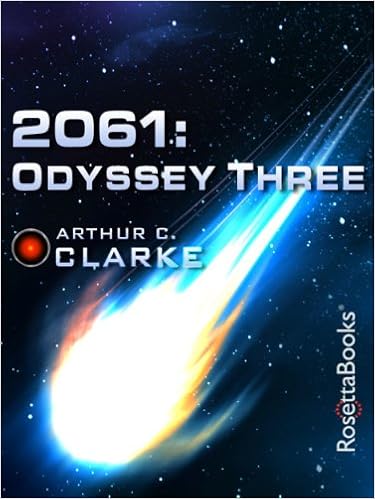
2061: Odyssey Three, by Arthur C. Clarke
We continue this week with the third of the Space Odyssey series, 2061: Odyssey Three. The selection of this year by Clarke is chosen to line up with the next return of Halley's Comet to the inner solar system, an event I hope I may be able to witness myself when I'm some seventy-odd years old. Of course, in this rapidly changing timeline from our own, humanity is in a position to launch a manned expedition to visit the surface of the comet. While we have managed to land robotic probes on a comet fairly recently, for right now the possibility of a manned mission remains unlikely. Although I may have the good fortune to be proven wrong in forty years.
I'm not sure if I have as much to say about this book opposed to the other two books. The monoliths and their mysterious creators, with their plan to foster intelligent life through the galaxy, are barely mentioned at all in this book. It's more a case of things happening in the same universe, but at an almost mundane level instead of the fantastic. There is, of course, the issue of Lucifer which I held off talking about because it was a massive spoiler in the last book, but I can't really talk about this book intelligently without mentioning it. So, of course:
Spoilers Spoilers Spoilers! Skip the following paragraph to avoid!
At the end of 2010 the monolith or perhaps monoliths, it's a little vague because they may have the ability to warp time itself, altered the mass of Jupiter and forced it to implode, creating a small star and turning our solar system into a binary system. The new star is named Lucifer and its moons, especially Europa and perennial favorite Ganymede, become hospitable to life because of their new proximity to a star. Humanity is also given a brief message, stating they are welcome to populate as many worlds as they wish, except for Europa. Ostensibly this is part of the monoliths', or their creators', plans to foster intelligent life in the galaxy, with Europa being identified as another potential cradle of intelligent life. Humans are of course intrigued by this forbidden fruit, but for now all attempts to interact with the planet's surface have been mysteriously intercepted.
The book has two plots which run sort of simultaneously, although the second one ends up taking over the plot and forces the first one to wrap up pretty quickly. The first is the aforementioned manned mission to Halley's Comet, an event of incredible historic, scientific, and cultural interest. Included among these delegates is Heywood Floyd, now just over one hundred years old, one of the handful of men who first examined the monolith on the moon, and now practically the only survivor of the mission to recover Discovery from Jupiter. More importantly, it shows how far humanity has come in the development of space travel, now being able to take a pleasure cruise to a comet.
The second plot involves Dr. van der Berg, a geologist working on the newly founded colony on Ganymede. Van der Berg has been very interested in the mysterious cloud-shrouded Europa and a chance satellite image begins van der Berg on an investigation that reveals Europa may have far more interesting secrets to reveal. And while I won't reveal them here, let's just say I think it's hardly a coincidence that it's a Boer, Afrikaner geologist that happens to discover it. Ultimately this plot ends up taking over the second one and in its own way helps set up the final book in the series.
I'm sort of left with the feeling that Clarke had two ideas for books but couldn't quite flesh them out long enough so he melded them together to create one longer story. Once the excitement of landing on Halley's Comet is over, you kind of come to the realization, ''Oh yeah, it's basically a giant, dirty snowball.'' Which, you know, neat, and I'm sure there's tons of things to learn from it, but after the initial discovery it kind of wears off. I definitely feel that the second story, with the discovery of a massive secret on Europa and the intrigue that's involved could have used further development. We're introduced to shadowy organizations like Der Bund and Shaka, although in the case of Shaka I'm not really sure on whose side they're supposed to be on. But that definitely could have been expanded into its own book with a little bit more corporate intrigue, IN SPACE!! But instead it gets welded to the comet story. Neither of them are bad, it just feels a little awkward.
Overall it's not a bad book. I kind of like the two adventures in space and Clarke's ability to take the utterly fantastical and make it seem commonplace really comes to the fore here. There's almost none of the incredibly dramatic, flowery prose that came with the other books, which I personally don't care for and certainly didn't miss at all. By far this is probably the one that can stand on its own the most and reads as a pretty simple sci-fi adventure. Next week we conclude with 3001: The Final Odyssey.
- Kalpar
Tuesday, April 19, 2016
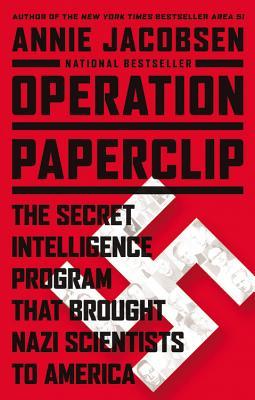
Operation Paperclip: The Secret Intelligence Program That Brought Nazi Scientists to America, by Annie Jacobsen
This week I'm taking another look at World War II with Annie Jacobsen's Operation Paperclip, which was actually read by the author in this audio book. Although to me it wasn't read with the same level of passion as say, The God Delusion or The Secret History of Wonder Woman, I always appreciate it when an author is able to take the time to read their book for the audio edition. Furthermore, this is a very serious subject matter so I can understand why the author might not take a terribly light-hearted or conversational tone when it comes to talking about the subject material.
To provide some background for those of you who aren't aware, Operation Paperclip was a program run by the United States right after World War II, which was initially to retrieve military technology from the Nazis to help equip America's arsenals for the next war, assumed to happen with the Soviets within a matter of years. This very quickly expanded to a project of retrieving the actual scientists and technicians themselves and bringing them to America, giving them employment contracts with the U.S. government. There had been protests both within the government and from among the public who were aware former Nazi scientists were being hired, but these protests were soon drowned out by the interests of national security.
Jacobsen talks about three main areas where Operation Paperclip concentrated its focus: chemical warfare, biological warfare and medical research, and aerospace engineering with jet engines and rockets. These were three areas the Nazis invested considerable time and resources for development and, more horrifically, utilized large portions of unwilling test subjects or slave labor to contribute to the war effort. Thousands of political prisoners, forced into slavery by the Nazi regime, were worked to death in underground factories assembling Wehrner von Braun's V-2 rockets. Thousands more were worked to death at the chemical factors of I. G. Farben at Auschwitz, or were used for tests of nerve gases. And many more people met their deaths in horrific medical experiments at Dachau, experiments devoid of any morality. And yet the United States was all too eager to utilize not only the information gleaned from these atrocities, but also bring back the scientists who perpetrated such atrocities and place them in government employ.
One of the biggest challenges behind researching this topic is the amount of white-washing that has occurred over the past seventy years. Intelligence officials were well aware the United States ''officially'' had a policy against granting immigration visas to former high-ranking Nazis and if the records of many Operation Paperclip recruits had been thoroughly examined they never would have been accepted. So the recruiters purposely omitted certain details and provided sanitized histories of hundreds of scientists to help ease their entry to the United States. In interviews with the public, scientist such as Wehrner von Braun perpetuated this myth, claiming they'd been forced to join the party against their will and were interested in science rather than politics. The paperwork proving this wasn't the case was buried under a smokescreen of misinformation and to this day remains difficult to obtain under the Freedom of Information Act or, perhaps also likely, it was intentionally lost decades ago. If there is no other reason for this book, it's to remind people that Americans compromising moral values for short term gains in ''national security'' is hardly a new thing. It in fact has a long and depressing history in the United States.
I think the worst thing about it was this program was sold to the American people as promoting American industry through peace technologies. In fact, at least within the focus of Jacobsen's book, the researchers they recruited were almost entirely for military purposes. Certainly there are peaceful uses for the medical research performed by Nazi scientists, especially in the areas of aeronautical medicine and hypothermia research. (Which isn't to downplay how truly horrific that research was under the Nazis.) But research and production of deadly nerve gases and mind-altering drugs, as well as the weaponization of biological contagions hardly has very useful peace purposes. Thankfully the tons of nerve gas manufactured by the United States was never used, but there's a certain irony that we spent a great amount of money manufacturing it, only to spend even more money safely disposing of them.
The most visible, and probably memorable, use of Nazi technology was the budding space program which eventually culminated with American missions to the moon. However, even this had military purposes, at least initially. Wehrner von Braun argued stridently that the United States should weaponize space before the Soviet Union did and advocated the construction of a space station capable of launching nuclear weapons from orbit. Thankfully these plans never came to pass, but it certainly takes some luster off of the American space program.
Although the bulk of the book talks about the researchers in the fields of rocketry, biological, and chemical warfare, Jacobsen also spares some time to talk about the Nuremberg Trials and operations such as Camp David and the Gehlen Organization after World War II. Although much press is made over the high-ranking Nazis who were convicted and some of whom were executed at these trials, there were many others who were quietly acquitted because they were needed for the interests of ''national security''. And some war criminals were released after serving laughably short prison sentences considering the enormity of their crimes. It tragically undermines the morality the Nuremberg trials were supposed to espouse, making them seem more and more like the show trials of victorious nations. On top of that, the CIA pioneered the use of blacksites, sometimes with former Nazis employed as agents, at Camp King in Germany, beginning yet another unsavory part of American history.
Overall this book is rather depressing but extremely necessary. All too often we like to think of America, especially during World War II, as being nothing but good guys. However as the Cold War began America proved there were no depths they weren't willing to stoop to in the sake of keeping the world ''safe'' for democracy. Unfortunately, even today we're all too willing to compromise principles for the sake of national security, which I'm sure will have unfortunate consequences for us in the future.
- Kalpar
Subscribe to:
Posts (Atom)