Today I'm looking at a biography of Edward III, a king who definitely influenced English society for many years after his death and to some extent today, but is usually overlooked in popular histories of the English monarchy. Just looking on Goodreads it looks like Mortimer has done a lot of writing about this time period and he has very good credentials. I bring this up because Mortimer makes a very, very bold claim in this book which contradicts most of conventional history for the past six hundred years. On the one hand, I don't want to be reactionary and dismiss Mortimer's arguments simply because they don't fit established dogma. But on the other hand, I feel like Mortimer's argument isn't completely proof against criticism. Unfortunately I simply don't know enough about Edward III to determine whether these facts are correct.
For the sake of simplicity I shall refer to the author as Mortimer through this review while Roger Mortimer will be referred to as Roger.
The main issue with this book is Mortimer's assertion that Edward II did not die in 1327, which has been generally accepted as true for the past six hundred years. Mortimer asserts that Edward II actually lived in exile for at least another decade, finally dying possibly sometime in the early 1340's. Mortimer draws extensively on the Fieschi Letter, a document from about 1337 written by a papal notary to Edward III explaining the whereabouts of Edward II for the past decade and where he was currently. The letter claims that Edward II escaped his captors, managed to make his way to Ireland, and then eventually France where he traveled as a pilgrim, visited the pope in Avignon, and eventually headed to Italy where he lived as a recluse. Mortimer argues that instead of escaping Edward II's jailers released Edward and, realizing he could never gain the political capital necessary to take back the throne, spent the rest of his life in exile.
I did some digging on my own and I did find that the Fieschi Letter is considered to be genuine, that is it is from the fourteenth century and probably written by Fieschi. The debate largely centers around whether the facts argued in the letter are true. Personally I find a couple of things with this argument that don't make a lot of sense. First is Mortimer's assertion that Roger Mortimer and Queen Isabella let Edward II flee England. While I could understand Isabella not wanting to off her husband, I'm not sure why Roger would be willing to let Edward disappear. Through his actions it definitely looks like Roger was set to supplant Edward III as king given the right opportunity and establish his own dynasty. Having previous monarchs around alive is usually problematic for a usurper because rebellions can rally around the deposed monarch and the cause to reestablish them on the throne. Edward II, as unpopular as he was, would simply be too dangerous to Roger alive and his political position would be much more secure with Edward II safely (and very publicly) dead.
Another problem is Mortimer's assertion that Roger used the knowledge that Edward II was still alive after 1327 to blackmail Edward III. Mortimer supports this with the Earl of Kent's rebellion in 1330 on rumors that his half-brother Edward II was still alive, followed by Kent's capture and execution at the behest of Roger. Mortimer argues that Roger used the fact Edward II was still alive as a threat to Edward III with the son potentially being replaced by the father. Personally, I don't think this makes terribly much sense. I think it would be all too easy for Edward III to reveal that Roger had lied to him, the king, and put Roger in an untenable position. Roger had already gone through the effort of having Edward II effectively deposed by Parliament and put into prison so the underage Edward III could take over with Roger as regent. If Roger wanted to exert control on the young Edward III, I think he could have just as easily used the threat of deposition and death on Edward III. Roger's done it to one king already, why should he have scruples about doing it to another?
I'm just not sure if Mortimer makes enough of an argument for Edward II living past 1327 for it to be fully convincing. It's certainly within the realm of possibility, but Mortimer just doesn't seem to have enough evidence. Plus, the fact that he gets incredibly defensive about his hypothesis in his writing and makes some disparaging remarks about the historical ''establishment'' doesn't help his case at all.
Understandably, this major departure from what we know about Edward III, as well as lack of evidence, does make me doubt the veracity of the rest of his book. What I know about Edward III mostly comes from David Starkey and his student Dan Jones. Quite a bit of what Mortimer described matches up with what Starkey and Jones covered, so I want to tentatively say that otherwise this is a pretty good biography but I simply don't know enough about Edward III to say definitively one way or the other. Plus, the incomplete and inaccurate nature of documentation from the time means there are going to be confusions and inaccuracies
I think if you're looking for an in-depth biography on Edward III, this is definitely worth your time to read, although you might need some context. I know I had to look up what exactly the wool subsidy was as it related to taxation. The biggest issue really is the Edward II hypothesis and I've already gone into that into detail.
- Kalpar
Tuesday, December 19, 2017
Thursday, December 14, 2017
The Diamond Conspiracy, by Pip Ballantine & Tee Morris
Today I'm looking at the fourth book in the Ministry of Peculiar Occurrences series, The Diamond Conspiracy. I think the biggest issue I had was I let there be a considerable gap between the time I listened to the last book, Dawn's Early Light, and this one because I had forgotten a few details and found myself struggling to catch up with plot points. I'm mentioning this now because it's not really a critique of the book more than a failing on my part. However, this series in general has left me feeling ambivalent at times or just not really sure what to think about the series.
The Diamond Conspiracy begins with Wellington Books and Eliza Braun heading back home to England after foiling an evil plan of Thomas Edison in America. On the way back, though, Books and Braun discover that the Ministry has been disavowed by Queen Victoria and her government and a rival organization, the Department of Imperial Inconveniences, has been sent to eliminate all Ministry agents. Worst of all it appears the Maestro, the alter-ego of the Duke of Sussex, is entering the endgame of his master plan which will come to fruition at Victoria's Diamond Jubilee. Books, Braun, and the other survivors of the Ministry will have to team up, on the run and with limited resources, to rescue the queen and the Empire.
Overall I though the plot had some promising points. The agents being disavowed and fighting their own government is an interesting plotline. If nothing else it gets our agents out of London and relying on their own resources rather than the Ministry's. I do felt like this book was maybe, maybe just a little too long. I think Ballentine and Morris did enough groundwork that you could fully guess where the last quarter or so of the book was going to go, and their detours and explorations just dragged out the conclusion further than necessary. I kept finding myself thinking, ''Dang, is there still more of this book?'' So I think there was a little bloat, yes, but it doesn't really get noticeable until the end.
I think the biggest issue I had was the introduction of preexisting characters, both historical and fictional, into the story at this point in the series. Having Queen Victoria be in the series makes perfect sense. She is the queen, and the Ministry is a government agency that reports to her, so she's going to show up. And I didn't mind Thomas Edison showing up as a villain in the last book. He definitely seems like the sort of person who would collaborate with a shadowy organization like the House of Usher to build superweapons. Also Edison's a jerk. So it makes sense.
No, the issue I have is the introduction of other people who I didn't think made the plot better. For example, H.H. Holmes, the notorious serial killer, gets a cameo as an operative of the House of Usher. Basically he shows up, is creepy, and then leaves. Maybe he'll show up in later books and have more of a role, but it just felt gratuitous to me. The authors also introduce H.G. Wells which makes the universe feel a lot smaller than it was and it doesn't make a whole heck of a lot of sense to me why he'd keep going by a different alias every decade. And then there's the introduction of John Carter (of Mars) who really exists just to supply a War of the Worlds style Martian Walker for the final epic showdown between the Ministry and the Maestro and his forces. And while a battle between a Martian tripod and steampunk battle mechs would in theory be really awesome, by the time the book got to the battle I was so bored I just wanted it to be over, which was a real shame.
So I'm left not sure what to think about this book. On the one hand, there are interesting concepts and cool secret agent adventures. On the other hand, the book does feel like it could be trimmed down and I'm not sure how much I like the references to other works by the inclusion of other characters. (And it's definitely possible there are other references in the other books that I just missed.) The result is I feel like this book is okay, but definitely not among the best things I've ever read.
- Kalpar
Tuesday, December 12, 2017
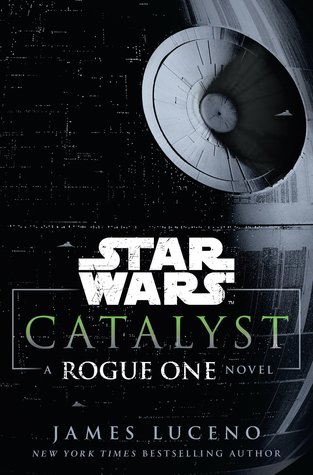
Catalyst, by James Luceno
Today I'm looking at a book called Catalyst set within the new Star Wars universe after the reboot/realignment/whathaveyou after the Disney purchase of the franchise. Catalyst takes place over several years, starting during the Clone Wars and ending sometime before Rogue One begins. The book is mostly about Jyn Erso's parents, Lyra and Galen, as well as Orson Krennic. (The guy with the white uniform in Rogue One if you weren't sure.) As you might also guess from the cover, the book has a lot to do with the Death Star project and Galen Erso's initially unknowing cooperation in the development of the Death Star's planet-killing superlaser.
The book begins with the Ersos being on a remote planet of the galaxy involved in research of kyber crystals, the crystals used in lightsabers, and their incredible energy potential. Unfortunately for them, the Clone Wars results in a shift of planetary government and Galen finds himself imprisoned on suspicion of being a Republic spy. Fortunately Krennic, an old school friend of Galen's and involved in the highly secret Republic superweapon project, puts together a rescue team. However this proves to be a mixed blessing because Krennic's real motivations for helping the Ersos is to get Galen, even somewhat indirectly, to start working on crystal technology that can be applied to the superweapon.
My overall opinion of the book is it was okay, but not really worth the effort of reading or listening to. It has that major problem of prequels in that we know the main characters are going to survive to the point where they started in Rogue One so there's not a lot of tension for bad things happening. Despite all the setbacks Krennic suffers, we know he's going to survive to be an antagonist in Rogue One with CGI Tarkin. Despite the horrible discoveries into Imperial plans the Ersos make, we know they're going to make it to their farm. As I've said before, a good prequel manages to make you doubt how it's going to end, even though you already know the ending, and I think that was the biggest strength of Rogue One. Even knowing that the Death Star plans were going to get to Leia by the end of the movie, I still wasn't certain that Jyn and Cassian would get the message through in time. Catalyst just lacks that same tension which makes it a bad prequel.
Another big issue I had was this book started raising some serious questions about the Death Star. I know that it's kind of silly for me to say the Death Star is unrealistic. I mean, it's a giant moon-sized space station capable of destroying a planet, as well as travelling through hyperspace. It's inherently a ridiculous notion. The problem I have is how under wraps the entire project manages to be successfully kept secret for two decades. Sometime during the Clone Wars the Republic actually begins construction of the Death Star, called the Ultimate Weapon. In the book it's implied that a whole government committee is involved in overseeing the project and getting regular status updates on it as well. And there are two things government committees spawn, regardless of the universe they're in: paperwork and more committees. I don't think Luceno exactly states how many people are involved in these committees but I got the impression it was fairly large, which would make it nearly impossible to keep everyone from talking about it.
And then there are the sheer number of resources involved as well. The Empire is literally stripping planets bare to come up with the resources to build the Death Star, along with their Star Destroyers, TIE fighters, AT-ATs, and who knows what else. In the book it's stated that all the Death Star resources get hidden in the huge ledgers of materials the Empire is using, but considering the Death Star's being built at Geonosis and there are no major shipyards or other factories there, you'd think people would start wondering. I could see the Death Star being built and kept secret over a period of three or five years. That makes sense to me. But two decades stretches my suspension of disbelief, even for Star Wars.
We also sort of get the religious elements of kyber crystals, and yet not really. We do see Lyra being a Force...devotee I guess? Like she believes in the Force as a religion but I got the impression she wasn't actually Force-sensitive. Space magic is weird. And it's mentioned that other people worship the kyber crystals as well sort of like what we saw on Jedha in Rogue One. But aside from sort of a vague explanation that the crystals are magic, we don't really know why people hold them to be sacred. I kind of wish there had been more of an explanation for this because it still seems really odd to me.
We also get an environmental message in the book through Galen Erso's quest to find ''sustainable energy'' from kyber crystals, and seeing how the Empire is strip-mining Legacy Worlds to build its Death Star, basically the equivalent of strip-mining a national park. The sustainable energy bit doesn't make a lot of sense to me because it's already established that the Star Wars universe has fusion power, currently something of a holy grail in the sustainable energy. So if you have fusion reactors, why the heck do you need more sustainable energy? Are you running out of hydrogen? It just raises too many questions. Second, the Empire strip-mining nature reserves is played for shock value when honestly that's one of the less evil things they've done. Don't get me wrong, it's bad, but corporations would do the same thing if there was money in it. Considering the Empire enslaves people and destroyed Alderaan, I think we've firmly established that the Empire are the bad guys. Seriously, remember Alderaan? And how they blew it up? And were going to blow up any other planets that resisted them? They're evil! Of course they strip-mine planets! They probably kick puppies too.
The result is a book that it honestly doesn't feel worth the effort of reading. If I really, really want to know how the Death Star was constructed, I could probably just look it up on Wookiepedia, and get several different versions of the story. The Ersos and Krennic don't feel very well developed as characters so I found it difficult to care about what happens to them before Rogue One. Add some issues like the heavy-handed but out of place environmentalism and it just makes the book feel worse. I think I can honestly say you're not missing a whole heck of a lot by skipping this book.
- Kalpar
Thursday, December 7, 2017
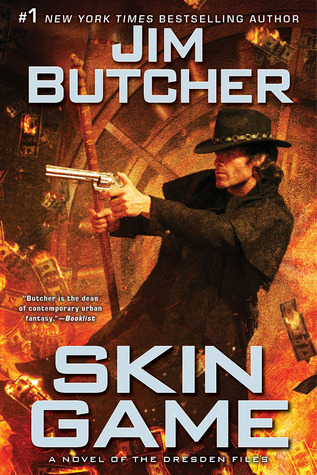
Skin Game, by Jim Butcher
Today I finally come to the (as of writing) end of the Dresden Files series with the novel Skin Game. I actually liked this book quite a bit and I think part of it was it went a little outside the rut that I'd felt the series had fallen into. There's some big world-ending emergency and Harry has to go save the world, which we've been seeing a lot in the series lately. In this book the stakes are much lower, so it feels like a breather and we're back to Harry having awesome magic adventures.
Dear and gentle readers, as I have said before with this long-running series, it is basically impossible to speak coherently about this book without going into some spoilers. If you wish to avoid such things please turn back now.
The problem for this book is the parasite in Harry's head that's been growing and causing the migraines he's been suffering. Unfortunately for Harry it's getting very close to the point the parasite will burst straight out of his head and kill him. Mab is willing to help Harry with his problem, but as always with fairies there is a price. And since Harry's the Winter Knight, he's not in much of a position to say no either. It turns out that Mab owes a debt to Nicodemus, leader of the fiendish Denarians, and she intends to repay that debt by loaning Harry and his services to Nicodemus. Harry, understandably, is not exactly thrilled with this idea but Mab being Mab she's put him in a position where he can't exactly refuse.
The job that Harry is obligated to assist Nicodemus with is a robbery of a treasure vault belonging to Hades, lord of the Underworld. Yes, that Hades, the Greek god. Obviously the treasure vault of one of the most covetous and powerful figures out of mythology is going to be absurdly difficult, if not impossible, for anybody to break into. Hence Nicodemus has assembled a team of top criminals from the magical underworld including a fire mage, a shapeshifter, a spirit binder, and one of the best ordinary human safecrackers to pull of the heist of the millennium. Now, ordinarily I don't go around watching, reading, or listening to heist stories, but they can be fun from time to time. And since this is a magical heist story, where the characters have to break into a vault protected by more than just mundane defenses, it makes the story all the more interesting to me.
There are a few other interesting developments in the book which I thought really showed how the series had grown. Waldo Butters, originally the timid polka-obsessed medical examiner, has become something of a magical vigilante, making use of low-magic devices and the help of Bob the Skull to help make the mean streets of Chicago a little safer. (And without spoiling it, Butters gets a truly epic moment towards the end of the book. Seriously. It's awesome.) Harry also finds out that the ''parasite'' in his head is actually a spirit of intellect that he and Lash, the shadow of the fallen angel Lasciel, created and has been growing in his head. The migraines have been because she's getting too big for Harry's head (not a surprise) and needs more room to grow. Granted, she's only very, very barely in the book, but I'm actually looking forward to seeing her in future books. Although I sometimes wonder how smart a spirit of intellect that comes from Harry's head really can be.
Overall I liked this book and I think it was because it was a change of pace with some awesome tidbits. Because the stakes are lower, only robbing the vault of the lord of the underworld opposed to saving the entire world, it feels like a little breathing space and we can have some more fun with the adventure. However, the overarching plot does get advanced at least slightly and we get to see Harry continue to develop, as well as quite a few other characters. Hopefully I'll get to see where the series goes from here.
- Kalpar
Tuesday, December 5, 2017
Hunter, by Mercedes Lackey
Today I'm looking at the first book in a new series by Mercedes Lackey, Hunter. I have talked about Lackey a few times on the blog before, specifically her book Gwenhwyfar, which I consider to be hands-down the best Arthurian retelling I've ever read. Lackey also wrote several stories for the Bolo series and I thought they were pretty good as well, so I was eager to try something else from this author from my public library's audio book collection.
Hunter is set in the distant future, some two hundred and fifty years after an event known as the Diseray when the boundaries between our world and the Otherworld were broken and all the monsters of folklore managed to come back and invade our world. Things were falling apart all over but fortunately humans had a few things going for them. First, the military was able to scavenge equipment and utilize modern weaponry to take on some of the worst monsters, as well as develop barriers that Otherworld monsters couldn't cross. Second, magic also entered the world and about one to two percent of the population developed magical talents which they could use to fight the monsters. Most important of all, a portion of those with magical abilities became Hunters, forming a psychic bond with Otherworld creatures known as Hounds. With a pack of Hounds to aid them, Hunters are the greatest weapon humans have in their fight for survival.
The book focuses on Joyeaux Charmand, a Hunter who grows up in mountain villages near a monastery in the Rocky Mountains. Life seems to be going okay until her uncle, head of the police, tells her she needs to report to the capital city of Apex, to join the teams of Hunters located there. When Joy arrives she discovers the Hunters are actually a form of entertainment for the civilian population of Apex, with each Hunter getting their own video streaming channel, and the most popular Hunters with the most fans get the best benefits. Joy also very quickly gets told everything is not as it appears in Apex and she may be used as a hostage against her uncle in a mysterious shadow political struggle.
As much as I hate to make the comparison, this book reminded me a lot of The Hunger Games, and not necessarily in a good way. I think partly this was because Joy and the other Hunters were a form of entertainment for the civilian population. They may be competing with each other indirectly, but they're still involved in fighting for people's entertainment and to distract the civilian population from how things have actually been getting worse in Apex and there are more monsters than ever. Plus there's the whole dystopian nature of Apex, with people apparently being jailed for sedition and a large gap between the haves and have-nots. There are elements where it definitely feels like this book is trying to cash in on the dystopian theme that's been running around fiction, especially young adult fiction, for quite some time now.
The biggest problem is I don't feel like it's done terribly well. Lackey doesn't do a great job in this book of showing us how everything is a dystopia. We're told about people being jailed for sedition, treason, homelessness, and other crimes, but we never really see police rounding people up or the inside of one of the prisons or anything like that. The Hunters patrol the slums for monsters, but they don't seem to interact with the poor segments of the population all that much, spending all their free time in the pleasant, gilded center of Apex. That at least is where Hunger Games shone, in my opinion, was by showing the dystopian nature of the government and its pervasiveness. Here it just doesn't feel quite the same.
Joy also kind of suffers from designated protagonist syndrome in this book. She has seven Hounds, meaning she has more hounds than almost everyone else, as well as being super-strong magically speaking. Before she even gets to Apex she faces down a magician of the Folk (basically fairies) and manages to get him to leave an entire train alone. I didn't track exactly how long the events of the book took, but it definitely felt like the entire book took less than a month in story time and that feels like far, far too short a time for everything that goes on. I will grant you that Joy is an experienced Hunter with several years of fighting monsters under her belt, but even with that taken into consideration it feels far, far too generous. And as a result the book just feels rushed, in my opinion.
So I'd say this book is okay, but I wouldn't say it's great. There are some good ideas in here and Lackey is a very good writer, but it feels like it's borrowing far too much from the current trend of dystopian sci-fi/fantasy novels. Obviously those books are popular because people are really digging that sort of thing right now, but after a while I do feel like it becomes more of the same thing. If this seems interesting to you, I'd say check it out, but don't expect too many great or new things to come from this book.
- Kalpar
Thursday, November 30, 2017
The Dark is Rising Sequence, by Susan Cooper
Today I'm looking at a series of books I read a long, long time ago when I was a kid. I actually realized they were available as audio books from the library. The series is loosely connected to Arthurian myth, being set in Cornwall and Wales, and relating to the struggle between forces known as the Light and the Dark over magical artifacts such as a grail, a harp, and a magic sword. If you're interested in reading or listening to the books they are, in order:
- Over Sea, Under Stone
- The Dark is Rising
- Greenwitch
- The Grey King
- Silver on the Tree
I say the series is loosely connected to Arthurian myth because it's set mostly in the ''present time'' of the late 1960's and early 1970's, when it was written. The imagery, ideas, and even names from Arthurian myth and other British folklore get used extensively, and Merlin is even a main character in the series. But for the most part the Arthurian mythos is used to let you know how important the different artifacts are, assuming you'll be familiar with the names. And I think that was the biggest problem I had when I was a kid reading them the first time. I knew a little bit about Arthur, and I liked the stories I could get my hands on, but these were the highly filtered, sanitized for kids versions so I didn't understand the references to various objects or other legends. And so I think if you're unfamiliar with a good chunk of the Arthurian mythos, you're going to be a little confused by some of the objects and names.
The first book, Over Sea, Under Stone, is definitely different from the other books in the series and has far less magic than the other four. It's been described more like a mystery adventure than a fantasy novel, so it's an example of early installment weirdness. The rest of the books go much deeper into the struggle between the Old Ones of the Light and the Lords of Darkness who are trying to influence the world. How their magic is done is only vaguely explained at best, with Will Stanton the last of the Old Ones reading a book that teaches him everything he needs to know about magic. There are some references to the Old Magic, the High Magic, and the Wild Magic and different ways that magic can be done, but for the most part it's fairly unexplained.
The Old Ones, and the Lords of Darkness, seem mostly able to influence time through magic. They're capable of going outside of time or, when conditions are right, stepping from one time to another. This causes some of the weirdness of the books because a lot of the really magical stuff happens outside of regular time in a Britain that is and yet isn't. The struggle between the Light and the Dark is also an attempt to either fulfill or thwart a prophecy that the Light will finally triumph, and the conflict takes place through time and yet out of time as well.
Basically the Dark is blamed for a lot of bad things happening to Britain, such as the invasions by the Angles, Saxons, Danes, Jutes, and Normans, as well as other times when the Dark has been able to exert influence. However the rules are that neither Light nor Dark is able to completely destroy the other so the Light is always to create a bastion of hope to ensure that humanity will continue and the Dark will not prevail. Until of course the final conflict which takes place in the 1970's when all the artifacts are found, rather quickly as a matter of fact, and the Light is able to use the artifacts to banish the Dark forever from the world. Granted, this does not banish the darkness in men's hearts, but it provides hope for the world to endure.
Overall I have mixed feelings about the series. On the one hand it shows enormous creativity on Cooper's part, such as utilizing magic to time travel which I don't see very often, and the series has a pretty good message that despite the bad influences such as greed, cruelty, and arrogance if we fight to keep hope alive we can always drive back the darkness. On the other hand Cooper doesn't explain a lot of stuff in the book and it left me, even as an adult, sort of confused more than anything. If you don't know the Arthurian references you're definitely going to be lost, and even then there's a lot that simply isn't explained. It implies deep ideas for world-building but we just don't get to see how complex the story could have been. It certainly doesn't get bogged down in exposition so it keeps a fairly brisk pace, but I feel like that might ultimately be to the book's detriment.
Despite all of this, the books are certainly interesting and I would say worth your time to check out. It definitely feels different from any other fantasy books out there which makes it stand out when so many things can sort of blend in with the rest of the competition.
- Kalpar
Tuesday, November 28, 2017
Perdido Street Station, by China Mieville
Today I'm looking at Perdido Street Station, the first in a series of steampunk-ish novels by China Mieville. I'm kind of mixed on this book for a couple of reasons. When I read the blurb for whatever reason it reminded me a little of Fallen London, another really gritty steampunk city, albeit seen in video games rather than novels, and from time to time I kept imagining the city of New Crobuzon underground, although that's clearly not the case. There are good parts to this book, but there were also parts that I found frustrating as well.
Perdido Street Station is set in the universe of New Crobuzon, a massive city located, at least partially, under the bones of a massive creature, although this book doesn't go into great detail about the creature or what people know about it so maybe that will be covered in a later book. New Crobuzon is a police state dominated by the Militia, an organization with informers and agents throughout the city and who often strike out of nowhere to haul lawbreakers to be Re-Made in the Punishment Factories. Usually the judges prescribe some cruelly ironic punishment such as a thief that refuses to speak has their mouth sewn shut. Which definitely adds to the grim and creepy nature of the setting.
The biggest issue I had with this book was it felt like it took the longest darn time getting to the actual plot, mostly because there were several plot threads that only gradually get woven together. In the beginning of the book we get introduced to Lin, a member of a species that look like humans except they have giant scarab beetles for heads and can produce sculpture through a cement-like spit they exude. Lin is one such artist and gets hired by a local crime boss to create a sculpture of himself. Meanwhile her lover, normal human Isaac Dan der Grimnebulin, has been hired by a bird person named Yagharek to fashion a new set of wings, since Yagharek's own wings were cut off by his tribe. And then there's their friend Derkhan Blueday, a writer for a radical and highly illegal newspaper. Plus the cleaning construct in Isaac's lab is acting strangely and the government of New Crobuzon is increasingly worried about some compromising information.
So that was my biggest problem was there were all these different threads and they eventually came together to make a single plotline and made sense in the grander scheme of things but they felt very disparate and it took quite a bit of time before we started seeing how all the different plotlines were joining up. If this book was condensed a bit more I'm certain it would be a much shorter novel and it would probably have a much better pace as well.
The thing I noticed, especially when I kept being amazed that this book was still going is that Mieville gets very Dickensian with his writing. Which is to say, extremely to the point of excessively detailed because Dickens was paid by the word so he would make the sentence as long as he could and go off on tangents and parentheticals just to get more money, Dickensian. On the one hand, this is good because Mieville manages to make his universe feel deep and complex through world-building and making it feel like New Crobuzon is a city with an actual history rather than something he just made up. On the downside, it bloats the book out considerably and there are some passages that are utterly egregious and add nothing to the story.
For example, there is an adventurer who is hired by the main characters to help them solve a problem during the book. After a while the adventurer decides she's had enough and she's cutting and running. Sorry, but she's a professional, she's not in it to get killed. All well and good. What follows is a passage describing the adventurer's departure from the city, reflections on the events, a brief discussion of her species's preferred method of architecture, (They're sort of frog people? Definitely amphibian.) and then her decision on what she's going to do now in the future. And honestly, I couldn't have cared less about what this character was going to do. She was barely, just barely in the novel and mostly some extra muscle the main characters had hired on with little to no characterization. I would have been perfectly happy with her waving goodbye and leaving, which is what she did initially, rather than going into an entire tangent about the character. Maybe Mieville means for this character to be important in later books, which is why he focused on her, but it seems entirely unnecessary in this book.
And even with the world-building I feel like the author resorted to a deus ex machina towards the end of the novel. The actual thing is mentioned before in the book, but only very briefly and dismissed as a myth so it still comes as a bit of a surprise when it shows up.
So that's really the biggest problem I have with this book, it feels super bloated with extra information. That feels cool for a bit, but after a while the exposition gets really boring and starts distracting from a plotline that is, in theory, time-critical. I think if Mieville was trying to add a sense of urgency to the plot, adding a bunch of exposition and making the book take a languid pace was not the best way to go about this. There's definitely a lot of good world-building but I think there's a lot that could have been left out and the book wouldn't have suffered. If you do read this be prepared for a lot of exposition.
- Kalpar
Subscribe to:
Posts (Atom)