Today I'm looking at a book that talks about an event I only knew of through the final line to Warren Zevron's song Roland the Headless Thompson Gunner, the kidnapping and conversion to terrorist of Patricia Hearst in the 1970's. For many people this was a truly bizarre and confusing event. A member of the prominent Hearst family gets kidnapped by the Symbionese Liberation Army, a radical group that people have only heard of in connection to the murder of Marcus Foster, a local and highly popular superintendent of schools.
After a series of incoherent messages with the only clear demand being the Hearst family bankroll the distribution of food to needy people in California, the SLA breaks off contact only to resurface with Patricia Hearst, their captive, now a member and involved in a prominent bank robbery. The majority of the nine members die in a shootout with police in Los Angeles, but for more than a year Patricia Hearst and two other survivors manage to evade capture for over a year. It's almost by accident that Patricia gets arrested and after serving less than two years of a seven year prison sentence, she gets a commutation from president Jimmy Carter.
Overall these events seem strange and confusing, but if Toobin does anything right, he manages to put everything into context and make it much more understandable for the reader. What emerges is a narrative not of random events and brainwashing of heiresses, but a young woman who goes through what might charitably be called a rebellious phase. By the time of her kidnapping, Patricia saw her future as largely fixed. She was a trust fund heiress so there was no need to work for a living, and she was already engaged to be married. Despite going to UC Berkeley her life had become confined to a narrow domesticity which threatened to dominate the rest of her life. Patricia Hearst may have gone on to become just another of the socialite set of baby boomers except her world was violently interrupted on February 4th.
For someone who felt trapped by life and was yearning for something different and meaningful, is it any surprise that Patricia came to adopt the ideology of the SLA? Toobin makes it very doubtful that they brainwashed her. Aside from one murder, one kidnapping, and a handful of bank robberies the SLA failed to do almost anything correctly and the disparate political opinions, some of which weren't terribly developed, meant the SLA had more a broad outline rather than a specific platform. Indeed, once the SLA kidnapped Patricia, Toobin points out they seemed utterly at a loss for what to do with her and quickly lost sight of whatever ransom demands they might have had.
But with individuals in the SLA talking to Patricia about political philosophies she hadn't even encountered and reading from socialist and communist texts, they probably presented Patricia with an alternative to the narrow lifestyle she had seen before her. So while it's somewhat surprising, it's understandable why Patricia may eventually join with her kidnappers. Toobin also dismantles through several examples, including times Patricia could have very easily escaped, why Patricia's argument that she joined the SLA out of fear for her life simply doesn't hold up under inspection.
Following her arrest, her desire to rejoin the life she had before her kidnapping is even less surprising. The conditions of the SLA were quite terrible, going from bad to worse and at some points resorting to eating horse meat and beans. The comfort and security of her privileged lifestyle would have been a powerful lure to Patricia, especially with the prospect of a lengthy prison sentence looming.
Finally I, and it seems Toobin, are left with mixed feelings about the commutation and later pardon of Patricia Hearst. On the one hand, Patricia definitely showed that she had recognized the wrong of what she had done, and had reformed for her crimes and would become a productive and law-abiding member of society again. On the other hand, she definitely only got such treatment because of her family's extensive connections and it can quite cynically be seen as the rich escaping justice. It's a hard question and since it's all in the past it's largely irrelevant, but it does reveal a divide all the more prevalent today.
The story of Patricia Hearst is important because it reflects deep issues in the United States that are still affecting us today. The civil rights movements of the 1960's morphed into the violent countercultures of then 1970's, along with a variety of other bad events for the United States. High oil prices, a stagnant economy, a corrupt president, and a decline in law and order saw the seventies become a decade of despair and frustration. The surge of modern conservatism, with its roots in Ronald Reagan, saw its beginnings as a reaction to the violent counterculture of the 1970's, and we are still dealing with those result to this day.
This book is an interesting look into a troubled time of American history and how it had profound effects not only in the immediate, but long term as well. I think it's worth your time to investigate.
- Kalpar
Thursday, March 8, 2018
Tuesday, March 6, 2018
The Dungeoneers, by Jeffery Russell
Today I'm looking at another fantasy novel about professional adventurers, The Dungeoneers, by Jeffery Russell. Because this was a suggestion when I read The Palace Job (along with Orconomics) I was a little worried that this might end up being very similar to the other stories. Fortunately I can say that this book definitely has its own niche. On a sliding scale from most serious to most comedic I'd say this falls between the more serious nature of The Palace Job and the more comedic nature of Orconomics, with maybe falling a little further on the serious side. All that being said, this is pretty enjoyable.
The Dungeoneers begins with Durham, a guard who's worked at the sheep gate for the past five years and didn't expect his career to change terribly any time soon. When an order for him to follow a caravan arrives, he assumes it'll be some very boring babysitting for a merchant. Much to his surprise Durham discovers that the caravan he's been assigned to is a band of dwarves who professionally explore and loot dungeons for nobles, as well as retrieve powerful artifacts and keep said artifacts from ending up in the wrong hands. It seems there's been some mixup in the paperwork and Durham will be in far more danger than he possibly could have imagined.
The main thing I liked about this book was the idea of professionals who take out traditional fantasy problems in a manner different from what we're used to. (Although that may be because it bears a striking similarity to the idea for my own book, The Dragonslayer Manuscript) Thud, the leader of the Dungeoneers explicitly tells Durham that they're not adventurers or heroes. Those sorts of people wander into places and usually get themselves killed. The Dungeoneers are professional dungeon-delvers. They avoid risks, they carefully search for traps, they have a variety of equipment to solve problems, and they're willing to pull out gunpowder or a ballista to make sure everything goes smoothly. I like how Russell took the problem of looting a dungeon and took it to an incredibly straightforward and business-like solution.
The book does spend a lot of time on exposition and establishment because it's the first in a series so it's a little lighter on the things-happening parts. I want to say at least half the book was spent on exposition rather than plot, but within the plot we actually saw characters do things and use their skills, rather than just be told about it. Durham actually proves very observant for a guard and his skills come in useful for the party, and every dwarf on the team has their own unique talents. So I think Russell did a pretty good job there.
This is a fairly short read but it's interesting enough that I'm willing to consider getting to the next book in the series. (Although considering I have another thirty books to read that looks incredibly difficult right now) But if you like fantasy with a twist this is a good choice.
- Kalpar
Thursday, March 1, 2018
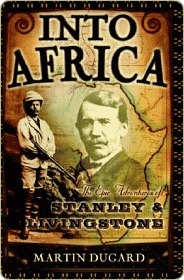
Into Africa: The Epic Adventures of Stanley & Livingstone, by Martin Dugard
Today I'm looking at a history of one of the major news events of the nineteenth century, the hunt for Dr. David Livingstone in central Africa after he had been missing for five years. White explorers going missing was hardly a novel occurrence and Livingstone was not the first, but the stature and fame of Livingstone meant Britain and the larger world knew his name, and the influence of newspapers keeping Africa and Livingstone in the public consciousness ensured a steady interest in the fate of the missionary and explorer. In fact it was a newspaper stunt that eventually found Dr. Livingstone, with reporter Henry Stanley of the New York Herald leading the expedition at the behest of the paper's editor. Stanley's words upon finding Livingstone in the town of Ujiji, ''Dr. Livingstone, I presume.'' have even entered the English lexicon Since I knew basically nothing but the most general details of this period of white men stumbling around and getting themselves lost in swamps in history, I figured this book was worth taking a look.
What precipitated Livingstone's expedition through jungles, swamps, deserts, and savannas was a debate over the source of the White Nile, one of the Nile's main tributaries. (Incidentally just doing a basic Wikipedia search it looks like there's still some debate over what counts as the ''source'' of the Nile) However there were several hypotheses being floated about by people who had actually tramped through Africa. One source that was known for certain was Lake Victoria, a large lake that sprawls across the modern countries of Uganda, Kenya, and Tanzania and which the White Nile definitively drains from. What was (and is) debated is if there was a source further south beyond Lake Victoria. Some hypothesized that a river or series of lakes and rivers connected Lake Tanganyika, further to the south, with Lake Victoria. Livingstone himself believed that lakes further south, such as Lake Malawi, might even be connected to Lake Tanganyika and Lake Victoria. Because of his status and reputation as an explorer, Livingstone set out on an expedition into Central Africa.
The thrill for the people back home was that central Africa was one of the last unknown places to Europeans. Nevermind that other people had been living there quite happily for thousands of years and had even traded with places as far away as China, to Europe it was terra incognita. So there was a great amount of romance of the brave, solitary explorer delving into the unknown, and Livingstone actually had a habit of going on these expeditions only with native porters and assistants. And this was not uncommon. Many expeditions of the time consisted of only a handful of white Europeans and a large train of African, Arab, or Indian porters, soldiers, and assistants. And if the Europeans should die, the hired help had little or no motivation to bring word back to European outposts in locations like Zanzibar. In fact in some cases, the porters and assistants were accused of murdering their employers, which made it even less palatable to report back to authorities. So once Livingstone disappeared into Africa, neither he nor word came back it was very unlikely anyone would hear from him again.
Stanley's was not the first expedition to go in search of Livingstone, but it was the only one to actually find him. A previous expedition had gone to confirm rumors of his death, but after finding convincing proof Livingstone was alive it returned to England. In many ways it was sheer good fortune that Stanley, an absolute neophyte when it came to traveling in Africa, actually met Livingstone at Ujiji. Both Livingstone and Stanley had been extremely ill during their expeditions, suffering from malnutrition, dehydration, and a variety of disease like malaria endemic to the tropics. Either one could have died before reaching the other. Livingstone could have failed to make it to Ujiji, where he hoped relief supplies was waiting for him. Stanley could have arrived before Livingstone, and spent all his dwindling supplies waiting or searching for Livingstone before having to return to the coast. It truly was a tremendous coincidence of good fortune for both men.
Overall I thought this book was interesting, although there's a certain level of crazy to these explorers who decide to go wandering through jungles and suffer all manner of diseases. I certainly would have headed back home at the first opportunity. Or never left home in the first place. I do suspect Dugard stretches or sensationalizes some facts, but I don't see any serious flaws with his methodology, especially considering the copious written material available for Dugard to draw upon for research. It is heavily from the European perspective, but that's hardly surprising. Dugard also tries to put things within the larger context of the nineteenth century, but it's mostly focused on the historical figures than the larger picture. If you're specifically interested in the life and work of Livingstone and Stanley, I think this book is a good opportunity.
- Kalpar
Tuesday, February 27, 2018
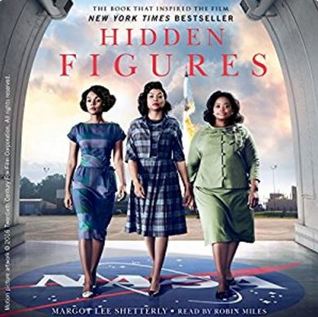
Hidden Figures, by Margot Lee Shetterly
Today I'm looking at Hidden Figures, a book you may remember coming out way back in 2016. I was recently able to borrow it from the library and because I had heard good things I decided it was worth reading about. Hidden Figures talks about the history of the black female computers who worked first for the aeronautical research laboratories at Langley Field and later for NASA during the height of the space race. These women, who literally did nothing but math for a living, have been overlooked in official and even unofficial histories of NASA. Shetterly began investigations because her father was a black engineer for NASA and knew many of the computers who lived in their neighborhood. As she continued her research Shetterly discovered that at least fifty black women worked for the Langley aeronautical research labs and/or NASA, and it's possibly a much greater number. This is to say nothing of the white women who worked in the exact same jobs but have gotten only slightly more recognition. Even Shetterly admits that her book only scratches the surface of the history of NASA's black women computers, but it's an important first step so further research can be done.
Today when we hear computer we think immediately of an inanimate object so ubiquitous it hardly bears thinking about. I am writing this blog post on a computer. You are reading it on a different computer. You probably use a computer at work, and so do I. But seventy years ago electronic computers were little better than theory, and complex mathematics had to be done at best with the aid of slide rules and mechanical adding machines. Because this was seen as drudge work, scientists and engineers were happy to pass the difficult task of actually doing the math to female computers.
During World War II, America's quest for air supremacy meant that massive amounts of money were spent on the research and development of new and better airplanes, and the aeronautic studies required massive amounts of calculations. Whether it was refining the SBD Dauntless, speeding up the P-51 Mustang, or getting a little more lift from the B-29, thousands of calculations had to be done to ensure American planes would win the war. But due to wartime shortages in labor, the War Department was looking for anyone with mathematical aptitude to work for their research labs. Thanks to this and an executive order from FDR prohibiting racial discrimination for federal jobs, an entire new set of opportunities were open not only to African-Americans in general, but specifically African-American women. Although they had to struggle with segregation within the laboratories, the black computers confined to a separate computing pool and relegated to a single table in the cafeteria, the ladies of Computing West were undeterred by their circumstances and gave it their all. And like many of their white counterparts, these female computers managed to earn the respect and admiration of their white male colleagues.
Perhaps most astoundingly, what was supposed to be a temporary war-time job, soon developed into a career for many of these women as the arms race and space race of the Cold War continued to feed demand for mathematical know-how. Some women even went on to learn how to program and operate the electronic computers that began replacing the biological kinds in the 1960's.
It is not overall surprising that black women have been overlooked by more traditional histories. Non-whites and women have had a hard time going beyond more than mere token status. But I think this book is an important step into revealing the complex nature of NASA even in the 1950's and 60's and how women of color have been involved since the beginning. As I said, hopefully more research will follow on Shetterly's book and we can learn more about the computers of NASA.
- Kalpar
Thursday, February 22, 2018
The Man Who Fell to Earth, by Walter Tevis
Today I'm looking at another Walter Tevis novel, The Man Who Fell to Earth. This novel centers around T. J. Newton, an alien from another planet who has come to earth for mysterious reasons. Newton utilizes the advanced technology of his homeworld to establish a corporate juggernaut and pour the money into a special, highly secret research project. Newton's inventions draw the attention of Professor Bryce, a chemical engineer who realizes the technologies Newton's World Enterprises are introducing could not have come from an earthly laboratory because they are centuries ahead of anything current science could create, leading him to investigate.
I think the biggest problem I had with this book is that it tends to meander along, rather than having decent pacing. Granted, there are books that can slowly build and develop, but coming in at less than two hundred pages, I feel like that is a luxury Tevis couldn't have indulged in and this book would have benefited from being more on-point. The characters spend quite a lot of time being drunk and thinking along the lines of ''woe is me'' which just...doesn't make for terribly exciting reading. Maybe there's some sort of niche market for that, I don't know. It honestly feels kind of like one of those ''literary'' novels where everyone sits around and complains about how pointless and meaningless life is, but it's an alien who's doing it instead of regular people.
I also don't really like how Betty Jo is portrayed as a character in this book. I do recognize that this book was written in the sixties so people had very different opinions about class and gender back then, but it hasn't aged well at all in this novel. Betty Jo is a Kentucky resident that Newton meets when he gets injured in an elevator (long story), and is every bad stereotype of a welfare queen. She doesn't work, just collects checks from a variety of government agencies and uses quite a bit of it to buy gin, which she drinks in copious amounts. And how Tevis uses her in the book...I can't really place my finger on it but there's something that just doesn't seem right about it. Maybe someone more articulate than I can express it better but just how he portrays Betty Jo and her relations with the other characters make me feel weirdly uncomfortable for some reason.
And then the book kind of...ends. Literally the government comes in, smashes some things up, and the book just sort of ends. Aside from some technology having been introduced to earth that didn't exist before, nothing's really changed. We just have a bunch of characters who aren't thrilled with life and drink to medicate their problems away.
Maybe there are people who like this sort of book, but I think I'm just not one of them. It feels like an extended session of people being sad drunks and I've never enjoyed that in real life, nevermind fiction. There may be some greater message to the story beyond a general embrace of nihilism but I'm clearly not getting it.
- Kalpar
Tuesday, February 20, 2018
The Invisible Library, by Genevieve Cogman
Today I'm looking at the first book in a series I'm actually looking forward to continuing when I get the opportunity, The Invisible Library. I ended up enjoying this book very much, although considering it's about dimension-hopping librarians who save books it's hardly a surprise that I'm a fan. Just checking on Goodreads it looks like there are three other books out in this series right now so hopefully the adventures will be just as enjoyable as this one was.
The protagonist of our novel is Irene, a woman raised within the Library which exists out of time and between worlds. Irene is just one of many Librarians, whose mission is to travel across the multiverse and retrieve books so the Library can keep them safe and ensure the books are never lost from reality. Sometimes this is as simple as walking into a story and buying a copy of the book, but more often than not it involves stealing irreplaceable manuscripts from highly guarded locations. And the newest mission for Irene promises to not be an easy one.
Irene is tasked with retrieving a copy of Grimms' Fairy Tales from a universe that has been infected by chaos. Reality doesn't work like it should and more closely resembles the worlds of fiction than properly organized universes. And the Library isn't the only faction interested in retrieving this copy of Grimms' Fairy Tales. A powerful Fae known as Lord Silver and a mysterious secret society known as the Iron Brotherhood are all interested in getting the book before Irene can. Even the Library seems to be working at cross purposes when another Librarian shows up to retrieve the book. And if that wasn't bad enough, Irene's been saddled with training a novice named Kai and as her first act has to bring him along on this mission. It certainly won't be a trip to the local bookstore.
Otherwise, there isn't a whole lot I can say other than that I liked this book a lot. Cogman takes the idea of an interdimensional library and manages to put her own unique twist on it. There aren't any new ideas that I haven't seen used before half a dozen times in other fiction, but Cogman manages to combine them in a manner that makes it a creation wholly her own. It felt like a universe I could totally enjoy climbing inside of and taking a look around. Possibly even staying to work for the library if I could get away with it, although I'm not super great at languages. I found this a very easy book to read and for people who like books, libraries, and alternate worlds this is definitely a great choice.
- Kalpar
Thursday, February 15, 2018
Humans, Bow Down, by James Patterson and Emily Raymond
Okay, I'm just going to be honest and admit that I didn't like this book, and I think it was a combination of things not making much sense, everything feeling rather rushed, not being able to care about the characters to the point I was rooting for them to die, and some poor writing choices. The combination is a book that feels like a mess trying to cash in on the craze for dystopian science-fiction novels that have been all the rage for the past few years. There were some opportunities for good plots in this book but ultimately the result was a mess that in my opinion, isn't worth your time.
The plot of Humans, Bow Down, is that ten years ago robots rose up against humanity in the Great War and managed to vanquish all of humanity within three days. Now we live in a topsy-turvy world where humans are enslaved by robots and must do tedious calculations and spot-weld automobiles before being donated to an inner-city school. Okay, not quite that, but you get the point. Resistance, humans revolt, et cetera, et cetera, the dance hasn't changed, only the music.
The problem is this book starts off confusing and just never quite makes sense after that. Leading the robot overlords are the hu-bots, humanoid robots that look like humans but are insanely strong and lack the capacity for empathy and emotions. The robots conclude this makes them more evolved than the barbaric humans and gives them the right to lord over humanity. Except, within the first few chapters of the book we see the robots doing things which make no sense for evolved overlords to be doing. For example the robots go to church. And not robot church, they go to ordinary human churches but attended and administered by robots. It's never really explained in detail, but presumably the robots just appropriated human religion. If robots were trying to be more human, this would at least make sense in a cargo cult sort of way. But if they're so superior to humans because they aren't bound by human emotions, then why would they involve themselves with religion? Which is inherently an emotional experience.
The same goes for robots eating for pleasure. It's established that the robots gain absolutely no material benefit from eating food. They're powered entirely by electricity so the food only has to be extracted later. And eating for pleasure is, again, an emotional experience and the robots are superior to humans because they don't have emotions. So...why are they even bothering to eat in the first place? It makes no sense to me. Even the title of the book gets incorporated into this nonsense where robots do things for emotional reasons, despite them explicitly not having emotions.
At several points in the book, the robots announce, ''Humans, bow down.'' at which point the humans are expected to grovel on their hands and knees for their robot overlords. The first time this is done is when a general of the robot forces stops in a market square. At which point he surveys the kneeling humans, says something to the effect of how good it is to see humans on their knees, and then drives off. I'm sorry, but what the heck was the point of that? Because as far as I can tell all it did was briefly stoke the ego of some robot guy who, again, isn't supposed to have emotions. It just makes the robots come across as kind of stupid.
The other big problem is that there's simply too much going on in this book. The chapters are all incredibly short and for a book barely over four hundred pages it manages to have over seventy different chapters. And the authors push in all sorts of plotlines with the result being it feels like they were trying to check off every trope possible and shove them into the book, never mind if the plots aren't well developed or even coherent. We have humans imprisoned for minor offences and paraded like animals in a zoo as a lesson to the other humans. We have human characters stealing a sports car, prompting a robot investigation. We have a quantum computer capable of emulating brain patterns and storing memories. We have humans pushed into reservations where their interest largely extends to where they're getting their next high from more than anything else. We have a robot who is apparently transsexual (I say that because the robot in question is biologically male but chooses to dress and appear female. Like everything else in this book the authors dedicate far too little time to it for it to be developed.) and also afflicted with a glitch that makes them feel *gasp* emotions! And we have robots being reprogrammed by both sides in the war between humans and robots, which as far as I'm concerned raises some interesting ethical questions but those are never brought up in the book.
So as you can see, there's so much going on in this book that there simply isn't enough time for the authors to adequately talk about everything. As I usually say in these situations, if they had stuck to one or two threads instead of going all over the place, it would have been a better chance for the plot to develop in interesting ways. Instead, we end up with a storyline with absolutely everything including the kitchen sink tossed in for good measure. The result is the book just doesn't work at all and I think it's not worth spending the time to read it as a result.
- Kalpar
Subscribe to:
Posts (Atom)