Tuesday, April 3, 2018

The Great Bridge: The Epic Story of the Building of the Brooklyn Bridge, by David McCullough

Today I'm looking at another book from historian David McCullough, which you may remember as the author of two other books I've read, John Adams and 1776. Obviously this is not in the same historical era as the Brooklyn Bridge was constructed in the late nineteenth century, but McCullough still brings excellent writing to a subject making it engaging and entertaining. If you're interested in the history of engineering projects in the nineteenth century, such as I am, this is definitely worth taking the time to check out.

The Brooklyn Bridge is one of many massive civic engineering challenges undertaken in the nineteenth century, each of which came with its own unique challenges. Whether it was building a canal through the Suez, railroads through the Rocky Mountains, or building bridges across the busiest harbor in the United States, each construction project came with its own engineering challenges, as well as financial and political problems that always follow such projects. Perhaps most impressive is the Brooklyn Bridge, one of the few suspension bridges to be built with stone towers, and remains in continuous use to this day, requiring only minimal maintenance and upkeep.

In addition to talking about the unique engineering challenges, McCullough provides plenty of context about the construction of the Brooklyn Bridge including the personal life of the Roebling family, the interference of infamous Boss Tweed, and the various financial issues which almost prevented the bridge from being completed. I am left wondering if this was an abridged copy of the book that I listened to, though, because it didn't seem quite as in depth as I thought it would be. And for a project that took fourteen years to complete, McCullough doesn't seem to spend as much time talking about the actual construction of the bridge as he does about other topics like the life of Washington Roebling and the influence of Boss Tweed in Tammany Hall. I tried looking on the library website and I didn't see anything about it being an abridged version so I'm not sure.

Despite my concerns I think this is a really good book about a civic engineering project of the nineteenth century. McCullough provides information and context without getting overly bogged down in the technical details, such as details about exactly how many tons of stone and steel were used in the bridge construction project, which certain other histories about engineering projects can fall prey to. If you're interested in this sort of history, this is definitely a book worth checking out.

- Kalpar

Thursday, March 29, 2018

Princesses Behaving Badly by Linda Rodriguez McRobbie

Today I'm looking at a book that provides brief biographies of a variety of royal women throughout history who became famous for a variety of reasons. Rodriguez McRobbie divides the the book into a variety of categories including women who were military leaders, women who seized power in their own right, and women who simply loved to party. Because the historical record doesn't favor women, it's often difficult to get information about these women and in some cases, as Rodriguez McRobbie admits most of what she has to go on is hearsay at best. However this book provides a good starting ground.

Instead of providing detailed biographies about every woman in this book, Rodriguez McRobbie provides vignettes of each woman, briefly covering main events of her life. I will admit that it is a little frustrating to see the lives of influential people summarized to a few pages or sometimes just a few paragraphs, especially when the author herself admits that the figures merit their own full-length biography. However, I choose to look at this book as a starting point rather than a be-all-end-all. Rodriguez McRobbie provides lists for additional reading in the back of the book so I think if a particular individual sounds interesting to you, there are resources available to read more about them.

Ultimately there's not a whole lot I can say about the book beyond that. There are some figures where Rodriguez McRobbie allows conjecture to overtake historical fact but in those cases there are usually too few existing facts for us to say much beyond mere conjecture anyway. Hopefully for people who read these books they'll be able to find information about historical figures who have otherwise often been ignored and do their own research. I'd say it's definitely worth the effort to check out.

- Kalpar

Tuesday, March 27, 2018

The Great Hunt, by Robert Jordan

I managed to get my hands on the second book from the library rather quickly so today I'm looking at the next book in the Wheel of Time series, The Great Hunt. While it moves away from cribbing largely from Lord of the Rings, I feel like this book is still leaving a lot to be desired. Jordan does a lot of work establishing aspects of his universe and creating additional plot threads, but I feel like we're still waiting for the main plot to get kick-started.

Let me take a minute to talk about the characters, which is difficult because there's about a thousand of them and at this point it's hard to tell who's going to be important and who's going to just be minor characters. (Although there's a possibility all of them will be important, so I can't even.) So let's start with Rand, Perrin, and and Matrim. These are three young men who grew up in the small town of Emond's Field and get called to adventure in the first book, along with the characters Nynaeve and Egwene, but more on them later. All three men have the ability to channel the one Power, which means all of them are destined to have a great influence on the world. Rand specifically as it turns out is the Dragon reborn, which is a sort of messiah-cum-destroyer end of days figure. Jordan pulls pretty extensively from Taoism so there are a lot of things being two things at once within his series.

Anyway, these three men are chosen ones, Rand being slightly more chosen than others, and they are involved in the hunt for the Horn of Valere. The horn is one of your typical artifact macguffins, it's tied to a prophecy regarding the final battle and whichever side has it will be able to summon a hundred slain heroes to their side, etc etc. Anyway, the characters found the horn in the previous book and had secured it in a vault. However this book begins with the bad guys successfully stealing the horn so now our heroes have to go get it back. The horn actually changes hands a couple times in the book but the thing that bugged me is that the hunt for the horn gets put aside a couple of times as characters get distracted by other plotlines. Specifically Rand gets lured by a beautiful woman to visit a city where deadly games of politics are occurring. I was 90% sure the woman was luring Rand into a trap because he kept making bad decisions based on what she was advising him to do, but it ultimately led to nothing other than him wasting a bunch of time.

Then there's the arrival of conquerors from over the sea, claiming to be  descendants of a warrior king from the age of legends. It looks like these conquerors are planning on reclaiming the known world and enslaving all women capable of channeling, but as of right now all it does is throw another ball into the air when we're still waiting on the Dark One plot to get going. And this doesn't even get into the brief amount of time Egwene and Nynaeve spent at wizard school. (Sort of wizard school, anyway.)

That's really my biggest problem, Jordan seems to have way too many things going on at once and the result is a muddled plot at best. It's sort of like the issue with Song of Ice and Fire as the series went on. We kept getting more and more characters, and more and more plotlines, and the result is a massive, tangled kudzu vine with no potential clarification in sight. If I can, I guess I'll keep trying these books from the library, but there hasn't been a lot of promise so far.

- Kalpar

Thursday, March 22, 2018

The Ocean at the End of the Lane, by Neil Gaiman

Today I'm looking at another Neil Gaiman book, The Ocean at the End of the Lane. This is a short novel but as typical of Gaiman's work, it's intensely packed with emotions and philosophy and I thought it was a really good read. If you've read anything else by Gaiman and enjoyed it, this will definitely be worth your time. I don't know if I can really put my finger on why this book, and so much of Gaiman's other writings, make some sort of connection on an emotional level, but it's definitely part of Gaiman's talent and skill as a writer.

The story is set within the framing device of a man returning to his old neighborhood in Sussex, England after a funeral and visiting a farmhouse at the end of the lane inhabited by the mysterious Hempstock women. He hasn't thought of the Hempstocks in years, but slowly the memories come back and we go into events when the main character was seven years old. It all began when an opal miner from South Africa who lodged with his family committed suicide in their car. Afterwards money starts appearing mysteriously all over the neighborhood, including a shilling piece appearing lodged in his throat while he sleeps. So our main character takes a trip down the lane to visit the Hempstocks, who reveal that some...thing from outside our own reality has decided to interfere. With the aid of the Hempstocks, including eleven year old Lettie, the main character discovers exactly what sort of things exist just beyond realms of our understanding.

I will say the scale of this story is very, very small. I'm pretty sure the events take place over the course of a week at most so it's very fast-paced as a novel and a lot smaller in scope than some of the other books that I've read. Despite its brevity I felt like there was something really deep to this book which, as I said, I can't really quantify. Gaiman does do a very good job of encapsulating the fears of childhood, especially the fear that adult authorities won't be willing to listen or believe you when you bring concerns to them. If there's one thing this book does well, it's encapsulate those feelings of fear and powerlessness in childhood.

As short as this book is, I think it's worth the read. If you're familiar with Gaiman's work, this will be more of the same stuff that we've come to love, and if you're unfamiliar this is as good a place to start reading as anywhere else.

- Kalpar

Tuesday, March 20, 2018

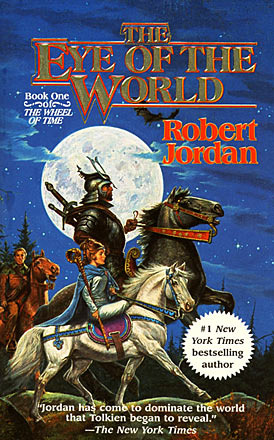
The Eye of the World, by Robert Jordan

Against my better judgement, I've decided to try listening to the Wheel of Time series originally by Robert Jordan. This series actually had a bit of a reputation at my high school because the school library had copies and it was considered a challenge for people to read because there were so darn many book in the series. Seriously, there are fourteen main books in the series, not all of them written by Robert Jordan because he died partway through writing the series. This series also has a reputation for being super trope-tastic, which isn't necessarily a bad thing, but it does leave the reader feeling like they're just in somebody's own attempt to create Lord of the Rings. Having finished the first book I can safely say it is very definitely chock full of tropes and at least follows the same general pattern of Lord of the Rings if not running in the exact same grooves. However, with thirteen other books to go, hopefully there's an opportunity for the series to develop beyond the first book.

I was actually kind of disappointed with the first book, Eye of the World, and I think it's because it spends so much time establishing the universe of the book while vaguely dancing around the main plot. You do get the impression that Jordan has developed a deep and complex world for his characters, possibly with lengthy genealogies as well, but I feel like Jordan spends way too much time on the development and just not quite enough time on moving the plot forward. Let me see if I can draw a comparison.

Remember how there's that first part of Fellowship of the Ring where Frodo, Sam, Merry, and Pippin are leaving the Shire but haven't gotten to Rivendell yet? Their main quest at that point is escaping from the pursuing Ringwraiths and reach Rivendell safely, but we don't get to the real quest involving the One Ring until the Council of Elrond. This first book feels a lot like that. The characters are trying to leave their home of Emond's Field in the Two Rivers and reach the city of Tar Valon, where everything will be explained to them there. More importantly the servants of the Big Bad are chasing the protagonists so it's important that they reach safety. Now I don't know about the rest of you guys, but for me that part between the Shire and Rivendell was the least exciting in the entire series. (Looking at you, Tom Bombadil.) So if the first book of this series is entirely like that, it's not as much fun for me either.

The finale for this book is also really rushed. Our main characters finally link up and go off to fight the Big Bad (Known as the Dark One, incidentally) utilizing an artifact from a previous age known as the Eye of the World. And then the main characters...win. The Dark One is defeated, presumably dead, and the day has been saved. This is all within the last few chapters as well, mind you, so it's kind of weird how it abruptly ends. Obviously the Dark One is not truly defeated because there are a baker's dozen more books to go and it's implied he's not really dead, just temporarily defeated. But for the amount of time we spent not knowing where we were going or what had to be done, the ending felt like a bit of an anticlimax.

Hopefully as the series goes on we'll get some more development and the characters will get fleshed out a little bit more for me to know them better. (In typical fantasy fashion they have overly elaborate names so I have to go do research to find out how to spell the darn things.) But as a start it leaves a lot of room for improvement.

- Kalpar

Thursday, March 15, 2018

The Day of the Triffids, by John Wyndham

Today I'm looking at a classic sci-fi book, The Day of the Triffids, written in 1951 and later adapted into a B science-fiction movie, making this one of the old school classics. Since this came up on sale I thought I'd give it a try, expecting some silly B-movie nonsense. I am left with mixed feelings about this book because even for the level of quality I was expecting, it fell pretty short of the standard. Most of the book focused on the apocalypse but the triffids played less of a role than I expected in the book.

This book is written from the perspective of a survivor of a global apocalypse that has mostly wiped out civilization. The crisis begins when the earth passes through the tail of a comet, causing green fireworks to appear in the night sky, visible to all the earth. Because of its uniqueness, much of earth's population turns out to observe this event, only to discover the next morning that they have gone blind. Only a handful of people, who for a variety of reasons didn't see the effects of the comet's tail, survive with their vision intact.

Although bad enough, the crisis is even worse because of the escape of the triffids. The triffids are strange plant creatures that appeared many years before the comet occurred. The triffids are commercially valuable but come with several dangers. They are carnivorous plants, capable of walking, and possessing a deadly venom-filled stinger. If that wasn't bad enough the triffids breed like crazy and are capable of growing pretty much anywhere. It was hard enough to keep the triffids in line when civilization was still operating, but now the triffids are able to run unchecked and attack the surviving humans with impunity.

Despite the triffids being in the title of the book, they don't play as large of a role as I thought they might. They're a constant menace through the book but you get to the point where people treat them as a constant annoyance more than anything else. Just when it gets to the point where the number of triffids presents an actual danger to our characters, the book ends and they move to a triffid-free island. Most of the focus of the book is on trying to figure out what the heck happened and finding a way to survive in a post-apocalyptic world, as well as a love story between the main characters. The fact that the comet which blinded everyone is later blamed on man's hubris just further undermines the triffids as the main threat of the book. And I have to say, as an enemy, deadly garden pests that can be taken out with the proper application of a chainsaw leave something to be desired.

The ending was also rather abrupt. Our main characters spend a significant portion of time working to make a farm habitable, despite being constantly under siege by triffids. Within the last chapter the main characters discover that humans have established a secure base on the Isle of Wight, giving our main characters an opportunity to escape. However, we also discover that a feudal military dictatorship has established itself in southern England and they want to take over the main characters' farm. Within a space of about five pages the main characters learn about the feudal dictators, escape from the feudal dictators, and the book ends. It just...ends. It felt like Wyndham was trying to throw in one final drama before the book ended. It might make more sense if the book was serialized and Wyndham didn't know when it was going to end, but as the ending of a novel it leaves a lot to be desired.

Ultimately this is a B-movie book so the expectations aren't very high for this book. That being said, even for a B-movie level of a book, I felt like the writing left a lot to be desired. It would have been a lot better if the triffids ever felt like more than just a headache for the main characters, and if  the ending wasn't as abrupt as it was. But if you like old B-movie quality sci-fi you can't go wrong with this.

- Kalpar

Tuesday, March 13, 2018

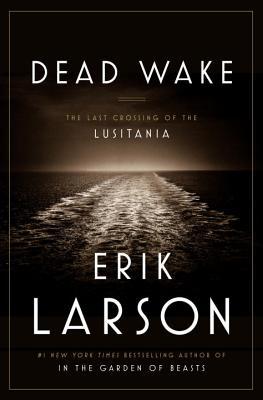
Dead Wake, by Erik Larson

Today I'm looking at a book titled Dead Wake which came out about a couple of years ago. As it says on the cover this book is about the sinking of the Lusitania in 1915 and I didn't know how interesting a read it would be so I left it on hold for a while. However, this book was part of an extensive advertising campaign on Smithsonian's website, and I kept seeing this book at the library and in bookstores so I broke down and decided that it was finally time to check this book out. The book goes into quite a lot of detail on a variety of subjects so I thought it was worth the effort.

As you might remember from high school history, the sinking of the Lusitania is one of the events that caused the United States to enter the First World War. If you know a little bit more about the event you might know that the Lusitania sunk within twenty minutes, which meant a significant number of passengers could not get to the lifeboats in time. There has been some debate among historians about why the Lusitania sank as quickly as it did. And the author does a really good job of explaining why preexisting theories were incorrect and providing evidence for his own theory.

First, a noticeable secondary explosion meant that many survivors, including the captain, assumed that the Lusitania was hit by two torpedoes from the attacking U-20. However U-20's logs and communications with German Navy command, as well as intercepts by British Intelligence, revealed that only one torpedo had been launched, which raised the question what caused the secondary explosion. Later disclosures of the manifest revealed that the Lusitania actually was carrying American-made ammunition for the British so it was believed that a cargo of munitions may have caused a secondary explosion. However the quantity of munitions loaded on the Lusitania were insufficient to cause a damaging explosion.

The explanation Larson provides lays in the structural design of the Lusitania itself. The Lusitania was originally part of a Royal Navy project to design large, fast ships and both the Lusitania and its sister ship the Mauritania were originally naval auxiliary ships. Although built and owned by Cunard lines, both the Lusitania and the Mauritania could be converted to cruisers in wartime. Although the navy decided to keep the Lusitania in civilian service, its military origins had significant effects on its design. Specifically the Lusitania had longitudinal coal bunkers. This meant that it had two large coal bunkers running along the entire length of the ship while most civilian ships had multiple small coal bunkers running across the beam of the ship. The idea behind this design was that the coal would serve as additional armor for the ship against enemy projectiles. Unfortunately, it appears longitudinal coal bunkers were actually a liability to ships hit by torpedoes. Because the watertight compartments within the coal bunkers weren't sealed, it basically provided a giant basin for water to enter the ship from a torpedo strike.

This explains why the Lusitania sank so quickly, especially considering the ship listed severely to the side on which it was struck, to the point it was difficult to get lifeboats launched from either side of the ship. As the water cascaded into the bowels of the ship, it is very likely the cold sea water caused some part of the steam machinery to explode. Larson points to a steam pipe, which may explain loss of control of the ship into the crisis, although a boiler or other apparatus is just as likely. The simplicity of the explanation as well as the evidence supporting this hypothesis provides a much better explanation for why the Lusitania may have sunk as quickly as it did.

Overall I think this book was well researched. Larson provides a lot of background detail which debunks the hypothesis that a secret cache of munitions on board caused the secondary explosion. As demonstrated with previous strikes on ships with longitudinal coal bunkers, a hit by a torpedo into the coal bunker caused the ship to sink in an astoundingly short period of time. It is probably safe to say the same occurred with the Lusitania.