Thursday, March 26, 2015

Black Mirror

This week I'm going to do something a little different and talk about a tv show which (as of late March 2015) is currently available for viewing on Netflix. This show is called Black Mirror, and as is typical of British shows is fairly short, containing a total of just six episodes. (Well, apparently seven but there's only six on Netflix at the moment.) And while I'll be perfectly honest that I don't care for one or maybe two of these episodes, the rest are incredibly fantastic and in my case left me thinking about them for the rest of the day, or even the rest of the week.

Black Mirror is a science-fiction anthology show, much in the same vein as The Twilight Zone, which is probably one of my favorite TV shows. I say science-fiction although some of the stories could happen with existing technology, but most of the stories have a definite science-fiction element to them. However the creators (mainly Charlie Brooker) utilize their stories to make commentary about society today, again very much in the vein of The Twilight Zone. And it's very easy for social commentary to get a little heavy-handed, and that sort of leaks through in a couple of episodes, but at the same time it's really thought-provoking and interesting. And perhaps, in forty or fifty years some of the episodes will be just as dated as some of the more Cold War-oriented Twilight Zone episodes will be, but I like to think that maybe a couple will become timeless classics as well.

As an anthology series, each episode contains its own story, but overall there's definitely a rather dark theme to the series. It tackles various subjects such as human infatuation with media, our relationship with technology, grief and loss, crime, and politics. And overall the episodes are really good because they left me thinking about them throughout the day. Even enough for me to write a blog post about them and tell people they should go watch this show as well. Even if the episode seems a little bit off the mark, it's something that you can talk about. And that's probably one of the greatest powers of tv as a medium, the ability to get us to think and talk about subjects that may not normally cross our minds. That's the power of any medium, really, and tv has definitely made attempts to get us to think about things, but very often shows are just about entertainment. Black Mirror is one of those gems that manages to do both, and I think more people should check it out.

If any of my readers are fans of The Twilight Zone, which I'm going to take a flying leap and guess that they probably are, then I highly recommend that they go and check out Black Mirror. I guarantee you won't be disappointed. (Just don't get turned off by the first episode, okay?)

- Kalpar

Thursday, March 19, 2015

Im Memoriam: Sir Terry Pratchett and Discworld

For those that know me, the Discworld series has been incredibly important in my life. Heck, I've written reviews about not only main Discworld books, but also an illustrated novel, and the young adult stories as well, probably in some hope that someone else out there, reading my blog, who hasn't picked up these books yet will. Discworld is important on so many levels. Something I've noticed is that many people who read usually have at least one book, something that hit them the right way at the right time and spoke to their very soul, the very essence of their being. A book that has somehow shaped who they are as a person and how they view life. I am very fortunate in that I cannot point to just one book that has influenced me in such a way, but an entire series.

My experience with Discworld began ages ago when I was a sophomore in college. My friend Brendan, who shares a great many interests to me as I do, one day passed a book onto me titled Small Gods. Being someone who tries to read books loaned to me in a timely manner, and finding myself with a little free time between classes I started reading it. And kept reading it, finding it incredibly compelling and incredibly difficult to put down. I am by my own admission, a fairly fast reader, but it has often been very rare for me to find a book that just grabbed me by, for lack of a better term, the soul and made me want to keep reading. I cannot recall exactly how quickly I read Small Gods, but I'm certain it was no more than a matter of days. Brendan soon afterward loaned me Night Watch, which has become one of my favorite books, and that summer I started collecting Discworld books like crazy. By my start of junior year I had a respectable collection. Within two years I had nearly all of them. I actually made it a goal to read all the main Discworld books by the time Snuff came out late in 2011. And while there are certain books in the series I don't care for, and certain books that I cherish, overall I would say Discworld has had a positive impact on my life. If nothing else than because one person decided to be my friend because, "He's sitting over there reading a Pratchett book, he seems interesting."

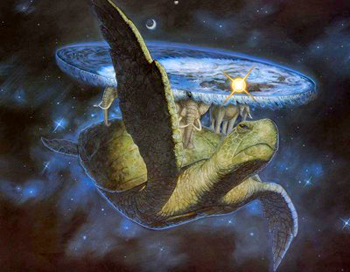
Because Discworld has long since gone beyond just being a satirical take on well-worn fantasy tropes. It certainly started that way in Colour of Magic, but it grew and became so much more over the years. Pratchett has tackled topics as divisive as politics and religion, commented on economics and law, and some would argue that he has created a modern school of philosophy through the lens of fantasy. And yes, they are silly stories about a world on the backs of four elephants on the back of a turtle, but at the same time they're stories about people as well, and as I'm sure Pratchett himself would say, one of the most powerful ways to shape people is through stories. Whether it be stories about the long and distant past, stories about the here and now, or stories about life on the Disc, when stories are about people they have the ability to shape people, for better or worse, and that's an incredible power.

So what have I learned from the five or so years I've spent exploring the Disc? Essentially, people are people. We can be downright selfish and terrible, or charitable to a fault and good. Sometimes within the same day. And maybe you can't solve all the world's problems. But the important thing is to give your best and try. And while it's sad that Pratchett has passed on, he will remain with us in his dozens of books, and hopefully influence generations of people, and how they think, for the better.

- Kalpar

Thursday, March 12, 2015

Bolo Strike, by William H. Keith, Jr.

Hey, look, Kalpar's reviewing another one of the Bolo books. Is anyone surprised in the least? Anyone at all? No? Okay, good. On with the review.

So I'm continuing my march through the full-length Bolo novels and actually coming towards the end of my endeavor. This particular book, Bolo Strike, is another production of William H. Keith, Jr. and is set some five hundred years after the fall of the Concordiat of Man and the end of the Final War with the Melconians. A new human government known as the Confederation has once again emerged and continues to use the redoubtable Mark XXXIII Bolos. In this particular instance a human-colonized world known as Caern has recently been rediscovered by Confederacy traders. However, the humans of Caern worship and are ruled by an alien species known as the Aetryx whom they venerate as gods. The exact relationship between humans and Aetryx is never really understood, but the Confederacy decides that no outpost of humanity, no matter how small, is going to be ruled by alien life forms and creates a task force to liberate the human population, including dozens of Mark XXXIII Bolos. However, the invasion does not go as planned, especially when the Aetryx begin sending Mark XXXII Bolos at the Confederation forces. Although outdated and unequal in firepower to a XXXIII, the XXXII's pose a significant threat in numbers, especially because if nothing else it means the Aetryx have been able to override the security protocols in a Bolo's programming.

The action in this book is all the glorious pulp I've come to this series, but it actually takes a back seat to some of the questions that are raised in this series, specifically what it means to be human and what counts as human. In the universe of this particular book, although it's definitely possible for a complete human mind to be copied and downloaded into a computer, humans almost universally see it not as immortality but as an illegitimate copy. That somehow that electronic copy of yourself is inherently less valuable than the flesh and blood version. And there's not really any debate on this point either, it's strongly outlined in black and white. Personally I feel like it raises an interesting question and a dilemma, especially when there are several copies of one person's memories running around, all convinced they're the original. I just wish the rationale behind an electronic copy not counting came to more than because it's not the original. Maybe it's a little much to expect a deep and thoughtful discussion about something like this in what's essentially a silly pulp novel, but pulp novels can talk about serious stuff too.

Another question I found myself asking was if the humans were really any better than the Aetryx, which was something that came up in Book Six: Cold Steel. As my readers may remember, that book dealt with the Tersae, a race of warriors who had been genetically engineered by their creators and forced into fighting humanity, a rather losing proposition when Bolos are involved. The question becomes are the humans really any better in creating mechanical monstrosities and then sending them into battle to fight and die for our needs, only to put them back into storage when the war's over and there's no need for them anymore? When the Aetryx do something similar to their human followers, it casts them forever as the villains, but it really just made me wonder if what humanity does to the Bolos is really fair. After all, these are fully self-aware beings. Who mass several thousand tons and are bristling with weapons, but self-aware nonetheless. And yet the Bolos are seldom to never given a say, and in fact can never feel things which we don't want them to feel because their programming simply doesn't include it. Humanity's treatment of its strongest protectors feels inherently unfair to me, but it's never really explored. And perhaps it can't be because Bolos can't see their relationship with humanity as anything other than proper because they're programed to be that way. It raises a lot of questions but never really gets a proper treatment.

Other than the questions I have, this book is all right. I don't have any serious complaints about it, but by this point in the series it's starting to just blend in with a lot of the other books. The challenge with the Bolo series is probably keeping it fresh because there's only so many tank battles you can do before you have to come up with something original. And this may be why I suspect the series ends eventually, because most of the ideas are exhausted and there's just no new ground to cover.

- Kalpar

Thursday, March 5, 2015

Flag in Exile, by David Weber

A Warning to my dear and gentle readers: Once again I am returning to the Honor Harrington series by David Weber. As I mentioned in my last review Field of Dishonor, this series has started to get complicated to the point it becomes very difficult to avoid spoilers entirely. I shall do my best to avoid them as much as possible, however read ahead at your own risk.

Much to no one's surprise, I am sure, I have returned to a definite favorite of mine, the space opera series of Honor Harrington, with the fifth installment Flag in Exile. (Hard to believe, I'm already five books in. It's a little bit crazy) Anyway, when we last left our protagonist, Honor had been put on half-pay and beached by the Royal Manticore Navy in response to all the political hub-bub caused by her duel with Lord Pavel Young. Honor retires to oversee her estate on Grayson, but the war between Manticore and Haven is beginning to reach a deadlock and the Navy can't keep Honor beached forever. In the meantime, though, Protector Benjamin IX of Grayson offers Honor a commission as an admiral in Grayson's own Navy due to their lack of experienced officers. But how Honor will respond to her first opportunity at flag rank remains to be seen.

In addition to Honor getting bumped up to flag rank there's an ongoing plot about the internal struggles that are still rocking Grayson in response to Protector Benjamin's reforms, as well as the appointment of Honor Harrington to the office of steadholder, the first female to hold such a post. I rather liked this plot because it showed how Grayson is developing and how there are still problems to be overcome on that planet. It makes Grayson appear more complex than simply a one-dimensional Planet of Hats, which you often see in space operas, and shows that Honor's actions in The Honor of the Queen haven't solved everything for forever either. Although it's certainly frustrating to see a bunch of religious fanatics trying to prevent reform and change, (something that's frustrating to me even in real life), it certainly makes for a far more believable planet with varied political and religious opinions.

I will say the cover of the book kind of gave one of the most epic parts of the book away. Instead of some of the more generic covers with Honor and Nimitz we've seen in the past, we now know that Honor's totally going to get into an epic sword fight at some point during the book. Building up to that point was pretty awesome but the fight was surprisingly short compared to how it takes precedence on the cover. But then again, what do I know about cover art? However, there are still some pretty epic and awesome things in this book, even if it makes Honor look freaking invincible compared to all the stuff she's gone through. But I'm sort of okay with that. This is an unapologetic space opera, and that's exactly what I signed on for.

Of course, in addition to all the stuff happening dirt-side that Honor has to deal with, that pesky war between Manticore and Haven has to come back into the plot again. Of course as the saying goes, if Honor cannot come to the war, then the war must come to Honor. Weber kind of spends some time trying to misdirect us about what exactly the People's Republic of Haven is up to with Operations Stalking Horse and Dagger, but I didn't buy it. It was sort of like, "Come on, Dave. You made Honor an admiral in this book for a reason. Just let the Haven fleet show up in Yeltsin already so she can fight them." So although it may take Honor by surprise, I was more, "Finally, let's get this space battle on already." That is sort of a weakness I'll admit, between the cover and the most elementary understanding of how these books work there isn't terribly much of a surprise for the reader. But do you want awesome space battles and sweet sword duels or not? Because I totally do.

As I said, I think the real strength of this installment is showing how Grayson has developed as a planet and making it more three dimensional overall. I will say that compared to the previous novel, Honor kind of takes a back seat, especially since she's still sort of shut down emotionally from all the trauma, which is understandable for anyone in her position. I do hope that Honor can develop more as a character and most likely the Royal Manticore Navy will call her back to duty in the next book.

- Kalpar

Thursday, February 26, 2015

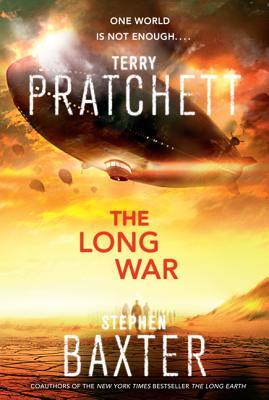
The Long War, by Terry Pratchett and Stephen Baxter

This week I've returned to the Long Earth with the sequel, The Long War. As you may remember in my review of The Long Earth, I was a little dissatisfied with the preceding book. However, I am usually one to give something a second try, especially after the first book because it might take a while for a series to find its stride. Unfortunately, The Long War simply wasn't it. With the series continuing in The Long Mars, I find myself not terribly interested in seeing where this series is going, and I'll try to explain why. But despite the enormous potential of this series it just continues to fail to deliver and the result is unsatisfying to say the least.

As you may recall, The Long Earth introduced us to the concept of a series of worlds, perhaps an infinity of worlds, similar but different to our own Earth, that can be reached simply through the use of a device known as a Stepper. Instead of being confined to a single world with a degrading ecosystem and diminishing resources, humanity now has access to millions of verdant worlds with practically unlimited resources. Suddenly the solution to all the pressures of humanity are literally just a step away. To be honest, the existence of a nearly infinite supply of worlds and resources poses interesting social, economic, and political questions and it would be interesting to see how humanity responds. (As well as the discovery that we are not alone and we have sapient hominid cousins throughout the Long Earth.)

Although initially ambitious, and promising to investigate several really interesting ideas about how the Long Earth would reshape society, The Long War spreads out too quickly and suffers from an incredible lack of focus. There are something in the neighborhood of five or six different plots going on in The Long War, ranging from the distant "colonies" of the outer worlds demanding equal treatment and representation in old Datum Earth's government, to humanity's treatment of the trolls, to China's expedition to the world of East 20,000,000. I almost feel like this is akin to a Philip K. Dick novel where there are a ton of interesting ideas presented but the authors go off into a lot of different directions instead of focusing on one story. I think if the authors had focused on one story for this novel, instead of splitting attention between five or six different plotlines, it would have resulted in a more coherent story overall. The result is a muddled mess of five different stories, none of which were developed or resolved much to my satisfaction.

Another thing I noticed, although this seemed to get better as the book went on, was a lot of things happened off-screen or were told in past tense or passive voice. It would have been interesting to see the rebellion against the Datum government develop as the pioneer's rights were slowly stripped away by a government pandering to increasingly xenophobic masses at home. Instead we're told about it after the fact as background material. Again, it's something I really noticed in the beginning of the book, and this may be because the authors decided to jump forward ten years from the ending of Long Earth so they had to cram in exposition somewhere, but it's pretty unsatisfying on my end.

For me the greatest sin of The Long War was that it became boring. An infinity of Earths for humanity to explore, colonize, and fight over offers practically limitless potential for numerous interesting stories. Unfortunately five plots which could have been interesting if properly developed in their own direction, become five lackluster plots that I ended up not caring terribly much about. I honestly found myself over 80% of the way through the book and just saying to myself, "Oh my god, when will this be over?" Instead of getting excited I just found myself bored, something you never want to be when you're reading a book.

I'll be honest, I'm probably not going to read The Long Mars because I have a very strong feeling it's going to be more of the same. As much as I love Terry Pratchett, this just doesn't seem to be his best work. I personally do not know much about Stephen Baxter and I may want to look at his books in the future, but I feel like this particular collaboration of authors simply isn't working.

- Kalpar

Thursday, February 19, 2015

The Comanche Empire, by Pekka Hamalainen

This week I'm returning once again to a stack of history books which I picked up when a colleague of mine was moving and needed to get rid of a ton of books. (Books can get downright heavy, man!) Anyway, among the tomes I selected for my self-improvement was The Comanche Empire, by Pekka Hamalainen. (And sorry in advance for not getting all the proper accent marks. I unfortunately do not know how to do that.) As I have only a very vague knowledge of Native American history, learning history from a Euro-centric point of view, I figured this would be a very good text to help expand my knowledge of American history as well as the Southwest. (Plus, another one of my work colleagues has some Comanche ancestry so she recommended this book to me as well.)

Hamalainen begins with the very noble goal of revising our understanding of history, especially in the American Southwest, which has often been depicted as a region between the borders of two large colonial empires, first France and Spain, and later the United States and Mexico. If the Comanches are mentioned at all, it is usually in passing and as a reference to their savagery and violence. Hamalainen attempts to tell the Comanche story from their own perspective, although even he admits that this is a challenging task. Traditional historical methods rely largely on written documents for source material, something many indigenous cultures across the globe did not leave behind, resulting in the Euro-centric view of much of history. Hamalanien does utilize numerous documents, but has also delved into oral histories, anthropological research, and a variety of other stories to create a more complete and accurate picture, however Hamalanien admits that not even his treatment is complete and future analysis may prove more accurate.

However the main objective, which Hamalainen readily achieves, is the depiction of Comanches as actors in their own right within the American Southwest rather than passive reactors to the actions of European imperial and colonial powers. Hamalanien successfully explains how Comanches were able to play a grand diplomatic game with other major powers for their own benefit, as well as engage in trading and warfare depending upon their own needs and larger political objectives. Really my only quibble is Hamalanien's decision to call this Comanche organization an empire. While definitely grand in scope and behaving economically and militarily as an empire, the Comanches never had the strong, centralized government apparatus that is the hallmark of empires across the globe and history. Yes, the Comanches included many ethnic groups within their fold, and yes they were able to utilize military and economic power to their benefit in negotiations with other polities, but at the end of the day there was no central unification.

Hamalainen does go into great detail about the political structure of the Comanches and while there were large tribe-level and even nation-level meetings, Comanche social structure tended to be more a confederation of many smaller groups. To me, it's sort of like saying that the Vikings had an empire. Strictly speaking, no they did not. Yes, they were able to launch successful raids throughout much of Europe, and they had great economic, military, and even political influence throughout many parts of Europe, but there was no single centralized "Viking" government. At most the Vikings were a loose confederation, but more likely it was a larger Northern European culture with shared values. The Comanches certainly seem to be more tightly-knit than the Vikings, but I'd say they're a successful confederation rather than an out and out empire. Ultimately, of course, this is an argument over semantics, but that's what keeps historians going.

Overall I rather liked this book. Although I may not gain any immediate benefit by expanding my knowledge about the Comanches in the American Southwest, I'm sure there are plenty of people who will find this a useful resource. Plus, I am always in favor of expanding knowledge, especially in areas that may have been largely neglected beforehand.

- Kalpar

Thursday, February 12, 2015

Fuzzy Nation, by John Scalzi

This week, possibly because I was reminded of John Scalzi from last week's novel, I'm reading another book from Scalzi called Fuzzy Nation. As Scalzi himself says in the introduction to this novel, Fuzzy Nation is actually a reboot of an earlier novel, Little Fuzzy, by H. Beam Piper. I myself have not had the fortune of reading Little Fuzzy, and it is not necessary to do so to enjoy Scalzi's work. However, I personally am now interested in reading the original material at some future point and comparing it with Scalzi's own reinterpretation.

Fuzzy Nation is set on the planet Zara XXIII, a metal-rich world currently being exploited by the interstellar mining Zarathustra Corporation. What makes Zara XXIII particularly valuable to Zarathustran holdings is the presence of sunstones, gemstones found only on ZaraXXIII, and which emit a faint glow from someone's body heat. Rarer than diamonds, Zarathustra hopes to maintain dominance in the interstellar market with a treasure trove of sunstones. Our main character is Jack Holloway, a surveyor under contract with Zarathustra to do all the hard work of finding the valuable resources which Zarathustra can then swoop in, mine, and then ship off-planet back to depleted and resource-hungry Earth. When Jack discovers the veritable mother lode of sunstones, it looks like he and Zarathustra will be financially set for decades to come. However when a family of hitherto unseen fuzzy critters shows up at Jack's compound, it may spell trouble for everyone planetside. If the fuzzies turn out to be sapient, as some people suspect, then all mining on Zarathustra will have to cease immediately.

Aside from a really good story about what we would consider to be sentient life on other planets, Fuzzy Nation raises really good questions about the ethics of a resource-hungry economy and if it can successfully coexist with, and help sustain, a vibrant ecology at the same time. The answer has always seemed to be a no, especially true where strip mining is involved. And as farms, cities, and human industries expand it leaves less and less space on our little blue marble here for the billions of other species that we share the planet with. Plus as of 2014 we're still stuck on our little blue marble so we don't have an option to move stuff off-planet if it's inconvenient to have it here. On the other hand, the fact that I was able to read this book and then write this review is largely because people mined materials out of the ground which then went into the electronic devices I used. It doesn't look like there's any easy answer, not soon at any rate, but it's definitely something we should be thinking about.

Fuzzy Nation also raises a very excellent point which sadly isn't explored terribly much because the book reaches its climax very soon afterwards. Characters point out that even if the fuzzies get protected status, it may actually cause them to go extinct more quickly. This is the double-edged sword of protected status that many creatures have encountered here in the United States and I'm certain elsewhere as well. In many cases it is illegal to disturb the nesting or breeding grounds of protected creatures and the discovery of those creatures mean any and all activity in that area must end immediately. However, as there is a financial motive for continuing activity in that area, whether it be house construction, mining, logging, or something else entirely, very often the animals will be quietly killed off so that humans can continue their activity, rather than descend into the red tape and bureaucracy of accommodating a protected species. Unfortunately, although this is a very real issue in conservation and protection efforts today, it doesn't get terribly fleshed out and quickly gets eclipsed by the fantastic climax.

I will admit that there were some things that seemed altogether far too convenient at the very end of the novel. Well, specifically one thing but I won't go into it because spoilers. Anyway other than that the ending had a ton of courtroom drama which actually made sense because it was a preliminary hearing instead of an actual trial. (Interestingly, the American legal system tries to make trials go as smoothly as possible so all evidence and witnesses are actually submitted ahead of time for use in the trial. Despite what movies and TV would have us believe, surprise witnesses are actually an exception.) Anyway, with a bit of downright awesome legal chicanery we get our resolution, which was probably my favorite part of the book to be honest. If anyone enjoys a good debate you'll definitely love the ending to Fuzzy Nation.

Overall, I really liked this book. I will admit that I felt it had its shortcomings because there was a really good opportunity there to examine human industry, needs, and desires and whether they can ever coexist with a sustainable ecology. However, that may have ended up overshadowing the fuzzy plotline, which is what the book's really about. I'd definitely say it's worth a read.

- Kalpar