Showing posts with label Dan Abnett. Show all posts

Thursday, January 30, 2014

Blood Pact, by Dan Abnett

As some of my readers are probably aware, I'm a very big fan of the Gaunt's Ghosts series set in the Warhammer 40,000 universe and follow the adventures of Colonel-Commissar Ibram Gaunt and the Tanith First-and-Only. However, all of my adventures with the ghosts so far have been in omnibus form that contain three or four books that I'll read in more or less one go. Blood Pact is the first book I decided to read by itself and while I certainly found it enjoyable I found it rather short as well. However, I think that's simply because I read it as a stand-alone novel rather than as part of an omnibus and I look forward to more of Gaunt's adventures from Abnett.

The basic plot of Blood Pact is in a very broad sense a retelling of the previous Ghost book Traitor General, and this is rather explicitly mentioned by the characters as well. However, instead of Gaunt and a small Imperial team on a Chaos-held world looking to eliminate a rogue Imperial General before he can spill his secrets to the enemy, a small Chaos team of Blood Pact land on an Imperial-held world to eliminate a rogue Chaos general. While the book is definitely reusing an idea, Abnett manages to tell the stories in new and interesting ways. In addition, the use of warp witchcraft by the Chaos strike team frustrates communication among the Imperial forces and leaves Gaunt relying mostly on his wits and combat training to evade the kill team. Despite the feeling of brevity I thought this book as rather good and I'd recommend it to 40k fans as a good action sampler.

The other thing that I found very interesting was the fact that the planet Gaunt and the Ghosts were based on, Balhaut, was a secure Imperial world well behind the front lines of the Crusade. While many troops would welcome the opportunity for a nice, quiet garrison duty and the Ghosts initially enjoy their stay, they quickly find themselves bored with the absolute tedium of garrison life and are become restive, which presents an issue for Commissar Viktor Hark who has taken over many of the disciplinary issues of the regiment. In addition, a number of the senior staff cadre are beginning to feel the twelve years of campaigning the Ghosts have experienced and the regiment is beginning in some respects to feel old. This is definitely a good subject to cover but I feel like it wasn't really fleshed out in this book. My hope, however, is that it will definitely be fleshed out in later books in this series.

Overall an enjoyable read and highly recommended.

- Kalpar

Thursday, September 5, 2013

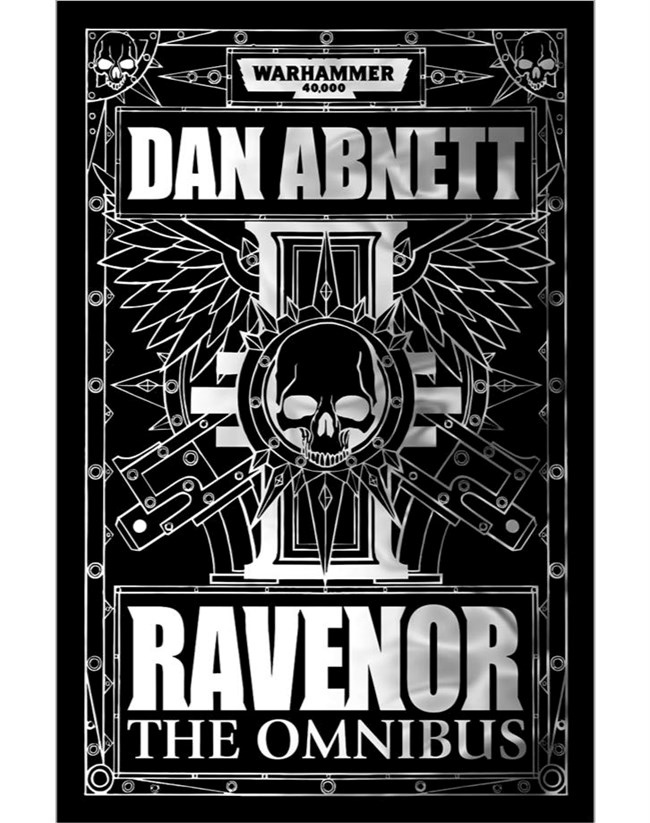
Ravenor Omnibus, by Dan Abnett

Once again I have decided to explore more of what is apparently called "The Daniverse" within the much larger Warhammer 40,000 universe with the Ravenor omnibus, which contains the novels Ravenor, Ravenor Returned, and Ravenor Rogue. Much like the Eisenhorn trilogy this book follows the adventures of Gideon Ravenor, and Imperial Inquisitor and psyker, as he roots out the enemies of the Imperium from within. (And if you didn't know already, Ravenor is Eisenhorn's apprentice who has graduated to become an Inquisitor in his own right.) While these books were enjoyable, as pretty much anything penned by Dan Abnett is, I had more difficulty with these than I did with Eisenhorn and I feel like they're not as well put together as the Eisenhorn novels. Definitely still worth a read, especially since the next omnibus is apparently Ravenor vs. Eisenhorn and I definitely plan on reading that in the future. Yes, it's good, but it's not my favorite thing to come from Dan's desk.

What I liked about this series of novels, and this is what I liked about the Eisenhorn books too, was that you got to see the Imperium operating from the inside. Most 40k novels occur when there's, you know, fighting going on, and normal life has been disrupted on whatever ball of dirt's being attacked. In the Inquisition novels they're not facing down an army of orks or a Tau battlegroup; instead, they're taking on Chaos cults and xenos sympathizers who threaten to weaken the Imperium from within. So you get to see how the Imperium works and what daily life for most people is like. Granted, life is still pretty bad when you're not getting eaten by Tyranids or something, but it's a change of pace.

Unlike the Eisenhorn books, though, I feel like these books require an understanding of some of the ins and outs of the 40k universe before reading. Eisenhorn did a great job of introducing people to concepts such as daemons, blanks, and rogue traders but in Ravenor you're expected to already know what those are without a lot of explanation. So if you're new to the 40k universe and looking to get yourself oriented, I'd recommend at least waiting on these books until you've gotten your feet wet. If you're an experienced vet, though, I think you'd enjoy these novels.

I think the main problem with this is that, according to Dan's introduction, these books were not initially meant to be a trilogy. Yes, they tie together as a trilogy in the end, but Abnett had originally envisioned the Ravenor series much like Gaunt's Ghosts: a series of ongoing adventures following our characters across space. The second two books definitely feel much more connected plot-wise to each other than they do to the first book, especially with the major plot of the birth of the deamon Slyte who threatens to destroy an entire sub-sector and seriously weaken the Imperium. It definitely works, but I feel like the first book kind of stands on its own. Much like how A New Hope kind of stands on its own from Empire Strikes Back and Return of the Jedi. Still connected, but the last two more connected than the first two.

The other thing I noticed was a tendency for the books to have a fairly slow investigative pace and then everything sort of suddenly come together at the last minute in a huge showdown. I think Abnett was trying to capture sort of the essence of police fiction in that regard, where there's a lot of time spent investigating the case and slowly putting all the pieces together, followed by a sudden burst of action at the end where the case gets busted wide open. It's certainly a legitimate literary approach but I get the feeling that it isn't Abnett's strong suit. Definitely a thumbs-up for trying something new and if the next omnibus is like this I hope that his skill develops and he gets better.

Despite the issues I had with this book, I think it was at least enjoyable. If you're an old hand at the 40k universe you'd definitely want to give this book a go, especially if you like a lot of Dan Abnett's other stuff. As with the Eisenhorn novels, it was a refreshing change to look at planets that weren't being completely destroyed by invading armies and see how the Imperium works on the inside. I don't think this is a book for newbies, though, and you should probably know about a number of things before jumping into this series.

- Kalpar

Thursday, February 9, 2012

Eisenhorn Trilogy by Dan Abnett

As my two readers probably know, I am a fan of Dan Abnett's Gaunt's Ghosts 40k series and had an opportunity a long long time ago to interview him. I also read a stand alone novel called Titanicus which starred the Titan Legions of the Adeptus Mechanicus. Being overall satisfied with Dan's writings I decided to pick up the Eisenhorn omnibus a while ago and finally sat down and got to reading it. I have to say overall that I liked the books, but I felt it had certain problems which I want to outline. I will say it is a great introduction to the world of Warhammer 40k for people who want to dip into the lore and recommend it for beginners.

I want to begin by stating that this is an omnibus which means it is actually three books combined into one larger book. I actually enjoy omnibuses, at least of Warhammer 40k books, because they're usually about $15 and contain three or four books which individually would cost $24-32 (Averaging about $8 a book) and it takes up less shelf space than the individual books. And I am perpetually running out of shelf space. Basically it's a lot more book for less money and will help tide you over longer if you're a constant reader like me. Well, I read so damn fast at times that I burn through it in a week anyway, but you get the idea.

Gregor Eisenhorn is an Inquisitor and I'll hopefully explain more about the Imperial Inquisition in a Kalpar Lecture down the line, but suffice to say he's sort of like a detective for the Imperium of Man. Inquisitors are tasked with rooting out heresy and Chaos wherever they find it in Imperial society and command tremendous resources and respect. Because Inquisitors work far from the battlefields of the 40k universe and often undercover. As a result the Eisenhorn novels read more like detective novels than the war stories of the Tanith First-and-Only and I personally thought it was a refreshing change of pace. Often times I find myself wondering "Okay, how is this 40k novel different from all the other war stories I've read?" So reading a story that was less combat-oriented was interesting. Granted there is still plenty of action, this is after all Dan Abnett, but it's more something that happens because of the plot rather than being the focus of the story.

Another thing I really enjoyed about these books was that it gave us an inside view of Imperial society and how it works. In the majority of 40k novels, following the Imperial Guard or the Space Marines, we only see Imperial society at war. Sure, sometimes the conflict happens in a hive-city or an Imperial world but what glimpses we see of Imperial citizens are people dealing with living in a war zone. The job of an Inquisitor is to protect Imperial society from internal threats and as a result I got to see how life is for the majority of the trillions of humans who never even see a battlefront. I enjoyed it for its informational value as well as the change of setting.

The other good thing I have to say about these books is that I felt the pacing was handled really well within the novels. I mentioned in my review of Titanicus that the middle part of the book sort of dragged for me, and a few of the Gaunt's Ghosts books I feel suffer from a lack of direction but the Eisenhorn books were solidly written in my opinion. I will say that the final book kind of lacked a denouement but I believe that was Dan's intention rather than any lack of writing skill. I am definitely going to try and obtain the sort-of sequel the Ravenor omnibus and look forward to more of this different perspective.

The good things being said, there is one big issue I had with the book. Eisenhorn's career as an Inquisitor spans over a hundred and fifty years and the books are set at certain points of his career. And I will say that they are highly important points in the overall narrative of Eisenhorn, but I find myself wishing I knew more about the intervening periods. Characters that make up parts of Eisenhorn's staff die off screen between novels and new members join. While I recognize that Eisenhorn's staff is going to change over a hundred years seeing that staff go from five in one book to nearly two hundred in the next leaves me feeling disjointed. Characters I knew and cared about disappear when I wasn't looking and are replaced. Ultimately it became very hard for me to become emotionally invested in the characters. If anything I would have appreciated at least a few more books about Eisenhorn's intervening years just so I could know the characters a little more.

Lack of attachment for certain characters aside, I felt like these books were a good example of Dan's writing. Even if the ending to the trilogy's kind of a "WTF?" moment. If you're new to 40k and want to learn about how Imperial society works I would definitely recommend picking up the Eisenhorn omnibus.

- Kalpar