Showing posts with label David Eddings. Show all posts

Thursday, May 29, 2014

The Belgariad, Volume Two, by David Eddings

This week we finish the Belgariad saga with volume two, which covers the last two books in the five part series, Castle of Wizardry and Enchanters' End Game. In a way, these almost form a second story from the first three books, so I can actually understand the decision to separate them as such. In the end of Volume One the mystical Orb of Aldur has been recovered by our heroes and while they're still deep within enemy territory, you honestly don't have any doubts they'll make it home safely, do you? I mean, with two whole books left? Yeah, that's what I thought. For me these books kind of were all over the place, going from really interesting when we explored the political complexities of the different fantasy kingdoms and how they actually had to prepare for a full-scale war, to boring with Garion continuing on his epic quest as the Chosen One and heading towards the final confrontation, to downright infuriating with the behavior of Ce'Nedra. The result for me is an all-around middle feeling with this book. Not terribly good but not terribly bad either.

We'll start with Garion and his hero's quest, which is not yet done at all. There is of course the requisite scene where he realizes he can never go home again, and then eventually the revelation that he's secretly been the Chosen One all along and if you hadn't figured that out by now you need to get a better education in tropes. Garion is confronted with the fact that the war against the different countries of Agnaraks will take decades, if not centuries, and an incalculable cost in both blood and treasure. When he learns that there may be a way he can avoid those millions of needless deaths he heads off to his final battle with Torak, the Shadow of this particular monomyth. In a way, I feel like the author himself kind of gets bored with Garion because we eventually leave him behind and all focus shifts to the other characters who have to prosecute a war against the hordes of Agnaraks.

The war bits themselves actually prove fairly interesting, perhaps at the expense of everything else. Ce'Nedra actually becomes interesting when she has to rally and unite the disparate people of the West into a unified fighting force and field an army in the millions capable of holding off the hordes of the East. Plus, one of my favorite chapters showed all the political jockeying going on back home between the people left behind, trying to take advantage of the fact that queens are ruling in the stead of their husbands. It is really interesting and probably could have been an entire story on its own that could have been deeply fleshed out, but like so many things eventually falls to the wayside and gets consumed by the monomyth in the end.

My biggest frustration was definitely Ce'Nedra, the female lead who's destined to fall in love with the hero, but you know those parts. What irritates me the most is that while Ce'Nedra undergoes some character development and actually becomes an inspirational leader for the army, she remains in many ways a spoiled, manipulative princess. Before the war we're explicitly shown how she plans to emotionally manipulate Garion into doing what she wants him to do and once the war's over she goes right back to emotionally manipulating him. And I get the feeling we're supposed to just be....fine with all of this. And, at least in my opinion, that's not how people should behave. Any sort of manipulation is just wrong but here it's depicted as funny because "Women, amirite?" I'm probably putting too much into this and at least the book remains readable, but jeezalpete, man.

Anyway, overall Belgariad is very much middle of the road for me. It's not bad, but it's not terribly good either. There's potential and some really good bits with the political intrigue and the fleshing out of countries beyond the basest description, but much of that is squandered on a Hero's Journey story that even the book itself becomes bored with and a spoiled princess you sometimes just want to chuck out a window.

- Kalpar

Thursday, May 22, 2014

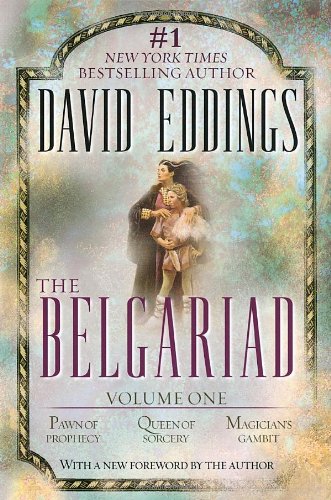
The Belgeriad Volume One, by David Eddings

A couple of years ago I had mentioned to someone that I had been feeling pretty burned out on high fantasy novels, largely because they all tend to heavily follow the example set by Tolkien's Lord of the Rings series. There's some sort of important artifact, a band of heroes usually including a wizard, a chosen one, a tricky thief, a brave warrior, and usually a princess thrown in for good measure. It's desperately important that they retrieve/destroy said artifact because the fate of the world is at stake, you know the drill. It's been done a thousand times in a thousand ways since Gilgamesh. Of course, this doesn't mean these stories are outright bad; most of the greatest works of mythology, literature, and film have followed this trend. However, personally I can only read so many Lord of the Rings with the serial numbers filed off before I get desperate for something new and interesting.

When this series was recommended to me I was told that it followed the author explicitly followed the formula of the monomyth in a way that many people have liked. I was at least intrigued by this promise, so I decided to pick up both volumes which contain the five books in this series. The plot is, of course, exactly what you'd expect. An artifact that the fate of the very world relies upon has been stolen, prophecies are becoming fulfilled, and the time is nigh when good and evil will have an epic confrontation. There's sorcerers, warriors, thieves, and of course the chosen one. Any reader who's half awake will fill in the numbers pretty quickly, which I think was the intention of the author. And I can see how a lot of people would like the books but for me it just become....boring.

I hate to say it but I feel like there was a lot of lost opportunity with these novels. We're shown a lot of interesting characters and a lot of interesting plots. Numerous countries are suffering from political turmoil (which is, of course, being fueled by the bad guys) and much like Song of Ice and Fire, there were some really good opportunities to show all the political jockeying and shadow games in the halls of power and we get a taste of that. But then we're off on the road again, going after the all-important artifact. I feel like there was an opportunity to take a typical high fantasy quest and include all these behind the scenes elements that add depth to a story. You feel like Eddings has spent time thinking out the political elements of each of the countries we visit and developed rich backstories going back thousands of years, but they amount to little more than set pieces.

As our band of heroes continues on its merry way, you also loose all sense of urgency. We're informed by the mentor character that it's desperately important that the bad guys don't get the artifact because then they can raise their evil god, but the bad guys are always one step ahead of the heroes and all sense of urgency is lost. In the first book they actually get taken off the trail for a good amount of time because of a war council, much to the mentor's frustration, and we only get back on the trail in the second book. Throughout the second book things just seem to advance at a leisurely pace, stopping here and there to pick up more characters or foil a local plot by the bad guys. It's interesting, but I kept being nagged by the thought, "Weren't we trying to get this artifact back? Guys? Shouldn't we pick up the pace a bit?" Anyway, by the end of the second book the bad guys (surprise) have the artifact and the response from the characters seems to be just, "Eh, well we know where it is now. We'll pick it up at first convenience." Personally it just seems like a huge disconnect between the fate of the world and how high a priority it is to the characters.

I think my other big issue is with the protagonist Garion. He starts out like a typical teenager, impulsive, hormonal, prone to error, really relatable character. He's then thrust into a situation that he doesn't understand, a larger world beyond the farm where he grew up, and finds himself along on this adventure for the fate of the world. He of course thinks he's just an ordinary guy who's being dragged along, but we're not fooled for a minute. The problem I have is that as the story progresses, he grows a little bit in his abilities, but also learns that he has to control these abilities otherwise bad things can happen. And the result makes him more....bland almost. He's just sort of there and the book keeps focusing on him and his....blandness. There are half a dozen other characters who all have their own dreams, ambitions, goals, and appear to be a thousand times more interesting than Garion. Even Durnik the smith, the true everyman who's tagging along for the ride, manages to prove more interesting at times than our protagonist. It's just frustrating to have a protagonist that isn't interesting.

I will, of course, read the other two books contained in the second volume of this series,  and hopefully I'll start enjoying it more.

- Kalpar