Today I'm looking at a book recommended to me by Angela of the Doubleclicks, Head On, by John Scalzi. This book is a sort of sequel to another of Scalzi's novel, Lock In, however this book is a stand-alone novel so you, much like myself, can read Head On without having read Lock In. The book is set sometime in the near future after a disease known as Haden's has affected approximately 1% of the world population. People affected with Haden's Disease are literally locked inside their own bodies, unable to move and dependent on intensive care for the rest of their life. The only way people with Haden's can interact with the world are through the online community called the Agora or through personal robots transports colloquially known as threeps.
Head On begins with the death of a player in a Hilketa match. Hilketa is a new sport that has developed using the technological improvements created in the wake of the Haden's epidemic. Hilketa is a team sport utilizing threeps who engage in gladiatorial combat, a level of violence that other sports can only dream of. And despite the violence between the threeps, the Haden athletes remain safe in their creches, watched over by their caretakers. At least, until Doug Chapman dies very publicly during a pre-season game. The suspicious suicide of a league commissioner gives FBI agents Leslie Vann and Chris Shane a murder investigation with major implications.
Like most Scalzi novels this book is a really quick read because Scalzi keeps the action running nonstop and his writing is incredibly tight. I think this is Scalzi's greatest strength because it makes his books really easy to read. This is especially true for a murder mystery because it makes time all that much more of the essence. As the bodycount continues to rise, Shane and Vann are in a race against a deeper conspiracy and there's a very good chance that they're the next targets.
I also liked the level of realism that comes with Scalzi's depiction of the future. Like a lot of good sci-fi writers he takes things that already exist and moves the into the realm of possibility. Although I'm not quite up on where robotics are currently (because bipedal motion is actually hard to replicate), usage of drones is becoming far more common. I think it would have been a little more realistic for Scalzi to include a scene where someone loses contact with their threep due to bad wifi, but having it happen a realistic amount of times would get annoying pretty quickly so I can forgive Scalzi just sidestepping that problem.
Another plotline that I thought was interesting was the government's repeal of subsidies and tax credits for Hadens which will make many of them unable to afford a personal threep. This certainly has some real-world parallels with increasing health costs and the issues many people with disabilities face. Scalzi could almost create an entire book talking about this subject alone, although I think that could be either part of Lock In, or perhaps in another novel Scalzi does in this universe. But I think to go too much into it would have taken away from the murder investigation.
Overall, I think this book is a really good choice to read. As usual, Scalzi's writing is tight and accessible, fun to read, and just a good sci-fi novel. I should probably read more of Scalzi in the future because I enjoy his writing so much. But this is definitely a sci-fi murder mystery worth reading.
- Kalpar
Showing posts with label John Scalzi. Show all posts
Tuesday, October 23, 2018
Thursday, February 18, 2016
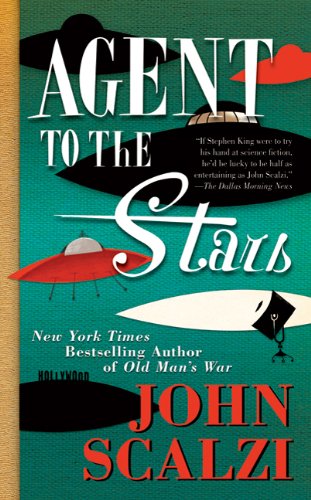
Agent to the Stars, by John Scalzi
This week I'm reviewing Agent to the Stars, another novel from science-fiction writer John Scalzi whose work has appeared two other times on my blog before. And I'm willing to admit I'm becoming a bit of a fan of Scalzi's work, at least in occasional doses. This particular book is Scalzi's first novel, originally released through his website for people to read, before getting published in both hardback and paperback editions. (Of course, I was reading the e-book version myself.)
The plot is an interesting idea, if perhaps a permutation on some older concepts. Of course, almost nothing in this world is new, so it's good to see some old ideas utilized in new ways. The book follows Tom Stein, an up and coming agent in Hollywood who's managed to start making it big time thanks to one of his clients. His boss mysteriously calls him into a meeting one day at work, and begins asking Tom his opinion on aliens. Tom is of course rather confused by this line of reasoning until his boss reveals that aliens have contacted him and asked him to find someone to represent their species on Earth.
The reason the aliens are seeking an agent is really quite simple. The aliens are friendly and only want to exist in peace with humans. However, they have received quite a lot of human television and radio broadcasts and they're well aware that humans, in movies at least, have a very bad habit of not responding well to aliens. Even if they're benign. To make it even more difficult, the aliens basically look like giant, clear blobs of gelatin and communicate primarily through smell, very pungent and malodorous smells to humans. So the aliens have hatched a plan: hire a Hollywood agent to help pave the way for their eventual arrival to earth. Hollywood is a powerful shaper of popular opinion, after all, so what better place to start?
The novel has a very interesting premise and I rather enjoyed the idea of friendly aliens who are well aware their arrival at earth might not go over so well. And furthermore they know that clear blobs that smell like week-old garbage certainly aren't going to be welcomed with open arms on earth without some amount of preparation. It's really an interesting idea and I enjoyed reading about it. Plus there's a lot of stuff that makes you feel that Scalzi did a lot of research into the workings of the movie business and how agents operate. I felt like it was a really fascinating look into two alien cultures at the same time.
My biggest complaint with this book, though, is I felt like it kind of ran out of steam about halfway through the book. Basically there's a big twist at the halfway mark and after that I could predict where the rest of the book was going. Maybe it's just because I read far, far too much science fiction, but once the initial premise gets laid it just sort of...peters out so to speak. I was a little disappointed, but not overly so.
Plus there are some really important moral and philosophical questions that get raised during the course of the book and I don't feel like they were given enough time to explore adequately. And these are some really big, big, big questions that get brought in. People have spent their entire lives discussing these questions and I felt like it wasn't given quite enough space. Ultimately, that's my own opinion, though.
Overall, the premise is interesting and getting it all set up is pretty fun. But as I said, after the halfway mark the book rapidly starts running out of steam. Scalzi's writing is a delight to read, though, in my opinion and there were some really enjoyable moments in this book. If you're a fan of Scalzi you'll probably enjoy this, but I would recommend reading some of his other works first if you haven't.
- Kalpar
The plot is an interesting idea, if perhaps a permutation on some older concepts. Of course, almost nothing in this world is new, so it's good to see some old ideas utilized in new ways. The book follows Tom Stein, an up and coming agent in Hollywood who's managed to start making it big time thanks to one of his clients. His boss mysteriously calls him into a meeting one day at work, and begins asking Tom his opinion on aliens. Tom is of course rather confused by this line of reasoning until his boss reveals that aliens have contacted him and asked him to find someone to represent their species on Earth.
The reason the aliens are seeking an agent is really quite simple. The aliens are friendly and only want to exist in peace with humans. However, they have received quite a lot of human television and radio broadcasts and they're well aware that humans, in movies at least, have a very bad habit of not responding well to aliens. Even if they're benign. To make it even more difficult, the aliens basically look like giant, clear blobs of gelatin and communicate primarily through smell, very pungent and malodorous smells to humans. So the aliens have hatched a plan: hire a Hollywood agent to help pave the way for their eventual arrival to earth. Hollywood is a powerful shaper of popular opinion, after all, so what better place to start?
The novel has a very interesting premise and I rather enjoyed the idea of friendly aliens who are well aware their arrival at earth might not go over so well. And furthermore they know that clear blobs that smell like week-old garbage certainly aren't going to be welcomed with open arms on earth without some amount of preparation. It's really an interesting idea and I enjoyed reading about it. Plus there's a lot of stuff that makes you feel that Scalzi did a lot of research into the workings of the movie business and how agents operate. I felt like it was a really fascinating look into two alien cultures at the same time.
My biggest complaint with this book, though, is I felt like it kind of ran out of steam about halfway through the book. Basically there's a big twist at the halfway mark and after that I could predict where the rest of the book was going. Maybe it's just because I read far, far too much science fiction, but once the initial premise gets laid it just sort of...peters out so to speak. I was a little disappointed, but not overly so.
Plus there are some really important moral and philosophical questions that get raised during the course of the book and I don't feel like they were given enough time to explore adequately. And these are some really big, big, big questions that get brought in. People have spent their entire lives discussing these questions and I felt like it wasn't given quite enough space. Ultimately, that's my own opinion, though.
Overall, the premise is interesting and getting it all set up is pretty fun. But as I said, after the halfway mark the book rapidly starts running out of steam. Scalzi's writing is a delight to read, though, in my opinion and there were some really enjoyable moments in this book. If you're a fan of Scalzi you'll probably enjoy this, but I would recommend reading some of his other works first if you haven't.
- Kalpar
Thursday, February 12, 2015
Fuzzy Nation, by John Scalzi
This week, possibly because I was reminded of John Scalzi from last week's novel, I'm reading another book from Scalzi called Fuzzy Nation. As Scalzi himself says in the introduction to this novel, Fuzzy Nation is actually a reboot of an earlier novel, Little Fuzzy, by H. Beam Piper. I myself have not had the fortune of reading Little Fuzzy, and it is not necessary to do so to enjoy Scalzi's work. However, I personally am now interested in reading the original material at some future point and comparing it with Scalzi's own reinterpretation.
Fuzzy Nation is set on the planet Zara XXIII, a metal-rich world currently being exploited by the interstellar mining Zarathustra Corporation. What makes Zara XXIII particularly valuable to Zarathustran holdings is the presence of sunstones, gemstones found only on ZaraXXIII, and which emit a faint glow from someone's body heat. Rarer than diamonds, Zarathustra hopes to maintain dominance in the interstellar market with a treasure trove of sunstones. Our main character is Jack Holloway, a surveyor under contract with Zarathustra to do all the hard work of finding the valuable resources which Zarathustra can then swoop in, mine, and then ship off-planet back to depleted and resource-hungry Earth. When Jack discovers the veritable mother lode of sunstones, it looks like he and Zarathustra will be financially set for decades to come. However when a family of hitherto unseen fuzzy critters shows up at Jack's compound, it may spell trouble for everyone planetside. If the fuzzies turn out to be sapient, as some people suspect, then all mining on Zarathustra will have to cease immediately.
Aside from a really good story about what we would consider to be sentient life on other planets, Fuzzy Nation raises really good questions about the ethics of a resource-hungry economy and if it can successfully coexist with, and help sustain, a vibrant ecology at the same time. The answer has always seemed to be a no, especially true where strip mining is involved. And as farms, cities, and human industries expand it leaves less and less space on our little blue marble here for the billions of other species that we share the planet with. Plus as of 2014 we're still stuck on our little blue marble so we don't have an option to move stuff off-planet if it's inconvenient to have it here. On the other hand, the fact that I was able to read this book and then write this review is largely because people mined materials out of the ground which then went into the electronic devices I used. It doesn't look like there's any easy answer, not soon at any rate, but it's definitely something we should be thinking about.
Fuzzy Nation also raises a very excellent point which sadly isn't explored terribly much because the book reaches its climax very soon afterwards. Characters point out that even if the fuzzies get protected status, it may actually cause them to go extinct more quickly. This is the double-edged sword of protected status that many creatures have encountered here in the United States and I'm certain elsewhere as well. In many cases it is illegal to disturb the nesting or breeding grounds of protected creatures and the discovery of those creatures mean any and all activity in that area must end immediately. However, as there is a financial motive for continuing activity in that area, whether it be house construction, mining, logging, or something else entirely, very often the animals will be quietly killed off so that humans can continue their activity, rather than descend into the red tape and bureaucracy of accommodating a protected species. Unfortunately, although this is a very real issue in conservation and protection efforts today, it doesn't get terribly fleshed out and quickly gets eclipsed by the fantastic climax.
I will admit that there were some things that seemed altogether far too convenient at the very end of the novel. Well, specifically one thing but I won't go into it because spoilers. Anyway other than that the ending had a ton of courtroom drama which actually made sense because it was a preliminary hearing instead of an actual trial. (Interestingly, the American legal system tries to make trials go as smoothly as possible so all evidence and witnesses are actually submitted ahead of time for use in the trial. Despite what movies and TV would have us believe, surprise witnesses are actually an exception.) Anyway, with a bit of downright awesome legal chicanery we get our resolution, which was probably my favorite part of the book to be honest. If anyone enjoys a good debate you'll definitely love the ending to Fuzzy Nation.
Overall, I really liked this book. I will admit that I felt it had its shortcomings because there was a really good opportunity there to examine human industry, needs, and desires and whether they can ever coexist with a sustainable ecology. However, that may have ended up overshadowing the fuzzy plotline, which is what the book's really about. I'd definitely say it's worth a read.
- Kalpar
Fuzzy Nation is set on the planet Zara XXIII, a metal-rich world currently being exploited by the interstellar mining Zarathustra Corporation. What makes Zara XXIII particularly valuable to Zarathustran holdings is the presence of sunstones, gemstones found only on ZaraXXIII, and which emit a faint glow from someone's body heat. Rarer than diamonds, Zarathustra hopes to maintain dominance in the interstellar market with a treasure trove of sunstones. Our main character is Jack Holloway, a surveyor under contract with Zarathustra to do all the hard work of finding the valuable resources which Zarathustra can then swoop in, mine, and then ship off-planet back to depleted and resource-hungry Earth. When Jack discovers the veritable mother lode of sunstones, it looks like he and Zarathustra will be financially set for decades to come. However when a family of hitherto unseen fuzzy critters shows up at Jack's compound, it may spell trouble for everyone planetside. If the fuzzies turn out to be sapient, as some people suspect, then all mining on Zarathustra will have to cease immediately.
Aside from a really good story about what we would consider to be sentient life on other planets, Fuzzy Nation raises really good questions about the ethics of a resource-hungry economy and if it can successfully coexist with, and help sustain, a vibrant ecology at the same time. The answer has always seemed to be a no, especially true where strip mining is involved. And as farms, cities, and human industries expand it leaves less and less space on our little blue marble here for the billions of other species that we share the planet with. Plus as of 2014 we're still stuck on our little blue marble so we don't have an option to move stuff off-planet if it's inconvenient to have it here. On the other hand, the fact that I was able to read this book and then write this review is largely because people mined materials out of the ground which then went into the electronic devices I used. It doesn't look like there's any easy answer, not soon at any rate, but it's definitely something we should be thinking about.
Fuzzy Nation also raises a very excellent point which sadly isn't explored terribly much because the book reaches its climax very soon afterwards. Characters point out that even if the fuzzies get protected status, it may actually cause them to go extinct more quickly. This is the double-edged sword of protected status that many creatures have encountered here in the United States and I'm certain elsewhere as well. In many cases it is illegal to disturb the nesting or breeding grounds of protected creatures and the discovery of those creatures mean any and all activity in that area must end immediately. However, as there is a financial motive for continuing activity in that area, whether it be house construction, mining, logging, or something else entirely, very often the animals will be quietly killed off so that humans can continue their activity, rather than descend into the red tape and bureaucracy of accommodating a protected species. Unfortunately, although this is a very real issue in conservation and protection efforts today, it doesn't get terribly fleshed out and quickly gets eclipsed by the fantastic climax.
I will admit that there were some things that seemed altogether far too convenient at the very end of the novel. Well, specifically one thing but I won't go into it because spoilers. Anyway other than that the ending had a ton of courtroom drama which actually made sense because it was a preliminary hearing instead of an actual trial. (Interestingly, the American legal system tries to make trials go as smoothly as possible so all evidence and witnesses are actually submitted ahead of time for use in the trial. Despite what movies and TV would have us believe, surprise witnesses are actually an exception.) Anyway, with a bit of downright awesome legal chicanery we get our resolution, which was probably my favorite part of the book to be honest. If anyone enjoys a good debate you'll definitely love the ending to Fuzzy Nation.
Overall, I really liked this book. I will admit that I felt it had its shortcomings because there was a really good opportunity there to examine human industry, needs, and desires and whether they can ever coexist with a sustainable ecology. However, that may have ended up overshadowing the fuzzy plotline, which is what the book's really about. I'd definitely say it's worth a read.
- Kalpar
Thursday, December 13, 2012
Redshirts, by John Scalzi
So a couple of months ago I heard about the then-new novel, Redshirts, which was a ruthless satire of Star Trek and other poorly written science fiction shows with massive death tolls. Being the complete sci-fi nerd that I am, I was eager to crack the pages of Redshirts and discover Scalzi's own insights into the lower grade of science fiction.
For those of my readers who are unfamiliar with the concept of a redshirt, (which is probably none) let me provide a brief explanation. In Star Trek: the Original Series it was very common for Kirk, Spock, McCoy, and some poor sap in a red shirt to beam down to the planet the Enterprise was orbiting that episode. Inevitably, Ensign Skippy in the red shirt would get eaten by a monster before the commercial break to raise the stakes for the main characters (who, of course, were never in any real danger thanks to plot armor). By the end of Star Trek's three-year run a total 13.7% of the Enterprise's crew had died, the vast majority being the eponymous redshirts. Since then redshirt has become a term for any expendable character who gets killed mostly for cheap shock value. Actual red shirts are, of course, optional.
Redshirts focuses on the events surrounding the Universal Union's flagship, the Intrepid, where strange things happen. New crew members Andy Dahl, Maia Duvall, Jimmy Hanson, Finn, and Hester notice that not only is everyone terrified of going on away missions, but the senior officers occasionally act just downright strange. Together they compare notes and discover that there might be more to the mysterious occurrences on the Intrepid than what meets the eye, provided that they can live long enough first.
Overall, I really enjoyed this novel and its take on a plethora of science-fiction tropes. In addition, it had plenty of leaning-on-the-fourth wall humor, which is a particular brand of humor I enjoy and can be very hard to do well. I will admit that the book got almost too meta for me towards the end, but I still think it was a very well-written book from Scalzi. Furthermore this book has some great advice for aspiring science-fiction writers on how to avoid common pitfalls of the genre. Or at least, how to avoid making the deaths of redshirts completely meaningless.
Another point I want to make is that I was expecting this book to be a little more lighthearted than it was, sort of on the same grade as Hitchhiker's Guide to the Galaxy, but this was a far more serious book than I anticipated. By all means, it's still an excellent book, but if you haven't read this yet the keep in mind that it is by no means a laugh-a-minute satire. I definitely went into Redshirts with the wrong expectations and had to adjust to the more serious tone.
Redshirts is definitely a must-read for any sci-fi geek, however, if you're not a fan of Star Trek in specific or a fan of sci-fi in general, then this book really doesn't have a lot to offer you.
- Kalpar
For those of my readers who are unfamiliar with the concept of a redshirt, (which is probably none) let me provide a brief explanation. In Star Trek: the Original Series it was very common for Kirk, Spock, McCoy, and some poor sap in a red shirt to beam down to the planet the Enterprise was orbiting that episode. Inevitably, Ensign Skippy in the red shirt would get eaten by a monster before the commercial break to raise the stakes for the main characters (who, of course, were never in any real danger thanks to plot armor). By the end of Star Trek's three-year run a total 13.7% of the Enterprise's crew had died, the vast majority being the eponymous redshirts. Since then redshirt has become a term for any expendable character who gets killed mostly for cheap shock value. Actual red shirts are, of course, optional.
Redshirts focuses on the events surrounding the Universal Union's flagship, the Intrepid, where strange things happen. New crew members Andy Dahl, Maia Duvall, Jimmy Hanson, Finn, and Hester notice that not only is everyone terrified of going on away missions, but the senior officers occasionally act just downright strange. Together they compare notes and discover that there might be more to the mysterious occurrences on the Intrepid than what meets the eye, provided that they can live long enough first.
Overall, I really enjoyed this novel and its take on a plethora of science-fiction tropes. In addition, it had plenty of leaning-on-the-fourth wall humor, which is a particular brand of humor I enjoy and can be very hard to do well. I will admit that the book got almost too meta for me towards the end, but I still think it was a very well-written book from Scalzi. Furthermore this book has some great advice for aspiring science-fiction writers on how to avoid common pitfalls of the genre. Or at least, how to avoid making the deaths of redshirts completely meaningless.
Another point I want to make is that I was expecting this book to be a little more lighthearted than it was, sort of on the same grade as Hitchhiker's Guide to the Galaxy, but this was a far more serious book than I anticipated. By all means, it's still an excellent book, but if you haven't read this yet the keep in mind that it is by no means a laugh-a-minute satire. I definitely went into Redshirts with the wrong expectations and had to adjust to the more serious tone.
Redshirts is definitely a must-read for any sci-fi geek, however, if you're not a fan of Star Trek in specific or a fan of sci-fi in general, then this book really doesn't have a lot to offer you.
- Kalpar
Subscribe to:
Posts (Atom)