Showing posts with label Philip K. Dick. Show all posts

Thursday, October 9, 2014

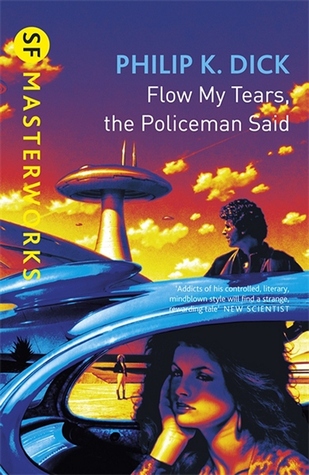
Flow My Tears, the Policeman Said, by Philip K. Dick

For whatever reason I've decided to take another stab at Philip K. Dick and his highly influential science-fiction literature. Flow My Tears, the Policeman Said is another one of Dick's full-length novels, fairly short in length, but because of his writing style you don't feel like a single page was wasted and this book probably could have been developed much further into a longer work. It's very interesting and there are a couple of very insightful passages into human nature within this book, specifically dealing with love and grief, but everything gets tossed into a large jumble with a ton of drugs going on as well. Hoo boy did Philip K. Dick like his drugs.

As I said in my reviews of Do Androids Dream of Electric Sheep? and Minority Report, it seems that Dick is much better at writing short stories rather than full-length novels. When he's working on a short story there's an arbitrary stopping point that forces Dick to be extremely tight in his focus and stay on whatever his main topic is about. In full-length novels, by contrast, Dick has much more space to work with and so sometimes dozens of ideas just sort of pop up, announce themselves, then scurry into the background with you saying, “Wait! You were interesting! I want to see you developed!”

The main plot in Flow My Tears is that television personality and famous singer Jason Taverner wakes up one day to discover he is in a world where no one knows he exists. No one he talks to has seen his weekly TV variety show, or heard one of his albums. To further complicate things there's no record that Jason Taverner exists at all: no birth certificate, no driver's license, no documented proof anywhere that he exists. In a world firmly under the heel of a police state where no identification means instant incarceration in a forced labor camp, Jason Taverner is in a very, very bad position.

Alone, this plot is pretty fantastic and could easily make its own novel, or in the case of Dick he could make a really fantastic short story out of this premise. Unfortunately, as I said, because this is a full-length novel, Dick's able to wander off and introduce a bunch of ideas that never really go anywhere. For example, Taverner is a six, one of a handful of people the result of genetic experimentation that produced human beings superior in almost every respect. Despite this being an aspect of Taverner's character which is mentioned repeatedly, it plays a very small role on the story overall.

Another really interesting idea is that to help solve the race problem a ton of legislation has been passed, more or less protecting blacks as a sort of endangered species. However, legislation has also been passed which requires blacks to be sterilized after the birth of their first child, dooming them to eventual extinction. Writing as he was in the seventies, a period of great racial tension, this idea could have been a very interesting reflection on the racial ideology of the day. However, it's just sort of mentioned and then the story moves on.

A final idea that Dick talks about, and believe me there are plenty, is the fact that in this particular world, many of the university campuses in at least the United States have been walled off from the rest of the world, surrounded by the police and the national guard who are heavily armed and informed to shoot anyone who tries to escape. We're never told why the campuses have been placed into a state of siege, what horrible political protest (for that's what I'm assuming happened) allowed the situation to balloon to such proportions. In the novel's epilogue we're told that the universities eventually surrender and the students disappear into the forced labor camps, but we never encounter any students or go to any university campus so it's an interesting idea that ultimately goes nowhere.

I definitely think that in the future I'm probably going to stick more to Dick's short stories rather than his novels. It seems to me that his short stories work out much better because they're not able to just go all over the place. I probably will explore some of his novels again, but they're definitely very different fare from most reading.


- Kalpar

Thursday, June 12, 2014

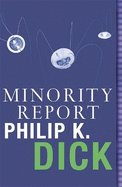
Minority Report, by Philip K. Dick

This particular book is an anthology of Dick's short stories put out by Orion Books and contains not only the titular story "Minority Report", but also the stories "Imposter", "Second Variety", "War Game", "What the Dead Men Say", "Oh, to Be a Blobel!", "Electric Ant", "Faith of Our Fathers", and "We Can Remember it for You Wholesale". Both "Minority Report" and "Imposter" have influenced films of the same name (albeit the film version is spelled Impostor), and "We Can Remember it for You Wholesale" was the inspiration for the cult favorite film Total Recall. As you can imagine there's a ton of really good sci-fi in this anthology, including what seems to be a favorite topic of Dick's: people who are secretly robots and don't realize it. And of course questioning if what we sense and perceive is real or not.

I think what I really liked about this collection was that a lot of the short stories had a much tighter focus and made a far more complete story. Opposed to certain longer works, (Granted, I've only read Do Androids Dream of Electric Sheep), but even his longer short stories seem to start meandering into various streams of thought that Dick had, losing a certain amount of focus in the story. In his shorter stories, by contrast, Dick is forced to keep things much tighter and much more focused because of the brevity which means the story flows much better. I can easily see how someone would attempt to build an entire two-hour or so movie out of a story like "Imposter" or "Minority Report". There's a ton of meat there that offers opportunities for development and expansion, but because Dick's forced to stay focused it remains a short little thing. Possibly the story that I liked the most in this collection was "War Game" which reminded me of an episode of The Twilight Zone with its little surprising twist at the end.

If you haven't tried reading Dick yet, then I'd definitely recommend starting off with perhaps an anthology of short stories before jumping into one of his novels. His writing style is very unique, to say the least, and some of the plots in the longer stories can be more complicated to read, even for me. And I took on Les Miserables! (Seriously, that book has a whole chapter on Paris's sewer system!) Anyway, sorry this is a short review but this was a pretty good anthology that I picked up at the used book store so if you can find it on the shelf on your next trip, I'd recommend snatching it up if you can.

- Kalpar

Thursday, October 31, 2013

Do Androids Dream of Electric Sheep? by Philip K. Dick

So this week I've decided to finally read Philip K. Dick's classic novel, Do Androids Dream of Electric Sheep? If any of you have seen the classic 1982 sci-fi film Blade Runner, this is the book that the novel is based off of. I have read that although Philip K. Dick died before the film was released, the work that he did get to see impressed him incredibly and he even said the film was better than his book. This was enough to pique my curiosity and I figured it was about time for me to actually start reading books from one of the giants of science fiction. I definitely have mixed feelings about this book and I hope I can give this book its full credit. However, I think I agree with the author in saying that this is one of the rare instances where the film adaptation is actually better than the novel.

To provide a general plot summary of Do Androids Dream of Electric Sheep? sometime in the 20th century the world experienced a third, final, devastating nuclear war that killed of much of the population. Faced with a planet slowly dying from nuclear fallout, the UN pushes for extensive off-world colonization, including Mars, and to help motivate citizens to leave earth each colonist is given an android "servant". Really, no better than electronic slaves. As the androids become better and more complicated it becomes harder to tell androids and humans apart aside from a couple of specific tests. Because androids occasionally kill their human masters and escape police departments employ bounty hunters like Rick Deckard to "retire" androids. Overall it raises a bunch of good questions such as what sort of value artificial life has and what makes someone human.

The book raises a lot of good questions, but I haven't even talked about half of what Dick manages to cram into this novel. And really I think that this is a weakness of his work and I've heard that this is a tendency of Dick's books and stories in general. Dick introduces all of these really interesting ideas such as a device that lets you control what emotions you feel, a religion based on holding all life, from humans down to the smallest bug as sacred, and an extensive market in pet animals that cost as much as cars and come with payment plans. Dick introduces all of these really interesting ideas that you could make a whole book out of just one of these ideas. (And no, so I don't get accused of plagiarism, this isn't really my idea, this is from the foreword to the edition that I read but I found myself agreeing with the foreword's author as I continued with this novel.)

So really, I think this is where the movie adaptation has a benefit well over the book. Blade Runner has cut out all of the superfluous elements of the novel like the electric sheep and Mercerism, which allows the story to be much better-paced and focus on the important element. I feel that because the book has all these various threads, many of which never really get developed, Do Androids Dream of Electric Sheep? loses a lot of its focus and you kind of lose the urgency of the narrative. I will say that the movie has your more expected Hollywood ending while the book just sort of ends, which I feel is kind of an appropriate ending for this story.

If you're interested in this story, I'd actually recommend that you watch Blade Runner, especially the director's cut which is widely considered to be better than the original theatrical release. The book's all right but it definitely lacks the focus and direction of the movie.

- Kalpar