Tuesday, February 13, 2018

Spain in Our Hearts, by Adam Hochschild

Today I'm looking at a history of the Spanish Civil War which specifically looks through the perspective of various American reporters and volunteers, as well as a handful of Brits. Ernest Hemmingway's dispatches from Spain are probably the most famous of these dispatches, with George Orwell's writings definitely in the same weight class. However, Hochschild utilizes the letters and diaries of ordinary volunteers, some of whom never managed to make it back home.

The Spanish Civil War was prompted by the election of a left-leaning coalition government of liberals, socialists, and communists. For years the ordinary people of Spain had struggled under the social and economic domination of the land-holding elites. In addition to the ever-popular topic of land reform, the republican government promoted a series of social and economic reforms that would improve the lot of common Spaniards and reduce the power of the big landowners and the Catholic Church. Unfortunately, a coalition of generals, eventually lead by Francisco Franco, led a military revolt against the Republican government and sought to reassert the power of the elites, the monarchy, and the Church. The following war lasted three bitter years, leaving thousands of people dead not only through combat but through disease, starvation, and political executions on both the Republican and Nationalist sides.

Aside from the toll it took on the Spanish people, the Spanish Civil War is important because of the international attention it received. Most importantly Mussolini and Hitler, eager to test new airplanes, tanks, and tactics, allied with Franco and dispatched troops and material to aid him. As a result the fascist powers gained experience that would prove extremely valuable in the early days of the Second World War, only a few months after the Spanish Civil War finally ended.

While Franco received aid from nations abroad and even the approbation of Pope Pius XII, the Republican government found themselves largely bereft. The western democracies of Britain, France, and the United States were unwilling to aid Republican Spain and often hampered or forbade the sale of arms and ammunition. In fact, the only country that provided aid in any significant quantities of the Soviet Union, and the communists would utilize this control on the purse strings to exert additional political control and launch their own purges within the Republican government. As a result the Spanish Civil War has become one of the great ''what if'' scenarios of the twentieth century. What if FDR had lifted the embargo on the sale of weapons to Republican Spain? What if the French had sent a few divisions across the Pyrenees to aid an ailing fellow Republic? The answer is, of course, unknowable, but it represents a great moment of when things should have been done in history.

Which makes the romance of the International Brigades all the greater. Composed of young men, some anarchists, some socialists, some communists, the International Brigades were forces of volunteers who often made their own way to Spain to fight for a cause they believed was vital. Undertrained and woefully underequipped, the International Brigades were thrown into the worst fighting of the Spanish Civil War and as a result saw the highest casualties out of any Republican units. Despite their doomed cause, the International Brigades represented the willingness of ordinary people to give their lives for their beliefs, even when they could have stayed home very comfortably and probably not be affected one way or the other.

Overall I thought this book was interesting. I knew very little about the Spanish Civil War so this was a useful introduction to this period of history for me. I also appreciate that we got to see perspectives beyond the most famous observers such as Hemmingway and Orwell. I definitely think this book is worth the time to check it out and learn about something American audiences might not know much about.

- Kalpar

Thursday, February 8, 2018

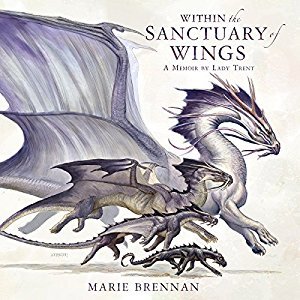
Within the Sanctuary of Wings, by Marie Brennan

Today I'm finally getting to the last book of the Lady Trent Memoirs series, Within the Sanctuary of Wings. On the downside I think this book and the series in general could have used a lot more development because there are still a lot of questions I have that probably should have been answered. Lady Trent assumes that the readers, members of her world, know things which are common knowledge in her world. While this makes sense and avoids a bunch of clunky exposition, it does leave the series with some questions unanswered.

This book focuses on a later and significant chapter of Lady Trent's career when she goes to her world's equivalent of the Himalayas to investigate a potential new and unknown species of dragon. The problem is that Lady Trent's home country, Scirland, is at war with this world's equivalent of China so aside from the remoteness of the location and the difficult terrain, there are numerous political challenges that have to be overcome as well. However the potential to discover a missing link between ancient dragons raised by the Draconian civilization and modern dragons proves too much of a temptation for Isabella and once Lady Trent sets her mind to something it's basically impossible to stop her, especially when dragons are involved.

The main point of this book is a huge spoiler for not only the book but the series as well, which reveals major information about the Draconian civilization. I will say I'm not sure I'm fully satisfied with how the book ends and I would have liked even more information about the Draconians. I will say it's fairly realistic that we don't have a complete picture for civilizations that disappeared thousands of years ago, which makes the universe feel real, but I felt since this was a work of fiction Brennan could have cheated a little bit to bring more info into the book than what we ended up getting.

My other biggest criticism is I felt like Brennan spends a lot of time on stuff like the scenery to build up the anticipation for the major plot twists. Now, I will admit that this makes sense and Brennan does a good job describing things like village life, the mountains, the difficulties in crossing glaciers, and all the other challenges that Lady Trent and company encounter. I'm sure there are lots of people who enjoy this sort of thing and it's definitely good writing on Brennan's part, but I honestly kind of wished that more time had been spent talking about plot developments than talking about say, how gorgeous the mountains were. But I think this is really a matter of personal taste and I'm willing to admit that I probably have bad taste.

Overall I think this was a good ending for the series. Considering how much time had been spent building up anticipation for the reveal about the Draconian civilization I wish there had been more of a payoff. However, I think Brennan does a good job in creating a realistic world in her novels and making it believable that dragons could be part of an ecosystem. If you're a fan of science and fantasy, these books do a great job of combining the two.

- Kalpar

Tuesday, February 6, 2018

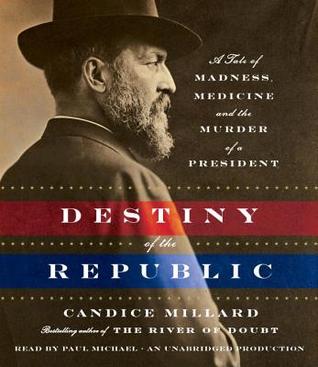
Destiny of the Republic, by Candice Millard

Today I'm looking at a book that's part biography, part larger history, and focuses around the events of the assassination of President James Garfield just a handful of months into his term in 1881. Despite initially surviving the bullet and clinging to life for several weeks, Garfield eventually died of massive internal infection leaving Chester A. Arthur, a man nobody had expected to be president, in the White House. In addition to talking about Garfield, this book focuses on the life of his assassin, Charles Giteau, who was not a sane individual by any stretch of the imagination. The aftereffects of this assassination are also important to American history both in what happened and what didn't happen as a result.

James Garfield was a politician from Ohio who did not expect to be nominated for president in 1880. To the very end, Garfield remained loyal to Senator John Sherman of Ohio who he had pledged his vote. The 1880 Republican convention was seeking a new candidate, after the ignominy of Rutherford B. Hayes's electoral victory in 1876 and was divided between three candidates. Ulysses S. Grant, although having already served two terms, was supported by the machine politicians but was opposed by James G. Blaine who was favored by those who supported reform. Finally John Sherman brought up the rear for those dissatisfied with either candidate. Eventually Garfield was selected as a compromise candidate, despite his loud protestations that he did not desire the candidacy. Reluctantly Garfield found himself the nominee, and eventually elected as president of the United States.

According to Millard and her sources, Garfield was a highly respected member of the Republican party at the time, even when he was only a junior congressman from Ohio his oratory skills were lauded by his colleagues. Garfield presents a wonderful opportunity of what could have been because of his political skill, his personality, and his desire for government reform and racial equality. Had Garfield been able to serve even just one full presidential term he might be remembered as far more than a presidential footnote.

Guiteau, by contrast, did not lead a very successful life and considering his mental illness this is not much of a surprise. And based on what Millard described, Guiteau definitely qualifies for some sort of personality disorder, although since I'm not a psychologist I can't define it with any precision. Guiteau spent much of his life wandering from place to place, unable to hold down a job, and trying to avoid creditors. Guiteau spent much of his life borrowing money from acquaintances, promising to pay it back once he got a check that was due to him any day now and purchasing many items for a down payment and failing to pay the remainder of the bill, as well as fleeing from boarding houses in the middle of the night. Most importantly, Guiteau suffered from persistent delusions. Guiteau believed that god had designated him for some special purpose and that a speech Guiteau had written (and had never delivered) was critical to getting Garfield elected. As a result, Guiteau assumed that a duly grateful Garfield would appoint him to some high office, first a consulate in Vienna and later as the general consul in Paris.

Garfield and his staff, receiving the letters and visits from a man who they deemed no more than an eccentric and persistent nuisance of an office seeker, simply stalled him until Blaine, now secretary of state, finally grew tired of Guiteau's inquiries and told him to stop asking about the Paris consulate. Guiteau, taken aback by these remarks, turned on Garfield and his administration and came to believe that god had told him to kill Garfield, ensuring a change in administration for which he would be duly rewarded. Finally, on July 2nd of 1881, Guiteau succeeded in shooting Garfield in the back at the Baltimore and Potomac train station.

The most tragic irony of all of this is that Garfield probably would have survived this assassination attempt and, if he had lived in the modern era, he'd probably be up and walking after a few days in the hospital. Although the bullet had shattered ribs and nicked an artery, it came safely to a rest behind Garfield's pancreas and even without the bullet being removed he probably would have survived. However, due to the unsanitary medical practices of the time, Garfield ended up with a terminal case of internal gangrene and quite literally rotted from the inside out.

Immediately after he was shot, Garfield was carried upstairs in the train station and several doctors probed the president's wound. Some utilized their bare hands, and some utilized a variety of probes, but none of these objects were sterilized before being inserted into the president. Germ theory and the process of sterilization had been relatively new developments to medical science and largely considered false by Americans. The idea that tiny, invisible creatures could make people sick and just by washing your hands and instruments in carbolic acid could prevent this seemed fairly suspicious to them at the time. After Garfield's agonizing death, and the revelation that he had died not from the bullet, but rather from sepsis, American medical science quickly began to accept that maybe there was something to this germ theory after all. However it would take the assassination of William McKinley for the American public to begin to think that maybe the president needed some protection and not just anyone could walk right into the White House.

Overall I thought this book was really interesting. There are a lot of different tangents to this book, such as Alexander Graham Bell (who I hadn't mentioned in the review) who developed a metal detector in an attempt to find the bullet and help save Garfield's life. However, I think they all manage to work together quite well and the result is a satisfactory book. It is interesting to learn about a president that isn't frequently talked about because of the short time he spent in office and Guiteau makes an interesting character by himself. If you're interested in nineteenth century America and learning more about one of the ''placeholder'' presidents or medical science at the time, this book is definitely worth checking out.

- Kalpar

Thursday, February 1, 2018

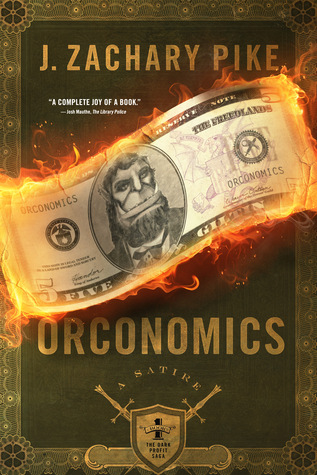
Orconomics: A Satire, by J. Zachary Pike

Today I'm looking at a parody novel written by J. Zachary Pike titled Orconomics. This book takes the idea of the standard swords and sorcery RPG like Dungeons & Dragons and explores, at least partially, the economy that would develop around heroes going into dungeons, killing monsters, and bringing back fantastic shares of loot. As it's been argued before in some D&D circles, the sheer fact that high level characters can instantly inject hundreds of thousands of gold pieces more or less instantly into an economy, and yet the economy suffers no inflation. To that end Pike creates a plausible economy of plunder futures trading and other financial derivative products which would help soak up the excess capital. However, Pike covers additional topics which means this is not solely an economically-driven satire.

Orconomics follows Gorm Igerson, a former Dwarven Berserker famed throughout the world as Pyrebeard. Due to a dishonorable incident some twenty years ago, Gorm was cast out of his clan, stripped of his titles, and declared an outlaw by the Heroes' Guild. Ever since Gorm has been scraping by best he can, finding solace in the bottom of a bottle more often than not. But when Gorm decides to get a goblin non-combatant papers he gets caught by Guild Enforcers and is faced with a decision: either certain execution at the hands of the Guild, or only almost certain death on a damn fool mission to aid the prophet of an insane deity. As Gorm puts it, it's not much of a choice at all but almost certain death is marginally better than certain death. Now Gorm just has to get a team including a naive prophet, two mages that can't stand each other, a bard who is almost definitely not a thief, and a washed-up has-been Elven ranger to work as a team rather than fighting each other and there may be a chance he'll actually survive.

As I said, this is partly a parody of a monster-killing and loot-gathering based economy, with traders purchasing shares in dragon hoards and professional unions for heroes, goons, and thugs. However, Pike takes on more standard fantasy tropes in his parody as well, such as the assumption that the ''evil'' races like orcs, gnolls, goblins, and kobolds truly are always evil. True, it's a topic that's been done before but I think that Pike manages to do it rather well in his novel. And there are plenty of other enjoyable moments throughout this book to make it easy to read.

If I have any critiques of this book, I think it's that Pike tries to take on too much in this particular book. As you might have noticed, this is intended to be the first book in a series. (As of writing it doesn't look like he's published the second novel so we'll have to wait and see for now.) It definitely seems like Pike has grand ambitions for his series because he sets up several plot threads, including heroes getting addicted to healing potions, a clan of aggressive weapons salesmen, and a prophecy about the fate of the world all in the first book. It almost feels like he was trying to take on too much at once in one book to get all his plot threads up and running at once. While I appreciate Pike doing so because it gives me a sense of what sorts of plans he has for the series, I feel like he could have saved a couple to be introduced later and gone a little more in depth in this book with a couple plotlines.

Overall though, I thought this book was pretty enjoyable. Maybe not the must subtle of satire or writing, but still a pretty good introduction to a series that has promise.

- Kalpar

Tuesday, January 30, 2018

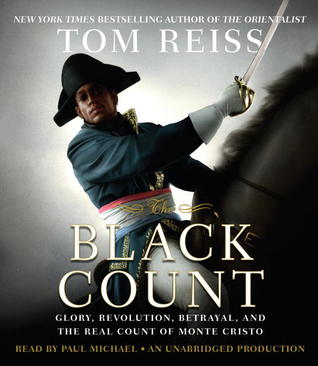
The Black Count, by Tom Reiss

Today I'm looking at a biography of Alex Dumas, father of the famous novelist Alexandre Dumas and grandfather to the playwright of the same name. Alexandre Dumas the writer is by far the most famous of this trio, famous for his novels The Three Musketeers and The Count of Monte Cristo, but that does not mean he was the only larger than life character in his family. In fact, his father looms equally as large in history, albeit in the field of warfare as a general for Republican France rather than a writer. However, the legacy of the first Alex Dumas has largely been forgotten partly because of his conflict with Napoleon, but largely because of his ethnicity. In this biography Reiss explores not only the life of Alex Dumas but the world surrounding him that enabled Dumas to rise to such spectacular heights before falling again into obscurity. There are a couple of issues that I have with this book, but I'll outline them later.

Alex Dumas was born a slave on the island of Haiti, then still the largest sugar-producing colony of France, as well as the world. Dumas's mother was a slave but his father was the feckless Marquis de la Pailleterie, who spent many years in hiding in Haiti but was remarkably proud of his son Alex. When de la Pailleterie returned to France, he brought Dumas with him, initially as a slave but later as his own natural son. Dumas enjoyed all the benefits of being a noble son in the waning days of the Bourbon monarchy, learning horseback riding, fencing, and dancing among many other skills. After a falling out with his father, Dumas joined the regiment of the Queen's Dragoons as a common private. This proved to be to Dumas's advantage when the revolution began in 1789 and very quickly Dumas found himself rising through the ranks of the revolutionary army. Furthermore, Dumas was a firm republican, devoted to the principles of liberty, equality, and fraternity and adopted the principles of the French Republic whole-heartedly.

Dumas was further aided by the, at the time, extremely radical attitude of racial equality that the French Republic adopted. The French Republic not only abolished slavery, itself a radical concept at the time and only beginning to gain traction in Britain, but granted full citizenship rights including the right to vote and the right to hold office to all citizens regardless of color. This was a significant boon to the large population of black and mixed-race people who had come to France from its colonies. Thanks to this policy of equality as well as his ability and boundless courage, Dumas was able to rise through the ranks and eventually became the equivalent of a four-star general. Unfortunately Dumas's disagreements with Napoleon, as well as his imprisonment by the government of Naples, led to his decline. Finally Napoleon, never a believer in racial equality, reestablished slavery and relegated people of color firmly to a second-class citizen status. As a result, Dumas was barely remembered in the official histories of France during the Revolution.

Unfortunately there are a couple of issues I have with this book, the biggest one being the sources. In the prologue Reiss goes into an extended account about how he believed there was a cache of lost Dumas family papers in a museum. Before Reiss could arrive the keeper of the papers died and she took the combination of the safe in which they were kept with her. After wrangling with an assistant mayor, Reiss finally bribed the government official to let him break open the safe and take photographs of the documents before the police collected the documents and stored them ''who knows where''. There is something a little too fantastic about this story which makes it sound like bad methodology. After some very cursory searches I don't have reason to believe that Reiss made anything up. I'm sure something would have come out by now if he had. But it is the tiniest bit concerning to me that source he claims to have consulted are not otherwise available. It is at the very least bad methodology and I would have rested easier if I'd known his primary sources were available for other people to check.

Another thing that bugs me about this book is how Reiss tries to play up that the reasons for Dumas's imprisonment were forever a mystery to Dumas and he never understood what role he played in a larger struggle. This is patently false. Dumas may have had some confusion as to why he languished in prison for two years before being ransomed by France, but he certainly understood why he'd been imprisoned. On his return from the poorly-planned Egypt expedition led by Napoleon, Dumas's ship landed in southern Italy, then part of the Kingdom of Naples which was at war with France. Since he was still a high-ranking general in the French Army, Dumas was considered a valuable prisoner and was kept captive by the Neapolitans as a bargaining chip and prisoner of war. Dumas certainly would not have been confused by why he was in prison. As for why he remained there for two years, the answer is simply Napoleon. On a variety of levels Dumas and Napoleon did not get along and it was simply Dumas's ill fortune that he was captured by the Neapolitans while Napoleon launched a coup and established himself as First Consul of a reorganized French Republic. Between his focus on other details and lack of love for Dumas, it is hardly surprising that Napoleon and his subordinates did not overburden themselves with the task of freeing Dumas. In addition, Dumas's republican sentiments might have been a liability considering Napoleon's aims at absolute power and reestablishment of slavery. Perhaps Dumas made these conclusions before he died, but I don't think he was utterly bewildered by his predicament.

Finally Reiss does play into the short man myth of Napoleon as an explanation for why he had such conflict with Dumas. As has been explained in countless other places, Napoleon was actually 5'7" tall (or 170 cm for you people who use rational units). (Interestingly that makes Napoleon a whole two inches or five centimeters taller than me.) For a man of the late eighteenth century this was actually average height. The myth only originated because 1. French inches were larger than English inches so when the English found out Napoleon's height (in French inches) was 5'2", they just took that and ran with it in all their propaganda and 2. (Kalpar's theory) Napoleon was surrounded by his grenadier guards who had to be at least six feet tall to be grenadiers, and also had giant hats that made them look even taller. Seriously. Look at those hats. No wonder he looked short, he was surrounded by freaking tall people with their giant-ass hats all the time. The point of this diversion is that Reiss explains some of the friction between Dumas and Napoleon down to Dumas being 6'1" tall, incredibly well muscled, and basically looking like some sort of eighteenth century version of Keith Hamilton Cobb.  Personally I think it's more likely Napoleon was a racist jerk and also didn't like anybody being more important than himself which was the cause of friction, rather than any ''Napoleon complex''.

Overall I think this was an interesting book. As I said, my biggest concern was the cache of documents Reiss claims he found by breaking into a safe, which may or may not be available. Otherwise, this is a really good book and shows a fascinating life of a man largely forgotten because of the color of his skin.

- Kalpar

Thursday, January 25, 2018

Eleanor and Hick: The Love Affair That Shaped a First Lady, by Susan Quinn

Today I'm looking at a biography about Eleanor Roosevelt and her friend Lorena Hickok, although based on their correspondence it is possible that Eleanor and Hick were far more than just friends. This book covers their lives, albeit only very briefly. (And in a life as full and complex as the lives of Eleanor Roosevelt or Lroena Hickock, it's very difficult to talk about either one fully in just one book.) Most of the focus of this book seems to be in the New Deal years, when Eleanor and Hick's relationship was at its closest, especially after Hick left her job with the Associated Press to work for the Roosevelt administration and later the Democratic Party. After they separated the two ladies remained in contact and Quinn also talks about other romantic connections in Eleanor's life which add depth to an already fascinating person.

Lorena Hickok died in 1968 and willed her surviving correspondence with Eleanor Roosevelt to the Franklin D. Roosevelt Library, on the condition that they be sealed for a decade after her death. When the letters were first examined in 1978 the depths of the romantic attachment between the two ladies was revealed for the first time, but this being the seventies the possibility of Eleanor Roosevelt, one of the most respected women of the twentieth century, being involved in a homosexual relationship was deemed impossible and dismissed. However, as times and mores have changed, a reexamination of the correspondence between Eleanor and Lorena is well worth going into. And Quinn makes a convincing argument that the two women were definitely involve romantically based on the available evidence.

First and foremost there is the depth of emotion and expression in their letters, especially the ones written by Eleanor. Eleanor herself was a very emotionally reserved person due to her childhood and had particular difficulty expressing emotions with her own family. Yes, Eleanor had an easier time expressing emotions with friends but the depth of emotion with Lorena was on quite another level. Second we know for a fact that Lorena was a lesbian so that makes the possibility of a homoromantic relationship between the two all the more possible. Third, Eleanor herself had lesbian friends some of whom she went into business with in the Val-Kill furniture shop so Eleanor was not unaware of the possibility either. (Although where Eleanor fell on the spectrum both romantically and sexually is a question ultimately unanswerable.) Finally, we know that Eleanor was trapped in an unsatisfying marriage after the discovery of Franklin's affair with Lucy Mercer in 1918. Unable to divorce because of Franklin's political ambitions, but equally unable to go to Franklin for emotional support because of his betrayal, it is perfectly rational that Eleanor might search elsewhere for romantic and emotional companionship outside her marriage, much like how Franklin did.

The question of whether Eleanor and Lorena were ever physically intimate is unanswerable. Any letters that may have answered that question have been destroyed so the matter is left purely to speculation, but I think the subject's largely irrelevant. We have a large body of evidence suggesting a deep emotional and romantic relationship between the two women, however they chose to express it within the limited roles available to them in the 1940's. And quite frankly I think it's an inspiring message to people across the gender and sexuality spectrums that even people like Eleanor Roosevelt didn't fit into neatly defined categories. People are ultimately people, regardless of time and place; messy, complicated, unsure of themselves, loaded with emotional baggage, and all manner of other issues.

A lot of the rest of the information in the book, at least about Eleanor, was a repeat of things I was already familiar with thanks to resources such as the Ken Burns Documentary and the book Eleanor and Franklin. As I said, this book specifically seems to focus on the New Deal/1930's era when Eleanor and Hick were closest in their relationship. But regardless I think this book is definitely worth checking out.

- Kalpar

Tuesday, January 23, 2018

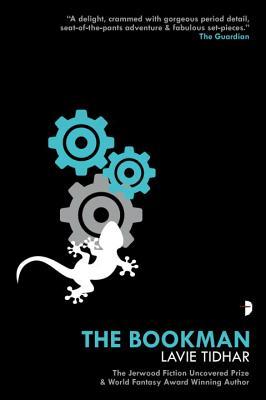
The Bookman, by Lavie Tidhar

Today I'm looking at the novel The Bookman, first in a steampunk series by Lavie Tidhar that follows the adventures of a man known only as Orphan. Orphan is an aspiring poet, part time bookseller, and deeply in love with whale biologist Lucy. Things seem to be going all right for Orphan when Lucy is tragically killed in an attack by the Bookman, a mysterious assassin that uses exploding books to attack the establishment of lizard people that rule the world. When Lucy is killed in one of the Bookman's attacks, Orphan finds himself thrown into a world of espionage, plot, and counterplot. Most tempting of all is an opportunity to bring Lucy back, but to do so Orphan will have to align himself with the Bookman.

I think my biggest criticism of this book is that there is simply way too much going on for this book to have a coherent plot. In my opinion Tidhar gets way too ambitious and tries to jam about five thousand different things into this book at once which means we never really have time to develop one idea to its full potential. I definitely think this book could have benefited from a tighter focus and sticking to maybe one or two plot threads instead of having multiple threads scattered all over the place running at once.

To provide an example of what I mean, let me just cover some of the things that are included in The Bookman. Orphan pulled a prank on Oscar Wilde. Lizard people have ruled Great Britain and its empire for nearly four hundred years. Professor Moriarty is the Prime Minister and Rudyard Kipling is a newspaper reporter. Mycroft Holmes is influential enough in government to commandeer mysterious black airships. Mycroft and Dr. Watson have consulted with Dr. Moreau, Dr. Jekyll, and Dr. West to try to bring Sherlock back to life. Karl Marx is a member of the small revolutionary group run by Orphan's boss. Orphan meets the Mechanical Turk, Tom Thumb, and Jojo the Dog-Faced Boy. Later Orphan teams up with Jules Verne and Captain Nemo to travel to a mysterious island. And these are just the references I caught. I have no doubt that Tidhar included multiple other references that I probably missed. As I've said in reviews of other books I have doubts about these sorts of references, especially when you have authors and their fictional characters in the same universe. And considering the sheer number of things that Tidhar has thrown into the book, it left me feeling a little overwhelmed.

The plot seems to revolve around three factions, although there might be more and it's difficult for me to tell because Tidhar throws so many things into the mix. We have the Bookman, the lizard people, and then the automatons who want rights as sentient beings. Orphan gets tossed between the factions as a playing piece and he realizes he doesn't seem to have much choice himself in the situation but to move ahead on the path laid before him. So the result is Orphan gets tossed around throughout the book.

Maybe this book gets better if you read it through a second time, but I was honestly left feeling kind of lost because there was so much going on. As I said, I think if Tidhar had focused on just one or two plot threads instead of trying to include every possible thing into the book this might have turned out a lot better.

- Kalpar