Showing posts with label African History. Show all posts

Thursday, March 1, 2018

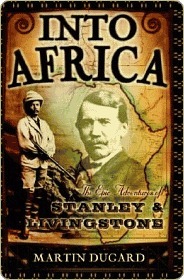
Into Africa: The Epic Adventures of Stanley & Livingstone, by Martin Dugard

Today I'm looking at a history of one of the major news events of the nineteenth century, the hunt for Dr. David Livingstone in central Africa after he had been missing for five years. White explorers going missing was hardly a novel occurrence and Livingstone was not the first, but the stature and fame of Livingstone meant Britain and the larger world knew his name, and the influence of newspapers keeping Africa and Livingstone in the public consciousness ensured a steady interest in the fate of the missionary and explorer. In fact it was a newspaper stunt that eventually found Dr. Livingstone, with reporter Henry Stanley of the New York Herald leading the expedition at the behest of the paper's editor. Stanley's words upon finding Livingstone in the town of Ujiji, ''Dr. Livingstone, I presume.'' have even entered the English lexicon Since I knew basically nothing but the most general details of this period of white men stumbling around and getting themselves lost in swamps in history, I figured this book was worth taking a look.

What precipitated Livingstone's expedition through jungles, swamps, deserts, and savannas was a debate over the source of the White Nile, one of the Nile's main tributaries. (Incidentally just doing a basic Wikipedia search it looks like there's still some debate over what counts as the ''source'' of the Nile) However there were several hypotheses being floated about by people who had actually tramped through Africa. One source that was known for certain was Lake Victoria, a large lake that sprawls across the modern countries of Uganda, Kenya, and Tanzania and which the White Nile definitively drains from. What was (and is) debated is if there was a source further south beyond Lake Victoria. Some hypothesized that a river or series of lakes and rivers connected Lake Tanganyika, further to the south, with Lake Victoria. Livingstone himself believed that lakes further south, such as Lake Malawi, might even be connected to Lake Tanganyika and Lake Victoria. Because of his status and reputation as an explorer, Livingstone set out on an expedition into Central Africa.

The thrill for the people back home was that central Africa was one of the last unknown places to Europeans. Nevermind that other people had been living there quite happily for thousands of years and had even traded with places as far away as China, to Europe it was terra incognita. So there was a great amount of romance of the brave, solitary explorer delving into the unknown, and Livingstone actually had a habit of going on these expeditions only with native porters and assistants. And this was not uncommon. Many expeditions of the time consisted of only a handful of white Europeans and a large train of African, Arab, or Indian porters, soldiers, and assistants. And if the Europeans should die, the hired help had little or no motivation to bring word back to European outposts in locations like Zanzibar. In fact in some cases, the porters and assistants were accused of murdering their employers, which made it even less palatable to report back to authorities. So once Livingstone disappeared into Africa, neither he nor word came back it was very unlikely anyone would hear from him again.

Stanley's was not the first expedition to go in search of Livingstone, but it was the only one to actually find him. A previous expedition had gone to confirm rumors of his death, but after finding convincing proof Livingstone was alive it returned to England. In many ways it was sheer good fortune that Stanley, an absolute neophyte when it came to traveling in Africa, actually met Livingstone at Ujiji. Both Livingstone and Stanley had been extremely ill during their expeditions, suffering from malnutrition, dehydration, and a variety of disease like malaria endemic to the tropics. Either one could have died before reaching the other. Livingstone could have failed to make it to Ujiji, where he hoped relief supplies was waiting for him. Stanley could have arrived before Livingstone, and spent all his dwindling supplies waiting or searching for Livingstone before having to return to the coast. It truly was a tremendous coincidence of good fortune for both men.

Overall I thought this book was interesting, although there's a certain level of crazy to these explorers who decide to go wandering through jungles and suffer all manner of diseases. I certainly would have headed back home at the first opportunity. Or never left home in the first place. I do suspect Dugard stretches or sensationalizes some facts, but I don't see any serious flaws with his methodology, especially considering the copious written material available for Dugard to draw upon for research. It is heavily from the European perspective, but that's hardly surprising. Dugard also tries to put things within the larger context of the nineteenth century, but it's mostly focused on the historical figures than the larger picture. If you're specifically interested in the life and work of Livingstone and Stanley, I think this book is a good opportunity.

- Kalpar

Tuesday, January 3, 2017

The Bad-Ass Librarians of Timbuktu, by Joshua Hammer

Today I'm looking at a book that deals with far more recent events, The Bad-Ass Librarians of Timbuktu and Their Race to Save the World's Most Precious Manuscripts. This is a book about events within the past decade that have unfolded in the African country of Mali, with some background going as far back as the fourteenth century, but that's fairly limited. The book focuses, at least partially, on Abdel Kader Haidara, a collector and preserver of Malian manuscripts who orchestrated the evacuation of hundreds of thousands of manuscripts from Timbuktu while the city was occupied by al Qaeda. Amazingly none of the manuscripts which were smuggled out of Timbuktu were lost in transport, although the manuscripts are still in relative danger because of poor storage conditions and are awaiting return to their homes in Timbuktu. But this is a testament to human ingenuity and resistance in the face of adversity.

Some people may have heard the name Timbuktu, if only because it's a funny-sounding foreign place that gets used in tv shows from time to time. The history of Timbuktu is actually far more interesting. Timbuktu grew as a meeting place and crossroads for the trans-Saharan caravan trades. Salt, gold, silver, ivory, slaves, spices, and other products were shipped across Africa by camel and passed through the growing mercantile center of Timbuktu. As the city grew and became prosperous, lavish amounts of money were spent on education and intellectual development, especially after the arrival of Islam. The University of Sankore (a wonder in the game Civilization IV) was founded by Emperor Musa I of Mali and numerous manuscripts were produced there, but it was one of only many educational institutions in Timbuktu. Over time it became a status of wealth and social standing in Timbuktu to own and collect manuscripts creating a permanent intellectual culture. For centuries Timbuktu has cherished its reputation as a center of Islamic scholarship on subjects such as astronomy, mathematics, medicine, chemistry, religion, music, poetry, and law.

This isn't to say that things have always worked out well for Timbuktu. Invasions by groups such as the Moroccans and French forced Malians to hide their precious manuscripts from destruction or theft. Families would brick up their libraries, bury their manuscripts in desert caves, or otherwise hide their precious intellectual heritage from wanton despoilment by outsiders. With the arrival of the French the European assumption that all African civilizations were illiterate and ''barbarous'' pushed the manuscripts further into hiding. It was only with the end of colonization in the twentieth century that Mali began taking back their intellectual patrimony.

Abdel Haidara was the son of a prominent businessman who collected thousands of manuscripts over his lifetime. When his father died, Haidara was charged with the supervision and maintenance of the family collection, with explicit instruction to keep the collection unified. Haidara was not initially interested in curating the family's manuscripts, but he was recruited by the Ahmed Baba Institute, the government-run manuscript collection, preservation, and restoration center to go out and find manuscripts for the government collection. Haidara ran into great initial resistance from the local population to turning over their prized possessions to a government organization, especially after the blatant thefts by French colonizers in the nineteenth and twentieth centuries. Eventually Haidara learned how to persuade Malians to part with their manuscripts and collected thousands for the Ahmed Baba Institute, before taking charge of his family's own collection Haidara was influential in kicking off a renaissance in manuscript collection and preservation in Timbuktu which led to some forty-five manuscript libraries being established in the city.

Unfortunately the chaos and political instability caused by regime change in neighboring Libya spilled over into Mali and led to the invasion of extremist Wahhabis to Timbuktu, affiliated with al Qaeda. The cosmopolitan intellectual culture of Timbuktu was anathema to al Qaeda's reactionary ideology and many in the city knew it was only a matter of time before they came after the city's manuscripts. Secretly Haidara activated an entire network of supports to collect and secure hundreds of thousands of the city's manuscripts and then ship them further south to safer locations. When al Qaeda was forced to leave the city by government forces, they regrettably burned some four thousand manuscripts, but the remainder of the city's three hundred seventy thousand manuscripts had been saved.

I do like the story of people working desperately to save their cultural heritage in the face of adversity and it's reassuring to know that people were able to save this very important part of African and Muslim history. Unfortunately the book doesn't spend all its time focusing on that. I kind of wished for more history about intellectual culture in Timbuktu as well as about the rescue operations of manuscripts in recent years. There's a good portion covered in the book, but it feels rather light for a book-length subject. Hammer spends a lot of time talking about the political and military situation in Mali, which is definitely necessary context, but it feels somewhat excessive. There's also considerable focus placed on al Qaeda's brutal enactment of Sharia law in Timbuktu and the executions, mutilations, and whippings that took place. While these are horrific crimes against humanity and highly distressing, I felt at times it was being thrown in more as voyeuristic torture porn rather than necessary context for the story of the evacuation of the manuscripts.

Ultimately I do like hearing about African cultures that usually aren't talked about in Western history classes, or if they are only very briefly. Unfortunately I do wish the book spent more time talking about that culture and its intellectual tradition than the depravities of al Qaeda, a subject I think most audiences will be familiar with by now.

- Kalpar