Showing posts with label Audio Books. Show all posts

Thursday, December 13, 2018

Smek for President, by Adam Rex

Some of you might remember when I reviewed the book The True Meaning of Smekday, which the...questionable movie Home is based on. I actually hunted down the book because I was forced to watch Home and was surprised at some of the fairly deep questions it asked, specifically with colonialism. In my review of The True Meaning of Smekday I was left a little disappointed because I felt the book got inches within having a very serious conversation about colonialism in a way kids could understand, but then went into a standard alien invasion story where a small item defeats the aliens and life goes back to mostly normal for Terrans. All that being said I thought it was a good book and worth other people checking out.

Smek for President takes place about a year and a half after the original Boov invasion. Gratuity and her mom are living in upstate New York, along with J. Lo who's moved in with them. The Boov have moved to Titan, the moon of Saturn, and renamed it New Boov World where Captain Smek remains as absolute leader. J. Lo is having trouble fitting in with human society and is more than a little homesick. Most of all he wants the other Boov to forgive him for making an honest mistake and while he told the Gorg where Earth is, he more than made up for that by helping Gratuity drive the Gorg away. So J. Lo and Gratuity decide to take a road trip to New Boov World to meet with Captain Smek, explain the whole situation, and hopefully make the other Boov not hate J. Lo.

I think this book is slightly shorter than the original so it spends far less time on development than the original book did. You definitely need to read the first book to make sense of this one. The biggest conflict is J. Lo trying to earn forgiveness while Captain Smek clearly is only interested in using J. Lo as a scapegoat to solidify his own powerbase. There's a second conflict between Gratuity and her mom, who as I mentioned in my other review went from being a ditz to being a responsible parent which is a lot for Gratuity to adapt to. I actually found this plotline rather touching and emotional, perhaps for personal reasons, so I kind of liked it better than the other one, but I'm not sure if the book would have been better if it had focused more on that. The J. Lo plotline is fine, it works. Nothing terribly spectacular about it, but it works.

Again, I have to give Bahni Turpin a ton of credit. She does all the voicework in this book and makes the Boov sound like aliens that just don't have English syntax down. Considering there's some portions where Turpin had to use alien language entirely I thought she did a really great job. And Gratuity as always is a great character.

This book may not be as developed or quite as potentially deep as The True Meaning of Smekday, but I really liked this book and though it was worth the time to check out. I highly recommend that you go check it out for yourself as well.

- Kalpar

Tuesday, December 11, 2018

Policing the Black Man, edited by Angela J. Davis

Today I'm looking at a collection of essays about the issues within the criminal justice system and the inherent, and not always conscious, racism which makes the criminal justice system target black men more strongly than almost any other ethnic group in the United States. In the introduction Davis states that women of color, and other ethnic minorities in the United States have their own experiences with a biased justice system, but this book specifically focuses on the black male experience. This is an issue that's risen to prominence in recent years with events like the deaths of Michael Brown in Ferguson, Missouri, Tamir Rice in Cleveland, Ohio, Eric Garner in New York City, and Freddie Grey in Baltimore, Maryland. These are just a handful of cases in a list that is far too long and illustrates that the system is in drastic need of reform for multiple reasons.

The essays talk about a lot of topics and various areas where reforms can be undertaken. A good example is the socialization of black children with police. There is a growing body of evidence that black children, and other children of color, have bad experiences with police during formative years. This is usually typified with police assuming children of color must be up to something, an assumption that is rarely if ever applied to white children. Because children are, well, children, and can be obstinate, disrespectful, impulsive, and a host of other ''improper'' behaviors, bad childhood experiences with police can leave children of color assuming the police cannot be trusted. And in a way, this assumption is correct and only reinforced by every bad experience. There are many instances where people of color are unwilling to go to the police because of this distrust and can stall legitimate criminal investigations because the community is unwilling to help law enforcement.

An important step to undertake is creating better social interactions with police, both for children and adults of color, that help them learn to trust and respect police and make them willing to work with police in future. They use an anecdote where a police officer does something as simple as explaining why they need people to not enter a certain area which helped build a rapport with people in the community and led to tips on other cases they were trying to solve. If police treat communities of color as people to treat with respect, protect and serve, much as the police treat white communities, rather than as problems to be ''managed'', the response from communities of color will be much more positive. But it's vital that police take that first step to begin the process of respect.

There is also the intrinsic problems of the criminal justice system that disproportionately targets black men. There is a large body of evidence that black men are often seen as more dangerous and more threatening than white men. The best explanation available is an implicit, unconscious bias created through societal stereotypes. This may explain why unarmed black men are continually shot by police who state they are ''in fear for their lives'' while white mass shooters somehow manage to be taken alive. The best method to fight implicit biases is training and education, to raise awareness within law enforcement and help police officers overcome their implicit biases, and there is some evidence that this training has helped to reduce violent responses from police. So it shows that things can be done to help end this senseless police violence.

Finally there is the issue of explicit bias, which people consistently try to prove but are blocked from accomplishing this by the courts. There is some evidence that black men consistently get harsher sentences than white men for similar crimes, and black men are more likely to be given the death penalty in cases where the victim is white, than in cases where the defendant is white and the victim is white, where the defendant is white and the victim is black, and where the defendant is black and the victim is black. I say some evidence because there are attempts to collect this data and multiple attempts by civil rights groups to collect prosecution data to prove a systemic and perhaps explicit bias by the criminal justice system. However when these cases are brought to the courts, the courts have consistently ruled that in order to prove systemic or explicit bias, the plaintiffs need to have evidence that prosecutors are acting in a biased way and without that evidence they cannot bring a case. But that very evidence is what the plaintiffs were asking for when they brought suit because they don't have access to that data and it's only through access to that data that they can bring their case. It's a sort of paradox where to bring a suit you need evidence, but you can't get evidence without bringing a suit. Until we can get more data from the criminal justice system and greater transparency, this will continue to be a problem.

Overall I thought these essays were interesting and pointed to specific issues we can try to address in the future. There's a lot of work that needs to be done to create a more just and equitable society in the United States, but I think if we're willing to learn and change it's something we can accomplish.

- Kalpar

Thursday, November 29, 2018

First Watch, by Dale Lucas

Today I'm looking at First Watch, the first book in a series titled Fifth Ward by Dale Lucas. This series is set in the city of Yenara, a massive fantasy city along the lines of Ankh-Morpork. I kind of made that comparison in my head because the book focuses on the watch wardens of the city. However the characters in this book are nothing like Sam Vimes and his own City Watch. The watch wardens of Yenara are largely another gang. This is reinforced by how the watches are set up. The city of Yenara is divided into five wards, with each ward having its own watch. The prefects of every ward are jealously defensive of their territory and will fight members of other wards that come into their territory. In addition, the majority of crime in Yenara is handled through a fine system, and everyone is in on the rampant graft. So this is definitely a darker fantasy.

The book focuses on the character of Rem, a former nobleman who decided to leave home and take his chances in the big city. Unfortunately this resulted in Rem getting into a major bar fight and waking up in the dungeons of the Fifth Ward. Through talent and a good dose of luck Rem manages to get himself recruited as the newest member of the Fifth Ward Watch. Rem is soon paired up with Torval, a dwarf whose partner has gone missing and is less than thrilled that he's been assigned a rookie to babysit. But Rem and Torval soon discover that Torval's former partner's been murdered, and he may have gotten himself into something much bigger and more dangerous than even Torval could have expected.

I'll have to admit, I have pretty mixed feelings on this book. As a fantasy cop mystery book I think Lucas does a pretty good job and managed to keep the story interesting throughout. I honestly think my biggest problem is that the book isn't the City Watch books from Discworld, and Rem, Torval, and the whole system are nothing like Sam Vimes and his crew. And I guess it's really not fair for me to say this book is bad just because it isn't Discworld. Lucas is doing his own thing and creating his own story.

On the other hand, the characters are supposed to be police, and Rem and Torval seem pretty okay with the whole concept of torturing people. On top of this, we see Torval being a good, honest family man who cares about his sister and three children. To go to Discworld again, it reminds me a lot of the bit in Small Gods where Pratchett said that even the worst and most terrible tortures could be casually inflicted by otherwise good an honest people who are just doing this for a paycheck. Ultimately I'm left conflicted about these characters, and I'm not certain if I can really get behind them. Maybe it's just because I like Discworld so much.

So really, that's my biggest criticism, it's not Discworld and Rem and Torval are in many ways dirty cops, so I'm not sure how much I can get behind them. That being said, it's not a terrible book so it might be worth your time to check out and see for yourself what you think.

- Kalpar

Thursday, November 22, 2018

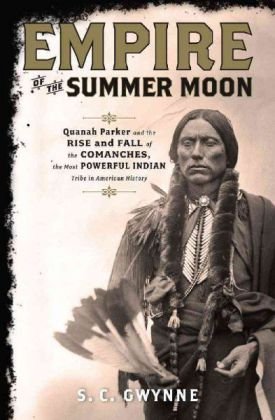
Empire of the Summer of Moon, by S.C. Gwynne

Today I'm looking at another book about Comanche history, Empire of the Summer Moon, by S.C. Gwynne. Some of my long-time readers may remember a lifetime ago when I looked at another book, Comanche Empire, and while I quibbled over the use of the term ''empire'' for what appeared to be a band of similar nomadic ethnic groups that exerted military and economic control over a vast geographic area, but I thought that Hamalainen did a pretty good job with their arguments. In Empire of the Summer Moon, however, Gwynne uses outdated methodology that reveals an underlying racist ideology which brings his whole work into question. The focus on Quanah Parker, who some people might suggest was a collaborator, further leads me to suspect this book isn't worth the effort of reading.

I know that in the last paragraph I made some pretty serious charges, but I think this is entirely justified by Gwynne's use of the terms ''primitive'' and ''civilized''. Without going into a huge lecture, basically the social sciences (history, sociology, anthropology, etc.) basically avoid using the terms primitive and civilized to describe people, societies, nations, etc. This is because the terms primitive and civilized, especially in how they were used in the nineteenth century to justify colonization and imperialism, come with inherent moral baggage. Civilization is good, primitiveness is bad and needs to be countered with the force of civilization. We're even at a point where using simple and complex to describe societies is debated because a society that appears simple may in fact be rather complex, depending on how one wishes to use the term.

At multiple points through the book, Gwynne uses the terms primitive to describe the Comanche people and pits them in conflict with white civilization. I remember two specific examples that stuck out for me. First was when Gwynne briefly talked about Comanche language he said that despite its primitive nature, it had extremely detailed descriptions of horses, such as a yellow horses with black hair and a black tail, a horse with red ears, a horse with white ears, and so on. To which I reply, of course the Comanche don't have words for concepts like plumbing or income tax. They're a nomadic hunting culture where horses are central to their way of life. Where their language is going to get precise and sophisticated is with horses, not with concepts they have no use for. Comanche language can be complex without necessarily talking about abstract ideas.

Another example is when Gwynne talks about the Comanche response to diseases such as cholera, smallpox, and syphilis which they had no previous experience dealing with. He dismisses their traditional medicine as ''primitive'' which would have had no effect on the underlying disease. Again, this is an assumption that native people are automatically primitive and white people are somehow advanced. I would like to point out by our modern standards at the time the Comanche were dealing with these illnesses, the 1850's, Western medicine was equally primitive, or perhaps even more harmful. The Comanche may not have been able to do anything about syphilis, but at least they weren't treating it with mercury pills.

On top of this, Gwynne seems to get invested in the idea of the Comanche as a warrior people. I will admit that the Comanche were extremely well trained as mounted archers, but considering their livelihood was hunting the American bison, it makes sense that they would get very, very good at mounted archery just as a matter of survival. Gwynne seems to take especial pleasure in describing the torture, murder, abduction, and rape carried out by Comanches against white settlers. While this is certainly a thing that happened, I find it frustrating when Gwynne literally glosses over the Sand Creek Massacre by merely saying that ''what happened is too terrible to speak about in detail''. To go into detail about Comanche atrocities while largely ignoring the extensive, systemic, and documented atrocities as part of the genocidal campaign of the American government does a great injustice to the cause of Native American history to merely pass over this. Coupled with his usage of the terms primitive and civilized leads me to think there is a far more racial bias in Gwynne's work.

All of this leaves me to look somewhat askance and Quanah Parker's inclusion in the book. As Gwynne depicts it, Parker seems the most responsible for encouraging the Comanche to settle on a reservation and adopt white ways of life. Because of the racial overtones in Gwynne's work, and the positive light in which Parker is depicted, I almost come to the conclusion that Parker was a collaborator with the white government in betraying his people. I don't know what the current Comanche people think about Parker, but Gwynne certainly leaves me with doubts.

Overall I would not recommend this book. Gwynne's mythology is flawed and he uses racial tones within his writing. Considering this book was written in the last ten years, that raises some serious red flags for me. If you're looking for a book about the Comanche, I would definitely go with Comanche Empire instead.

- Kalpar

Tuesday, November 20, 2018

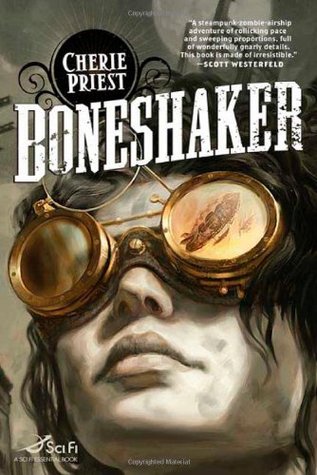
Boneshaker, by Cherie Priest

Today I'm looking at the first book in a series of steampunk books by Cherie Priest, Boneshaker, which I've heard is her most famous novel. At least to the point within the steampunk community that Boneshaker is often remembered as her fist novel when Priest had actually written other books prior to this one. (This is at least what Priest said anyway.) Overall I'd say this book is okay, but it leaves me with a lot of questions, at least one of which I think needs a serious answer.

The book is set in an alternate history United States about 1876 or so. Right before the American Civil War began, gold was discovered in Russian Alaska and the Klondike Gold Rush began. Seattle, located on the western coast and an ideal launching point for prospectors, boomed with the growth of the gold trade in the Klondike. Until the incident with the Boneshaker.

See, the biggest problem was most of the gold in the Klondike was inaccessible to miners. (Have you read a Jack London story? Don't, the lesson is Alaska is a dangerous place and will kill you.)  So the Russian government held a contest for the design of a machine to make mining the goldfields practicable. The winning submission was presented by Dr. Levi Blue of Seattle who at the behest of the Russians launched a test of his Boneshaker Drill. The result of the test was a significant portion of downtown Seattle was destroyed and a source of deadly Blight Gas, which kills everyone and turns some of those exposed to it into zombies, made the city uninhabitable. The residents of Seattle responded by building a wall two hundred feet high around the old city, containing the Blight and the shambling monsters.

Our main characters are Briar Wilks, widow of the late, unlamented Dr. Blue, and her son Ezekiel. Zeke is convinced that all rumors that his father's use of the Boneshaker was intentional are false, and is determined to prove that what happened to render Seattle uninhabitable was an accident. To do this, Zeke goes under the wall into old Seattle searching for scraps of evidence left behind. Briar knows that inside the wall is a deadly place that her sixteen year old son can't hope to survive, so she goes in to rescue her son herself.

Plot wise, I don't know if I really enjoyed this story. Despite the setting, it felt like a ''two characters trying to find each other'' sort of story, with at least a few incidents where the characters paths potentially could cross but don't until we get to the climax of the story. I mean, it's good that Briar is looking to rescue her darn kid from his stupid and potentially deadly situation, but for whatever reason I couldn't find myself getting emotionally invested in them as characters.

I will leave aside, for the time being, the question as to how the Civil War has been going on for about sixteen years. It's at least implied within the book that there are at least a few reasons why the war could be extended as long, including airships, a southern railroad, and British intervention. At this point I will forego my usual historian rant about the larger economic, social, and political factors which make such an outcome unlikely to say the least.

My biggest question for this book is why the heck people still live in Seattle anymore. The survivors create a settlement outside the wall called Outskirts, and there's still some trading activity, but it was stated that most of the trade has dried up when the most accessible of the gold was depleted in the Klondike rush. Now, cities have grown up around booms and then continued having grown into viable communities, but mining rushes have also produced numerous ghost towns that dot the American West. With the town infrastructure and the trade gone, I'm not sure why people would stay in Seattle. I mean, they have to boil all of their water because Blight Gas still escapes the Wall and even rainwater can't be trusted to be potable, which sounds like it's better to just abandon the place entirely than keep trying. Maybe the amount of trade was bigger than I gleaned from the book, Briar does visit an airship port, but I'm not certain.

The only real resource of note anymore is the Blight itself, which is useful for creating a drug referred to as lemonsap, but that's about it. And most of the Blight collected and processed for lemonsap is done by criminal organizations operating inside the wall. So why anybody would continue to live outside is puzzling to me.

Otherwise the book is okay. I have reason to hope that the later books would build on the foundation and maybe go to more interesting places and more interesting adventures. But because I didn't really emotionally connect with either Briar or Zeke I couldn't get as invested in their personal story as Priest might hope.

- Kalpar

Thursday, November 15, 2018

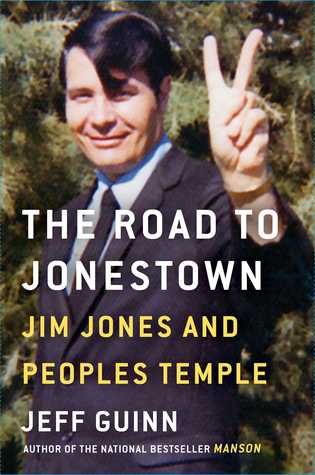
The Road to Jonestown: Jim Jones and the Peoples Temple, by Jeff Gunn

Today I'm looking at a pretty serious book which examines the life of Jim Jones and his infamous organization the Peoples Temple. Jim Jones began as a preacher in the 1950's, promoting Christian Socialism and railing against racial and economic injustice. However Jones has become inextricably linked with the mass suicide of him and some nine hundred followers, including three hundred children, in Guyana. How nine hundred people could be convinced to collectively commit suicide remains a distressing puzzle. The debate over Jim Jones for the past forty years has left many wondering where Jim Jones went bad but Guinn's book leaves us with the impression that there was always something not quite right with Jones, perhaps some form of sociopathy, the result is a very dark story that shows people can do the right thing, but very often for the wrong reasons.

The biggest thing that struck me about this biography was the history of Jim Jones from his early childhood. Guinn amasses a large amount of evidence, including Jones's fascination with Hitler, that Jones was always a little bit off. And keep in mind, this is back during World War II when everyone else is solidly behind the Allied cause, Jones has a strange fascination with Hitler and his followers. Perhaps it's only with the benefit of hindsight that we see the numerous red flags, but it creates a long and concerning pattern of behavior over decades.

Even in his work as a church, there is evidence that Jones was doing it not for the help of other people or for the glory of god, but for the glory of Jim Jones. Jones tackled issues such as poverty and racism, but even in the earliest days it seemed to be for his own benefit rather than the benefit of his culture. For example, Jones would frequently ''poach'' members of different congregations by lobbying on behalf of newcomers, writing letters to local government, the local power board, speaking with local shop owners and convincing them to integrate. Jones manages to do good, but it seems to me that his motivation to do good was because it promoted Jim Jones.

As time this got even worse and perhaps more blatant as Jones moved his congregation from Indiana to California. Cut off from friends and family, Jones extorted even larger sums of money from his followers and had them sign over personal possessions to be sold for the good of the Peoples Temple. True, some of this money went to a variety of programs including college tuition for children who were part of the Peoples Temple, feeding the hungry, clothing the naked, traditional Christian charity. But millions of dollars disappeared into personal accounts, some of which the government has never been able to recover.

The result is a book that shows a series of gradual increases until a mass suicide becomes the logical conclusion for Jones and some of his most dedicated followers. Many resisted, some hid, some escaped, but the result was three hundred dead children, killed out of fear that they were about to be kidnapped by the CIA.

Guinn does extensive research and provides exhaustive evidence, but the story is hard to read, to say the least. It's a long story and with the inevitable conclusion it all takes a very dark and sinister turn. I'd only read this book if you were really interested, and I'd suggest interspersing it with something light as well.

- Kalpar

Tuesday, November 13, 2018

God, A Human History, by Reza Aslan

A long time ago, but not in a galaxy far far away, I was a college freshman taking comparative theology. Among the books we read was a history of Islam titled No god But God by Reza Aslan. I remembered rather liking the book and when I found another book from the same author, I thought it was worth taking the time to check it out. Rather than dealing solely with Islam, this book looks at the history of religion in a broader context going back into the stone age and ending with the monotheism of Islam. This book is rather short for tackling such a broad subject and I'm left wondering what other resources are available for additional research, but as an introductory book I think Aslan does a pretty good job.

The issue with debating the theology of stone age humans is that the work is mostly conjecture from the fragments of archaeological evidence that we've found. We know that there are cave paintings throughout the world including discs, handprints, and animals. We can make guesses as to the significance of those paintings and what they might have meant to stone age humans,why they made those paintings, and how they understood the world. But ultimately the best we can do is make educated guesses.

As Aslan manages to get to recorded history he moves onto firmer ground, although again because this book is so darn short I feel like there was a lot more subject matter that Aslan could have talked about but he provided such a short overview that it felt incomplete. Aslan also makes arguments that are so broad and vague that it's difficult to contradict them by their own generality. The stuff that I thought was most interesting though, was Aslan's revelation of theological research showing monotheism only developed in Judaism after the Babylonian exile. Aslan states that there is evidence that Judaism actually practiced a polytheistic system with at least two deities, Elohim and YHWH. It was only after the Babylonian exile that Elohim and YHWH were merged into a single deity, the only deity. Needless to say, multiple books can be written about this subject so for Aslan to talk about it in just one chapter feels a little inadequate.

Aslan also throws in a chapter about early Christian schisms, again another book-length subject, before finally getting to Islam. The result is a tantalizing glimpse at deeper theological subjects showing how difficult the concept of monotheism can be for people to accept. I'd actually be interested in a full-length book from Aslan about just that subject but for an introductory book I think Aslan does a pretty good job.

Overall I think this book is worth checking out. Specifically the information that I didn't know about Judaism and Christianity was tantalizing and I'd have appreciated resource to check out more. (There actually may be more in the physical book but as with most of my books at this point I listened to an audiobook.) But if you're interested in the history of theology in a very general sense this book is a good choice.

- Kalpar

Thursday, November 8, 2018

American Pain, by John Temple

Today I'm looking at a book that explores the industry of pill mills that cropped up in recent decades in the United States, with the most flagrant examples being ''pain clinics'' in Florida. The biggest and most profitable of these was American Pain, run by Chris George, a college drop-out, convicted felon with Nazi tattoos. The pain clinics that George operated took in thousands of dollars in cash every day, deposited in garbage cans because regular tills were inadequate for the sheer quantity. Large groups of people from Appalachia would make marathon drives from out of state to purchase supplies of powerful narcotics, and make the trip back in a month. And amazingly the entire thing existed within the realm of legality due to lax laws and weak regulation.

Ordinarily you would not think that a convicted felon in his mid-twenties, whose main experience is house construction, would be able to get involved in anything resembling the medical field. Chris George got his start by selling diet pills and steroids, but a doctor got him started in the field of opioid painkillers. George merely had to rent a location, and provide the start-up money to produce something resembling a walk-in clinic. The doctor would provide their DEA license which enabled George to make purchases of oxycodone and other drugs from wholesalers and the doctor would write the prescriptions. The pain clinic could then fill the purchases in-house under the ''supervision'' of the physician. George wasn't certain that the idea would really take off, but was willing to give it a try. As patients continued coming in, packing the waiting room and stretching the line outside into the tiny parking lot, George realized they were onto something. From there the business grew by leaps and bounds until George's clinic was processing hundreds of patients in a single day, and bringing in hundreds of thousands of dollars in revenue each day as well.

Why this happened is because of a multitude of reasons, which created a perfect storm situation that allowed George and his cadre to grow absurdly wealthy on something that was (technically) legal. The first was the increase in the availability of opioids starting in the late 1990s. Prior to that period opioids were largely restricted to patients who most likely weren't going to live long enough for addiction to become an issue. However, starting in the 1990s drug manufacturers began aggressively campaigning for increased sales of opioid painkillers through a variety of methods. This included advertising campaigns with fallacious information about how new opioids were safe and non-addictive if taken ''as prescribed'', dubious or downright illegal efforts by drug representatives to encourage physicians to prescribe opioids, and lobbying of the DEA to increase annual quotas of controlled substances. (Go ahead and put a pin in that last part. We're going to come back to it later.)

In addition, Florida had fairly lax regulations regarding pain clinics and opioid prescriptions. Basically anybody who could fill out a business registration form could start up a pain clinic, regardless of their background. And any doctor, so long as they had a valid DEA license, could order and prescribe opioid painkillers. The doctors did not even have to be pain specialists, they just had to have a valid license. There were various ways that doctors could trip automatic alerts and cause increased scrutiny from the DEA and other police agencies, but generally as long as a doctor didn't prescribe more than 240 30mg doses per patient per 28 day period, they could fly under the radar.

George even went to the effort of making it appear they were a legitimate medical facility. MRI reports were required before treatment, mounds of paperwork including a pain management contract were created, and patients with obvious track marks or forged paperwork were turned away, just to give the organization a veneer of legitimacy. But it was at most a paper shield to cover everyone's ass. People could tell that this was drug-dealing, plain and simple. The fact that patients would start shooting ground-up pills in the parking lot was proof enough of that. Eventually the police did end George's operation and new legislation made setting up a pill mill more difficult, but the fact that they operated for two years in the wide open, with multiple imitators and competitors, shows how dangerously lax the regulatory environment was.

Okay, so to return to the issue of the DEA and quotas, this was my biggest takeaway from the book. Every year the various drug manufacturers submit requests to the DEA for quotas on how much of controlled substances, such as amphetamines, opioids, and other drugs, they can produce in a year. Now, the public doesn't know how much opioids a specific manufacturer is allowed to produce in a year, but the DEA does release its total for the industry as a whole. In the past 25 years, the total quota for opioids has increased dramatically. In the past ten years it's at least doubled. In the past 25, it's increased by a factor of 42. Yes. 42. For every kilogram of opioids produced in 1993, there are 42 being produced today. The question isn't how we ended up with an opioid epidemic in the United States. We're so awash in pills nowadays that the more apt question is how couldn't we?

And yet, there's something the DEA could have done. Back in the 1970s when there was concern that amphetamines were being abused, the DEA drastically cut national quotas for the drugs and severely curtailing supply. When the supply dried up, the market for amphetamines dried up as well. At any point in the past decade when people started expressing concerns about the abuse of prescription painkillers the DEA could have drastically curtailed the quotas and dried up the supply of opioids. Instead, year after year, the DEA has obligingly raised the quotas meaning, year after year, we end up with an even greater supply of opioids. If we were serious about ending the opioid epidemic in the United States we could cut the supply off at the source, and it wouldn't cost us anything we weren't already spending.

I think this book is definitely worth reading. If nothing else it reveals the core problems surrounding our current opioid crisis, an overly plentiful supply of drugs and lax regulations regarding them. I definitely recommend giving this book a read for that, as well as the true crime aspects of the story involving the American Pain clinic.

- Kalpar

Tuesday, November 6, 2018

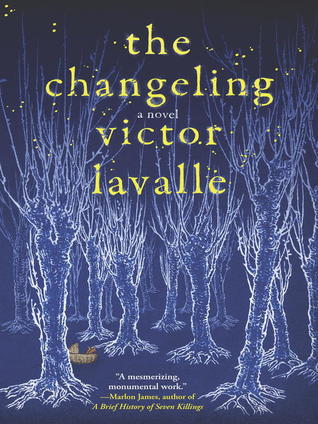
The Changeling, by Victor La Valle

Today I'm looking at a novel by Victor La Valle that is only loosely, loosely defined as fantasy and even then I'm not sure if it counts. This book is mundane for basically three-quarters of its total length and when magic is finally inserted in the last fourth of the book it left me wondering if what they'd encountered actually was magic or if it was a hallucination shared by the characters. That's honestly my biggest frustration with this novel, it's classified as a ''fantasy'' novel, but it's so freaking mundane that I don't think it's worth the effort if you're a big fantasy fan.

I'm actually going to do something that I usually avoid in my reviews and include the blurb from the back of the book for this story. I remember being intrigued by the blurb when I looked at this on the library's website so this was a major reason I bothered with this book in the first place:

''Apollo Kagwa has had strange dreams that have haunted him since childhood. An antiquarian book dealer with a business called Improbabilia, he is just beginning to settle into his new life as a committed and involved father, unlike his own father who abandoned him, when his wife Emma begins acting strange. Disconnected and uninterested in their new baby boy, Emma at first seems to be exhibiting all the signs of post-partum depression, but it quickly becomes clear that her troubles go far beyond that. Before Apollo can do anything to help, Emma commits a horrific act—beyond any parent’s comprehension—and vanishes, seemingly into thin air. Thus begins Apollo’s odyssey through a world he only thought he understood to find a wife and child who are nothing like he’d imagined. His quest begins when he meets a mysterious stranger who claims to have information about Emma’s whereabouts. Apollo then begins a journey that takes him to a forgotten island in the East River of New York City, a graveyard full of secrets, a forest in Queens where immigrant legends still live, and finally back to a place he thought he had lost forever. This dizzying tale is ultimately a story about family and the unfathomable secrets of the people we love.''

Okay, so this plot summary literally, literally, describes the entire book. The major twist, Emma's horrific act, doesn't happen until about halfway into the book. And as I said, we have no evidence that magic is real until the last quarter of the book, and even then the evidence seems pretty scanty. I'm basically left thinking that perhaps this is supposed to be an entirely mundane story and the magic is how the characters understand things. That does leave a large plot hole or leaves us with the conclusion that Apollo and Emma when insane at the end of the book and they just hallucinated the ending. I'm not sure which is more possible.

This book also reminds me of a more ''literary'' novel and I say that because Apollo, the main character, is a rare book dealer and his wife, Emma, is a librarian. Authors by definition are people who enjoy books, that's why they write them. But inevitably whenever somebody wants to write a ''serious'' book it's almost guaranteed that the main character will be a writer or librarian or somebody somehow connected with books. Which would be fine, but I get the impression that Apollo doesn't really care about books. We're told that he's a consistent reader which is how he gets into the used book trade, but after that he seems to just trade in books for the money, rather than for love of books themselves.

I'm also left with multiple questions about this book. There's the character Kinder Garten who is the main antagonist of the book, except we're not given much to understand about him. Why does he go by the alias Kinder Garten? What the hell is his ideology, if any? The character is a consistent liar so we don't know what coming out out of his mouth is true. This gets even more confusing when we get to the end of the book and he's talking with people who use the words ''beta cuck'' and another one mentions white men's natural birth rights. Is he an alt-righter or isn't he? Was La Valle including these just to make the book topical and play well with critical audiences? Who are the Wise Ones? Like how did they come to be, and where and how do people find them? There are just a lot of these questions and I'm left grasping for ideas.

The result is a book that in my opinion isn't all that great. If it was trying to convince me it was a fantasy novel, it did a really bad job and left me thinking there wasn't any fantasy involved at all. This book felt like it was trying really hard to get an award of some sort. If you like the more literary sorts of novels then this book might be enjoyable for you, but this wasn't really my cup of tea.

- Kalpar

Thursday, November 1, 2018

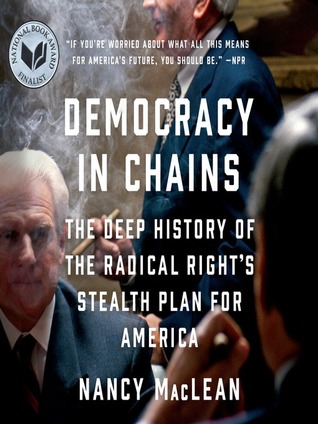
Democracy in Chains, by Nancy MacLean

Today I'm looking at another rather concerning book about the history of politics in the United States and how we got into the seemingly interminable mess that we now find ourselves. MacLean dug into archives from multiple universities and discovered what can only be called a conspiracy, spanning decades, and inspired by the ideological work of at least one man, James McGill Buchanan. This book is mostly a biography of Buchanan and his professional life until his break with the Koch brothers, forcing him into retirement. While I think it may be a stretch to say that Buchanan alone was responsible for the development of the radical right, I think it's fair to say that he was one of multiple influential figures who helped to shape the ideology of the modern right.

MacLean traces the origins of the modern right wing back to a key event in American history,  Brown v. Board of Education, in 1954. Many southerners resisted this decision, and the fight for integration continued for many years, and is in many ways still ongoing. However, the overt resistance in places such as Arkansas and Mississippi were not as appealing to border regions such as Virginia. The wealthy, elite ruling classes of Virginia maintained control through systems such as poll taxes, literacy tests, and extreme gerrymandering to ensure their continued dominance of their respective states, without any challenge from ordinary people. Effectively, an oligarchy in all but name. The federal decision to force integration of public schools under the Fourteenth Amendment promised additional federal changes to existing power structures within the states, breaking the chokehold of the oligarchs. The oligarchs needed a method to resist, without bringing overt attention to their objectives Buchanan managed to provide a solution. Privatize the schools. If there are no public schools, then there can be no discrimination. Private schools can refuse blacks admittance, and the burden of taxes for public education can be removed in favor of people who desire education actually paying for it. And in fact, that's what Virginia did in Prince Edward County for five years, despite massive local protest. The state government overruled local school boards and closed all the public schools, leaving black children without education for five vital years.

Buchanan and many of his compatriots were committed to an ideology that sought to return the United States back to an era of absolute economic freedom, resembling the Gilded Age more than anything else. No minimum wage, no right to organize, and no government regulation. Buchanan and his allies in fact want to go even further, disdaining corporate welfare systems such as health insurance and pension plans provided through employers. If people want health insurance or retirement money, they'll have to do it themselves. The government should exist only to protect private property and to repress the masses.

Yes, that's actually an important aspect of their entire ideology, repressing the masses. See, here's the biggest paradox that Buchanan and his ilk discovered when trying to promote their ideology. It's actually unpopular among the majority of people. For the most part, people like having clean air and water, good schools for children, old age insurance, and a number of other government programs that have to be supported by taxes. As libertarians discovered in the 1950's and 1960's, coming out directly and stating a desire to return to Gilded Age laissez faire did not go over well with really any focus group at all. The solution for Buchanan and their wealthy supporters was to impose their system of economic ''freedom'' on the majority through a combination of voter suppression and outright deceit, gradually dismantling the U.S. support net and regulatory systems until the network is completely destroyed.

This is perhaps the most galling and aggravating thing about libertarian intellectuals is their absolute and total lack of any morality or concern for political freedoms, which becomes apparent in much of their writing. MacLean includes an example of one member of Buchanan's cadre who stated that if their program was successful, many Americans would have to live in slums like the favela in Rio de Janeiro, casually stating that the air and water might not be what Americans are used to, but they'd have to adapt. It's social Darwinism pure and simple, the poor are poor because of some sort of inherent failing or weakness. If they're willing to work hard, tighten their belts, and raise themselves by their bootstraps, they can get ahead through rough individualism. If they're not willing to put in the work, then nobody else should have to carry them. This cruel callousness fits perfectly with their nineteenth century ideology. So long as they're fine, the rest of the world can go straight to hell for all they care.

The picture that emerges is highly disturbing. A small cadre of the ultra-rich and their lackeys, working to simultaneously undermine support for social welfare and regulatory programs while disenfranchising the very masses that they seek to exploit. The rise of the radical right, funded by ultra-wealthy backers, has thrown the future of American democracy in doubt. We are in the midst of a class war, started by the upper classes, and they are in the process of winning because they have convinced a significant percentage of the lower classes that the class war is in their own best interest. It is only through organization and education that we'll be able to fight back against the upper classes and ensure the future of social democracy.

- Kalpar

Thursday, October 18, 2018

White Trash: The 400 Year Untold History of Class in America, by Nancy Isenberg

Today I'm looking at the book White Trash, a book that talks about the history of class in the United States, specifically poor whites living in the American south from the early colonial era into the modern day. Throughout the centuries this underclass has has been called a number of things: waste people, clay eaters, crackers, white trash, hillbillies, and rednecks. This underclass has been consistently stereotyped as poor, lazy, sexually licentious, uneducated, and morally suspect. Isenberg illustrates that these stereotypes about poor whites, which have been extended to poor blacks as well, have been persistent through the centuries and Isenberg draws on multiple sources to make her point. Obviously covering four centuries makes this book more a broad overview than a detailed investigation but I think Isenberg does a very good job of making her points through the book.

When the United States was first colonized by England the major source of colonists, especially in regions such as Virginia, the Carolinas, and Georgia, were what were considered ''waste peoples''. England had a not insignificant population of unemployed people who, due to the harsh poor and anti-vagrancy laws of the time period, were often in and out of prisons or forced to wander from location to location. In times of war this expendable underclass were pressed into service to fight in Britain's military and in time of peace they were expected to either find work or die through starvation or on the gallows. For colonies thousands of miles across the Atlantic and with high death tolls, an expendable population made ideal candidates to be dumped in the colonies. If they died, then they wouldn't be a burden on the home country. If they managed to learn how to work and thrive, perhaps they could become of economic benefit to the mother country. This stereotype of the poor as inherently lazy and needing to be forced to work is one of the most consistent and has perpetuated to the modern era.

As the South developed into a slave economy, the underclass of poor whites developed an important racial component, which has remained an important aspect of American class and racial relations into the modern era. African-Americans and other racial minorities have been the subject of systemic racial discrimination perpetuated by white elites. The real genius of this system is that so long as the poor whites have blacks to look down upon, they willingly perpetuate the system. Poor whites are often no better off than the poor blacks, but as long as there is the feeling of superiority to someone else, they are willing to participate in the system. This is best illustrated in the rebellion of 1861 in which poor whites were overwhelmingly conscripted into insurgent forces while the rich planter class, who began the rebellion, were exempted from military service including the exemption of all individuals owning more than twenty slaves. Poor whites were the muscle that perpetuated the slavery system.

The latest trend relating to poor whites is the almost voyeuristic pleasure that American culture has taken in looking at the lives of poor, mostly Southern, whites. Isenberg specifically mentions figures like Sarah Palin and Honey Boo Boo, although the growth of popularity in the blue collar comedy group including Jeff Foxworthy and Larry the Cable Guy is definitely in the same vein. The growth of the Tea Party and its ideology, although not mentioned by Isenberg, definitely feels like a continuation of the same ideas. Poor whites are manipulated by white elites into attacking (usually) racial others and acting against their own interests for the benefit of white elites. Based on Isenberg's evidence it appears that the issues we are dealing with today is only a continuation of a centuries-long tradition.

Overall I thought this book was pretty interesting if brief and fairly shallow in its investigation of race and class relations in the United States. However Isenberg makes a consistent argument that poor whites have consistently been seen as an expendable, degenerate breed for four hundred years, useful to white elites when fighting or helping oppress other groups, but largely exploited or ignored by elites when no longer useful. I think this is a book well worth reading to gain insight into both class and race relations in the United States that has shaped political debates to this day.

- Kalpar

Tuesday, October 16, 2018

The Phoenix Unchained, by Mercedes Lackey and James Mallory

Today I'm looking at the first book in a series co-written by Mercedes Lackey and James Mallory. Now, I've sort of talked about Mercedes Lackey before on here, and her novel Gwenhwyfar is by and far is one of my favorite books of all time and hands down the best reinterpretation of Arthurian legend I've ever encountered. I've also encountered Lackey in the Bolo series and a few of her other books so I was willing to give this one a try to see if it was any good. I don't think I've read anything by James Mallory before so this was a good opportunity to look at more stuff.

As much as I hate to say it, this book is pretty paint-by-the-numbers fantasy fare. The book begins with two adolescent boys who are on the cusp of manhood. Harrier is the youngest son of the harbor master in the great port city of Armethalieh and destined to take over the duties of harbor master himself one day. Tiercel meanwhile is the eldest son of a minor noble family, heading for the university and a probably uneventful career in Aremthalieh's civil service. However a book that Harrier gets for his naming day leads to Tiercel attempting ancient High Magic, a practice that has been extinct for a thousand years since the Flowering that ended the war with the Endarkened Ones. It's soon revealed that Tiercel has the ability to use the High Magic and must leave his home behind to find someone to teach him how to use his abilities before they end up killing him.

Basically this book feels a lot like most epic fantasy quests which have been churned out ever since Lord of the Rings first hit shelves. Now, this isn't to say that epic fantasy quests are bad, there's a lot to be said for them and a lot that can be done with them. But it is kind of frustrating when they all seem to come out the same in the end. Obviously this book isn't exactly the same as Lord of the Rings but it fits pretty heavily into the fantasy quest mold. There's an epic battle brewing between good and evil, the latest in a conflict that's been going for thousands of years, and we have some young heroes who have to leave home and go fight evil, gaining new powers and abilities on the way. They expect the journey will be fairly short and uneventful, but they soon end up on a larger quest that will take them further away from home than they ever expected. There's even a point where they get rescued by a ranger-type character, actually a member of the Forest Watch, who's a centaur. Now, I did like Samara and I thought the idea of including centaurs was kind of neat because you don't usually see those in fantasy.

Overall I think this book was okay, but as I said I felt it fell a little too easily into the standard epic fantasy genre. It's okay and I can't point to anything specific that's wrong with the book, but there's nothing about the book that makes it stand out in any particular way. The arrival of a unicorn at the end of this book made the future potential kind of interesting but the first book leaves a lot to be desired.

- Kalpar

Tuesday, October 9, 2018

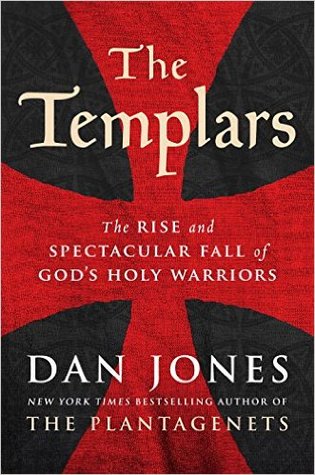
The Templars: The Rise and Spectacular Fall of God's Holy Warriors, by Dan Jones

Today I'm looking at another book from Dan Jones about the Knights Templar, one of the crusading orders of knights established in the years after the first Crusade. Although the Templars were not the only international crusading order they are far more well known than the Knights Hospitaller or the Teutonic Knights, and far beyond the smaller orders such as the Livonian Sword Brethren or the Order of Santiago. Jones speculates a little on the enduring popularity of the Templars as an order, but the majority of the book focuses on the history of the Knights Templar from their founding in 1119 to their spectacular downfall starting in 1307 and concluded by 1312.

In hindsight the most surprising thing about the First Crusade is that it succeeded at all considering how poorly organized the entire venture, and most later crusades were. The main advantage of the crusaders was the fact that Jerusalem and much of the Levant existed at the time in a border region between the Fatimid, Shia caliph's capital in Cairo and the Sunni Abbasid caliph in Baghdad. The division between Egypt and Mesopotamia allowed the crusader kingdoms to survive despite their weaknesses and it was largely when both flanks acted in concert that the crusader kingdoms were in most danger.

An inherent problem of the crusader kingdoms was a lack of resources, specifically money and manpower, the two most necessary resources for prosecuting a war. The original mission of the Knights Templar was to provide protection for Christian pilgrims visiting sites such as the Holy Sepulcher in Jerusalem. This original mission quickly grew to the Knights Templar, as well as the Knights Hospitaller, being an elite military force. However the Templars and Hospitallers had significant advantages over the secular rulers of the crusader kingdoms. In their founding charter the papacy granted numerous rights to the holy order which gave them significant benefits. The Templars were made responsible only to the pope, immune from almost all taxation, and granted lucrative rights regarding religious ceremonies and rituals. Coupled with this were the numerous donations of land and resources made by pious Christians in Europe, the Templars became incredibly rich as an organization.

Because the Templars had access to such tremendous resources, they were able to arm and equip a dedicated fighting force of knights and sergeants. Soon the Templars were assigned the garrison of numerous strategic castles in the Levant and Templar contingents made a significant portion of any crusade army. For much of the book Jones focuses on the military history of the Templars and their battles in Egypt and the Levant. There are brief mentions to the more business-aligned aspects of the Templars, such as their involvement in the trade hub of Acre and their fleet of galleys used for both military and commercial uses. I actually would have liked to see more about that because Jones briefly makes the argument that the Templars in many ways were a medieval version of a corporation and NGO rolled into one. I would have appreciated more time on the more economic aspects of the Templar order, but I can see where for the most part their income came from being a major landowner which isn't terribly interesting.

The ultimate irony is that while their wealth enabled the Templars to field major armies against Muslim powers, it also made them a target among Christians at home, especially Philip IV of France. This became especially prominent after the collapse of the crusader kingdoms and the Latins had to fall back to the isle of Cyprus. While the military orders and eastern Latins tried to raise support for renewed Crusading efforts, the European leaders were largely more concerned with local affairs and dynastic struggles. This lack of enthusiasm for continued crusades left the Templars and other military orders at loose ends. While the Teutonic Knights had their own campaigns in the Baltic, the Templars and Hospitallers were faced with the prospect of being merged into a single military order.

Ultimately it was Philip IV of France who ended the Templars, which was fueled by his need for money to perpetuate his military campaigns at home. Jones illustrates that Philip had attacked other targets including churchmen and French Jews to not only cement his power but increase his personal wealth. Jones shows that Philip was initially alone in his persecution of the Templars, and several fellow monarchs were confused at his persecution of the Templar order. Even Edward II only began his persecution of the Templars when it was beneficial for his own personal ends. Most rulers were fairly lax in the persecution and suppression of the Templar order in their own lands when ordered to do so at behest of the pope, so the most significant persecution appears to have occurred solely in France, famously ending with Jacques de Molay, the Grand Master of the Templar Order, and numerous other officials being burned as heretics. Jones argues that a significant part of the allure of the Templars is their dramatic end, compared to the Hospitallers and Teutonic Knights who still exist today albeit in a far smaller and limited form.

This does raise the question of why the Hospitallers, an equally wealthy and powerful organization, wasn't the target of suppression and most of the Templar resources were merged into the Hospitallers. What I've heard about the Teutonic Order is that they were able to play the Holy Roman Emperor and the Pope off each other, ensuring their continued existence, but it leaves me wondering why the Hospitallers were able to survive. Maybe there's another source that will answer these questions but I think it's something Jones could have answered.

Overall I think this book is really interesting because of the history that it covers. Jones is a very dedicated medieval historian so you can really tell he's enjoying his subject matter and it really shows in the book There are some areas where I'd like to have seen more development and historical detail, but otherwise I think this book was pretty good.

- Kalpar

Thursday, October 4, 2018

The Spider Network, by David Enrich

Today I'm looking at a book that deals with the history of the LIBOR fixing scandal that started in the early twenty-first century and resulted in a trial and conviction of Tom Haynes in 2015. Enrich makes a fairly strong argument that Haynes, the only banker convicted for the LIBOR scandal and sentenced to fourteen years in prison as an example, was used as a scapegoat by the financial industry. Considering that none of the other multiple bankers involved in what appears to have been a major conspiracy or gotten incredibly light sentences it seems pretty obvious that Haynes was used as a scapegoat. Enrich goes into great detail with the evidence available to show that the LIBOR fixing scandal was a wide-ranging and institutional problem rather than the actions of a few rogue actors.

To provide a brief explanation, LIBOR is an acronym for the London Inter-Bank Offer Rate. This rate is supposed to represent the actual cost to London banks to borrow money from other institutions, providing an average institutional interest rate. By reflecting the rate at which banks can borrow money it in turn affects at which rate banks are able to loan money to ordinary consumers like you and me. This means that minor changes in LIBOR can have huge economic impacts. Among these economic effects are the trade in derivatives based on LIBOR.

Now this is where it starts to get complicated. Broadly speaking a derivative is a financial security whose value is derived from some sort of asset. This includes simple products such as stocks and bonds, but includes more complex instruments such as futures contracts, credit default swaps, and interest rate swaps. Among these instruments are derivatives whose value can increase or decrease based on whether the LIBOR goes up or down. As Enrich explains it in the book, these derivatives can be roughly explained as bets on whether LIBOR would go up or down. And based on the volume of trades in derivatives traders and brokers could make huge profits by even minor changes as little as a tenth of a percentage point.

Where this starts to get shady is how LIBOR gets determined. LIBOR is reported by the individual banks and there has been very little oversight of how LIBOR is set by the banks. This meant that as long as banks stayed within a certain band of expected values, banks could game the LIBOR system and push the overall rate in their favor. Enrich provides ample evidence that multiple bankers, brokers, and other organizations saw the manipulation of LIBOR for economic gain as a perfectly normal and acceptable practice.

If there's one thing I've taken from this book, it's that there is an underlying toxic culture within Wall Street and other financial institutions. It seems that booze-fueled benders and trips to strip clubs are par for the course among the biggest and baddest traders, not to mention blatant kickbacks and other free perks. In this cutthroat culture all that matters is who makes the most money, no matter how they make the money. It suggests that the culture among financial traders is in need of a massive reform and massive regulation.

I think this book is really interesting in how it illustrates the toxic culture of the financial sector and why people who are asked to do nothing but make money and are given little or no oversight will do plenty of questionable or downright illegal things just to get ahead. It makes a pretty strong argument in favor of a reform not only of the regulation of the industry, but also a reform of the dog-eat-dog culture as well.

- Kalpar

Thursday, September 27, 2018

The Internationalists, by Oona Hathaway & Scott Shapiro

Today I'm looking at a history book that analyzes the Kellogg-Briand Pact, also known as the Paris Peace Pact, which was signed in October of 1928. The pact is seldom mentioned in history classes and if's mentioned at all it gets lumped in with other attempts of the inter-war era to prevent a second war such as the League of Nations and the London Naval Treaty of 1930. Theoretically, the signatories of the Paris Peace Pact formally renounced war as a tool of politics and declared war illegal. Although signed by the major powers the pact had no provisions for enforcement or punishment of people and states who violated the act. The fact that the pact was signed by nations such as Germany, Japan, and Italy, which later broke the pact and started World War II has resulted in many people dismissing the Kellogg-Briand Pact as a dismal failure. However, Hathaway and Shapiro amass considerable evidence in their arguments that the Kellog-Briand Pact fundamentally changed our perception of international relations and after the end of World War II created a more peaceful, although perhaps less stable, world.

Hathaway and Shapiro marshal literally centuries of evidence to make their arguments, which is necessary considering the size of the argument they're making. The fact that the deadliest of all wars in history happened after the nations involved chose to abolish war significantly undermines the idea that the Paris Peace Pact actually worked, but I think that Hathaway and Shapiro manage to construct a convincing argument that the treaty managed to change at least popular opinions on the legitimacy of war as a tool of political power.

 Hathaway and Shapiro divide history into the ''Old'' and ''New'' orders, dating the ''Old'' order back to the 1600s and the work of Hugo Grotius, the Dutch legal scholar credited with first codifying the ideas of international law. Most importantly Grotius developed the framework for just wars which influenced European diplomacy and how Europeans declared war for centuries. As European nations expanded and enforced their legal systems on the rest of the world, the framework that Grotius created spread with them, the most famous example they use being the rapid industrialization of Japan and their adoption of European legal systems to become a member of the club of Great Powers.

Hathaway and Shapiro argue that from 1928 to the beginning of war in 1939 international relations were in a transitional state, where war was outlawed but no effective means of punishing states such as Italy and Japan that invaded and conquered other countries existed. Economic sanctions were attempted but were weakly enforced at best and largely ineffective as a result. The only exception was the sanction on oil to Japan which completely cut of Japan's supply of oil and pushe dJapan to declaring war on the United States in 1941. To use war to punish those who waged aggressive wars was a contradiction that the other signatories to the Paris Peace Pact couldn't stomach and with no other enforcement mechanism the Pact, as well as the League of Nations, proved ineffective.

During World War II the Allied powers, and even before the United States was involved in the war, began organizing general war goals as expressed in the 1940 Atlantic charter. The United States, the United Kingdom, and later signatories declared that this would not be a war of conquest, that the victors would not seek new territory at the end of the war. Instead the Allied powers professed a commitment to the right of self-determination and protection of the sovereignty of independent nations. These ideals became part of the framework of the United Nations with a general admonition against war in general and wars of conquest in specific and Hathaway and Shapiro argue rather successfully that it worked.

Looking at data from 1816 to 2016, Hathaway and Shapiro not only counted the instances of war, but also the transfer of territory from one country to another as the result of war. From 1816 to 1928 the number of wars and the amount of territory transferred through conquest was incredibly high and on average a nation could expect to lose territory to conquest on average once every twenty years. But when you look at the data after 1928, the results are the reverse. While the nations occupied by the Axis powers represents large transfers of territory by conquest, the important thing is that these territories were returned to their previous owners at the end of the war and did not stick. Furthermore, there were additional large transfers of territory but this was through a largely peaceful process of decolonization rather than through wars of conquest. The number of military conflicts that actually resulted in a transfer of land has been infinitely smaller than in the previous century.

However, this has not been all to the good. Hathaway and Shapiro point out that while the likelihood of a state being attacked by its neighbors has become fairly low, the likelihood of a state being riven apart by civil war or other internal conflict has increased significantly. This has allowed terrorism, insurgency, and other forms of asymmetric warfare to flourish. While strong states can control and prosecute criminal violence through police forces and the justice system, weak states often do not have the capacity or ability to end these except through military force, further fueling internal conflict. However, despite the issues Hathaway and Shapiro argue, and I'm inclined to agree, that the decreased likelihood of military conflict between states is a net benefit and while we have problems now, it does not mean we can't work to solve them in the future.

Overall I thought this book was interesting because it looked at something so often ignored or dismissed in major history and makes a pretty strong argument that the Kellogg-Briand Pact was far more influential than we give it credit. If you're interested in legal or political history then this is definitely a book worth taking the time to check out.

- Kalpar

Thursday, September 20, 2018

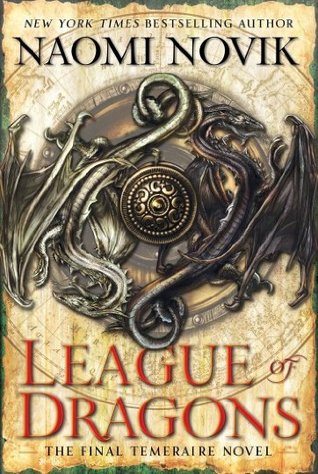
League of Dragons, by Naomi Novik

Today I'm finally finishing with the Temeraire series with the ninth book, League of Dragons. As I mentioned in my review of the previous book, Blood of Serpents, I had started having concerns about this series because I knew we were close to the end and it seemed like there wasn't quite enough space to finish the series. I hate to say it but I feel like this kind of happened with this book as well. It seemed like Novik had a lot of really neat ideas that could have been developed further but there just wasn't enough time in the series to talk about those ideas. I'm left wondering if maybe Novik had gotten tired with the series and was just looking to end it with everything (mostly) wrapped up. The result is a book that feels alternately fast paced and meandering and with me wishing for more.

The book begins where we left off, with Laurence and Temeraire in Russsia after Napoleon's disastrous 1812 campaign. But after we spend some time in Russia, Temeraire and Laurence discover that Temeraire and Iskierka's egg is in danger of being stolen by French agents with the aim of binding the dragon within to Napoleon's son and jeopardizing the already tenuous alliance between Britain and China. Temeraire rushes off towards China, only to get halfway across Russia and be told that the French have already stolen the egg and he now has to rush back towards Europe to try and catch them in the Alps.

Temeraire and Iskierka rush towards France to get their egg back, only to be captured by the French. They then have to plot how to escape with Laurence, and Granby, and the egg. After spending a good chunk of time captured and plotting their escape, they then flee back to England and get involved in planning the counter-attack against Napoleon in the 1813 campaign. As the Peninsular campaign pushes towards the Pyrenees, Laurence finally is awarded the rank of Admiral and is sent with a British detachment of dragons to fight with the Coalition forces including Prussians and Russians and eventually the Chinese as well. Towards the end of the book the Coalition manages not only to crush Napoleon's army, but capture Napoleon himself. Napoleon is allowed to abdicate in favor of his son, and goes into exile on St. Helena.

This is kind of what I mean by the book being alternately fast-paced and meandering. When we're spending time with our main characters being kept prisoner or sitting in camp waiting for Napoleon's forces to come into Prussia, we seem to spend a lot of time sitting around talking about the rights that dragons are interested in getting, and dealing with issues like feeding hundreds of dragons. But then really important things happen (sometimes off-screen) really quickly and we spend some time afterwards catching up on events.

One of the most interesting things about this book was the idea of a concord, initially proposed by Napoleon. The concord is a collection of ideas and rights for dragons, putting them on an equal footing with humans. This initially gets quite a large amount of support from feral dragons, which prompts Temeraire and other English dragons to start working on their own concord. This eventually gets introduced as the Dragon Rights Act by Perscitia, who's the first dragon member of Parliament. This actually was a development I thought was interesting and would have been interested in seeing more of, especially after it's passed and Temeraire starts thinking about pursuing a career in politics. That's just something I would have liked to see more of and might have been more interesting than sitting around dealing with supply problems while on campaign in Germany.

Ultimately I'm a little disappointed with the results of the series. There was a lot of potential in this series and there were a lot of interesting ideas, but I'm left wishing for a little bit more in the end. I think this series has some good parts and there are some enjoyable parts, especially the characters. But I feel like there could have been some more development, especially towards the end of the series. They're enjoyable reads, but as I've said before this series is mostly literary candy.

- Kalpar 

Tuesday, September 18, 2018

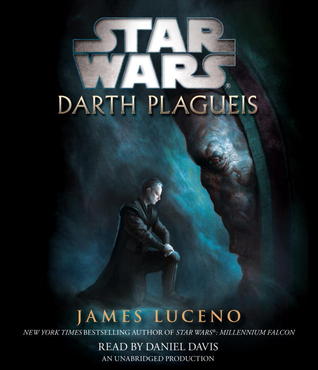
Darth Plagueis, by James Luceno

Today I'm looking at another Star Wars book because apparently I'm a glutton for punishment. Of course this book is part of the Legends canon so it doesn't count as canon anymore within the new Disney canon. (Yes, Star Wars is confusing.) I think this was one of the last books written before the Disney takeover, though, so it kind of shows how complicated the canon had gotten. If you've had the misfortune to sit through Revenge of the Sith you probably remember Palpatine's speech about the Tragedy of Darth Plagueis the Wiiiiiiiise. After the movie a lot of fan theories floated around about who exactly Darth Plagueis was with the favorite being that Darth Plagueis was Palpatine's own former teacher. This book confirmed that theory and expanded on both Plagueis and Palpatine. But I feel that this book in an attempt to answer questions just ends up raising more questions.

This book establishes that Darth Plagueis is a Muun. Now if you don't remember what the heck a Muun is, I certainly don't blame you. Basically they were these tall aliens and they were behind the Intergalactic Banking Clan, the major economic power in the galaxy. Darth Plagueis, like so many Muuns, is a major financial broker in his own right. Now on one level this makes a lot of sense because someone with massive financial power would be able to set the conflict of the Clone Wars into motion, both through political manipulation as well as underwriting the manufacture of armaments for each respective faction. In a way this makes a lot of sense. But the trouble with this book is that it just creates a disconnect between Darth Plagueis the manipulator and Darth Plagueis the immortality-obsessed maniac. Of the two, the chasing immortality plotline seems to have been almost forgotten at times, like Luceno was like, ''Oh right, the immortality and the midichlorians. Right. Got to include that.'' Plagueis's ultimate goal is to rule the galaxy for forever, but based on where the book spent its focus it felt like Plagueis's main goal was galactic domination and immortality was just a sweet bonus.

This book also focuses a lot on midichlorians (when Plagueis is actually working on the immortality project) and then all the financial and political debates that were in the prequels. Now I think it's pretty safe to say that there were a lot of people who didn't like the tedious political debates that were in the prequels, so having a whole book with a lot of those debates is probably not going to be appealing to the average Star Wars fan. Not to say that political intrigue and Star Wars couldn't potentially be an interesting story like Song of Ice and Fire, but in this case it's a more of the prequel variety which isn't that great.

The canon problems also start getting confusing. This book includes a reference to the Heir to the Empire with Jorus C'baoth making a cameo and I'm pretty sure that there's an inclusion of a plotline about Darth Maul taking out leaders of the Black Sun criminal organization.And I'm pretty sure I read a comic with that exact same plot back when I was a teenager. (It's called Star Wars: Darth Maul published by Dark Horse, if anyone's interested) And those are the only two references I was able to catch, I'm sure there were more that I missed as well. But this just made me think of the of the fact that Jorus C'baoth was cloned and his clone suffered from clone madness, all of which got forgotten with the new Clone Wars. So now I'm mixing canons that contradict each other in my head.

I feel like this book tries to answer some other questions such as ''What the heck were all those giant bottomless shafts in Naboo that the lightsaber fight was in? And for that matter why is the Trade Federation blockading Naboo? What space supplies could this lush, verdant planet need that would cause them to surrender?'' Well this book actually answers those questions that we had. It turns out that Naboo's entire economy is based around mining plasma and then the Trade Federation has a contract to ship it off world. So the blockade by the Federation is over a disagreement involving shipping rates and it brings Naboo's economy to a standstill because their economy is based on a single export. And those bottomless shafts are just plasma mines.

...except that plasma is an ionized gas either found in either the upper atmosphere or more commonly what stars are made out of. So...you...shouldn't be mining it from a planet's core. I...it just doesn't make sense. I'm sorry, I know I'm making a big deal about this but it bugs me on some level. And this is just the biggest thing that bothers me, there are a lot of other questions that I'm left asking about this book. It just raises more questions.

Overall I think this book is worth skipping. While it explains more of how the Clone Wars were set up, it does it in such a dry manner that I don't think most fans are going to want to read this entire book just for that.

- Kalpar

Thursday, September 13, 2018

Sister Queens, by Julia Fox

If you live in the United States you might vaguely remember Ferdinand and Isabella as the monarchs who hired Christopher Columbus before he ''discovered'' the New World. However Ferdinand and Isabella had a much greater influence on European politics beyond sending an Italian who didn't know what the heck he was doing to murder some natives. Ferdinand and Isabella completed the centuries-long project of the reconquista and united the states of Castile and Aragon into modern Spain. And the marriages of their children would affect dynastic politics for generations to come. This book focuses on two of their children, Katherine of Aragon and Juana, Queen of Castile, often known as Juana the Mad.

Katherine of Aragon was familiar to me because she was the first of Henry VIII of England's six wives. Katherine's depiction varies from source to source, especially depending on the religion of the writer, but she has understandably received considerable coverage in English history and literature. So a lot of the material in this book was a refresher for me. I think Fox did a very good job of portraying Katherine as a whole and complex person rather than a cardboard cut-out.

The biggest thing I learned from this book was about Katherine's older sister, Juana of Castile. Juana was the third of Ferdinand and Isabella's children and was never expected to inherit. However once their brother Juan and older sister Isabella died, Juana was left to inherit the kingdoms of Castile and Aragon after already being married to Philip, Archduke of Burgundy, of the influential Hapsburg family. When Isabella died before Ferdinand in 1504, this meant that potentially whoever could control Juana very likely would control Castile as well. This launched a fight between Ferdinand, Philip, and on Philip's death in 1506, his son Charles who would become Emperor Charles V. Eventually Ferdinand and Charles would both imprison Juana under claims of her insanity and Juana would spend the majority of her life imprisoned.

The story that is mostly used to justify the claims of Juana's insanity was a story relating to her husband's body, which Fox manages to explain really well within the context of dynastic and religious politics of the sixteenth century. Juana sought to have her husband buried in the Alhambra located in Granada, the final conquest of her parents in 1492, and importantly where Isabella herself had been buried. By burying her husband with her mother, the former Queen of Castile, Juana sought to cement her position as queen in her own right. However both her father Ferdinand and later her son Charles were able to turn the royal progress of her husband's body into the actions of a madwoman to legitimize  their own usurpation of her power.

The ultimate irony of course is that despite being held prisoner for most of her life, Juana eventually influenced all of Europe through her children. The Hapsburgs married into the royal families of Europe and the Austrian branch of the family would rule as Holy Roman Emperors and later Emperors of Austria-Hungary until 1918. And Fox argues that since Juana's actions always seemed to be for the good of her dynasty, she would perhaps be satisfied with the final outcome.

Overall I thought this book was a really good reexamination of at least Juana, who I really only knew the one story about her alleged craziness that's been perpetuated for centuries. Katherine it feels very familiar but on a much deeper level than some of the more general Tudor histories that I've read or listened to. I did appreciate Fox going into the details of Katherine's struggles with Henry VII, definitely one of the more avaricious Kings of England. I think this is well worth the time to check out and give you better understanding of the dynastic politics of the sixteenth century.

- Kalpar

Tuesday, September 11, 2018

How Rome Fell: Death of a Superpower, by Adrian Goldsworthy

Today I'm looking at a book which does exactly what it says on the tin, looks at how the Roman Empire fell. In the first century CE the Pax Romana had reached every corner of the Mediterranean and for centuries it seemed Rome could weather any challenge, face down any enemy. However by 476 the Western half of the Empire had been occupied by Goths, Franks, Vandals, and other Germanic tribes and Rome itself was sacked. Romulus Augustulus, the last Western Emperor, was deposed and nobody bothered to replace him. The Eastern Empire continued for another millennium, but the power of Rome in Western Europe and Africa had forever been curtailed.

Even as the Empire itself fell, people were debating what caused the Empire to collapse. In the classical era people tended to attribute it to the displeasure of the gods. Pagan writers said the old gods were displeased by the empire's conversion to Christianity while Christina writers blamed backsliding to pagan rituals losing Jesus's favor. Later writers, including Edward Gibbon, blamed the collapse on the Roman Empire on the invasion of Germanic barbarians. As Goldsworthy explains, the underlying assumption is that the institutions of the Roman Empire were fundamentally sound, but the external pressures were simply too much for the empire to bear. Goldsworthy argues that instead it was internal issues that sapped the strength of the Roman Empire and made it susceptible to invasion by the Germanic tribes.

Goldsworthy illustrates this problem through centuries of evidence, showing that through the third and fourth centuries CE the Roman Empire was plagued by civil wars and usurper emperors, as a result much of the empire's strength was spent fighting itself rather than its enemies. Over time the empire's institutions including its military and civil bureaucracy were reformed in an attempt to keep the emperor safe from usurpation or assassination, dividing authority and reducing the power that any one individual subordinate might hold. Ironically this did nothing to stop the civil wars and for most of those centuries strong, long-reigning emperors such as Diocletian, Constantine, or Theodosius, were the exception rather than the rule.

Ultimately Goldsworthy's argument is that the Roman Empire managed to survive through ontological inertia rather than because it was an efficient and united regime. The Empire was simply too big, too rich, and too powerful for it to fall overnight despite the rot within the structure. The Germanic tribes, and even the feared Huns, were able to raid and bloody the empire, but almost never had the numbers to truly overthrow or replace it for most of its history. The only closest rival in terms of strength and money was Sassanid Persia and due to geography they would not have been able to strike at the cores of the Roman Empire.

Goldsworthy's methodology is well thought out and he makes excellent use of the available sources to make an argument that internal, rather than external, pressures made the Roman Empire collapse. What bothers me, though, is when Goldsworthy makes the comparisons to other nations and the inevitable comparison to the United States. As he explains, the United States has been comparing itself to Rome (albeit the Roman Republic) since 1776, so the comparison to the Roman Empire is equally apt. However, Goldsworthy argues first that the United States, much like Rome, had no serious challengers. When this was written in 2008 that was clearly not the case as our ongoing ''war on terror'' continues to quagmire in the Middle East with no real goal or end in sight. While the nature of asymmetric warfare means it's unlikely a terrorist army could invade Washington, D.C., the challenges that they pose are no less frustrating. And even in 2008 the rise of China and ambitions of Putin were plainly obvious as future security concerns.

Goldsworthy also, albeit not by name, makes a reference to the Roman Empire being ''too big to fail''. Although definitely not being tossed around at the time he finished writing (well before the publication date of 2008) the words ''too big to fail'' have come back to haunt us in a serious way. To members of the left wing, myself included, the notion itself that a financial institution can become so large that its collapse can threaten the world economy suggests that something has become seriously wrong with the system and is in desperate need of reform. And it does raise the question, if Rome was too big to fail and still failed, what does that mean about the banks?

Despite these concerns about Goldsworthy's attempts to compare Rome to the modern era (a difficult proposition even in the best of times), I think this book is well worth taking the time to check out. Goldsworthy makes a compelling argument that in the end, Rome's greatest enemy was itself.

- Kalpar

Thursday, August 30, 2018

Blood of Tyrants, by Naomi Novik

Today I'm looking at the eighth and penultimate book of the Temeraire series, Blood of Tyrants, and this is actually a point where I was outright disappointed in the series. As I've said time and time again the thing I've noticed about this series is that most of the books are similar to the others and most of the time it involves Laurence and Temeraire being tourists in various locations throughout the world. I think it's interesting to see how different cultures treat dragons in this world where humans and dragons coexist, but there was a lot of the series that felt like literary candy similar to the Sharpe series. So I've been giving the series middling reviews because while I liked them and there was a lot that was pretty good, there wasn't anything spectacular to write home about either.

The biggest issue I had with this book was the decision to start the book with Laurence having amnesia, which seems to serve no purpose but create filler. When we last left our characters, the Potentate, Laurence, Temeraire, and the rest of their dragon wing set sail from Brazil to China for an official visit with the Imperial family, Laurence's adopted family, for a potential alliance between China and Great Britain. Along the way the Potentate runs into a storm and ends up washed on rocks off the coast of Japan. Along the way Laurence is washed overboard and wakes up in Japan with amnesia, having completely forgotten the past eight years of his life, incidentally completely wiping out any memory of Temeraire or his service in the aerial corps.

Personally I disliked the amnesia plot because I felt it didn't really serve any purpose in the story. I think it would have been fine to have Laurence wash up on Japan and get the taste of Japanese dragons versus Chinese dragons (although based on what little we got I don't know how different Japan was) before heading onward to China. Instead we have Japanese officials wondering what exactly to do with Laurence especially because he says he has amnesia and the Japanese don't believe him anyway. Really the only thing that the amnesia does is create drama for later on between Laurence, Temeraire, and the other aviators. First there's the drama of Temeraire feeling guilty that Laurence has missed out on all the things he could have experienced with a naval career instead. And then there's the awkwardness around talking about Laurence's past, specifically when he gave the cure to the dragon plague to the French and as a result was convicted of treason. And it felt so tiresome to tread over this ground over and over again.

This is the point where the amnesia plot starts to feel like so much filler because we're going over the same psychological problems that Laurence and Temeraire have gone over before and we resolved them. Now since I have psychological problems myself I understand that deep-seated issues aren't solved overnight, or even solved once and for all. But with fiction it gets frustrating that the characters keep going over the same issues that were resolved in previous books And it feels like Laurence gets amnesia just so we could go over the same ground again, but regardless of whether he'd had amnesia or not, Temeraire felt responsible for losing Laurence's fortune and the need to make it up to Laurence somehow. So there still would have been an issue whether Laurence had amnesia or not.

I say this feels like filler because this book finally returns to the war with Napoleon by having Laurence and Temeraire lead three hundred Chinese dragons to the Russian front to help the Russians drive back Napoleon. Students of history will of course recognize this is Napoleon's 1812 Russia campaign, widely regarded as the major reason for his empire falling. When we leave our main characters the outcome of the Russian campaign is in doubt, the Russians and Chinese have been driven back, their lines of supply destroyed, and despite all their efforts Napoleon appears to once again have the upper hand. With winter setting in, the situation looks desperately grim for the coalition powers. But for me it didn't feel like a natural stopping point in the narrative and now I'm worried that the end to the Russian campaign in the last book is going to be rushed so Novik can put other things in. Maybe I'll be wrong but we'll have to find out.

Honestly, the amnesia plot is my biggest complaint because it doesn't seem to serve a purpose beyond filler. Especially when we've gotten this deep into the series and are on the cusp of wrapping everything up once and for all. The rest of the book feels a lot like the rest of the series so it's fair to middling, I just think Novik could have used time more profitably.

- Kalpar