Showing posts with label Bolo Series. Show all posts

Thursday, July 2, 2015

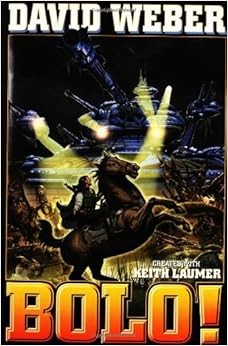
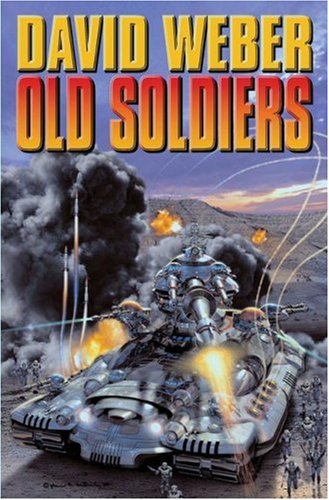
Bolo! and Old Soldiers, by David Weber

This week I'm knocking out two books at once and have come at last to the end of the Bolo series. So alas there will no longer be any more posts with me squealing about giant robot tanks and how awesome I think they are. Technically there is one more book, Their Finest Hour: Best of the Bolos, but that is an anthology of previous stories which I have already read and so I probably am not going to be reviewing it here. The reason I'm tackling two books today is that Bolo! specifically is a collection of four short stories written by David Weber, and three of them have been published before in other Bolo anthologies. The only new story is With Your Shield, which actually is sort of a prologue for the full-length novel Old Soldiers, and gives backstory for the main human character, Maneka Trevor. I'm also aware that I already talked about the other main work of Weber's that I've been reading last week, but I assure my readers that this blog isn't going to turn into just another David Weber fan club. ...I hope.
Anyway, the plot of both of these books is set during the Final War, an event that looms large in more than a few of these books. For anyone who hasn't read any of my other reviews of these books: the Concordiat of Man and the Melconian Empire, through a failure of diplomacy and a battle where neither side was sure who shot first, get engaged in a galaxy-spanning war. The Concordiat has a technological edge, including the mighty Bolos, but the Melconians aren't too far behind and have sheer numbers which more than offset humanity's edge. As the war continues, it escalate into a genocidal campaign known as Operation Ragnarok, where both humans and Melconians begin burning each other's planets to cinders, both sides hoping that the enemy will run out of planets before they do. As the war drags on the Concordiat realizes they've grossly underestimated the size of the Melconian Empire and there's a very good chance humanity is going to lose, even with the Bolos on their side. This begins plans for Operation Seed Corn, an attempt by the Concordiat to send human colonization fleets beyond the explored edges of the galaxy to ensure that humanity, in some form at least, will continue to exist.

Included in this expedition are an aging Mark XXVIII Bolo, named Lazarus, and his commander, Maneka Trevore, both the only survivors of their unit from a Melconian attack on Chartes. Both are suffering from survivor's guilt and will have to work together so they can protect one of humanity's attempt to ensure something survives beyond the Final War.

I will admit that I'm not as huge a fan of Final War stories because it ultimately results in the fall of the Concordiat and the Melconian Empire in a final maelstrom of destruction. Granted, there are stories showing at least fragments of both sides surviving afterwards, but it's small comfort considering what we lose in the process. The writing is fairly good and at least in this one I didn't notice too much extraneous exposition, but that may just be me and my usual love for exposition. What I liked about both these stories the most, though, is that Weber was able to answer a question which had been raised in earlier books and had never really been answered to my satisfaction. Previous books had raised the question is it really right for humanity to create sentient beings that exist merely to fight and die on our behalf? The Bolos are fully-developed people. They have personalities, idiosyncrasies, they make jokes, they have friends, and in a way they can also know fear. Is it truly just for humanity to create a race that you could very well call slaves to do all our fighting for us?

Previous books had raised this question before and had sort of glossed over it or not really looked into it very deeply. And it made me wonder if maybe the Bolos actually resented us for making them our warriors. However, in this book Weber actually manages to answer the question to my satisfaction through the voice of Lazarus. See, Bolos are aware that they exist to fight and die on the behalf of their creators, but they don't see that as a bad thing. Bolos respect humans because humans created them far better than humans could ever hope to be. A Bolo after all is a building-sized weapons platform capable of standing up to fusion warheads and an ability to make decisions in milliseconds. No human could ever hope to out-perform a Bolo on the battlefield. But more importantly, humans made Bolos the epitome of honor, duty, obligation, and other ideals that humanity constantly strive and often falls short of achieving. Bolos believe that humanity has made Bolos better than humanity could ever hope to become, and they feel not only honored by this decision, but an obligation to protect their creators. And the humans have not failed to appreciate this, either. Even though a human commander will probably have very little they can accomplish from the cockpit of a Bolo, humans still ride in Bolos out of an obligation to share the risk with their armored protectors and ensure they do not fight alone.

Although this book has some really sad parts, it has what I thought was a very touching and appropriate ending for the Bolo series as a whole, with hope for the future of mankind. As much as I hate to have finished this series, I'm also very glad I read it as well.

- Kalpar

Thursday, April 30, 2015

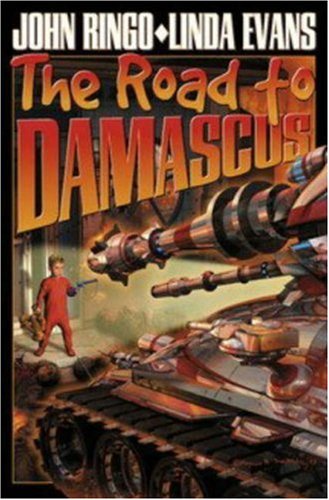
The Road to Damascus, by John Ringo & Linda Evans

This week I'm tackling another Bolo book, but one which I had heard rumors of bad things beforehand and found myself rather worried about reading it in the first place. The Road to Damascus is cowritten by John Ringo and Linda Evans. Now, Evans has appeared on this blog before as a contributor to Bolo stories, but Ringo so far has not. From what I've been able to gather, Ringo has some fairly strong conservative political opinions which slip into some of his books, Road to Damascus included. In addition, this book clocks in at about 750 pages, nearly twice as long as any other single Bolo book in the series, which gave me serious apprehensions about going into this book. I will say that in the end it didn't turn out as bad as I thought it would be, but it still comes across to me as a little bit dumb.

Plot wise this book is also set in the days of the Final War between the Terran Concordiat and the Melconian Empire, but in this case on the distant planet of Jefferson. Located on the border between humanity's on-again off-again enemy the Deng, Jefferson merits the strategic investment of a Bolo for its protection. However, due to its remote location from the major battlefronts of the escalating Melconian War, all the Concordiat can spare is a practically antique Mark XX Bolo named Lonesome Son, and his commander Major Simon Krushtinov. Sonny and his commander prove his worth rather quickly, defeating a Deng incursion on Jefferson in the space of a few days, but at the cost of most of Jefferson's infrastructure. (This all happens within the first hundred pages, by the by.) The majority of the book is focused on the growth of a political movement known as POPPA that advocates economic and social equality for all, decreased military spending, and environmental protection. The book then follows POPPA's ascent to power, dramatic restructuring of Jefferson's social and economic fabric, and then ultimately a revolution. Deprived of his commander, Sonny becomes a tool of the increasingly corrupt POPPA regime, utilized in quashing protests and rebellions, until he finally has a change of heart at the very end of the book and joins the side of the rebels in the last ten pages. And then the book...ends. Just like that.

My apprehensions about this book were centered around Ringo's... I'll call it an attempt at political commentary which had been described to me in other reviews as strongly pro-conservative and anti-liberal. (Under current American definitions of the terms anyway.) The reason that I call it an attempt at political commentary, with some space ships and a Bolo thrown in, is that the bad guys of POPPA are never remotely anything like the Democratic party, to the point where it's practically political satire more than anything else. Towards the beginning of the book POPPA wants to basically abolish the military, enforce stronger environmental protection measures on Jefferson, and remove government investment in the reconstruction of Jefferson's agricultural and industrial economies. The military abolition looks silly simply because there's still a very real threat of Deng invasion. (And Jefferson had maintained a military despite experiencing roughly a century of peace.) The government investment in agriculture and industry just comes across as stupid, and the heroic characters flat out say as much, because people are still rebuilding from the Deng invasion, yet no one makes an effort to try and convince the masses otherwise. Like the people getting taken in by POPPA are just too stupid to understand the truth. Finally the environmental protection measures, which remain a sort of undercurrent through the book, are really an apples to oranges comparison. Jefferson is a planet with a population of ten million people, sparsely settled, and with large areas of land still not under human habitation. While it makes sense to want to protect some of that unsettled land for future generations, it's just plain dumb to try and return already terraformed land into Jeffersonian wilderness because, hey, we need that to live on. Furthermore, Jefferson isn't the only planet with humans on it in the neighborhood, nevermind the galaxy. Running out of resources isn't too much of a problem. However, in real life we have a population of over six billion on one planet with an environment that appears to be heating up considerably and an ultimately finite amount of resources. It makes sense on Earth to return unproductive and unprofitable farms back into wilderness, as some people have done, to help preserve species with less and less space to live. As a Take That to environmentalism, Road to Damascus simply doesn't work.

From there POPPA goes directly into the nightmares of pretty much any conservative in the United States and fails to reflect American politics whatsoever. A system of childhood indoctrination begins with government-mandated daycare centers, regular inspections by government agents to make sure parents are "appropriately" caring for their children with the threat of losing their children to a foster care system, increasing regulation and restriction of firearm ownership, and widespread unemployment subsistence benefits which more and more people end up on due to a slowly collapsing economy. And said "Subbies" are left with nothing better to do but create more parasites on the government treasury. Certainly what Fox News claims is happening in the United States, but again, in no way a reflection of reality. Ringo then starts going into Soviet and Chinese agricultural collectivism where farms are taken over by the government, farmers are demonized as profiteering off of high food prices and hoarding food, and farmers are forced to work a minimum of fifty hours on state-run collective farms. Eventually a police state is established with its own paramilitary arm, any and all forms of dissent are brutally crushed, and work camps are established to hold the growing number of convicts. Pretty much every terrifying and awful thing gets thrown in until POPPA goes full-blown Nazi with actual, literal death camps, a "final solution" genocide, and plans to expand their regime to other planets. The result is like a slippery slope argument that just comes across as dumb more than anything like an actual commentary on American politics.

Ultimately the book just seems to play out like persecution porn for conservatives. I'm willing to go out on a limb and say that in real life conservatives are probably one of the least-persecuted groups in the United States. In fact, I think in some cases the conservatives are often the persecutors. However, nothing stirs up righteous indignation more than a good persecution story, which is why Fox News is still around. The Road to Damascus just reads as a story where dangerous, out-of-control liberals are out to completely ruin the world and it's only through the resistance of brave, gun-toting conservatives that the world is saved. There's even an Easy Evangelism moment where one of the characters slaps her POPPA-brainwashed daughter and shouts how everything's wrong with POPPA and her daughter pretty much instantly believes her. I'm almost left wondering who the heck this book is meant for because it's got all the traces of persecution porn, but I don't know how many conservatives are going to pick up a book about robot tanks.

Well ostensibly about robot tanks. The reviews that I had looked at before reading this had also mentioned that Sonny the Bolo was barely in the book. I feel like he's certainly in it enough to be a main character, but he doesn't seem to do terribly much. He does an excellent job of ending the Deng incursion on Jefferson, but spends most of the book sitting on his shiny behind wondering why anyone would listen to POPPA's demonstrably false manifesto and why POPPA would take actions which will destroy the planet's economy in six point seven years or so. Sonny feels no obligation to inform anyone of these facts (although they probably wouldn't listen anyway) and when he does get out of the maintenance depot, whether to crush some protestors in the streets, literally, or fight against some rebels, he comes across as not terribly clever. Now, there might be some leeway since he's a Mark XX Bolo and therefore of the first types to be fully sentient, but it's explicitly stated that Sonny's as good as a Mark XXIV or XXV because of his century of field experience to call on. But time and again he keeps getting outsmarted by the rebels and stumbles into their traps, making you seriously doubt his effectiveness as a Bolo. I think the title, The Road to Damascus, is supposed to be a reference to Sonny's ultimate conversion to the rebel cause because he realizes POPPA was committing genocide and simply "following orders" isn't good enough, but while we get to see Paul's work after his conversion on the road to Damascus, the book ends right after Sonny's conversion. It's ultimately very disappointing.

Finally, for a book that's nearly 800 pages, Ringo somehow manages to make me want him to show rather than tell. Important events are often described to the reader, rather than actually happening. For example when one of the main characters is assumed dead, the eulogy which practically canonizes her as a saint of the farmers resisting POPPA, it's described as incredibly moving instead of actually being written. There are dozens of examples like this throughout the book and while some exist to let the horrors of POPPA be left to the reader's imagination, it feels just plain lazy most of the time. In addition, the book has quite a few time jumps, which are necessary to an extent because the book's set over twenty years, but this feeds back into the telling instead of showing where we're told characters have developed over time instead of getting to see that development for ourselves. In addition, the book is divided into four parts, which do not in any way correspond with any developments in the book. It reads like one big long novel instead of a story told in four acts. It just further adds to the frustration with the book when it's already clearly persecution porn.

To its credit, the book is at least readable through the first five hundred pages or so. It wasn't until I got towards the end that I just wanted the book to be over already. But for the most part, this is probably the one Bolo book you can probably safely skip. As I've said in other reviews, when the Bolo series tries to talk about bigger issues it always seems to fall incredibly short. The Road to Damascus is no exception. It feels like an attempt at political commentary that's really conservative persecution porn with a Bolo thrown in from time to time. It's certainly proof I'm dumb enough to read anything with spaceships in it, but nowhere close to the fun, gripping, pulp action that made me fall in love with the Bolo series in the first place. Definitely not worth your time and can be safely skipped.

- Kalpar

Thursday, March 12, 2015

Bolo Strike, by William H. Keith, Jr.

Hey, look, Kalpar's reviewing another one of the Bolo books. Is anyone surprised in the least? Anyone at all? No? Okay, good. On with the review.

So I'm continuing my march through the full-length Bolo novels and actually coming towards the end of my endeavor. This particular book, Bolo Strike, is another production of William H. Keith, Jr. and is set some five hundred years after the fall of the Concordiat of Man and the end of the Final War with the Melconians. A new human government known as the Confederation has once again emerged and continues to use the redoubtable Mark XXXIII Bolos. In this particular instance a human-colonized world known as Caern has recently been rediscovered by Confederacy traders. However, the humans of Caern worship and are ruled by an alien species known as the Aetryx whom they venerate as gods. The exact relationship between humans and Aetryx is never really understood, but the Confederacy decides that no outpost of humanity, no matter how small, is going to be ruled by alien life forms and creates a task force to liberate the human population, including dozens of Mark XXXIII Bolos. However, the invasion does not go as planned, especially when the Aetryx begin sending Mark XXXII Bolos at the Confederation forces. Although outdated and unequal in firepower to a XXXIII, the XXXII's pose a significant threat in numbers, especially because if nothing else it means the Aetryx have been able to override the security protocols in a Bolo's programming.

The action in this book is all the glorious pulp I've come to this series, but it actually takes a back seat to some of the questions that are raised in this series, specifically what it means to be human and what counts as human. In the universe of this particular book, although it's definitely possible for a complete human mind to be copied and downloaded into a computer, humans almost universally see it not as immortality but as an illegitimate copy. That somehow that electronic copy of yourself is inherently less valuable than the flesh and blood version. And there's not really any debate on this point either, it's strongly outlined in black and white. Personally I feel like it raises an interesting question and a dilemma, especially when there are several copies of one person's memories running around, all convinced they're the original. I just wish the rationale behind an electronic copy not counting came to more than because it's not the original. Maybe it's a little much to expect a deep and thoughtful discussion about something like this in what's essentially a silly pulp novel, but pulp novels can talk about serious stuff too.

Another question I found myself asking was if the humans were really any better than the Aetryx, which was something that came up in Book Six: Cold Steel. As my readers may remember, that book dealt with the Tersae, a race of warriors who had been genetically engineered by their creators and forced into fighting humanity, a rather losing proposition when Bolos are involved. The question becomes are the humans really any better in creating mechanical monstrosities and then sending them into battle to fight and die for our needs, only to put them back into storage when the war's over and there's no need for them anymore? When the Aetryx do something similar to their human followers, it casts them forever as the villains, but it really just made me wonder if what humanity does to the Bolos is really fair. After all, these are fully self-aware beings. Who mass several thousand tons and are bristling with weapons, but self-aware nonetheless. And yet the Bolos are seldom to never given a say, and in fact can never feel things which we don't want them to feel because their programming simply doesn't include it. Humanity's treatment of its strongest protectors feels inherently unfair to me, but it's never really explored. And perhaps it can't be because Bolos can't see their relationship with humanity as anything other than proper because they're programed to be that way. It raises a lot of questions but never really gets a proper treatment.

Other than the questions I have, this book is all right. I don't have any serious complaints about it, but by this point in the series it's starting to just blend in with a lot of the other books. The challenge with the Bolo series is probably keeping it fresh because there's only so many tank battles you can do before you have to come up with something original. And this may be why I suspect the series ends eventually, because most of the ideas are exhausted and there's just no new ground to cover.

- Kalpar

Thursday, January 22, 2015

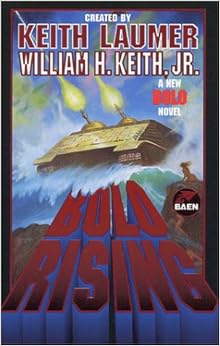
Bolo Rising, by William H. Keith, Jr.

As last week's post was some pretty heavy stuff, I decided to take a bit of a break and head back to one of my all-time favorite series, the Bolos. This week I read more of William H. Keith, Jr.'s work in the full-length novel, Bolo Rising. This particular book is set well after the Final War between the Concordiat of Man and the Melconians, set on the distant human colony world of Cloud. Faced with the chance that humanity will be utterly destroyed in the escalating cataclysm of the Final War, humanity began sending multiple colonies to the far reaches of the galaxy in a hope that at least some of these widely-dispersed settlements would survive and prevent humanity's extinction. Cloud is one such colony and has thrived for nearly two hundred years in a neighborhood close to the galactic core. Unfortunately a mysterious and incomprehensible mechanical enemy, known only as the !*!*!, attacked Cloud about a year ago and currently keep humanity in slave labor camps on the surface, for inscrutable reasons. Humanity's only hope lies in Hector, the Mark XXXIII Bolo corrupted by the !*!*! and used as a guard outside one of the prison camps. If humanity can take back their greatest protector, they may be able to strike back against their mechanical oppressors.

Honestly, aside from changing up what sort of enemy humanity's facing and changing the type of Bolo and their personality, this book isn't terribly different from most of the others that I've read. Some sort of alien menace that threatens to overwhelm humanity. Bolos come in. Bolos help humanity fight alien menace. It becomes a very close thing at several points, with a chance that humanity and the Bolos will be beaten, but more often than not they end up carrying the day. The short stories definitely had more variation, but I think that's simply because there were more of them, allowing a larger sample size. Because of the mechanical nature of the !*!*! you sort of get a justification for some humans being suspicious of the Bolos and whether we can really trust our mechanical protectors, but it doesn't really come to the fore in this book and as always the fears of rogue Bolos proves incredibly unfounded. I kind of wished we learned more about the !*!*! and their motivations, their origins and so on, but it turns out that even they don't exactly know their own motivations and origins. (Although I don't know if that makes for a good character or just lazy writing. It's hard to say)

Aside from the pulp sci-fi tank action nonsense that happens in this book, and most of the other Bolo books, it's really hard to justify them as literature. They're sort of like action schlock movies, but in book form. Pretty to look at and all manner of stupid sorts of fun, but not necessarily great literature. Of course, I happen to really like that sort of thing, and I really hope other people do too, but there's just not a lot of substance otherwise.

In short, "WHEE! GIANT ROBOT TANKS!"

- Kalpar

Thursday, December 4, 2014

Bolo Brigade, by William H. Keith Jr.

This week I've returned to my perennial favorite series, the Bolos, with a full-length novel Bolo Brigade. When I initially began this series I sought to read it in chronological order. However, in the helpful guide of books located on Wikipedia I only recently noticed that the full-length Bolo novels were published concurrently with many of the Bolo short story anthologies, which I've already reviewed. However, I'm very happy to be going into the full-length novels and look forward to the opportunities provided by additional space.

This particular book deals with an area of space out on the galactic rim that is independent of the Concordiat of Man, but still strongly affiliated and protected by ancient Bolos against the remote possibility of a threat. Of course, we know that since the focus of the book is on this particular galactic backwater, the Bolos are going to have to save the day. In this case a race known as the Malach, very similar to raptor-like dinosaurs in many respects, have invaded the human worlds. The humans are no match for the hunter-warriors of the Malach, and some of the Bolos are simply insufficient as well. But hope lies in Freddy and Ferdy, two ancient (and perhaps most importantly self-aware) Mark XXIV Bolos, defenders of the sector's capital.

If you asked me my opinion on this particular book, I'd say it's okay. I wouldn't say it's going to win any awards, but it's a worthwhile contribution to the Bolo canon. As I've said before with other books, you usually go into Bolo books expecting some crazy awesome tank goodness and the book seldom fail to deliver on that promise. It's probably not going to change the world, but sometimes it's fun to kick back and read some pulp adventures. And honestly it has a giant tank on the cover, what did you expect? I will say that the Bolo books in the past have been able to raise the question of what makes someone, or something, human, and while this book sort of touches on that, it doesn't go into terribly great detail, focusing instead on the pulp action.

I will say that the book sort of makes an attempt to contrast the Malach and their societal values with human values, which are definitely alien to say the least. I do wonder if it was entirely fair for humans to judge Malach by human values, simply because the Malach are so alien. But at the same time, when people are determined to kill all of you and take all your land and resources, you kind of want to focus on killing them right back and morality can be damned. The book also does work in people who want to make peace with the Malach, assuming that they can be reasoned with as you would with other humans and a peaceful resolution to the current conflict can be achieved. I will admit that this peace faction comes across as little more than straw men because we know that the Malach terms, if the Malach bothered to offer them, would be completely unacceptable to any humans. So it sort of turns out the military people are right, but it doesn't feel terribly heavy-handed in this instance. I will also say it was kind of funny to find another species that is expanding from a solitary world and simply cannot believe that humanity is in control of more than a handful of planets. Although the Concordiat's resources aren't brought to bear in this novel, it definitely leaves the Malach in for a very rude awakening when a true Bolo Brigade arrives in the sector.

Simply put if you like Bolos, you'll like this book, and if you're new to Bolos then this book is also a good choice. (Although you might not catch all the references.) Definitely worth the read if you want some sci-fi action.

- Kalpar

Thursday, October 2, 2014

Bolos Book Six: Cold Steel, created by Keith Laumer

Once again the mighty Bolos shall grace the pages of Kalpar's Arsenal in the last of the numbered installments in the series, Cold Steel. (There are several other books about the Bolos which I fully intend to read but for whatever reason Baen Books decided to drop the numbering convention.) This is what seems to be another in-between book in the series and its overall development. As I mentioned in the last book, the short stories all focused on one particular war that was fairly limited in scope, as well as the Bolos efforts in defending humanity from this new threat. Cold Steel once again focuses on just one planet, in this case Thule, and has only two stories. The second one, “Though Hell Should Bar the Way”, by Linda Evans, is long enough to be its own novel and leaves me rather optimistic about the later books.

Cold Steel, as I mentioned, focuses on the world of Thule, a planet with an extremely harsh winter, intense volcanic activity, and innumerable asteroids and meteors making interstellar travel a massive headache to say the least. It would have been entirely ignored by humanity except for an incredibly rich supply of saganium, a material component of the new duralloy which makes up Bolo warhulls. This has made Thule a priority mining operation of immense strategic significance and human colonies are quickly established. However, the preliminary survey did not reveal the existence of a native intelligent species, the Tersae, who become rather violent when humans show up on their planet.

Overall the writing is enjoyable pulp Bolo action. If you've enjoyed the series so far you'll enjoy this, no doubt about it. However, among all the awesome pulp action which the Bolo series is fueled by, there are some really uncomfortable questions that get raised. First off, there is of course the imperialism parallel where a more technologically advanced culture arrives at a “barren” location to obtain natural resources, only to find themselves in conflict with locals who are rather unhappy with all these strange people on their land. This is side-stepped when it turns out the Tersae were created by and are receiving orders from “Ones Above”, so the conflict is a proxy war between two powers and the Tersae are just tools. Which actually makes it much worse come to think of it.

Another important question that gets raised is are the humans really any better? The Tersae are a genetic experiment that are thrown into a war by their creators, expected to die on their behalf. Are the humans really all that better with their Bolos? An intelligent, self-aware, self-directing species that exists merely to fight and die or become obsolete and replaced? I feel like Evans was aware she kind of painted herself into a corner with that question and gets out with an argument that kind of boils down to:“Humans good, aliens bad.” I feel we could really only ask the Bolos their opinion, but that may not be legitimate either since Bolos are fundamentally hardwired to protect their human creators. It just results in an uncomfortable question with no real answer. And it's fine if there was no real answer, plenty of science fiction has gone that way, Twilight Zone included, but we're given a quick and easy answer so we can feel better and get back to the pulp action.

At the end of the day, the Bolo series has largely had, “Whee! Giant robot tanks!” as its premise. And as pulp-action, giant robot tank space battles fluff it works. And when the books start to introduce more complicated ideas into the giant robot tank space battles it works as well. And I think that's a credit to the writers, but in this particular instance it just didn't work out. The questions they raised don't have easy answers and it feels disingenuous to both the series and the reader to just say, “Humans aren't monsters” and go about business as usual. At least, that's how I feel about it.

I choose to see this as a developmental period in the Bolo series, moving from the shorter stories toward longer narratives that also try to incorporate more complex ideas beyond pulp action awesome. Don't get me wrong, I love my pulp, but when it can be sophisticated as well? Wins all around. Hopefully the other books, in the hands of such capable authors as David Weber, will build upon the Bolo's noble legacy.

-Kalpar


P.S. I've been trying to find more books by Linda Evans as well. I really like her work with the Bolos and I want to read more, but I haven't had much luck finding any. If anybody knows any good books by her please post them in the comments! Thank you!  

Thursday, June 19, 2014

Bolos Book 5: Old Guard

This week I've decided to return to my ever-favorite Bolo series with the "fifth" (although technically eighth or so) installment, Old Guard. I quite enjoyed this novel and liked seeing the new Mark XXXIV Bolos, an expansion of the universe beyond the original canonical XXXIII Marks. The book helps to expand the universe of the Bolos, as other books have done before, while remaining in many respects still grounded by the existing canon. The fateful Melconian War is on the background, and in previous novels we've already seen the unfortunate effects of that conflict, but the determination of the Bolos and their human commanders remains hopeful.

This novel keeps the by now familiar formula of a series of short stories about Bolos in various battles, but takes in a new direction by instead focusing on one specific campaign. Instead of a series of stories scattered across both time and location, three of the four stories in this novel talk about the Kezdai invasion of the planet Delas on the far edges of Concordiat territory. We get to see the initial incursion by the Kezdai onto Delas, which is pushed back by a handful of Bolos, a renewed Kezdai invasion that is slowed by a renewed presence of Bolos, and then the eventual destruction of Kezdai forces on Delas. It was interesting to see an entire campaign that requires numerous Bolos over a period of years, even if only in a handful of snapshots. It makes me wonder what a full-length Bolo book will be like and I hope that I'll be able to run into them as I continue my way through the series. The final story also talks about the Kezdai invasion, although on a separate planet called Izra'il. Although it's a different story it at least keeps with the theme of the Kezdai invasion, helping to tie it in with the others.

Honestly, plot-wise there's just not a lot of variation here. It's the same formula you've seen a dozen times already and will see a dozen times in the future. Some sort of threat shows up. People call upon Bolos to defeat threat. Bolos then defeat threat in the raddest way possible. It's not groundbreaking, pushes no envelopes, and won't win any awards, but personally I'm okay with that. As long as you go into every Bolo book expecting nothing more than some fun pulp sci-fi adventures with giant tanks, you won't be disappointed. However, I am hopeful about the development of a Bolo story into a full-length novel, which I'm aware may be some of the later books.

- Kalpar

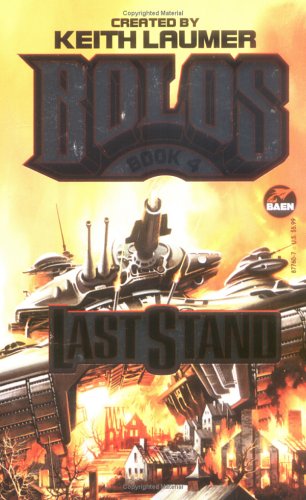
Thursday, November 7, 2013

Bolos Book Four: Last Stand

I've decided to return to one of my favorite series to review this week, the great and mighty Bolos. Like pretty much all the other books in the Bolo series this is actually a collection of short stories in an anthology which comes from a wider range of authors, however old hands like David Weber and Linda Evans return to continue contributing to the series. Overall I think this is a very good book with some really good stories, but like most of the Bolo stories it has a very bittersweet element as you watch these somehow relateable war machines sacrifice themselves for the people they protect. 

I think one of the biggest things that I liked in this book was the introduction of an overall history of the Bolo series as understood from human civilization well after a cataclysmic event known as the Final War. I'll spare you much of the spoiler-y details about this War, but the end result is that all civilization beyond the planetary level was wiped out leaving a handful of remote enclaves. As a result the history of the Bolos before the Final War exists in fragmented records that are often contradictory. I like this a lot because since the Bolo series is written by a many different authors with their own takes on the series, it provides an in-universe explanation for all of the contradictions within the works. I do hope that in later books they manage to smooth out the contradictions and make the series far more cohesive. 

This book is an interesting contrast to some of the other earlier books because in most of the stories the Bolos actually manage to survive their missions. And I do like seeing the Bolos succeed and survive after completing their missions. Somehow, despite the fact that these are giant, thousand ton war machines built for simply one purpose, I still want them to survive in a peace that they've fought for as well. Even if they were never built for that peace. I was definitely interested in the last story when a Bolo decides that it's tired of killing and wants to spend the rest of its days in peace. There's definitely a very human element to the Bolos that makes them something more than just giant metal machines designed for war that really comes to the fore in quite a few of these stories. 

I also really like this book because it further fleshes out the universe in addition to the Final War I discussed above. More alien races and conflicts are introduced, more Bolo models are developed, and the history of the Crazy Years is also developed as well. I like authors both old and new can come to this series and help develop the series and keep it alive with new ideas and innovation. It definitely leaves me hopeful that the later books of this series will also be enjoyable.  Definitely a good read for fans of the Bolo series and I'd recommend it for fans of pulp sci-fi. 

- Kalpar

Thursday, July 18, 2013

Bolos Book III: The Triumphant, by Linda Evans & David Weber

This week I have decided to again return to the Bolo series with "book three", The Triumphant with three short stories by Linda Evans and one longer short story by David Weber. I thought that these stories were very well done and reaffirm my faith in the Bolo series which was established with book one, Honor of the Regiment, with the utter mind-blowing awesomeness of tanks the size of houses fighting for their human creators. However, Triumphant has a great deal in common with Unconquerable as well because while all four Bolos featured in this novel are (as the title suggests) ultimately triumphant, these victories are bittersweet as well. It really attests to Evans's and Weber's writing ability to characterize giant tanks and make them so relateable that I could personally mourn their loss in service to humanity. I was glad to meet Digger, Red, Gawain, and Nike and I was rooting for them until the very end. And as the book says, "Bolos might fail. They might die and be destroyed. But they did not surrender, and they never - ever - quit."

I definitely feel that in the first novel, Honor of the Regiment, it was an exploration of the capabilities of the Bolo universe and the sheer amount of awesome potential with huge tanks. I definitely enjoyed riding along with Sir Kendrick, Das Afrika Korps, and Rommel as they fought alien invaders and the galactic scum that preyed on unsuspecting colonists. Unconquerable, on the other hand, felt more like a deconstruction of the Bolo universe and the sheer amount of carnage these huge war machines are capable of producing, ending with the Final War where humanity and their enemies are driven back to a pre-space existence because of the devastation. Triumphant, in turn, is a further exploration of the human qualities of the mighty Bolos and learning how they can be so much more than just bloodthirsty killers. I will admit that Digger gets the least characterization since his is the shortest story, but he proves that even a decommissioned and retrofitted Bolo is a threat not to be taken lightly.

Perhaps it's because I'm drawn to these honorable and tenacious metal behemoths, but I really enjoyed seeing the different personalities manifest in the different Bolos. I adored Red's motherly love for her crew and dedication to ensuring their safety, and I understood Gawain's frustrations over his perceived failure and state of continued disrepair. And while Nike's self-exploration as a sentient AI trying to understand its place in the world was fairly typical sci-fi fare, the fact that it was in a several thousand ton war machine trying to figure this out satisfied me immensely. I must admit that I'm not entirely sure where the rest of the series will be going beyond this novel, but I'm looking forward to meeting more of the heroic members of the Dinochrome Brigade.

What I really enjoyed the most about this particular book was the bonus material contained in the back of the book, which listed all thirty-three models of Bolos and their tactical capabilities and years of construction. I was just pleased that someone sat down and calculated what weapons, armor, and road speeds each Bolo would be capable of, which probably made it a lot easier for later writers working within this shared universe. Granted, it was a little surprising that a several thousand ton war machine could "sprint" for speeds of roughly five hundred kilometers per hour, but are you going to argue with the sheer awesome? I certainly am not going to. I also really liked the bit slipped in at the end about how humanity and the Bolos end up surviving the Final War, despite its devastation, which gave me a small sense of optimism despite the bleak outlook.

Definitely a must-read if you're a fan of the Bolos already, and probably a good introduction novel for newcomers because of the supplemental material.

- Kalpar

Thursday, May 16, 2013

Bolos Book II: The Unconquerable, edited by Bill Fawcett

So, rather predictably I must admit, I am returning again to the Bolo series with the next anthology of short stories, The Unconquerable. Although I did not hate this installment of the Bolo universe, I did not enjoy it as greatly as I did Honor of the Regiment, and largely I think this was a matter of tone. Regardless, this book has plenty of that pulp sci-fi action which I love wrapped in a crunchy flintsteel coating.

As I mentioned, my biggest issue with this book was the theme of loss and desperate last stands that permeate the book. The tagline on the cover says "Bolos may be destroyed - they do not surrender" which initially sounds like a pretty badass boast but a couple of the stories have large-scale battles where dozens or even hundreds of bolos are destroyed, going down fighting against an endless horde of alien enemies to protect their human masters. While it is stirring that such self-sacrifice can come from hundred-ton metal monsters, I at the same time want the Bolos to win and felt their losses very acutely. Yes, I am aware that they are fictional AIs that exist merely to fight on behalf of humanity, but I feel a strong connection with these warriors and was saddened by each loss they suffered against the apparently infinite swarms of enemies.

There is also one story I did not care for because of the unfortunate undertones it seemed to carry. I will admit that I initially liked Sir Kendrick's Lady because it was nice to see Sir Kendrick and the people of Camelot again, giving a real sense of permanence to the bolo universe. The problem I had is that for much of the story we are shown how utterly frustrating life can be on Camelot, especially for women who are actively discouraged from "having ideas" and are married off, occasionally against their will. It's an incredibly sexist regime which the main character, Abigail, spends almost the entire story trying to escape by taking the Merchant Guild exam and running off to be a spacer. The problem (and pardon the spoilers) is that at the end of the story it's revealed the Merchant Guild is actually a front for a slave-trading ring which has been stealing youths from Camelot for years. At the end of the story Camelot is reaffirmed in Abigail's eyes and she rejects her dreams of becoming a spacer. (Although she does become head of port security.)

 My frustration stems from the fact that clearly there is something wrong with Camelot with its systematic gender discrimination and expectation that women fit a role which only occurred in the (highly fictional and idealized) accounts of King Arthur. Abigail even raises the legitimate point that everyone is living in a fairy tale world, but at the end of the story Camelot is the same place it always was and has be redeemed in Abigail's eyes. Quite frankly, although slavery is a horrible institution that still exists today, I do not think the slave ring in Camelot's space port was indicative of the larger galactic society beyond Camelot. Based on the information available in the other stories galactic society appears to be very progressive with numerous female soldiers and officers in the armed services working with the bolos and this isn't treated as a big deal by anyone. I was just annoyed that a culture which marries young girls against their will declared itself morally superior to a culture that practiced slavery.

Overall, despite my personal issue with the tremendous sacrifices the bolos must bear in the book, as well as the more legitimate issues with Sir Kendrick's Lady, I thought this book was a good addition to the bolo series. Perhaps not as mind-blowingly epic as Honor of the Regiment, but an entertaining way to pass the time. Definitely a must-read for fans of our mighty tank friends.

- Kalpar

Thursday, April 11, 2013

Bolo Book 1: Honor of the Regiment, with David Drake, S.M. Stirling, Christopher Stasheff, & Mercedes Lackey

To the utter lack of surprise of my readers, I have decided to continue with the epic awesomeness of the Bolo series with the next book, Honor of the Regiment, also known as "Book One" of the series. This is by far my favorite book of the series so far, exceeding the tank goodness of The Compleat Bolo and The Stars Must Wait. This book seriously has everything I was hoping for with the series and sets the bar pretty high for later installments of this series. 

This book is formatted into several short stories written by a number of science fiction authors who draw upon Kieth Laumer's original ideas, but truth be told I only recognized Mercedes Lackey. However, I'm glad that they managed to bring several new authors who all seemed to agree on the direction of the universe and, perhaps more critically, agreed on the defining characteristic of the Bolo tanks: their undying loyalty to their human leaders. Perhaps more importantly for me, all but one of these stories had fully sentient Bolos with their own unique personalities. Some of these stories even went as far as to question if Bolos should have the same rights as humans since they are, as far as we can tell, sentient and if it's right for humans to keep the Bolos as a warrior race. None of the stories really explore that issue to a great extent but I hope future stories will.

I think what I really loved about this book was the unshakeable and almost naive optimism it has in humanity and the future. I will readily admit that these stories are really nothing more than cheap sci-fi pulp written for cheap schmucks like me who love a good war story. Except, and this is I think an important difference, it is fun and never devoid of hope. I don't know about everyone else but paraphrasing the lovely Sofie Liv Pendersen of The Agony Booth, too many works right now take themselves incredibly seriously and are trying to be gritty and realistic and end up losing sight of the fun that drew most people into the genre in the first place. Granted, she was talking about the superhero genre with Linkara at the time, but I feel that the statement is equally accurate when it comes to science-fiction. I know that may seem like a paradox when you consider that I am also a huge fan of the notoriously grim-dark Warhammer 40,000 series, but sometimes I just want to have fun with science-fiction and see some ridiculously awesome shit go down, like a tank that calls itself Sir Kendrick Evilslayer defend a colony called Camelot from space pirates. Seriously, what is to not like about that? 

Overall I found this to be a fun read of some kickass pulp stories with tanks big as, or bigger than, houses doing awesome things for the sake of honor and duty. I do wish there was a more well-defined timeline and more information on some of the enemies that humanity is facing in this distant future, but I am hoping that future books will further develop those ideas. A must-read for any fans of tanks and fun pulp action. 

- Kalpar 

Thursday, February 14, 2013

The Stars Must Wait, by Keith Laumer

Yes, yes, I know that I am not exactly in the holiday mood by talking about tanks and death and so on, but I quite like the Bolo series so you can take it up with me and my tank. Damn straight. Hennyway, so The Stars Must Wait is actually a continuation of an earlier story written by Laumer called Night of the Trolls, which was included in Bolo: Annals of the Dinochrome Brigade and The Compleat Bolo. I'm not sure why Laumer decided to revisit this particular story and expand it into its own novel, but that's his prerogative as a writer. Regardless of my other issues with this novel, which I intend to discuss later, this story is not going to be my favorite in the series by a long shot. The Bolo tanks have a very, very small role in the story so while it's a pretty good sci-fi story it just doesn't have the tank goodness I've come to expect from this series.

The Stars Must Wait follows the adventures of Lieutenant Command Torrence Jackson, an astronaut who was supposed to be in suspended animation for a day, or nine years and on one of Saturn's moons at the most. Instead, Jackson discovers he's been asleep for eighty years and the world he knew has disintegrated in the intervening years. The United States has devolved into a state of techno-barbarism where a number of people can use pieces of technology from before the fall, but for the most part a majority of the body of knowledge has been lost. If that wasn't bad enough, it turns out Jackson's old shipmate Tobey Mallon got out of suspended animation twenty years earlier and has set himself up as Baron. Jackson must not only figure out how to survive in a world where most technology has been lost, but outsmart his powerful and very dangerous former friend.

Now, to address my issues with this particular novel I shall have to delve into the differences of the plotlines of The Stars Must Wait and the original source material, Night of the Trolls. So, for my readers who are concerned with this sort of thing: SPOILERS AHOY! ALLONS-Y!

The main problem I had with this novel was a lot of the extended plot which involved Jackson discovering just how far civilization had collapsed in the eighty-odd years that he had been asleep. While this was fairly entertaining and could have made for a very good sci-fi story this happened after a very important plot event in the story. Let me explain. Previously, Mallon and other members of the crew of the Prometheus (That's the ship that was supposed to go to Saturn) were brought out of suspended animation by a fail-safe and discovered that civilization had collapsed. They also had two Bolos at their disposal and Mallon used the larger Bolo to establish himself as Baron. However Mallon and his crewmates came to a disagreement over what to do with the Prometheus. Mallon wanted to strip the Prometheus for technological resources and rebuild society with himself as an absolute ruler, but Mallon's crewmates wanted to send Prometheus on its mission to Saturn. Ultimately Mallon's crewmates locked down the Bolos to keep Mallon away from the ship. Mallon then uses Jackson to unlock one of the Bolos which will allow Mallon to finally break into the Prometheus.

After Jackson unlocks the Bolo he escapes from Mallon's palace, he learns more about society in the eighty years since he left, how it fell, and even meets some of his descendants. The problem with having Jackson go through these crazy adventures is that Mallon is off getting ready to break into the Prometheus and if Jackson doesn't get there before him, then Mallon will be establishing himself as the High King of the entire eastern seaboard. The plot worked a lot better as a short story because Jackson immediately went to the launch pad where Prometheus to head Mallon off right away. By having Jackson spend some time faffing about instead of actually addressing the issue at hand all sense of urgency is lost from the narrative. I think if Laumer had had Jackson have his adventures before unlocking the Bolo for Mallon this story would have worked better.

I also find myself disagreeing with the new ending for this story which actually is the exact opposite of the original short story. In Night of the Trolls, Jackson decides to launch Prometheus on its mission and begin working on rebuilding society without its treasure trove of lost technology. In The Stars Must Wait, though, Jackson decides to scavenge the crew and the Prometheus to help rebuild society, much as Mallon would have done. What really bothers me is as far as I can tell it really doesn't make Jackson any better than Mallon, even if he has better intentions. I know that he's working with his crewmates to make a better society rather than setting himself up as king, but he still uses his technology, especially the Bolo, to accomplish his goals. Whenever progress comes at gunpoint you have to wonder if it's really progress.

If I could, I would really fix the pacing issues which is my major problem with this book. I still debate over whether I like the new ending or the old ending better, but I am at least right now still leaning toward the old ending. As a science-fiction after-the-end book it's pretty good and worth a read, but if you're in it for just the Bolos then I advise you just pass this one by.

- Kalpar

Thursday, January 3, 2013

The Compleat Bolo, by Keith Laumer

I decided to start 2013 with a bang and review the first couple of books from the Bolo series by Keith Laumer. If you haven't watched my introduction video to the Bolo series, I suggest you go watch it first. I actually read The Compleat Bolo, which combines the first two books Bolo: Annals of the Dinochrome Brigade and Rogue Bolo into one anthology. Overall I enjoyed this book but I was not without a few disappointments with this story. Fortunately, this is just the beginning of a rather long series and it shows definite promise in these early, if rather old, novels.

As I mentioned, The Compleat Bolo actually contains two separate novels combined in an anthology. I found this a definite bonus because the earlier books in the Bolo series were written nearly forty years ago and can be very difficult to obtain. The Compleat Bolo, on the other hand, was published in 1990 and so it will probably be much easier for my readers to obtain. In addition I would recommend getting this book because it has more stories with the fully sentient bolos, which is what I was really interested in reading about. I had actually read Bolo: Annals of the Dinochrome Brigade before reading Compleat Bolo and was a little disappointed that the two largest stories in the novel didn't involve sentient bolos. (And in fact had very little to do with the bolos to be perfectly honest.) So if you're new to the series, like I am, I'd suggest getting The Compleat Bolo and starting there.

Once the stories started including sentient bolos, I really got into the stories. For whatever reason I really like these sentient tanks that are willing to risk their very existence for the sake of their human creators and masters. I will admit that it's a little unsettling that the bolos, which are sentient beings, are a kind of warrior slave for us humans, but I'm hoping that the relationship between humans and bolos in future books of the series is more developed and develops into a partnership rather than a master-slave dynamic. I also thought it was amazing that characters in the stories, as well as myself, could be touched by the sacrifices of these gargantuan war machines.

I do have a couple of issues with the book but I think they're more the teething issues of a new series rather than inherent problems. The first thing I noticed, especially since this is a collection of short stories rather than one book, was that there wasn't a lot of context provided for the stories. Yes, I ended up understanding the stories regardless of the context, but I would have enjoyed more information about the First Terran Empire, the Concordiat, and other organizations and their formation and organization. I was able to infer an amount of information from the stories, but I would have enjoyed more world-building and I hope to learn more from later books in the series.

The other problem I had was a couple of these short stories were actually a collection of documents or quotes from different people that show the development of a story over a period of time. While this is a legitimate means to tell a story and has been done elsewhere, I ended up not enjoying the stories as much because they felt disjointed in comparison to the more linear narratives. Again, I think this is more an issue with the series being relatively new in these books rather than a portent of future problems. Hopefully there will be more linear stories, from Keith Laumer at least, which make me love these honorable warrior tanks even more.

If you're a fan of sci-fi combat and really like tanks, like I do, then you really can't afford to let the Bolo series pass you by. The oldest books are readily available on Amazon and I highly recommend you at least get The Compleat Bolo and give it a try. I will definitely be reading more books from this series, which goes through a number of authors, and it will hopefully become a favorite series.

- Kalpar

Monday, December 24, 2012

Kalpar Lecture: The Bolo Series

Twas the night before Christmas, and all through the house, not a Bolo was stirring, not even the Maus.

Well, here's a special early Christmas present to all my readers, I hope you enjoy the video as much as I had fun making it.


- Kalpar