America is going to kill refugees.
I earnestly hope that what I say isn't going to be true. I hope that in two or three months time people can look back and say, ''Well Kalpar was wrong and he worried over nothing.'' And if I get a bunch of people telling me how wrong that statement was, I'll gladly accept the criticism. But right now I am seriously afraid that America is going to kill refugees.
If you don't know, and I can't blame you if you haven't been watching the news, there is currently a caravan of refugees fleeing the crime and violence of Central America. This caravan numbers in the thousands, moving for mutual protection, and is working its way through Mexico towards the U.S. border. In response, the United States government, under the administration of DJT, has sent some 5,000 soldiers to the border and DJT is speaking of plans to send upwards of 15,000 troops to the border. As a fascist and pathological liar, backed by a pack of Quislings, DJT and the Republican Party have boldly claimed that refugee caravan consists of Islamic terrorists, gang members, thugs, with absolutely no evidence. In fact, some right-wing pundits have gone so far as to claim that the refugees will bring diseases to the United States including smallpox, which would be downright amazing considering smallpox was declared eradicated by the WHO in 1980.
On top of all this yesterday there was an off-the-cuff comment, something very easy to miss but which may prove deathly important. DJT made a statement that U.S. troops should consider rocks thrown by refugees to be firearms. What this will actually mean for U.S. troops is still unclear, and it looks like the actual use of firearms is going to be limited. BUT that doesn't mean things can get changed or even confused in the intervening weeks until the caravan actually arrives at the U.S. border. And that doesn't leave out the possibility of a horrible, awful mistake.
Let me tell you a story. A long time ago in a galaxy far, far away I was a Boy Scout earning a variety of merit badges including the rifle-shooting merit badge. As part of this merit badge we were required to hit a certain number of shots within the space of a quarter. The rangemaster would have us all get set up on the range, tell us to load one cartridge into our .22 rifles, and then wait for permission to fire. Inevitably, someone would fire their rifle before being given permission. I can't say how often this happened, but it happened more than once.
Now you're probably saying, ''But Kalpar! That isn't the same situation at all! You've never even been in the military!'' And that's basically my point. It wasn't the same situation as what's going on at the border at all. A Scout rifle range is fairly low-risk, low-stakes, and if the rangemaster is doing their job right, nobody's going to get hurt or killed. Troops on a border is an entirely different situation whatsoever. All it will take is one accidentally discharged firearm for the situation at the border to turn into a massacre.
There are good arguments that this nightmare situation, of U.S. troops firing on unarmed refugees, will not come to pass. The U.S. military is highly trained, they understand the rules of engagement, and there are rules in place to limit deployment of firearms to U.S. troops in situations such as these. A significant number of the troops being sent to the border, after all, are engineers who are setting up razor wire and other obstacles. And hopefully these safeguards will be enough to prevent something awful from happening.
But in an era where so many other safeguards and institutional precautions seem to keep failing. In an era where people are outright calling these refugees criminals and...well, vermin, in an era where concentration camps are being set up for children torn away from their parents, in an era where DJT thinks he can overturn the Constitution through executive order, I'm not so sure. In an ideal situation we assume everything works as it should and also assume the best of people. But I'm truly afraid there is too much of an opportunity for something to fail somewhere.
- Kalpar

Analyzing science-fiction, fantasy, and history for your reading pleasure.
Showing posts with label Kalpar Lectures. Show all posts
Showing posts with label Kalpar Lectures. Show all posts
Friday, November 2, 2018

Thursday, September 13, 2018
Dear Dana Loesch and the NRA, What the Fuck is Wrong With You?
I am writing an extra thing today that is out of my usual purview of talking about books. As most of my readers are probably aware, I like trains. Really, really like trains. To the point that people joke the I Like Trains Kid is based off of me. I can safely say that the origin of this obsession began with Thomas the Tank Engine, whose stories I first encountered through Shining Time Station on PBS in the early 1990s. Thomas and his friends have long since grown beyond the original stories of the Rev. Wilbert Awdry, but continue to bring joy to millions of children (and children at heart) throughout the world. As you can imagine I have very, very strong positive emotions tied to Thomas and Friends.
So I found out today that Dana Loesch and the NRA got their panties in a bunch over new characters for Thomas and Friends and felt the appropriate response was to create an image of Thomas, James, and Percy wearing Ku Klux Klan hoods. And I'm going to be entirely honest, I have completely lost my shit. I am incandescent with rage. And as an...attempt at catharsis I'm writing this. I don't know if it'll help.
Dear Dana Loesch and the NRA,
What the fuck is wrong with you? What the fuck is wrong with you? Granted, this is a question I ask every time, Ms. Loesch, you get up there after a school shooting and tell us with a straight face that we actually need more guns to make us "safe". That I at least understand because that's the entire NRA's agenda and you're paid to say that. But getting offended over increased diversity in a children's tv show? That has absolutely nothing to do with guns or the Second Amendment, why are you even talking about this? What the fuck is wrong with you?
If you were a cynical person you could say that Mattel's decision to include more characters is an opportunistic move to sell more toys. You could also say that it's an opportunistic decision to expand the popularity of Thomas and Friends among a more global audience by including characters from across the globe, as well as introducing female characters to appeal to the half of the audience that is female in a series that has been historically light on female characters. (I don't think Annie, Clarabell, and Henrietta really count as characters per se as they have less agency than the engines do.) But you know what? It can be a cynical, opportunistic cash grab and a good thing.
Because you know what? Yes, the series has been short on girl characters. The original series only had Mavis and Daisy, both of whom were diesels and had a bit of an attitude until they had an inevitable incident with trucks and an incident with a cow respectively. I'm pretty sure Emily was the first female steam engine introduced to the series and even then she was the only female character for a long, long time. And sure, maybe I find the decision to include engines from different countries with special paint schemes a little questionable because most steam engines were painted black because of all the soot but kids like bright colors so let's make all the engines bright colors. Whatever, it's for kids.
And I was emotionally invested in Thomas. If I'm being entirely honest, I find the new CGI weird and well into the uncanny valley and I really miss the old model trains even though they were probably expensive and a lot of work. And I hate seeing some of my favorite characters like Donald & Douglas getting shunted aside for new kids on the block, but fine. Whatever. I'm a little sad, but they're not making the show for me, they're making it for the little kids of today.
But for whatever reason, you weren't satisfied. You had to go and get your panties all up in a bunch about the fact that Thomas and Friends is promoting things like clean water, gender equality, and quality education for everyone and doing it with a cast of diverse characters. What the fuck is wrong with you? Do you just hate clean water? Do you hate children? Do you hate fun? Why are you so angry about this? It's a children's show about trains who perpetually learn that it's better to work together and be kind to each other. How can you object to any of this? What the fuck is wrong with you?
What bugs me the most is this isn't even about guns. Like, far be it from me to tell people to stick within their wheelhouse but this is totally not in your wheelhouse. It's like you specifically hunted down something to be offended about, and it was something that is almost inherently inoffensive. Which is rich irony coming from people who are always complaining about "snowflake liberals" who are constantly being "triggered" by things they find offensive. At least when we're offended it's because of the overt racism, sexism, and bigotry that seems to constantly spew from your mouths. When you're offended it's because we said clean water was a good idea. What the fuck is wrong with you?
How does a person become so filled with hate that they see something good and kind in this world and immediately say, ''I want to smash that!"? How does everything in the world become a personal attack on you and your beliefs? Are you exhausted from constantly being under siege? Because I can't see how any person with intelligence, with compassion, with even a shred of empathy would do what you decided to do. I guess ultimately what I'm asking is: What the fuck is wrong with you?
- Kalpar
Monday, September 4, 2017
Baby Boomers are Killing Railroads

But what is to blame for the failure of railroads? Many economists have pondered why a company as large as the Penn Central, which continued to pay dividends despite poor earnings, would fail as completely as it did. Some cite issues such as poor railroad management, competition from federally subsidized highways and airports, and increasing costs in both labor and infrastructure. Farmers in Maine especially blame Penn Central's poor handling of last year's potato harvest which resulted in entire shipments of potatoes getting lost and rotting en route to market. However many are laying the blame for Penn Central and other railroads' difficulties squarely at the doorstep of the up and coming generation of Baby Boomers.
''The problem with Baby Boomers is they want everything right now,'' a Penn Central representative said. ''Many Baby Boomers simply don't appreciate that we're willing to take the time necessary to make sure they get where they're going safely. In some places our track has deteriorated so badly we can only travel fifteen miles an hour over it or the train will derail. For whatever reason, Baby Boomers simply aren't willing to accept that.''
Prominent sociologists agree with this assessment. ''Baby Boomers simply value the speed of air travel or the convenience of car travel over the frustrations associated with rail travel. As a generation, Baby Boomers are more interested in getting the best service possible for the best price possible, rather than supporting traditional industries like railroads.''
Railroads are only the latest of industries that Baby Boomers are responsible for killing, with radio, big band music, and propeller driven aircraft being other prominent casualties of the Baby Boomer onslaught.
Thursday, March 19, 2015
Im Memoriam: Sir Terry Pratchett and Discworld
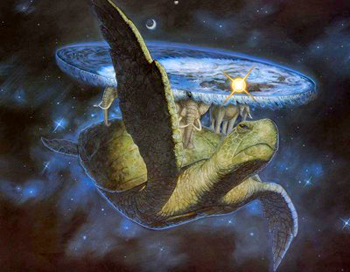
My experience with Discworld began ages ago when I was a sophomore in college. My friend Brendan, who shares a great many interests to me as I do, one day passed a book onto me titled Small Gods. Being someone who tries to read books loaned to me in a timely manner, and finding myself with a little free time between classes I started reading it. And kept reading it, finding it incredibly compelling and incredibly difficult to put down. I am by my own admission, a fairly fast reader, but it has often been very rare for me to find a book that just grabbed me by, for lack of a better term, the soul and made me want to keep reading. I cannot recall exactly how quickly I read Small Gods, but I'm certain it was no more than a matter of days. Brendan soon afterward loaned me Night Watch, which has become one of my favorite books, and that summer I started collecting Discworld books like crazy. By my start of junior year I had a respectable collection. Within two years I had nearly all of them. I actually made it a goal to read all the main Discworld books by the time Snuff came out late in 2011. And while there are certain books in the series I don't care for, and certain books that I cherish, overall I would say Discworld has had a positive impact on my life. If nothing else than because one person decided to be my friend because, "He's sitting over there reading a Pratchett book, he seems interesting."
Because Discworld has long since gone beyond just being a satirical take on well-worn fantasy tropes. It certainly started that way in Colour of Magic, but it grew and became so much more over the years. Pratchett has tackled topics as divisive as politics and religion, commented on economics and law, and some would argue that he has created a modern school of philosophy through the lens of fantasy. And yes, they are silly stories about a world on the backs of four elephants on the back of a turtle, but at the same time they're stories about people as well, and as I'm sure Pratchett himself would say, one of the most powerful ways to shape people is through stories. Whether it be stories about the long and distant past, stories about the here and now, or stories about life on the Disc, when stories are about people they have the ability to shape people, for better or worse, and that's an incredible power.
So what have I learned from the five or so years I've spent exploring the Disc? Essentially, people are people. We can be downright selfish and terrible, or charitable to a fault and good. Sometimes within the same day. And maybe you can't solve all the world's problems. But the important thing is to give your best and try. And while it's sad that Pratchett has passed on, he will remain with us in his dozens of books, and hopefully influence generations of people, and how they think, for the better.
- Kalpar
Tuesday, June 3, 2014
Tuesday, April 29, 2014
Kalpar Lectures: Outrageous Facts About Cincinnati
May it never be said that the Kalpar failed to rise to a challenge. Sorry if this video looks weird, I'm fiddling with some controls and things to try and improve it.
- Kalpar
Tuesday, April 8, 2014
Kalpar Lectures: The History of Cincinnati Union Terminal
Guys, hey guys! I made a video! After....almost a year...ish.
- Kalpar
- Kalpar
Thursday, November 21, 2013
Kalpar Lectures: Why Get Offended by Fiction?
Kalpar's Note: Sorry, this is another long, wordy post this week with me ranting about various things which I have opinions about. I had considered doing this as a video lecture but I'm much better at writing my ideas down and I feel like I can transmit it in a more cohesive fashion through this medium. No I haven't died or been attacked or anything, I just haven't felt up to making videos for quite a while due to a combination of laziness and Minecraft. I hope you at least enjoy this post.
Recently I had someone ask me what was the point of getting offended over fiction. The gist of their argument was that since fiction's made up then it doesn't really matter and there's no point in getting offended. I have a much longer response which I'll detail through the rest of this post, but the main point I'm going to make is that fiction does matter and we should care about the messages it sends. And obviously people do get offended by works of fiction, otherwise we wouldn't have a list of the most commonly banned books in the United States, however that offense is not always justified or with some of these books is frequently misguided. But every once in a while you get a book that truly is offensive and sends a message that has no merit whatsoever and it is our right and responsibility as readers to stand up and refuse to accept this sort of garbage as reading material.
Perhaps for as long as humans have existed, we have had fiction. There have always been stories and in some cases they actually pre-date the written word and have been passed down in the oral tradition before being committed to paper. These stories, more specifically these myths (for that's what I'm talking about), served a very important role in helping people understand and make sense of the universe around them. Questions like, "Where did we come from? Why are we here? What's life all about? How should I act towards other people? What happens to me when I die?" Myths sought to explain all of these questions and give people meaning to their existence and an idea on how to operate in the larger world. From the very beginning fiction was a medium to communicate ideas to other people.
Obviously things have gotten a little more complex in the past ten thousand years, but fiction retains its power to communicate philosophies, ideologies, and even theologies to a large number of people in a familiar form. Sometimes fiction is used like a mirror, such as in Gulliver's Travels, where the author reflects all the flaws and issues in society and how they seem so terribly important to those involved, but are really quite silly if you can look at it objectively. Sometimes fiction is used to show how the world really is in contrast to how it really is, like in All Quiet on the Western Front that dispelled the legend of glorious and honorable combat and revealed war for the nightmarish hell that it really is. And sometimes fiction is a means to talk about what's wrong with society and how things can be made better, like the many tangents in Les Miserables which deal with sewers, taxation, and prison reform and how they failed a modern France. With fiction the possibilities are practically endless because you can do all of this and more and are only constrained by the limits of the imagination. Fiction has been and remains a powerful force for influencing how people think, how people act, and how people live and enables one person to share their ideas and beliefs with a very wide range of people.
However, once we get into issues such as opinions and beliefs we start getting into sticky territory. At least in the United States with this glorious freedom of speech and the press, people are allowed to express whatever opinions they wish, no matter how misguided or ill-informed they may be. This has lead to an almost sacred nature of other people's opinions and you're not allowed to challenge their opinions and explain why you think they're wrong in the public forum and be taken seriously. Granted, as the public forum exists now it's very hard to have a reasonable and rational discourse of ideas with another person and it very quickly devolves into a loud shouting match, but ideas should constantly be challenged otherwise there's no way to see if they have any merit and the important thing is to remain respectful despite your disagreement. As with any rule, though, there is of course an exception: when people are completely and utterly wrong and have an opinion that is hurtful than others. Much of America's progress as a nation has been because people have been brave enough to challenge the "opinions" of other people. For example, it was the opinion of quite a few people that African-Americans were "better off" as slaves in the United States and they just didn't have the intellectual capacity to be equal citizens in our country. It was the opinion of many people that Catholics could never be true American citizens because of their loyalty to an overseas absolute monarch: the pope. It was an opinion that women could never be rational enough to trust the vote and they'd just end up voting how their husbands told them to vote. All of these opinions were offensive and based on illegitimate facts and if they had been considered "sacred" and weren't allowed to be challenged in the public forum then we'd be faced with a country still completely dominated by rich, white, Anglo-Saxon, Protestant men. (Although now it's only mostly dominated by rich WASP men. So...some progress I guess.)
In the same way, because fiction is capable of transmitting philosophies and ideologies it is very possible for fiction to transmit beliefs and opinions that are simply wrong and need to be vigorously challenged in the forum. And sometimes the author may not even be aware of the unfortunate implications of their writings, such as stating that a strong female character's backstory is because she was raped in her past. As I explained in another lecture elsewhere, rape as a backstory diminishes the agency of a female character and is offensive because it implies that women can only become tough and strong if something extremely bad like rape happens to them. And this trope has been so strongly woven into fiction that some authors might not even be aware that there's something wrong with this message so it's our duty as readers to inform them about why it's wrong and suggest how they can avoid such pitfalls in the future.
There are times when it's a lot harder to tell if the author accidentally put a message into a novel or honestly believes the message that they're promoting through their work. If they appear to be fully behind this message, though, then it once again is our duty to counter their opinions and explain why we find them offensive and what's wrong with them because it is only by doing so that we can affect change. If an author writes a book that is about a truly abusive relationship but constantly describes it as true love, then we should point out how and why it's abusive and challenge this definition of "true love" at every turn. If a book claims that only the best and brightest deserve to prosper and all others should be left behind to suffer and die, we should challenge this assumption and point out that we're all in this together as human beings and, after all, the world needs ditch diggers in addition to geniuses. Offensive and wrong opinions deserve to be challenged and fought in the forum to help us become better as readers, as writers, and as people. If we demand better writing from our authors and vote with our wallets, we can definitely change how things are written and, although to a lesser effect nowadays, what gets published.
Now, is all fiction going to have deep messages and somehow affect how you live and look at the world? No, of course not. Sometimes a story is just a story and you want to be entertained for a while and there's nothing wrong with that. I do that myself on numerous occasions. The danger is assuming that because fiction is fun it is harmless and cannot affect the world beyond the bookshelf and the library. The simple fact of the matter is yes, books can change the world and greatly affect how people live, even fiction books. If this wasn't the case then tyrants would not have censorship and book burning. Authors have a great power in their writing and can influence thousands, if not millions of people with their words, but not every author is going to utilize this power responsibly. We as the consumers have the power of choice in what books we read, what books we recommend for other people, and what books we tell other people to avoid. By voting with our voices and wallets we can control what ideas spread and flourish, and what ideas wither and die. It is an awesome responsibility and we should use it wisely.
- Kalpar
Recently I had someone ask me what was the point of getting offended over fiction. The gist of their argument was that since fiction's made up then it doesn't really matter and there's no point in getting offended. I have a much longer response which I'll detail through the rest of this post, but the main point I'm going to make is that fiction does matter and we should care about the messages it sends. And obviously people do get offended by works of fiction, otherwise we wouldn't have a list of the most commonly banned books in the United States, however that offense is not always justified or with some of these books is frequently misguided. But every once in a while you get a book that truly is offensive and sends a message that has no merit whatsoever and it is our right and responsibility as readers to stand up and refuse to accept this sort of garbage as reading material.
Perhaps for as long as humans have existed, we have had fiction. There have always been stories and in some cases they actually pre-date the written word and have been passed down in the oral tradition before being committed to paper. These stories, more specifically these myths (for that's what I'm talking about), served a very important role in helping people understand and make sense of the universe around them. Questions like, "Where did we come from? Why are we here? What's life all about? How should I act towards other people? What happens to me when I die?" Myths sought to explain all of these questions and give people meaning to their existence and an idea on how to operate in the larger world. From the very beginning fiction was a medium to communicate ideas to other people.
Obviously things have gotten a little more complex in the past ten thousand years, but fiction retains its power to communicate philosophies, ideologies, and even theologies to a large number of people in a familiar form. Sometimes fiction is used like a mirror, such as in Gulliver's Travels, where the author reflects all the flaws and issues in society and how they seem so terribly important to those involved, but are really quite silly if you can look at it objectively. Sometimes fiction is used to show how the world really is in contrast to how it really is, like in All Quiet on the Western Front that dispelled the legend of glorious and honorable combat and revealed war for the nightmarish hell that it really is. And sometimes fiction is a means to talk about what's wrong with society and how things can be made better, like the many tangents in Les Miserables which deal with sewers, taxation, and prison reform and how they failed a modern France. With fiction the possibilities are practically endless because you can do all of this and more and are only constrained by the limits of the imagination. Fiction has been and remains a powerful force for influencing how people think, how people act, and how people live and enables one person to share their ideas and beliefs with a very wide range of people.
However, once we get into issues such as opinions and beliefs we start getting into sticky territory. At least in the United States with this glorious freedom of speech and the press, people are allowed to express whatever opinions they wish, no matter how misguided or ill-informed they may be. This has lead to an almost sacred nature of other people's opinions and you're not allowed to challenge their opinions and explain why you think they're wrong in the public forum and be taken seriously. Granted, as the public forum exists now it's very hard to have a reasonable and rational discourse of ideas with another person and it very quickly devolves into a loud shouting match, but ideas should constantly be challenged otherwise there's no way to see if they have any merit and the important thing is to remain respectful despite your disagreement. As with any rule, though, there is of course an exception: when people are completely and utterly wrong and have an opinion that is hurtful than others. Much of America's progress as a nation has been because people have been brave enough to challenge the "opinions" of other people. For example, it was the opinion of quite a few people that African-Americans were "better off" as slaves in the United States and they just didn't have the intellectual capacity to be equal citizens in our country. It was the opinion of many people that Catholics could never be true American citizens because of their loyalty to an overseas absolute monarch: the pope. It was an opinion that women could never be rational enough to trust the vote and they'd just end up voting how their husbands told them to vote. All of these opinions were offensive and based on illegitimate facts and if they had been considered "sacred" and weren't allowed to be challenged in the public forum then we'd be faced with a country still completely dominated by rich, white, Anglo-Saxon, Protestant men. (Although now it's only mostly dominated by rich WASP men. So...some progress I guess.)
In the same way, because fiction is capable of transmitting philosophies and ideologies it is very possible for fiction to transmit beliefs and opinions that are simply wrong and need to be vigorously challenged in the forum. And sometimes the author may not even be aware of the unfortunate implications of their writings, such as stating that a strong female character's backstory is because she was raped in her past. As I explained in another lecture elsewhere, rape as a backstory diminishes the agency of a female character and is offensive because it implies that women can only become tough and strong if something extremely bad like rape happens to them. And this trope has been so strongly woven into fiction that some authors might not even be aware that there's something wrong with this message so it's our duty as readers to inform them about why it's wrong and suggest how they can avoid such pitfalls in the future.
There are times when it's a lot harder to tell if the author accidentally put a message into a novel or honestly believes the message that they're promoting through their work. If they appear to be fully behind this message, though, then it once again is our duty to counter their opinions and explain why we find them offensive and what's wrong with them because it is only by doing so that we can affect change. If an author writes a book that is about a truly abusive relationship but constantly describes it as true love, then we should point out how and why it's abusive and challenge this definition of "true love" at every turn. If a book claims that only the best and brightest deserve to prosper and all others should be left behind to suffer and die, we should challenge this assumption and point out that we're all in this together as human beings and, after all, the world needs ditch diggers in addition to geniuses. Offensive and wrong opinions deserve to be challenged and fought in the forum to help us become better as readers, as writers, and as people. If we demand better writing from our authors and vote with our wallets, we can definitely change how things are written and, although to a lesser effect nowadays, what gets published.
Now, is all fiction going to have deep messages and somehow affect how you live and look at the world? No, of course not. Sometimes a story is just a story and you want to be entertained for a while and there's nothing wrong with that. I do that myself on numerous occasions. The danger is assuming that because fiction is fun it is harmless and cannot affect the world beyond the bookshelf and the library. The simple fact of the matter is yes, books can change the world and greatly affect how people live, even fiction books. If this wasn't the case then tyrants would not have censorship and book burning. Authors have a great power in their writing and can influence thousands, if not millions of people with their words, but not every author is going to utilize this power responsibly. We as the consumers have the power of choice in what books we read, what books we recommend for other people, and what books we tell other people to avoid. By voting with our voices and wallets we can control what ideas spread and flourish, and what ideas wither and die. It is an awesome responsibility and we should use it wisely.
- Kalpar
Tuesday, September 24, 2013
Kalpar Lecture: The American Narrative
Hey look! A new video! And Kalpar talks about history and what he likes to call the American Narrative. We probably just made that name up.
-Kalpar
-Kalpar
Tuesday, June 18, 2013
Tuesday, February 26, 2013
Kalpar Lectures: The Korean War and North Koreans with Nukes
This week Kalpar gives a (short for him) lecture on the Korean War and the fact that North Korea, the world's chief exporter of crazy since 1953, has nuclear weapons. Hide under your desks so the radiation won't get you.
- Kalpar
- Kalpar
Tuesday, February 12, 2013
Kalpar Lectures: Kalpar vs. The Nice Guys Trope
To honor the holiday of Valentine's Day Kalpar has decided to flame-bait half the internet by taking on the Nice Guys trope which can be found in numerous movies and TV series. Sorry for the cuts, we're trying a new way of editing things. Feel free to leave feedback!
- Kalpar
- Kalpar
Tuesday, January 15, 2013
Kalpar Lectures: The Trillion Dollar Coin (and why it's a bad idea.)
Happy Tuesday! Today we have a video lecture for you on the whole Trillion Dollar Coin debate and why, as far as The Kalpar is concerned, it is a terrible idea for everyone. Be sure to come by on Thursday for Kalpar's review of Rust: Secrets of the Cell.
- Kalpar
- Kalpar
Tuesday, January 8, 2013
Kalpar Lectures: The War of 1812 in (about) 25 Minutes
Hello everyone, I apologize for the relative length of this video. I just get started talking about something and there's no one there during shooting to get me to shut up. Now, this is by no means a comprehensive history of the War of 1812 and is really just a clumsy attempt at describing it in broad strokes. That being said, if this is something that interests you then by all means feel free to go read more about it. Hopefully I helped people learn something today and made the world a better place. Maybe.
- Kalpar
- Kalpar
Monday, December 24, 2012
Kalpar Lecture: The Bolo Series
Twas the night before Christmas, and all through the house, not a Bolo was stirring, not even the Maus.
Well, here's a special early Christmas present to all my readers, I hope you enjoy the video as much as I had fun making it.
- Kalpar
Well, here's a special early Christmas present to all my readers, I hope you enjoy the video as much as I had fun making it.
- Kalpar
Tuesday, November 27, 2012
Kalpar Lectures: The History of Christmas
Well, the Christmas madness has finally taken hold here in the United States, despite our best efforts to ignore it until the last possible moment. To help everyone get into the Christmas spirit Kalpar gives a lecture about how we got to where we are today and who exactly to blame for it. Be sure to check out my review of Les Miserables on Thursday!
- Kalpar
Wednesday, November 7, 2012
Kalpar Lectures: Disney buying Star Wars
While everyone else was busy with the hubbub of the presidential election, Kalpar was busy talking about Disney's purchase of Lucasfilm Limited and its associated properties. (Don't worry, Kalpar submitted his ballot too, but you got to focus on the important stuff!) Thanks for watching and be sure to check out Kalpar and Carvan's debate over V for Vendetta.
Thursday, November 1, 2012
Kalpar Lectures: Why Kalpar Dislikes V for Vendetta
Now, before I get into my issues with the movie, I want to make it clear that most of my problems are on a philosophical, and therefore subjective footing. If I were asked to say if V for Vendetta was objectively bad, I would say no. The A-list cast of Natalie Portman, Hugo Weaving, and Stephen Fry did an excellent job, the movie's very well made, and there are even some parts which I enjoy. (Basically any part of the movie that involves Stephen Fry I like.) Furthermore, I am specifically addressing the movie in my post today, not the original comic book by Alan Moore. I am aware that the movie varies in some aspects from the comic, but as I have not read the comic yet I am unable to pass judgement on that work. All of my complaints are specifically focused on the movie and its more subjective content.
The first issue that I want to talk about, and I will admit this is my weakest argument, is that V for Vendetta uses bad history. My long-time readers should be utterly unsurprised that I simply cannot leave the history alone and must drag it into the argument, but I feel that this is a critical problem with the film. At the beginning of the movie we see Guy Fawkes and the attempted Gunpowder Plot in 1605 where Guy Fawkes and a number of other conspirators attempted to blow up King James I and Parliament. The problem with this, though, is that Guy Fawkes is depicted as a freedom fighter attempting to topple an unjust regime, much like the main character V does later in the film. However, this could not be further from the truth because Guy Fawkes was quite simply a religious terrorist. To provide more context, Guy Fawkes and his co-conspirators were English Catholics who had hoped that James I (originally the Scottish monarch James VI who ascended the throne after Elizabeth I died without an heir) would end Protestant rule in England and bring the Catholic Church back. James I, however, found that he quite liked being in charge of his own religion and decided to stick with this Protestantism idea. (All right, that might be a gross exaggeration since James was raised Protestant, but you get the idea.) The goal of the Gunpowder Plot was to return England to Catholic rule, rather than to topple an unjust regime. Now, I'm sure Carvan will point out that the English had extremely strict laws against Catholics at the time, but considering that the Gunpowder Plot was the third Catholic assassination attempt against James in three years, can you really blame him for not trusting papists?
My point here ultimately is that in the movie Guy Fawkes is depicted as a freedom fighter when in history he was really a religious terrorist interested in reestablishing the control of the highly conservative Catholic Church. The movie simply could not be any further off the mark with its history and we really should not accept this from our films. I am acutely aware that there will be many, many historical inaccuracies in films but as viewers we really should not tolerate such blatant manipulation of facts. When your entire philosophical premise is based upon an outright lie, as it is in V for Vendetta, it calls the legitimacy of your whole argument into question. And, just as Guy Fawkes was no freedom fighter, neither is V, despite what the movie tries to tell us.
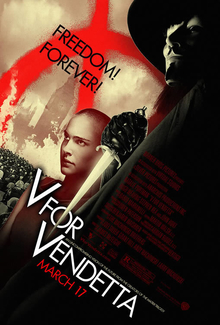
Throughout the film V is painted as a freedom fighter intent on toppling the unjust and tyrannical Norsefire government in Britain. I mean, look at the poster at the top of the page: "Freedom! Forever!" And really, I think we're supposed to side with V in the movie because the Norsefire government is so utterly horrific in its abuses of human rights that they can't be anything but villains. But, as far as I can tell from V's actions in the movie, his primary goal is not liberating Britain from the yoke of Norsefire rule. V instead is motivated primarily by revenge in the film and for much of the movie we watch him specifically hunt down and assassinate people who were in charge of the concentration camp where he was interred. Instead of attacking strategic resources necessary for the Norsefire government to function and maintain its despotic grip, V chooses to spend a year-long campaign attacking individuals who personally harmed him in the past. This is further reinforced by the fact that V's favorite work of fiction is The Count of Monte Cristo, a work in which revenge is a significant overarching theme and remains a motivation for the main character of Edmond Dantes. However, V tragically misses one point of The Count of Monte Cristo, which is that revenge ultimately isn't worth it. Edmond Dantes is only saved at the last minute from becoming utterly consumed in his pursuit of revenge, but in the film V is both figuratively and literally consumed in his pursuit of revenge when his body is engulfed in the explosion which destroys Parliament. Unlike Dantes, V does not learn that the pursuit of revenge is a futile and unfulfilling gesture which makes you just as bad as, if not worse than, the people who harmed you in the first place. Especially considering V tortures the character of Evie in the same manner that the Norsefire government tortures "undesirables" it's hard to say if V is really any better.
My final point is that even as a freedom fighter, V isn't really a character I can get behind. V doesn't provide any sort of ideas or structure of how things should be run after he topples the Norsefire government. Which is more or less the point because V is an anarchist and doesn't believe in any form of government control so once Norsefire is gone he's accomplished his goal. Really, this is where my inherently Lawful sensibilities come to the fore in this argument and it becomes more a matter of personal preference than anything else. On many levels modern society needs a government and even the most hardened libertarian will admit that we need a government to maintain infrastructure and protect personal property. If you got up, ate breakfast, and brushed your teeth today, the government has already affected you by making sure your cereal wasn't 90% rat shit and your toothpaste didn't contain radium. To take a modern society and completely burn down the established order would be to condemn thousands, if not millions, to death from starvation, disease, and internal strife. Does the Norsefire government need to be reformed? Yes, very much so, but it still contains good people like Inspector Finch. To burn the entire system down is both spiteful and childish. It would have been better for V to motivate the people to actively resist and push for reform from the Norsefire government rather than to violently destroy it.
Overall V for Vendetta just fails so completely with its philosophical arguments, at least as far as I am concerned, that I cannot enjoy it as a movie. Despite the excellent job of the cast, crew, and editors I find myself frustrated by its message and assumption that anarchy is preferably to any government at all. People should not have to fear their governments, but they should be able to rely upon their governments to provide order and structure for them to thrive. I know if I had to fighting off slavers every morning before breakfast, I'd never get any blogging done, and then where would we be? Not reading Kalpar's Arsenal, that's for sure. While fascism, intolerance, and totalitarianism should be resisted wherever they rear their ugly heads, there are better ways of doing it than burning the world around you. V for Vendetta offers no such alternative methods within its content and offers a bleak future for post-Norsefire Britain.
- Kalpar
Sunday, October 28, 2012
Kalpar Lectures: Kalpar Talks About Firefly
Little special update for you before October ends. Kalpar gushes for eleven minutes about Firefly by Joss Whedon.
Thursday, September 13, 2012
Kalpar Lectures: Kalpar Tackles the Strong Independent Woman (TM)
Hello, everyone, I have some good news and some bad news for you today. The bad news is that the comic I was going to review, Rust: Secrets of the Cell, has had its publication date pushed back a month. Don't worry, dear and gentle readers, for I shall be reviewing the next issue of Rust in October, Emperor provided that the publication date is not delayed again.
Instead, for your immediate gratification today, I have decided to talk to you directly about an issue that's been bugging me for a couple of months. I hope you enjoy my video presentation, even if it's me just talking for fourteen minutes. Please let me know what you think and if you'd like to see more videos from myself in the future.
Instead, for your immediate gratification today, I have decided to talk to you directly about an issue that's been bugging me for a couple of months. I hope you enjoy my video presentation, even if it's me just talking for fourteen minutes. Please let me know what you think and if you'd like to see more videos from myself in the future.
Subscribe to:
Posts (Atom)