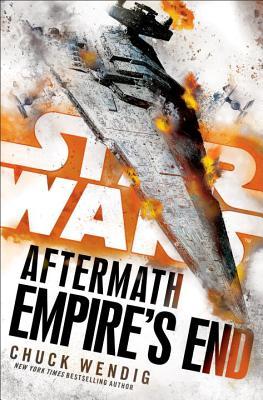
Today I'm finishing the Aftermath trilogy with the book Empire's End and in coming to the end I'm still left with more questions than answers. I get the feeling that I went into this series with completely wrong expectations because I was hoping to at least get some more explanation on issues, the biggest one being WHERE THE HECK DID SNOKE COME FROM?! This question has been vexing me and my friends for some time, moreso after Last Jedi came out, and even the expanded universe has been incapable of answering that question. This book does finally, partway answer the question of where the First Order came from but I feel like the books weren't worth the ultimate effort.
As I mentioned in my review of Life Debt, a lot of this focus is also on the relationships of characters such as Norra and Temmin Wexley, Jas Emari, and Sinjir Rath Velus. However it's difficult for me to get invested in the series for a couple of reasons. The first is the lack of emotional stakes in the series, which is something I mentioned in my review of Aftermath. There are multiple points where Norra almost dies and Temmin's robot Mr. Bones actually gets destroyed but at the end of the book Mr. Bones is put back together. The second book was similar in that respect. Our characters were put in danger, but nobody died. Jom Barell lost an eye, Brentin Wexley was a programmed sleeper agent, and Mon Mothma got seriously wounded but everyone was still alive afterwards. It didn't feel like there were serious consequences.
This book keeps doing the same thing with putting Sinjir's boyfriend, Conder Kyl in danger (but no actual harm), and even going so far as to bomb Mon Mothma's office (but without Mon Mothma in it). The book does finally pull the trigger, in a very literal sense, and kills off both Jom Barell and Bretin Wexley (oh and Mr. Bones dies too), but neither had as much of an emotional punch for me. In fact, it seemed strange to me in the end of the book that Temmin seemed more upset that Mr. Bones was destroyed than the fact that his dad died. Norra also seemed to move on pretty quickly to Wedge after Bretin's death as well. I guess it could be implied that they had already moved on emotionally since Bretin had disappeared years ago but I felt it would have been more emotionally impactful for Norra and Temmin to get Bretin back from the dead just to lose him again. As for Jom, I felt like the books simply weren't long enough for him to be developed into a character for me to be invested in.
At the end of the day, I feel like these books took a little too much time for too little payoff. I appreciate the attempt to introduce new characters, but for whatever reason I found it difficult for me to get emotionally invested in them. While we get some explanation of where the First Order came from, with the remnants of the old Empire fleeing beyond the edges of the known galaxy. It does beg the question of what happened to Admiral Sloane afterwards and again, HOW THE HECK DID SNOKE END UP IN CHARGE? But otherwise there doesn't seem to be a lot recommending this, or other books in the new canon.
- Kalpar
Showing posts with label Chuck Wendig. Show all posts
Tuesday, June 26, 2018
Thursday, June 14, 2018
Life Debt, by Chuck Wendig
Today I'm looking at the second book in the Aftermath trilogy, Life Debt. As Star Wars fans can probably guess from the title, this book focuses, at least in part, on the liberation of the wookie homeworld Kashyyyk, and includes some awesome scenes of wookies ripping stormtroopers apart.And of course I'm all for that, but the liberation of Kashyyyk makes up only a small part of the book, most of it focusing instead on the relationships of not only Han and Leia, but the relationships of the members of Norra Wexley's team as well. I think the hardest part is that I haven't really connected emotionally with the members of Norra's team so it's hard for me to get invested in their personal relationships.
The things I care the most about these books, obviously, is how much it explains the political situation in the galaxy when we get to The Force Awakens. Unfortunately this book just leaves me with as many, if not more questions, than I had previously. The biggest complaint people have had recently, especially after The Last Jedi, is we know basically nothing about Chairman Snoke. We don't know who he is, where he came from, how he ended up in charge, or why we should care about him. However we're into the second book and the only people in charge of the remnant Empire at this point are Grand Admiral Rae Sloane and Fleet Admiral Gallius Rax. We have gotten some hints that Admiral Rax had deep connections with Emperor Palpatine and may be a Dark Side cultist of some sort, but Snoke hasn't made any appearance. Obviously this is still some thirty years until the events of Last Jedi but I feel like this would have been a good explanation for how the First Order came about from the ashes of the old Empire.
Another thing that I didn't care for was the prison ship Ashmead's Lock, which was apparently a centuries-old prison ship that crashed on Kashyyyk and was retrofitted by the Empire to hold rebel prisoners in stasis. There are a couple of problems with this ship. First, and perhaps dumbest thing about the ship, is that it uses the prisoners as a power supply, just like in The Matrix. It was dumb when The Matrix did it, and it's dumb when it's done here because using humans and other living beings as batteries is impossible. Humans and other biological beings generate heat, true, but only by burning calories from food they consume. To get energy out of a human being you have to put just as much, if not more energy in, making any energy profit impossible.
Secondly, Ashmead's Lock is part of a program to brainwash rebel prisoners and make them sleeper agents for the Empire, to activate them to wreak havoc with the rebellion. I will admit this would be a spoiler for the book except that it's telegraphed so obviously that it's hardly a surprise when it does happen. Admiral Rax orchestrates the liberation of Ashmead's Lock so it's clear that it's part of some nefarious plan he's got cooking. Then we see the liberated prisoners acting strangely after they came back and having secret meetings, so when they try to assassinate Mon Mothma and the rest of the New Republic leadership it doesn't come as a surprise at all. It also doesn't make much sense for the Empire to be sitting on these sleeper agents for years and years and never deploying them when they could conceivably use the agents to deal the rebellion a blow after a setback such as Yavin. Why keep them until the Empire's all but lost the war for the galaxy?
Overall the book's okay. By far the largest parts of the book focus on the personal relationships of the characters, but because I haven't gotten deeply invested in people such as Jas Emari and Sinjir Velus, so those parts of the book just don't hold as much appeal for me as other sections. If people get invested in those characters those parts of the book will obviously have greater appeal, but for whatever reason they just don't work for me. Otherwise these books don't answer nearly as many questions as I'd hoped.
- Kalpar
The things I care the most about these books, obviously, is how much it explains the political situation in the galaxy when we get to The Force Awakens. Unfortunately this book just leaves me with as many, if not more questions, than I had previously. The biggest complaint people have had recently, especially after The Last Jedi, is we know basically nothing about Chairman Snoke. We don't know who he is, where he came from, how he ended up in charge, or why we should care about him. However we're into the second book and the only people in charge of the remnant Empire at this point are Grand Admiral Rae Sloane and Fleet Admiral Gallius Rax. We have gotten some hints that Admiral Rax had deep connections with Emperor Palpatine and may be a Dark Side cultist of some sort, but Snoke hasn't made any appearance. Obviously this is still some thirty years until the events of Last Jedi but I feel like this would have been a good explanation for how the First Order came about from the ashes of the old Empire.
Another thing that I didn't care for was the prison ship Ashmead's Lock, which was apparently a centuries-old prison ship that crashed on Kashyyyk and was retrofitted by the Empire to hold rebel prisoners in stasis. There are a couple of problems with this ship. First, and perhaps dumbest thing about the ship, is that it uses the prisoners as a power supply, just like in The Matrix. It was dumb when The Matrix did it, and it's dumb when it's done here because using humans and other living beings as batteries is impossible. Humans and other biological beings generate heat, true, but only by burning calories from food they consume. To get energy out of a human being you have to put just as much, if not more energy in, making any energy profit impossible.
Secondly, Ashmead's Lock is part of a program to brainwash rebel prisoners and make them sleeper agents for the Empire, to activate them to wreak havoc with the rebellion. I will admit this would be a spoiler for the book except that it's telegraphed so obviously that it's hardly a surprise when it does happen. Admiral Rax orchestrates the liberation of Ashmead's Lock so it's clear that it's part of some nefarious plan he's got cooking. Then we see the liberated prisoners acting strangely after they came back and having secret meetings, so when they try to assassinate Mon Mothma and the rest of the New Republic leadership it doesn't come as a surprise at all. It also doesn't make much sense for the Empire to be sitting on these sleeper agents for years and years and never deploying them when they could conceivably use the agents to deal the rebellion a blow after a setback such as Yavin. Why keep them until the Empire's all but lost the war for the galaxy?
Overall the book's okay. By far the largest parts of the book focus on the personal relationships of the characters, but because I haven't gotten deeply invested in people such as Jas Emari and Sinjir Velus, so those parts of the book just don't hold as much appeal for me as other sections. If people get invested in those characters those parts of the book will obviously have greater appeal, but for whatever reason they just don't work for me. Otherwise these books don't answer nearly as many questions as I'd hoped.
- Kalpar
Tuesday, May 15, 2018
Aftermath, by Chuck Wendig
Today I'm looking at the first of three books in the Aftermath trilogy which helps to fill in the gaps between Return of the Jedi and The Force Awakens. I'm hoping that these books will answer some of my questions about the political situation in the galaxy, although I'm not overly optimistic about the results. To start with as I've said before about Star Wars as a franchise, I worry about the multimedia nature the franchise is starting to take. I've been getting the feeling that to truly understand everything going on in the Star Wars universe, you have to go track down all the comics, books, video games, movies, and whatever other versions of media they decide to utilize. On the one hand, the old Expanded Universe was very much like this and so for people who really like Star Wars it gives them a lot of stuff to explore and enjoy.
On the other hand, to paraphrase Mr. Plinkett, we shouldn't have to read a book to understand a movie. The original movies were self-contained and while not everything was explained in agonizing detail, we didn't have to go check supplemental sources to understand the plotline. We weren't told how the Emperor became Emperor, but for the purposes of the story that wasn't terribly important. We knew he was the Emperor and was in charge, how that came to be was largely secondary. However in the case of Force Awakens, we don't really get an explanation as to who the First Order is or where they came from. Or for that matter what the situation with the Resistance is, because they're apparently not the military of the Republic but they're Republic aligned. So why is the Republic being defended by a paramilitary force? These are questions which probably should be answered within the movie, and we don't even need a super long explanation, a few lines of exposition would be necessary.
As for the plot of this book, Wedge Antilles is doing some post-Endor scouting operations for the New Republic and finds not one but three Star Destroyers in the backwater system of Akiva. Wedge concludes that something big is going down but before he can get the word back to the Republic he finds himself captured by the Empire. He manages to get a message out to Norra Wexley, another Republic operative, who puts together a team on planet to disrupt the Imperial meeting and strike another blow for the New Republic.
Plot-wise this book is okay. Mostly I got the impression that the Empire has bases and resources out in the Outer Rim and beyond the edges of known space where they'll regroup and possibly form the New Order. Otherwise this feels a lot like other Star Wars books which I've read before and I don't know if it brings all that much new to the table. Republic wins and the Empire gets driven further back. I think what I liked most is the vignettes of other things happening around the galaxy to show that the Civil War is not yet over and there are still battles to be won and work to be done to make the galaxy a better place.
The thing that bugs me the most about this book, though, is the character Temmin Wexley, Norra's son. Norra left Temmin behind three years ago to join the Rebel Alliance and has been involved in battles like Endor. She returns to find her son Temmin has gotten involved in black market dealings and basically turned into a typical shitty teenager. I actually found myself really disliking Temmin throughout the book. He isn't interested in the galactic struggle, just wants to keep his head down and make money. By the end of the book he's gotten fully on board with the Republic cause, but I feel like he hasn't learned as a character at all. What annoys me the most is that Temmin doesn't experience any loss during the book. At multiple points his mom Norra almost dies because of her fights against the Empire and towards the end of the book Temmin's robot Mr. Bones (a psychotic patched together battle droid) is shot by the Imperials. But at the end of the book Temmin has his mom and he has Mr. Bones. I felt like this really undermined the book because Temmin didn't experience loss forcing him to grow as a character. Everything turned out okay for him at the end and he goes on further adventures.
I'll have to see where the rest of the books in this series go because so far it's been kind of a disappointment. It's certainly not the most interesting Star Wars book I've read or feeling all that vital yet.
- Kalpar
On the other hand, to paraphrase Mr. Plinkett, we shouldn't have to read a book to understand a movie. The original movies were self-contained and while not everything was explained in agonizing detail, we didn't have to go check supplemental sources to understand the plotline. We weren't told how the Emperor became Emperor, but for the purposes of the story that wasn't terribly important. We knew he was the Emperor and was in charge, how that came to be was largely secondary. However in the case of Force Awakens, we don't really get an explanation as to who the First Order is or where they came from. Or for that matter what the situation with the Resistance is, because they're apparently not the military of the Republic but they're Republic aligned. So why is the Republic being defended by a paramilitary force? These are questions which probably should be answered within the movie, and we don't even need a super long explanation, a few lines of exposition would be necessary.
As for the plot of this book, Wedge Antilles is doing some post-Endor scouting operations for the New Republic and finds not one but three Star Destroyers in the backwater system of Akiva. Wedge concludes that something big is going down but before he can get the word back to the Republic he finds himself captured by the Empire. He manages to get a message out to Norra Wexley, another Republic operative, who puts together a team on planet to disrupt the Imperial meeting and strike another blow for the New Republic.
Plot-wise this book is okay. Mostly I got the impression that the Empire has bases and resources out in the Outer Rim and beyond the edges of known space where they'll regroup and possibly form the New Order. Otherwise this feels a lot like other Star Wars books which I've read before and I don't know if it brings all that much new to the table. Republic wins and the Empire gets driven further back. I think what I liked most is the vignettes of other things happening around the galaxy to show that the Civil War is not yet over and there are still battles to be won and work to be done to make the galaxy a better place.
The thing that bugs me the most about this book, though, is the character Temmin Wexley, Norra's son. Norra left Temmin behind three years ago to join the Rebel Alliance and has been involved in battles like Endor. She returns to find her son Temmin has gotten involved in black market dealings and basically turned into a typical shitty teenager. I actually found myself really disliking Temmin throughout the book. He isn't interested in the galactic struggle, just wants to keep his head down and make money. By the end of the book he's gotten fully on board with the Republic cause, but I feel like he hasn't learned as a character at all. What annoys me the most is that Temmin doesn't experience any loss during the book. At multiple points his mom Norra almost dies because of her fights against the Empire and towards the end of the book Temmin's robot Mr. Bones (a psychotic patched together battle droid) is shot by the Imperials. But at the end of the book Temmin has his mom and he has Mr. Bones. I felt like this really undermined the book because Temmin didn't experience loss forcing him to grow as a character. Everything turned out okay for him at the end and he goes on further adventures.
I'll have to see where the rest of the books in this series go because so far it's been kind of a disappointment. It's certainly not the most interesting Star Wars book I've read or feeling all that vital yet.
- Kalpar
Subscribe to:
Posts (Atom)


