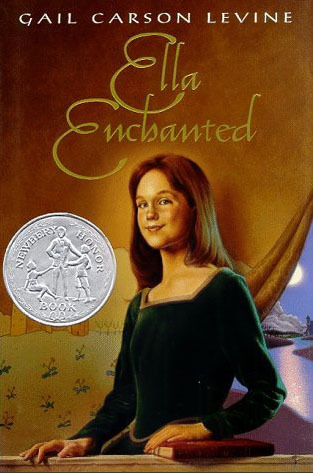
Today I'm looking at a book which I actually read years and years ago, Ella Enchanted. Some of you might even remember a movie adaptation from ages and ages ago which received mixed reviews. Now I haven't actually seen the movie but I remember the book itself being pretty interesting. (Although I remember at the time not knowing it was a re-telling of Cinderella and being unreasonably angry when I finally put two and two together.) But going back and listening to it again I have to conclusively say that this is a really good book and I highly recommend it.
In this re-telling of Cinderella, our heroine Ella is cursed by the fairy Lucinda at birth with the ''gift'' of total obedience. Anything which somebody orders Ella to do, she is magically compelled to obey. With concentration Ella can resist momentarily, and anything phrased as a request she can choose to ignore, but ultimately she finds herself unable to resist a direct command. Although annoying if she's told to do something simple like get almonds from the pantry, if someone tells her to do something dangerous like walk off a cliff Ella would actually have to do it.
As a re-telling of Cinderella I really appreciate the work that Levine does in developing the characters beyond the basic archetypes in the original story. There isn't as much development in the book as I'd like with some of the characters, such as Ella's father Sir Peter, but it's an improvement I appreciate. Levine does a very good job of making Ella's step-sisters an odious and greedy pair, and her father a somewhat unethical and rather avaricious merchant. Even if the book is written for kids, there are a lot of elements of characterization that I think adults will appreciate as well.
There are also a lot of really emotional moments in the book, which I think is another example of Levine's writing ability. It's very easy to get mad or frustrated or even enraged at the unfairness of Ella's circumstances in the book. Reading this again I found myself very emotionally invested in Ella's story, even though I knew how it would end. So I think Levine does a very good job of sucking you into the story and making you unable to wait to find out what happens next.
There are some downsides. It's not a terribly long book so the characters of the story don't grow much beyond two dimensions. It's certainly an improvement over the barest suggestion or non-existence of characters in the original story, but I wouldn't say it's complete either. And I would definitely say that the ending of the book feels a little rushed compared to the amount of groundwork Levine puts in to getting to the finale.
Overall I think this is a really good book that families can enjoy. While Confessions of an Ugly Stepsister put the story into a strictly historical context with no magic at all, Ella Enchanted keeps the magic and remains accessible on what I feel to be a wider level. I think if you enjoy fairy tales like I do it's definitely worth a read.
- Kalpar
Showing posts with label Cinderella. Show all posts
Tuesday, July 11, 2017
Tuesday, December 13, 2016
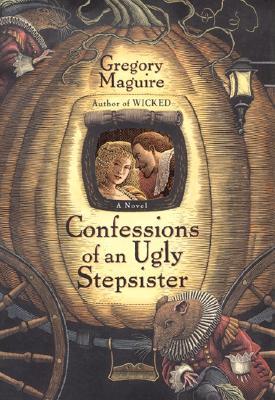
Confessions of an Ugly Stepsister, by Gregory Maguire
This week I'm taking a look at a book I'm actually calling more historical fiction than fantasy, Confessions of an Ugly Stepsister. Much like how Maguire's more famous work, Wicked is a retelling of The Wizard of Oz from the perspective of the villain, Confessions of an Ugly Stepsister is a retelling of the classic story of Cinderella from the perspective of the stepsisters who in many adaptations have very little characterization and are just antagonists to Cinderella. Maguire also takes an interesting approach by making the story completely mundane by excising all of the magic, which makes this book feel a lot more like a historical fiction novel than a fantasy novel, even if it's inspired by a fairy tale.
The story is framed by the reminisces of Ruth, one of the two stepsisters who has discovered that children have begun telling the story of Cinderella, albeit in a far more fanciful and edited form than the family scandal that Ruth remembers. The majority of the story is told from the perspective of Iris, the other stepsister who is described as fairly plain but very intelligent and talented at art, while Ruth struggles with an intellectual disability. The book is set in the early seventeenth century with Ruth and Iris forced to flee England with their mother to Holland after their father was killed by a mob. They first spend time working for a master painter, who with his apprentice Capsar remain good friends with Iris and Ruth, and later Iris is recruited to be a friend for Clara, the only child of a prosperous tulip merchant family who is sheltered in the extreme from the world by her mother. As for the rest of the story, well you can probably guess. Maguire stays faithful to the structure of the story, while putting his own twist on it and keeping the story well grounded in the mundane world.
I think ultimately the most interesting things were the decisions Maguire made to make the story different from the original that we all know by heart. There's some debate as to how wicked Ruth and Iris's mother is, although in my opinion she seems kind of a bad person rather than just morally ambiguous. Maguire does emphasize how physically ugly Ruth and Iris are, which I have to admit gets really repetitive after a while and it made me say, ''No wonder the two of them have such low self-esteem!'' However, they both come across as decent people who are just trying to do their best to survive in the world. Which is an almost total inversion of the ''attractive in body but ugly in spirit'' interpretation which has become common in many modern portrayals.
What's also interesting is the approach to Clara. While in practically all versions Cinderella is portrayed as a gentle and kind-hearted girl, in the book she's portrayed as really a spoiled brat. She's described as incredibly beautiful and since her family is wealthy she's had the luxury of never having to help her family or work to survive, opposed to Ruth and Iris. In addition, thanks to her mother she's incredibly coddled to the point of not being allowed to leave the house, which has definitely stunted her emotional development despite her being well into her teens. Although Clara has her good aspects, she comes across as an incredibly frustrating character as well. Overall Maguire does a pretty good job of showing people as not all good or all bad, even if he inverts the major characters the most.
The setting of early seventeenth century Holland is also interesting and the tulip mania actually plays a slight role in the story which makes it much more interesting. I actually spent some time wondering if there had been a made-for-tv movie adaptation that I only half-remembered until I could finally get to a computer and look it up. (Short answer, yes, there was a tv movie and I'm not crazy, at least not for that reason.) It's very distinct from any of the other interpretations of Cinderella that have been produced through the years and gives the book a distinct flavor which I appreciated.
The biggest weakness for this book is I think it kind of dragged at various points. We have the disadvantage in this story of knowing how the story ends so a lot of the suspense is either gone or tied up in ''how do we get from this point that's unfamiliar to the familiar point?'' And once we start venturing into familiar territory I just felt like we were just killing time until the climax, which made the story feel much longer than it probably was.
Overall I think this book is interesting. I honestly was a little disappointed to find it was strongly mundane and there were almost no fantasy elements whatsoever, but it's an interesting approach. Portraying the story of Cinderella as an old family scandal that became town gossip and then faded into memory as myth is an interesting and somewhat plausible origin story. Overall, I liked the book, even if I felt it dragged in the middle. Although it doesn't have magic if you like fairy tales this might be worth your effort.
- Kalpar
The story is framed by the reminisces of Ruth, one of the two stepsisters who has discovered that children have begun telling the story of Cinderella, albeit in a far more fanciful and edited form than the family scandal that Ruth remembers. The majority of the story is told from the perspective of Iris, the other stepsister who is described as fairly plain but very intelligent and talented at art, while Ruth struggles with an intellectual disability. The book is set in the early seventeenth century with Ruth and Iris forced to flee England with their mother to Holland after their father was killed by a mob. They first spend time working for a master painter, who with his apprentice Capsar remain good friends with Iris and Ruth, and later Iris is recruited to be a friend for Clara, the only child of a prosperous tulip merchant family who is sheltered in the extreme from the world by her mother. As for the rest of the story, well you can probably guess. Maguire stays faithful to the structure of the story, while putting his own twist on it and keeping the story well grounded in the mundane world.
I think ultimately the most interesting things were the decisions Maguire made to make the story different from the original that we all know by heart. There's some debate as to how wicked Ruth and Iris's mother is, although in my opinion she seems kind of a bad person rather than just morally ambiguous. Maguire does emphasize how physically ugly Ruth and Iris are, which I have to admit gets really repetitive after a while and it made me say, ''No wonder the two of them have such low self-esteem!'' However, they both come across as decent people who are just trying to do their best to survive in the world. Which is an almost total inversion of the ''attractive in body but ugly in spirit'' interpretation which has become common in many modern portrayals.
What's also interesting is the approach to Clara. While in practically all versions Cinderella is portrayed as a gentle and kind-hearted girl, in the book she's portrayed as really a spoiled brat. She's described as incredibly beautiful and since her family is wealthy she's had the luxury of never having to help her family or work to survive, opposed to Ruth and Iris. In addition, thanks to her mother she's incredibly coddled to the point of not being allowed to leave the house, which has definitely stunted her emotional development despite her being well into her teens. Although Clara has her good aspects, she comes across as an incredibly frustrating character as well. Overall Maguire does a pretty good job of showing people as not all good or all bad, even if he inverts the major characters the most.
The setting of early seventeenth century Holland is also interesting and the tulip mania actually plays a slight role in the story which makes it much more interesting. I actually spent some time wondering if there had been a made-for-tv movie adaptation that I only half-remembered until I could finally get to a computer and look it up. (Short answer, yes, there was a tv movie and I'm not crazy, at least not for that reason.) It's very distinct from any of the other interpretations of Cinderella that have been produced through the years and gives the book a distinct flavor which I appreciated.
The biggest weakness for this book is I think it kind of dragged at various points. We have the disadvantage in this story of knowing how the story ends so a lot of the suspense is either gone or tied up in ''how do we get from this point that's unfamiliar to the familiar point?'' And once we start venturing into familiar territory I just felt like we were just killing time until the climax, which made the story feel much longer than it probably was.
Overall I think this book is interesting. I honestly was a little disappointed to find it was strongly mundane and there were almost no fantasy elements whatsoever, but it's an interesting approach. Portraying the story of Cinderella as an old family scandal that became town gossip and then faded into memory as myth is an interesting and somewhat plausible origin story. Overall, I liked the book, even if I felt it dragged in the middle. Although it doesn't have magic if you like fairy tales this might be worth your effort.
- Kalpar
Subscribe to:
Posts (Atom)