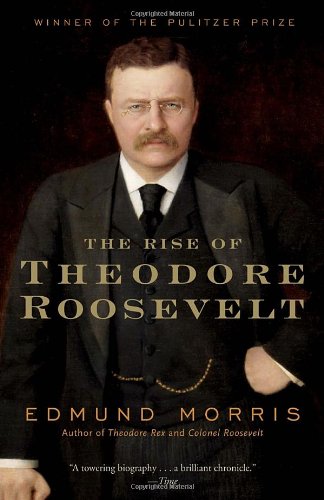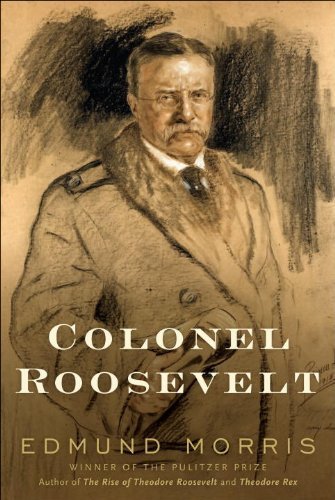
This week I'm completing Edmund Morris's three-part biography of Theodore Roosevelt with the final installment, Colonel Roosevelt. While The Rise of Theodore Roosevelt covered everything up to his presidency, and Theodore Rex focused on TR's seven years in office, Colonel Roosevelt follows TR for the remainder of his life until he passed away in January of 1919. I will admit that this was, for me, probably the hardest of the three books for me to read, simply because the material got rather dry or repetitive at several points. In addition, TR seems to go through a marked decline during his final years, exacerbated no doubt by his numerous physical ailments. As a result, the less savory aspects of TR's personality, although present in the past, seem to come to the fore in his later years and certainly tarnish some of his dignity. On top of that, TR begins to take a back seat to other figures, especially as World War I dominates the final part of Morris's narrative. It's certainly a necessary ending to a monumental life, but seems to drag.
To assist Taft's presidency, Roosevelt decided to take a retirement safari in Africa, hunting specimens for the Smithsonian, followed by a whirlwind tour of Europe. The problem, of course, was even in retirement TR was far more of a fascinating figure than Taft, who Morris portrays as a very sleepy and ineffective president. But more on that later. The simple fact of the matter is that Roosevelt made good copy wherever he went, and was almost universally hailed by people in Europe wherever he went. TR also spoke very strongly about the importance of imperialism and the duty of the white man to civilize and enlighten the savage, statements which I found most distressing. Roosevelt certainly had an imperialistic streak, his buildup of the American navy and construction of the Panama Canal are evidence of that, but they seem to come to the fore more than they ever had before during this time in Roosevelt's life. But this should unfortunately be expected by a rich, white man raised in the latter half of the nineteenth century.
Upon TR's return to the United States he almost immediately becomes displeased with Taft's policies and although maintaining a political silence for some time he comes out very strongly against Taft's administration. This couples with a growing split within the Republican party between the progressives who seek to expand TR's regulatory and reform initiatives, and the more conservative business wing which seeks to maintain the laissez faire policies of the past. TR, despite his privileged background, sides strongly with the progressives and seeks to keep the Republican party moving forward. Morris depicts Taft as more aligned with the establishment and the business interests. This in turn leads to the dramatic split of the Republican Party in 1912 with Taft's nomination on the Republican ticket, and Roosevelt's nomination on the Progressive ticket.
Morris writes very much from TR's corner and I would call some Morris's accusations against Taft as too much, at one point he goes so far as to describe the president as a hippo. I counter with the fact Taft did not desire the job of president in the first place and was really pushed into it by Roosevelt, his mentor, and his wife, Helen. This of course begs the question why Taft even sought a second term as president, rather than bowing out to his far more popular predecessor who probably could have won with the Republican nomination in 1912. Morris offers no reason beyond perhaps spite and a vague belief that TR shouldn't pursue a third term. Goodwin, by contrast, provides at least a very personal reason for Taft to run, the matter of judicial recall. Morris vaguely touches upon this issue, but does not go into depth how Taft believed in the importance of the courts and feared the potential disaster that overturning judicial decisions could cause, something Roosevelt seemed blithely unaware of. I think Morris is rather unfair to Taft, as was Roosevelt at the time, who lashed out at everyone who "stole" the election from him. It makes TR seem far more unstable and potentially even dangerous.
After his defeat in the 1912 election, TR takes a second trip to explore an unknown river in Brazil. This was the part of the book that dragged the most for me. I'm sure that Roosevelt's accounts of struggling for weeks down an unknown river, unsure that he'd ever make it back to the United States, is all very interesting. But Morris somehow manages to make it more of an ordeal than anything else and he also almost seems bored with this chapter of TR's life. It really just amounts to a lot of getting sick in the rainforest and hauling canoes past rapids so they can continue downriver. And perhaps it's hindsight considering TR almost dies because of this adventure, but considering he was in his fifties when he decided to go explore an uncharted river in Brazil it kind of seems like it was a bad idea. Perhaps it was bravado and lust for adventure on Roosevelt's part, but he was really getting to old for that sort of thing.
After World War I breaks out, Roosevelt becomes probably the loudest voice in favor of American involvement in the war, especially after word of atrocities committed by Germans in Belgium gets out. However Roosevelt's bloodthirsty streak also comes out and for many Americans who see no need to get involved in what amounts to a European family squabble he comes across as a sabre-rattler. And considering a significant portion of the American population, including in my hometown somewhere around fifty percent, claimed German heritage there were many not unsympathetic to the German cause. (Although Woodrow Wilson's neutrality more amounted to Allies-friendly neutrality.) There is a certain irony that Roosevelt seeks for himself a glorious death in battle at the head of a cavalry charge and makes sure that all four of his sons enlist in the military when America finally joins the Allied side, but his extreme grief at the death of his youngest son, Quentin, and considerably less warlike tone after the wounding of his sons Theodore, Jr. and Archie. It seems almost like TR didn't believe that the worst could happen to his sons and was unsure how to respond when it did. However even at the conclusion of hostilities in late 1918 TR still advocated strong military assets to protect American interests.
Overall, this book seems to be about a man in decline. TR is certainly past his prime by this point, his health fails with repeated bouts of malaria he originally caught from his time in Cuba. After being president of the United States it's hard to find a career after that, and TR is no individual to stay still and enjoy his golden years. Unfortunately it comes across like an old man desperately trying to grasp at his youth long gone. While there are some good parts of TR, I feel like more of the bad came out in his later years as well.
- Kalpar
Showing posts with label Edmund Morris. Show all posts
Thursday, October 29, 2015
Thursday, September 4, 2014
Theodore Rex, by Edmund Morris
This
week I've decided to continue with my reading of Morris's three-part
series chronicling the life of Theodore Roosevelt. Theodore
Rex focuses exclusively on
Theodore Roosevelt's time as president from the death of William
McKinley in September of 1901 to his succession by William Howard
Taft in March of 1909. These seven and a half years are some of the
most influential in creating the modern presidency and shifting the
balance of power in Washington away from the legislative to the
executive branch. Of course Roosevelt had plenty of challenges put
forth by a sometimes obstinate Congress, but in many ways his sheer
force of personality reshaped the presidency to the center of
national politicial affairs. I will say that this particular book is
a very good grounding in the basic history of Roosevelt's
administration, but it is in no way exhaustive.
From a mechanical
viewpoint I did have some serious concerns regarding the focus of
attention in the book. My hardcover edition clocks in at five hundred
and fifty-five pages, yet nearly two-thirds of the book is focused
exclusively on his first administration. Roosevelt's second term, one
which was certainly equally significant, is crammed into the last
third of the book and feels definitely more rushed by comparison. I
feel like there certainly was enough material to talk about his
second term at length, especially the wide range of reform
legislation including the landmark Pure Food and Drug Act, his
negotiation of the peace settlement between Japan and Russia in 1905,
and other economic, ecological, and diplomatic efforts.
Morris definitely
seems to pick specific incidents of historic note in his biography
that tell an interesting story and develop over time. Specifically
anti-trust reform, economic policies, the Panama Canal, race
relations, and diplomatic negotiations take up a significant portion
of the text, often unfolding as a sort of narrative. However many
stories abruptly disappear from the narrative, such as the Panama
Canal. Once the treaty for construction of the canal has been
approved by a freshly independent Panama, it fades entirely from the
narrative. There is a brief mention of Roosevelt's visit to the
construction site of the canal and his investigation of the poor
conditions, but nothing is said about the actions (if any) taken by
Roosevelt to improve the working conditions in Panama. Granted, the
construction of such a massive structure is a heroic tale in and of
itself, but for it to disappear so suddenly after considerable
attention had been paid to it is certainly jarring to say the least.
I will say from a
policy standpoint I have certainly become far more mixed on my
opinions of Theodore Roosevelt. Although his federal regulation and
reform of big business, as well as conservation efforts are
definitely ground-breaking during their era and setting a tone for a
whole new approach to government, his foreign and racial policy
certainly leave a lot to be desired. Roosevelt begins his presidency
as fairly progressive, inviting the great educator Booker T.
Washington to a White House dinner. However there was an incredibly
negative reaction, especially in the still racially segregated South,
which caused Roosevelt to begin an almost frantic backpedaling on his
policies. He certainly makes a few other forays to try and advance
the cause of racial equality, but they are very few and very early on
in his administration. By his second term he seems to have almost
regressed when he dismisses an entire regiment of black troops for
alleged wrongdoing, despite an incredible lack of any evidence that
they were guilty of anything. Foreign policy wise, Roosevelt is a
very typical late nineteenth, early twentieth century Imperialist,
determined to expand American influence, both military, political,
and economic across the globe but most especially in the Western
Hemisphere. His statement that it is the duty of the United States to
“spank” any misbehaving Latin American republics is discouraging
to say the least. These shortcomings are understandable, considering
the time period, but still frustrating to say the least.
I will also say
that this book has continued making me interested in reading more
about other historical figures. As the last book made me curious
about Grover Cleveland and his policies, which seemed to be fairly
reform minded, I was also made curious about William Howard Taft who
very much did not wish to become president and was forced to do so by
his wife, Helen. I'm also a little curious now about J.P. Morgan as
well, who is described in this book as a brilliant economic mind bu
also painfully shy and socially awkward. Of course this doesn't mean
that J.P. Morgan wasn't an asshole, he certainly seems to have been
one, but it definitely makes me interested in reading more.
Overall
I think this book is pretty good, although it has some definite
faults. The biggest of course is the lack of focus on Roosevelt's
second term, which included the historic Treaty of Portsmouth and
Pure Food and Drug Act, both of which were major achievements of his
presidency and could be the center of their own monographs, if they
haven't been already. As a basic grounding of Roosevelt's presidency
and his policies, it's a fairly good book for just that. The lack of
exhaustive detail is certainly disappointing and leaves me wondering
about finding other books that are far more detail-oriented. I will
hopefully be reading the final book in Morris's series, Colonel
Roosevelt, provided, of course,
that I can find a copy in the first place. Believe it or not, I can
never see to find one whenever I go to Half Price Books. Oh well,
back to good old science-fiction next week.
- Kalpar
Thursday, July 17, 2014
The Rise of Theodore Roosevelt, by Edmund Morris
This week I've decided to read part one of a three-part biography about my favorite president, Theodore Roosevelt. The Rise of Theodore Roosevelt chronicles the life of TR from birth to September 1901 when the death of William McKinley makes TR the most powerful man in America. The next book, Theodore Rex, focuses on TR's seven years in office as President, and the final book, Colonel Roosevelt, talks about TR's life after the presidency. I will definitely be reading the next two books at some future point, however even I need occasional breaks from historic research.
Overall I found this book very interesting and, for me at least, not too difficult to read. For whatever reason I have a great amount of difficulty reading biographies so finding one that I can enjoy is always a good thing. I will say that this book definitely skimps on TR's personal life after his marriage to his second wife, Edith. There is a lot of focus in his earlier years, and his courtship of Alice Lee gets quite a lot of attention. Of course, as TR has no professional life during this time period I suppose that the author has nothing else to talk about besides TR's personal life. However, once he enters the political sphere and once Alice tragically passes away in 1884, the focus becomes almost entirely on TR's professional life. Of course, don't get me wrong, I'm quite interested in TR's professional life and was happy for the focus, but TR's growing family and relationship with Edith are quietly in the background, seldo mentioned and added really only as an afterthought. I suppose that may have been a conscious choice of the author, who wanted to focus more on TR's rise to political power, but it feels like a major hole from an otherwise rather detailed biography.
I will admit that this biography has also been really helpful in expanding my knowledge and allowing me to evaluate TR more objectively. I was, of course, aware of TR's ardent support of American expansion and the growth of an American empire, but had accepted it as going hand in hand with all the other imperialist philosophies floating around the industrialized nations at the time. I was, however, rather concerned to discover he took pride in the fact that his regiment took the most casualties in battle during the Spanish-American War, seeing it as a symbol of the manliness of his men. I think almost anyone else would see it as a sign of poor leadership. I was also rather surprised, despite his public person of a reformer and numerous efforts to combat machine politics and blatant corruption and cronyism in politics, that TR was willing on several occasions to cooperate with machine politicians to get what he wanted. It seems rather hypocritical to me, but at the same time TR was a consummate politician with everything that entails.
What I'm really taken away with is the sheer boundless energy that carries TR through life. The first part certainly seems to drag, as if hampered by TR's own struggles with asthma and gastroenteritis. As he reaches adulthood and begins to overcome his childhood ailments he takes off running and never looks back, and the book seems to fly along with him. I was amazed to find out the longest TR held a job prior to becoming president was six years as a federal Civil Service Commissioner. Most of the other jobs he held, New York Assemblyman, Police Commissioner, Assistant Secretary of the Navy, Governor of New York, he held for only a couple of years before rushing off to the next stepping stone. Sometimes I find it a wonder TR got anything done at all.
Overall, I'd say this book is fairly strong in its praise of TR, although most biographies tend to be somewhat positive about their subject. However, there is enough information in there about TR's faults, such as his jingoism and racism so typical of the late nineteenth century, as well as his utter spendthrift habits, that you can make an almost objective view of TR. I am, of course, rather late to the party as this biography has been out for quite some time and has been highly regarded by many people, but it's definitely worth the read in my opinion.
- Kalpar
Overall I found this book very interesting and, for me at least, not too difficult to read. For whatever reason I have a great amount of difficulty reading biographies so finding one that I can enjoy is always a good thing. I will say that this book definitely skimps on TR's personal life after his marriage to his second wife, Edith. There is a lot of focus in his earlier years, and his courtship of Alice Lee gets quite a lot of attention. Of course, as TR has no professional life during this time period I suppose that the author has nothing else to talk about besides TR's personal life. However, once he enters the political sphere and once Alice tragically passes away in 1884, the focus becomes almost entirely on TR's professional life. Of course, don't get me wrong, I'm quite interested in TR's professional life and was happy for the focus, but TR's growing family and relationship with Edith are quietly in the background, seldo mentioned and added really only as an afterthought. I suppose that may have been a conscious choice of the author, who wanted to focus more on TR's rise to political power, but it feels like a major hole from an otherwise rather detailed biography.
I will admit that this biography has also been really helpful in expanding my knowledge and allowing me to evaluate TR more objectively. I was, of course, aware of TR's ardent support of American expansion and the growth of an American empire, but had accepted it as going hand in hand with all the other imperialist philosophies floating around the industrialized nations at the time. I was, however, rather concerned to discover he took pride in the fact that his regiment took the most casualties in battle during the Spanish-American War, seeing it as a symbol of the manliness of his men. I think almost anyone else would see it as a sign of poor leadership. I was also rather surprised, despite his public person of a reformer and numerous efforts to combat machine politics and blatant corruption and cronyism in politics, that TR was willing on several occasions to cooperate with machine politicians to get what he wanted. It seems rather hypocritical to me, but at the same time TR was a consummate politician with everything that entails.
What I'm really taken away with is the sheer boundless energy that carries TR through life. The first part certainly seems to drag, as if hampered by TR's own struggles with asthma and gastroenteritis. As he reaches adulthood and begins to overcome his childhood ailments he takes off running and never looks back, and the book seems to fly along with him. I was amazed to find out the longest TR held a job prior to becoming president was six years as a federal Civil Service Commissioner. Most of the other jobs he held, New York Assemblyman, Police Commissioner, Assistant Secretary of the Navy, Governor of New York, he held for only a couple of years before rushing off to the next stepping stone. Sometimes I find it a wonder TR got anything done at all.
Overall, I'd say this book is fairly strong in its praise of TR, although most biographies tend to be somewhat positive about their subject. However, there is enough information in there about TR's faults, such as his jingoism and racism so typical of the late nineteenth century, as well as his utter spendthrift habits, that you can make an almost objective view of TR. I am, of course, rather late to the party as this biography has been out for quite some time and has been highly regarded by many people, but it's definitely worth the read in my opinion.
- Kalpar
Subscribe to:
Posts (Atom)