Showing posts with label Foundation Series. Show all posts

Thursday, August 28, 2014

Forward the Foundation, by Isaac Asimov

At long last I have come to the end of the Foundation series, at least the books which were written by the Grand Master himself, Isaac Asimov. Forward the Foundation is another prequel book which actually fits in chronologically between Prelude to Foundation and Foundation, bringing the series full circle. This is true in at least one other respect because the book returns to a series of shorter stories rather than a full-length novel, much like the original Foundation novel. Having read the books in publication order it felt like a very appropriate ending to the series, bringing the timeline and story back to where it all began, tying the series up rather nicely from a thematic standpoint at least, even if plot wise it's still left open-ended from Foundation and Earth.

What I really noticed about this book is that it had a much grimmer outlook than all the other books. I did some digging and found out this was one of the last books Asimov read before he tragically passed away in 1992, which may explain the darker tones. I noticed that throughout the book Hari Seldon consistently complains about getting old. Whether he's forty at the start of the book or seventy towards the end, he constantly frets about his advancing years and worrying that he won't be able to finish psychohistory in time for it to be of any real use. Personally I suspect it's because Asimov felt he was towards the end of his life and so his own concerns over getting old started to bleed over into the character of Hari Seldon. And considering Seldon's described as a prolific writer and remembered as a kindly old man venerated by millions, I think Seldon started to reflect some of what Asimov saw in himself.

The overarching story is, as you probably guessed, Seldon's struggles to complete psychohistory to a functional level in time that they can prevent, or at least ameliorate the fall of the Galactic Empire. Through the book we see Seldon walk the halls of power in the Empire, watch helplessly as the edges begin to fray, and then see Trantor itself, the Eternal Planet, begin to go into extreme urban decay that will eventually rot the very heart of the Empire. It's very atmospheric to say the least and although it's a little extreme to see an Empire fall in a generation, (And previous books had explicitly stated the Empire hangs on in some form for another two hundred years or so) you really get a feel for the decline and the desperation to do something to keep the galaxy from sliding into perpetual barbarism.

Overall I really liked this book and while I am aware that other authors continued the Foundation series after Asimov's death, I actually want to hold off on that and read more of Asimov's work first. Specifically the Robot and Empire novels which promise to shed far more light on the history of Asimov's universe. Coming to the end of the series overall, I'm very happy that I read it. With the exception of Foundation and Earth. But really that's how life goes if we're being perfectly honest. Sometimes people write absolutely terrific books, sometimes they write horrible books, and often they write both. I'm still not sure exactly what Asimov was trying to do with Foundation and Earth, but I get the feeling with his change in tack in the later novels that he realized it wasn't working and shifted back to what had made Foundation great. If you're a fan of space opera and haven't already picked up this book series, I highly recommend (most of) it.


- Kalpar  

Thursday, August 21, 2014

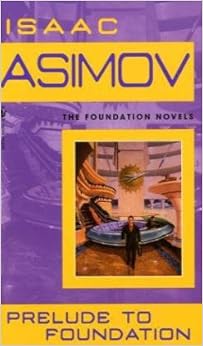
Prelude to Foundation, by Isaac Asimov

Okay, so as my readers probably remember, last week I expressed some serious concerns regarding this week's reading material, Prelude to Foundation. Fortunately, and this is very, very fortunately, Prelude to Foundation abandoned all of the incessant moral arguments of Foundation and Earth and instead returned to the space history and sci-fi adventure which I had originally enjoyed in this series. I really, really enjoyed this book and I'm much more hopeful about the final book, Forward the Foundation, and what it may yet hold in store.

Prelude to Foundation is actually a prequel novel to the series, going all the way back to the waning days of the Galactic Empire when Hari Seldon first presents his paper on the theoretical possibilities of psychohistory, although he is convinced that it will never be a practical field. Seldon soon finds himself embroiled in events on Trantor, capital world of the Galactic Empire, pursued by political players who seek to use psychohistory for their own ends. Seldon then travels through several locations on Trantor, seeing the decaying heart of the Empire, slowly becoming more and more convinced that his psychohistory may be necessary after all.

What I really liked about this book was a return to the feeling of the original novels. The series certainly never really abandoned the space adventure aspect, especially since the last book consisted of an epic quest to try and find the mythical planet of Earth, but that began to be overshadowed by moralistic arguments that went nowhere and became more and more frustrating with each reiteration. In this book we get to see the halcyon days of the Galactic Empire, already sliding towards decline, and see more of the almost mythical Hari Seldon. You get a real sense that large events are happening all around the characters, much like I got in the first three books, and that they're going to be influential in shaping how events are going to play out.

The other thing I really liked is that you got to see aspects of the Empire up close and personal and see how decay has subtly already taken a hold of many of its underpinnings. For example the power station at Dahl is described by its workers as a black box: they have no idea how it works and are content to call in outside help to fix it if something goes wrong. If for whatever reason that knowledge were to be lost, then the Dahl power station would be made useless, but no one is terribly concerned at this potential danger. You see all around a stagnation of innovation and a decline in infrastructure, so necessary in a world-spanning city but slowly falling apart over time. Even the attitude that seems to take a hold of the Empire in later years has already formed, that managing the galaxy is a waste of resources and Trantor needs to turn inwards, abandoning a galaxy-spanning Empire and leaving the provinces to their own devices. It's all very atmospheric and much more enjoyable compared to the previous book.

I will admit that one of my biggest issues is that the events seem to repeat themselves throughout the novel. The characters even comment on the oddity of repeated events, which only serves to draw attention to this fact. The book also kind of ends abruptly, in an "Oh. Well okay then." way. Despite that I really enjoyed this book and I'm hoping the last one will be more like it as well.

- Kalpar

Thursday, August 14, 2014

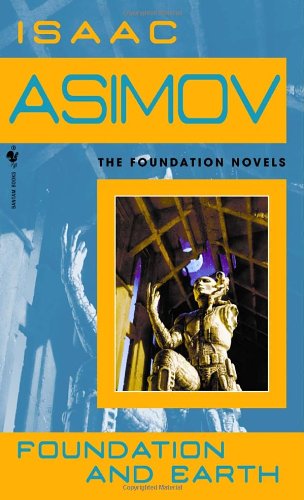
Foundation and Earth, by Isaac Asimov

WARNING: What with one thing and another, I'm not able to adequately talk about this book without going into spoilers. I apologize in advance. For my readers who wish to avoid spoilers the short version is this book was so bad I threw it against the wall once, and probably would have done it numerous times. Please avoid this book.

Okay, so I'm kind of regretting continuing with the Foundation series. Really, really regretting my decision to commit this whole month to the other four books Asimov wrote relating to the Foundation series. Let me explain. Foundation and Earth takes place pretty much immediately after Foundation's Edge and Golan Trevize's decision in favor of the entire galaxy becoming a super-organism holistic entity known as Galaxia, albeit very gradually. However Trevize is not sure why he made that decision and seeks to have it justified by some source of outside information. The source that Trevize selects is the mythical origin planet of Earth, believing that there will be something that will tell him if he made the right choice. And so with that Trevize and friends head off into the galaxy to begin their search.

Honestly, if this had simply been a space adventure to find mythical Earth-That-Was and discovering more about galactic history along the way, I'd totally be behind it. I liked the space history aspects of the Foundation series in the earlier books, and I enjoyed watching the characters try to sift truth out of the numerous, and sometimes contradictory, legends surrounding the origin planet. Personally I found their disbelief in a satellite as large as our moon, as well as a planet with as impressive rings as Saturn, to be worth a few chuckles. And I will say that this book has, more than anything else, made me want to read the Robot series novels by Asimov to see a first-hand non-distorted perspective of this ancient human history.

The trouble is that the book is not content to be just another space archeology adventure, which I would totally be behind! The problem is that it seems every thirty pages or so this book is absolutely determined to get into another tedious argument over morality. I will admit that in my own personal perspective I find arguments about morality to be best restricted to a philosophical forum and such arguments are very seldom well-done when it comes to fiction, often feeling very shoe-horned into the narrative. In this particular instance Trevize constantly gets into arguments with Bliss, Gaia's representative on this particular little expedition, over the merits of individualism versus Galaxia's collective consciousness. Most of these arguments just sort of fizzle out with no real conclusion in favor of one side or the other, which is made all the more frustrating because it means we get to hear more of the arguments! It got so bad that I eventually thew the book against the wall about page three hundred or so after the sixth or seventh such argument. And keep in mind I'm a bibliophile that finds even the slightest desecration of a book tantamount to sacrilege, that's how pissed off the book made me.

Furthermore, the more you think about it, the creepier Gaia's shared consciousness gets. On the planet the trees all grow in straight lines, of their own volition. It always rains exactly the right amount to keep everything healthy, people only have children when it's deemed appropriate to the balance for them to have children, basically every aspect in respect to free will is completely taken from you. Furthermore, everything on the planet from the birds and bees to its molten core and the clouds are part of the planet's collective consciousness. Even your poop is part of it! I wish I was kidding but we are specifically told by Bliss that even her waste shares in the consciousness of Gaia. Is anyone else creeped the hell out by that? Because I am.

Granted, there are extremes to free will as well, and we're shown that in at least one very good example on the crew's adventures when they arrive on Solaria. The Solarians are isolationists in the extreme, who can barely bring themselves to look upon the image of another Solarian, the idea of even being within a kilometer of another one is simply unthinkable. The Solarians all live in robot-tended, isolated estates, perfectly content in their “freedom” from other beings and being free to do whatever they please. Bliss is quick to point out that this is a result of free will and individualism, while Trevize is quick to point out that this is an absolute extreme and is in no way indicative of the ultimate route of individualism. I'm left with the feeling that Asimov was trying desperately to come up with a good reason why Galaxia represents a good choice for the future of humanity but he keeps coming up short in the novel.

Ultimately, they do find Earth at the end, although even Trevize wonders aloud why he thinks he'll find an answer on Earth. (Which personally made me wonder why we were bothering with this story anyway.) But the payoff is just so terrible. We spend nearly five hundred pages going through tedious moral arguments, getting dragged slowly across the galaxy and making me personally wonder if humanity is worth saving, and you know what the reason Trevize settles on? We need to form a galaxy-spanning consciousness because space aliens from another galaxy might invade us, and that's our best way to defend against them.

If you just went “What?” you're not alone, because I'm right there with you dear reader. Space invaders from another galaxy is your best argument? Not, achieving harmony with the cosmos. Not, creating a higher evolutionary state of existence. Not, effective immortality because every part of you remains a part of the greater whole, albeit perhaps in a diminished form. No. Space invaders from the next galaxy over. Not even factual space invaders mind you, but potential space invaders. I just...I can't even....

As I've already committed to this month being another Foundation Month, and I already have Prelude to Foundation and Forward the Foundation, I will be continuing my reading of the Foundation series, albeit with ever-increased apprehension. I ardently hope that these books will be less frustrating than Foundation and Earth has been, but I'm not exactly sanguine about the prospect.

- Kalpar


Thursday, August 7, 2014

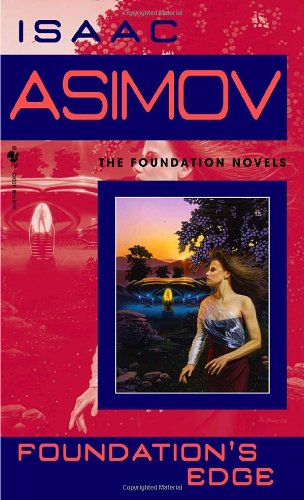
Foundation's Edge, by Isaac Asimov

I've decided once again to launch a Foundation month here at the Arsenal, taking all of August to look once more at Isaac Asimov's Foundation series. This month I'll be looking at the next four books in the series, going once again in publication order. As I said in my previous reviews I am rather fond of this series. Aside from my well-established fandom of Isaac Asimov, I really enjoyed seeing historic parallels with the fall of the Roman Empire being applied to a science-fiction setting. Science-fiction and history combined together! Absolutely fantastic! So I was, of course, eager to see the series continue.

I will start my review by saying that Foundation's Edge takes the series in a very different direction. I certainly liked this book and I look forward to more adventures following the Seldon Plan, but there was a definite departure from previous books. This particular novel occurs right after a Seldon Crisis has been resolved. To remind my readers or those who may be unfamiliar, the basic premise of Foundation is that psychohistorian Hari Seldon has predicted the fall of the Galactic Empire. To prevent a dark age lasting thirty thousand years he has developed a plan to enable a scientific Foundation to create a Second Empire in a mere thousand years. Every so often the Foundation will face a Seldon Crisis where they will have limited options and be forced to take a path that will lead towards the Second Empire. All previous books had focused, largely, on Seldon Crises and the events leading up to them and their eventual resolution. Second Foundation even had a Seldon Crisis in the works before the arrival of the Mule seriously disrupted the Seldon Plan. Foundation's Edge, however, occurs right after a Seldon Crisis when the decision to keep the growing Foundation Federation's capital on Terminus has been reaffirmed by a holograph of Hari Seldon. I will admit I was kind of sad by the decision that seems to move the series away from the Plan because I really liked all that social, political, and economic mumbo-jumbo, but I'm certainly not disappointed with the book.

The book focuses Golan Trevize, a member of the Foundation Council who voices serious concerns that the Second Foundation, believed destroyed in the previous novel, still exists. He claims that the Plan is too well on track which implies that the Second Foundation is still pulling the strings behind the scenes, an idea that the First Foundation finds downright offensive. Meanwhile Stor Gendibal, the youngest Speaker on the Second Foundation's Table, voices equal concerns, stating that the deviations that would normally be expected as the Plan reaches its five hundred year mark have disappeared entirely and the plan is running far too smoothly, even with the Second Foundation's influence. He suspects that a third party is managing the Plan for their own benefit, again something which cannot be tolerated. And so a group of characters head off, trying to discover what's really going on. The result takes the series in a far more...mystical direction, which definitely seems very much at odds with the strongly hard-science approach previous stories had taken.

I will say that this book makes it explicit, if nothing else than from a final not from Asimov, that all of his works take place in a shared universe. Most of my previous Asimov readings have been largely the robot stories and I have personally read The Complete Robot cover to cover. (Albeit some time ago) If nothing else, this decision to make all the stories part of one larger, shared universe, makes me eager to read not just Foundation, but the Empire and other Robot stories as well. I certainly am going to have more material to read in the future, as if there wasn't so many other things to read already.

Although I lament the apparent shift of the series away from a hard-science and Economic, Social, and Political (ESP) perspective, I still enjoyed this book. It definitely adds to and expands the universe, showing that Hari Seldon could not account for everything. I am curious about future books because Seldon seems to have taken on an almost divine status within the Foundation and to deny the Seldon Plan exists is tantamount to heresy on Terminus. I'm curious if the Foundation may find itself struggling with a religious crisis at home because of an orthodox adherence to faith in the Plan above all else. I guess we'll see where it goes from here.

- Kalpar

Thursday, March 21, 2013

Second Foundation, by Isaac Asimov

Well, we finally bring Foundation month to close with the last of the first three books, Second Foundation, which deals with both the Mule's and the First Foundation's search for the mysterious titular Second Foundation. While the First Foundation was made entirely of physical scientists and was designed to keep the spark of technology and research alive, the Second Foundation was composed of psychohistorians like Seldon whose duty was to manipulate galactic events to keep the Seldon Plan on its thousand year track. Although the Second Foundation prefers to act from well within the shadows and influence events indirectly, the recent turn of events caused by the mutant known as the Mule has forced them to take a far more direct role in galactic affairs. Now the Second Foundation faces the very real risk of discovery and destruction which may ruin any chances of the Seldon Plan reaching fruition.

As much as I really loved this book, I actually have one recommendation for how this and the previous book, Foundation and Empire, were organized. As I mentioned in my previous review, Foundation and Empire consisted of two stories, one which detailed the exploits of the Empire general Bel Riose, and the second dealing with the Mule's conquest of the First Foundation. Second Foundation also contains, as I mentioned, a story involving the Mule and a story involving just the First Foundation. If I were editing this series I would recommend putting Bel Riose's story in the first volume with the other Foundation short stories and then give both of the Mule stories their own book, leaving the last story on its own. I feel like it would work better thematically, regardless of how the stories were initially published, but that's my opinion.

Overall I really liked these stories and was really satisfied to actually see this mysterious Second Foundation at work.  Knowing that there was a group of people whose sole job was to oversee the Seldon Plan and account for accidents like the Mule made the premise much more believable for me. As I mentioned in my previous reviews I had a little trouble swallowing the idea that one man was able to carefully chart out the history of an entire galaxy for a thousand years, even if it was in vague generalities. However, the Second Foundationers continually remind the reader that the Seldon Plan is never complete and must continually be amended and reanalyzed with a constant risk of the plan being completely destroyed. Knowing that there was an active force ensuring the success of the Seldon Plan made the whole premise more believable for me.

I did have a slight issue with the ending of the first story which involved a mental showdown between the Mule and the First Speaker of the Second Foundation. I think it might be because it involved a psychic battle of wills and morale which isn't really something I can understand, not being psychic myself, but I think I grasped the general idea. I also kind of found the idea of the Second Foundation having well-placed double agents a little implausible, but considering they are a group of people dedicated to careful calculations of the future it makes sense for them to have that level of preparation. For most of the stories I liked the level of space opera battles and galactic intrigue which made for an interesting political narrative.

Overall I was very pleased with these three novels and am excited to read the rest of the Foundation series in the future to see the fate of the Seldon Plan and if the First Foundation can successfully create a Second Empire. Next month we shall be returning to more common books here on the blog like the Bolo series but hopefully Asimov will make another appearance here in the future. I recommend all my readers who are interested in history, politics, or a good space opera to check out the Foundation series.

- Kalpar

Thursday, March 14, 2013

Foundation and Empire, by Isaac Asimov

This week I continue my ongoing review of the original Foundation trilogy written by the great master, Isaac Asimov, in the 1940's and 50's. As I said last week, I really enjoyed the first book, Foundation which is a collection of short stories related to the process of forging a Second Galactic Empire a mere millenium after the fall of the first one and goes to about two hundred years into that process. Foundation and Empire picks up after Foundation and features two crises. The first crisis is the inevitable clash between the growing forces of the Foundation and still strong but rapidly receding and greatly diminished Galactic Empire, while the second deals with the emergence from almost nowhere of a figure known only as the Mule and his ability to defeat the previously unstoppable forces of the Foundation.

As I mentioned, Foundation and Empire is split into two longer stories that go much further in depth than the stories in the previous novel. As one of my main problems was the relative lack of development in the shorter stories I thought this was an excellent improvement for the series and I hope that the later books are just as developed, if not more so. The first story centers around the Empire general Bel Riose, an ambitious young warrior who seeks to expand his career and the Empire by finding the mysterious magicians said to exist in the galactic periphery who perform incredible feats of technological expertise. Perhaps what I found most interesting about this story was that the Foundation, despite being technologically superior to the Empire in many ways, still could not win open battles with the Empire and was on the defensive for pretty much all of Riose's campaign. Even in a state of advanced atrophy, the Galactic Empire still has a significant bite to it. The Foundation is only saved, in fact, because of larger social and political forces predicted by the great visionary Hari Seldon. As it's explained in the novel, Seldon predicted that a combination of a strong emperor and a strong general would lead the ambitious general to attack the Foundation to expand his career, the Empire, and perhaps place himself in a position to contend for the Imperial throne. While the Foundation would stumble over these defeats, the strong emperor would eventually be recalled to the imperial capital of Trantor because of the Emperor's own fear for his throne, halting the imperial advance. While it still kind of relies upon the very disputed great man theory of history, I appreciated its larger political and social implications.

One thing that kind of bugged me was that between the short stories the Sack of Trantor, the Imperial capital world, has already happened. It was foretold in Foundation and considered to be a major event that would mark the end of First Galactic Empire, much like the sack of Rome and death of Romulus Augustus in 476 CE marks the "official" end of the Roman Empire in western Europe. Basically we go from the story of Bel Riose to the story of the Mule and the Empire has already vanished. A rump state ruling over a mere twenty agricultural worlds exists, but any claims to imperial dominion over the entire galaxy are fanciful delusions at best. I had really hoped to see more of the empire falling and the dramatic Great Sack but sadly those were regulated to off-screen events.

The thing I really liked about the Mule's story is that we actually see the Foundation lose to something that hadn't been included in Hari Seldon's plan. While there was a civil war among Foundation forces that was brewing and Seldon did predict, the actions of the warlord known as the Mule were completely unaccounted for in Seldon's plan. (At least, that the First Foundation knows about, but more on that later.) It was actually really interesting for me because after facing down four crises, the Foundation had become complacent in the faith that Seldon had planned for everything and they need not worry about future events. Indeed, the myth of Foundation invulnerability is well know to all the characters at the three hundred year mark in our series' timeline and people assume the Foundation will win regardless. If the Foundation had won and successfully weathered the civil war crisis, as interesting as it could have been, it would have suffered the same problems as Superman suffers as a character. Superman is boring as a character because he is immune to pretty much everything that isn't kryptonite and has more powers than I have battle scars. There is never really any doubt if Superman will save the day or not because he can freaking FLY BACKWARDS IN TIME TO FIX THINGS, which completely destroys any dramatic tension. The same can be said for the Foundation who, while they cannot travel through time except in the usual manner we all do, are convinced that Seldon's great plan is completely flawless and will result in a Foundation victory regardless of other factors. Having the Mule come in and basically throw the game pieces out of the window was a refreshing change of pace.

Basically, the Mule is a mutant about whom very little is known and who has risen to considerable power in a short period of time. Because he is a mutant and apparently has powers beyond the scope of normal human abilities, he is well outside Seldon's plans for First Foundation and utterly derails the original crisis between the democratic free traders and the autocratic plutocrats. However, as it is hinted very strongly at the end of the book, it may be that Seldon counted on the Mule after all and the Second Foundation has the tools necessary to defeat the would-be galactic conqueror. I will admit that the mysterious and charismatic figure leading a galaxy-uniting military campaign bears more than a few passing similarities with the Emperor and his Great Crusade to reunite humanity in Warhammer 40,000.

The thing I liked the most about this novel in specific was its direct parallels with classical history and the fall of the Western Roman Empire in the 300's and 400's CE. Having learned a little of those time periods from a number of different classes I found the transition to a sci-fi setting pretty darn cool and really enjoyed it. I also felt that Asimov really did his research before writing these stories and doesn't rely on some of the less credible explanations for why empires collapse, instead focusing on the clearly quantified social, economic, and political factors. So for all of my readers who happen to be Roman history buffs and science-fiction fans this is definitely a book you'll want to check out. As for all the other sci-fi fans, I really am seeing how this is a landmark series in the genre and you should definitely go check it out as well.

- Kalpar

Thursday, March 7, 2013

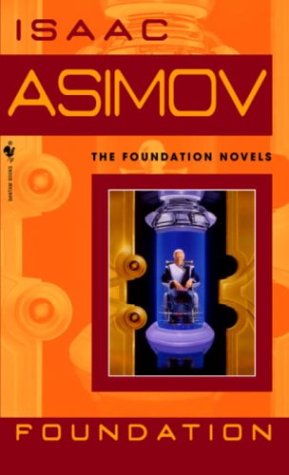
Foundation, by Isaac Asimov

So I finally decided to read the landmark science fiction series, the Foundation series by Isaac Asimov. I initially had some hesitation getting involved because there's an original trilogy and then a combination of sequels and prequels. Ultimately I was recommended by friends to read the books in publication order, starting with Foundation, and this month I will be reviewing the original three books in the series written by the great master, Asimov himself. Overall I am extremely excited about this book series and I am looking forward to reading the rest of this series.

The Foundation series actually covers a series of events covering over a thousand years of history. The premise is that Hari Seldon and a group of other people have developed the field of psycho-history to such an extent that they can prove, with mathematical certainty, what events will happen in the future. What is most concerning to Seldon and his compatriots is that they have predicted the inevitable fall of the Galactic Empire within the next three hundred years followed by a dark age spanning thirty thousand years during which the vast majority of human knowledge will be lost. However Seldon has managed, through the field of psycho-history, to determine a plan to shorten the inevitable dark age by a thousand years and speed the foundation of the Second Galactic Empire. While I found the idea of being able to predict future history with mathematical certainty a little far-fetched, I thought the premise was interesting and it was exciting to watch the political and socioeconomic situations develop over hundreds of years.

I do have one minor issue with Foundation in specific, the division of the book into five separate short stories. The problem I had with the short stories was I felt that once I finally understood what was going on we jumped forward fifty years and had to be briefed on what happened in the meantime. While I personally found it frustrating for the first half of the book, I must admit I finally got used to it. Furthermore, since this is a series of stories that take place over a thousand year time span I understand the need to jump forward in time so the books don't take forever to complete.

The thing that I really ended up liking about Foundation was its really apparent influence on later sci-fi works, specifically some of my perennial favorites, Warhammer 40,000 and Star Wars. The capital of the Galactic Empire, Trantor, is probably the inception of the idea of a hive city, a planet completely covered by an urban landscape with a population in the tens or hundreds of billions. Furthermore such planets are completely dependent on dozens of agricultural worlds for daily supplies of foodstuffs to keep the billions of people fed. Countless such worlds exist in the 40k universe and the capital city of Coruscant from Star Wars is like Trantor to a T.

The influence of Foundation on Warhammer 40,000 is even more apparent when we get to the Foundation itself and the course of action that its leaders take to help shorten the dark age. The first is the creation of the church of the Galactic Spirit which I am going to say is definitely the inspiration for the Adeptus Mechanicus of the 40k universe, right down to the red robes. The only real difference I've noticed is that in Foundation the highest members of the techpriests actually know how the technology works, while in the Adeptus Mechanicus even the highest Magos of Mars only knows technology as a series of religious rituals and couldn't tell you how it works, just that it does. The other really fascinating influence was the Traders of the Foundation, merchants with licenses to do damn near whatever they see fit within a few rather loose guidelines in the pursuit of profit. The incredibly similar Rogue Traders of 40k are probably directly influenced by the Traders of Foundation and I'm looking forward to reading more from this series and seeing how it influenced the science fiction genre.

Perhaps the thing I found most interesting about this book was the initial discussion by Hari Seldon about the gradual fall of the Galactic Empire and a number of factors which are contributing to the downfall of that empire. The reason I found it particularly relevant to me was the fact that the American empire is collapsing as we speak. I know I don't really get political here on the blog but with the ongoing internal struggles facing the government of the United States and the apparent decline of American power definitely suggest to me that the American empire which policed the post World War II world is definitely on a rapid decline. Despite being written in the 1940's and probably being about the then-collapsing British empire, I find its commentary  still as relevant seventy years later.

I really ended up liking Foundation and I fully intend to read the rest of at least the original trilogy and review it this month. Hopefully in the future I will find the rest of the books in this series and will find them just as entertaining and informative as the first one. I definitely recommend all of my readers go read this book and look into reading more books from Asimov as well.

- Kalpar