Showing posts with label James Luceno. Show all posts

Tuesday, September 18, 2018

Darth Plagueis, by James Luceno

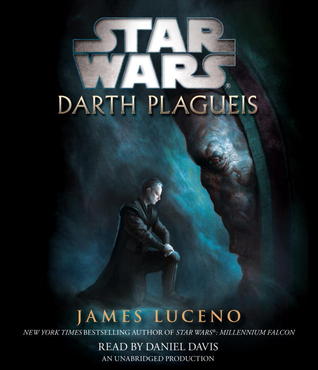
Today I'm looking at another Star Wars book because apparently I'm a glutton for punishment. Of course this book is part of the Legends canon so it doesn't count as canon anymore within the new Disney canon. (Yes, Star Wars is confusing.) I think this was one of the last books written before the Disney takeover, though, so it kind of shows how complicated the canon had gotten. If you've had the misfortune to sit through Revenge of the Sith you probably remember Palpatine's speech about the Tragedy of Darth Plagueis the Wiiiiiiiise. After the movie a lot of fan theories floated around about who exactly Darth Plagueis was with the favorite being that Darth Plagueis was Palpatine's own former teacher. This book confirmed that theory and expanded on both Plagueis and Palpatine. But I feel that this book in an attempt to answer questions just ends up raising more questions.

This book establishes that Darth Plagueis is a Muun. Now if you don't remember what the heck a Muun is, I certainly don't blame you. Basically they were these tall aliens and they were behind the Intergalactic Banking Clan, the major economic power in the galaxy. Darth Plagueis, like so many Muuns, is a major financial broker in his own right. Now on one level this makes a lot of sense because someone with massive financial power would be able to set the conflict of the Clone Wars into motion, both through political manipulation as well as underwriting the manufacture of armaments for each respective faction. In a way this makes a lot of sense. But the trouble with this book is that it just creates a disconnect between Darth Plagueis the manipulator and Darth Plagueis the immortality-obsessed maniac. Of the two, the chasing immortality plotline seems to have been almost forgotten at times, like Luceno was like, ''Oh right, the immortality and the midichlorians. Right. Got to include that.'' Plagueis's ultimate goal is to rule the galaxy for forever, but based on where the book spent its focus it felt like Plagueis's main goal was galactic domination and immortality was just a sweet bonus.

This book also focuses a lot on midichlorians (when Plagueis is actually working on the immortality project) and then all the financial and political debates that were in the prequels. Now I think it's pretty safe to say that there were a lot of people who didn't like the tedious political debates that were in the prequels, so having a whole book with a lot of those debates is probably not going to be appealing to the average Star Wars fan. Not to say that political intrigue and Star Wars couldn't potentially be an interesting story like Song of Ice and Fire, but in this case it's a more of the prequel variety which isn't that great.

The canon problems also start getting confusing. This book includes a reference to the Heir to the Empire with Jorus C'baoth making a cameo and I'm pretty sure that there's an inclusion of a plotline about Darth Maul taking out leaders of the Black Sun criminal organization.And I'm pretty sure I read a comic with that exact same plot back when I was a teenager. (It's called Star Wars: Darth Maul published by Dark Horse, if anyone's interested) And those are the only two references I was able to catch, I'm sure there were more that I missed as well. But this just made me think of the of the fact that Jorus C'baoth was cloned and his clone suffered from clone madness, all of which got forgotten with the new Clone Wars. So now I'm mixing canons that contradict each other in my head.

I feel like this book tries to answer some other questions such as ''What the heck were all those giant bottomless shafts in Naboo that the lightsaber fight was in? And for that matter why is the Trade Federation blockading Naboo? What space supplies could this lush, verdant planet need that would cause them to surrender?'' Well this book actually answers those questions that we had. It turns out that Naboo's entire economy is based around mining plasma and then the Trade Federation has a contract to ship it off world. So the blockade by the Federation is over a disagreement involving shipping rates and it brings Naboo's economy to a standstill because their economy is based on a single export. And those bottomless shafts are just plasma mines.

...except that plasma is an ionized gas either found in either the upper atmosphere or more commonly what stars are made out of. So...you...shouldn't be mining it from a planet's core. I...it just doesn't make sense. I'm sorry, I know I'm making a big deal about this but it bugs me on some level. And this is just the biggest thing that bothers me, there are a lot of other questions that I'm left asking about this book. It just raises more questions.

Overall I think this book is worth skipping. While it explains more of how the Clone Wars were set up, it does it in such a dry manner that I don't think most fans are going to want to read this entire book just for that.

- Kalpar

Tuesday, December 12, 2017

Catalyst, by James Luceno

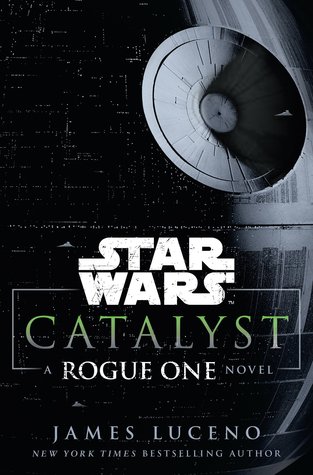
Today I'm looking at a book called Catalyst set within the new Star Wars universe after the reboot/realignment/whathaveyou after the Disney purchase of the franchise. Catalyst takes place over several years, starting during the Clone Wars and ending sometime before Rogue One begins. The book is mostly about Jyn Erso's parents, Lyra and Galen, as well as Orson Krennic. (The guy with the white uniform in Rogue One if you weren't sure.) As you might also guess from the cover, the book has a lot to do with the Death Star project and Galen Erso's initially unknowing cooperation in the development of the Death Star's planet-killing superlaser.

The book begins with the Ersos being on a remote planet of the galaxy involved in research of kyber crystals, the crystals used in lightsabers, and their incredible energy potential. Unfortunately for them, the Clone Wars results in a shift of planetary government and Galen finds himself imprisoned on suspicion of being a Republic spy. Fortunately Krennic, an old school friend of Galen's and involved in the highly secret Republic superweapon project, puts together a rescue team. However this proves to be a mixed blessing because Krennic's real motivations for helping the Ersos is to get Galen, even somewhat indirectly, to start working on crystal technology that can be applied to the superweapon.

My overall opinion of the book is it was okay, but not really worth the effort of reading or listening to. It has that major problem of prequels in that we know the main characters are going to survive to the point where they started in Rogue One so there's not a lot of tension for bad things happening. Despite all the setbacks Krennic suffers, we know he's going to survive to be an antagonist in Rogue One with CGI Tarkin. Despite the horrible discoveries into Imperial plans the Ersos make, we know they're going to make it to their farm. As I've said before, a good prequel manages to make you doubt how it's going to end, even though you already know the ending, and I think that was the biggest strength of Rogue One. Even knowing that the Death Star plans were going to get to Leia by the end of the movie, I still wasn't certain that Jyn and Cassian would get the message through in time. Catalyst just lacks that same tension which makes it a bad prequel.

Another big issue I had was this book started raising some serious questions about the Death Star. I know that it's kind of silly for me to say the Death Star is unrealistic. I mean, it's a giant moon-sized space station capable of destroying a planet, as well as travelling through hyperspace. It's inherently a ridiculous notion. The problem I have is how under wraps the entire project manages to be successfully kept secret for two decades. Sometime during the Clone Wars the Republic actually begins construction of the Death Star, called the Ultimate Weapon. In the book it's implied that a whole government committee is involved in overseeing the project and getting regular status updates on it as well. And there are two things government committees spawn, regardless of the universe they're in: paperwork and more committees. I don't think Luceno exactly states how many people are involved in these committees but I got the impression it was fairly large, which would make it nearly impossible to keep everyone from talking about it.

And then there are the sheer number of resources involved as well. The Empire is literally stripping planets bare to come up with the resources to build the Death Star, along with their Star Destroyers, TIE fighters, AT-ATs, and who knows what else. In the book it's stated that all the Death Star resources get hidden in the huge ledgers of materials the Empire is using, but considering the Death Star's being built at Geonosis and there are no major shipyards or other factories there, you'd think people would start wondering. I could see the Death Star being built and kept secret over a period of three or five years. That makes sense to me. But two decades stretches my suspension of disbelief, even for Star Wars.

We also sort of get the religious elements of kyber crystals, and yet not really. We do see Lyra being a Force...devotee I guess? Like she believes in the Force as a religion but I got the impression she wasn't actually Force-sensitive. Space magic is weird. And it's mentioned that other people worship the kyber crystals as well sort of like what we saw on Jedha in Rogue One. But aside from sort of a vague explanation that the crystals are magic, we don't really know why people hold them to be sacred. I kind of wish there had been more of an explanation for this because it still seems really odd to me.

We also get an environmental message in the book through Galen Erso's quest to find ''sustainable energy'' from kyber crystals, and seeing how the Empire is strip-mining Legacy Worlds to build its Death Star, basically the equivalent of strip-mining a national park. The sustainable energy bit doesn't make a lot of sense to me because it's already established that the Star Wars universe has fusion power, currently something of a holy grail in the sustainable energy. So if you have fusion reactors, why the heck do you need more sustainable energy? Are you running out of hydrogen? It just raises too many questions. Second, the Empire strip-mining nature reserves is played for shock value when honestly that's one of the less evil things they've done. Don't get me wrong, it's bad, but corporations would do the same thing if there was money in it. Considering the Empire enslaves people and destroyed Alderaan, I think we've firmly established that the Empire are the bad guys. Seriously, remember Alderaan? And how they blew it up? And were going to blow up any other planets that resisted them? They're evil! Of course they strip-mine planets! They probably kick puppies too.

The result is a book that it honestly doesn't feel worth the effort of reading. If I really, really want to know how the Death Star was constructed, I could probably just look it up on Wookiepedia, and get several different versions of the story. The Ersos and Krennic don't feel very well developed as characters so I found it difficult to care about what happens to them before Rogue One. Add some issues like the heavy-handed but out of place environmentalism and it just makes the book feel worse. I think I can honestly say you're not missing a whole heck of a lot by skipping this book.

- Kalpar