Showing posts with label Roman History. Show all posts

Tuesday, September 11, 2018

How Rome Fell: Death of a Superpower, by Adrian Goldsworthy

Today I'm looking at a book which does exactly what it says on the tin, looks at how the Roman Empire fell. In the first century CE the Pax Romana had reached every corner of the Mediterranean and for centuries it seemed Rome could weather any challenge, face down any enemy. However by 476 the Western half of the Empire had been occupied by Goths, Franks, Vandals, and other Germanic tribes and Rome itself was sacked. Romulus Augustulus, the last Western Emperor, was deposed and nobody bothered to replace him. The Eastern Empire continued for another millennium, but the power of Rome in Western Europe and Africa had forever been curtailed.

Even as the Empire itself fell, people were debating what caused the Empire to collapse. In the classical era people tended to attribute it to the displeasure of the gods. Pagan writers said the old gods were displeased by the empire's conversion to Christianity while Christina writers blamed backsliding to pagan rituals losing Jesus's favor. Later writers, including Edward Gibbon, blamed the collapse on the Roman Empire on the invasion of Germanic barbarians. As Goldsworthy explains, the underlying assumption is that the institutions of the Roman Empire were fundamentally sound, but the external pressures were simply too much for the empire to bear. Goldsworthy argues that instead it was internal issues that sapped the strength of the Roman Empire and made it susceptible to invasion by the Germanic tribes.

Goldsworthy illustrates this problem through centuries of evidence, showing that through the third and fourth centuries CE the Roman Empire was plagued by civil wars and usurper emperors, as a result much of the empire's strength was spent fighting itself rather than its enemies. Over time the empire's institutions including its military and civil bureaucracy were reformed in an attempt to keep the emperor safe from usurpation or assassination, dividing authority and reducing the power that any one individual subordinate might hold. Ironically this did nothing to stop the civil wars and for most of those centuries strong, long-reigning emperors such as Diocletian, Constantine, or Theodosius, were the exception rather than the rule.

Ultimately Goldsworthy's argument is that the Roman Empire managed to survive through ontological inertia rather than because it was an efficient and united regime. The Empire was simply too big, too rich, and too powerful for it to fall overnight despite the rot within the structure. The Germanic tribes, and even the feared Huns, were able to raid and bloody the empire, but almost never had the numbers to truly overthrow or replace it for most of its history. The only closest rival in terms of strength and money was Sassanid Persia and due to geography they would not have been able to strike at the cores of the Roman Empire.

Goldsworthy's methodology is well thought out and he makes excellent use of the available sources to make an argument that internal, rather than external, pressures made the Roman Empire collapse. What bothers me, though, is when Goldsworthy makes the comparisons to other nations and the inevitable comparison to the United States. As he explains, the United States has been comparing itself to Rome (albeit the Roman Republic) since 1776, so the comparison to the Roman Empire is equally apt. However, Goldsworthy argues first that the United States, much like Rome, had no serious challengers. When this was written in 2008 that was clearly not the case as our ongoing ''war on terror'' continues to quagmire in the Middle East with no real goal or end in sight. While the nature of asymmetric warfare means it's unlikely a terrorist army could invade Washington, D.C., the challenges that they pose are no less frustrating. And even in 2008 the rise of China and ambitions of Putin were plainly obvious as future security concerns.

Goldsworthy also, albeit not by name, makes a reference to the Roman Empire being ''too big to fail''. Although definitely not being tossed around at the time he finished writing (well before the publication date of 2008) the words ''too big to fail'' have come back to haunt us in a serious way. To members of the left wing, myself included, the notion itself that a financial institution can become so large that its collapse can threaten the world economy suggests that something has become seriously wrong with the system and is in desperate need of reform. And it does raise the question, if Rome was too big to fail and still failed, what does that mean about the banks?

Despite these concerns about Goldsworthy's attempts to compare Rome to the modern era (a difficult proposition even in the best of times), I think this book is well worth taking the time to check out. Goldsworthy makes a compelling argument that in the end, Rome's greatest enemy was itself.

- Kalpar

Tuesday, January 31, 2017

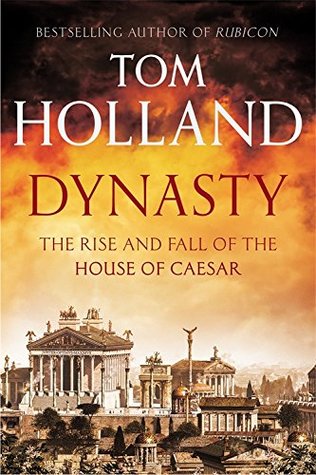
Dynasty: The Rise and Fall of the House of Caesar, by Tom Holland

Today I'm looking at Dynasty: The Rise and Fall of the House of Caesar, which is a book that talks about the Julio-Claudian emperors, the first five men that ruled Rome through the very late first century BCE and into the first century CE before Nero committed suicide in 68 CE. Although the family and its heirs were wiped out, largely through internal rivalries and fratricides, the titles of princeps, imperator, augustus, and caesar would continue until the fall of the Western Empire in 476 and the Eastern Empire in 1453. To provide proper context, however, the book begins in the waning days of the Roman Republic and the rise of the strongmen of the First Triumvirate: Pompey the Great, Crassus, and Gaius Julius Caesar. The Republic would be wracked by costly civil wars between Caesar and Pompey which would only end with victory for Caesar and his appointment to the office of dictator for life. Already much of the framework for the office of princeps, king in all but name, had been laid when Julius Caesar was assassinated in 44 BCE. This led to yet another round of civil wars as the Second Triumvirate of Octavius Caesar (later Caesar Augustus), Marcus Antonius, and Lepidus sought revenge against Caesar's assassins and then later turned on each other with Octavius the ultimate winner.

The Julio-Claudian emperors are a subject of much historical research because they are some of the most memorable of Roman emperors, especially in a critical era for Rome's transition from an imperial republic to an imperial monarchy in all but name. You have Augustus, the first princeps and forger of the imperial system and excessive legislator of morality. The melancholy Tiberius who aspired to Roman virtues but spent his last years in orgiastic decadence in an island pleasure palace. Caligula, widely depicted as insane and so known for his depravity in his own time that his own bodyguards assassinated him. The epileptic Claudius, the man who did not desire to be emperor but proved capable at the job and organized the conquest of Britain. And finally Nero, a publicly avowed matricide who built an enormous pleasure palace on the burned ruins of Rome. There is an insane amount of sex, violence, and human drama which makes the Julio-Claudians almost irresistible to popular histories, academic histories, and even popular media in a variety of forms.

The biggest problem in analyzing these emperors is that the histories are inherently biased one way or the other. If written during the lifetimes of the emperors, they are of course highly salutary because the emperors did not take criticism very well and were prone to showy treason trials when frustrated. Or the histories were sponsored by the emperors, such as the Res Gestae Divi Augusti which was basically one long list of ''Awesome things done by me, Augustus. Also I'm a god now.'' However once the emperors were safely dead, especially unpopular ones such as Caligula or Nero, historians wrote scathing calumnies, which may be based on some grains of truth but many historians accept may also be greatly exaggerated. The challenge is of course finding the path of truth within the varying accounts we have from the time period.

And Holland admits this challenge from the get-go, however I found myself wondering if Holland was trying a little too hard to rehabilitate the ''bad'' emperors, especially Caligula and Nero. I think it got to the point Holland was protesting a bit too much. On the one hand, I felt he was a lot more even with his treatment of Augustus, Tiberius, and Claudius. Those three have the best reputations but each of them come with their own problems. Augustus became obsessed with sexual morality and passed strict laws regarding adultery and promoted a culture of informants within the capital. Tiberius was a competent soldier and administrator but in his later years simply could not be bothered with running the empire and engaged in orgiastic excesses. Holland also argues that Tiberius knew full well what sort of person Caligula was and encouraged Caligula's own excesses. And Claudius's conquest of Britain may not have been as profitable as he had hoped.

But my biggest concern is with Caligula and Nero. Those two are definitely the most infamous of the Julio-Claudians and have very bad reputations. But I feel like this may be well deserved. From Holland's own account both emperors did not seem terribly interested in actually running the empire and just enjoyed the benefits of being in power. Both spent lavishly on games and entertainment for the masses and enjoyed shocking ''proper'' Roman society, especially the senatorial aristocracy. And to me, Holland seems to argue that all of Caligula and Nero's scandals and escapades aren't acts of madness so much as playful tweaks of the nose of Roman society. Enormous practical jokes if you will. And while I can understand breaking with convention, appointing your horse consul is definitely not a practical joke.

So, to provide some explanation for people who may not know Roman history, the consuls were like the co-presidents of Rome. There were two of them, elected for a one-year turn, and they were in charge of the government. Under Augustus power began being shifted away from the senate, the consuls, and the various other offices of the Republic and concentrated in the princeps, or ''first citizen''. Romans basically had this huge aversion to kings and monarchy so while Augustus was effectively acting as a monarch for Rome, he maintained a polite fiction that he was merely the ''first among equals'' of the senate and definitely not a king. So the consuls might symbolically still be the most important office in Rome, but much of the power has been transferred to the princeps.

All right, so why would anyone appoint a horse consul? This is one of the more famous incidents in Caligula's reign and has traditionally been ascribed to madness. Only an obviously insane person would name a horse consul. Holland argues that this was not an act of insanity, but rather a calculated move by Caligula to irritate the Senate. Frankly I'm not sure which one is worse. If it's an act of insanity it merely means excessive inbreeding put a psychopath on the throne of the nascent Roman Empire. But if it was truly a calculated move then it means Caligula was deliberately destroying the polite fiction that the princeps was not a monarch, despite now being a hereditary title with increasing power, and alienating the weakened but still influential Senate. In the case of Nero, Holland goes into detail of Nero's tour of Greece and participation in a number of competitions, including the Olympics, where regardless of his actual performance he was always awarded first place. (It's good to be the princeps.) This was a long and protracted tour and while it may have boosted Nero's popularity with the lower classes, it left a lack of a guiding hand at the helm of state for Rome and eventually led to rebellion by numerous generals.

I think this book is interesting and informative, but I think Holland goes to too great an extent to rehabilitate Caligula and Nero. They may not have been the cackling melodramatic villains that they're often depicted as in histories, both academic and popular, but I think we would be justified in saying they weren't terribly good emperors either. The corruption by power affected all the Julio-Claudians to some extent, even venerable Augustus, and many other men who became imperator. But I think that corruption of power is most obvious in Caligula and Nero and to try and rehabilitate them as pretty okay, fun-loving guys is to stretch alternate historical interpretation to its utmost limits. Overall it's okay, but as I said, the author doth protest too much.

- Kalpar