Showing posts with label S.P. Somtow. Show all posts

Thursday, April 20, 2017

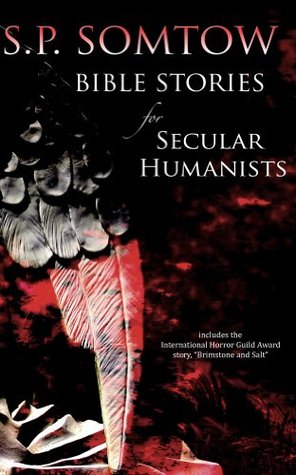
Bible Stories for Secular Humanists, by S.P. Somtow

Today I'm looking at another book by the Thai author, S.P. Somtow. Some of you may remember when I looked at his Chronicles of the High Inquest series some time ago and my conclusion was, ''These are kind of weird.'' Interestingly enough, I can't remember how exactly Bible Stories for Secular Humanists  got on my list of things to read because it was definitely before I knew who Somtow was. (This is a continual problem for me where interesting books get put on a to-read list and then I come back to them years later.) I'm willing to quibble a little over the title because some of these aren't retellings of  bible stories with Somtow's distinctive twist, but horror stories with religious themes. But I feel like it's an interesting selection of Somtow's writing and I feel like I'm getting a better read on his personality. I don't know if I can say I enjoyed this book, but that's more because horror isn't really my cup of tea.

As Somtow states in the introduction to this book, these short stories are ultimately about sex and death, which he sees as the two main driving forces behind humanity. Also lots of zombies. Somtow also admits he really likes zombies and he uses a lot of opportunities to put them in stories, whether in Roman times or a sci-fi future. But I feel like Somtow manages an interesting range with his stories. Some are just kind of silly, like his story about a hard-boiled detective in Roman times dealing with zombies. But some are deeply emotional and show Somtow's thoughts on humanity's place in the universe, even with all the zombies shuffling about. The Inquest definitely had its own flavor and I'm still having trouble digesting all of it, but these stories helped show me Somtow has a good range as a writer.

I don't normally mention formatting or typos because it's usually not an issue with the books or so rare it barely merits commenting upon. I will say with the kindle edition of this book there were a couple of stories where, for no reason I could discern anyway, the text was ridiculously large. I even messed with the text settings on my kindle and compared it to other chapters and it seems to be something specifically within the file itself rather than anything I did. In the end it wasn't a big issue, but it meant I had just a couple of sentences per page because of the font. I also recall at least one story having several typos which actually made it difficult for me to figure out what the sentence meant. This wasn't just a they're/their/there problem, it was a completely different word that makes no sense within the context of the sentence and is clearly an error. Of course, Somtow does enjoy using archaic words or archaic definitions of words so I had to use my dictionary a couple of times, but even then there were some typos where I just couldn't parse the sentence.

So I think I can say from a writing perspective that this book is very good and Somtow has some interesting stories. However, almost all of them involve vampires, zombies, or some other horror aspect and Somtow definitely enjoys the horror genre. Unfortunately it's not my favorite thing in the world so I think some of the appeal of the book is lost on me. But it's definitely different and interesting and if you like horror it may be worth your time to check out.

Thursday, November 19, 2015

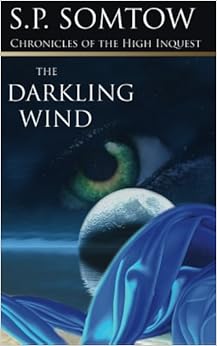
The Darkling Wind, by S.P. Somtow

This week I'm finishing the series referred to as The Chronicles of the High Inquest with the final book, The Darkling Wind. Again, as this is pretty soon after my review of the previous book, Utopia Hunters, it's because my friend foisted the last two upon me at once and I'd like to return these books in a timely manner. Largely because I hate people who borrow books for two years and then never read them. Anyway, this is the very last of a rather odd series of books which by the author's own admission is a five book trilogy contained in four novels.

I'll begin by saying that everything that happens in the previous three books definitely feels like it's been building up to the final book. And it opens very triumphantly with prologues and a dramatis personae of the seven Inquestors at the center of this story so it certainly feels like you're getting into an epic adventure. The problem I had was as you start getting into the novel it felt less like an epic adventure and more like a chore. The one thing I noticed about this book was that it dragged for so long. I think it ties back to that the ultimate fate is sort of known to the reader. We know the Inquest falls, mankind enters a ''dark age'' of sorts, and the facts about the Inquest become shrouded in myth and legend. We're told as much in the prologue, we know what the ultimate ending is going to be. It's not a matter of if the Inquest is going to fall, it's just a matter of how. Sort of like in the third of those movies which shall not be named. We already knew the Jedi were going to be wiped out and Anakin Skywalker was going to become Darth Vader, we just didn't know the how. And so while you've got characters walking around, fighting over the fate of the galaxy, I just couldn't get invested in the conflict because I knew how it was going to end. The fact that at one point one character explicitly says he doesn't care about the Inquest and their war made it even more difficult for me to care as a reader.

During this war there are also half-hearted attempts at arguing philosophy and the characters themselves even state they're bored with going over the same arguments again and again. No, literally, one character actually says that. So hearing them argue about philosophy when they themselves aren't even really interested is tedious at best. And you might even say it's not really an argument because one side wants to perpetuate the Inquest with their ''compassion'' and pretend wars, while the other wants to end the Inquest and doesn't really offer anything as a replacement. Granted, humanity doesn't really need the Inquest as far as I'm concerned because they don't accomplish anything useful, But I feel like the Shadow Inquest's arguments are underdeveloped to say the least. Mostly ''The Inquest is bad. We should stop them.'' So it sort of lurches along and eventually the Inquest just...self-destructs. And that's it. We're done. War's over. All the Inquestors are dead. Just like that. It feels very anti-climatic considering the pomp that went into launching the book.

The absolute final ending is a little interesting but also confusing. Well, the confusing part involves time-travel and people in stasis and I don't entirely understand it so let's not worry about it too much. But at the very end there are two short appendices which in a very weird way claim that the entire thing is mythological claptrap and in our enlightened future age we're not even sure that the Inquest exists or not. It's a little meta considering that Somtow himself is writing these stories, and then appendices to these stories, claiming that they're all made up. It's...interesting to say the least.

Basically when I was reading this book I just couldn't wait for it to be over, and I'm a little surprised I made it through the entire thing if I'm being honest. It just sort of ends and you're finally glad the ordeal is over more than anything else. Personally I feel kind of bad because these books mean a lot to my friend, but for whatever reason I'm just not getting the appeal.

- Kalpar

Thursday, November 5, 2015

Utopia Hunters, by S.P. Somtow

This week I'm reviewing the third book in the series which is referred to, by my friend anyway, as The Inquest. I will also be reviewing the fourth book later this month because my friend foisted the last two books upon me at once so I want to read them as quickly as possible and return them because unlike certain other slackers I could name, I try to return books loaned to me in a timely manner. Anyway, for my readers who haven't read my reviews of the previous two novels, you can find Light on the Sound here, and The Throne of Madness here. Onwards with Utopia Hunters.

To provide a bit of a refresher for people, The Inquest occurs in a distant future where humanity is scattered across the galaxy, inhabiting thousands or perhaps millions of worlds. The only thing connecting all of humanity is their rule by the distant Inquest, viewed by most people as immortal god-kings, watching humanity from their starship palaces as they drift through the galaxy. However, figuring out even that much is a little difficult in the beginning if you start with Light on the Sound. As I've said in my previous reviews, Somtow has a habit of interspersing lengthy passages of purple prose with some refreshingly direct exposition, but until this book I had felt like I was missing some vital pieces of the puzzle. I had an overall idea of what seemed to be going on, but I feel much more aware thanks to Utopia Hunters.

The book is a collection of short stories set within Somtow's universe, some of which feel relevant to what's going on, some of which don't. With Somtow's writing I almost feel like I have to guess what bits are going to be relevant and what bits won't be later on, and if I'm wrong I have to go back and poke around again. The short stories to me seem rather unrelated, and having one of the main characters say she doesn't understand why people keep telling her stories makes me ask the same question. Surrounding this is the frame story of Jenjen, a lightweaver artist who has come in contact with the Inquest and, much like us ordinary humans, is desperately trying to understand their seemingly ineffable motivations. To the book's credit, the short stories do manage to shed some light on that, as well as the Inquest's terrible flaws. I finally got confirmation of several things I suspected before in Throne of Madness, which leaves me rather disliking the Inquest as an institution overall. Hopefully this book will have provided useful information for the final book in the series.

Most importantly we're told the Inquest's philosophy, which I had kind of guessed at before but was trying to piece together from disparate bits of information. Basically, the Inquest believes that humanity needs chaos from time to time to keep from becoming stagnant or entering the dead-ends of utopias. So the Inquest (in their compassion) has taken it upon themselves to create ''war'' from time to time in the galaxy and shoulder all the guilt for killing people. Basically the Inquestors play a game called makrúgh, and based on who wins or loses certain planets will be destroyed to keep humanity from becoming stagnant. And in their compassion (that gets repeated a lot) the Inquest tries to mitigate the destruction by shipping as much of the population off-world in people bins before they totally destroy the planet. To summarize: The Inquest blows up planets from time to time to keep things from getting too boring for humanity.

As my readers may have guessed, this annoys me to no end because this is the Broken Window Fallacy taken to the extreme. For those of you unaware of the Broken Window Fallacy, it runs a little something like this. There's a bakery in the center of town, and one day some yahoo chucks a brick through the front window of the bakery, completely shattering it. The people of the town gather around and make the usual comments of kids these days. However, one person speaks up and says maybe the vandal did a good thing for the community. Because now the baker has to buy a new window, which is money that will go into the pocket of the window-glazier. The window-glazier in turn will spend that money on other things, causing a ripple of productivity to go through the community. So perhaps, a little destruction can be good for the economy! The purpose of this thought exercise is to explain the economic booms in the United States, Europe, and Japan after World War II. Perhaps the destruction of World War II caused such a need for capital to be spent that it allowed economies around the world to prosper.

The simple fact of the matter is that this idea is utterly fallacious on every scale. On the micro scale, the fact that the baker has to buy a new window doesn't help the baker. He's now out the money he needs for the new window. Money which he could have spend on new equipment for his bakery, or a new suit of clothes, or any number of other things. Instead that capital is spent on repairing things that they shouldn't need to fix in the first place. With World War II, the economic prosperity for the United States can be explained by the absolute destruction of the industrial infrastructure of pretty much every other nation in the world at the time, leaving the United States the sold industrial superpower. However, extensive investment under the Marshall Plan ensured that Europe and Japan were also able to quickly recover their industrial power. All the resources that are used in a war on things like planes, tanks, guns, bombs, and so on, are resources that can't be used elsewhere and for possibly better purposes. Wanton destruction is only detrimental when it's inflicted. The Inquest's approach of randomly destroying planets in an effort to keep humanity from becoming stagnant is perhaps worse than the Broken Window Fallacy because humanity doesn't even get anything tangible out of it. It seems to be destruction for destruction's sake, which is completely pointless and wasteful.

The worst part is that the Inquestors insulate themselves from the destruction they cause, and Jenjen actually calls them out about it in the book. A lot of Inquestors surround themselves with art in various forms. Paintings, sculptures, music. The idea is to keep from ever having to think about the destruction they cause. There are people whose sole job is to remind Inquestors of the worlds they've destroyed, but they seem to often be shunted aside so as not to harm the Inquestors' delicate sensibilities. It's like the Inquest are children who are given the power to do anything they wanted, and they decide to use that power to burn anthills down, call it compassion because the ants have to leave their hill, and then assuage their guilt over the whole matter with pretty things.


My friend has told me we're not supposed to like the Inquest, but it makes me wonder about these books to some degree. Because ultimately liking characters helps you get invested in a story and care about whether they succeed or fail. Since I don't care one bit for the Inquest I rather hope that they collapse with the oncoming civil war and absolutely nothing is left in their wake. Humanity is left to ponder the galaxy without the Inquest, and considering the Inquest seems to do nothing but burn planets, I think the galaxy will be much better off. We'll just have to see what the next books brings.

- Kalpar  

Thursday, June 11, 2015

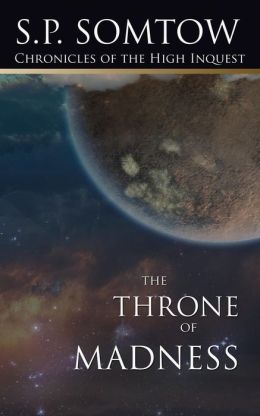
The Throne of Madness, by S.P. Somtow

This week I'm reviewing the second book in the Chronicles of the High Inquest, titled The Throne of Madness. And if it seems that it's a little early for me to be going into the second book of this series, as I usually tend to stretch a series out over time, well after I had revealed I'd hunted down a copy of Light on the Sound, my friend foisted the second book upon me and I hate borrowing books longer than necessary so here we are.

I realize in my last review I didn't really talk about the overarching plot, and in a way we hadn't quite gotten to the plot itself yet. Make no mistake, Light on the Sound has its own plot, but I feel that as a book it serves more to introduce us to characters and establishing events, which set a further series of events in motion in The Throne of Madness. But to provide some context for my dear and gentle readers, here goes: At some point in the distant future humanity discovers an artificial world towards the center of the galaxy surrounding a black hole. By feeding stars into the black hole, the planet is able to tap tremendous energy, including the ability to create tachyon bubbles, which I think are the only means of instantaneous interstellar flight. I'm a little fuzzy on the details because it's certainly not the only method, and the characters talk about time dilation during travel between planets to it's all a little vague. However, with the power of this planet, as well as the tachyon bubbles, a group known as the High Inquest is able to establish a sort of government over the millions of worlds inhabited by the Dispersal of Man and the Inquest has ruled for twenty thousand years. It's only in The Throne of Madness that we begin learning more about the Inquest and their methods, which were fairly ambiguous in Light on the Sound.

Central to the Inquest's is the tenet that stagnation is bad for humanity and it is the Inquest's duty to stir the pot every now and then to make sure things change. This manifests itself in two main activities that Inquestors concern themselves with, utopia-hunting and makrúgh. The Inquest believes that utopias can only lead to stagnation and decay so they should be hunted out and destroyed to prevent such stagnation from occurring. Makrúgh, however, appears to be a board game where Inquestors play over the fates of planets which results in real interstellar wars being fought and planets being torched to cinders. Just to keep things from getting too boring. (Again, this isn't very clear and it seems that anything Inquestors do can become part of a game of makrúgh. Somtow seems to vacillate between the frustratingly ambiguous and the refreshingly direct.) The plot revolves around a growing rejection of this predominate ideology and the weaknesses that it entails. So it's a philosophical work, but with spaceships and winged cats and whatnot.

There's actually quite a lot going on in this book and for a work this grand in scope you might expect it to be considerably longer. However it's only about 250 pages long, making it actually a bit of a lightweight. Somtow certainly could have expanded his story into something like the thousand-page tomes that Song of Ice and Fire has become, but by keeping it short we certainly never lose track of the action either. And as I said in my review of Light on the Sound, Somtow sometimes devolves into passages of the prettiest purple prose which can be a little annoying, but he also can be straight and to the point. Throw in some really creative and at times disturbing imagination on the part of Somtow, and you end up with a book with a fairly high WTF? factor. But at least it isn't boring!

I will say that The Throne of Madness was a little more interesting for me than Light on the Sound because it went into more expositionary information. And boy do I love exposition. I'm sure I'll have the other two books thrown upon me as well, so look out for the reviews. If nothing else, it's definitely different and memorable.

- Kalpar

Thursday, April 16, 2015

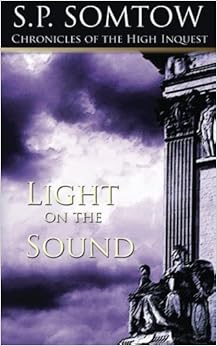
Light on the Sound, by S.P. Somtow

I'm going to be completely honest with people here, I'm not entirely sure what to think of this book. You see, I initially read this book on a sort of self-imposed challenge. A good friend of mine sort of vaguely mentioned this book series she referred to as The Inquest, which no one else she'd ever met had read or even heard of. Her boyfriend and I even joked that perhaps the series was an elaborate hoax on the part of her parents since it seemed to be that obscure. Heck, the ever-venerable TV Tropes where I stumbled across the Bolos has absolutely nothing regarding Chronicles of the High Inquest. I eventually had to wring my friend's arm to give me more information so I could track these books down and finally, perhaps miraculously, found a reprinting from 2013 available on Amazon. And so, flushed with the success of having found the damn thing, I went ahead and read the first of four books in this series.

The result is now that I'm in a very delicate situation and I'm not really sure what to say about this book. My friend is a very big fan of this series, perhaps for reasons which will be revealed in later books, but I have yet to be certain about that. However, this book has been out of print for nearly thirty years and so that leaves my blog in a position to say something that may prove influential. So I'm going to proceed as carefully as I can, and try my very best to be as just as I can.

The plot of the book starts off with disparate threads that are woven together into a larger plot dealing with the Inquest, an interstellar government which rules over the Dispersal of Man, the millions of worlds settled by humans throughout the galaxy. The Inquest is able to do so through ships which can travel through the Overcosm, a plane of existence parallel to our own which makes interstellar flight practical. However, a key component of travel through the Overcosm is a brain of a delphinoid, an alien that sees only in the Overcosm, and acts as the navigational computer of a spaceship. Of course, delphinoids can only be found on the planet Gallendys, which makes control of Gallendys extremely vital for the continued dominance of the Inquest over the Dispersal of Man. The main characters of this novel are brought together by this particular plot, however there is a much larger plot going on as well which I suspect may be continued in later books as well.

The other plot, which is sort of brushed upon but definitely seems to take a back seat, is of a more philosophical bend and deals with the Inquest's firmly held belief that man is a fallen creature and so does not deserve to be happy. Because when man is happy and content then there is no drive forwards, no attempt at improvement, at least according to the Inquest. Member of the Inquest actually specialize in hunting down utopias, finding their hidden flaws and dragging them down so that man does not become content. However over the twenty thousand years of the Inquest's existence there is a growing belief that perhaps man does deserve to be happy, and are seeking to push over the already tottering and creaking Inquest.

The issue I take with this is that all of the "utopias" we find in this book have some sort of secret, hidden flaw, such as everyone has to kill themselves at the age of fifty. Which makes me want to argue that they are not really utopias, but rather dystopias that create a semblance of happiness. And so you might say that the Inquest was justified in tearing them down, if it weren't for the fact the Inquest itself is rather awful in its own way. However I also found myself thinking about utopian fiction independent of this work, and often there's something wrong with the utopia, some sort of horrible secret it's founded upon. The story The Ones Who Walk Away From Omelas sort of sums it up best in my opinion, because for whatever reason we simply cannot imagine a society that's perfect. There always has to be at least one flaw. You can even look at the Federation in Star Trek and how it goes from Rodenberry's vision of a perfect future with no war, no crime, no poverty, and no sickness, to by the end of Deep Space Nine, an imperfect government with its own dirty secrets, and lots of economic plenty in the center which makes the Federation look perfect, but less economic plenty on the edges, which leaves plenty of motivation for crime. In a way Somtow is taking the opposite argument, that a utopia can exist, without being founded on some horrible secret or awful sacrifice, but this plot thread definitely takes a backseat to the less philosophical plot dealing with the fate of the delphinoids and the Inquest.

I did notice that the writing seems to jump between flowery purple prose and being refreshingly and almost exposition-dumpy direct. (Of course, as someone who reads encyclopedias for the fun of it, I usually don't mind exposition dumps in a work of fiction.) This seemed to be most prolific towards the beginning of this book, but either it died down or I got a better grip on the plot of the book as it progressed. Somtow did develop a sort of vocabulary of special words in his Inquisitorial High Speech, which varied from klomet, a logical corruption of kilometer over millenia, to zul, a term for a fermented beverage made out of fruit. Seriously, just call it wine. I was probably most annoyed with the words which I went to look up in the book and the definition was the word or the explanation provided within the text. It made looking at the glossary feel unnecessary and so I ended up ignoring it for most of the book. The result is a writing style which I found initially maddening, but eventually got used to as I got further into the book.

Ultimately, I really don't know what to think about this book. There are three other books in this series, and I'm left with the feeling that this book merely establishes the larger plot which will be dealt with over the course of the next three books. Some progress was made and the conflict was established, but ultimately nothing was terribly resolved and we're left with a larger conflict that's still to come. I think I'm going to have to withhold final judgement until I can look at the rest of the series. Because Light on the Sound definitely doesn't work as a stand-alone book.

- Kalpar