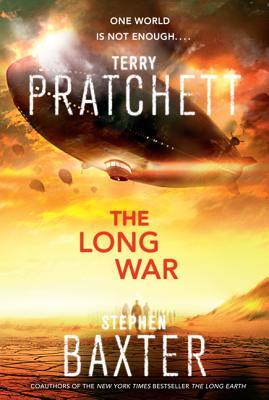
This week I've returned to the Long Earth with the sequel, The Long War. As you may remember in my review of The Long Earth, I was a little dissatisfied with the preceding book. However, I am usually one to give something a second try, especially after the first book because it might take a while for a series to find its stride. Unfortunately, The Long War simply wasn't it. With the series continuing in The Long Mars, I find myself not terribly interested in seeing where this series is going, and I'll try to explain why. But despite the enormous potential of this series it just continues to fail to deliver and the result is unsatisfying to say the least.
As you may recall, The Long Earth introduced us to the concept of a series of worlds, perhaps an infinity of worlds, similar but different to our own Earth, that can be reached simply through the use of a device known as a Stepper. Instead of being confined to a single world with a degrading ecosystem and diminishing resources, humanity now has access to millions of verdant worlds with practically unlimited resources. Suddenly the solution to all the pressures of humanity are literally just a step away. To be honest, the existence of a nearly infinite supply of worlds and resources poses interesting social, economic, and political questions and it would be interesting to see how humanity responds. (As well as the discovery that we are not alone and we have sapient hominid cousins throughout the Long Earth.)
Although initially ambitious, and promising to investigate several really interesting ideas about how the Long Earth would reshape society, The Long War spreads out too quickly and suffers from an incredible lack of focus. There are something in the neighborhood of five or six different plots going on in The Long War, ranging from the distant "colonies" of the outer worlds demanding equal treatment and representation in old Datum Earth's government, to humanity's treatment of the trolls, to China's expedition to the world of East 20,000,000. I almost feel like this is akin to a Philip K. Dick novel where there are a ton of interesting ideas presented but the authors go off into a lot of different directions instead of focusing on one story. I think if the authors had focused on one story for this novel, instead of splitting attention between five or six different plotlines, it would have resulted in a more coherent story overall. The result is a muddled mess of five different stories, none of which were developed or resolved much to my satisfaction.
Another thing I noticed, although this seemed to get better as the book went on, was a lot of things happened off-screen or were told in past tense or passive voice. It would have been interesting to see the rebellion against the Datum government develop as the pioneer's rights were slowly stripped away by a government pandering to increasingly xenophobic masses at home. Instead we're told about it after the fact as background material. Again, it's something I really noticed in the beginning of the book, and this may be because the authors decided to jump forward ten years from the ending of Long Earth so they had to cram in exposition somewhere, but it's pretty unsatisfying on my end.
For me the greatest sin of The Long War was that it became boring. An infinity of Earths for humanity to explore, colonize, and fight over offers practically limitless potential for numerous interesting stories. Unfortunately five plots which could have been interesting if properly developed in their own direction, become five lackluster plots that I ended up not caring terribly much about. I honestly found myself over 80% of the way through the book and just saying to myself, "Oh my god, when will this be over?" Instead of getting excited I just found myself bored, something you never want to be when you're reading a book.
I'll be honest, I'm probably not going to read The Long Mars because I have a very strong feeling it's going to be more of the same. As much as I love Terry Pratchett, this just doesn't seem to be his best work. I personally do not know much about Stephen Baxter and I may want to look at his books in the future, but I feel like this particular collaboration of authors simply isn't working.
- Kalpar
Showing posts with label Stephen Baxter. Show all posts
Thursday, February 26, 2015
Thursday, November 15, 2012
The Long Earth, by Terry Pratchett & Stephen Baxter
As my readers are no doubt well-aware, I am a huge fan of the writings of Terry Pratchett, specifically his much-acclaimed Discworld series. When I heard that he had written a new book called The Long Earth I was very interested. Furthermore this was an introduction to the science-fiction writer Stephen Baxter who has collaborated with giants such as Arthur C. Clarke in the past and he may show up again on the blog. (We'll see when I work through my backlog, which is huge!) Anyway, although The Long Earth starts out with a lot of promise, it ended up being rather disappointing with a lackluster ending.
I actually discussed this book with a friend who actually introduced me to Terry Pratchett and we agreed that the problem with The Long Earth is that it starts with an excellent premise with a lot of potential, but that potential is never really fully developed in the novel. In 2015 the schematics for a device known as a "stepper" appear on the internet, which consists of easy-to-find circuitry and is powered by a potato. The stepper allows people to travel to parallel earths which are very similar to our own earth but are entirely devoid of people. Despite limitations such as the inability to carry iron or steel across worlds, people quickly expand across the alternate earths to set up vacation communities, harvest resources now scarce on the original earth (now called Datum), or even leave Datum entirely to settle. The opportunities for adventure and exploration are literally limitless in the world Pratchett and Baxter have created.
The main plot centers around Joshua Valiente, a member of the roughly fifth of the population who can step between worlds without the aid of a stepper. Joshua is recruited by the powerful Black Company. Joshua will accompany Lobsang, a Tibetan motorcycle repairman reincarnated as an artificial intelligence, on a journey across the Long Earth to see what's out there. Meanwhile problems occur back home on Datum as well as across the Long Earth as humanity adapts to infinite resources and space.
I think the weakest thing about this book is that the majority of its focus becomes uninteresting. Most of the book follows the travels of Joshua and Lobsang as they go further into the Long Earth to discover what's out there. While it's cool to see all the different earths with distinct animal life and geographies, it gets extremely tedious after a while. Eventually I got utterly bored with the adventures of Lobsang and Joshua and I was more interested in the secondary plots happening on Datum. You see, along with a fifth of the human population being able to step between world without a stepper, another fifth of the population are unable to step between worlds even with a stepper. At best they can be physically carried by another person across worlds, but the process makes them violently ill and the majority of them are stranded on Datum. I ended up being more interested in the fate of Datum and the people who were unwilling, or unable, to travel the Long Earth.
The book also mentions the repercussions of the opening of the Long Earth, with significant portions of country's populations just leaving Datum, and causing a major world-wide economic recession. I think it would be really great to explore the consequences of a significant portion of the population just leaving and how humanity would cope. Furthermore, once-valuable metals like gold and platinum become worthless on Datum because almost anyone can step to an alternate world and bring back enough gold to crash the market. Perhaps what I found most interesting was the resentment of the "phobics", the 20% of the population that can't leave Datum, and their embrace of radical ideologies and hatred of steppers. Unfortunately, what I considered to be the most interesting aspects of the world Baxter and Pratchett have created remain largely out of focus for the majority of the novel and the focus is instead on the increasingly tedious Joshua/Lobsang exploration mission.
Overall I was fairly disappointed with this novel, despite the stellar work from one of the contributors in the past. Pratchett and Baxter set up a fascinating premise with literally infinite possibilities, but it ends up being executed in a rather tedious and boring manner. I may read the explicitly planned sequel to this book, but I'm don't have rather high expectations. I'd suggest at best waiting on this book until the sequel comes out and then maybe taking them both together. Otherwise, you can probably leave this one.
- Kalpar
I actually discussed this book with a friend who actually introduced me to Terry Pratchett and we agreed that the problem with The Long Earth is that it starts with an excellent premise with a lot of potential, but that potential is never really fully developed in the novel. In 2015 the schematics for a device known as a "stepper" appear on the internet, which consists of easy-to-find circuitry and is powered by a potato. The stepper allows people to travel to parallel earths which are very similar to our own earth but are entirely devoid of people. Despite limitations such as the inability to carry iron or steel across worlds, people quickly expand across the alternate earths to set up vacation communities, harvest resources now scarce on the original earth (now called Datum), or even leave Datum entirely to settle. The opportunities for adventure and exploration are literally limitless in the world Pratchett and Baxter have created.
The main plot centers around Joshua Valiente, a member of the roughly fifth of the population who can step between worlds without the aid of a stepper. Joshua is recruited by the powerful Black Company. Joshua will accompany Lobsang, a Tibetan motorcycle repairman reincarnated as an artificial intelligence, on a journey across the Long Earth to see what's out there. Meanwhile problems occur back home on Datum as well as across the Long Earth as humanity adapts to infinite resources and space.
I think the weakest thing about this book is that the majority of its focus becomes uninteresting. Most of the book follows the travels of Joshua and Lobsang as they go further into the Long Earth to discover what's out there. While it's cool to see all the different earths with distinct animal life and geographies, it gets extremely tedious after a while. Eventually I got utterly bored with the adventures of Lobsang and Joshua and I was more interested in the secondary plots happening on Datum. You see, along with a fifth of the human population being able to step between world without a stepper, another fifth of the population are unable to step between worlds even with a stepper. At best they can be physically carried by another person across worlds, but the process makes them violently ill and the majority of them are stranded on Datum. I ended up being more interested in the fate of Datum and the people who were unwilling, or unable, to travel the Long Earth.
The book also mentions the repercussions of the opening of the Long Earth, with significant portions of country's populations just leaving Datum, and causing a major world-wide economic recession. I think it would be really great to explore the consequences of a significant portion of the population just leaving and how humanity would cope. Furthermore, once-valuable metals like gold and platinum become worthless on Datum because almost anyone can step to an alternate world and bring back enough gold to crash the market. Perhaps what I found most interesting was the resentment of the "phobics", the 20% of the population that can't leave Datum, and their embrace of radical ideologies and hatred of steppers. Unfortunately, what I considered to be the most interesting aspects of the world Baxter and Pratchett have created remain largely out of focus for the majority of the novel and the focus is instead on the increasingly tedious Joshua/Lobsang exploration mission.
Overall I was fairly disappointed with this novel, despite the stellar work from one of the contributors in the past. Pratchett and Baxter set up a fascinating premise with literally infinite possibilities, but it ends up being executed in a rather tedious and boring manner. I may read the explicitly planned sequel to this book, but I'm don't have rather high expectations. I'd suggest at best waiting on this book until the sequel comes out and then maybe taking them both together. Otherwise, you can probably leave this one.
- Kalpar
Subscribe to:
Comments (Atom)