Today I'm looking at one of Pratchett's non-Discworld novels, Dodger. This is a stand alone vaguely historical novel set in nineteenth century London and follows the adventures of the title character, Dodger. Dodger is a tosher, someone whose primary form of employment is to go through London's informal system of sewers to find lost coins, jewelry, and other valuables. On a rainy night, Dodger finds two men attacking a woman desperately trying to escape. Dodger intervenes and drives the woman's attackers off, to return and find that Charles Dickens and Henry Mayhew have discovered the unconscious woman. Dodger soon gets embroiled in a plot of international dimensions and faces the possibility that there's something in his life beyond toshing.
I will say that this book, like a lot of historical fiction, seems to veer into Forrest Gump territory from the very beginning. Not only does Dodger meet Charles Dickens and Henry Mayhew, but he defeats Sweeny Todd, meets Benjamin Disraeli, Angela Burdett-Coutts, Sir Robert Peel, and Joseph Bazalgette. Pratchett also draws extensively on Mayhew's evidence and other sources about nineteenth century London to create an extensive image of London. Pratchett being Pratchett he had to take a few liberties, but it does create a rather detailed impression of what life was like.
Dodger constantly running into famous people was a little frustrating but honestly that wasn't what concerned me the most about this book. What bothered me was certain things about the character Solomon Cohen. Solomon is a Jewish jeweler who lives in Seven Dials and provides space for Dodger to live and acts as a good influence on Dodger. There's also evidence that Solomon was a spy previously and may or may not have met Karl Marx. But what concerns me is towards the end of the book when Dodger is preparing to go into high society Solomon goes along with Dodger to help him get the best deals. And it turns out that Solomon is very, very good at haggling the best prices, and I'm not sure how I feel about that. There are a lot of really unfortunate stereotypes about Jews as cheap and extremely aggressive hagglers, which Solomon is. So I'm a little concerned that Solomon, a Jew, is also an extreme haggler. It's just a very concerning stereotype and I hate to see it in a Pratchett novel.
Overall, I thought this book was pretty good. I wouldn't say this is one of Pratchett's better novels, but I think it's well in the middle of his books. If you like nineteenth century London then this book definitely has lots of stuff for you to enjoy.
- Kalpar
Showing posts with label Sir Terry Pratchett. Show all posts
Thursday, December 20, 2018
Thursday, March 16, 2017
Mrs. Bradshaw's Handbook, by Sir Terry Pratchett
Today I'm looking at a slim little volume that I picked up when I was on vacation back in August, Mrs. Bradshaw's Handbook, which is a complimentary book to the Discworld series. As people who read Raising Steam may remember, Mrs. Bradshaw was a character who Moist von Lipwig met very briefly and recommended to Harry King to write about the railway as a form of advertising. Mrs. Bradshaw's Handbook is that book, albeit written by Sir Terry Pratchett and aided with The Discworld Emporium as a sort of artifact from the Disc. Sort of like how you can buy copies of the Imperial Infantryman's Uplifting Primer if you're a 40k fan. (Also, holy cow, $150? I definitely didn't pay that much for my copy!) Anyway it's a neat little book if a little...repetitive.
I can't really talk about the plot of this book because there is no plot. It's actually written as a guidebook for a traveller on the Ankh-Morpork & Sto Plains Hygienic Railway and divided into six chapters. The first chapter deals with ticketing, boarding trains, and details about the main terminal in Ankh-Morpork. The remaining five chapters deal with various portions of the AM&SPHR's line and the various stops, as well as the different attractions and amenities one can expect to find at various locations. Each chapter also includes a more detailed description of the hotels at various stops along the line.
Physically it's a very nice book. So far it's only been printed in hardcover and includes the appearance of a distressed book on the cover, which is a neat little feature I like. There are also lots of neat illustrations and bits of ephemera from the Disc that are included in the book. Now you're probably wondering, ''Kalpar, why are you talking about what the book looks like? You never talk about that.'' And you'd be right to ask that but...there's not a lot more to the book beyond that. It looks nice and it's a neat thing to have but it feels very lacking in substance. There are some good jokes but otherwise it's just a list of small towns that don't have a lot about them other than the unique way the locals use cabbages.
And that's where the book gets really repetitive in my opinion, especially when it comes to cabbages. Like, it's a little funny at the beginning when they start mentioning cabbages. It's like, ''Haha, man, those people really like their cabbages!'' And then it turns into a joke that's beaten to death and it becomes a relief when we finally get to parts of the Disc that don't grow cabbages. This town makes boots out of cabbages. This town makes paper out of cabbages. This town has a cabbage theme park. This town doesn't exist anymore because somebody made explosive sauerkraut. I just got tired of hearing about cabbages over and over.
So who would I recommend this book for? Probably avid Discworld fans like me who want to collect anything and everything connected to Discworld. If you're already deeply in love with the Disc this will be a nice addition to your collection of all things Pratchett. If you're just a casual fan or a newcomer, this book isn't really worth your time because you'll just be confused more than anything else.
- Kalpar
I can't really talk about the plot of this book because there is no plot. It's actually written as a guidebook for a traveller on the Ankh-Morpork & Sto Plains Hygienic Railway and divided into six chapters. The first chapter deals with ticketing, boarding trains, and details about the main terminal in Ankh-Morpork. The remaining five chapters deal with various portions of the AM&SPHR's line and the various stops, as well as the different attractions and amenities one can expect to find at various locations. Each chapter also includes a more detailed description of the hotels at various stops along the line.
Physically it's a very nice book. So far it's only been printed in hardcover and includes the appearance of a distressed book on the cover, which is a neat little feature I like. There are also lots of neat illustrations and bits of ephemera from the Disc that are included in the book. Now you're probably wondering, ''Kalpar, why are you talking about what the book looks like? You never talk about that.'' And you'd be right to ask that but...there's not a lot more to the book beyond that. It looks nice and it's a neat thing to have but it feels very lacking in substance. There are some good jokes but otherwise it's just a list of small towns that don't have a lot about them other than the unique way the locals use cabbages.
And that's where the book gets really repetitive in my opinion, especially when it comes to cabbages. Like, it's a little funny at the beginning when they start mentioning cabbages. It's like, ''Haha, man, those people really like their cabbages!'' And then it turns into a joke that's beaten to death and it becomes a relief when we finally get to parts of the Disc that don't grow cabbages. This town makes boots out of cabbages. This town makes paper out of cabbages. This town has a cabbage theme park. This town doesn't exist anymore because somebody made explosive sauerkraut. I just got tired of hearing about cabbages over and over.
So who would I recommend this book for? Probably avid Discworld fans like me who want to collect anything and everything connected to Discworld. If you're already deeply in love with the Disc this will be a nice addition to your collection of all things Pratchett. If you're just a casual fan or a newcomer, this book isn't really worth your time because you'll just be confused more than anything else.
- Kalpar
Thursday, May 12, 2016
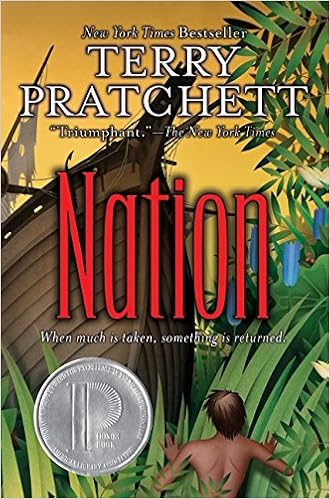
Nation, by Sir Terry Pratchett
This week I'm taking a look at one of Pratchett's stand-alone novels, Nation, which is set in an alternate universe Earth in the Great Pelagic Ocean which is like the South Pacific, but different! Although the fact it's an alternate universe doesn't factor in as greatly until you get towards the end of the book, but I digress. Overall this is very much a Pratchett book because it manages to simultaneously be funny with that dry English wit Pratchett specializes in, while also being immensely philosophical as well. In some ways I think it's a good way to introduce people to Pratchett without overwhelming them with the complex cast of characters found in Discworld.
The plot centers mostly around Mau, a boy from an island referred to only as the Nation who is finishing his ritual stay on the Boys Island and is returning home to complete his coming of age ritual. However his world is swept away, very literally, when a great tsunami washes through the Mothering Sunday Islands, devastating the entire island chain. Mau is forced to find a way to survive in a world devoid of people, although that begins to change when first he discovers a mysterious white girl, the survivor of a ship that's been tossed onto the Nation. After the initial misunderstandings they start working together, although things become much more complicated when other people begin turning up on the island as well.
As a Pratchett book this is actually pretty standard for him, and I don't mean that disparagingly. It's quite a good book and he deals with topics such as religion, science, politics, the seething trouble that is humanity providing his own humanistic philosophy towards everything. But for me personally, who's read almost everything else he's written, it's hardly anything new to me. As an avid Pratchett fan I have been exposed numerous times to his philosophy and it's certainly affected my thinking quite a bit. But after reading it so many times it starts to get a little preachy. Again, this isn't to say that his philosophy is bad or anything, I actually agree with quite a lot of it, but for me it kind of feels like more of the same at this point rather than something new.
I think if I were to recommend this book to anyone, I'd recommend it to people who don't feel like they could commit to reading Discworld. I will admit that with it being such a long-running and complicated series it's a little intimidating to know where to begin. Nation however is a stand-alone novel and it's not overly long so I think it'd be less intimidating for the casual reader. Especially those poor deluded souls who look down on fantasy as being an inferior genre. While Pratchett's other books have gone into matters like law, politics, religion, and stories in greater detail, Nation talks about everything a little more generally so I think it's a nice eclectic selection of his personal philosophy. If you ever wanted to read about the ideas of what may be considered one of the greatest humanist philosophers in recent times, Nation is a very good way to do that.
Otherwise, if you've read Discworld and you're familiar with Pratchett's personal philosophy I think you'll find this is very much the same stuff. It's good stuff! But still the same.
- Kalpar
The plot centers mostly around Mau, a boy from an island referred to only as the Nation who is finishing his ritual stay on the Boys Island and is returning home to complete his coming of age ritual. However his world is swept away, very literally, when a great tsunami washes through the Mothering Sunday Islands, devastating the entire island chain. Mau is forced to find a way to survive in a world devoid of people, although that begins to change when first he discovers a mysterious white girl, the survivor of a ship that's been tossed onto the Nation. After the initial misunderstandings they start working together, although things become much more complicated when other people begin turning up on the island as well.
As a Pratchett book this is actually pretty standard for him, and I don't mean that disparagingly. It's quite a good book and he deals with topics such as religion, science, politics, the seething trouble that is humanity providing his own humanistic philosophy towards everything. But for me personally, who's read almost everything else he's written, it's hardly anything new to me. As an avid Pratchett fan I have been exposed numerous times to his philosophy and it's certainly affected my thinking quite a bit. But after reading it so many times it starts to get a little preachy. Again, this isn't to say that his philosophy is bad or anything, I actually agree with quite a lot of it, but for me it kind of feels like more of the same at this point rather than something new.
I think if I were to recommend this book to anyone, I'd recommend it to people who don't feel like they could commit to reading Discworld. I will admit that with it being such a long-running and complicated series it's a little intimidating to know where to begin. Nation however is a stand-alone novel and it's not overly long so I think it'd be less intimidating for the casual reader. Especially those poor deluded souls who look down on fantasy as being an inferior genre. While Pratchett's other books have gone into matters like law, politics, religion, and stories in greater detail, Nation talks about everything a little more generally so I think it's a nice eclectic selection of his personal philosophy. If you ever wanted to read about the ideas of what may be considered one of the greatest humanist philosophers in recent times, Nation is a very good way to do that.
Otherwise, if you've read Discworld and you're familiar with Pratchett's personal philosophy I think you'll find this is very much the same stuff. It's good stuff! But still the same.
- Kalpar
Thursday, October 15, 2015
The Carpet People, by Sir Terry Pratchett
This week I'm reviewing what's often referred to as PTerry's first novel, The Carpet People. There actually is a little bit of background for this novel which was originally published back in 1971 by a much younger Sir PTerry. The edition which I read is a reprinting from 2013 which includes illustrations made by PTerry, but perhaps more importantly it's also been rewritten. By PTerry's own admission in the introduction to this edition the original version of The Carpet People wasn't very good. And quite frankly I can't blame him. Early books tend to be very rough around the edges and it can take a while for an author to find their voice. In addition, PTerry began work on The Carpet People when he was 17 and it was first published when he was in his twenties. Even if you're the greatest writer in the world, the stuff that you write when you're a teenager isn't going to be as good as the stuff that you write later on. So while I'm not entirely sure what the original version of this book contained, I've been informed that it was basically Lord of the Rings, but on a carpet so I'm very much in favor of a rewriting of the novel along more Pratchett lines.
To provide a summary of the plot, the entire story takes place on a carpet, inhabited by tiny people and animals. So tiny that one of their major cities is about the same size as the period at the end of this sentence. The story focuses largely on a tribe known as the Munrungs whose village is destroyed by a mysterious force known only as the Fray. (What the Fray is is never explained in the book so theories abound.) Once their village is destroyed they begin being attacked by creatures known as Mouls, who apparently worship the Fray and are determined to spread death and destruction across the Carpet. Again, the motivations of the Moul don't go much beyond they're a bunch of jerks and I kind of wish they'd been more developed. Anyway the Munrungs wander across the Carpet trying to avoid Mouls, the Fray, and find somewhere safe to live and discovering things may be much worse than they thought.
For me, this book feels kind of underdeveloped, but it may be because it's meant for children. It definitely has a very easy reading style and it's very easy to read through it quickly, so I think that may be intentional on the part of the author. It has a very unpolished feel to it as well, which I expected for it being a first book, but it definitely has the distinctive PTerry feel to it as well. There are a lot of lessons and themes in this particular book which have turned up in Discworld books as well so it definitely feels as part of Pratchett's work. In addition, the idea of little people was explored again in his Bromeliad trilogy which results in a book that feels like an unpolished example of the author's work.
Overall this book is pretty good, but it definitely has that unpolished feeling and I wish that some of the ideas or topics that PTerry brought up in this particular novel were explored a little more, but we can't have everything we want. Definitely a good book for younger readers and I highly recommend it for them.
- Kalpar
To provide a summary of the plot, the entire story takes place on a carpet, inhabited by tiny people and animals. So tiny that one of their major cities is about the same size as the period at the end of this sentence. The story focuses largely on a tribe known as the Munrungs whose village is destroyed by a mysterious force known only as the Fray. (What the Fray is is never explained in the book so theories abound.) Once their village is destroyed they begin being attacked by creatures known as Mouls, who apparently worship the Fray and are determined to spread death and destruction across the Carpet. Again, the motivations of the Moul don't go much beyond they're a bunch of jerks and I kind of wish they'd been more developed. Anyway the Munrungs wander across the Carpet trying to avoid Mouls, the Fray, and find somewhere safe to live and discovering things may be much worse than they thought.
For me, this book feels kind of underdeveloped, but it may be because it's meant for children. It definitely has a very easy reading style and it's very easy to read through it quickly, so I think that may be intentional on the part of the author. It has a very unpolished feel to it as well, which I expected for it being a first book, but it definitely has the distinctive PTerry feel to it as well. There are a lot of lessons and themes in this particular book which have turned up in Discworld books as well so it definitely feels as part of Pratchett's work. In addition, the idea of little people was explored again in his Bromeliad trilogy which results in a book that feels like an unpolished example of the author's work.
Overall this book is pretty good, but it definitely has that unpolished feeling and I wish that some of the ideas or topics that PTerry brought up in this particular novel were explored a little more, but we can't have everything we want. Definitely a good book for younger readers and I highly recommend it for them.
- Kalpar
Thursday, September 10, 2015
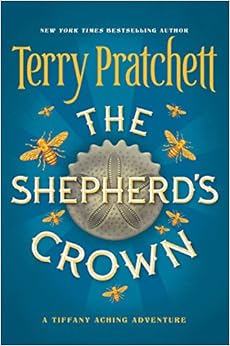
The Shepherd's Crown, by Sir Terry Pratchett
Hello, everyone. I'm messing with the schedule a little this week because I received my preordered copy of The Shepherd's Crown the other day and managed to read through it rather quickly so I wanted to get a review out to everyone this Thursday. As my readers are probably aware, The Shepherd's Crown is the last novel from Sir PTerry, published posthumously after his death this past March. As such it feels very much like an end to the adventure of Discworld, as well as a personal farewell from Pratchett himself. And in a way we get to see how the Disc has changed over the years from parody of swords and sorcery to its own blend of magitek. I for one greatly enjoyed this book and I think it will bring a tear to the eye of more than one Discworld fan.
This is another Tiffany Aching adventure so we get to follow Tiffany as she comes into her own as a witch. The previous books have been about her training and learning what being a witch is really about, and by the time we get to Shepherd's Crown Tiffany is undoubtedly a full-fledged witch. Granted, she is struggling with the levels of responsibility that being a witch entails, but a tremendous number of people have great faith in her. However, as always, there are far greater problems afoot. It seems the elves are trying to return to the Disc once again, wishing to take their place as the "rightful" rulers. It will fall to Tiffany and the other witches to bring the fight to the elves.
Long-time readers of Discworld will remember that the elves have been dealt with before, in both Lords and Ladies and The Wee Free Men, so it makes sense for the elves to desire revenge. However, there is something almost idiotic in their desire to return to the Disc to spread terror. As the King of Elves said in Lords and Ladies, there was too much iron in the world then. And not just iron that people produced, there was iron in people's minds, which is why they got driven back to where they came from. And if it was bad enough back then, what about the Disc now? There are railroads on the Disc now, thanks to Raising Steam, practically the spirit of iron made manifest! In a world ruled by iron the elves are doomed to failure from the start. So in a way, I felt like the elves plot was almost a minor inconvenience compared to Tiffany struggling with being a fully-fledged witch and the transition to adulthood. It's still a good story, I was just smirking the entire time because I knew the elves were going to get it good this time.
I will also say that this book feels a little unfinished around the edges, like it's an earlier draft of what might be a much longer novel. And in the afterword they say basically that was Pratchett's entire process. He'd start writing a book, and then go back and add things, throw in details, link passages together, and if his publishers didn't pry the book away from him and run it off to the printers he probably never would have stopped tinkering with it. And so yes, I can see how it could have been extended a little bit here and there. But I feel that the decision to publish the book as-is, without someone else trying to expand on what Pratchett was trying to write, is a very respectful one and I'm very happy for the book we got, rather than no book at all.
As much as Raising Steam felt like a bit of a good-bye to the series for a lot of readers, The Shepherd's Crown feels like one as well. And personally it's a good-bye that I think we all needed. It's good to see some of our friends one last time, just to check up and see that everything's all right. And the Disc is there. The Disc will always be there, with things running along smoothly. The railroads and the clacks are bringing the Disc together, and even trolls and dwarfs are getting along together. And Tiffany Aching will be there, keeping an eye on the Chalk, calling in on people that get overlooked, making sure old men on their own have a hot meal every now and then. As much as I hate to leave the Disc behind, I think it's in good hands.
- Kalpar
This is another Tiffany Aching adventure so we get to follow Tiffany as she comes into her own as a witch. The previous books have been about her training and learning what being a witch is really about, and by the time we get to Shepherd's Crown Tiffany is undoubtedly a full-fledged witch. Granted, she is struggling with the levels of responsibility that being a witch entails, but a tremendous number of people have great faith in her. However, as always, there are far greater problems afoot. It seems the elves are trying to return to the Disc once again, wishing to take their place as the "rightful" rulers. It will fall to Tiffany and the other witches to bring the fight to the elves.
Long-time readers of Discworld will remember that the elves have been dealt with before, in both Lords and Ladies and The Wee Free Men, so it makes sense for the elves to desire revenge. However, there is something almost idiotic in their desire to return to the Disc to spread terror. As the King of Elves said in Lords and Ladies, there was too much iron in the world then. And not just iron that people produced, there was iron in people's minds, which is why they got driven back to where they came from. And if it was bad enough back then, what about the Disc now? There are railroads on the Disc now, thanks to Raising Steam, practically the spirit of iron made manifest! In a world ruled by iron the elves are doomed to failure from the start. So in a way, I felt like the elves plot was almost a minor inconvenience compared to Tiffany struggling with being a fully-fledged witch and the transition to adulthood. It's still a good story, I was just smirking the entire time because I knew the elves were going to get it good this time.
I will also say that this book feels a little unfinished around the edges, like it's an earlier draft of what might be a much longer novel. And in the afterword they say basically that was Pratchett's entire process. He'd start writing a book, and then go back and add things, throw in details, link passages together, and if his publishers didn't pry the book away from him and run it off to the printers he probably never would have stopped tinkering with it. And so yes, I can see how it could have been extended a little bit here and there. But I feel that the decision to publish the book as-is, without someone else trying to expand on what Pratchett was trying to write, is a very respectful one and I'm very happy for the book we got, rather than no book at all.
As much as Raising Steam felt like a bit of a good-bye to the series for a lot of readers, The Shepherd's Crown feels like one as well. And personally it's a good-bye that I think we all needed. It's good to see some of our friends one last time, just to check up and see that everything's all right. And the Disc is there. The Disc will always be there, with things running along smoothly. The railroads and the clacks are bringing the Disc together, and even trolls and dwarfs are getting along together. And Tiffany Aching will be there, keeping an eye on the Chalk, calling in on people that get overlooked, making sure old men on their own have a hot meal every now and then. As much as I hate to leave the Disc behind, I think it's in good hands.
- Kalpar
Thursday, March 19, 2015
Im Memoriam: Sir Terry Pratchett and Discworld
For those that know me, the Discworld series has been incredibly important in my life. Heck, I've written reviews about not only main Discworld books, but also an illustrated novel, and the young adult stories as well, probably in some hope that someone else out there, reading my blog, who hasn't picked up these books yet will. Discworld is important on so many levels. Something I've noticed is that many people who read usually have at least one book, something that hit them the right way at the right time and spoke to their very soul, the very essence of their being. A book that has somehow shaped who they are as a person and how they view life. I am very fortunate in that I cannot point to just one book that has influenced me in such a way, but an entire series.
My experience with Discworld began ages ago when I was a sophomore in college. My friend Brendan, who shares a great many interests to me as I do, one day passed a book onto me titled Small Gods. Being someone who tries to read books loaned to me in a timely manner, and finding myself with a little free time between classes I started reading it. And kept reading it, finding it incredibly compelling and incredibly difficult to put down. I am by my own admission, a fairly fast reader, but it has often been very rare for me to find a book that just grabbed me by, for lack of a better term, the soul and made me want to keep reading. I cannot recall exactly how quickly I read Small Gods, but I'm certain it was no more than a matter of days. Brendan soon afterward loaned me Night Watch, which has become one of my favorite books, and that summer I started collecting Discworld books like crazy. By my start of junior year I had a respectable collection. Within two years I had nearly all of them. I actually made it a goal to read all the main Discworld books by the time Snuff came out late in 2011. And while there are certain books in the series I don't care for, and certain books that I cherish, overall I would say Discworld has had a positive impact on my life. If nothing else than because one person decided to be my friend because, "He's sitting over there reading a Pratchett book, he seems interesting."
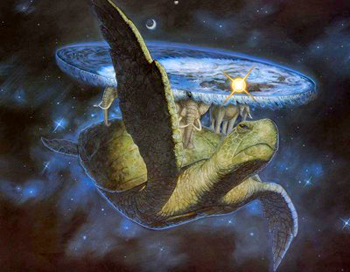
Because Discworld has long since gone beyond just being a satirical take on well-worn fantasy tropes. It certainly started that way in Colour of Magic, but it grew and became so much more over the years. Pratchett has tackled topics as divisive as politics and religion, commented on economics and law, and some would argue that he has created a modern school of philosophy through the lens of fantasy. And yes, they are silly stories about a world on the backs of four elephants on the back of a turtle, but at the same time they're stories about people as well, and as I'm sure Pratchett himself would say, one of the most powerful ways to shape people is through stories. Whether it be stories about the long and distant past, stories about the here and now, or stories about life on the Disc, when stories are about people they have the ability to shape people, for better or worse, and that's an incredible power.
So what have I learned from the five or so years I've spent exploring the Disc? Essentially, people are people. We can be downright selfish and terrible, or charitable to a fault and good. Sometimes within the same day. And maybe you can't solve all the world's problems. But the important thing is to give your best and try. And while it's sad that Pratchett has passed on, he will remain with us in his dozens of books, and hopefully influence generations of people, and how they think, for the better.
- Kalpar
My experience with Discworld began ages ago when I was a sophomore in college. My friend Brendan, who shares a great many interests to me as I do, one day passed a book onto me titled Small Gods. Being someone who tries to read books loaned to me in a timely manner, and finding myself with a little free time between classes I started reading it. And kept reading it, finding it incredibly compelling and incredibly difficult to put down. I am by my own admission, a fairly fast reader, but it has often been very rare for me to find a book that just grabbed me by, for lack of a better term, the soul and made me want to keep reading. I cannot recall exactly how quickly I read Small Gods, but I'm certain it was no more than a matter of days. Brendan soon afterward loaned me Night Watch, which has become one of my favorite books, and that summer I started collecting Discworld books like crazy. By my start of junior year I had a respectable collection. Within two years I had nearly all of them. I actually made it a goal to read all the main Discworld books by the time Snuff came out late in 2011. And while there are certain books in the series I don't care for, and certain books that I cherish, overall I would say Discworld has had a positive impact on my life. If nothing else than because one person decided to be my friend because, "He's sitting over there reading a Pratchett book, he seems interesting."
Because Discworld has long since gone beyond just being a satirical take on well-worn fantasy tropes. It certainly started that way in Colour of Magic, but it grew and became so much more over the years. Pratchett has tackled topics as divisive as politics and religion, commented on economics and law, and some would argue that he has created a modern school of philosophy through the lens of fantasy. And yes, they are silly stories about a world on the backs of four elephants on the back of a turtle, but at the same time they're stories about people as well, and as I'm sure Pratchett himself would say, one of the most powerful ways to shape people is through stories. Whether it be stories about the long and distant past, stories about the here and now, or stories about life on the Disc, when stories are about people they have the ability to shape people, for better or worse, and that's an incredible power.
So what have I learned from the five or so years I've spent exploring the Disc? Essentially, people are people. We can be downright selfish and terrible, or charitable to a fault and good. Sometimes within the same day. And maybe you can't solve all the world's problems. But the important thing is to give your best and try. And while it's sad that Pratchett has passed on, he will remain with us in his dozens of books, and hopefully influence generations of people, and how they think, for the better.
- Kalpar
Thursday, February 26, 2015
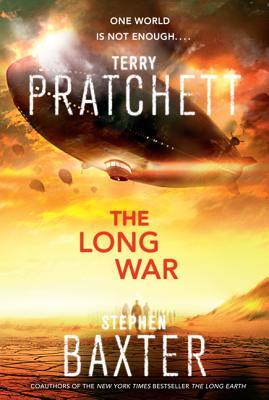
The Long War, by Terry Pratchett and Stephen Baxter
This week I've returned to the Long Earth with the sequel, The Long War. As you may remember in my review of The Long Earth, I was a little dissatisfied with the preceding book. However, I am usually one to give something a second try, especially after the first book because it might take a while for a series to find its stride. Unfortunately, The Long War simply wasn't it. With the series continuing in The Long Mars, I find myself not terribly interested in seeing where this series is going, and I'll try to explain why. But despite the enormous potential of this series it just continues to fail to deliver and the result is unsatisfying to say the least.
As you may recall, The Long Earth introduced us to the concept of a series of worlds, perhaps an infinity of worlds, similar but different to our own Earth, that can be reached simply through the use of a device known as a Stepper. Instead of being confined to a single world with a degrading ecosystem and diminishing resources, humanity now has access to millions of verdant worlds with practically unlimited resources. Suddenly the solution to all the pressures of humanity are literally just a step away. To be honest, the existence of a nearly infinite supply of worlds and resources poses interesting social, economic, and political questions and it would be interesting to see how humanity responds. (As well as the discovery that we are not alone and we have sapient hominid cousins throughout the Long Earth.)
Although initially ambitious, and promising to investigate several really interesting ideas about how the Long Earth would reshape society, The Long War spreads out too quickly and suffers from an incredible lack of focus. There are something in the neighborhood of five or six different plots going on in The Long War, ranging from the distant "colonies" of the outer worlds demanding equal treatment and representation in old Datum Earth's government, to humanity's treatment of the trolls, to China's expedition to the world of East 20,000,000. I almost feel like this is akin to a Philip K. Dick novel where there are a ton of interesting ideas presented but the authors go off into a lot of different directions instead of focusing on one story. I think if the authors had focused on one story for this novel, instead of splitting attention between five or six different plotlines, it would have resulted in a more coherent story overall. The result is a muddled mess of five different stories, none of which were developed or resolved much to my satisfaction.
Another thing I noticed, although this seemed to get better as the book went on, was a lot of things happened off-screen or were told in past tense or passive voice. It would have been interesting to see the rebellion against the Datum government develop as the pioneer's rights were slowly stripped away by a government pandering to increasingly xenophobic masses at home. Instead we're told about it after the fact as background material. Again, it's something I really noticed in the beginning of the book, and this may be because the authors decided to jump forward ten years from the ending of Long Earth so they had to cram in exposition somewhere, but it's pretty unsatisfying on my end.
For me the greatest sin of The Long War was that it became boring. An infinity of Earths for humanity to explore, colonize, and fight over offers practically limitless potential for numerous interesting stories. Unfortunately five plots which could have been interesting if properly developed in their own direction, become five lackluster plots that I ended up not caring terribly much about. I honestly found myself over 80% of the way through the book and just saying to myself, "Oh my god, when will this be over?" Instead of getting excited I just found myself bored, something you never want to be when you're reading a book.
I'll be honest, I'm probably not going to read The Long Mars because I have a very strong feeling it's going to be more of the same. As much as I love Terry Pratchett, this just doesn't seem to be his best work. I personally do not know much about Stephen Baxter and I may want to look at his books in the future, but I feel like this particular collaboration of authors simply isn't working.
- Kalpar
As you may recall, The Long Earth introduced us to the concept of a series of worlds, perhaps an infinity of worlds, similar but different to our own Earth, that can be reached simply through the use of a device known as a Stepper. Instead of being confined to a single world with a degrading ecosystem and diminishing resources, humanity now has access to millions of verdant worlds with practically unlimited resources. Suddenly the solution to all the pressures of humanity are literally just a step away. To be honest, the existence of a nearly infinite supply of worlds and resources poses interesting social, economic, and political questions and it would be interesting to see how humanity responds. (As well as the discovery that we are not alone and we have sapient hominid cousins throughout the Long Earth.)
Although initially ambitious, and promising to investigate several really interesting ideas about how the Long Earth would reshape society, The Long War spreads out too quickly and suffers from an incredible lack of focus. There are something in the neighborhood of five or six different plots going on in The Long War, ranging from the distant "colonies" of the outer worlds demanding equal treatment and representation in old Datum Earth's government, to humanity's treatment of the trolls, to China's expedition to the world of East 20,000,000. I almost feel like this is akin to a Philip K. Dick novel where there are a ton of interesting ideas presented but the authors go off into a lot of different directions instead of focusing on one story. I think if the authors had focused on one story for this novel, instead of splitting attention between five or six different plotlines, it would have resulted in a more coherent story overall. The result is a muddled mess of five different stories, none of which were developed or resolved much to my satisfaction.
Another thing I noticed, although this seemed to get better as the book went on, was a lot of things happened off-screen or were told in past tense or passive voice. It would have been interesting to see the rebellion against the Datum government develop as the pioneer's rights were slowly stripped away by a government pandering to increasingly xenophobic masses at home. Instead we're told about it after the fact as background material. Again, it's something I really noticed in the beginning of the book, and this may be because the authors decided to jump forward ten years from the ending of Long Earth so they had to cram in exposition somewhere, but it's pretty unsatisfying on my end.
For me the greatest sin of The Long War was that it became boring. An infinity of Earths for humanity to explore, colonize, and fight over offers practically limitless potential for numerous interesting stories. Unfortunately five plots which could have been interesting if properly developed in their own direction, become five lackluster plots that I ended up not caring terribly much about. I honestly found myself over 80% of the way through the book and just saying to myself, "Oh my god, when will this be over?" Instead of getting excited I just found myself bored, something you never want to be when you're reading a book.
I'll be honest, I'm probably not going to read The Long Mars because I have a very strong feeling it's going to be more of the same. As much as I love Terry Pratchett, this just doesn't seem to be his best work. I personally do not know much about Stephen Baxter and I may want to look at his books in the future, but I feel like this particular collaboration of authors simply isn't working.
- Kalpar
Thursday, June 5, 2014
Raising Steam, by Terry Pratchett
First, before I begin, I'd just like to say something for those of you who aren't aware....
*cough* Anyway, moving on....
This week I've finally read Terry Pratchett's latest Discworld novel, Raising Steam, in which the Disc finally moves out of the world of high fantasy into the world of steampuk with the arrival of the Disc's first steam-powered railroad. Needless to say, I was super excited about this particular novel and was happy to see my old friend Moist as a focal character once again, although the story isn't really about Moist von Lipwig as it is about the railway itself and everything it brings.
The subject material is, especially for me, fun. We get to see Dick Simnel become the Disc's first engineer, relying upon his trusty slide rule and his precise measurements, so that he can develop the first steam locomotive. He then comes to Ankh-Morpork and Harry King, one of the most wealthy men in the city, and with the cunning help of Moist they begin construction of probably the greatest project the Disc has ever seen. Of course, I wouldn't be doing my job as a reviewer if I didn't find something to constructively criticize about this novel, although personally I do worry that I'm turning into one of those fans that isn't entirely happy with new works because they're different.
Aside from the railway story, Raising Steam also deals with an internal religious schism among the dwarfs. The grags and the other deep-downers, which we had seen in Thud!, are causing trouble once again and have begun attacking people they consider to be not "truly dwarfish", as well as burning down the clacks system that has become so important for communication across the Disc. The Low King of the Dwarfs is particularly frustrated because it threatens to undo all the good work he has done with Lord Vetinari and Diamond King of Trolls. The plot is....interesting, but the jumping between plots is rather confusing in the very early parts of the books. Pratchett has written books, Hogfather being probably the best example, where multiple narratives occur throughout the book and eventually become sewn together in the novel's finale. It probably makes more sense on re-reading, but it makes the book feel extremely disjointed in the first hundred or so pages of the novel.
Personally my other big criticism of the novel is that things involving the railway frequently happen off-camera so to speak. We get to see Dick Simnel bring his idea to Ankh-Morpork, and working out the initial details with Harry King. Eventually they build a line from Ankh-Morpork to Sto Lat and it's opened with great fanfare, and then daily traffic between the two cities becomes common place. Eventually the railway's lines expand across the continent, heading towards distant Uberwald, and we see only slight fragments of this. Dick Simnel develops new technologies, builds new engines, and an entire railway culture is developed. Yet we see much of this in passing, if we see it at all. It's probably because I'm a Rail Enthusiast myself, but I really wanted to see how the railway was going to develop on the Disc in much more detail. Perhaps it wouldn't have been as interesting to outsiders, but I think Pratchett made even the post office seem interesting in Going Postal, so I think he could have risen to the challenge.
Aside from my complaints, is the novel good? Oh definitely. If you're already a frequent traveler to the Disc then I'd highly recommend you hop on the Ankh-Morpork and Sto Plains Hygenic Railway. If you're new, I'd suggest starting earlier in the series so you can build up some steam before tackling this novel. (And no, I refuse to apologize for that pun.)
....I like trains.
- Kalpar
*cough* Anyway, moving on....
This week I've finally read Terry Pratchett's latest Discworld novel, Raising Steam, in which the Disc finally moves out of the world of high fantasy into the world of steampuk with the arrival of the Disc's first steam-powered railroad. Needless to say, I was super excited about this particular novel and was happy to see my old friend Moist as a focal character once again, although the story isn't really about Moist von Lipwig as it is about the railway itself and everything it brings.
The subject material is, especially for me, fun. We get to see Dick Simnel become the Disc's first engineer, relying upon his trusty slide rule and his precise measurements, so that he can develop the first steam locomotive. He then comes to Ankh-Morpork and Harry King, one of the most wealthy men in the city, and with the cunning help of Moist they begin construction of probably the greatest project the Disc has ever seen. Of course, I wouldn't be doing my job as a reviewer if I didn't find something to constructively criticize about this novel, although personally I do worry that I'm turning into one of those fans that isn't entirely happy with new works because they're different.
Aside from the railway story, Raising Steam also deals with an internal religious schism among the dwarfs. The grags and the other deep-downers, which we had seen in Thud!, are causing trouble once again and have begun attacking people they consider to be not "truly dwarfish", as well as burning down the clacks system that has become so important for communication across the Disc. The Low King of the Dwarfs is particularly frustrated because it threatens to undo all the good work he has done with Lord Vetinari and Diamond King of Trolls. The plot is....interesting, but the jumping between plots is rather confusing in the very early parts of the books. Pratchett has written books, Hogfather being probably the best example, where multiple narratives occur throughout the book and eventually become sewn together in the novel's finale. It probably makes more sense on re-reading, but it makes the book feel extremely disjointed in the first hundred or so pages of the novel.
Personally my other big criticism of the novel is that things involving the railway frequently happen off-camera so to speak. We get to see Dick Simnel bring his idea to Ankh-Morpork, and working out the initial details with Harry King. Eventually they build a line from Ankh-Morpork to Sto Lat and it's opened with great fanfare, and then daily traffic between the two cities becomes common place. Eventually the railway's lines expand across the continent, heading towards distant Uberwald, and we see only slight fragments of this. Dick Simnel develops new technologies, builds new engines, and an entire railway culture is developed. Yet we see much of this in passing, if we see it at all. It's probably because I'm a Rail Enthusiast myself, but I really wanted to see how the railway was going to develop on the Disc in much more detail. Perhaps it wouldn't have been as interesting to outsiders, but I think Pratchett made even the post office seem interesting in Going Postal, so I think he could have risen to the challenge.
Aside from my complaints, is the novel good? Oh definitely. If you're already a frequent traveler to the Disc then I'd highly recommend you hop on the Ankh-Morpork and Sto Plains Hygenic Railway. If you're new, I'd suggest starting earlier in the series so you can build up some steam before tackling this novel. (And no, I refuse to apologize for that pun.)
....I like trains.
- Kalpar
Thursday, November 14, 2013
The Bromeliad Trilogy, by Terry Pratchett
This week I've decided to review Sir Terry Pratchett's Bromeliad Trilogy, which is actually an anthology of three books titled Truckers, Diggers, and Wings. This is not a Discworld novel and is actually set in our own universe, but it still comes with the classic Pratchett wit and insight. I was overall pretty satisfied with this book, as I usually am with Pratchett's writing, however I felt like this book could have used some more time to develop. Definitely worth your time to read, and like the other Pratchett young-adult novels I've read it's good for the whole family because it asks some really tough questions that even adults can have trouble with.
In my opinion Bromeliad really isn't three books in a series, it's instead one large book divided into three segments, and if you're going to read this I'd recommend getting the anthology version where all three are bound in one volume because you feel how the whole story is connected together. This is especially true in the case of Diggers and Wings where Diggers tells the beginning and one half of the middle of a story while Wings tells the other half of the middle and then the end. If you read these as separate novels, and especially if you space time between reading them, then there's a good chance that you'll lose track of part of the plot, so I'd definitely recommend taking all of it at one go. And, as with a lot of Pratchett's works, the reading flows rather easily so I think even younger kids would be able to tackle the whole thing.
My main issue with this book is that the pacing feels terribly rushed and I felt like there wasn't a lot of time for ideas to develop. Just to provide an example, within the first two chapter's you're introduced to the fact that nomes, humanoid creatures approximately four inches tall, exist and live on the edges of human society. You're also introduced to the fact that an entire civilization of nomes lives within a department store and thinks that the store comprises the entirety of the known universe. Finally it's revealed that the nomes actually crash landed on our planet fifteen thousand years ago and are aliens from outer space. Again, all of this is within the first two chapters. To establish all of that an author might take half a book, but you're barely into the Bromeliad and all of that gets unloaded on you. And the speed doesn't diminish from there; although the driving plot is the desire of the nomes to "Go home and be safe" , events proceed at an almost breakneck pace.
Indeed, Bromeliad only clocks in at five hundred pages and is still feels on the light side for all the issues that it touches upon. If Pratchett had added another one or two hundred pages of development I think this book would be just about the right length. I think that there might be a good reason for this book feeling rather fast, because nomes live at a much faster pace than we do, although it seems a normal length of time for them by comparison. Perhaps, then, since we are humans reading about nomes the fast pace is to further emphasize the disconnect between our two species. However, as Bromeliad stands it's still an excellent piece of literature and reveals a lot about the nomish (and even human!) condition.
I think the biggest thing about this novel, and I feel like this holds true for all of Pratchett's young adult novels, is that it doesn't talk down to kids or feed them something too simple. Yes there are plenty of works with fairly simple storylines that enjoy great popularity. Pretty much any story that follows the monomyth is going to have familiar archetypes and stick to a semi-familiar pattern, and there are a lot of good examples to that. However, that isn't the only story to be told and sometimes you have to talk about things more complex, such as when there's no bad guys, just people who don't know the consequences of their actions, like in the Bromeliad. Plus, this novel tackles tough issues such as theology and our place in the universe and it doesn't really give any answers, which I think was a good choice on Pratchett's part. When you get right down to it with matters like theology or the universe there's a lot we still don't know and probably can't know and the important thing is to keep asking questions and never get stuck believing things are the way they are because someone else told you. Philosophically I think the book raises more questions than it answers and it's a very good book to challenge a lot of assumptions people might have, especially young people.
Overall a really good book that I enjoyed in spite of its fast pace and potential for more development. Another good read for the family.
- Kalpar
In my opinion Bromeliad really isn't three books in a series, it's instead one large book divided into three segments, and if you're going to read this I'd recommend getting the anthology version where all three are bound in one volume because you feel how the whole story is connected together. This is especially true in the case of Diggers and Wings where Diggers tells the beginning and one half of the middle of a story while Wings tells the other half of the middle and then the end. If you read these as separate novels, and especially if you space time between reading them, then there's a good chance that you'll lose track of part of the plot, so I'd definitely recommend taking all of it at one go. And, as with a lot of Pratchett's works, the reading flows rather easily so I think even younger kids would be able to tackle the whole thing.
My main issue with this book is that the pacing feels terribly rushed and I felt like there wasn't a lot of time for ideas to develop. Just to provide an example, within the first two chapter's you're introduced to the fact that nomes, humanoid creatures approximately four inches tall, exist and live on the edges of human society. You're also introduced to the fact that an entire civilization of nomes lives within a department store and thinks that the store comprises the entirety of the known universe. Finally it's revealed that the nomes actually crash landed on our planet fifteen thousand years ago and are aliens from outer space. Again, all of this is within the first two chapters. To establish all of that an author might take half a book, but you're barely into the Bromeliad and all of that gets unloaded on you. And the speed doesn't diminish from there; although the driving plot is the desire of the nomes to "Go home and be safe" , events proceed at an almost breakneck pace.
Indeed, Bromeliad only clocks in at five hundred pages and is still feels on the light side for all the issues that it touches upon. If Pratchett had added another one or two hundred pages of development I think this book would be just about the right length. I think that there might be a good reason for this book feeling rather fast, because nomes live at a much faster pace than we do, although it seems a normal length of time for them by comparison. Perhaps, then, since we are humans reading about nomes the fast pace is to further emphasize the disconnect between our two species. However, as Bromeliad stands it's still an excellent piece of literature and reveals a lot about the nomish (and even human!) condition.
I think the biggest thing about this novel, and I feel like this holds true for all of Pratchett's young adult novels, is that it doesn't talk down to kids or feed them something too simple. Yes there are plenty of works with fairly simple storylines that enjoy great popularity. Pretty much any story that follows the monomyth is going to have familiar archetypes and stick to a semi-familiar pattern, and there are a lot of good examples to that. However, that isn't the only story to be told and sometimes you have to talk about things more complex, such as when there's no bad guys, just people who don't know the consequences of their actions, like in the Bromeliad. Plus, this novel tackles tough issues such as theology and our place in the universe and it doesn't really give any answers, which I think was a good choice on Pratchett's part. When you get right down to it with matters like theology or the universe there's a lot we still don't know and probably can't know and the important thing is to keep asking questions and never get stuck believing things are the way they are because someone else told you. Philosophically I think the book raises more questions than it answers and it's a very good book to challenge a lot of assumptions people might have, especially young people.
Overall a really good book that I enjoyed in spite of its fast pace and potential for more development. Another good read for the family.
- Kalpar
Thursday, August 22, 2013
The Amazing Maurice and His Educated Rodents, by Terry Pratchett
So, I had one more young-adult Discworld novel to read, which was actually the first young-adult Discword novel that Sir Terry wrote. The Amazing Maurice and His Educated Rodents in no way ties in with any of the other Discworld novels which is probably what is what I found to be so odd about this book. Almost every other Discworld book, except for the very early ones which have a very distinct character on their own, feel like you're on the Disc and part of a larger universe. Usually this is something very simple like familiar geographic landmarks, like the city of Ankh-Morpork or the Lancre highlands, or a familiar character like Lord Vetinari or Granny Weatherwax. Even in the first Tiffany Aching book, The Wee Free Men, it introduces the new location of the Chalk, but somehow ties it into the larger world of the Disc. I'm not saying that The Amazing Maurice is bad because it doesn't feel like a Discworld book, but if it weren't for the fact that the story happens entirely in Uberwald, I would have forgotten that this is a Discworld book.
Probably what confused me most about this book was its repeated insistence that stories aren't real and the real world doesn't follow story logic. Just as an example, in a story the third and youngest son who goes on a quest that his older two brothers have gone on and failed is guaranteed success because that's how stories work. In real life, the third son probably has no better chance than his brothers unless he has some sort of extra knowledge or an extra talent. Possible, yes, but definitely not guaranteed in any way. And in this respect I feel like the book is in conflict with itself because the characters openly state that the real world doesn't work like stories and they have to write their own destiny because the story won't help them. Despite the fact that in other books like Witches Abroad it is very clearly stated that the Disc runs on narrative causality and people get shaped by the story-magic that dominates the Disc. Granted, this being Discworld there are subversions of the archetypes and tropes, but the stories still follow a familiar format. Heck, in The Last Hero Cohen and his Silver Horde succeed because they know how to manipulate the power of stories to their benefit. For the characters to be fighting against the forces of narrative, and at the same time benefiting from them, it made the book feel almost schizophrenic.
I also got the impression that the plot of this book ran along rather quickly and didn't really pick up until maybe a third of the book had gone by. This impression may be because I read this book rather quickly, but there was definitely a lot of time establishing the premise of talking rats and a talking cat who are all sapient before the real plot of the book got underway.
I will admit that this book was actually rather dark in tone, but I think it was still appropriate for children and definitely for young adults. I think it's also a reference to original fairy tales where the wicked are punished mercilessly and there's plenty of blood and gore. Granted, not a lot of blood and gore in this novel, but there are some pretty scary things in there too.
If the book didn't explicitly take place in Uberwald, I wouldn't categorize it as a Discworld book. And even then, the Uberwald in The Amazing Maurice is not the same as the Uberwald in The Fifth Elephant. There are no vampires, werewolves, Igors, or dramatic thunderclaps. It just...happens to be in a vaguely German village. But it's still an enjoyable book and I'd recommend it for fans of fantasy, but don't get your impressions of the Disc from this one book.
- Kalpar
Thursday, June 6, 2013
I Shall Wear Midnight, by Terry Pratchett
So I've finally reached the very last of the Tiffany Aching novels, and while it's a little sad to say farewell to a character I have come to consider to be a friend, at the same time I'm very happy for Tiffany and wish her all the best. (And really that speaks to the strength of Pratchett's writing that I can consider Tiffany to be incredibly real.) Like all Pratchett novels it comes bundled with his bountiful wit and excellent writing, while artfully handling serious topics that many of us deal with in our lives. I Shall Wear Midnight is definitely a book that adults can read with their children and, hopefully, have a very serious discussion about grief, evil, hatred, and jealousy.
As much as I enjoyed this book, I have to be completely honest in saying that the plot in this book isn't terribly different from the other three. There is a very powerful and very dangerous magical being which is out on the hunt for Tiffany and she has to face it more or less alone, but with a generous dose of help from other witches and the ever reliable Nac Mac Feegle. I did have a little doubt as to if Tiffany would make it out okay in this book, considering it's the (so-far) last one, but she's a really tough girl so I was pretty confident she'd make it through okay. And honestly, if all that was going on in this book I'd probably have a far lower recommendation for this novel like I did with Wintersmith. Fortunately, I Shall Wear Midnight explores new material and explores the very human emotions of jealousy and grief, as well as at least looking into what makes people do evil things in the name of righteousness.
As I mentioned in my Wintersmith review, it felt a lot like a retread of A Hat Full of Sky, where it covered the same ideas of taking responsibility and doing things because no one else will because that's what witches do. What I liked about I Shall Wear Midnight was that I got to see Tiffany Aching develop as a character and deal with her jealousy regarding Roland and his fiancee. Granted, as a reader I generally do not care for all that romantic nonsense, especially with teenage characters who tend to be petty, but Pratchett managed to write it in a manner I found rather palatable. I think one of Pratchett's greatest strengths is creating characters that feel incredibly real, and he made the envy of Tiffany very believable to me as a reader. I really think teenage readers would be able to connect with Tiffany because she's a very well-written and it's very easy to get inside her head and have a look around.
I'm kind of on the fence regarding the other plot that kind of addresses where evil comes from. Pratchett kind of slips in a bit at the end that the evil is always there inside of us just looking for an excuse to come out, but at the same time I got the impression that evil is a something....else out there that looks for a way to corrupt us. I take issue with this because in other books Pratchett is really good about saying that evil comes from within. To quote Pratchett's earlier work, Small Gods, "There are hardly any excesses of the most crazed psychopath that cannot be easily duplicated by a normal, kindly family man who just comes into work every day and has a job to do." And that's just one example of many other quotes from Discworld where Pratchett admits that there is the potential for evil in all of us if we just let the barriers that hold us back fall away. To suggest that part of it is something...other than us, a magical force beyond our control that makes us behave that way and it isn't our fault is just contrary to everything that Pratchett has said previously, even within the Tiffany Aching series. I'd hate to give people the impression that we're occasionally not responsible for our actions because that leads down a very dark path.
I thought this was a very good conclusion to the Tiffany Aching series and liked to see her develop as a character across the books. The reading level is simple enough that most young adults would be able to understand the concepts, but not so watered down that it's unbearable for adults. I think they would all be great books to share with your teenage children and hopefully spark some discussion about serious topics.
- Kalpar
Thursday, May 2, 2013
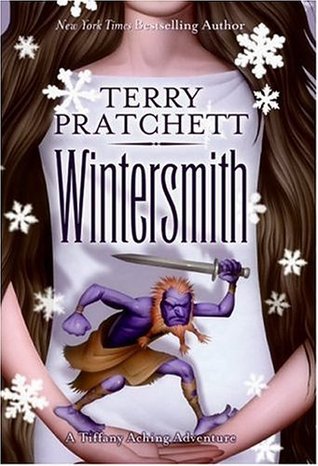
Wintersmith, by Terry Pratchett
I've decided to return to the Tiffany Aching series again this month with the novel Wintersmith which interesting coincides with the celebration of the Morris Dance which is celebrated through the English-speaking world as a celebration of the arrival of spring. However, since I'm writing this post in March with a foot of snow outside I cannot at this time be entirely certain spring will have arrived by the time this post goes live. If we have ended up with an unending winter and I'm the only one still alive then we are in serious trouble indeed. Hopefully, though, it won't come to that.
Overall, I have to admit that the plot of Wintersmith is not terribly different from Wee Free Men or Hat Full of Sky which makes for some repetitive reading. Tiffany gets wrapped up in events much bigger than she had expected and has to rely on the help of the Nac Mac Feegle and Granny Weatherwax to get her back out of trouble again. The only real difference I noticed was this time it's pretty much Tiffany's own damn fault that she got in trouble because she did something she shouldn't have done, which thirteen year olds tend to do, and now she has to reap the consequences. This time, however, Tiffany danced with the Wintersmith and if things aren't fixed by May then the whole world will be covered in endless winter.
The problem I had with this book, as you might have gleaned, isn't anything mechanical. As always with Pratchett the writing is excellent, the characters are well-rounded, and the plot is interesting. The problem I had was that it was the same plot and by this point I don't feel like Tiffany is growing as a character. Yes, in this book Tiffany is taking responsibility for something dumb she did (which I full-heartedly support) but that's been the theme of the last two books as well. Really, Tiffany only gives a sort of half-hearted "But I didn't mean to" before being forcefully reminded by Granny Weatherwax about what a witch is all about and she gets back to work. I actually found the limited glimpses of Roland's development as a character rather more interesting and wished I could have seen more of him in this story. I know that it's Tiffany's book but some development is better than none at all.
The other major theme, and this is a typical theme in Pratchett works, is the idea that some things have power merely because we give them power. While it's an interesting idea which I think is a good concept to introduce to young adults, I feel like Pratchett handled it a lot better in Hogfather and Small Gods, both of which could very easily be read by this age range as well so it doesn't add a lot to the novel. If your teenager hasn't read Discworld books other than Tiffany Aching then it'll at least be new to them, but as an old hand on the Disc it's the same stuff I've read elsewhere.
Overall, Wintersmith isn't a bad book and I thought it was very enjoyable. My problem was that it felt like it was a sequel written just for the sake of having a sequel rather than because Pratchett had new ground to cover. I'd still recommend it for up-and-coming Discworld readers and the maniacs like me who have to read every Discworld book, but everyone else can probably safely pass it by.
- Kalpar
Overall, I have to admit that the plot of Wintersmith is not terribly different from Wee Free Men or Hat Full of Sky which makes for some repetitive reading. Tiffany gets wrapped up in events much bigger than she had expected and has to rely on the help of the Nac Mac Feegle and Granny Weatherwax to get her back out of trouble again. The only real difference I noticed was this time it's pretty much Tiffany's own damn fault that she got in trouble because she did something she shouldn't have done, which thirteen year olds tend to do, and now she has to reap the consequences. This time, however, Tiffany danced with the Wintersmith and if things aren't fixed by May then the whole world will be covered in endless winter.
The problem I had with this book, as you might have gleaned, isn't anything mechanical. As always with Pratchett the writing is excellent, the characters are well-rounded, and the plot is interesting. The problem I had was that it was the same plot and by this point I don't feel like Tiffany is growing as a character. Yes, in this book Tiffany is taking responsibility for something dumb she did (which I full-heartedly support) but that's been the theme of the last two books as well. Really, Tiffany only gives a sort of half-hearted "But I didn't mean to" before being forcefully reminded by Granny Weatherwax about what a witch is all about and she gets back to work. I actually found the limited glimpses of Roland's development as a character rather more interesting and wished I could have seen more of him in this story. I know that it's Tiffany's book but some development is better than none at all.
The other major theme, and this is a typical theme in Pratchett works, is the idea that some things have power merely because we give them power. While it's an interesting idea which I think is a good concept to introduce to young adults, I feel like Pratchett handled it a lot better in Hogfather and Small Gods, both of which could very easily be read by this age range as well so it doesn't add a lot to the novel. If your teenager hasn't read Discworld books other than Tiffany Aching then it'll at least be new to them, but as an old hand on the Disc it's the same stuff I've read elsewhere.
Overall, Wintersmith isn't a bad book and I thought it was very enjoyable. My problem was that it felt like it was a sequel written just for the sake of having a sequel rather than because Pratchett had new ground to cover. I'd still recommend it for up-and-coming Discworld readers and the maniacs like me who have to read every Discworld book, but everyone else can probably safely pass it by.
- Kalpar
Thursday, January 24, 2013
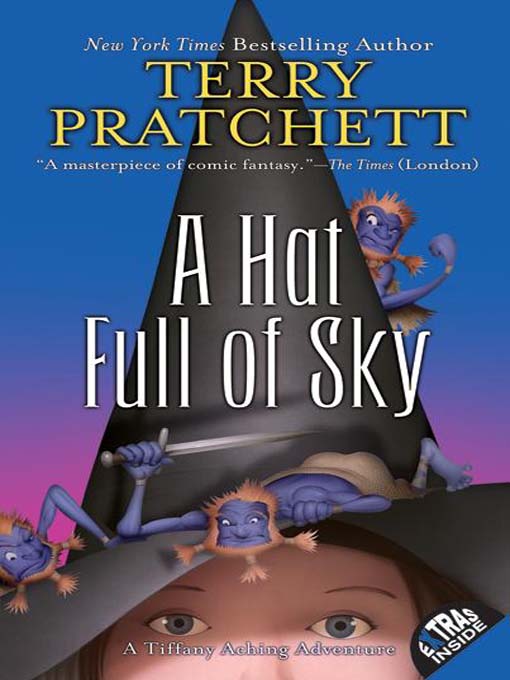
A Hat Full of Sky, by Terry Pratchett
So in my attempt to finish the rest of the Discworld series I am continuing with the Tiffany Aching series with the next installment, A Hat Full of Sky. In this novel Tiffany goes away from her family farm on the Chalk into the mountains to study witching with Miss Level. While Tiffany is learning that witchcraft is about far more than casting spells and riding broomsticks, it turns out that a very powerful creature known as a hiver is after Tiffany. No one's been able to fight off a hiver in the past, but with the help of Granny Weatherwax and the fearsome Nac Mac Feegle Tiffany might be the first.
Overall, I'm actually of mixed opinions of this book. On the one hand, I really liked seeing Tiffany again and seeing her learn what witchcraft is, but on the other hand I felt that this book retrod ground that has been covered before in the Discworld series. A major theme is witchcraft isn't about spells and magic amulets and wands, but about taking care of people when no one else will. While this is a pretty good message, I have to admit that a lot of these issues were covered in previous books like Lords and Ladies. I especially feel that the message that all the magic amulets, circles, and frooh-frah was very well covered in Lords and Ladies and I'm not sure why Pratchett decided to revisit it in this novel. If you're new to the Disc then I can see how this book would be a good introduction to what Discworld witches are really all about (especially for young adults) but for Disc veterans it felt very much like a retrod.
I had some difficulty with the larger plot of this book as well. As I mentioned, Tiffany is being chased by a hiver, a being which is incredibly powerful and no one has ever successfully defeated before. My concern mainly stemmed from Tiffany being one of the most powerful witches of all time which makes her a ripe target for the hiver. While I understand that without that specific threat then the plot would suffer significantly, I tend to get irritated with various eleven-year-olds being one of the most powerful witch/wizard/ Jedi/whatever evers. I know it's designed to appeal to the target demographic, but I just get so tired of there being so many most powerful evers who aren't old enough to shave. My other issue was kind of with Tiffany being able to (mostly) fight off a hiver through sheer force of will. (Although she had some help as well.) However, the more I thought about it, the more I realized that Sam Vimes also fought off a possessing demon through sheer willpower alone and so I decided I was okay with Tiffany using willpower to get through as well because it's at least possible within the universe.
If you've read Lords and Ladies I feel like you really could skip A Hat Full of Sky because it doesn't really cover anything that hasn't been covered in that book. If your teenagers are interested in starting reading about the Disc, though, then the Tiffany Aching series is still a great place to start. I definitely recommend you start with The Wee Free Men, though, because it helps to know something about Tiffany before jumping into her adventures.
- Kalpar
Overall, I'm actually of mixed opinions of this book. On the one hand, I really liked seeing Tiffany again and seeing her learn what witchcraft is, but on the other hand I felt that this book retrod ground that has been covered before in the Discworld series. A major theme is witchcraft isn't about spells and magic amulets and wands, but about taking care of people when no one else will. While this is a pretty good message, I have to admit that a lot of these issues were covered in previous books like Lords and Ladies. I especially feel that the message that all the magic amulets, circles, and frooh-frah was very well covered in Lords and Ladies and I'm not sure why Pratchett decided to revisit it in this novel. If you're new to the Disc then I can see how this book would be a good introduction to what Discworld witches are really all about (especially for young adults) but for Disc veterans it felt very much like a retrod.
I had some difficulty with the larger plot of this book as well. As I mentioned, Tiffany is being chased by a hiver, a being which is incredibly powerful and no one has ever successfully defeated before. My concern mainly stemmed from Tiffany being one of the most powerful witches of all time which makes her a ripe target for the hiver. While I understand that without that specific threat then the plot would suffer significantly, I tend to get irritated with various eleven-year-olds being one of the most powerful witch/wizard/ Jedi/whatever evers. I know it's designed to appeal to the target demographic, but I just get so tired of there being so many most powerful evers who aren't old enough to shave. My other issue was kind of with Tiffany being able to (mostly) fight off a hiver through sheer force of will. (Although she had some help as well.) However, the more I thought about it, the more I realized that Sam Vimes also fought off a possessing demon through sheer willpower alone and so I decided I was okay with Tiffany using willpower to get through as well because it's at least possible within the universe.
If you've read Lords and Ladies I feel like you really could skip A Hat Full of Sky because it doesn't really cover anything that hasn't been covered in that book. If your teenagers are interested in starting reading about the Disc, though, then the Tiffany Aching series is still a great place to start. I definitely recommend you start with The Wee Free Men, though, because it helps to know something about Tiffany before jumping into her adventures.
- Kalpar
Thursday, December 27, 2012
The Wee Free Men, by Terry Pratchett
Recently I decided to go back to the excellent Discworld series and read the young-adult novels that tie into that universe, which are also written by Terry Pratchett. I initially had no real interest in these books, assuming that as young adult fiction it would be somehow less developed than what I had come to expect from Discworld. Fortunately for me, a friend advised me that the only real difference between the young adult novels and the regular Discworld novels is that the protagonists are younger than the usual Discworld protagonists. Otherwise they are just as enjoyable as the adult Discworld books and I myself did not notice a significant change in reading level. I would definitely recommend this book for teenagers, adults, and those younger kids with a very high reading level.
The Wee Free Men is the first book in which we meet nine-year old Tiffany Aching, a resident of a region known as Chalk on the Disc. Tiffany, unlike most children, pays careful attention to the world around her and is constantly asking questions. She's the kind of child who wonders why the witch in the fairy tale is automatically evil, no questions asked, and why Jack gets away with killing a giant and stealing the giant's gold when he's clearly not bright enough to realize a cow is worth more than a handful of beans. (Tiffany's also the sort of child who reads the entire dictionary from cover to cover because no one told her otherwise.) So when creatures out of her storybooks start cropping up in Chalk and Tiffany's little brother, Wentworth, goes missing, she decides someone has to do something about this and that someone is her. Fortunately she's got some fearsome help as well, the Nac Mac Feegle.
Overall I really enjoyed this book and felt it touched on some really deep issues, specifically an emphasis on paying attention to details and thinking critically. Tiffany's main strength in the novel is she's able to keep calm during a crisis and think through a situation logically rather than jumping to conclusions which can be extremely dangerous. Plus, she's got an entire clan of pictsie warriors backing her, which helps more than you'd think. I also really enjoyed the message of speaking up for those who don't have a voice of their own and I think that's a really good call to action for people of all ages. I can really see a family reading this book together and discussing the issues covered in this story.
Overall this is another great example of the quality writing I have come to expect from Terry Pratchett, and has a strong, well-written female protagonist who I think a lot of awkward children who don't fit in can really relate to. I will definitely be reading the rest of the Tiffany Aching stories in the future and would highly recommend these for fans of excellent fantasy stories.
- Kalpar.
The Wee Free Men is the first book in which we meet nine-year old Tiffany Aching, a resident of a region known as Chalk on the Disc. Tiffany, unlike most children, pays careful attention to the world around her and is constantly asking questions. She's the kind of child who wonders why the witch in the fairy tale is automatically evil, no questions asked, and why Jack gets away with killing a giant and stealing the giant's gold when he's clearly not bright enough to realize a cow is worth more than a handful of beans. (Tiffany's also the sort of child who reads the entire dictionary from cover to cover because no one told her otherwise.) So when creatures out of her storybooks start cropping up in Chalk and Tiffany's little brother, Wentworth, goes missing, she decides someone has to do something about this and that someone is her. Fortunately she's got some fearsome help as well, the Nac Mac Feegle.
Overall I really enjoyed this book and felt it touched on some really deep issues, specifically an emphasis on paying attention to details and thinking critically. Tiffany's main strength in the novel is she's able to keep calm during a crisis and think through a situation logically rather than jumping to conclusions which can be extremely dangerous. Plus, she's got an entire clan of pictsie warriors backing her, which helps more than you'd think. I also really enjoyed the message of speaking up for those who don't have a voice of their own and I think that's a really good call to action for people of all ages. I can really see a family reading this book together and discussing the issues covered in this story.
Overall this is another great example of the quality writing I have come to expect from Terry Pratchett, and has a strong, well-written female protagonist who I think a lot of awkward children who don't fit in can really relate to. I will definitely be reading the rest of the Tiffany Aching stories in the future and would highly recommend these for fans of excellent fantasy stories.
- Kalpar.
Thursday, November 15, 2012
The Long Earth, by Terry Pratchett & Stephen Baxter
As my readers are no doubt well-aware, I am a huge fan of the writings of Terry Pratchett, specifically his much-acclaimed Discworld series. When I heard that he had written a new book called The Long Earth I was very interested. Furthermore this was an introduction to the science-fiction writer Stephen Baxter who has collaborated with giants such as Arthur C. Clarke in the past and he may show up again on the blog. (We'll see when I work through my backlog, which is huge!) Anyway, although The Long Earth starts out with a lot of promise, it ended up being rather disappointing with a lackluster ending.
I actually discussed this book with a friend who actually introduced me to Terry Pratchett and we agreed that the problem with The Long Earth is that it starts with an excellent premise with a lot of potential, but that potential is never really fully developed in the novel. In 2015 the schematics for a device known as a "stepper" appear on the internet, which consists of easy-to-find circuitry and is powered by a potato. The stepper allows people to travel to parallel earths which are very similar to our own earth but are entirely devoid of people. Despite limitations such as the inability to carry iron or steel across worlds, people quickly expand across the alternate earths to set up vacation communities, harvest resources now scarce on the original earth (now called Datum), or even leave Datum entirely to settle. The opportunities for adventure and exploration are literally limitless in the world Pratchett and Baxter have created.
The main plot centers around Joshua Valiente, a member of the roughly fifth of the population who can step between worlds without the aid of a stepper. Joshua is recruited by the powerful Black Company. Joshua will accompany Lobsang, a Tibetan motorcycle repairman reincarnated as an artificial intelligence, on a journey across the Long Earth to see what's out there. Meanwhile problems occur back home on Datum as well as across the Long Earth as humanity adapts to infinite resources and space.
I think the weakest thing about this book is that the majority of its focus becomes uninteresting. Most of the book follows the travels of Joshua and Lobsang as they go further into the Long Earth to discover what's out there. While it's cool to see all the different earths with distinct animal life and geographies, it gets extremely tedious after a while. Eventually I got utterly bored with the adventures of Lobsang and Joshua and I was more interested in the secondary plots happening on Datum. You see, along with a fifth of the human population being able to step between world without a stepper, another fifth of the population are unable to step between worlds even with a stepper. At best they can be physically carried by another person across worlds, but the process makes them violently ill and the majority of them are stranded on Datum. I ended up being more interested in the fate of Datum and the people who were unwilling, or unable, to travel the Long Earth.
The book also mentions the repercussions of the opening of the Long Earth, with significant portions of country's populations just leaving Datum, and causing a major world-wide economic recession. I think it would be really great to explore the consequences of a significant portion of the population just leaving and how humanity would cope. Furthermore, once-valuable metals like gold and platinum become worthless on Datum because almost anyone can step to an alternate world and bring back enough gold to crash the market. Perhaps what I found most interesting was the resentment of the "phobics", the 20% of the population that can't leave Datum, and their embrace of radical ideologies and hatred of steppers. Unfortunately, what I considered to be the most interesting aspects of the world Baxter and Pratchett have created remain largely out of focus for the majority of the novel and the focus is instead on the increasingly tedious Joshua/Lobsang exploration mission.
Overall I was fairly disappointed with this novel, despite the stellar work from one of the contributors in the past. Pratchett and Baxter set up a fascinating premise with literally infinite possibilities, but it ends up being executed in a rather tedious and boring manner. I may read the explicitly planned sequel to this book, but I'm don't have rather high expectations. I'd suggest at best waiting on this book until the sequel comes out and then maybe taking them both together. Otherwise, you can probably leave this one.
- Kalpar
I actually discussed this book with a friend who actually introduced me to Terry Pratchett and we agreed that the problem with The Long Earth is that it starts with an excellent premise with a lot of potential, but that potential is never really fully developed in the novel. In 2015 the schematics for a device known as a "stepper" appear on the internet, which consists of easy-to-find circuitry and is powered by a potato. The stepper allows people to travel to parallel earths which are very similar to our own earth but are entirely devoid of people. Despite limitations such as the inability to carry iron or steel across worlds, people quickly expand across the alternate earths to set up vacation communities, harvest resources now scarce on the original earth (now called Datum), or even leave Datum entirely to settle. The opportunities for adventure and exploration are literally limitless in the world Pratchett and Baxter have created.
The main plot centers around Joshua Valiente, a member of the roughly fifth of the population who can step between worlds without the aid of a stepper. Joshua is recruited by the powerful Black Company. Joshua will accompany Lobsang, a Tibetan motorcycle repairman reincarnated as an artificial intelligence, on a journey across the Long Earth to see what's out there. Meanwhile problems occur back home on Datum as well as across the Long Earth as humanity adapts to infinite resources and space.
I think the weakest thing about this book is that the majority of its focus becomes uninteresting. Most of the book follows the travels of Joshua and Lobsang as they go further into the Long Earth to discover what's out there. While it's cool to see all the different earths with distinct animal life and geographies, it gets extremely tedious after a while. Eventually I got utterly bored with the adventures of Lobsang and Joshua and I was more interested in the secondary plots happening on Datum. You see, along with a fifth of the human population being able to step between world without a stepper, another fifth of the population are unable to step between worlds even with a stepper. At best they can be physically carried by another person across worlds, but the process makes them violently ill and the majority of them are stranded on Datum. I ended up being more interested in the fate of Datum and the people who were unwilling, or unable, to travel the Long Earth.
The book also mentions the repercussions of the opening of the Long Earth, with significant portions of country's populations just leaving Datum, and causing a major world-wide economic recession. I think it would be really great to explore the consequences of a significant portion of the population just leaving and how humanity would cope. Furthermore, once-valuable metals like gold and platinum become worthless on Datum because almost anyone can step to an alternate world and bring back enough gold to crash the market. Perhaps what I found most interesting was the resentment of the "phobics", the 20% of the population that can't leave Datum, and their embrace of radical ideologies and hatred of steppers. Unfortunately, what I considered to be the most interesting aspects of the world Baxter and Pratchett have created remain largely out of focus for the majority of the novel and the focus is instead on the increasingly tedious Joshua/Lobsang exploration mission.
Overall I was fairly disappointed with this novel, despite the stellar work from one of the contributors in the past. Pratchett and Baxter set up a fascinating premise with literally infinite possibilities, but it ends up being executed in a rather tedious and boring manner. I may read the explicitly planned sequel to this book, but I'm don't have rather high expectations. I'd suggest at best waiting on this book until the sequel comes out and then maybe taking them both together. Otherwise, you can probably leave this one.
- Kalpar
Thursday, August 2, 2012
The Last Hero: A Discworld Fable, by Terry Pratchett and with art by Paul Kidby
As my two readers probably know by now, I am a huge fan of the Discworld series by Sir Terry Pratchett and I have read a majority of the books in that wonderful series. However, I have not yet read some of the supplemental books to the series or the children's books of Discworld but I intend to rectify that in the near future. Recently I read the illustrated novel, The Last Hero, which is written by Sir PTerry and has many excellent illustrations created by longtime Discworld artist Paul Kidby. This novel is a must-have for any fan of Discworld and an excellent afternoon read.
The plot of The Last Hero takes place sometime after the novel Interesting Times in which Cohen the Barbarian and his Silver Horde of octogenarian heroes had managed to take over the Agatean empire. Cohen has everything he could possibly want, but when his friend Vincent chokes to death on a cucumber Cohen realizes dying in the lap of luxury is no fitting end for a hero. So Cohen decides to imitate Mazda, the first hero, who stole fire from the gods by returning fire to the gods on Cori Celesti. With interest. Yep, Cohen and his gang are going to blow up Dunmanifesten, the home of the gods, in one final act of epic heroism.
Unfortunately, Archchancellor Ridicully and the rest of the Unseen University staff realize that if Cohen succeeds in blowing up Cori Celesti then the entire magical field of the Disc would be destroyed. This may not seem too concerning but since magic is what holds the Disc together it could mean the end of the world. So Ankh-Morpork sends off a team to stop Cohen and the Silver Horde, consisting of Leonard da Quirm, inventor of their spaceship, Captain Carrot Ironfounderson of the Ankh-Morpork City Watch, who bravely volunteers to go stop Cohen, and Rincewind the wizard, who knows he'll end up going anyway because that's how the universe works.
I do have one complaint about this book, it isn't very well fleshed out in parts and the transitions between locales is downright clumsy in parts. The flow of the book gets a lot better as you get further in, but for the first quarter or so I kept getting disoriented. I was especially disappointed in this instance because I expect better from Pratchett, but overall I still think it's a worthy addition to the Discworld franchise.
The illustrations are absolutely fantastic and offer a great view of Discworld. Some of the wide-angle pictures of A'Tuin with the four elephants and the Disc on top of them were gorgeous. I definitely don't regret buying this and love having some excellent Discworld art in my collection now. However I don't know if it's a book you should share with your kids and any parents should definitely read it first. I know the one picture of Cohen giving the gods of the Disc the middle finger would have kept my mother from letting me read it when I was a kid. Adults fans of Discworld will definitely enjoy it, though, and you can probably read it in an afternoon.
I also loved that this book decided to lampshade tropes that keep appearing in hero stories and even video games. I found myself asking, "Yeah, who does put all those keys and weapons and medicine kits in those abandoned dungeons?" If you've ever played a dungeon-crawler like the Legend of Zelda games or you're a fan of the Conan the Barbarian stories you'll definitely appreciate The Last Hero. Apparently evil overlords are contractually obligated to hire henchmen so stupid they can't see through the flimsiest of disguises, while heroes are obligated to let the overlords escape to fight another day. Plus it's good for both of them because they're not out of work tomorrow.
If you're new to the Disc I don't think I'd recommend starting with The Last Hero, there are a couple of other books which are much better introductions, such as Guards! Guards!, Witches Abroad, and Small Gods. Also, I feel like you kind of have to read Interesting Times first to really understand Cohen and the Silver Horde, a rare example in the series. But if you're an old friend to the Disc and haven't checked this out yet you definitely won't be disappointed.
- Kalpar
The plot of The Last Hero takes place sometime after the novel Interesting Times in which Cohen the Barbarian and his Silver Horde of octogenarian heroes had managed to take over the Agatean empire. Cohen has everything he could possibly want, but when his friend Vincent chokes to death on a cucumber Cohen realizes dying in the lap of luxury is no fitting end for a hero. So Cohen decides to imitate Mazda, the first hero, who stole fire from the gods by returning fire to the gods on Cori Celesti. With interest. Yep, Cohen and his gang are going to blow up Dunmanifesten, the home of the gods, in one final act of epic heroism.
Unfortunately, Archchancellor Ridicully and the rest of the Unseen University staff realize that if Cohen succeeds in blowing up Cori Celesti then the entire magical field of the Disc would be destroyed. This may not seem too concerning but since magic is what holds the Disc together it could mean the end of the world. So Ankh-Morpork sends off a team to stop Cohen and the Silver Horde, consisting of Leonard da Quirm, inventor of their spaceship, Captain Carrot Ironfounderson of the Ankh-Morpork City Watch, who bravely volunteers to go stop Cohen, and Rincewind the wizard, who knows he'll end up going anyway because that's how the universe works.
I do have one complaint about this book, it isn't very well fleshed out in parts and the transitions between locales is downright clumsy in parts. The flow of the book gets a lot better as you get further in, but for the first quarter or so I kept getting disoriented. I was especially disappointed in this instance because I expect better from Pratchett, but overall I still think it's a worthy addition to the Discworld franchise.
The illustrations are absolutely fantastic and offer a great view of Discworld. Some of the wide-angle pictures of A'Tuin with the four elephants and the Disc on top of them were gorgeous. I definitely don't regret buying this and love having some excellent Discworld art in my collection now. However I don't know if it's a book you should share with your kids and any parents should definitely read it first. I know the one picture of Cohen giving the gods of the Disc the middle finger would have kept my mother from letting me read it when I was a kid. Adults fans of Discworld will definitely enjoy it, though, and you can probably read it in an afternoon.
I also loved that this book decided to lampshade tropes that keep appearing in hero stories and even video games. I found myself asking, "Yeah, who does put all those keys and weapons and medicine kits in those abandoned dungeons?" If you've ever played a dungeon-crawler like the Legend of Zelda games or you're a fan of the Conan the Barbarian stories you'll definitely appreciate The Last Hero. Apparently evil overlords are contractually obligated to hire henchmen so stupid they can't see through the flimsiest of disguises, while heroes are obligated to let the overlords escape to fight another day. Plus it's good for both of them because they're not out of work tomorrow.
If you're new to the Disc I don't think I'd recommend starting with The Last Hero, there are a couple of other books which are much better introductions, such as Guards! Guards!, Witches Abroad, and Small Gods. Also, I feel like you kind of have to read Interesting Times first to really understand Cohen and the Silver Horde, a rare example in the series. But if you're an old friend to the Disc and haven't checked this out yet you definitely won't be disappointed.
- Kalpar
Thursday, May 24, 2012
Night Watch, by Sir Terry Pratchett
Today I want to talk about the Discworld novel Night Watch which features Sam Vimes and the Glorious Revolution of May 25th. I want to talk about it partly because it's one of my favorite Discworld novels in the series, and partly in memory of the anniversary of the Ankh-Morpork revolution and the short-lived Glorious People's Republic of Treacle Mine Road. I think it's in Night Watch that we really get to understand Vimes as a character really well, and get to see a number of events in his youth that shaped him as a copper.
Even though his wife, Sibyl, is expecting their child any day now Sam Vimes simply cannot stop being a policeman. Especially when the Ankh-Morpork Watch gets close to capturing the notorious murder Carcer. Vimes himself manages to corner Carcer in the upper levels of Unseen University's library, but a bolt of lightning sends both men thirty years into the past. With only a mere couple of days before the revolution Vimes must step into the role of his mentor, John Keel, and teach a much younger version of himself how to be a good copper for the sake of Ankh-Morpork's future, and his own.
I think one of the things I really love about Night Watch is seeing how far the Watch has developed over the course of the Discworld novels. At the beginning of Night Watch we see Vimes as not only Commander of the Watch but also the wealthiest man in all of Ankh-Morpork, a far cry from the usually-drunk wreck we met in Guards! Guards!. Even the Watch has gone from being a handful of misfits who didn't belong anywhere else to a respected organization that has trained most of the policemen on the Sto Plains. Just the sheer scope of power available to Vimes in the future makes his lack of resources all the more frustrating of a challenge in the past. I just really liked seeing that Vimes still plenty of police skills he can use on his own, even though in the more recent novels he's been able to rely on capable subordinates like Captain Carrot, and Sergeants Angua, Detritus, and Littlebottom. He may be the leader of a talented and powerful organization, but when push comes to shove Vimes has still got it.
I will admit that this is probably the darkest Discworld book by far and some other reviewers have commented on the lack of obvious jokes. As a result Night Watch makes for a very different reading experience from most other Discworld novels, including some downright dark passages. But does this make Night Watch bad? I say very much no because despite the dark world we live in, Sir Pratchett says that there is ultimately hope. Police don't need to be paragons of virtue but as long as they remain mostly decent people, so long as they follow the proper rules and continue to serve the public trust and protect the innocent, then the system will continue to work.
Another important point Pratchett makes in Night Watch (and it's sort of used in Thud! as well) is that everyone has the potential within them to become a monster. Everyone can realize that the rules of society are completely arbitrary and don't apply to them. However, every day we choose not to give in to temptation. Sure, maybe it's because the punishments outweigh the benefits of doing so, but we can all consciously choose to use the law as a shield to protect us from our inner monster. Yes, even today there are plenty of people who decide the rules don't apply to them, but isn't it more comforting to think that the vast majority of people don't think that way? Maybe it's idealistic but I think it's a good message.
Overall I would definitely recommend you check Night Watch out if you haven't already. Even for people new to the Disc it might be a great introduction to the series. Just keep in mind that its tone is a lot darker than other books in the series. And to all my readers: you may not have much Truth, Justice, or Freedom tomorrow, but maybe, just maybe, you can get a hard-boiled egg.
-Kalpar
Even though his wife, Sibyl, is expecting their child any day now Sam Vimes simply cannot stop being a policeman. Especially when the Ankh-Morpork Watch gets close to capturing the notorious murder Carcer. Vimes himself manages to corner Carcer in the upper levels of Unseen University's library, but a bolt of lightning sends both men thirty years into the past. With only a mere couple of days before the revolution Vimes must step into the role of his mentor, John Keel, and teach a much younger version of himself how to be a good copper for the sake of Ankh-Morpork's future, and his own.
I think one of the things I really love about Night Watch is seeing how far the Watch has developed over the course of the Discworld novels. At the beginning of Night Watch we see Vimes as not only Commander of the Watch but also the wealthiest man in all of Ankh-Morpork, a far cry from the usually-drunk wreck we met in Guards! Guards!. Even the Watch has gone from being a handful of misfits who didn't belong anywhere else to a respected organization that has trained most of the policemen on the Sto Plains. Just the sheer scope of power available to Vimes in the future makes his lack of resources all the more frustrating of a challenge in the past. I just really liked seeing that Vimes still plenty of police skills he can use on his own, even though in the more recent novels he's been able to rely on capable subordinates like Captain Carrot, and Sergeants Angua, Detritus, and Littlebottom. He may be the leader of a talented and powerful organization, but when push comes to shove Vimes has still got it.
I will admit that this is probably the darkest Discworld book by far and some other reviewers have commented on the lack of obvious jokes. As a result Night Watch makes for a very different reading experience from most other Discworld novels, including some downright dark passages. But does this make Night Watch bad? I say very much no because despite the dark world we live in, Sir Pratchett says that there is ultimately hope. Police don't need to be paragons of virtue but as long as they remain mostly decent people, so long as they follow the proper rules and continue to serve the public trust and protect the innocent, then the system will continue to work.
Another important point Pratchett makes in Night Watch (and it's sort of used in Thud! as well) is that everyone has the potential within them to become a monster. Everyone can realize that the rules of society are completely arbitrary and don't apply to them. However, every day we choose not to give in to temptation. Sure, maybe it's because the punishments outweigh the benefits of doing so, but we can all consciously choose to use the law as a shield to protect us from our inner monster. Yes, even today there are plenty of people who decide the rules don't apply to them, but isn't it more comforting to think that the vast majority of people don't think that way? Maybe it's idealistic but I think it's a good message.
Overall I would definitely recommend you check Night Watch out if you haven't already. Even for people new to the Disc it might be a great introduction to the series. Just keep in mind that its tone is a lot darker than other books in the series. And to all my readers: you may not have much Truth, Justice, or Freedom tomorrow, but maybe, just maybe, you can get a hard-boiled egg.
-Kalpar
Thursday, December 22, 2011
Christmas Special: Hogfather by Terry Pratchett
This week, right before Christmas, I want to take some time to talk about one of my favorite Christmas stories. As I have said before on I Smell Sheep, I freaking love the Discworld series by Sir Terry Pratchett and like all series that have lasted for twenty-odd years, Discworld has its own Christmas special, titled Hogfather. This book is largely responsible for re-igniting my love of Christmas and giving new meaning to the holiday for me. Now I will talk a little bit about the plot because while the plot is fantastic, it's not what makes me love this book. The Disc has a holiday called Hogswatch which, due to the nature of the universe, bears a resemblance to our Christmas. However the Hogfather, the Disc's equivalent to Father Christmas (or Santa Claus to us Yanks) has gone missing. Now it's up to Death, yes that Death, to fill in for the Hogfather otherwise the sun will not rise. While Death's out making the deliveries, it's up to his granddaughter Susan to find out what happened to the Hogfather. And what are the Eater of Socks and Oh God of Hangovers doing at Unseen University? It's a fantastic adventure and fine example of Sir PTerry's work.
I feel like I love this book more for the message it contains rather than the fantastic plot. You know, let me go ahead and find the quote, PTerry says it best in a conversation between Death and Susan. (Death speaks in all-caps by the way.)
HUMANS NEED FANTASY TO BE HUMAN. TO BE THE PLACE WHERE THE FALLING ANGEL MEETS THE RISING APE.
"Tooth Fairies? Hogfathers? Little - "
YES. AS PRACTIC. YOU HAVE TO START OUT LEARNING TO BELIEVE THE LITTLE LIES.
"So we can believe the big ones?"
YES. JUSTICE. MERCY. DUTY. THAT SORT OF THING.
"They're not the same at all!"
YOU THINK SO? THEN TAKE THE UNIVERSE AND GRIND IT DOWN TO THE FINEST POWDER AND SIEVE IT THROUGH THE FINEST SIEVE AND THEN SHOW ME ONE ATOM OF JUSTICE, ONE MOLECULE OF MERCY. AND YET - Death waved a hand. AND YET YOU ACT AS IF THERE IS SOME IDEAL ORDER IN THE WORLD, AS IF THERE IS SOME....SOME RIGHTNESS IN THE UNIVERSE BY WHICH IT MAY BE JUDGED.
"Yes, but people have got to believe that, or what's the point - "
MY POINT EXACTLY.
I feel like this is one of the best messages Sir PTerry has ever put in one of his book. The myths of Santa Claus, the Tooth Fairy and the Easter Bunny aren't just elaborate lies created by adults to distract children. They serve the distinct purpose of getting children used to believing in something so when they get older they can believe in things greater than themselves. True, to an extent it's fanciful thinking, but I think it's a great message that anyone can get behind for the Christmas season.
Now, there is, of course, the novel, but if you want to experience Hogfather with family or friends, there is a film version of the book produced by the BBC. I should warn you ahead of time that the film version is about three hours long and has a pause halfway through so you might want to take a break at that point. That being said, I am glad the BBC took as much time as they did for Hogfather because they give the book its full justice and did a really good job translating it to film. If you're an old Discworld fan or are looking for a new holiday tradition, Hogfather is an excellent decision.
As a final thought, I want to quote the dedication to Hogfather, "To Everyone Who Hoped It Might Be True." Merry Christmas.
- Kalpar
I feel like I love this book more for the message it contains rather than the fantastic plot. You know, let me go ahead and find the quote, PTerry says it best in a conversation between Death and Susan. (Death speaks in all-caps by the way.)
HUMANS NEED FANTASY TO BE HUMAN. TO BE THE PLACE WHERE THE FALLING ANGEL MEETS THE RISING APE.
"Tooth Fairies? Hogfathers? Little - "
YES. AS PRACTIC. YOU HAVE TO START OUT LEARNING TO BELIEVE THE LITTLE LIES.
"So we can believe the big ones?"
YES. JUSTICE. MERCY. DUTY. THAT SORT OF THING.
"They're not the same at all!"
YOU THINK SO? THEN TAKE THE UNIVERSE AND GRIND IT DOWN TO THE FINEST POWDER AND SIEVE IT THROUGH THE FINEST SIEVE AND THEN SHOW ME ONE ATOM OF JUSTICE, ONE MOLECULE OF MERCY. AND YET - Death waved a hand. AND YET YOU ACT AS IF THERE IS SOME IDEAL ORDER IN THE WORLD, AS IF THERE IS SOME....SOME RIGHTNESS IN THE UNIVERSE BY WHICH IT MAY BE JUDGED.
"Yes, but people have got to believe that, or what's the point - "
MY POINT EXACTLY.
Now, there is, of course, the novel, but if you want to experience Hogfather with family or friends, there is a film version of the book produced by the BBC. I should warn you ahead of time that the film version is about three hours long and has a pause halfway through so you might want to take a break at that point. That being said, I am glad the BBC took as much time as they did for Hogfather because they give the book its full justice and did a really good job translating it to film. If you're an old Discworld fan or are looking for a new holiday tradition, Hogfather is an excellent decision.
As a final thought, I want to quote the dedication to Hogfather, "To Everyone Who Hoped It Might Be True." Merry Christmas.
- Kalpar
Subscribe to:
Posts (Atom)