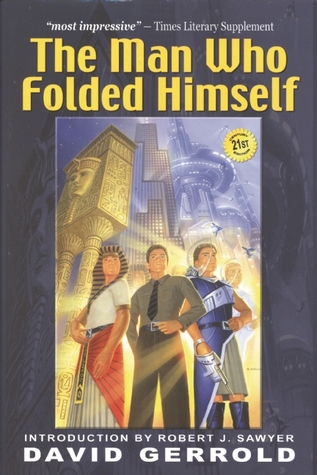
Today I'm looking at a science-fiction and time-travel novel, The Man Who Folded Himself, which I have been told by the library website, GoodReads, and the introduction and afterword of this book that a lot of people think this is the best darn time-travel novel to come down the pike in a long time. Unfortunately, I find myself disagreeing rather strenuously with this assertion. The edition that I listened to is a little different than the original 1973 release, being re-released thirty years later and updated with some references, such as to the September 11th attacks, which makes this feel not like a ground-breaker in the field of science fiction but just another, if somewhat weirder, variation of the same tired themes.
The book follows the adventures of Daniel Jameson Eakins, a boy raised by his Uncle Jim and given the very generous allowance of a thousand dollars a week just to go to college and keep his nose clean. One day in 2005, Uncle Jim shows up mysteriously at Danny's apartment and tells Danny to start keeping a diary, just of the important things. The next day, Danny's informed his Uncle Jim is dead and Jim's lawyers inform Danny of a few things. First, his uncle has bequeathed him a package containing a belt, and second, instead of $143 million Danny has a mere six thousand dollars to his name. Rather confused by this turn of events, Danny grows even more confused when he discovers the belt given to him by his uncle is, in fact, a time belt that allows him to travel through the time-space continuum at will.
What follows is Danny having adventures through time and space and beginning to wonder what pronouns such as I really mean and how timestreams really work. As I was listening to this book, which came out in 1973, I couldn't help but compare it to two short stories by Heinlein. In particular By His Bootstraps, first published 1941, and All You Zombies, first published in 1959. By His Bootstraps is story about a man who ends up creating a stable predestination paradox where he ends up emperor of his own little world through time travel. He has pulled himself up by his bootstraps because his future self is helping his past self get to where his future self will be. And that's a significant chunk of The Man Who Folded Himself. Danny uses the benefits of time travel to make himself an insane amount of money, first with horse races and then with timely investments in the stock market. Eventually he does end up worth $143 million, but has access to considerably more money beyond that. So Danny using time travel to benefit himself immensely from a financial standpoint is hardly new and different.
Where The Man Who Folded Himself differs is that while By His Bootstraps is a stable, predestination paradox, The Man Who Folded Himself has lots of outright paradoxes. At multiple points Danny does things differently, like wear a different set of clothing or change a bet slightly, or even go back in time and warn himself out of doing something. Ordinarily you'd think this would create multiple paradoxes, especially the classic grandfather paradox, and Danny would have to untangle these. But instead, Danny doesn't have to deal with the consequences. If he doesn't like them, he can just change them. And if it creates a paradox, he doesn't have to worry about it at all, because every time he changes something in the past, it creates a new timestream that he enters and he's unable to return to the old timestream because the past has been altered. I felt like this was a convenient workaround for Gerrold more than anything else because we could ignore the issue of paradoxes and let Danny do whatever the heck he wanted.
Now, some of you might be familiar with All You Zombies, which is a time travel short story in which all the characters involved are the same person. One individual, through the use of time travel and hermaphroditism, is both their mother and their father and is responsible for conceiving themselves. Oh, and is also the bartender. But that's not important. Point is, somebody decided using time travel to have sex with themselves was a fantastic idea. Gerrold uses the same idea in his book, and I actually saw it coming because it was very heavily foreshadowed. Danny has sex with himself many times, in fact even engages in orgies consisting of just himself. Plus, through the use of time travel and a female version of himself named Diane, manages to conceive himself and ensure his continued existence within the time stream, which was also pretty heavily foreshadowed.
Honestly, I just don't get the appeal of something like this. Apparently there's some people who find this really interesting or even attractive on some level. But I simply do not understand the appeal of using time travel just to have sex with yourself. I understand that it was really forward of Gerrold to have gay romance and sexual activity in a book in 1973, but the fact that it's Danny doing it with himself just feels really darn weird. Plus the way that Danny describes it makes him sound like an insane narcissist who can only love himself and only has sex with himself because he's incapable of loving or being attracted to another person. It just seems very weird to me.
Overall I don't feel like this book really did anything that hadn't been done in a couple of Heinlein short stories before. It's just weird and for a time travel story really predictable. Obviously there are some people who really like this book but I find myself just not understanding the appeal.
- Kalpar
Showing posts with label Time Travel. Show all posts
Thursday, July 27, 2017
Thursday, November 28, 2013
TV Review: Continuum
In the slowly increasingly history of the Arsenal I've really only talked about TV shows twice. The very first official post where I talked about Gene Roddenberry's Andromeda, and that one time I talked about my opinions on the sixth series of the new Doctor Who. (Well, okay, three times if you include that time I talked about Firefly in a video.) It's a little funny because it's not like most of the entertainment I consume is just books so that's what I have to talk about. There are plenty of times where I sit down on the couch after a rough day and enjoy whatever happens to be in my Netflix queue at the moment (Mythbusters if you were interested) and there are plenty of video games that I enjoy playing. Perhaps the only person I know who is a more avid fan of the Total War franchise is my colleague Carvan. I think, however, that a lot of the TV shows I watch and video games that I play are pretty out there in the public consciousness and I don't really need to talk about them. I mean, who the heck in the sci-fi community hasn't heard of Doctor Who by now?
Continuum, I suspect, makes a notable exception in that case. I was only made aware of it because it was in a list of suggestions for me on Netflix based on my interest in sci-fi and time travel. Although I've only seen the first season I've ended up with rather strong opinions on Continuum and I have yet to meet anyone who's also seen the show. (Considering that as of writing it's an ongoing series that at least suggests it has got a rather strong following to merit continued existence.) As such I feel justified in writing about this series and pestering you all with my opinions on it.
Continuum is a series that is (originally) set in the year 2077. The governments of the world failed financially and had to be bailed out by the large corporations. As a result the corporations now control and own everything and there are, unsurprisingly, some people who are unhappy with this situation and are leading a rebellion/terrorist campaign against the corporate-controlled government. A handful get captured for bombing the Corporate Congress and were slated for execution but managed to engineer an escape attempt that transported them back to the year 2012, taking with them a police officer called Kiera Cameron. Much of the show then revolves around Cameron trying to stop the terrorists/rebels from trying to interfere with the past so that they can change the future as well as trying to return to her family in her own time. The series relies on a lot of what at this point are time-travel tropes such as the future fish out of water, meeting future famous and influential people, and exploring the paradoxes of time-travel. It doesn't bring terribly much new to the table aside from some Great Recession social commentary, but it's at least fairly enjoyable.
I have, however, two fairly large issues with this series which make me rather ambivalent to the whole thing. The first, and definitely my biggest issue, is how the show handles its portrayal of Cameron and the terrorists/rebels. As you've probably noticed throughout this review I've been adding a stroke whenever I talk about the rebel/terrorist group known as Liber8 in the series. The reason I do so is because I'm not entirely convinced that Liber8 are the bad guys in this scenario. To further explain, in the future of 2077 the freedoms of speech, press, and peaceable assembly have been removed by the government and in many cases martial law has been instituted. In response to these and other harsh measures the member of Liber8, much like V in V for Vendetta have been left with no alternative than violent (and explosive) insurrection. Officer Cameron, by contrast, only occasionally questions the morality of her cause and her support of the existing regime. In the TV show the members of Liber8, who are some pretty hardened criminals regardless of the cause for which they fight, are unequivocally depicted as the villains engaging in theft, murder, kidnapping, extortion, and all manner of other crimes. Cameron is depicted very cleanly as the hero of the series, a traveler lost in time who is trying to do the right thing. However she also utilizes fairly unethical means to gain evidence and confessions in her police work and shows no respect for the legal protections all people are granted when suspected of a crime. And I at least didn't hate Cameron, she was an interesting character and fairly compelling, but there's a part of my brain that was constantly going, "She's a pawn of the government quashing the rights of the people! She violates legal protocol to get results!" That part then picks up a red flag, climbs a barricade, and promptly gets shot but it raises some good points.
The other big issue I have with this series, and perhaps this gets resolved in later seasons, is an inconsistency on whether or not the events occur in one timeline. The first and last episodes of the series pretty strongly state that the series occurs within one timeline and the characters are currently in a time loop and are unable to alter past events in spite of their intentions. However, in the middle of the series they deal specifically with the grandfather paradox and end up with a "Well we just don't know. Maybe we're in a branching timeline. Maybe this is the same timeline but something's different." For my readers who are unaware, the grandfather paradox is a classic time-travel paradox that has bugged the heck out of sci-fi nerds for decades. Suppose you have a time machine and decide to travel back in time to a point before your grandfather has ever met your grandmother. You then kill him. What happens? Some suggest you can kill him, but the timeline will auto-correct and you will cease to exist when the timeline "erases" any errors, a la Back to the Future. Others theorize that you simply cannot kill your grandfather because then you would not be able to exist to come back in time and kill him. Even if you tried your hardest to kill your grandfather the simple fact that you exist means he'll have a series of extremely close scrapes and continue to go on and meet your grandmother. And then some hypothesize that he wasn't really your grandfather all along and in fact you might be your own grandpa, a la Futurama. Continuum takes on the grandfather paradox and actually kills the grandmother of one of the characters, however said character continues to exist after their grandmother dies. Perhaps this is explored in a later season of the series, but because this is very definitely the same timeline it raises the question of how the character's still able to exist when by all rights they shouldn't. It's all very frustrating and makes me wish the series was more consistent with its own time travel rules.
Overall I have mixed feelings on the series. It was kind of enjoyable, but I feel like it doesn't bring anything new to the table and doesn't do everything it's trying to do well. Definitely not on my recommend list of TV shows if that tells you anything.
- Kalpar
Subscribe to:
Comments (Atom)
