Thursday, February 12, 2015

Fuzzy Nation, by John Scalzi

This week, possibly because I was reminded of John Scalzi from last week's novel, I'm reading another book from Scalzi called Fuzzy Nation. As Scalzi himself says in the introduction to this novel, Fuzzy Nation is actually a reboot of an earlier novel, Little Fuzzy, by H. Beam Piper. I myself have not had the fortune of reading Little Fuzzy, and it is not necessary to do so to enjoy Scalzi's work. However, I personally am now interested in reading the original material at some future point and comparing it with Scalzi's own reinterpretation.

Fuzzy Nation is set on the planet Zara XXIII, a metal-rich world currently being exploited by the interstellar mining Zarathustra Corporation. What makes Zara XXIII particularly valuable to Zarathustran holdings is the presence of sunstones, gemstones found only on ZaraXXIII, and which emit a faint glow from someone's body heat. Rarer than diamonds, Zarathustra hopes to maintain dominance in the interstellar market with a treasure trove of sunstones. Our main character is Jack Holloway, a surveyor under contract with Zarathustra to do all the hard work of finding the valuable resources which Zarathustra can then swoop in, mine, and then ship off-planet back to depleted and resource-hungry Earth. When Jack discovers the veritable mother lode of sunstones, it looks like he and Zarathustra will be financially set for decades to come. However when a family of hitherto unseen fuzzy critters shows up at Jack's compound, it may spell trouble for everyone planetside. If the fuzzies turn out to be sapient, as some people suspect, then all mining on Zarathustra will have to cease immediately.

Aside from a really good story about what we would consider to be sentient life on other planets, Fuzzy Nation raises really good questions about the ethics of a resource-hungry economy and if it can successfully coexist with, and help sustain, a vibrant ecology at the same time. The answer has always seemed to be a no, especially true where strip mining is involved. And as farms, cities, and human industries expand it leaves less and less space on our little blue marble here for the billions of other species that we share the planet with. Plus as of 2014 we're still stuck on our little blue marble so we don't have an option to move stuff off-planet if it's inconvenient to have it here. On the other hand, the fact that I was able to read this book and then write this review is largely because people mined materials out of the ground which then went into the electronic devices I used. It doesn't look like there's any easy answer, not soon at any rate, but it's definitely something we should be thinking about.

Fuzzy Nation also raises a very excellent point which sadly isn't explored terribly much because the book reaches its climax very soon afterwards. Characters point out that even if the fuzzies get protected status, it may actually cause them to go extinct more quickly. This is the double-edged sword of protected status that many creatures have encountered here in the United States and I'm certain elsewhere as well. In many cases it is illegal to disturb the nesting or breeding grounds of protected creatures and the discovery of those creatures mean any and all activity in that area must end immediately. However, as there is a financial motive for continuing activity in that area, whether it be house construction, mining, logging, or something else entirely, very often the animals will be quietly killed off so that humans can continue their activity, rather than descend into the red tape and bureaucracy of accommodating a protected species. Unfortunately, although this is a very real issue in conservation and protection efforts today, it doesn't get terribly fleshed out and quickly gets eclipsed by the fantastic climax.

I will admit that there were some things that seemed altogether far too convenient at the very end of the novel. Well, specifically one thing but I won't go into it because spoilers. Anyway other than that the ending had a ton of courtroom drama which actually made sense because it was a preliminary hearing instead of an actual trial. (Interestingly, the American legal system tries to make trials go as smoothly as possible so all evidence and witnesses are actually submitted ahead of time for use in the trial. Despite what movies and TV would have us believe, surprise witnesses are actually an exception.) Anyway, with a bit of downright awesome legal chicanery we get our resolution, which was probably my favorite part of the book to be honest. If anyone enjoys a good debate you'll definitely love the ending to Fuzzy Nation.

Overall, I really liked this book. I will admit that I felt it had its shortcomings because there was a really good opportunity there to examine human industry, needs, and desires and whether they can ever coexist with a sustainable ecology. However, that may have ended up overshadowing the fuzzy plotline, which is what the book's really about. I'd definitely say it's worth a read.

- Kalpar

Thursday, February 5, 2015

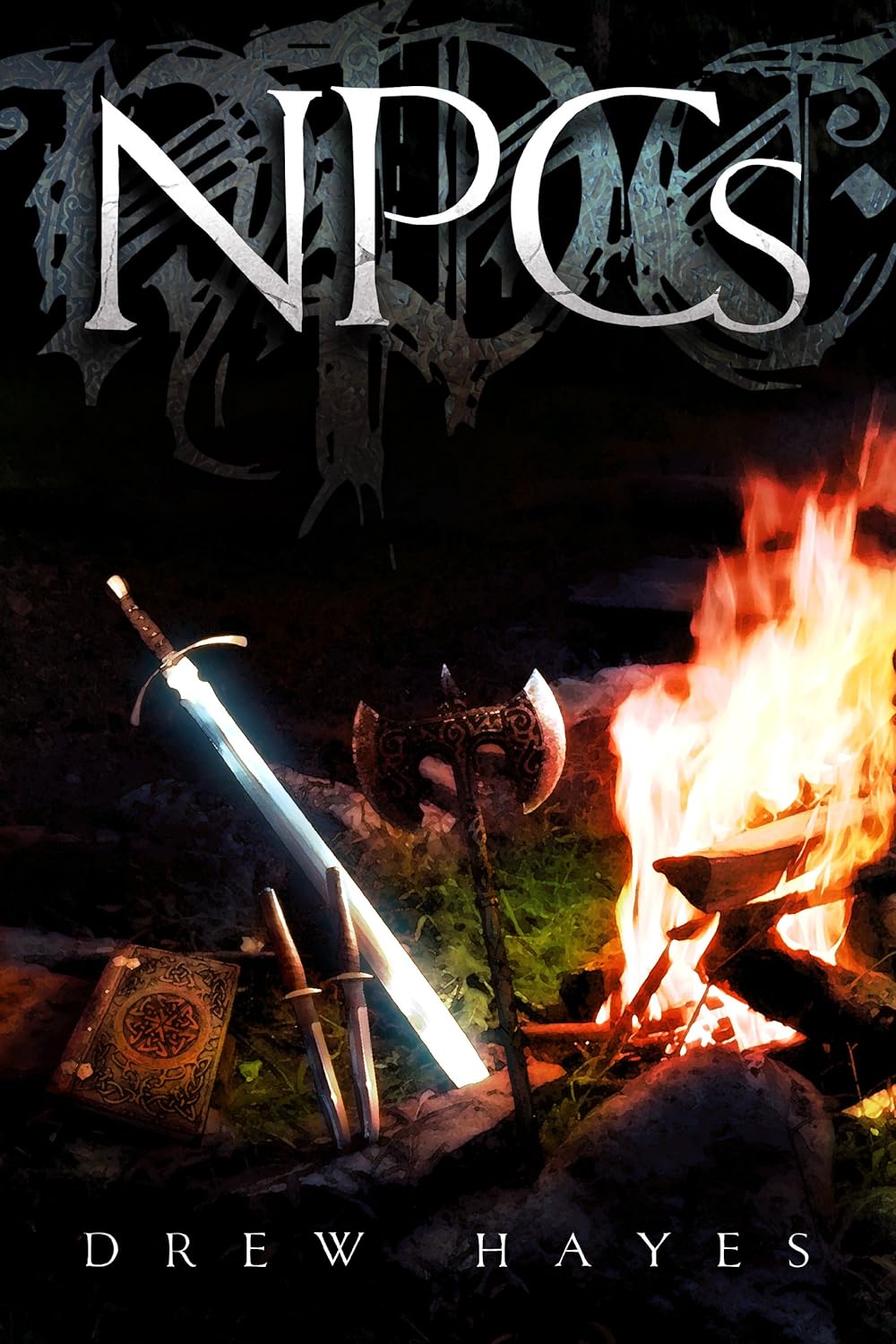
NPCs, by Drew Hayes

This week I'm reading a fantasy satire titled NPCs, originally published as an e-book by Drew Hayes. For those of you unfamiliar with the term (Which I suspect will be very few of my readers) NPCs, or Non Player Characters, are supporting characters at best and obstacles at worst for the players who are the main characters in whatever narrative it happens to be.  As I'm sure you can imagine from the title, this book explores the lives of the NPCs in a tabletop fantasy akin to Dungeons & Dragons and how they deal with the incredibly strange people called Adventurers that wander into their world and start killing all of the local wildlife.

The plot actually follows four characters originally NPCs content to live out their lives in the village of Maplebark: Thistle a gnome and retired professional minion; his friend Grumph, a half-orc bartender and brewmaster; Eric, a local member of the town watch; and Gabrielle, the mayor of Maplebark's daughter. When four adventurers come into Grumph's tavern late one night, take a single drink of mead, and suddenly keel over dead everyone's lives suddenly became infinitely more complicated. This unlikely foursome will have to take up the quest of the now deceased Adventurers and fake their newfound roles long enough to survive. At least, that's the plan anyway.

Overall, this book was rather enjoyable for me, especially as an experienced tabletop player. I especially found the DM's frustrations with the players that just want to murder and loot everything as a familiar experience considering some of the people I've played with over the years. I will say the opening chapter is a little weird because it explains concepts like NPCs, which is helpful for people who are unfamiliar with tabletop games, but I'd think the overwhelming majority of people picking this book up would be familiar with such concepts. Once you get into the fantasy adventure from the perspective of the NPCs, though, the book really takes off and I found it really enjoyable. It reminded me a lot of John Scalzi's Redshirts because it's taking the same theme of looking at the lives of background characters but in this case a tabletop fantasy game rather than a science-fiction TV show. And because they're different in terms of genre and the mechanics of the setting it results in different books that are still able to talk about similar themes.

In that same vein, towards the end there was a lot of playing with the fourth wall in a very similar way to Redshirts where fiction influences reality and reality influenced fiction. I'm not quite sure if I understood all of it because frankly it's some pretty deep stuff, but it's still a very good book. I think my only real complaint is that the writing at times got a little purple with its prose, something I've experienced in the limited amount of fanfic I read, but I'm willing to tolerate a few literary flourishes from the author because he's bringing something both familiar and new and perhaps most importantly enjoyable. This book manages to be both insightful and fun, something I really like encountering in a novel.

As I may have mentioned in my review of Redshirts, I've always had a certain fondness for the background characters in stories. Often because I always sort of assumed I'd be one of them. So there was a lot of appeal in reading about NPCs and how they marvel at Adventurers who treat life as something that they can simply buy more of from a merchant. (And when you think of some of the stuff Adventurers do it's downright crazy if you think about it logically.) Furthermore, as an avid tabletop player I quite enjoyed a little poke in the ribs at the inherent silliness of the genre. If you're a fantasy gamer and an old hand at D&D, Pathfinder, or something similar, you'll probably get a few good chuckles out of this book. Or at least a good adventure.

- Kalpar

Thursday, January 29, 2015

The Sigh of Suzumiya Haruhi, by Tanigawa Nagaru

This week I've continued forward with the second novel in the SOS Brigade story, The Sigh of Suzumiya Haruhi. Having been suckered into watching the second season of the anime adaptation (Curse you, Endless Eight!), I was already rather familiar with the events contained within this novel. Of course this book continues the fine tradition of anachronic storytelling by jumping roughly six months ahead from the end of The Melancholy to tell the story of Haruhi's attempt to create a cinema masterpiece. Kyon, our omnipresent yet plodding narrator, obliquely references several of these events such as the baseball game and trip to the island which viewers of the anime will already be familiar with. Doing a little looking ahead, these events will be told in the next book, The Boredom of Suzumiya Haruhi, but I feel like it may have been a little confusing to first time readers.

Warning: The following is fairly spoilerish. Reader discretion is advised.

Anyway, as I mentioned before The Sigh chronicles Haruhi's attempts to create a cinematic masterpiece for their school's cultural festival, increasing the fame and prestige of the SOS Brigade. Kyon, as usual, is frustrated and confused, but everyone else seems willing to go along with Haruhi's plans because it keeps her distracted and prevents Haruhi from destroying the world. As filming progresses, however, subtle hints that Haruhi is changing reality around them are beginning to appear. Fortunately, Haruhi remains blissfully ignorant of the changes she's causing, but the other SOS Brigade members become increasingly concerned that these changes may become permanent. I will say that I felt the author sort of ran out of steam towards the end of the book. Everything quickly gets tidied up and so the resolution's a little bit of a disappointment. Still, that may be the impression the SOS Brigade's own hastily created movie made on its audience as well.

The series also gets more depth as we start to get hints that the ESPer, Time Traveler, and Alien factions are not perfectly aligned in their goals. Kyon is given multiple hints that the Brigade members he thinks he knows may have ulterior motives and may be far more dangerous than they appear to be. Kyon, of course, doesn't fully understand these implications, (More on that later) but it leads to promising avenues of development for the series and a complicated shadow war over Haruhi's fate. I'm really hoping that the factional strife, including internal quarrels, play more of a role in future books.

I do have two slight complaints about this book. First of all I keep noticing Kyon being a bit of a plodder throughout the book. A constant refrain of Kyon's internal monologue is something along the lines of, "I don't understand what you're talking about." Maybe I'm just genre savvy thanks to an education in far too many pulp sci-fi novels, but Kyon just seems slow on the uptake when Koizumi and Yuki try explaining things to him. I understand that an unknowledgeable everyman character is necessary for audiences to understand complex sci-fi or fantasy worlds. However, when your everyman doesn't seem to learn anything or develop I personally begin to get frustrated. You'd think Kyon'd get a little faster on the uptake but unfortunately this does not seem to be the case quite yet.

The other complaint, and this is a far more justified one, is one of the really dramatic events in the course of the novel. Basically Haruhi decides it's a good idea to drug Mikuru and does so. Kyon, understandably, gets rather upset and yells at Haruhi because, dude, you just drugged someone. This results in everyone else saying that Kyon was wrong to yell at Haruhi because now she's all mopey and we're trying to keep her from being mopey because fate of the world. And while yes, I understand that to an extent it's necessary to humor some of Haruhi's capricious whims, SHE DRUGGED MIKURU! That is totally not okay! I don't know if this is a culture disconnect between the U.S. and Japan, or if I'm just being a total square about it, but I feel like it should have been a bigger deal than it was and the result was Kyon had to apologize for doing the right thing. It just felt wrong to me.

Overall, this book feels kind of weak, but it might just be because it's hard to follow the strong first act of The Melancholy. I'll definitely be moving on to The Boredom at some future point and seeing how the series progresses, so we'll see what happens.

- Kalpar

Thursday, January 22, 2015

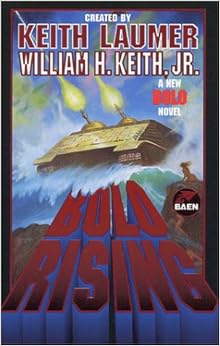
Bolo Rising, by William H. Keith, Jr.

As last week's post was some pretty heavy stuff, I decided to take a bit of a break and head back to one of my all-time favorite series, the Bolos. This week I read more of William H. Keith, Jr.'s work in the full-length novel, Bolo Rising. This particular book is set well after the Final War between the Concordiat of Man and the Melconians, set on the distant human colony world of Cloud. Faced with the chance that humanity will be utterly destroyed in the escalating cataclysm of the Final War, humanity began sending multiple colonies to the far reaches of the galaxy in a hope that at least some of these widely-dispersed settlements would survive and prevent humanity's extinction. Cloud is one such colony and has thrived for nearly two hundred years in a neighborhood close to the galactic core. Unfortunately a mysterious and incomprehensible mechanical enemy, known only as the !*!*!, attacked Cloud about a year ago and currently keep humanity in slave labor camps on the surface, for inscrutable reasons. Humanity's only hope lies in Hector, the Mark XXXIII Bolo corrupted by the !*!*! and used as a guard outside one of the prison camps. If humanity can take back their greatest protector, they may be able to strike back against their mechanical oppressors.

Honestly, aside from changing up what sort of enemy humanity's facing and changing the type of Bolo and their personality, this book isn't terribly different from most of the others that I've read. Some sort of alien menace that threatens to overwhelm humanity. Bolos come in. Bolos help humanity fight alien menace. It becomes a very close thing at several points, with a chance that humanity and the Bolos will be beaten, but more often than not they end up carrying the day. The short stories definitely had more variation, but I think that's simply because there were more of them, allowing a larger sample size. Because of the mechanical nature of the !*!*! you sort of get a justification for some humans being suspicious of the Bolos and whether we can really trust our mechanical protectors, but it doesn't really come to the fore in this book and as always the fears of rogue Bolos proves incredibly unfounded. I kind of wished we learned more about the !*!*! and their motivations, their origins and so on, but it turns out that even they don't exactly know their own motivations and origins. (Although I don't know if that makes for a good character or just lazy writing. It's hard to say)

Aside from the pulp sci-fi tank action nonsense that happens in this book, and most of the other Bolo books, it's really hard to justify them as literature. They're sort of like action schlock movies, but in book form. Pretty to look at and all manner of stupid sorts of fun, but not necessarily great literature. Of course, I happen to really like that sort of thing, and I really hope other people do too, but there's just not a lot of substance otherwise.

In short, "WHEE! GIANT ROBOT TANKS!"

- Kalpar

Thursday, January 15, 2015

Mao's Great Famine, by Frank Dikoetter

My readers probably remember how about a year ago I read a very basic and general history about the Chinese dynasties as part of an ongoing attempt to educate myself more about the history of the most populous nation in the world. In an attempt to further my education in this particular field a while back I picked up a copy of Mao's Great Famine by Frank Dikoetter. This is probably the most recent text to be published about Mao's Great Leap Forward, an attempt to enable China to jump from a predominately agrarian relative backwater to an industrialized superpower surpassing Great Britain in a matter of years. But the road to hell, as they say, is paved with good intentions, and a nation-wide project that was supposed to launch China into the modern era ended up killing millions of people.

I will say first of all that this book is depressing as hell. And I don't mean that to be a criticism that history that isn't happy or enjoyable shouldn't be studied. In fact, quite the opposite, it's important to study tragedies and horrible incidents in history because within them is the potential to learn and avert future tragedies of similar caliber. And it would be folly to claim that any country hasn't done something horrible in its past either. But, this doesn't make reading and researching about these tragedies any less difficult. I personally had to put the book down a few times when it started getting to be a bit too much, just so people are aware of that going into this book.

To provide a very basic outline of events as explained by Dikoetter, after Mao and the Communists finally gained control of mainland China, they remained very much in the shadow of Stalin and the Soviet Union. Mao sought to propel China into a position of leadership in the Communist bloc, and the further world as well. When the U.S.S.R. announced a fifteen year plan to eventually surpass the United States as an industrial and economic power, Mao also declared that China would surpass Britain in a Great Leap Forward, focusing on agricultural output and important statistics like steel production. (I do get the impression that Mao may have confused correlation with causation, assuming that if a country produces a lot of steel it will become industrialized, rather than say an industrialized country producing a lot of steel.) The hope was to bring China into the modern era and challenge both the Soviet Union and the Western bloc on the world stage.

The Great Leap Forward begins with increased collectivization of agriculture and implementation of new agricultural techniques, such as deep-plowing, close-cropping, and extreme use of fertilizer. (All of which have since been discredited as pseudoscience gibberish.) Traditional terraced farms were dismantled for large, rectangular fields, orchards and rice paddies were removed to grow wheat, and in some cases crops were planted, torn up, replanted, and torn up again as administrators changed their minds about what crops should be planted where and how. (All the while, of course, ignoring the advice of experienced farmers.) There then became an ongoing competition to see who could produce the most food, with many administrators highly exaggerating their numbers to unrealistic levels. Assured that there will be enough food the leadership at the top, Mao included, begin encouraging people to waste food, throwing it away in the streets, because so great is the expected bounty from collectivized agriculture. In reality, the amount of food would actually being to decline, specifically because farm labor began being diverted to two separate projects.

Mao also encouraged massive irrigation and water conservancy projects, exhorting the people of China to build massive dams, aqueducts, and reservoirs so that previously arid and unproductive land could become a lush garden to further increase China's agricultural output. Unfortunately many of these irrigation projects were poorly thought out and executed anyway, despite the protests of Soviet hydro engineer advisers. These irrigation projects carried off a large number of the able-bodied men from farming villages all across China and meant that necessary labor was not available at key points during the farming season. Labor was also diverted into backyard steel furnaces set up in many of the villages to try and help increase the nation's overall steel production. In addition to iron ore, pots, pans, and even farming tools were tossed into the scrap pile to be melted down in the backyard furnaces, which were so poorly managed that they produced nothing but lump after lump of useless brittle pig iron. These drains on farm labor, as well as the ill-planned agricultural "improvements" meant that agricultural output actually fell much shorter than the wildly exaggerated predictions made earlier in the year. However, state requisitions of food only grew more and more onerous as time went on, leaving less and less food available for a diminishing and weakening population of farmers.

There are many other aspects which I didn't really go into, such as the tearing down of houses for the use of fertilizer, creating a housing shortage in rural China and exposing much of the population to the elements, but there is a lot of stuff that goes on in these five or so years. Probably the most important other thing pointed out in the book is that at multiple points dissent with Mao's vision was voiced and people raised legitimate concerns with his programs of modernization. However any and all dissent was immediately quashed by Mao, resulting in greater and more fervent support of his policies, if nothing else than out of fear that any hesitation would be mistaken for treason within the ranks. As the situation rapidly degrades, Mao is quick to blame it on capitalist and imperialist saboteurs, resulting in yet another round of purges and witch-hunts.

Dikoetter does a very good job outlining all the aspects of this five year tragedy, explaining how such a collective madness could occur, and utilizing what resources are available to a Western researcher delving into a darker part of the Communist Party of China's history. This is probably the hardest part in researching events like the Great Leap Forward, because of a different cultural attitude regarding the freedom of information. However, Dikoetter works with the resources available, including municipal and provincial records, diaries, letters, interviews, and newspapers. Granted, there is a certain amount of censoring in even primary documents, but these limited resources are valuable in increasing our knowledge of the situation from almost nothing to a little more beyond that. His final tally of the deaths caused by the Great Leap Forward, estimating at least 45 million deaths, is certainly greater than any previous estimate, but inaccessibility of records make that claim difficult to refute entirely out of hand, and he makes a convincing argument for his calculations.  But through Dikoetter's own admission, his research even fifty years later remains fairly limited by China's less open policy regarding information and only time will tell if better and more accurate sources will come to light.

Overall this is a very good book in that it exposes a lot of details about an unfortunate event in recent history. Of course, it doesn't make for easy reading, but history isn't always an easy subject to study.

- Kalpar

Thursday, January 8, 2015

Station Master, by Mayfair Games

A few weeks ago my friends and I celebrated our second annual Krinsmas, our own little Christmas celebration which centers around a White Elephant gift exchange. At our first Krinsmas all of the gifts ended up being able to be classified as either Books, Booze, or Board Games. (Well, sort of. Listen, the games come in a box, okay?) So we decided to make the BBB theme official and do it again. In the ensuing anarchy there were a lot of really neat games, including Station Master, a game which I stole from Carvan at the first opportunity. Interestingly enough, no one attempted to steal Station Master from me for the rest of the night. Possibly because I kept it out of view, but I like to think it was because everyone was afraid of what would happen if they tried taking it away from me. After all, I like trains. Anyway, as my review of the game Imperial currently remains my most popular post ever on the Arsenal, I decided to go ahead and make another board...er...card game review.

Station Master is a fairly simple game that can be learned in a few minutes, a definite advantage when you're debating which game you should try playing after you finish unwrapping presents. In terms of plot, the players are all station masters at a train station who are attempting to get as many passengers as possible onto trains and out of the station. Mechanically you're trying to get as many points as possible by assigning your passenger tokens to the most advantageous trains and then getting those trains out of the station.The game contains thirty-six passenger tokens, and two decks of cards, one of locomotives, and one of station master cards. Each player begins the game with six passenger tokens and three station master cards. During your turn you may choose to place a passenger token on a train, or play a station master card, drawing a replacement card at the end of your turn. Once a train containing your passenger tokens leaves the station, you get those tokens back and you can put more passengers on more trains. Once the deck of locomotives is depleted the total score is tallied and whoever got the most ridiculous amount of points wins.

The locomotive cards, as you can imagine, have locomotives on them, and are helpfully colored blue. Each locomotive has a maximum number of passenger tokens it can carry on it, as well as a maximum number of carriages it can pull. Once the maximum number of carriages has been reached the train departs the station, however it can depart with less than a full compliment of passengers. The station master deck is divided into four types of cards, green, red, green/red, and yellow. The green cards are passenger cars and you want to add them to your train because they'll increase the train's overall score. Red cards are freight cars and have negative value, so they'll decrease the train's score. (Unless they're attached to the one freight train.) Green/red cards are special luxury cars that are a positive value if they're attached to an express train, but negative value if they're attached to any other train. Because one percenters get mad if they have to ride with common people, I guess. Yellow cards have instructions on them and let you change up gameplay to your advantage. The game really only gets complicated when you have to keep score because the value of the train cars is multiplied by the value of your passengers, resulting in some ridiculously high scores if you pull off a decent train combo. Just keep a calculator, pencil, and some paper handy and you should be fine.

What we found really interesting about this game is that it can be simultaneously competitive, and yet cooperative at the same time. Obviously you want to get more points than your opponents, however sometimes the best way to get a lot of points is through cooperation. If everyone has passengers on a specific train, everyone has a motivation to make sure the train gets as many points as possible. You just have to look out for the people who didn't get any of their passengers on the train and now are motivated to do anything to keep everyone else from getting a ton of points. There's still a motivation to get more points than the guy next to you, but you can work together to an extent as well.

I do kind of wish there was more than one freight train, considering how many freight cars there are, but that may actually upset the game balance so I'm happy to accept the game how it is. Really, the only difficulty we had playing this game was the massive calculations we had to do when someone got a really good combo train out of the station. The limited options during your turn also mean the game takes forty-five minutes to maybe an hour to play, that includes going over the rules, and the game actually has some built-in mechanics to keep the game from dragging out indefinitely.

Overall, it's a short and very fun game, which may actually be a little better for my blood pressure than Ticket to Ride. (Anyone who's played Ticket to Ride can tell you that game can get super-intense, especially towards the end.) Because there's still opportunities for collaboration rather than confrontation in Station Master, it definitely feels less stressful. I for one look forward to forcing more people into playing trains with me in the future.

- Kalpar

Thursday, January 1, 2015

The Forever War, by Joe Haldeman

This week I'm reviewing The Forever War, a sort of vintage book at this point since it was first published in 1974 and apparently has since become part of the pulp sci-fi canon. In some respects I will say this book has not aged particularly gracefully, yet at the same time it remains rather valid because it talks about a war that is highly divided from civilian life, much like the wars in Iraq and Afghanistan have been for the past decade. I'd definitely recommend that fans of sci-fi check this book out, but be aware that it hasn't aged as well as it could have.

Plot wise, The Forever War talks about an interstellar war between humanity and a race known as the Taurans. Humanity initially knows very little about the Taurans, in fact we don't even know what they look like. As if this wasn't complicated enough, the war is made even more difficult by the interstellar distances involved and the time dilation caused by near-light-speed travel. Although the soldiers involved in an engagement have only spent a few months getting to the front and fighting, as they have traveled decades or even centuries have passed back at home on earth. The result is an inability for returning veterans (what few there are) to integrate back into civilian society who will then spend what looks like the rest of eternity involved in an endless and eventually futile war.

The parallel with Vietnam and the inability of veterans to successfully integrate back into civilian life is of course fairly obvious, and the author states this explicitly in the introduction about how his book's based on his own experiences in Vietnam. However, it is still applicable today since the United States is still involved in a conflict in Afghanistan and recent developments (As of September 2014) heavily suggest that there will be some U.S. involvement back in Iraq for time yet to come. But aside from vague news reports, the war has become background chatter in the American consciousness. We may know friends or family members who have served in Iraq or Afghanistan, but it's an experience totally divorced from our own with little to no impact on civilian life. The Forever War is in some ways an accurate prediction. Obviously the U.S. economy is not totally centered around the military, (Not yet, at least, anyway.) but the war seems to stretch with no end except that of sheer fatigue. The goals and objectives, so clear in the beginning, have become muddled and in some cases barely understood.

The one thing in specific that I noticed didn't age well with this book was homosexuality. I will say the book had a fairly tolerant attitude towards it, the main character didn't quite understand it, but it could have been a much worse attitude for the time period this was written in. There was an unfortunate implication that homosexuality is just a switch in the brain that can be flipped on or off with the correct conditioning, which I believe is largely incorrect based on our current understanding of human sexuality. (And this of course blatantly ignores bisexuality, yet another issue common in many works of fiction) Again, that might be just sort of a side effect of the times more than anything else.

The other big thing with the book is that it just sort of ends abruptly. We're given a vague explanation as to why, but for me it wasn't a terribly satisfying pay-off for the novel's build-up. It does make an interesting parallel to the real-life Iraq and Afghanistan conflicts as the U.S. left Iraq because of a shift in policy, with an equal dissatisfaction with the progress achieved. Overall, the book's rather good and I definitely recommend it if you haven't read it already.

- Kalpar