Thursday, August 28, 2014

Forward the Foundation, by Isaac Asimov

At long last I have come to the end of the Foundation series, at least the books which were written by the Grand Master himself, Isaac Asimov. Forward the Foundation is another prequel book which actually fits in chronologically between Prelude to Foundation and Foundation, bringing the series full circle. This is true in at least one other respect because the book returns to a series of shorter stories rather than a full-length novel, much like the original Foundation novel. Having read the books in publication order it felt like a very appropriate ending to the series, bringing the timeline and story back to where it all began, tying the series up rather nicely from a thematic standpoint at least, even if plot wise it's still left open-ended from Foundation and Earth.

What I really noticed about this book is that it had a much grimmer outlook than all the other books. I did some digging and found out this was one of the last books Asimov read before he tragically passed away in 1992, which may explain the darker tones. I noticed that throughout the book Hari Seldon consistently complains about getting old. Whether he's forty at the start of the book or seventy towards the end, he constantly frets about his advancing years and worrying that he won't be able to finish psychohistory in time for it to be of any real use. Personally I suspect it's because Asimov felt he was towards the end of his life and so his own concerns over getting old started to bleed over into the character of Hari Seldon. And considering Seldon's described as a prolific writer and remembered as a kindly old man venerated by millions, I think Seldon started to reflect some of what Asimov saw in himself.

The overarching story is, as you probably guessed, Seldon's struggles to complete psychohistory to a functional level in time that they can prevent, or at least ameliorate the fall of the Galactic Empire. Through the book we see Seldon walk the halls of power in the Empire, watch helplessly as the edges begin to fray, and then see Trantor itself, the Eternal Planet, begin to go into extreme urban decay that will eventually rot the very heart of the Empire. It's very atmospheric to say the least and although it's a little extreme to see an Empire fall in a generation, (And previous books had explicitly stated the Empire hangs on in some form for another two hundred years or so) you really get a feel for the decline and the desperation to do something to keep the galaxy from sliding into perpetual barbarism.

Overall I really liked this book and while I am aware that other authors continued the Foundation series after Asimov's death, I actually want to hold off on that and read more of Asimov's work first. Specifically the Robot and Empire novels which promise to shed far more light on the history of Asimov's universe. Coming to the end of the series overall, I'm very happy that I read it. With the exception of Foundation and Earth. But really that's how life goes if we're being perfectly honest. Sometimes people write absolutely terrific books, sometimes they write horrible books, and often they write both. I'm still not sure exactly what Asimov was trying to do with Foundation and Earth, but I get the feeling with his change in tack in the later novels that he realized it wasn't working and shifted back to what had made Foundation great. If you're a fan of space opera and haven't already picked up this book series, I highly recommend (most of) it.


- Kalpar  

Thursday, August 21, 2014

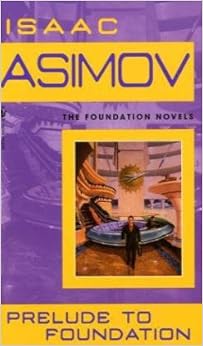
Prelude to Foundation, by Isaac Asimov

Okay, so as my readers probably remember, last week I expressed some serious concerns regarding this week's reading material, Prelude to Foundation. Fortunately, and this is very, very fortunately, Prelude to Foundation abandoned all of the incessant moral arguments of Foundation and Earth and instead returned to the space history and sci-fi adventure which I had originally enjoyed in this series. I really, really enjoyed this book and I'm much more hopeful about the final book, Forward the Foundation, and what it may yet hold in store.

Prelude to Foundation is actually a prequel novel to the series, going all the way back to the waning days of the Galactic Empire when Hari Seldon first presents his paper on the theoretical possibilities of psychohistory, although he is convinced that it will never be a practical field. Seldon soon finds himself embroiled in events on Trantor, capital world of the Galactic Empire, pursued by political players who seek to use psychohistory for their own ends. Seldon then travels through several locations on Trantor, seeing the decaying heart of the Empire, slowly becoming more and more convinced that his psychohistory may be necessary after all.

What I really liked about this book was a return to the feeling of the original novels. The series certainly never really abandoned the space adventure aspect, especially since the last book consisted of an epic quest to try and find the mythical planet of Earth, but that began to be overshadowed by moralistic arguments that went nowhere and became more and more frustrating with each reiteration. In this book we get to see the halcyon days of the Galactic Empire, already sliding towards decline, and see more of the almost mythical Hari Seldon. You get a real sense that large events are happening all around the characters, much like I got in the first three books, and that they're going to be influential in shaping how events are going to play out.

The other thing I really liked is that you got to see aspects of the Empire up close and personal and see how decay has subtly already taken a hold of many of its underpinnings. For example the power station at Dahl is described by its workers as a black box: they have no idea how it works and are content to call in outside help to fix it if something goes wrong. If for whatever reason that knowledge were to be lost, then the Dahl power station would be made useless, but no one is terribly concerned at this potential danger. You see all around a stagnation of innovation and a decline in infrastructure, so necessary in a world-spanning city but slowly falling apart over time. Even the attitude that seems to take a hold of the Empire in later years has already formed, that managing the galaxy is a waste of resources and Trantor needs to turn inwards, abandoning a galaxy-spanning Empire and leaving the provinces to their own devices. It's all very atmospheric and much more enjoyable compared to the previous book.

I will admit that one of my biggest issues is that the events seem to repeat themselves throughout the novel. The characters even comment on the oddity of repeated events, which only serves to draw attention to this fact. The book also kind of ends abruptly, in an "Oh. Well okay then." way. Despite that I really enjoyed this book and I'm hoping the last one will be more like it as well.

- Kalpar

Thursday, August 14, 2014

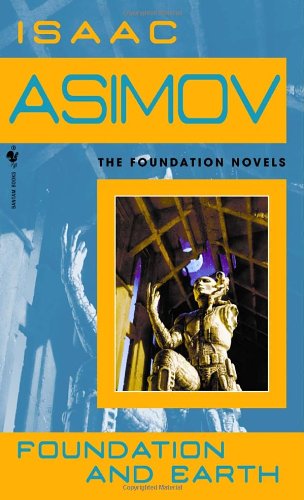
Foundation and Earth, by Isaac Asimov

WARNING: What with one thing and another, I'm not able to adequately talk about this book without going into spoilers. I apologize in advance. For my readers who wish to avoid spoilers the short version is this book was so bad I threw it against the wall once, and probably would have done it numerous times. Please avoid this book.

Okay, so I'm kind of regretting continuing with the Foundation series. Really, really regretting my decision to commit this whole month to the other four books Asimov wrote relating to the Foundation series. Let me explain. Foundation and Earth takes place pretty much immediately after Foundation's Edge and Golan Trevize's decision in favor of the entire galaxy becoming a super-organism holistic entity known as Galaxia, albeit very gradually. However Trevize is not sure why he made that decision and seeks to have it justified by some source of outside information. The source that Trevize selects is the mythical origin planet of Earth, believing that there will be something that will tell him if he made the right choice. And so with that Trevize and friends head off into the galaxy to begin their search.

Honestly, if this had simply been a space adventure to find mythical Earth-That-Was and discovering more about galactic history along the way, I'd totally be behind it. I liked the space history aspects of the Foundation series in the earlier books, and I enjoyed watching the characters try to sift truth out of the numerous, and sometimes contradictory, legends surrounding the origin planet. Personally I found their disbelief in a satellite as large as our moon, as well as a planet with as impressive rings as Saturn, to be worth a few chuckles. And I will say that this book has, more than anything else, made me want to read the Robot series novels by Asimov to see a first-hand non-distorted perspective of this ancient human history.

The trouble is that the book is not content to be just another space archeology adventure, which I would totally be behind! The problem is that it seems every thirty pages or so this book is absolutely determined to get into another tedious argument over morality. I will admit that in my own personal perspective I find arguments about morality to be best restricted to a philosophical forum and such arguments are very seldom well-done when it comes to fiction, often feeling very shoe-horned into the narrative. In this particular instance Trevize constantly gets into arguments with Bliss, Gaia's representative on this particular little expedition, over the merits of individualism versus Galaxia's collective consciousness. Most of these arguments just sort of fizzle out with no real conclusion in favor of one side or the other, which is made all the more frustrating because it means we get to hear more of the arguments! It got so bad that I eventually thew the book against the wall about page three hundred or so after the sixth or seventh such argument. And keep in mind I'm a bibliophile that finds even the slightest desecration of a book tantamount to sacrilege, that's how pissed off the book made me.

Furthermore, the more you think about it, the creepier Gaia's shared consciousness gets. On the planet the trees all grow in straight lines, of their own volition. It always rains exactly the right amount to keep everything healthy, people only have children when it's deemed appropriate to the balance for them to have children, basically every aspect in respect to free will is completely taken from you. Furthermore, everything on the planet from the birds and bees to its molten core and the clouds are part of the planet's collective consciousness. Even your poop is part of it! I wish I was kidding but we are specifically told by Bliss that even her waste shares in the consciousness of Gaia. Is anyone else creeped the hell out by that? Because I am.

Granted, there are extremes to free will as well, and we're shown that in at least one very good example on the crew's adventures when they arrive on Solaria. The Solarians are isolationists in the extreme, who can barely bring themselves to look upon the image of another Solarian, the idea of even being within a kilometer of another one is simply unthinkable. The Solarians all live in robot-tended, isolated estates, perfectly content in their “freedom” from other beings and being free to do whatever they please. Bliss is quick to point out that this is a result of free will and individualism, while Trevize is quick to point out that this is an absolute extreme and is in no way indicative of the ultimate route of individualism. I'm left with the feeling that Asimov was trying desperately to come up with a good reason why Galaxia represents a good choice for the future of humanity but he keeps coming up short in the novel.

Ultimately, they do find Earth at the end, although even Trevize wonders aloud why he thinks he'll find an answer on Earth. (Which personally made me wonder why we were bothering with this story anyway.) But the payoff is just so terrible. We spend nearly five hundred pages going through tedious moral arguments, getting dragged slowly across the galaxy and making me personally wonder if humanity is worth saving, and you know what the reason Trevize settles on? We need to form a galaxy-spanning consciousness because space aliens from another galaxy might invade us, and that's our best way to defend against them.

If you just went “What?” you're not alone, because I'm right there with you dear reader. Space invaders from another galaxy is your best argument? Not, achieving harmony with the cosmos. Not, creating a higher evolutionary state of existence. Not, effective immortality because every part of you remains a part of the greater whole, albeit perhaps in a diminished form. No. Space invaders from the next galaxy over. Not even factual space invaders mind you, but potential space invaders. I just...I can't even....

As I've already committed to this month being another Foundation Month, and I already have Prelude to Foundation and Forward the Foundation, I will be continuing my reading of the Foundation series, albeit with ever-increased apprehension. I ardently hope that these books will be less frustrating than Foundation and Earth has been, but I'm not exactly sanguine about the prospect.

- Kalpar


Thursday, August 7, 2014

Foundation's Edge, by Isaac Asimov

I've decided once again to launch a Foundation month here at the Arsenal, taking all of August to look once more at Isaac Asimov's Foundation series. This month I'll be looking at the next four books in the series, going once again in publication order. As I said in my previous reviews I am rather fond of this series. Aside from my well-established fandom of Isaac Asimov, I really enjoyed seeing historic parallels with the fall of the Roman Empire being applied to a science-fiction setting. Science-fiction and history combined together! Absolutely fantastic! So I was, of course, eager to see the series continue.

I will start my review by saying that Foundation's Edge takes the series in a very different direction. I certainly liked this book and I look forward to more adventures following the Seldon Plan, but there was a definite departure from previous books. This particular novel occurs right after a Seldon Crisis has been resolved. To remind my readers or those who may be unfamiliar, the basic premise of Foundation is that psychohistorian Hari Seldon has predicted the fall of the Galactic Empire. To prevent a dark age lasting thirty thousand years he has developed a plan to enable a scientific Foundation to create a Second Empire in a mere thousand years. Every so often the Foundation will face a Seldon Crisis where they will have limited options and be forced to take a path that will lead towards the Second Empire. All previous books had focused, largely, on Seldon Crises and the events leading up to them and their eventual resolution. Second Foundation even had a Seldon Crisis in the works before the arrival of the Mule seriously disrupted the Seldon Plan. Foundation's Edge, however, occurs right after a Seldon Crisis when the decision to keep the growing Foundation Federation's capital on Terminus has been reaffirmed by a holograph of Hari Seldon. I will admit I was kind of sad by the decision that seems to move the series away from the Plan because I really liked all that social, political, and economic mumbo-jumbo, but I'm certainly not disappointed with the book.

The book focuses Golan Trevize, a member of the Foundation Council who voices serious concerns that the Second Foundation, believed destroyed in the previous novel, still exists. He claims that the Plan is too well on track which implies that the Second Foundation is still pulling the strings behind the scenes, an idea that the First Foundation finds downright offensive. Meanwhile Stor Gendibal, the youngest Speaker on the Second Foundation's Table, voices equal concerns, stating that the deviations that would normally be expected as the Plan reaches its five hundred year mark have disappeared entirely and the plan is running far too smoothly, even with the Second Foundation's influence. He suspects that a third party is managing the Plan for their own benefit, again something which cannot be tolerated. And so a group of characters head off, trying to discover what's really going on. The result takes the series in a far more...mystical direction, which definitely seems very much at odds with the strongly hard-science approach previous stories had taken.

I will say that this book makes it explicit, if nothing else than from a final not from Asimov, that all of his works take place in a shared universe. Most of my previous Asimov readings have been largely the robot stories and I have personally read The Complete Robot cover to cover. (Albeit some time ago) If nothing else, this decision to make all the stories part of one larger, shared universe, makes me eager to read not just Foundation, but the Empire and other Robot stories as well. I certainly am going to have more material to read in the future, as if there wasn't so many other things to read already.

Although I lament the apparent shift of the series away from a hard-science and Economic, Social, and Political (ESP) perspective, I still enjoyed this book. It definitely adds to and expands the universe, showing that Hari Seldon could not account for everything. I am curious about future books because Seldon seems to have taken on an almost divine status within the Foundation and to deny the Seldon Plan exists is tantamount to heresy on Terminus. I'm curious if the Foundation may find itself struggling with a religious crisis at home because of an orthodox adherence to faith in the Plan above all else. I guess we'll see where it goes from here.

- Kalpar

Monday, August 4, 2014

Adventures of Krinsblag: Divine Intervention

We prepared our assault on the Pathfinder vault and broke into the Guild building after hours, sneaking through Amavor's broken window and distracting the guards through our ability to disguise one of us as Amavor. Utilizing the bells and dimension door we managed to get everyone into the vault and started investigating the rooms. I must say, this vault security is kind of annoying because the location of the rooms kept shifting around. Basically everyone but Meda wondered how in the hell the Pathfinders found anything in this damn vault. We checked a few rooms, mostly bypassing them because they contained cursed items or in one of them a couple of furies which we would have rather not tangled with. Eventually we did find one storage room containing a few interesting items, including the Manta Lord cloak I had sold, which I immediately looted. At one point we even got trapped in a maze spell, which I was able to break with my Iron Heart Surge, and resulted in us going toe-to-toe with a couple of minotaurs. Which, by the way, aren't terribly bright. It was actually kind of entertaining watching one of them charge me and basically throw themselves onto my braced spear. Finally we managed to find a room populated with gold statues, all of which appeared to be in pain. We immediately put two and two together and found a golden scimitar at the end of the room, which we immediately approached to loot.

And of course, the scimitar mysteriously was picked up and disappeared into thin air, implying an invisible person had just stolen it. We heard a slow clap and found Amavor standing behind us. He proceeded to go into some villain banter which Meda engaged him in. I was personally beyond the point of caring and didn't say anything. Eventually Amavor's invisible servant delivered the scimitar to him and Amavor decided he had enough of the witty banter and ordered some golems, which apparently none of us noticed when we came into the room, to murder us. Amavor walked off, leaving us to die horribly.

As we really didn't have a chance in hell of fighting off two golems and apparently an inevitable as well, Soma's immediate reaction was to leg it, followed by Meda. As Whitmore was a little slower on the uptake I decided to keep a path of retreat open for him, going straight up to one of the golems and smacking it with my warhammer. If nothing else it made me feel slightly better about myself and helped buy Whitmore time to get out of the room. Personally I'm kind of surprised I didn't go down fighting. I mean, yeah, I got pretty beat up there, but I was still okay. We finally got everyone out of the room and we slammed the door shut behind us, relieved at the sound of deadbolts sliding home.

We headed back to the entrance of the vault and the wayfinder teleported me back into the Guild building, where I was treated to Amavor running away like a bitch before he threw a fireball back into the building. I managed to avoid most of the damage, and I must say Soma must have prepared a ton of dimension doors today because he not only got everyone else out of the vault, but also teleported into the building, grabbed me, and teleported back out to the front, resulting in us walking away from the ensuing explosion like a couple of badasses.

In the following panic, we managed to slip away and headed back to Festivus's tavern, to discover not only Festivus there, but Palaveen, the cleric from No Fun, and Winifred from the Island of Fuck You as well. Needless to say we were a little confused and when they told us that things hadn't exactly gone to plan, I responded with a “No, really? Amavor running off with a legendary sword and the Pathfinder guild exploding into flame wasn't in your plan? Who the hell are you guys anyway?” To which the three sort of looked at each other and then transformed, Festivus turning into Cayden Cailean, Palaveen turning into Asmodeus, and Winifred turning into Nethis.


Gods. Fucking. Damnit.

- Krinsblag

This ends the current Adventures of Krinsblag. Next week Kalpar's D&D group will begin playing the pre-written adventure path Wrath of the Righteous. For those that are interested I may decide to chronicle the adventures of my new character, Sir Wilhelm von Koenigsturm. Until next time, friends. 

Thursday, July 31, 2014

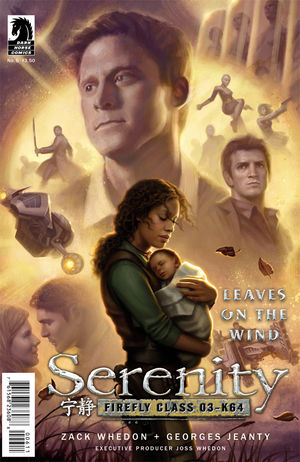
Serenity: Leaves on the Wind, Issues #5 & #6, by Dark Horse Comics

Okay, first off I want to apologize for the relative lateness of this particular post. Due to the regular internet blackouts I've been suffering, I just plain forgot when the final issue of Leaves on the Wind came out. On top of that due to one thing and another I wasn't able to upload a new post until very recently. Rest assured, dear readers, that the Kalpar is out there fighting the good fight. Just mostly without internet.

Secondly, I want to state that I was rather disappointed with this series as a whole. You may recall that early on I voiced some concerns because it seemed like they were rehashing old ideas that had been utilized in the series rather than introducing new ideas and expanding the 'Verse. Now I can understand a desire to establish a sense of continuity with the series and movie, reusing old ideas, old characters, and old situations, but honestly I don't think it was necessary to make a good comic. You already have the continuity of the characters and the ship from the original series and as readers we want to know what happens to Serenity and her crew. And I think I'd like to see new and exciting adventures for her as well. And going in new directions is probably the real strength for the comics. For example, probably my favorite Serenity comic is Float Out, a one-shot story that shared stories of Wash's past as told by three different people who knew him. Float Out preserved continuity with the character of Wash, but introduced new aspects of his past. Granted, we already knew that Wash was a great pilot and saw that quite a few times, but we get to see how Wash forged his reputation while still being that funny, goofy, pretty nice guy that we know and love. Of course, this isn't guaranteed to work. I don't much care for The Shepherd's Tale (BECAUSE IT MAKES NO SENSE!) But there was at least an attempt to build the 'Verse up.

The biggest problem I have with Leaves on the Wind is that it squanders its potential as a story. In the first issue, you get a feeling of how very big things have become. Mal and company can no longer stay out of the way of the Alliance because their names are on everybody's lips. The New Resistance waxes in strength and the foundation of the Alliance begins to crumble. Personally I was really interested in seeing the aftereffects of the revelation regarding the Reavers and how the Alliance sought to maintain control. But the story....doesn't go there. It may start out big, but it contracts and becomes very, very small, focusing once again on Malcolm and his crew while the Alliance disappears into the background. The story starts with Mal trying to lie low, and ends with him trying to lie low.

Which actually leads to my other frustration is that things don't change terribly much over the course of the comics. Yes, things happen, but they don't really build the 'Verse in a meaningful way. Bea joins Serenity's crew, but Bea received so little development of a character in this miniseries that she could be replaced by a cardboard cutout with no real changes. Mal decides he's going to start fighting back against the Alliance rather than running away. A decision which he had already made (quite dramatically I might add) in the film and apparently forgot in the intervening nine months. Finally we get a new villain who's determined to capture River. This does set up a new conflict for what I'm assuming will be the inevitable next set of comics, but aside from the most basic details of the new villain we don't really know much about them. We don't even get a name. And I get the feeling like we're still stuck story-wise and we can't break out of the larger arc of “River on the run from the Alliance”. Which the movie was supposed to tie up in a nice neat bow. It all feels very frustrating.


As a die-hard Browncoat I'll probably find myself sucked into the next series of comics that come out, but my expectations are going to stay fairly low. It just seems like the comic creators can't really strike out in a new direction with the series, even in its new format. Possibly the new villain will make things a little more interesting, but I'm not optimistic. But here's hoping. Keep 'em flying.

- Kalpar  

Monday, July 28, 2014

Adventures of Krinsblag: Robot House!

These past few days have been a bit of a blur, what with the binge drinking and ultimate frisbee on the campus quad. However, I did attend a few classes with Meda and learned a few things from Tandem. Well, and a few through independent research, but some progress is better than none at all. We had noticed a rather annoying amelodic chiming of bells that occurred at random points with no real rhyme or reason coming from the second floor of Pathfinder U. Meda asked Tandem and he gave some bullshit answer about celebrating a new artifact being discovered by the Pathfinders, but Whitmore claimed it was far too often for artifacts of true importance. I decided to go upstairs after class and investigate the bells, poking a couple of them to see what they did. Nothing terribly interesting happened until a man appeared, carrying a rapier. I tried to pump as much information out of him, but with no real success, resulting in me getting dragged off by campus police. Whitmore, however, noticed my plight and was able to sneak up and look at the bells later on, and was able to figure out the order they rang in, as well as noticing it seemed to activate a portal that lead to what we assumed was the Pathfinder vault.

As all of this was going on Soma managed to break into Tandem's office and stole a few items, including Tandem's Wayfinder, which Festivus had told us allowed Pathfinders to access the vaults. Soma decided to also experiment with the Wayfinder, putting different Ioun stones into the slot resulting in interesting effects. But when Whitmore put a stone in the slot the Wayfinder exploded, which, needless to say, was not according to plan. Soma was able to craft up a replacement Wayfinder, but held off on putting it in Tandem's office.

In class the next day Tandem was a little....irritated to say the least. He went into a very long lecture about responsibility with magical items and demanded to know who had stolen his Wayfinder, which was now missing. As Soma had decided class was beneath him, he wasn't there to return the Wayfinder, so we got treated to a boring-ass and mostly made-up lecture about a poem that totally wasn't the secret key to opening the vault. Except it was. Man, they have terrible security. After class Soma had managed to put the replacement Wayfinder in Tandem's office, and we decided we should try to steal Venture Captain Amavor's Wayfinder next. I gathered a couple of my bros for a frisbee game and “accidentally” threw the frisbee through Amavor's office window. As expected, Amavor stormed out of his office, swearing and leaving the door unlocked behind him. This allowed Soma to slip into Amavor's office and quickly search for Amavor's Wayfinder while Meda kept lookout and Whitmore kept an eye on Amavor. Soma didn't manage to find anything we could use, but Whitmore noticed Amavor kept his Wayfinder on him at all times, meaning we'd have to obtain one from someone else if we hoped to be successful.

After everyone had left campus for the day, we broke back into the building and rung the bells in the proper sequence, opening a portal. Soma went through and performed a quick reconnaissance of the vault, confirming that we needed a Wayfinder to even begin looting the hell out of this place. Unsure what our next move should be, we decided to wait until tomorrow and see what the day would bring.


Tandem had found Soma's replacement Wayfinder, but informed us that despite it being a very good Wayfinder it was not in fact his because it lacked the appropriate clearance codes. This did not, for whatever reason, stop him from giving us each our own Wayfinder to mess with. (Granted, these were without any security clearance so I suppose the threat was rather low.) By a random coincidence the combination of my Ioun stone and the Wayfinder I was assigned resulted in me being able to use disguise self at will, albeit limited to only three disguises. Seeing an excellent opportunity I chose Amavor as one of my disguises, as well as that Corrister fucker, and a generic nondescript disguise. I briefly considered getting into all sorts of shenanigans, but my party members suggested I use my Amavor disguise to get Hewron's Wayfinder. I will say it was a little dicey considering I'm not the best at convincing people, but I managed to get Hewron's Wayfinder by admitting there had been a security breach with the vault. Hewron said he would be keeping a closer eye on the vault and would let me (i.e. Amavor) know if he noticed anything strange. I think if we're going to pull this job off we're going to have to hit the vault tonight, before Hewron gets even more suspicious.

- Krinsblag