Showing posts with label Dieselpunk. Show all posts

Thursday, August 3, 2017

Leviathan, by Scott Westerfeld

Today I'm looking at the novel Leviathan, the first in a trilogy by Scott Westerfeld that straddles the border between the related genres of steampunk and dieselpunk, which makes sense since it is set during an alternate history First World War. In Westerfeld's universe, technology has taken two alternate routes from our historical ''baseline''. Britain, France, and Russia have become ''Darwinist'' powers, utilizing genetic and biological engineering to create animals to take the place of machines. From draft animals dozens of times stronger than a horse to messenger lizards capable of relaying vocal messages perfectly to huge airships that are part whale, part jellyfish, and part hydrogen-exuding bacteria, the Darwinists have countless varieties of animals available to replace machinery.

Germany and Austria-Hungary, as well as the Ottoman Empire, have gone a more traditional route with various steam and internal-combustion powered vehicles and machines to match the Darwinist forces. The biggest change from regular technology though is the immense walkers that that the ''Clankers'' have constructed. These range in size from small, unarmed personal walkers, to massive land dreadnoughts capable of leveling entire cities. With the assassination of Archduke Franz Ferdinand, the Great Powers are drawn into a conflict that promises to engulf all of Europe.

The book folows two main characters, Deryn Sharp and Prince Aleksander of Austria. Deryn is a Scottish girl who wishes to join the British Air Service and disguises herself as a boy to enroll as a midshipman. And I have to be honest, even though this book came out back in 2009, Deryn feels incredibly cliched as a character to me. Based on the amount of steampunk that I've read there's apparently some law that you have to include a spunky female scientist/engineer/airship pilot/etc. within your steampunk story and she shocks everybody with how spunky and unlike a proper lady she is. What with the doing science. Or piloting airships. Or blowing things up. I do like Eliza blowing things up. ANYWAY, Deryn disguising herself as a boy is really the only thing that distinguishes her from half a dozen other characters I could name who fit the same mold. So while I like spunky female characters, the apparent requirement that every steampunk story have them is starting to feel hackneyed.

Prince Aleksander by comparison is slightly more interesting as a character. Like Archduke Franz Ferdinand's actual, historical children, Aleksander is barred from inheriting the throne of Austria Hungary. In this reality, however, Franz Ferdinand managed to get a papal bull issued legitimizing Aleksander and placing him in line for the succession. When Franz Ferdinand and his wife Sophie are assassinated (in this case by German agents to provide a causus belli for Austria to invade Serbia) Aleksander poses a threat to the rest of the Hapsburgs. Soon Aleksander, with the help of two of his teachers and a walker, is on the run from the forces of not only Germany, but Austria as well.

Deryn aside, I had some other issues with this book which made me feel like it couldn't have been as good as it could have been. First and foremost, I feel like this book is just setting the stage for the later books and conflicts rather than being just a story in its own right. If this was a long-running series such as Honor Harrington or The Dresden Files, I wouldn't have as much of an issue because it means we're getting an introduction before getting into a complex storyline. In this case, the series is only three books long so I feel like the first book should have established the arc of the story and laid some sort of expectation for what's at stake. When I finished this book I was left rather unsure what exactly was at stake beyond Alek's life and inheritance, and Deryn secretly being a girl. There's something going on with the mission to the Ottoman Empire, but we've been given only the broadest outlines.

Overall I feel like this book just doesn't live up to its potential. There are important questions that remain unanswered and I'm not sure where the series plans to go or even have an inkling of what might happen. Deryn as a character isn't terribly original, and since she's half the focus it weakens half the story. Maybe the other two books are better, but this first one feels inadequate.

- Kalpar

Thursday, February 25, 2016

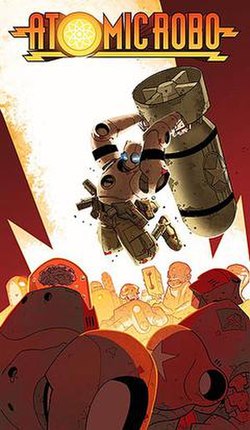
Atomic Robo, by Brian Clevinger and Scott Wegener

This week I'm doing something a little more unusual and talking about a comic series known as Atomic Robo. I have talked about comic books on this series before. In fact, I've even talked about webcomics before too, but it's certainly not my usual fare when it comes to what I talk about here at the Arsenal. However, I was recently exposed to Atomic Robo through a secondary source on the internet and it seemed like a rather interesting comic to read. When I found out that many of the Atomic Robo books were free to read online, and finding myself with some spare time, I decided to go ahead and read these comics. I have to say I rather enjoyed this series and its pulpy science-fiction adventures and I highly recommend it to other people to read.

The basic premise of this series follows the adventures of the titular Atomic Robo. As you probably guessed, Robo is an atomic-powered robot designed and built by awesome real-life mad scientist Nikola Tesla in the 1920's. Throughout history Robo has been involved in a variety of different adventures, all of which are incredibly pulpy and quite frankly kind of awesome. These vary from fighting a literal Lovecraftian horror from beyond time and space, fighting Nazi super weapons during World War II, and dealing with an incredibly persistent and very likely delusional dinosaur. They're all pretty fun adventures and if you're a fan of pulp stuff like dieselpunk and raygun gothic as much as I am, you're definitely going to enjoy these stories.

One of the things I really like is that there's a conscious decision by the creators to avoid what seems to have been numerous sins of the comic book industry. They say so explicitly in their About section on their website that they want to keep their comic book true to its roots of Robo punching other robots, or occasionally some sort of monster or something. Which he does a lot of. And sometimes all you really want to read is a story about a robot punching another robot, because it can be fun! But they also want to avoid other problems such as the continual reboots, the angsty emotions, and the biggest problem comics seems to be facing recently: portrayal of women. I am in no way prepared to go into an in-depth discussion of the portrayal of women in comics or why it's such a problem, and numerous other people have done it elsewhere, but suffice to say I find this refreshingly progressive and worthy of praise.

I think one of the best things about this series is that I can come in, without any prior knowledge or backstory or lore, and I can start from Volume 1 and read all the way up to where they are in Volume 10 with no problems whatsoever. Granted the story jumps around a little bit as the authors go from idea to idea, and there are some things that are talked about at greater length in other stories, but I never felt utterly adrift reading this comic series.

A problem that I have had reading superhero comics, that I have attempted on a few occasions, is that I find myself unable to follow a consistent plotline, even within trade paperbacks. A good example for me is when I read a paperback containing stories from Blackest Night, a large Green Lantern event from 2009-2010. When I went in, I didn't know terribly much about Green Lantern or really much else but I thought since this would contain all of the storyline it'd be easier to follow. Unfortunately, I found myself reading quite a few summary pages during the course of the book which briefly covered events which were covered in other comic books but not included in this book. So to understand the complete story I'd have to go elsewhere to find other books that contained small parts of the story or references to plot elements. It just seemed like a very confusing proposition.

Quite frankly, I find the whole thing rather off-putting to be entirely honest. For whatever reason to me it feels like comic books, at least superhero comics, have gotten to a point where you can't sit down and read a single story without having to cross-reference half a dozen other stories first to make sure you're getting all the details properly. With Atomic Robo, there are other storylines which are contained in other works, and yeah I'd have liked to know a little bit more about Majestic 12 before they kind of suddenly show up in Volume 6, but it didn't completely ruin my enjoyment of the series because I hadn't read these other books. It just worked as a story from start to finish.

If the idea of an atomic-powered robot invented by Nikola Tesla who goes around punching problems for science sounds like your sort of deal, then this is definitely a series you'll want to check out. If you're not a fan of robots for some strange reason, then I recommend that you pass.

- Kalpar

Thursday, May 21, 2015

Rust: Death of the Rocket Boy, by Royden Lepp

All right, all right, so this one's technically dieselpunk, but I like to think that dieselpunk and steampunk are related as genres! Anyway, so I finally got around to the third volume of the series Rust, this one titled Death of the Rocket Boy. Apparently this book had actually come out a year ago and I had not been aware of this fact for some time. Anyway according to the blurb on the back of this book, Death of the Rocket Boy is the penultimate book in this series, meaning that we have only one book left in this series to go. (Whenever that one will come out.)

To recap, the story takes place on the Taylor family farm where oldest brother Roman works to try and keep things running for his family. Roman believes that if he can repair and reprogram some robots leftover from the war, he can really get the farm where it should be economically. The sudden arrival of Jet Jones on his farm shakes things up a little bit, and begins to reveal that some of these robots may not be as benign as Roman thinks they are.

Death of Rocket Boy has two main roles in the story of Rust, at least as far as I can tell. First, it finishes off all the loose ends I think we're going to have revealed to us in this story. We know quite a bit about Jet's backstory, as well as the secrets of the technology that won the war. Obviously not every question I could possibly posit is going to be answered. We're probably never going to learn what started this war, how long it lasted, and such, but it seems like everything Lepp wanted to reveal within this story has been revealed so far. Of course, some of these are questions which I'd like to have answered, goddamnit, but it doesn't mean the story is deficient without that information.

The other main role of this book is that it has taken us to our lowest point within the story, creating dramatic tension that has to be resolved in the final book. The first book established the characters and setting, as well as establishing the conflict for the rest of the story. The second book expands the conflict, which continues into the third book. By the end of the third book the story has reached its lowest point, with all of our characters being in very bad situations. As such I can't really say whether this story's been good or bad because it still has to have its denouement which will hopefully come in the final book.

My main concern with this story, though, is that it's been very, very bare bones. There's a handful of characters like Roman, his brother Oswald, Jet, and the girl next door, Jesse, but I don't feel any particular attachment to those characters. Most of the narrative has been told through the perspective of Roman and his letters to his father. So I feel like I know Roman the most as a character, but I still don't feel any strong attachment to him. And these are pretty long for graphic novels. They're close to two hundred pages each, but a lot of that has been action sequences or characters acting without dialogue. Granted, there are ways to tell stories without dialogue, but there's just so little to work with that it's unsatisfying to say the least.

And really, this has the potential to be a great story. Especially because it sort of brings up the question of if machines can become human, which has always been one of my favorite sorts of stories. (I have a fondness in my heart for the short story Bicentennial Man. Not the movie, though. That's just garbage.) But the story's just been so sparse that it feels like the skeleton or basic outline of a story. It feels like it needed more. I'll see what the last book brings, and hopefully there's at least a satisfactory conclusion.

- Kalpar

Thursday, January 17, 2013

Rust: Secrets of the Cell, by Royden Lepp

As my readers may recall, I reviewed the first volume of Rust a long time ago way back in April of last year and at the end of my review I told my readers I'd be reviewing the second volume when it was due to come out in September of 2012. Well...funny story. You see, for whatever reason, the release of Rust: Secrets of the Cell got initially pushed back until October, and then got pushed to January of 2013. I was actually a little worried that the book would never get released at all! Fortunately the January release date remained the "true" release date and I received my copy of the second volume to much rejoicing.

Overall, I liked this new volume because it explained a lot of things happening within the series's universe and established what a "cell" is and why it's important. (Short version, it's a power source for the various mechs that inhabit Rust's universe which is a closely-guarded secret. Only the highest of military brass and scientists know how they work.) Furthermore we get more of Jet Jones's backstory and his character motivations which I enjoyed because it made him more than just "some guy." 

In addition, this volume has some more awesome jetpack action which, to be honest, is kind of what sold me on this series in the first place. Despite the relative lack of dialog, except in fairly large exposition chunks, I thought the story was fairly well-told with an economy of art style with no panel wasted. Furthermore I felt that this issue answered enough questions about the story to make the plot move along at a decent pace while keeping plenty of deeper mystery for a good plot burner like A Song of Ice and Fire. We even got some more information about the war which serves as a lot of the backstory for this setting, although I hope we get more information in newer volumes. 

Despite the things that I liked about this book, there were a couple of problems I still had with the series. In the first case I am still not really sure about the timeline of this series still. As I mentioned in my first review, the war apparently occurs forty-eight years before the main events of the series but is still going at least thirty-ish years later, and possibly still is. This is confusing because it's implied that the country the main characters live in won the war, but Mr. Taylor, the father of Roman and Oswald, is still away at the front. If the war's still going on I quite frankly have a hard time believing that it's been going for fifty-odd years in an industrialized war. Even with World War I Germany was ready to collapse in 1918, without American involvement. If a second war broke out after the first one mentioned, then I might find it more plausible, but no one mentions that in the story and I am given the impression that they're at peace so, as I mentioned, confusing. I really wish I could just get a straightforward answer regarding the timeline of this series.

The other main issue I had was the direction that this plot seems to be taking. Jet Jones, as I probably mentioned, is a warmachine from the original war forty-eight years ago. This book opens with Jet escaping from a research facility where he was created and he is very against being a tool just for killing so he runs away. While this is a common plot for artificially created people and has been in science fiction for forever, I feel like it's covering ground which has been extensively covered and isn't bringing anything new to the plotline. In addition Oswald, Roman's kid brother, finds out that Jet is a machine and instantly hates him. Granted, Oswald disliked Jet before he found out, but it's a very typical hating artificial people because they're artificial storyline. I kind of expect that Oswald's opinion will be changed by some sort of event in the future, and I'm left wishing Lepp had been a little more creative with his storyline.

Despite my issues with this book, I am still looking forward to the next volume. (However, I have no idea when that will be.) I will admit that I'm hoping the next issue will really get this series off the ground because while I've been enjoying it, I'm still kind of waiting for it to go forward. If this next volume doesn't really go anywhere I'm afraid I may have to drop the series. 

- Kalpar 

Monday, December 31, 2012

Kalpar Vlog: Iron Sky Review

Well, dear readers, we have once again come to the conclusion of a calendar year. So if you find yourself with a half hour and nothing better to do, watch Kalpar be sad about things! It's entertainment, apparently.


- Kalpar

Thursday, April 12, 2012

Rust:Visitor in the Field, by Royden Lepp

All right, so to end this week of Archaia graphic novels I'm going to talk about the first volume of the Rust series by Royden Lepp, Visitor in the Field. Let me begin by saying that I absolutely loved this book and look forward to the next book in this series to come out in September of 2012.

Rust is a dieselpunk story and I want to talk a little bit about dieselpunk before I go on with the review. Some of my readers might be familiar with steampunk which is a genre of science fiction usually set in the late 19th century and makes extensive use of steam-based technology. Thematically speaking steampunk tends to be optimistic and includes the belief that technology will make tomorrow better than today. Dieselpunk is a little different in that it is typically in the early 20th century, specifically between the World Wars, and electricity and internal combustion engines have supplanted the steam engine as the main sources of power. Thematically dieselpunk is more an homage to the pulp adventure novels of the 30's and 40's with hard-boiled detectives, intrepid reporters and hotshot fighter pilots among other characters. Overall dieselpunk tends to be darker and grittier than steampunk thematically, but that's not always the case anymore. Today dieselpunk and steampunk stories range from highly idealistic to highly cynical and the only real way to tell between the two genres is their technologies. The Rust series is definitely dieselpunk with plentiful electric and petroleum-based technology.

The book opens on a battlefield which reminds me largely of World War I with gas masks and Brodie helmets, but we quickly realize that this world is not like our own when robot soldiers, as well as giant mechanical walkers, and jetpack troopers are deployed in an increasingly deadly battlefield. We then jump forty-eight years to the "present" and meet Roman Taylor, struggling to keep his family farm running as he writes a letter to his father. Roman recently met a boy with a jetpack known only as Jet Jones who was being pursued by a leftover giant walker from the war. Roman and Jet manage to beat the walker and Jet has been helping the Taylor family on the farm since. There is definitely more to Jet than meets the eye because he can use his jetpack with ease but is far too young to have fought in the war, and more importantly why was that walker chasing him in the first place? Lepp leaves some tantalizing hints to Jet's true identity while layering on additional levels of mystery to his story.

I do have two complaints about Visitor in the Field and in the sense of fairness I should definitely talk about it. The first issue I had was that all of the pictures in this comic were a sepia tone brown. I understand the thematic reasons Lepp probably went with this color, imitating the colors of old photographs we have from the 30's and 40's and to his credit I can at least tell objects apart. I just like more color in my comics and that's a personal preference. The other issue I have is that I'm not quite sure when the war that forms the world's backstory ended. It's implied that the war is over, but since Roman's father is missing I wonder if the war's still going on and Roman's father is fighting on the front lines. I was wondering if the 48 years caption was a mistake but Mr. Aicot, a grandfather, served in the war as a young man so I assume it has been 48 years. I guess the only conclusion is that the war lasted around forty or more years but I feel like the devastation would have been far more widespread than it appears in the book. Sure, characters like Ava and Oswald are physically disabled and that could be a side effect of the war, but they're children who were nowhere near a battlefront so I'm left confused. I hope Lepp clarifies more in his next book, but we'll just have to see.

Timeline issues aside, I really liked Visitor in the Field. The technology is familiar and yet the same time alien. The world has an overall feel of run down and exhausted from a devastating war and I can feel the struggle of the Taylor family to just get by. We are given enough information about Jet to make his story intriguing but not boring. I'm curious to see where this story goes and maybe finding out about the world beyond the Taylor farm. I definitely recommend all my readers go and check Lepp's Rust series out and I will be looking forward to Secrets of the Cell in September.

-Kalpar