Showing posts with label England. Show all posts

Thursday, August 31, 2017

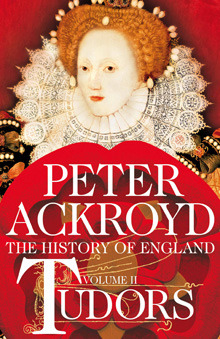
The Tudors, by Peter Ackroyd

Today I'm looking at a history about by far the most infamous monarchs of England, the Tudors. The sheer amount of sex and violence surrounding this family has made them irresistible to not only academic historians, but popular historians of all stripes. Whether it be the more fanciful tv series The Tudors, William Shakespeare's equally fanciful plays, or any number of other historical dramas, the lives of the Tudors have been the subject of endless examination.

Peter Ackroyd's work is competent, if a little problematic at various points. It certainly meshes with all the other information I've read about this dynasty, especially books that I read for a class that focused just on the Tudors. Since this was an audio book I couldn't look at the sources but based on the quotations he utilizes, which is sources available to many other historians, I think Ackroyd gets his facts right so I have no quibbles on that. If you're looking for information about this dynasty this is definitely worth your time and effort as a general primer. My biggest issue seems to be Ackroyd's decisions of interpretation.

My first concern was the decision to start this history with Henry VIII instead of his father, Henry VII. Henry VII gets overlooked a lot, and compared to the scandal and outrage surrounding his son it's easy to see why. Henry VII merely defeated Richard III to become king, married Elizabeth of York, and was a tight-fisted administrator and hoarder of money, leaving his son a bursting treasury when Henry VIII succeeded his father. Henry VII can definitely be a boring individual. But at the same time I feel if you choose to ignore him you're missing an important and vital part of the Tudor story. Otherwise Ackroyd goes fairly well in depth.

The biggest issue I have is Ackroyd's argument that Protestantism was responsible for turning Britain into the imperial power it became. Ackroyd claims that because Britain threw off the superstition of Catholicism, it was able to make progress while other nations like France and Spain were held back. Personally I find this to be entirely inadequate for a number of reasons. First, France and Spain remained powerful colonial and industrial rivals with Britain into the eighteenth century and France remained a powerful rival into the nineteenth century. Furthermore there were Protestant nations which challenged Britain at various points but didn't become or remain global powers. The Netherlands, for example, was a powerful colonial force and challenged Great Britain at various points, but declined in power into the eighteenth century. Sweden and Denmark were also strong Protestant states, but neither of them reached the colonial and economic power of Great Britain by any means. To claim that religion alone was responsible for Britain's greatness is definitely insufficient.

Aside from these issues, I thought this book did a pretty good job talking about England's most salacious dynasty. If you're looking for just general information this is definitely a good choice.

- Kalpar

Tuesday, April 12, 2016

The Plantagenets: The Warrior Kings and Queens Who Made England, by Dan Jones

This week I'm talking about a...sort of biography by Dan Jones about the Plantagenets. I say sort of biography because the book actually covers the lives of dozens of people over about a century of history, but it's a narrative driven by the individuals that make up the dynasty referred to as the Plantagenets. Although this is today referred to as the monarchs who ruled England from Henry II to Richard II, who was deposed by his cousin, Henry Bolingbroke who became Henry IV. Really the only person who referred to themselves by the surname Plantagenet was Henry II's father, Geoffrey of Anjou, who never ruled England. However historians love giving names to things so ultimately the name has stuck, and it's much easier than saying ''those guys who were all related to each other and ruled England during that time.''

The Plantagenets are some of the most important kings in English history, both from the development of England today, as well as in the popular imagination. The Plantagenet dynasty included Richard the Lionheart, Bad King John, Edward Longshanks, Edward III, and the Black Prince, all major figures in England's historic folklore. This is no accident as several of these kings, such as Edward I and Edward III understood the power of propaganda and purposely cultivated their images for posterity. So it is no exaggeration for Jones to state that these are the monarchs who made England.

I was already passingly familiar with the history involved, if nothing else than because there are plenty of English-language sources for English history. The most interesting resource I've seen on the subject is the documentary series Monarchy with David Starkey which I highly recommend. (It used to be on Netflix but as of the writing of this post it's been taken down, which is a crying shame.) So of course there's a deal of overlap between what I already knew from Monarchy and Jones's book. There is of course the perennial problem with sources in medieval history, and sifting through to come at something approximating the truth. Chroniclers during the middle ages were hardly impartial recorders and while there are plenty of overt biases, there can be fare more subtle ones as well. How accurate Jones's sifting through sources I'm sure other historians have utilized is I cannot say, but it's still informative and interesting.

The Plantagenets are important for a couple of reasons, most importantly establishing English dominance in the British Isles and the creation of Magna Carta. Although the struggles between England, Scotland, and Ireland would continue for centuries and in some cases remain unresolved to this day, the campaigns of kings such as Henry II and Edward I established English dominance and Edward I's campaigns permanently annexed Wales as part of the English kingdom. The Plantagenet kings were also responsible for alternately extending English holdings in France, such as Henry II and Edward III did, or losing them almost entirely, like John or Richard II. The other major contribution, however, was the Magna Carta and the precedent of parliaments.

If we were to ask the Plantagenet rulers, Magna Carta, the charters that followed, and the parliaments that resulted would not be proud accomplishments. Many rulers attempted to overturn or repeal the charters and act unilaterally without the consent of Parliament. And in a way, the Magna Carta did not affect the ''little people'' when it was sealed in 1215, primarily concerned more with the rights of the barons who had rebelled against John than the commoners. However it has become enshrined in popular imagination and is generally credited today with being the origin of English democracy and the uniquely English tradition of common law. As someone who has grown up in the Anglosphere which carries on the tradition of common law, even I am not immune to the worship of these principles that go back centuries. Truly it's the Plantagenet era where the concept that the monarch rules with the consent of the governed becomes codified in the English tradition.

Overall this is a pretty good book, although it tends to focus more on the narrative and a lot of the gory details of ruling in the middle ages. There was a certain amount of big-picture stuff to keep me satisfied, but when you get to Edward II and especially the misrule of Richard II Jones doesn't hold back on the blood. If you're interested in learning more about the rulers of England during the middle ages, then this is a good resource, but I still recommend Monarchy as well.

- Kalpar

Friday, February 1, 2013

Just Give Me a Reason

With the crown of Scotland almost in our power at this stage, we just need one last reason to go to war against the Scottish king to usurp his last bit of power. In all fairness though, I am unifying the Celtic peoples to go beat up on the English, so in that sense this game is historically accurate, right?

Part 19:


Part 20:


God Save the Queen
- Carvan

Tuesday, January 29, 2013

It's Only a Revolution if You Win

With many of the English nobility seemingly constantly in a state of revolt, we find ourselves surrounded by opportunities for more land grabs. On the flip side however, our growing realm and desmense prove fertile ground for continued revolts against our own power. Can't we all just get along...?

Part 16:

Part 17:


Part 18:


God Save the Queen
- Carvan

Sunday, January 27, 2013

The Most Useless Office Ever Devised by the Mind of Man

Spoiler Alert. We pick up the title of King of Ireland in this part, but the King of England becomes emperor of Britannia. Furthermore it seems that all of our luck with securing more claims has wholly dried up. Just when we grab at some real power, everything slows down. This must be what being the vice president is like.

Part 14:


Part 15:

God Save the Queen
- Carvan

Friday, January 25, 2013

Burning the Candle at Both Ends

Growing our power, we take advantage of fights and revolts both to the north of us in the Scottish lands and to the south of us in Lancaster. Truly an English way to wage a war I think. Let people fight amongst themselves and then come in and take everything while they're looking the wrong way.

Part 12:


Part 13:

God Save the Queen
- Carvan

Tuesday, January 22, 2013

Filling the Cumberland Gap

Greetings and salutations! We return back to the Crusader Kings LP with Ireland firmly under our thumb we change our focus back to mainland Britain and also the Isle of Man for some more land grabbing, and also find ourselves up against our first (surely of many) rebellions within the realm.

Part 10:


Part 11:

God Save the Queen
- Carvan

Saturday, November 24, 2012

I Am Fairly Out, And You Are Fairly In

Greetings. I hope you are all well stuffed on leftovers still and perhaps got some lovely shopping deals as well. You know where the pilgrims came from right? England. You know who loves England? Carvan? Do you know who can't think of a better transition to open up this next segment of the Let's Play? Forget it. Don't answer. Just watch these videos and eat more food.

Part 8:


Part 9:

God Save the Queen
- Carvan

Sunday, November 18, 2012

Erin Go Take Over Ireland

Hello friends! Our conquest of the British Isles continues as we pick on Ireland, and in our spare time we take part in a Danish succession crisis. We fabricate some claims, have some wars, and just generally serve to be a complete menace, all the while increasing our power. Sound like fun? Of course it is, because dear readers, history is fun!

Part 5:


Part 6:


God Save the Queen
- Carvan

Monday, November 5, 2012

Why King James I & VI Was a Jackass, or How I Learned to Stop Worrying and Love V for Vendetta

Happy Guy Fawkes Day! Give children pennies and burn some effigies and have a right good old time!

Depicted: Fun

After having celebrated this most auspicious of nights, I thank you for taking the time to sit down with me and have a little chat. Specifically, I would like to rebut the argument made by the esteemed Mr. Kalpar regarding V for Vendetta. While I will not go so far as to say that V for Vendetta is a perfect film, I would put it that Kalpar's charge that the film has philosophical flaws is grossly overstated. I would like to start by echoing Kalpar in saying that objectively, the acting, special effects, the tone and ambiance all work very well together to produce a quality product. However, I do take issue with Kalpar's argument that the film fails on a philosophical level.

Depicted: Wrong

There is some legitimacy to the point that the film shanghais the historical person of Guy Fawkes and turns him into some kind of radical freedom fighter, which V goes on to later parallel and emulate. While Kalpar is largely correct in labeling Fawkes as a religious terrorist, there are some important parallels between the goal Fawkes was trying to achieve and what V tries to achieve in the film.

For those of you who don't know, the lead up into the Gunpowder Plot and Guy Fawkes Day begins with Henry VIII's break from the Catholic Church and the subsequent back and forth England had between being a Catholic nation and a Protestant nation with the monarch as head of both Church and State. During the reign of Queen Elizabeth, several rather stringent laws were passed by Parliament to enforce the authority of the Church of England and Elizabeth's role as the head of said Church. While the laws were targeted directly at the queen's ministers and vassals, they nevertheless still applied to the everyman as well. Elizabeth's successor would have to deal shrewdly with both Catholics and Protestants to ensure that England could be governed effectively.

Enter King James the I of England and VI of Scotland. James was a masterful politican who did his absolute best to play both sides, Catholic and Protestant, off of each other until he determined who would "win" in the end. James' bid for the English throne was not an easy one to make, and much like modern politicians he was willing to promise a great deal to gain the support of English nobles. Specifically, James promised to repeal the laws restricting Catholicism, and to allow some degree of religious freedom within his realm. As you might expect, once he was strapped into the throne, James' disdain for "popery" is keenly felt and the laws against Catholicism in England would be kept in place or made more stringent.

Depicted: Douche

The leaders of the Gunpowder Plot sought to redress these wrongs through the natural course of blowing up the King and all of Parliament at the opening of a new session scheduled for 5 Novemeber 1605. Their overall plan after having blown up said king was to reinstate England as a Catholic nation with a Catholic monarch at her head.

While perhaps not the best comparison and means of political redress, I do think that Fawkes and V are both striving for the same goal: the overthrow of a government which has up to that point oppressed a given group of its citizens. Again, granted the means are not exactly keen, nor is the plan beyond the attack very well thought out as to what will be accomplished after the explosion, but the philosophy of the ideas is largely congruent; the head of state has chosen to ignore or spurn the rights of a (significant) portion of the citizenry. Is Fawkes the libertarian fighter we see in the film? No. But, I think to say that his actions are not driven by a restriction on human rights would be a fallacy.

Like Fawkes, V's drive for liberty is motivated by personal cause. Whereas for Fawkes it was religious vengeance on a king whom he felt betrayed his promises to Catholics, for V it is on a leadership who betrayed the trust of the people and used them for experimentation and fearful exploitation. To Kalpar's point that V is motivated not by a desire to liberate Britain from Norsefire, but by personal revenge, I would have to agree to some extent. I do think V is trying to free Britain from the rule of a government whose methods and means are horrifically oppressive and atrocious, however, he seems to go about doing so in such a way that allows him to revenge himself on those who personally wronged not only him, but all those who were subjected to the tests of the government run facilities.

The individuals V seeks to bring down, with the possible exception of the coroner, were people who held leadership roles in the party and the government. Prothero specifically springs to mind as one who might be necessary for V to remove. Removing a trusted and respected and authoritative public party voice is something which might allow the citizenry to think a little more for themselves. Perhaps it is a weak argument, but the communications we receive do color our viewpoints and assassinating individuals like Prothero, Creedy, etc. are necessary in ensuring not only that the populace might have a chance at change, but that the old regime does not rear its head once again. I would argue that the philosophical point here is muddied by the aversion to V's methods; we'd like to think the hero of the story could act simply for the common good and interest and not in his own. V, for better or worse tries to have his cake and eat it too. I argue that it is certainly revenge, but a necessary one.

Depicted: Motivation

Finally to Kalpar's point that V is not a character he can get behind, I can fully understand his position, but I simply disagree. V is an anarchist in the sense that he does not want the government that is established. Fawkes was an anarchist in much the same way. Though I think to call them true anarchists that wanted no government at all would be a gross misnomer. It was not that Fawkes or V wanted NO government, but simply that the government that existed was not serving their personal interests or the interest of any who were like them. Further to the point, the types of government Fawkes and V were up against, a divine right monarchy and a despotic "conservative" regime respectively, offered them no other means of redress save violence. In a sense I mean that "You don't vote for kings." The system had failed them in offering them no means of redress or protest to change the system short of literally blowing it up. The system needed to be burnt to the ground because there was no way to change it short of tearing it down and rebuilding it. V does not have a problem with the whole of government and welcomes Finch's investigation into the Norsefire regime, but within the regime itself, there was no way change could have been reasonably affected. However, I do agree with Kalpar that there is going to be a good deal of strife and turmoil as the country attempts to rebuild.

As Kalpar said, much of these reviews was subjective, and on an objective level the film is well done. I suppose it largely comes down to where your personal alignment on the issue stands. To grossly over-embellish my stance vs. Kalpar's, he is Adams and I am Jefferson. Ideally people should not have to fear their governments and governments should not have to fear their people. Both should be able to rely on each other for mutual support, encouragement and growth. When this is not possible, the government needs must be changed for the good of the people.

Depicted: Badasses

As a final note, I have always liked the fact that Guy Fawkes Day typically falls around the American Election Day. I do like that, for me at least, it serves as a reminder that the principles of government necessitate consent of the people and that if redress is needed then we have the forums to do that. Free speech, protest, and the right to vote are all essential to our society and allow for transitions which do not require the detonation of explosives. Thankfully we have grown into a culture with values and traditions not found in Fawkes' or V's England; I think V for Vendetta serves the purpose of illustrating the barbarity that can occur when those values are not respected. So in closing, whatever you do tomorrow yanks, just make sure you get to the polls and exercise the freedoms that you have!

God Save the Queen
- Carvan

Sunday, November 4, 2012

It's the Counties that Count

Greetings friends.

Rest assured that I am preparing my rebuttal for tomorrow based on Kalpar's scathing review of V for Vendetta. However, in the meantime, I do have some Let's Plays for you. We look to expand our territories by moving into more or less neutral territories in Wales and Ireland. They're not neutral in the sense that they are unowned, but they are simply owned by people who are not powerful enough to stop us, therefore they belong to us. See? Aren't I a good Englishman?


God Save the Queen
- Carvan

Monday, October 29, 2012

Crusader Kings II: I Still Don't Quite Understand All the Rules...

So, now that my Medieval II game has drawn to a close, I have moved on to a game which was largely the reason my Medieval II updates were so delayed. Crusader Kings II is a game developed by Paradox Interactive and set in the Middle Ages as well and covers the course of history beginning with the Norman invasion of England and leading straight up to the cusp of the Renaissance. Over the course of this game, you control one particular dynasty with landed titles, going from counts, to dukes, to kings, all the way to imperial titles.

Furthermore, you have a council of ministers to do your bidding and the way to victory necessitates using both diplomacy, intrigue and brute military force in order to claim what is rightfully yours. This in my opinion is really a step up from most strategy "take over Europe" style games. Typically any characters in the game outside of your military units are at best ancillaries and at worst wholly a waste of time and resources. In Crusader Kings, non-combatant characters are essential to keeping your vassals happy with you, collecting your revenue, ensuring the Church doesn't excommunicate you, and of course leading your men to victory on the battlefield. The holistic nature of the game's setup is really very appealing, though does create some headaches which I will discuss later on.

One of the most interesting things about this game is there is no set "win" condition. It is a truly open ended game and can be mostly whatever the player wants it to be. You want to get a ridiculously high score? Go for it. You want to rise from a count to an emperor? Do it. You want to simply survive the approximately 400 years of history this game spans? Make it happen. (Seriously, simply surviving is a legitimate goal sometimes with this game.) What is winning and what is losing is totally up to the player and that makes for some interesting gameplay choices.

The lack of a end win condition is, I think, both a boon and a drawback. Again, the major plus is that you have the freedom to do really whatever you want within the games system of rules, and that does give you a lot of freedom and can be very fun. However, the lack of something to build towards, or measure success by is also felt, and until you invest a decent chunk of time into the game, you have no idea how to grade your play of the game. Many games are fun because the player is working towards a specific goal (defeating the bad guy, taking over X amount of something, finding the damn princess, etc.) and once that goal has been achieved there is a sense of accomplishment that Crusader Kings II can lack at times.

Another major part of Crusader Kings II is the rules system within the game. This largely comes down to two major groups which I will call the "inheritance laws" and the "claims laws." The inheritance laws basically state who gets what when someone dies, and can be somewhat unforgiving at times. These laws have strict conditions to change them, and maybe it's just my play style, but I find that you are largely stuck with the system you adopt within the first 50 years or so of the game. The claims laws focus on who can call dibs on a particular piece of dirt. These are a little more simple but the game is rather restrictive with information as to why a claim can/cannot be pressed. There have been times where I have had to dig through title histories and family members past and present before I can figure out why I can't attack something I initially thought I could. Essentially my gripe here is that the learning curve is tremendous, and unfortunately I found the tutorial largely unhelpful in these matters. Is it impossible to learn all the rules? Of course not, but as the title would suggest, I still haven't quite mastered them after several months of fairly regular play.

Overall, despite my complaints, Crusader Kings has largely eaten up my free time. It is certainly immersive and addicting if you allow it to grow to that extent. While some of the setup and complexity leaves some additional information to be wanting, fans of strategy gaming will enjoy the various levels of thought that must go into it. It is not perfect, but certainly enjoyable.

Oh, and it is the game which my next Let's Play series will feature.

God Save the Queen
- Carvan

Tuesday, October 23, 2012

'Til we Have Built Jerusalem in England's Green and Pleasant Land!

Welp kiddos, here it is. The final installment of my Medieval II Let's Play. I hope it's been fun viewing for you as much as it has been fun playing for me. In this bit we smack the Polish around a bit for their insolence and try to make up for a blunder at Cordoba, all the while sailing for Jerusalem for a... less than climactic battle... Oh well.

Part 91:


Part 92:


Part 93:


God Save the Queen
- Carvan

Monday, October 22, 2012

This is the Penultimate Supper!

At the start of this LP, I incorrectly predict that this will be the last session. Oh well. The English force of arms carries on with a battle here and there as our preparations for the final assault on Jerusalem come to a head. Anchors away as we sail across the Mediterranean!

Part 88:


Part 89:


Part 90:


God Save the Queen
- Carvan

Friday, September 21, 2012

Deus Vult!

Welp, here I am with yet another LP update for you. Slightly less exciting and battle heavy than usual, but then again, we are steadily running out of people to kill... Oh well. At least there is a Crusade to keep things interesting!

Part 84:


Part 85:


Part 86:


Part 87:

God Save the Queen

- Carvan

Sunday, August 26, 2012

De Bello Hispaniensi e Germanicum

Some pitched battles against the Danes and an assault on the fortresses in Iberia form the crux of this update.  We also work on buying our way back into the Pope's good graces, because medieval popes are corrupt like that. Enjoy!

Part 78:


Part 79:


Part 80:


Part 81:


Part 82:


Part 83:


God Save the Queen

- Carvan

Wednesday, August 22, 2012

The Prodigal Son Returns

Good news everyone! Carvan has another Let's Play after a bit of a hiatus. Sorry about that. Got involved in the Steam sale at the end of July and Crusader Kings and Civilization V ate up ages of my time. Not to mention the fact that the school year crept up on me like a ninja or something. Seriously.

Anyway enough of my blathering via text, listen to me blather in these lovely Let's Play vids! Enjoy!


God Save the Queen

- Carvan

Friday, July 27, 2012

A Horse, A Horse, My Kingdom For a Horse!

We are burning both ends of the candle as we press against the Danes on one side and the Spanish on the other. Now if only there was another faction we could set ourselves up against...

Part 69:


Part 70:


Part 71:


Part 72:


Part 73:

God Save the Queen

- Carvan

Tuesday, July 24, 2012

Over the Hills and O'er the Main

Over the hills, and o'er the main
To Flanders, Portugal and Spain
The king commands and we'll obey
And go over the hills and far away.

While we have not yet reached Portugal, this 17th century English folk tune, with seemingly innumerable versions of lyrics is a pretty good description of what we are working towards accomplishing at this part. Also it's been stuck in Kalpar's head lately, so I figured I'd do what I could to help him out in that department.


Part 65:


Part 66:


 Part 67:


Part 68:

God Save the Queen

- Carvan

Saturday, July 14, 2012

On Desperate Ground, Fight

Finding ourselves with enemies on all sides (granted some of them self-made) and an enemy in St. Peter's chair (okay, that one was very much self-made) we stand on desperate ground and therefore, as Sun Tzu said, we must fight.

Part 59:

Part 60:

Part 61:

Part 62:

Part 63:


God Save the Queen

 - Carvan