Showing posts with label Medieval History. Show all posts

Tuesday, October 9, 2018

The Templars: The Rise and Spectacular Fall of God's Holy Warriors, by Dan Jones

Today I'm looking at another book from Dan Jones about the Knights Templar, one of the crusading orders of knights established in the years after the first Crusade. Although the Templars were not the only international crusading order they are far more well known than the Knights Hospitaller or the Teutonic Knights, and far beyond the smaller orders such as the Livonian Sword Brethren or the Order of Santiago. Jones speculates a little on the enduring popularity of the Templars as an order, but the majority of the book focuses on the history of the Knights Templar from their founding in 1119 to their spectacular downfall starting in 1307 and concluded by 1312.

In hindsight the most surprising thing about the First Crusade is that it succeeded at all considering how poorly organized the entire venture, and most later crusades were. The main advantage of the crusaders was the fact that Jerusalem and much of the Levant existed at the time in a border region between the Fatimid, Shia caliph's capital in Cairo and the Sunni Abbasid caliph in Baghdad. The division between Egypt and Mesopotamia allowed the crusader kingdoms to survive despite their weaknesses and it was largely when both flanks acted in concert that the crusader kingdoms were in most danger.

An inherent problem of the crusader kingdoms was a lack of resources, specifically money and manpower, the two most necessary resources for prosecuting a war. The original mission of the Knights Templar was to provide protection for Christian pilgrims visiting sites such as the Holy Sepulcher in Jerusalem. This original mission quickly grew to the Knights Templar, as well as the Knights Hospitaller, being an elite military force. However the Templars and Hospitallers had significant advantages over the secular rulers of the crusader kingdoms. In their founding charter the papacy granted numerous rights to the holy order which gave them significant benefits. The Templars were made responsible only to the pope, immune from almost all taxation, and granted lucrative rights regarding religious ceremonies and rituals. Coupled with this were the numerous donations of land and resources made by pious Christians in Europe, the Templars became incredibly rich as an organization.

Because the Templars had access to such tremendous resources, they were able to arm and equip a dedicated fighting force of knights and sergeants. Soon the Templars were assigned the garrison of numerous strategic castles in the Levant and Templar contingents made a significant portion of any crusade army. For much of the book Jones focuses on the military history of the Templars and their battles in Egypt and the Levant. There are brief mentions to the more business-aligned aspects of the Templars, such as their involvement in the trade hub of Acre and their fleet of galleys used for both military and commercial uses. I actually would have liked to see more about that because Jones briefly makes the argument that the Templars in many ways were a medieval version of a corporation and NGO rolled into one. I would have appreciated more time on the more economic aspects of the Templar order, but I can see where for the most part their income came from being a major landowner which isn't terribly interesting.

The ultimate irony is that while their wealth enabled the Templars to field major armies against Muslim powers, it also made them a target among Christians at home, especially Philip IV of France. This became especially prominent after the collapse of the crusader kingdoms and the Latins had to fall back to the isle of Cyprus. While the military orders and eastern Latins tried to raise support for renewed Crusading efforts, the European leaders were largely more concerned with local affairs and dynastic struggles. This lack of enthusiasm for continued crusades left the Templars and other military orders at loose ends. While the Teutonic Knights had their own campaigns in the Baltic, the Templars and Hospitallers were faced with the prospect of being merged into a single military order.

Ultimately it was Philip IV of France who ended the Templars, which was fueled by his need for money to perpetuate his military campaigns at home. Jones illustrates that Philip had attacked other targets including churchmen and French Jews to not only cement his power but increase his personal wealth. Jones shows that Philip was initially alone in his persecution of the Templars, and several fellow monarchs were confused at his persecution of the Templar order. Even Edward II only began his persecution of the Templars when it was beneficial for his own personal ends. Most rulers were fairly lax in the persecution and suppression of the Templar order in their own lands when ordered to do so at behest of the pope, so the most significant persecution appears to have occurred solely in France, famously ending with Jacques de Molay, the Grand Master of the Templar Order, and numerous other officials being burned as heretics. Jones argues that a significant part of the allure of the Templars is their dramatic end, compared to the Hospitallers and Teutonic Knights who still exist today albeit in a far smaller and limited form.

This does raise the question of why the Hospitallers, an equally wealthy and powerful organization, wasn't the target of suppression and most of the Templar resources were merged into the Hospitallers. What I've heard about the Teutonic Order is that they were able to play the Holy Roman Emperor and the Pope off each other, ensuring their continued existence, but it leaves me wondering why the Hospitallers were able to survive. Maybe there's another source that will answer these questions but I think it's something Jones could have answered.

Overall I think this book is really interesting because of the history that it covers. Jones is a very dedicated medieval historian so you can really tell he's enjoying his subject matter and it really shows in the book There are some areas where I'd like to have seen more development and historical detail, but otherwise I think this book was pretty good.

- Kalpar

Tuesday, December 19, 2017

Edward III: The Perfect King, by Ian Mortimer

Today I'm looking at a biography of Edward III, a king who definitely influenced English society for many years after his death and to some extent today, but is usually overlooked in popular histories of the English monarchy. Just looking on Goodreads it looks like Mortimer has done a lot of writing about this time period and he has very good credentials. I bring this up because Mortimer makes a very, very bold claim in this book which contradicts most of conventional history for the past six hundred years. On the one hand, I don't want to be reactionary and dismiss Mortimer's arguments simply because they don't fit established dogma. But on the other hand, I feel like Mortimer's argument isn't completely proof against criticism. Unfortunately I simply don't know enough about Edward III to determine whether these facts are correct.

For the sake of simplicity I shall refer to the author as Mortimer through this review while Roger Mortimer will be referred to as Roger.

The main issue with this book is Mortimer's assertion that Edward II did not die in 1327, which has been generally accepted as true for the past six hundred years. Mortimer asserts that Edward II actually lived in exile for at least another decade, finally dying possibly sometime in the early 1340's. Mortimer draws extensively on the Fieschi Letter, a document from about 1337 written by a papal notary to Edward III explaining the whereabouts of Edward II for the past decade and where he was currently. The letter claims that Edward II escaped his captors, managed to make his way to Ireland, and then eventually France where he traveled as a pilgrim, visited the pope in Avignon, and eventually headed to Italy where he lived as a recluse. Mortimer argues that instead of escaping Edward II's jailers released Edward and, realizing he could never gain the political capital necessary to take back the throne, spent the rest of his life in exile.

I did some digging on my own and I did find that the Fieschi Letter is considered to be genuine, that is it is from the fourteenth century and probably written by Fieschi. The debate largely centers around whether the facts argued in the letter are true. Personally I find a couple of things with this argument that don't make a lot of sense. First is Mortimer's assertion that Roger Mortimer and Queen Isabella let Edward II flee England. While I could understand Isabella not wanting to off her husband, I'm not sure why Roger would be willing to let Edward disappear. Through his actions it definitely looks like Roger was set to supplant Edward III as king given the right opportunity and establish his own dynasty. Having previous monarchs around alive is usually problematic for a usurper because rebellions can rally around the deposed monarch and the cause to reestablish them on the throne. Edward II, as unpopular as he was, would simply be too dangerous to Roger alive and his political position would be much more secure with Edward II safely (and very publicly) dead.

Another problem is Mortimer's assertion that Roger used the knowledge that Edward II was still alive after 1327 to blackmail Edward III. Mortimer supports this with the Earl of Kent's rebellion in 1330 on rumors that his half-brother Edward II was still alive, followed by Kent's capture and execution at the behest of Roger. Mortimer argues that Roger used the fact Edward II was still alive as a threat to Edward III with the son potentially being replaced by the father. Personally, I don't think this makes terribly much sense. I think it would be all too easy for Edward III to reveal that Roger had lied to him, the king, and put Roger in an untenable position. Roger had already gone through the effort of having Edward II effectively deposed by Parliament and put into prison so the underage Edward III could take over with Roger as regent. If Roger wanted to exert control on the young Edward III, I think he could have just as easily used the threat of deposition and death on Edward III. Roger's done it to one king already, why should he have scruples about doing it to another?

I'm just not sure if Mortimer makes enough of an argument for Edward II living past 1327 for it to be fully convincing. It's certainly within the realm of possibility, but Mortimer just doesn't seem to have enough evidence. Plus, the fact that he gets incredibly defensive about his hypothesis in his writing and makes some disparaging remarks about the historical ''establishment'' doesn't help his case at all.

Understandably, this major departure from what we know about Edward III, as well as lack of evidence, does make me doubt the veracity of the rest of his book. What I know about Edward III mostly comes from David Starkey and his student Dan Jones. Quite a bit of what Mortimer described matches up with what Starkey and Jones covered, so I want to tentatively say that otherwise this is a pretty good biography but I simply don't know enough about Edward III to say definitively one way or the other. Plus, the incomplete and inaccurate nature of documentation from the time means there are going to be confusions and inaccuracies

I think if you're looking for an in-depth biography on Edward III, this is definitely worth your time to read, although you might need some context. I know I had to look up what exactly the wool subsidy was as it related to taxation. The biggest issue really is the Edward II hypothesis and I've already gone into that into detail.

- Kalpar

Tuesday, August 8, 2017

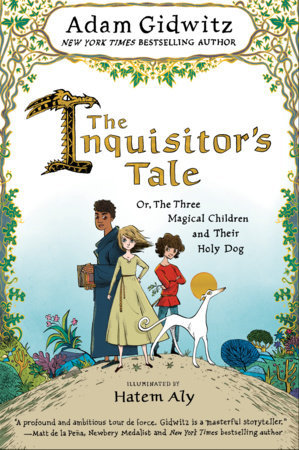
The Inquisitor's Tale, by Adam Gidwitz and Hatem Aly

Today I'm looking at a book which was foisted upon me by one of my friends, The Inquisitor's Tale ,Or, The Three Magic Children and Their Holy Dog. This book is set in France in 1242 and was described to me as a modern-day reimagining of Chaucer's The Canterbury Tales and also done for children. And I have to admit, at least in the beginning the parallels with The Canterbury Tales is very pronounced, although I feel like it sort of tapers off as the book goes on.The main message of the book is also fairly heavy-handed but it's a good message so I can't fault Gidwitz too much.

The book begins with travellers in an inn, discussing the three magical children and their holy dog who have been declared outlaws by King Louis IX of France. But nobody precisely knows what the children have done to raise the ire of the king or who they are. However, the travellers in the inn start sharing stories, revealing that all of them know a little bit about the tale and together they're able to create a more coherent picture.

Gradually we are introduced to our four protagonists. First we have Gwenforte the greyhound, who died protecting baby Jeanne from an adder and was venerated as a saint by peasants in a village until Gwenforte was resurrected. And then there's Jeanne, the French peasant girl Gwenforte saved who can see the future. Next we meet William, an enormous oblate in a monastery whose father was a knight in the reconquista and whose mother was a Moor. William possesses enormous strength, capable of shattering a stone bench with his bare hands. Finally there's Jacob, a Jewish boy whose home village is burned down by some foolish Christian boys on a dare and who possesses the ability to miraculously heal any wound with different plants. The children eventually meet up and become boon companions.

Another way that this book is a lot like Canterbury Tales is there's a lot of low-brow humor, especially in the first third or so of the book. There's a point where peasants send a bunch of knights swimming through a dung heap looking for a child that isn't there, there's a farting dragon, and there's a pun on the multiple uses of the word ass. Considering that in The Miller's Tale, which is one of the ones I was forced to read in high school, two young students plan to bed another man's wife, one of them succeeds in doing so, the woman gets another one of the students to kiss her butt, and then the first student farts in the other student's face, the things I just described would totally not go amiss in one of the more comedic of Chaucer's tales. I do feel in hindsight that the humor doesn't fit as well because of the tonal shift around a third of the way through the book, but that's just me.

The main theme of the book is about tolerance in general and religious tolerance in specific. Now this is a theme which I'm all in favor of. I'm on board with loving your neighbor as yourself, even if it's really darn hard sometimes. But I feel like this book does it in kind of a heavy-handed way that it becomes too much. Obviously there are people who aren't into the whole tolerance thing in the first place, but I'm not sure they'd pick up this book in the first place and even if they did if it would change their minds at all. Maybe there are a few people who would benefit, but it feels a lot like Gidwitz is stating something his audience already agrees on with him.

Overall though, I thought this book was pretty good, in spite of the heavy-handedness and sharp tonal shift. The illuminations by Hatem Aly done within the book are wonderful to look at and occasionally capture the feeling of a true medieval manuscript. Gidwitz has also done significant research to ensure his book doesn't stray too far from the truth of medieval life in thirteenth century France. For anybody who enjoys all things medieval, I think this is worth a look.

- Kalpar

Thursday, December 1, 2016

Magna Carta: The Birth of Liberty, by Dan Jones

Today I'm looking at another book from Dan Jones, in this case Magna Carta: The Birth of Liberty, which was written as part of the celebrations last year over the eight-hundredth anniversary of the issuance of Magna Carta by King John of England in 1215. To historians, though, the excitement over Magna Carta seems largely misplaced. Put within the context of the era, it was an attempt at a negotiated peace between King John and his rebelling barons, a peace which did not last a month before John was repudiating Magna Carta and trying to exert his will over his barons once again. Furthermore Magna Carta is overwhelmingly concerned with the rights of the nobility concerning the king and the limited rights it granted freemen, as Jones points out, would have affected maybe twenty percent of England's entire population in 1215. Jones argues rather eloquently that the Fourth Lateran Council, which condemned trial by ordeal, should be more remembered than Magna Carta. And yet somehow this obscure document has earned an almost sacred status.

The majority of the book focuses on putting Magna Carta within the proper historical context. As Jones is a medieval historian this makes a lot of sense because that's the subject that he's studied the most and has the most expertise talking about. Jones does a very good job of explaining the history of heavy-handed governance and taxation, started by Henry II and Richard I to finance their perpetual wars, which finally came to a head under the less successful and less charismatic John. Jones does spend time going into subjects such as medieval siegecraft which give a fuller understanding of the story, but may not entirely relate to Magna Carta specifically. And since I've already listened to The Plantagenets from the same author, who of course covers Magna Carta in that book as well, a lot of the subject matter was review for me.

Ultimately I did find myself wishing that Jones had spent more time talking about the evolution of Magna Carta in the intervening eight hundred years and why it has developed such a significance. When pointing out that it is mostly a medieval document concerned with issues such as scutage and feudal inheritances, it seems very strange indeed that Magna Carta has such significance today. The last chapter of the book very briefly covers how Magna Carta went from an embarrassment best ignored by the sixteenth century, to a key constitutional argument for opponents of Charles I's attempts at absolute royal authority during the English Civil War. Even as the numerous clauses in Magna Carta became obsolete, principles such as trial by jury, due process of law, and a vague notion of representation in exchange for taxation, became part of English tradition, as well as the traditions of numerous countries settled by English colonists. This is a huge subject which could be its own book, or even multiple books, but I think it would be interesting to listen to or read about.

I think if you've already read The Plantagenets or even seen Monarchy with David Starkey (who actually taught Dan Jones!) then you'll find a lot of the stuff in Magna Carta a review because it talks mostly about John's reign more than anything else. It's still very good writing from Jones who is becoming one of my other favorite English historians and if you want a much shorter book focusing just on this subject matter then this is a good choice. But I still recommend The Plantagenets over this one.

- Kalpar

Tuesday, November 15, 2016

The Third Horseman: Climate Change and the Great Famine of the 14th Century, by William Rosen

This week I'm talking about The Third Horseman, a book ostensibly about the Great Famine, an event in the early fourteenth century with widespread food shortages in Europe caused by a variety of factors which is often overlooked because of the Black Death which appeared a few decades later. I say ostensibly because this book feels only partially about the Great Famine for most of the time. Instead Rosen spends a considerable amount of time talking about the reigns of Kings Edward I and Edward II of England and their on-again-off-again wars with the Scottish. Rosen tries to tie this to agriculture and how the wars exacerbated the Great Famine in England, except the Great Famine affected much of northern Europe, which was almost always in varying degrees of conflict. And he spends considerably less time talking about France, Germany, the Low Countries and Scandinavia where the famine was equally harsh. The result is very disappointing and feels like another history of England's wars with Scotland.

What I found most interesting was the parts where Rosen actually talked about medieval agriculture. I know, I know, that's a really weird thing to be interested in but I went into this book hoping to expand something I knew very little to nothing about whatsoever. Rosen goes into some detail about the European diet, heavily based on cereal grains, and argues medieval agriculture had become more and more tenuous through the Medieval Warm Period. For those of you that aren't aware, the Medieval Warm Period was a centuries-long period of increased average temperatures experienced by Northern Europe from about the ninth to the fourteenth century C.E. Reasons behind it are still not entirely understood, and as far as they can tell it was an event localized to Europe rather than a global phenomenon. Equally mysteriously, the Medieval Warm Period was followed by what's referred to as the Little Ice Age, an era where temperatures returned to much cooler levels in Europe.

Rosen argues that during the Medieval Warm Period, warmer temperatures and more reliable weather made cultivation of land not optimal for cereal cultivation more profitable. Increased food led to increased population, which pushed further demand for increased cultivation until more and more marginal lands were under cultivation. However, once the weather patterns of Europe changed, with cooler and wetter summers, these lands no longer produced sufficient food for the population. This problem was further exacerbated by land exhaustion as fields were used repeatedly for the cultivation of wheat, a nitrogen-intensive crop, which led to more decreases in yields. Plus the constant warfare which entailed raiding and burning crops made a bad situation much, much worse.

Rosen also tries to argue that certain social structures, feudalism being a big example, were a result of the Medieval Warm Period and increased agriculture. I feel like this argument doesn't stand up as well because, at least from my understanding, feudalism was largely a response to the limitations of the era which required localized administration, government, and defense. Of course there's ongoing debate among medievalists about what exactly feudalism was because it has become a sort of catch-all term and while it's portrayed in medieval Europe as a neat and tidy pyramid, the truth is far more complicated.

The biggest impression I got, though, was that Rosen wasn't really interested in writing about the Great Famine. Yes, it and agriculture and the Medieval Warm Period are all part of the story, but he spends far more time talking about Edward I, Robert the Bruce, and Edward II than about agriculture. I was left with the feeling Rosen really wanted to talk about that instead, and agriculture was just sort of a supplement rather than being the main topic of conversation. Numerous chapters are devoted to the wars between the English and Scottish while the history of Germany and the Holy Roman Empire during this era gets shoved into one chapter. If Rosen wanted to talk about the English and Scottish wars, that's fine. I just wish he'd have titled the book about that instead.

My biggest complaint ultimately is the book doesn't feel like it's really about what it's ostensibly about. The parts about agriculture and the Medieval Warm Period are interesting, but they just make up far too small a part of the book for the book to really be about that. If you want a book about the Plantagenets, then I recommend the book by Dan Jones more than this one.

- Kalpar

Tuesday, August 9, 2016

The History of the Medieval World: From the Conversion of Constantine to the First Crusade, by Susan Wise Bauer

This week I'm taking a look at another incredibly ambitious book, The History of the Medieval World. Although this week's book deals with only about seven  or eight hundred years of history, opposed to last week's two thousand years, it's still fairly ambitious in its scope as it attempt to talk about everything going on in the world rather than focusing on say, just the pope. And yet at the same time the book feels somewhat inadequate because it takes an almost shotgun approach. I'm left wondering if this was meant to be a textbook for classes rather than a historical monograph considering how broad and shallow its focus is.

The word that best describes this book is ambitious, and I think in trying to at least touch upon absolutely everything over some seven centuries of history is an incredibly difficult task. The result is I feel like Bauer has bitten off more than she can chew because the results feel a little muddled. There's also an argument that surfaces from time to time in the book that religion becomes just one more tool of the state to wield power, starting with Constantine's incorporation of Christianity in the Roman Empire and Bauer argues reaches its ultimate denouement in the First Crusade. Now, to completely ignore religion during the Medieval period, especially the spread of Christianity and later the birth and spread of Islam, would be to completely ignore a key aspect of social and political structures during this time period. However, I don't think Bauer spends sufficient time making her arguments coherently and the inclusion of India, China, Korea, and Japan only muddy the waters further.

One of the areas where I felt Bauer got too ambitious was trying to include Asia in her analysis and a very limited analysis of the Americas as well. To be fair, traditional histories which are almost entirely reliant on written records are largely blind when it comes to American civilizations whose writings have largely been lost, destroyed, untranslated, or never existed in the first place. Much of our understanding of those civilizations comes from archaeological research, which involves more than a little guesswork. However the cultures of Asia did have writings during this time period and extremely rich and detailed history. While Bauer goes into these cultures at various points, the lion's share of focus seems to remain in Europe and the Mediterranean.

Now, are Euro-centric histories a problem? Yes. Europe has dominated ''standard histories'' for generations and trying to include cultures from across the globe into more standard history curricula is an ongoing challenge. After all, I know infinitely more about Europe than I can tell you about almost any other place on the globe. But it definitely feels like Asia as a continent gets less attention than Europe and the Americas get practically no attention at all. The fact that sub-Saharan Africa is excluded entirely from this narrative is particularly jarring. I honestly think the book might have been better served by focusing on the main area of interest: Europe.

A challenge I did have was also the sheer amount of names and information included in this book. When you're dealing with dozens of geographic locations, scores of countries, and hundreds of people it can be very difficult to keep track of them all. Especially when you're listening to the book rather than reading. That being said, I learned quite a few things, especially about places like the Byzantine Empire that I don't necessarily know too much about, which was pretty interesting. It's a very shallow overview, but there are some good things to learn in here.

Overall, the book's okay but I think it has a few problems. The religion as a tool of government argument crops up a couple of times but I feel like Bauer doesn't articulate her argument well enough to make it really stick. The inclusion of non-European cultures is nice, but they're largely presented in isolation of Europe rather than how they or Europe may have influenced each other. The inclusion feels incomplete and as I said, the lack of anything about Africa is especially concerning in light of what else is included. I can't think of any good overviews that throw their nets as broadly, but I can think of some that stay far more focused.

- Kalpar

Tuesday, April 12, 2016

The Plantagenets: The Warrior Kings and Queens Who Made England, by Dan Jones

This week I'm talking about a...sort of biography by Dan Jones about the Plantagenets. I say sort of biography because the book actually covers the lives of dozens of people over about a century of history, but it's a narrative driven by the individuals that make up the dynasty referred to as the Plantagenets. Although this is today referred to as the monarchs who ruled England from Henry II to Richard II, who was deposed by his cousin, Henry Bolingbroke who became Henry IV. Really the only person who referred to themselves by the surname Plantagenet was Henry II's father, Geoffrey of Anjou, who never ruled England. However historians love giving names to things so ultimately the name has stuck, and it's much easier than saying ''those guys who were all related to each other and ruled England during that time.''

The Plantagenets are some of the most important kings in English history, both from the development of England today, as well as in the popular imagination. The Plantagenet dynasty included Richard the Lionheart, Bad King John, Edward Longshanks, Edward III, and the Black Prince, all major figures in England's historic folklore. This is no accident as several of these kings, such as Edward I and Edward III understood the power of propaganda and purposely cultivated their images for posterity. So it is no exaggeration for Jones to state that these are the monarchs who made England.

I was already passingly familiar with the history involved, if nothing else than because there are plenty of English-language sources for English history. The most interesting resource I've seen on the subject is the documentary series Monarchy with David Starkey which I highly recommend. (It used to be on Netflix but as of the writing of this post it's been taken down, which is a crying shame.) So of course there's a deal of overlap between what I already knew from Monarchy and Jones's book. There is of course the perennial problem with sources in medieval history, and sifting through to come at something approximating the truth. Chroniclers during the middle ages were hardly impartial recorders and while there are plenty of overt biases, there can be fare more subtle ones as well. How accurate Jones's sifting through sources I'm sure other historians have utilized is I cannot say, but it's still informative and interesting.

The Plantagenets are important for a couple of reasons, most importantly establishing English dominance in the British Isles and the creation of Magna Carta. Although the struggles between England, Scotland, and Ireland would continue for centuries and in some cases remain unresolved to this day, the campaigns of kings such as Henry II and Edward I established English dominance and Edward I's campaigns permanently annexed Wales as part of the English kingdom. The Plantagenet kings were also responsible for alternately extending English holdings in France, such as Henry II and Edward III did, or losing them almost entirely, like John or Richard II. The other major contribution, however, was the Magna Carta and the precedent of parliaments.

If we were to ask the Plantagenet rulers, Magna Carta, the charters that followed, and the parliaments that resulted would not be proud accomplishments. Many rulers attempted to overturn or repeal the charters and act unilaterally without the consent of Parliament. And in a way, the Magna Carta did not affect the ''little people'' when it was sealed in 1215, primarily concerned more with the rights of the barons who had rebelled against John than the commoners. However it has become enshrined in popular imagination and is generally credited today with being the origin of English democracy and the uniquely English tradition of common law. As someone who has grown up in the Anglosphere which carries on the tradition of common law, even I am not immune to the worship of these principles that go back centuries. Truly it's the Plantagenet era where the concept that the monarch rules with the consent of the governed becomes codified in the English tradition.

Overall this is a pretty good book, although it tends to focus more on the narrative and a lot of the gory details of ruling in the middle ages. There was a certain amount of big-picture stuff to keep me satisfied, but when you get to Edward II and especially the misrule of Richard II Jones doesn't hold back on the blood. If you're interested in learning more about the rulers of England during the middle ages, then this is a good resource, but I still recommend Monarchy as well.

- Kalpar