Today I'm looking at the first book in a series co-written by Mercedes Lackey and James Mallory. Now, I've sort of talked about Mercedes Lackey before on here, and her novel Gwenhwyfar is by and far is one of my favorite books of all time and hands down the best reinterpretation of Arthurian legend I've ever encountered. I've also encountered Lackey in the Bolo series and a few of her other books so I was willing to give this one a try to see if it was any good. I don't think I've read anything by James Mallory before so this was a good opportunity to look at more stuff.
As much as I hate to say it, this book is pretty paint-by-the-numbers fantasy fare. The book begins with two adolescent boys who are on the cusp of manhood. Harrier is the youngest son of the harbor master in the great port city of Armethalieh and destined to take over the duties of harbor master himself one day. Tiercel meanwhile is the eldest son of a minor noble family, heading for the university and a probably uneventful career in Aremthalieh's civil service. However a book that Harrier gets for his naming day leads to Tiercel attempting ancient High Magic, a practice that has been extinct for a thousand years since the Flowering that ended the war with the Endarkened Ones. It's soon revealed that Tiercel has the ability to use the High Magic and must leave his home behind to find someone to teach him how to use his abilities before they end up killing him.
Basically this book feels a lot like most epic fantasy quests which have been churned out ever since Lord of the Rings first hit shelves. Now, this isn't to say that epic fantasy quests are bad, there's a lot to be said for them and a lot that can be done with them. But it is kind of frustrating when they all seem to come out the same in the end. Obviously this book isn't exactly the same as Lord of the Rings but it fits pretty heavily into the fantasy quest mold. There's an epic battle brewing between good and evil, the latest in a conflict that's been going for thousands of years, and we have some young heroes who have to leave home and go fight evil, gaining new powers and abilities on the way. They expect the journey will be fairly short and uneventful, but they soon end up on a larger quest that will take them further away from home than they ever expected. There's even a point where they get rescued by a ranger-type character, actually a member of the Forest Watch, who's a centaur. Now, I did like Samara and I thought the idea of including centaurs was kind of neat because you don't usually see those in fantasy.
Overall I think this book was okay, but as I said I felt it fell a little too easily into the standard epic fantasy genre. It's okay and I can't point to anything specific that's wrong with the book, but there's nothing about the book that makes it stand out in any particular way. The arrival of a unicorn at the end of this book made the future potential kind of interesting but the first book leaves a lot to be desired.
- Kalpar
Showing posts with label High Fantasy. Show all posts
Tuesday, October 16, 2018
Tuesday, June 5, 2018
The World of Ice & Fire, by George R.R. Martin
Today I'm looking at The World of Ice & Fire, a supplemental book to the Song of Ice & Fire series, better known as Game of Thrones. This book delves into the history of the Targaryen reign of the seven kingdoms, as well as goes into a detailed account of each of the regions of Westeros, as well as region across Essos. While this book is an interesting supplement providing some background material, I was left with feeling that this book was inadequate on a lot of levels. Irritatingly, it also leaves questions we've had for quite some time unanswered and really leaves me wishing Martin would finish the darn series already.
The book is divided into roughly two halves. The first half talks partly about the history of the world and the history of Westeros. The book very briefly talks about the Dawn Age and the Age of Heroes, but the majority of the history is focused on the arrival of Aegon the Conqueror and the reign of the Targaryens up through Robert's Rebellion. The second half of the book talks about each region of Westeros in detail, providing more historical information especially before the arrival of the Targaryens, and then goes to the various locales beyond Westeros including the nine free cities, the Dothraki lands, and territories even further beyond. It's a lot of great supplemental information designed for the super-fans of Song of Ice & Fire, but you can safely enjoy the series without having to read this. At least for now, anyway.
I think the biggest issues I had with this book were, as I said, that Martin leaves some important questions unanswered and it doesn't deliver some materials that I would have enjoyed learning about the book's universe. The biggest two issues I had were the Tragedy at Summerhall and what exactly happened to Lyanna Stark. The narrator of the book mentions both events within the book but makes comments that they're ''so well known'' within the universe that there's no need to talk about them further within this book. The problem is, we the readers know little or almost nothing about both events which leave them a mystery and by saying they're well-known within the universe so he doesn't have to explain them. For those that aren't familiar, Summerhall was a palace built by the Targaryens and where a large number of the family gathered to celebrate the birth of Aegon V's great-grandson, Prince Rhaegar. From the information we have available, we know that the palace burned down and a significant number of the Targaryen family died. A few other clues suggest that wildfire and dragon eggs were involved, with perhaps Aegon V trying to create dragons using wildfire. Other than that we don't know a whole lot. This doesn't play a huge role in the larger series, but it's frustrating that Martin keeps it vague.
The other big issue was Rhaegar's abduction of Lyanna Stark, which sparked Robert's Rebellion. This is one of the big sources of speculation within the series, with multiple theories abounding to explain the events. In all probability this is tied to some major plot point Martin has in reserve for later within the series, but I find that the book brushes the incident off as ''too well known to merit mentioning'' honestly rather frustrating. It makes me wish that Martin would go ahead and just finish the darn series so we can have all our questions answered rather than sitting around playing what if for forever and ever. (Yes, I know, there's the tv show but I'm in the book camp.)
Otherwise I was a little disappointed with what Martin ultimately included within the book. I personally would have appreciated more stories about Bran the Builder, Garth Greenhand, the Winged Knight, and Lann the Clever, the figures from the Age of Heroes who influenced the world of Westeros. We do get versions of the story of how Lann the Clever stole Castlery Rock from the Castlerys, but it's told in a very dry and historical way, I kind of wish that Martin had told it like an anthology of folklore instead of as a historical text.
Ultimately this is a history and geography text book for the series and it's probably going to be dry for even the most dedicated readers of the series. It's okay, but I wish we'd gotten more answers than we got and maybe I just want Martin to finish the series.
- Kalpar
Tuesday, March 27, 2018
The Great Hunt, by Robert Jordan
I managed to get my hands on the second book from the library rather quickly so today I'm looking at the next book in the Wheel of Time series, The Great Hunt. While it moves away from cribbing largely from Lord of the Rings, I feel like this book is still leaving a lot to be desired. Jordan does a lot of work establishing aspects of his universe and creating additional plot threads, but I feel like we're still waiting for the main plot to get kick-started.
Let me take a minute to talk about the characters, which is difficult because there's about a thousand of them and at this point it's hard to tell who's going to be important and who's going to just be minor characters. (Although there's a possibility all of them will be important, so I can't even.) So let's start with Rand, Perrin, and and Matrim. These are three young men who grew up in the small town of Emond's Field and get called to adventure in the first book, along with the characters Nynaeve and Egwene, but more on them later. All three men have the ability to channel the one Power, which means all of them are destined to have a great influence on the world. Rand specifically as it turns out is the Dragon reborn, which is a sort of messiah-cum-destroyer end of days figure. Jordan pulls pretty extensively from Taoism so there are a lot of things being two things at once within his series.
Anyway, these three men are chosen ones, Rand being slightly more chosen than others, and they are involved in the hunt for the Horn of Valere. The horn is one of your typical artifact macguffins, it's tied to a prophecy regarding the final battle and whichever side has it will be able to summon a hundred slain heroes to their side, etc etc. Anyway, the characters found the horn in the previous book and had secured it in a vault. However this book begins with the bad guys successfully stealing the horn so now our heroes have to go get it back. The horn actually changes hands a couple times in the book but the thing that bugged me is that the hunt for the horn gets put aside a couple of times as characters get distracted by other plotlines. Specifically Rand gets lured by a beautiful woman to visit a city where deadly games of politics are occurring. I was 90% sure the woman was luring Rand into a trap because he kept making bad decisions based on what she was advising him to do, but it ultimately led to nothing other than him wasting a bunch of time.
Then there's the arrival of conquerors from over the sea, claiming to be descendants of a warrior king from the age of legends. It looks like these conquerors are planning on reclaiming the known world and enslaving all women capable of channeling, but as of right now all it does is throw another ball into the air when we're still waiting on the Dark One plot to get going. And this doesn't even get into the brief amount of time Egwene and Nynaeve spent at wizard school. (Sort of wizard school, anyway.)
That's really my biggest problem, Jordan seems to have way too many things going on at once and the result is a muddled plot at best. It's sort of like the issue with Song of Ice and Fire as the series went on. We kept getting more and more characters, and more and more plotlines, and the result is a massive, tangled kudzu vine with no potential clarification in sight. If I can, I guess I'll keep trying these books from the library, but there hasn't been a lot of promise so far.
- Kalpar
Tuesday, March 20, 2018
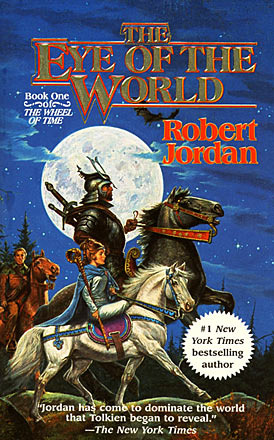
The Eye of the World, by Robert Jordan
Against my better judgement, I've decided to try listening to the Wheel of Time series originally by Robert Jordan. This series actually had a bit of a reputation at my high school because the school library had copies and it was considered a challenge for people to read because there were so darn many book in the series. Seriously, there are fourteen main books in the series, not all of them written by Robert Jordan because he died partway through writing the series. This series also has a reputation for being super trope-tastic, which isn't necessarily a bad thing, but it does leave the reader feeling like they're just in somebody's own attempt to create Lord of the Rings. Having finished the first book I can safely say it is very definitely chock full of tropes and at least follows the same general pattern of Lord of the Rings if not running in the exact same grooves. However, with thirteen other books to go, hopefully there's an opportunity for the series to develop beyond the first book.
I was actually kind of disappointed with the first book, Eye of the World, and I think it's because it spends so much time establishing the universe of the book while vaguely dancing around the main plot. You do get the impression that Jordan has developed a deep and complex world for his characters, possibly with lengthy genealogies as well, but I feel like Jordan spends way too much time on the development and just not quite enough time on moving the plot forward. Let me see if I can draw a comparison.
Remember how there's that first part of Fellowship of the Ring where Frodo, Sam, Merry, and Pippin are leaving the Shire but haven't gotten to Rivendell yet? Their main quest at that point is escaping from the pursuing Ringwraiths and reach Rivendell safely, but we don't get to the real quest involving the One Ring until the Council of Elrond. This first book feels a lot like that. The characters are trying to leave their home of Emond's Field in the Two Rivers and reach the city of Tar Valon, where everything will be explained to them there. More importantly the servants of the Big Bad are chasing the protagonists so it's important that they reach safety. Now I don't know about the rest of you guys, but for me that part between the Shire and Rivendell was the least exciting in the entire series. (Looking at you, Tom Bombadil.) So if the first book of this series is entirely like that, it's not as much fun for me either.
The finale for this book is also really rushed. Our main characters finally link up and go off to fight the Big Bad (Known as the Dark One, incidentally) utilizing an artifact from a previous age known as the Eye of the World. And then the main characters...win. The Dark One is defeated, presumably dead, and the day has been saved. This is all within the last few chapters as well, mind you, so it's kind of weird how it abruptly ends. Obviously the Dark One is not truly defeated because there are a baker's dozen more books to go and it's implied he's not really dead, just temporarily defeated. But for the amount of time we spent not knowing where we were going or what had to be done, the ending felt like a bit of an anticlimax.
Hopefully as the series goes on we'll get some more development and the characters will get fleshed out a little bit more for me to know them better. (In typical fantasy fashion they have overly elaborate names so I have to go do research to find out how to spell the darn things.) But as a start it leaves a lot of room for improvement.
- Kalpar
Tuesday, March 6, 2018
The Dungeoneers, by Jeffery Russell
Today I'm looking at another fantasy novel about professional adventurers, The Dungeoneers, by Jeffery Russell. Because this was a suggestion when I read The Palace Job (along with Orconomics) I was a little worried that this might end up being very similar to the other stories. Fortunately I can say that this book definitely has its own niche. On a sliding scale from most serious to most comedic I'd say this falls between the more serious nature of The Palace Job and the more comedic nature of Orconomics, with maybe falling a little further on the serious side. All that being said, this is pretty enjoyable.
The Dungeoneers begins with Durham, a guard who's worked at the sheep gate for the past five years and didn't expect his career to change terribly any time soon. When an order for him to follow a caravan arrives, he assumes it'll be some very boring babysitting for a merchant. Much to his surprise Durham discovers that the caravan he's been assigned to is a band of dwarves who professionally explore and loot dungeons for nobles, as well as retrieve powerful artifacts and keep said artifacts from ending up in the wrong hands. It seems there's been some mixup in the paperwork and Durham will be in far more danger than he possibly could have imagined.
The main thing I liked about this book was the idea of professionals who take out traditional fantasy problems in a manner different from what we're used to. (Although that may be because it bears a striking similarity to the idea for my own book, The Dragonslayer Manuscript) Thud, the leader of the Dungeoneers explicitly tells Durham that they're not adventurers or heroes. Those sorts of people wander into places and usually get themselves killed. The Dungeoneers are professional dungeon-delvers. They avoid risks, they carefully search for traps, they have a variety of equipment to solve problems, and they're willing to pull out gunpowder or a ballista to make sure everything goes smoothly. I like how Russell took the problem of looting a dungeon and took it to an incredibly straightforward and business-like solution.
The book does spend a lot of time on exposition and establishment because it's the first in a series so it's a little lighter on the things-happening parts. I want to say at least half the book was spent on exposition rather than plot, but within the plot we actually saw characters do things and use their skills, rather than just be told about it. Durham actually proves very observant for a guard and his skills come in useful for the party, and every dwarf on the team has their own unique talents. So I think Russell did a pretty good job there.
This is a fairly short read but it's interesting enough that I'm willing to consider getting to the next book in the series. (Although considering I have another thirty books to read that looks incredibly difficult right now) But if you like fantasy with a twist this is a good choice.
- Kalpar
Thursday, February 1, 2018
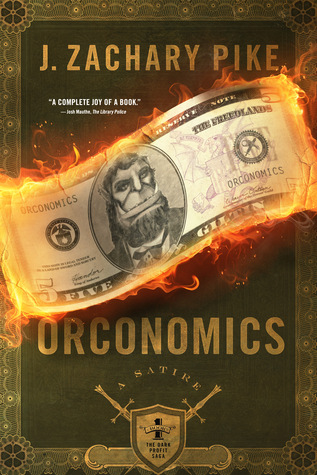
Orconomics: A Satire, by J. Zachary Pike
Today I'm looking at a parody novel written by J. Zachary Pike titled Orconomics. This book takes the idea of the standard swords and sorcery RPG like Dungeons & Dragons and explores, at least partially, the economy that would develop around heroes going into dungeons, killing monsters, and bringing back fantastic shares of loot. As it's been argued before in some D&D circles, the sheer fact that high level characters can instantly inject hundreds of thousands of gold pieces more or less instantly into an economy, and yet the economy suffers no inflation. To that end Pike creates a plausible economy of plunder futures trading and other financial derivative products which would help soak up the excess capital. However, Pike covers additional topics which means this is not solely an economically-driven satire.
Orconomics follows Gorm Igerson, a former Dwarven Berserker famed throughout the world as Pyrebeard. Due to a dishonorable incident some twenty years ago, Gorm was cast out of his clan, stripped of his titles, and declared an outlaw by the Heroes' Guild. Ever since Gorm has been scraping by best he can, finding solace in the bottom of a bottle more often than not. But when Gorm decides to get a goblin non-combatant papers he gets caught by Guild Enforcers and is faced with a decision: either certain execution at the hands of the Guild, or only almost certain death on a damn fool mission to aid the prophet of an insane deity. As Gorm puts it, it's not much of a choice at all but almost certain death is marginally better than certain death. Now Gorm just has to get a team including a naive prophet, two mages that can't stand each other, a bard who is almost definitely not a thief, and a washed-up has-been Elven ranger to work as a team rather than fighting each other and there may be a chance he'll actually survive.
As I said, this is partly a parody of a monster-killing and loot-gathering based economy, with traders purchasing shares in dragon hoards and professional unions for heroes, goons, and thugs. However, Pike takes on more standard fantasy tropes in his parody as well, such as the assumption that the ''evil'' races like orcs, gnolls, goblins, and kobolds truly are always evil. True, it's a topic that's been done before but I think that Pike manages to do it rather well in his novel. And there are plenty of other enjoyable moments throughout this book to make it easy to read.
If I have any critiques of this book, I think it's that Pike tries to take on too much in this particular book. As you might have noticed, this is intended to be the first book in a series. (As of writing it doesn't look like he's published the second novel so we'll have to wait and see for now.) It definitely seems like Pike has grand ambitions for his series because he sets up several plot threads, including heroes getting addicted to healing potions, a clan of aggressive weapons salesmen, and a prophecy about the fate of the world all in the first book. It almost feels like he was trying to take on too much at once in one book to get all his plot threads up and running at once. While I appreciate Pike doing so because it gives me a sense of what sorts of plans he has for the series, I feel like he could have saved a couple to be introduced later and gone a little more in depth in this book with a couple plotlines.
Overall though, I thought this book was pretty enjoyable. Maybe not the must subtle of satire or writing, but still a pretty good introduction to a series that has promise.
- Kalpar
Thursday, November 9, 2017
The Mists of Avalon, by Marion Zimmer Bradley
Today I'm looking at another retelling of the Arthurian mythos, The Mists of Avalon, by Marion Zimmer Bradley. I was interested in this book because it's billed as the story of King Arthur as told from the perspective of the women in his life, such as his mother Igraine, his sister Morgaine, and his wife Gwenhwyfar. Since the women in Arthurian myth are often relegated to side roles or, in the case of Morgan le Fay, antagonistic roles I was hopeful that this would be a new and interesting take on a thousand year old storytelling tradition.
Unfortunately I'm left with the feeling that this book simply isn't worth the time and effort that I put into reading it. There are a few good parts which I want to talk about first before I get to the big issues, but I was left feeling extremely disappointed. Perhaps it's unfair for me to judge a book published over thirty years ago by today's standards, but for a radical new perspective on the Arthurian mythos, this feels like it doesn't break new ground.
The thing that I liked most about this book was how it explained some things that never really made sense to me in the Arthur legend. For example why Morgaine, Arthur's sister, would help him and then later decide to hurt him by stealing Excalibur's magic scabbard and plot his downfall. In a lot of the older stories Morgaine isn't developed much beyond her being an evil sorceress so the fact that Zimmer Bradley puts in the effort to make it sense within the narrative I greatly appreciated.
I also liked how Zimmer Bradley explained why the Grail Quest was such a curse on Arthur and Camelot. In some versions of the mythos, the Grail Quest scatters Arthur's knights to the corners of the earth, and many die or disappear, so that when Mordred attacks Camelot Arthur doesn't have his full strength. And it seemed curious to me that God should send Arthur and his knights on a quest to find the most holy of relics only to have it end up destroying Camelot. The way that Zimmer Bradley frames the Grail Quest and what's truly going on makes the story make a lot more sense. Obviously these are stories that have been told, retold, edited, and remixed for hundreds of years so a lot of stuff isn't going to make sense, but I appreciate how Zimmer Bradley managed to turn it into a cohesive narrative.
The biggest issue I had with this book though was what the women spent about 80-90% of their time talking about, namely their relationships with men and having babies. For me this was incredibly boring and it just utterly failed the Bedchel Test over and over. Which is a little weird to use the Bedchel Test when it dates from the early 2000s, but I feel like if your main characters are going to be the women, it's a valid test to use. But I'm still torn over this for a number of reasons. On the one hand, at the time period they're depicting the roles of high-born women were largely circumscribed and dominated by men and their ability to bear children, so it is an accurate portrayal in that regard and if the goal was to show how frustratingly boring and limited these women's lives were, then Zimmer Bradley does a good job.
On the other hand, for a nearly nine-hundred page book it makes for really, really tedious reading and if this is supposed to show how powerful women can be then it still shows that they're dominated by their relationships by men and their ability to bear children. And I do think Zimmer Bradley was trying to go with the women being powerful message because Morgaine and several other characters are priestesses of Avalon, representatives of the Goddess in the mortal world with their own mighty, magical powers. So we have all these powerful women who are trying to influence the future of Britain and yet they are almost still by their relationships to men rather than their own abilities.
The other 20-10% of the time, the women were arguing about religion, which is the second biggest theme in this book after men and babies. Morgaine is a partisan of the old ways and the traditional druidic religion of Britain, passed down from Atlantis, in which all gods are one God and all goddesses are on Goddess. Gwenhwyfar, however, is a devout Christian, the proponents of only one God and who wish to stamp out all other forms of religion. At least, that's what we're told by Zimmer-Bradley. For most of the book we're told about the Christians' intolerance for other religions and the pagans' willingness to tolerate the Christians, although based on the things we actually see in the book the pagans look like the intolerant ones. It's really a case where Zimmer Bradley needed to show rather than tell to us. And as someone who has no dog in this fight beyond a general attitude of letting people worship however they please as long as they leave me alone, I couldn't get terribly invested in the conflict.
Another thing that kind of annoyed me was that Zimmer Bradley threw in various things that could have led to plots more interesting than what we got. For example, it's heavily implied if not outright stated that Arthur and Lancelet are sexually interested in each other and Lancelet is, if not gay, then at least very, very bisexual. And this would have been really groundbreaking in 1982, never mind today when it would still be new. But this gets barely any attention at all. Or the ambitions of Moraguse, Arthur's aunt, wife of King Lot, and foster-mother to Mordred. We get told that Moraguse is an extremely ambitious woman with great sexual appetites and is extremely interested in becoming High Queen of all Britain someday. We actually get to see Moraguse be the ruthless operative willing to utilize dark magic to achieve her goals, but only a couple times in the entire book. Most of the time Moraguse is barely in the book to the point she's a side character rather than a main character. I feel like this could have been a much better story than what we ended up getting but for whatever reason Zimmer Bradley left it as an undeveloped thread.
I think my negative opinion of this book is just because of how dreadfully long it is which made it feel like that much more of a chore to read. I personally felt that the payoff was not worth all the time and effort invested in this book, and I finally finished it with relief more than anything else. If you're looking for a really good Arthur re-telling from a female perspective, my favorite of all time is still Gwenhwyfar, by Mercedes Lackey. As much as Zimmer Bradley tried, I just can't make myself love this adaptation.
- Kalpar
Tuesday, July 4, 2017
The Books of the South, by Glen Cook
Some of you may remember years and years ago when I reviewed a book called The Chronicles of the Black Company. This was a book that was pitched to me as kind of like Lord of the Rings but told from the bad guys' side, which I thought would be pretty interesting. If you remember my review, or have just checked that helpful link, you may also recall that while I liked the characters and the setting I had some issues with Cook's writing and a huge problem with Cook telling instead of showing. So while there were parts I enjoyed, it's a little understandable that I was hesitant to come back to the series.
Returning to the series some two and a half or three years later does come with downsides, such as forgetting certain specific details in the narrative. I remembered the broader, important details, but I was unfortunately a little hazy on some other things. So I did have to spend some time reorienting myself, but once I had my feet under me I was happy to be tagging along with Croaker, Lady, Goblin, One-eye and the rest of the gang.
This is actually an anthology of three books, although I think the anthology title is a misnomer because the last book, The Silver Spike, takes place entirely in the north and exists almost independent of the other books so it's a little weird. The first two books follow the Black Company as it heads south, on Croaker's mission to return to the city of Khatovar. Along the way the handful of survivors start rebuilding the Black Company and discovering details about the Company's history. Much to Croaker's frustration, details about Khatovar and the very early days of the Company are frustratingly scarce.
As they head south, the Black Company discovers their way is blocked by mysterious figures known as the Shadowmasters, who seem to have an existing grudge against the Black Company. If they wish to get to Khatovar, the Black Company will have to help the inhabitants of Taglios drive off the Shadowmasters once and for all.
The Silver Spike by contrast deals with characters such as Raven, Silent, and Darling, who were associated with the Company but went their own ways. This book takes place mostly in the north where the Lady's old empire is still running along, despite her absence. The book focuses on the silver spike in which much of the Dominator's power was sealed and then placed within a tree to hopefully keep it sealed for all eternity. Unfortunately some people get the bright idea to steal the spike and a race among every two-bit wizard in the northlands who wants to get their hands on the spike, along with people who want to keep the Dominator's power from being unleashed, turns into a major war. After the plot of the Company in the south gets left at a cliff-hanger, it's entertaining but a little weird to jump back north and see what's going on elsewhere.
What I will say about this book is Cook's writing has definitely improved. I felt like the narrative flowed a lot better and it was easier for me to get invested in the story than it was for me in the first anthology. I was actually really curious about what the big mystery surrounding Khatovar was and started putting the clues together to come to the same conclusion Lady did, maybe only a little ahead of her. There were some plot twists that were a little odd and some things I didn't fully understand, but I think overall these books were an improvement.
Other than that? There's not a lot I can say. These books were good, and I liked them. Cook does a really good job of making his universe realistic while also incorporating fantasy elements and lots of high magic. I can definitely see, especially with Taglios, where he's borrowing from real-life to create cultures for his world, but plenty of authors do that so I'm hardly critiquing him for that.
Cook has definitely left me curious about what will happen to the Black Company and if they'll ever reach Khatovar and discover their past. Hopefully it'll be less than three years before I pick up the next anthology in the series. If you like fantasy, adventure, and something a little different then this is definitely worth checking out.
- Kalpar
Tuesday, May 16, 2017
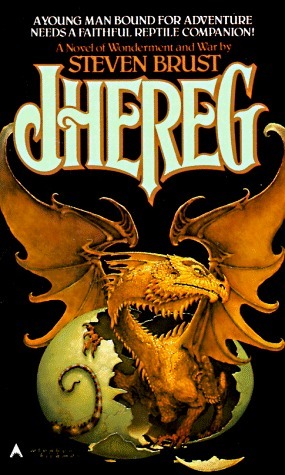
Jhereg, by Steven Brust
Today I'm looking at a book which was loaned to me by a friend, Jhereg. Doing a little digging around I found out that this is actually the fourth book chronologically in the series, but the first one which was published. And I can definitely say that this book feels a little incomplete. It's pretty short and I can see a lot of areas where it could have been expanded but otherwise it's pretty good.
Jhereg follows the life of Vlad Taltos, who is apparently talked about more in other books but this is the first time we meet him and his jhereg familiar, Loiosh. Vlad is an Easterner or human, at least what passes for human in this series. A good chunk of the world is ruled by the Dragaeran Empire, the Dragaerans being a tall, long-lived species with an affinity for sorcery and other abilities. So...kind of elves and yet kind of not at the same time? It's a little confusing. As a result Easterners, aka humans, have second-class citizen status within the Empire. Anyway, the Dragaeran are divided into seventeen different houses with different specialties. The Dragons, for example, are great warriors and generals, while the Jhereg are spies, thieves, and assassins. Vlad's father actually purchased a title within the Jhereg House, making Vlad have something approaching equal rights with the Dragaerans but still the taint of being an Easterner by blood.
The plot centers around an assassination mission that Vlad has been hired for by one of the members of the Jhereg council, known only as ''The Demon''. Apparently an individual named Mellar has absconded with over nine million gold imperials of the council's operating funds. Aside from seriously hampering council operations, if word of Mellar's theft leaks out and he remains unpunished then the respect and fear that most of the criminal underworld has for the Jhereg council will disappear overnight, permanently weakening the house's power. Vlad has to find Mellar soon and take him out, the only trouble being nobody knows exactly where he's gone.
The plot is pretty good and Brust does a really excellent job of world-building in his book. I could have used a little more exposition, but it does manage to avoid that ''as you should already know'' lectures of exposition that some sci-fi and fantasy series fall prey to very easily. I can see that Brust has developed a very complex world in his mind and I kind of wish we'd gotten to explore it more in a longer book, rather than the 240 page book that we ended up getting. But there is the possibility that the world gets explored more in-depth in later books.
There are also a couple of plotlines that get introduced but are really incidental to the ''we need to kill Mellar so everyone takes Jheregs seriously'' plotline, to the point I almost feel like Brust was cramming too much stuff in. As I said it's a pretty short book so I almost wonder if we might have gotten more about the assassination plot if he wasn't throwing in all these big side plots which make the world feel a lot more complex, although sometimes feeling a little too complex.
Overall this was a short and pretty interesting read. This definitely felt like Brust had enough ideas to make this a huge, door-stopper tome like some of Martin's books or other fantasy books that I've read. But its brevity makes it a good weekend read. If anything, I wish it had been at least a little longer for some more development and in-depth exploration.
- Kalpar
Tuesday, April 25, 2017
First Rider's Call, by Kristen Britain
As you might remember, I reviewed a book some time ago called Green Rider, the first in a series by Kristen Britain. I remember thinking the main character, Karigan, seemed to stumble from one crisis to the next while usually requiring help from other people, but overall I thought it wasn't that bad. At the encouragement of the friend who suggested I read this series in the first place, I decided to read the second book, First Rider's Call, which is set about two years after the events of the first book.
When we left Karigan at the end of Green Rider, she had refused the Call to Adventure and had gone back to live with her father and work with their merchant clan's business. At the time I had expressed some frustration because of our heroine's decision to turn down a very literal call. Fortunately I was not the only one and the book begins with the very irate ghost of the First Rider finally rousing Karigan to answer the call and join the Green Riders, which I found very hilarious. The rest of the book involves Karigan mostly resigned to her role as a Green Rider. There is some grumbling on her part, but it seems like she's accepted this is the path that's been chosen for her.
There were a couple of things I really liked about this book and I think I found it somewhat better than the first one. The biggest thing is a time travel plot which you don't see a lot in fantasy. Sci-fi it's very common but I think I'd be hard pressed to name more than a couple of examples of time travel in a fantasy series. The result is we learn more about the history of the world Britain has created and the history of the Green Riders as well. Sprinkled through these books are journal entries from an imperial official which, while initially confusing, you begin to see how they're connected to the rest of the narrative and become that much more interesting. Plus I'm always a sucker for a good time-travel plot so this book definitely had that going in its favor.
I also feel like Karigan didn't stumble as much from crisis to crisis in this book. There are points where she's helpless and needs to be rescued by others, but I was left with the feeling Karigan had far more agency in this book than she did in the previous one. I'm not so crazy about her being the Chosen One Super Special Snowflake, at least that's kind of the vibe that I got from the book, but I'm not a big fan of Chosen Ones in the first place so that's hardly a surprise. I feel like we get to see Karigan develop as a character and there is promise she'll develop into a fine leader in later books.
One thing I did notice was Britain seemed to be pushing the relationship between Karigan and King Zachary really hard, especially when we find out the First Rider and the first high king were romantically involved which creates further parallels between the two characters. You know, beyond both of them sharing the same magical brooch. On some level I'm okay with it because while I'm not a huge fan of romance plots, they don't bother me overmuch. The problem is when, especially towards the end of the book, this gets played for all sorts of drama between Karigan and Zachary which promises to continue well into later books. I'm not a huge fan of the endless drama sort of romance plots so I'm certainly not looking forward to that.
Overall though, I enjoyed this book. It had been a while since I'd read the first one so some of the details had gotten a little fuzzy, but I thought it was pretty good. Definitely better than some of the other fantasy novels I've slogged through.
- Kalpar
Thursday, November 3, 2016
Green Rider, by Kristen Britain
This week I'm taking a look at the first book in a series recommended to me by a friend, although she has strongly suggested that I only read the first three books in this series because, in her opinion, they rapidly go downhill from there. But considering how many other things I've reviewed on this blog, I'm willing to give a wide range of things a read. So without further ado, Green Rider by Kristen Britain, the first of the Green Rider series.
The plot follows Karigan G'ladheon, the only daughter and heir of the prominent merchant clan G'ladheon who has just been suspended from school. Karigan has decided to head back home on her own and has started the journey through the Green Cloak forest. Not very far into her journey, Karigan runs into a dying Green Rider, a member of the king's own elite messenger corps with an absolutely vital message for King Zachary. Being the only person in the vicinity, the Green Rider recruits Karigan to deliver the message and entrusts her with his brooch, sword, and horse. Karigan soon finds herself in a far greater adventure than she could have ever imagined with the fate of the entire kingdom at stake.
Generally speaking this feels like a lot of fantasy books I've read and fits into the mold. That being said, it's a mold that is extremely popular and I feel Britain manages to make the story work a lot better than some of the stuff I've made myself read before. I at least wasn't rolling my eyes the entire time or wondering where details that hadn't been mentioned before had wandered into the book. I will admit that Karigan is giving off a pretty strong Chosen One vibe, and I have mixed feelings about Chosen Ones so that may be affecting my perception of the story. However, Karrigan does have some redeeming qualities like spunk and standing up to bullies of all sorts, which makes her an enjoyable Chosen One, if I am correct in assuming she's the Chosen One.
I do have some other concerns about the books which kept me from fully enjoying it. Foremost, I felt like Karigan wasn't really in control during the book and I wasn't sure if that was a good thing or a bad thing. Especially in the first half of the book she seemed to stumble from one crisis to the other and got rescued mostly by the coincidence of friendly people being in the area. On the one hand, it's kind of frustrating because it feels like she's just stumbling around and is only making progress because of fortuitous circumstance. On the other hand, Karigan's only a teenager so it feels appropriate for her to be only marginally competent and have to rely on a lot of help. So, as I said, I'm not sure if it's a good thing or a bad thing.
Another thing that bothers me is how much Karigan is refusing the call through the book. And is still refusing it by the end. On the odd chance none of you are familiar with it, the Call to Adventure is something, whether a person or an event which breaks the status quo of the heroine's life and forces her to undertake the quest of the story. Sometimes the heroine jumps at the opportunity, eager to break out of her humdrum existence. Other times she is far more reluctant and may initially refuse the call, such as Luke Skywalker's protest that he can't get involved. (More often than not something comes along to prove the heroin must get involved.) Throughout the whole book Karigan protests that she's not a Green Rider. This is despite her agreeing to carry the message to the king, having turned down countless opportunities to give up, and remaining involved well past the point she had no further obligation and could have walked away. By the end of the book Karigan is still protesting that she's not a Green Rider and will never be involved again. Although the reader, like pretty much everyone else in the book, knows this simply isn't the case and Karigan will be back in the center of things. I kind of just want to shout at her that the Call knows where she lives and she can't avoid it, but I have a feeling that would be utterly ineffective.
Overall, this book's okay despite my reservations. As I think about it, it's much better than some of the first fantasy novels of various series I've looked at and had absolutely no desire to continue reading. I will admit some of the appeal is because a friend suggested this to me, but it's pretty good. I'm actually looking forward to the prospect of reading more in this series.
- Kalpar
Thursday, October 20, 2016
Gwenhwyfar: The White Spirit, by Mercedes Lackey
Today I'm taking a look at another Mercedes Lackey book, in this case Gwenhwyfar: The White Spirit, which is Lackey's own take on the Arthurian mythos and a sort of reinterpretation as well. When you get something as old as the legends surrounding Arthur there are dozens, if not hundreds of stories which have been edited, altered, censored, expanded, or otherwise changed over the centuries. During her research into Arthurian legend, Lackey came across an interesting and old idea that Arthur actually had three queens, all of whom were named Guinevere, or Gwenhywfar for a more Welsh version. (When it comes to some characters there seems to be a different spelling for each version.) On top of that, one of the Gwenhwyfars also had a sister named Gwenhwyfach, to make it only more confusing. Lackey thought that having three Gwenhwyfars would explain far more about all the shenanigans that Arthur's queen supposedly got into. And also how she could have had two sons or no sons at the same time.
Now, I haven't talked about it much on this blog, aside from that one time I reviewed Le Morte d'Arthur way, way back. But I'm like, a huge sucker for Arthurian legend. I have vivid memories of checking out every book I could find about Arthur from the library, as well as anything I could find about knights, castles, and medieval history in general. So when I was looking through the library and found a reinterpretation of Arthurian myth from an author who I've enjoyed before, I absolutely had to pick it up. And I had an absolute blast listening to this book. It was kind of confusing in the beginning as I was getting myself oriented within the framework of the story, but once the story got its feet under it it just goes and doesn't stop until the very end. And if you're a fan of Arthurian myth as much as I am, you're going to enjoy this story immensely.
Plot-wise the book follows the third and youngest Gwenhwyfar, who is the third of four daughters of one of King Arthur's sub-kings and begins following the path of the warrior in a very Boudica-esque fashion. The story also follows her perspective entirely and never shifts out, which I was kind of annoyed with at the beginning because it's hard to see how Gwen's life and warrior training tie into the larger story which you sense is going on ''out there'' somewhere. Which, as I said, makes the book kind of slow to start. But as the book progresses, I actually started liking the story more and more. There are a lot of things that happen that are obliquely referenced to or not fully explained, or you see snippets of what's going on. But if you're a fan of Arthurian legend and already know the story then you can fill in the details pretty easily. Eventually I came to actually enjoy the limited viewpoint since we were following just Gwen around. Largely because I knew things she didn't and could put things together because I knew the mythos so it became a sort of puzzle for me to put together. By the end, I actually found myself hoping that maybe the characters might be able to avoid the disaster at the very end of the book, with Arthur dying, Camelot falling, and Britain falling into chaos, which was pretty exciting for me.
Lackey also attempts to do a more ''historical'' interpretation of Arthur, you know, aside from all the magic floating around which I'm willing to give her a pass on. Of course, the fact that I'm the absolute worst person to look at any attempt to create a more ''historical'' Arthur came to the fore. I'm the guy who will quibble over whether or not the Romano-British, which is what the characters are supposed to be, would have used stirrups or not. Or even the use of the term castle. I get that picky. But for the most part I was able to put that aside and was able to enjoy the story. There are plenty of things that Lackey does that makes the story feel right to me. It all just really works and make the universe feel real.
Overall, I really loved this book. As I said, I've been a fan of the Arthurian mythos since forever so this book was an easy sell for me. There are some issues I had. The writing doesn't feel quite right in some places, and the book takes a while to get started, but it eventually builds up steam and then there's no stopping it. For a new interpretation of an old classic, with incorporation of elements both old and new, Gwenhwyfar is definitely worth it.
- Kalpar
Thursday, October 6, 2016
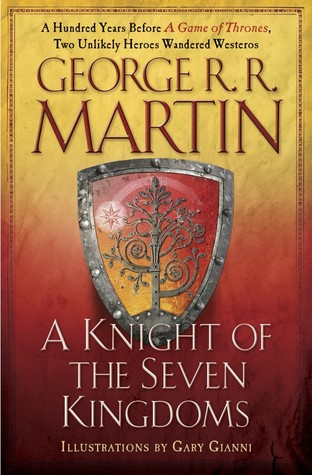
A Knight of the Seven Kingdoms, by George R.R. Martin
This week I'm taking a look at a spin-off of the extremely popular Song of Ice and Fire fantasy series, more commonly known as Game of Thrones after it became an insanely popular tv series. A Knight of the Seven Kingdoms is a collection of short stories set about a hundred years before the events of Game of Thrones, back when the Targeryens rule Westoros from their Iron Throne. The stories follow the adventures of Ser Duncan the Tall, also known as Dunk, and his squire known as Egg. Dunk is a hedge knight, really not much more than a vagabond at the bottom rungs of society. Dunk takes what work where he can, while aspiring to remain loyal to the principles of chivalry and true knighthood. To further complicate this is Dunk's squire, Egg, who has a rather interesting family background but that's for you to find out in the stories.
This book contains three novellas which follow our heroes as they wander across Westeros. Martin claims to be planning several other stories with Dunk and Egg, but only time will tell how many we actually end up seeing. For now, though, I rather enjoyed these stories and I highly recommend them to other people. I will say that while they're independent of the Song of Ice and Fire storyline, I think it's highly beneficial to have read the other books because they provide much more information about the setting's backstory, locations, and other details which Martin doesn't really go into in these stories. I think someone who hasn't read Song of Ice and Fire would be able to read these stories all right, but I think they'd be somewhat confused by the references characters make. If you know the setting, though, then you'll be just fine.
The thing I really liked about these stories is they feel a lot like stories from the Arthurian mythos. If I haven't mentioned this before, I am a huge fan of Arthurian legend and I am an absolute sucker for stories about knight errants seeking for quests. These stories have a far earthier tone, though, compared to the old chivalric romances and that's something Martin does very, very well. We may be in a setting with dragons and magic, but Martin manages to make the world feel very realistic and he shows what life for people at the bottom of the heap is like as well. There's just something about Martin's writing that makes the world feel incredibly realistic.
Another thing that I liked was the inclusion of illustrations within the book by Gary Gianni. Although they're just black and white illustrations, I think a few of them are downright gorgeous and they really add an extra visual quality to the story. Even if these are stories for grown-ups, the illustrations are an excellent bonus.
Overall, I think these stories were very enjoyable, but as I said, it's a genre that I really enjoy and Martin creates a rich and very believable world. At the end of this book, as with a lot of Martin's other books, I'm left wanting more, and it truly is an enjoyable universe. But ultimately we'll see what happens with the series as time goes on.
- Kalpar
Thursday, July 21, 2016
A Quest of Heroes, by Morgan Rice
Okay, so this week we're looking at another fantasy novel from those anthologies that I purchased so long ago on Amazon. A decision which I'm rapidly coming to regret if I'm completely honest. A Quest of Heroes is the first in somehow a mind-boggling seventeen books of a fantasy series, which I have been left with absolutely no desire to continue reading whatsoever. I've actually been left wondering how there are seventeen books in this series which is a little curious but I suppose that's neither here nor there.
I want to start off by saying that I tried to give this book a fair shake, I really did. I had concerns in the beginning, but I wanted to give it a try and figured there was a chance it would turn out okay. Unfortunately the last chapter left me rolling my eyes with frustration and I kept putting my kindle down. There isn't anything particularly offensive or wrong about this book, it's just not terribly well written and...I really don't have a better word to describe it than dumb.
The book starts out okay as a pretty standard fantasy story. We meet Thor, a shepherd boy who's finally turned fourteen and is old enough to join the Legion, a unit of the king's army that's basically the only path of social advancement in the kingdom. Thor dreams of joining the Legion and eventually the Silver, the elite corps of knights, along with all the honor, titles, and lands that comes with it. Selection day approaches and a group of the Silver visits Thor's village to choose boys to become recruits for the Legion. Thor's three older brothers, and his father's favorites, are selected, but Thor is left behind. Despondent, Thor goes into the forest where he meets a druid, is told he has to find his destiny, unlocks a mysterious magical power that lets him kill a monster, and he runs away to join the Legion despite not having an invitation.
It's pretty standard fantasy fare. Thor's the Chosen One. No, seriously, Rice uses the actual words Chosen One. I wasn't entirely sure if it was meant to be satirical, but I'm pretty sure it was being played completely straight in the book. And honestly? I'm not as bothered by what happens afterwards in the book. Now, in this book they don't explicitly state that Thor's the Chosen One but, come on. He's a simple shepherd boy that everyone thinks looks like a noble and has mysterious magical powers. Do you seriously think he isn't the Chosen One? I kind of wonder why Rice didn't have at least a confirmation that Thor's the Chosen One in the first book. That's kind of a thing that you do to set up the rest of the series, but maybe because the series is just so long they decided to keep it for later. Anyway, kingdom, prophecy, magic sword, chosen one, all the rest, you know the drill by now so that's enough about that.
If the book had just been a standard fantasy quest, in the vein of Lord of the Rings or Belgariad, it would have been okay. I probably wouldn't have cared for it much because I'm honestly kind of burned out on those sorts of books, but it would have been okay. The problem is so much of the writing is inconsistent or the other things Rice decides to throw in are just...dumb and the last chapter takes it to new heights of ridiculousness. A good example is things start appearing in the narrative that weren't there before. At the end of one chapter Thor goes off to meet someone in a courtyard and in the next chapter he's looking for a door with a red handle. I went back and double-checked because I thought I could have missed it but no, there was no door with a red handle mentioned in the previous chapter. I'm aware that's kind of nit-picky of me, but it's a little confusing when things show up in the narrative that weren't there before. Or Rice forgot things they already put in the book, such as Thor getting drunk. There's a scene in an alehouse where Thor admits that he's only had a few sips of ale before, except at a wedding in an earlier chapter Thor drinks so much ale he ends up having a hangover the next morning. So, he's already been drunk. We as the readers have seen it and I didn't get the impression Thor was trying to lie because Rice acted like it was the first time he had alcohol again. It just feels like they weren't paying attention to what they had and hadn't already put into the book.
Another thing that bothered me was some of the comments made about Thor, specifically the fact other characters joke that he hasn't bedded a woman yet. Might I remind you, Thor has just turned fourteen and probably isn't old enough to shave, much less have a tumble in the hay. If he was eighteen it'd be slightly more believable for him to be drinking and wenching and so on, but fourteen seems a little to young for that. It just felt weird to me. A further part that doesn't make sense is the scene where the king has to choose a successor from among his children, in accordance with the traditions of the kingdom. His first son isn't eligible to inherit because he's illegitimate, his second son is shifty and evil so he's out, and his third son is a drunkard so he's not a good choice either. That leaves his daughter and his son, both of whom are fine candidates, although his last son is about two years younger than his daughter. The weird thing is he decides that his daughter should inherit because she's slightly older, despite there not being a tradition of female inheritance. Honestly this doesn't make sense to me because it's not like he has to abdicate right away or anything. The king's planning to remain on the throne for a number of years before his heir will have to take over. So his youngest son being only fourteen isn't really an impediment. Actually it may be a benefit because that means you'll have the longest time to groom him and prepare him for the responsibility of leadership. It's just the most backwards way of designating a leader that it doesn't make sense.
The thing that really annoyed me was the very end of the book which I'd feel bad about spoiling except since this is the first of seventeen books I'm hardly talking about anything significant. Basically Thor has a vision that the king is going to be poisoned and he rushes back to prevent it from happening. Except he's told the king's away and won't be back until tonight for the feast. So, you know, pretty serious situation, right? King's in danger. Thor's the only one who can help, ticking clock and so on. And by this point in the book it's already been established that there are people who believe Thor and recognize he has magical powers. Heck, a whole stadium of people saw him use magic once and they had the first of many awards ceremonies for the things he's done. So there are people who if he told, ''Hey, the king's in danger.'' they'd believe him.
So what does he do? Does he go for help? Does he let his friend, the king's youngest son know? Does he raise the alarm? No. He goes for a joy ride all day with the knight he's squire for. (Again, another person he could have told about this.)
...seriously. The king is in danger. Time is of the essence. And the Chosen One goes on a joy ride for most of the day and then unnecessarily has to rush back to save the king in time. You didn't think that maybe being close by so you could warn the king in advance might have been important? Even for a fourteen year old this seems particularly dumb. Anyway, Thor manages to get back in time, nobody believes him, then he sees the poisoned cup and knocks it out of the king's hands. People are shocked but then a dog drinks the wine and dies so they realize it's poisoned and then they accuse him of being the poisoner because he knew which cup it was in. Which makes absolutely no sense because he's been personally rewarded by the king twice before already for acts of bravery. He's friends with two of the king's sons. An entire stadium of people witnessed him use magic and know he has special powers. Furthermore he rushed trying to warn the king that someone was going to try to poison him ahead of time. And yet everyone immediately assumes he's the poisoner and they throw him in prison? It just doesn't make sense. It's like the author had to create a conflict for the next book to resolve really quickly and so they threw something together and it feels incredibly haphazard.
This book starts out okay but starts going downhill and by the end it's just an absolute mess. In the last chapter it feels like everyone's forgotten everything Thor did over the past two weeks or so and he's suddenly got no friends at court and nobody trusts him. The story is inconsistent and it feels like Rice wasn't keeping track of what they had and hadn't already put into the book which is a serious issue from a continuity standpoint if nothing else. I wouldn't recommend reading this book and I'm certainly not going to expend the time and effort to read the other sixteen.
- Kalpar
Thursday, February 11, 2016
Swords of the Emperor, by Chris Wraight
This
week I'm taking a short foray into the world of Warhammer
Fantasy. As my readers are
probably aware, I have spent considerable time trekking around in the
universe of the younger and more famous brother of the Games Workshop
family, Warhammer 40,000.
However there was a time when there were no Space Marines, no
Imperial Guard, no Traitor Legions, and no foul xenos menace. Instead
there was a fantasy setting with elves, dwarves, men, orcs, vampires,
and the ruinous powers of Chaos. Although Warhammer Fantasy
has been overshadowed considerably by its younger brother, it retains
its own following and is even getting its own Total War game. So I
decided to pick up one of the many, many omnibuses and see what the
fuss was about.
Swords of the Emperor
is an omnibus collection of a duology, a story divided into two
parts, as well as two short stories. The short stories are both
character vignettes of Ludwig Schwarzhelm, the Emperor's Champion,
and Kurt Helborg, master of the elite Reiksguard. Personally I would
have placed the short stories at the front of the book rather than
the end because they provide a little bit of characterization for
both, who are major characters in the novels but are just kind of
thrown at us without much by the way of introduction.
Plot-wise the
province of Averland, one of the major provinces of the Empire
(totally not a fantasy Renaissance Holy Roman Empire, we swear) has
been without an elector-count for too long. As a result the imperial
tithes and levies have been somewhat lacking, especially since
Averland is located in the south of the Empire, far from the constant
wars in the north. Emperor Karl Franz of Schleswig-Holstein, I mean
Holswig-Schlestein, has decided this nonsense has gone on for long
enough and is sending his Champion, Ludwig Schwarzhelm, to go down
and kick the necessary butts until a decision is made. However, as
always, there is far more at work than a petty squabble over who gets
to sit in the fancy chair and inevitably things get worse.
I will
say I felt out of my depth at certain points because I didn't know
terribly much about the Warhammer Fantasy
universe so I found myself asking why characters are important.
Because other characters treat them as important, but at least
initially they don't really go into why
they're Very Important People. If you're not familiar with the
Warhammer Fantasy universe
this probably won't be a good book to start with because there are a
few things that aren't explained and it's just assumed you're going
to know what they are. For example, the Reiksguard feature
prominently in both books, and while I knew from my own research that
the Reiksguard were elite warriors dedicated to the service of the
Emperor alone, they never really explained that in the book. It was
just kind of assumed you would know it. Which you can do in a shared
universe, but it's confusing and off-putting to a new reader.
My biggest
complaint is that I found myself bored with the book at various
points, especially during fight scenes. And there are a lot of fight
scenes in this book. There were other parts which I enjoyed and found
far more interesting, but for whatever reason the fight scenes in
this book just started feeling the same and for me it was kind of
“Ugh, great, more poking things with halberds.” There are just so
many ways you can describe people decapitating greenskins before it
starts getting repetitive.
Another
weakness of this book was I felt nothing was really at stake. One of
the biggest criticisms lobbied at both Warhammer 40,000 and
Warhammer Fantasy is
that the status quo can never be upset. The forces of Chaos and Order
have been fighting for decades now and things still stand pretty much
the same as they did when everything began. So on some level I knew
that everything would be set to rights at the end. In a way,
Warhammer Fantasy has
even less room to play around than Warhammer 40,000.
At least in 40k the author can create a planet or three in some
forgotten corner of the galaxy and sacrifice them to whatever baddie
they're writing about. In Fantasy,
you've kind of already got all of the borders sketched out and if you
start messing with things too much it's going to upset the balance
one way or the other. So while some really bad things went down in
Averland, I kind of knew it would all get reset by the end which made
the in between bits kind of meaningless.
If
you're a fan of Warhammer Fantasy
and actually know who Emperor's Champion Schwarzhelm, Reikmarshal
Helborg, and Grand Theogonist Volkmar are and are invested in their
stories, then this book will definitely get your interest. If you're
new to this universe you're going to get thrown in the deep end and
probably get confused very quickly. Other than the fight scenes which
felt painfully repetitive, this book was really interesting. I just
felt like it was a lot of wasted effort because everything got reset
at the end.
- Kalpar
Thursday, December 10, 2015
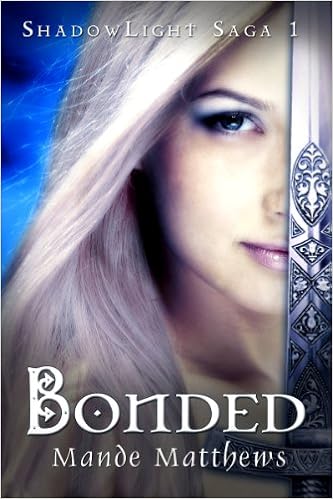
Bonded, by Mande Matthews
This week I'm reviewing another book contained in an e-book collection called Epic I bought from Amazon. This particular book, Bonded, is the first in a planned trilogy from Mande Matthews which in her own words is described as a combination of Norse mythology and the Hero's Journey as described by Campbell. For my readers who might be somehow unfamiliar with the concept of the Hero's Journey a.k.a. monomyth, you can find an entertaining and educational video here.
I would provide a brief overview of the plot for Bonded, but I'm kind of at a loss because I felt like the plot was by far the weakest part of Bonded, especially in what it lacked as a monomyth. Basically we have the main characters of Hallad and Erik, along with Erik's brother Rolf, who are out in the forest one day with Hallad's little sister Emma. They meet a mysterious woman in the forest, and suddenly a shadow appears that kidnaps Emma. Very simple plot hook, Emma (both Hallad's sister and Erik's love interest) has been kidnapped so a quest must be undertaken to rescue her. Throughout the book there are statements that imply Emma's kidnapping is part of a much larger plot, but throughout the entire book we're never given specific information about what this plot is. We get some vague information about a prophecy, Hallad being the chosen one, and we meet Lothar who's an underling for the Big Bad referred to only as the Shadow but possibly may be Loki. The plot is very vague on this point which actually makes it weaker as a book in my opinion.
The thing about the monomyth is that it doesn't do subtle. That's probably one of its greatest strengths and why it's persisted for thousands of years. There are very obvious good guys and very obvious bad guys and perhaps more importantly the stakes of the good guys losing are made incredibly clear. For example, in Star Wars you know that the Empire are the bad guys because they have the Death Star, which can blow up planets. Generally, good people don't go around blowing up planets. On top of that, if the Rebellion doesn't stop the Empire they'll keep going on blowing up planets. And that's bad. Or for another classic example, take Lord of the Rings. If Sauron recovers the One Ring, he'll cover all of Middle Earth in darkness. Forever. Also bad. The problem with Bonded was I never learned what exactly the bad guy was planning. There was something sinister afoot, I was assured of that much, but aside from Emma getting kidnapped the bad guys didn't really seem to do anything. And I still feel a little vague on who exactly the bad guy is in this story.
The reason I feel vague on who the heroes and villains are is because of how things work in Alvenheim, a realm the heroes aren't from but a lot of the action takes place in. Basically the majority of residents have magical powers which make them connected with the realm of Alvenheim and allow them to call upon the world to give them food, clothing, shelter, heat, pretty much everything humans need to survive. Fruit is not picked from trees, but rather freely given when asked for. Fires are not created because they cause pain to the world. Instead heat and light are called forth and provided. However, there is a very small fraction of the population which is born without magical abilities. They are completely dependent on others to provide for their needs because they cannot call upon Alvenheim to provide their needs. As a result the majority despises those unable to do magic and sees them as little more than worthless parasites who should be left to die of starvation and exposure.
Those without magic, left to fend for themselves, light fires, hunt animals, and do various other things normal people do to keep themselves alive. Furthermore the non-magical become outright brazen with their behavior because to the non-magical doing as little as picking a flower is worthy of the death penalty. So in the vein of "may as well be hanged for a sheep as a lamb" the non-magical people burn the land and boil the sea (sorry, couldn't resist) because they're going to get killed regardless of what they do, may as well get some good old revenge in while they're at it. Which although not explicitly stated, has left me with the impression of a bitter civil war between the two.
Why is this relevant? Well Lothar, the chief minion of the Big Bad and main bad guy for this book, is actually trying to help the non-magical. Granted, he's doing so for his own selfish ends (or so we're told), but he's the only person in the book who treats the non-magical as human beings rather than parasites. It certainly puts a damper on the whole monomyth if you show the bad guy working to help people who are risking death just to feed themselves and their children. Because that sounds like a very good guy sort of thing to do, kidnappings aside.
Otherwise, I felt like a lot of the book was spent sitting around waiting. The characters didn't know a lot of information, so they'd stumble around or sit around and wait and maybe get a little bit of information revealed to them, but not terribly much. I even got the feeling that the main characters got tired of waiting and rushed off into the unknown because they got as bored as I was. As I reached the halfway point I was just forcing myself through but losing any hope of getting a better explanation of what was happening, rather than some events which are tied to a mysterious and sinister plot.
Overall, I didn't really care for this book. The inclusion of Norse mythology is a nice touch and the author has definitely done her research on that subject. But plot wise I felt like this book was a bit of a mess, especially for something trying to follow the monomyth. There's a bad guy, but he seems to have very limited goals and the stakes are fairly small for a monomyth story. Plus, if your bad guy is helping people in trouble it makes him a little less of a bad guy. I'd recommend passing on this one.
- Kalpar
Thursday, October 1, 2015
Mageborn: The Blacksmith's Son, by Michael G. Manning
This week I'm reading another book from the larger e-book collection I purchased off of Amazon some time back. This particular collection is referred to as Fierce. Why, I have no earthly idea but that's entirely irrelevant at this point so onward with the review. The Blacksmith's Son is the first of five books in Michael G. Manning's Mageborn series. As a result, this book is largely an introduction to the characters and universe of the story which Manning is creating, as well as setting up some elements of a larger plot which I'm sure will be more fully developed in later books. I will say that this particular book just kind of...ends, which is a little disappointing.
This book focuses on the character of Mordecai Elridge, the titular blacksmith's son. Like several fantasy heroes I'm sure my readers can think of themselves, Mordecai discovers he's secretly nobility and a wizard. What I just said would count as a spoiler, except for two very important facts. First of all the prologue basically gives us Mordecai's tragic backstory ahead of time so we know exactly who Mordecai is, which makes his character's discovery of his true heritage not terribly surprising for the reader in the latter half of the book. The other fact is that a lot of the book is written from Mordecai's perspective, specifically he's writing from an older perspective recollecting on his youthful adventures so I at least got an inkling he was going to find out he was special fairly early on. As a result, a lot of the conflict doesn't really come from Mordecai's discovering of his abilities and heritage so much as his conflict with other characters. Which is a fine approach to a book, but it felt like specifically the discovery of his true family took place too far back in the book considering we the readers knew all along.
However, that being said, Mordecai's struggles to learn about magic and its capabilities, especially with a lack of anyone to teach him anything about magic, provides an interesting conflict in and of itself, coupled with most people's association of magic with evil powers which makes it all the more important for him to keep it a secret. In addition, there is conflict with other characters who are in league with evil powers and Mordecai's efforts to both stop them and protect his family and friends, which aren't always successful. The disappointing thing is that in the first book all the plot threads seemed to be tied up very neatly. There are some vague and nebulous threats which I'm sure come into play in the later books, but there isn't a threat in the first book left to bridge to the second book because they're all handled within this book. It left me a little confused about the overall direction of this series because it seemed like Manning didn't have a clear direction as to where he wanted to go. There are some general ideas and potentialities, but nothing terribly concrete.
And I will throw in, because I feel obligated to whenever I run into it, that there is a case of attempted rape in this book. I personally was left with the feeling that it was rape being utilized to up the drama and make a particular character seem even worse, but I didn't really need a lot of convincing that this guy was bad in the first place. So it just feels wrong to me, but that's ultimately a matter of personal opinion more than anything else.
To this book's credit, though, the writing is fairly enjoyable and I found myself chuckling along at several points throughout the book so it has that going for it. Plus all the main characters are teenagers who often act in irrational and stupid ways, which I find very believable for teenage characters. Especially considering all the hormones they've got surging around inside their bodies.
Overall this book isn't bad. It could be a lot worse than it is. But on the flip side I'm not jumping up and down and telling people they should go out and read it either. For me it was okay at best, but it's not something I'd foist on other people.
- Kalpar
Thursday, August 13, 2015
The Last Ringbearer, by Kirill Yeskov
This week I'm reviewing a book which was originally published in Russian and has been translated (somewhat unofficially) into English. The Last Ringbearer is a re-telling of the fantasy classic The Lord of the Rings, operating off of the assumption that Tolkien's text is a white-washing, sanitized version of events told from a pro-West viewpoint. The Last Ringbearer seeks to tell the story from the point of view of Mordor and reveals that maybe Gandalf, Elrond, and Aragorn didn't have as pure intentions as we've been led to believe. For the fantasy reader who's grown tired of the monomyth format that so many fantasy stories have followed, as well as the unabashed Tolkien fan, this is definitely a worthwhile book to read, even if there are some struggles with it.
The general principle of The Last Ringbearer is that the War of the Ring was not an epic struggle between Good and Evil, but began as a normal series of diplomatic misunderstandings between countries, which is what more than a few wars have been fought over in the past. Mordor is depicted as going through the early stages of an Industrial Revolution, a pinnacle of scientific achievement and knowledge, while the lords of Rohan and Gondor sit in their little castles and listen to mythical tales of ages long past. However the elves and the wizards, led by Gandalf over the protests of Saruman, seek to strengthen magic's grip on the world, dooming it to medieval stasis, and launch a war of extermination against Mordor. As we know from the traditional narrative, Mordor loses, and a brutal occupation and extermination campaign begins to wipe out all the scientific knowledge and progress that Mordor has made.
Into this is thrust Haladdin, a brilliant physician who volunteered and became a Medic Second Class in Mordor's army during the war. More importantly Haladdin is a rare individual who is immune to magic which means one of the surviving nazgûl charges him with an all-important quest: to rid Middle Earth of magic forever. If Haladdin succeeds, then Mankind will rise with the aid of science and technology and become master of his own universe. But if he fails, then humanity will become the mere pets and playthings of the elves, who seek to make Middle Earth a perfect, immaculately maintained, and stagnant garden. So in some ways, The Last Ringbearer is a re-telling of The Lord of the Rings with an epic quest to save all of Middle Earth, but at the same time it brings something fresh and new to an existing universe and gives it depth as well.
As someone who's bothered to go through and read The Silmarillion, as well as some of Tolkien's appendices, I can tell that Yeskov is a dyed-in-the-wool Tolkien fan as well, which is necessary for a work that seeks to retell and expand upon the original source material. Yeskov makes use of locations and nations that are hardly mentioned in the main stories but Tolkien felt were necessary to "complete" his work. It definitely left me feeling that Yeskov could be trusted with this particular undertaking and he did not fail to disappoint. Granted, there were plenty of times where I felt like I was just reading someone's fan-fiction, but I feel like The Last Ringbearer is an example of how someone can put their own spin on an existing work, to the benefit of the fans.
I will admit that the writing kind of varies throughout the book. There are various awkwardly placed exposition-dumps which have little to no bearing on the story whatsoever. This includes an entire history of the slave trade in Harad and the eventual defeat of the slavers by the Harad emperor with a little help from Mordor advisors, while a Harad prisoner is being whipped in a Gondorian rock quarry. The prisoner soon dies afterwards and the entire expository tract doesn't move the story forwards at all so it probably could have been left out. (However, as one of those weird people that likes exposition I enjoyed reading that passage, but I can see how people wouldn't.) I also found myself wondering how much of it was the translation rather than the author's writing, but ultimately that's hard to tell.
There's even a spy thriller story set in the Middle Earth equivalent of medieval Venice which is related to the major plot, but almost could have been a story on its own. That was the part that dragged the most for me because it felt like the main plot had been put on hold. Although it seems almost fitting at the same time seeing as in The Two Towers and The Return of the King, Tolkien decided to divide the story into Aragorn, Gandalf, and company's plot arcs and Sam and Frodo's plot arcs, which only come back together at the very end of The Return of the King. And if we're being fair, Tolkien does go off on expository rants, page-long songs, and various other things that derail the plot. *cough Tom Bombadil cough* So if The Last Ringbearer isn't perfect, well I'm willing to say neither is The Lord of the Rings.
Overall it's a pretty good story and I enjoyed reading it. I especially liked getting to see a couple of my favorite characters, Faramir and Éowyn again. It was sort of like getting to see some old friends after a long time apart. And I think any Tolkien fan who's managed to trudge their way through the novels will greatly enjoy this work as well. In a way, it almost feels appropriate that The Lord of the Rings is the sanitized and white-washed version. Even the most ardent Tolkien fan will probably admit that Tolkien's take on Easterlings and Southrons contains more than just a smack of racism. And Tolkien is a product of his time, after all, when the British Empire encompassed a quarter of the globe and the superiority of the Nordic races was considered a matter of course. The Last Ringbearer serves as a slightly more politically correct and revisionist take on the same story, which I overall rather liked.
The real shame is that the book isn't available commercially in English. You can download it for free, but the Tolkien estate has blocked any commercial publication of the book in English, and considering how long copyright lasts anymore there's a very good chance that The Last Ringbearer will never get an "official" English release. Because taking other people's ideas (or, okay, okay, downright stealing them) and putting your own twist on them is a fine and noble tradition going back hundreds of years. Heck, Tolkien himself stole elements from Norse mythology and Wagner's Ring cycle to create his own magnum opus. If you're looking for an Exhibit A on why we need to reform copyright law, The Last Ringbearer is it.
If you're a Tolkien fan, especially one who's read the books, and have found that they haven't aged as well since you've gotten older, then I'd definitely recommend The Last Ringbearer.
- Kalpar
Subscribe to:
Posts (Atom)