Showing posts with label Arthurian Legend. Show all posts

Thursday, November 30, 2017

The Dark is Rising Sequence, by Susan Cooper

Today I'm looking at a series of books I read a long, long time ago when I was a kid. I actually realized they were available as audio books from the library. The series is loosely connected to Arthurian myth, being set in Cornwall and Wales, and relating to the struggle between forces known as the Light and the Dark over magical artifacts such as a grail, a harp, and a magic sword. If you're interested in reading or listening to the books they are, in order:


  1. Over Sea, Under Stone
  2. The Dark is Rising
  3. Greenwitch
  4. The Grey King
  5. Silver on the Tree
I say the series is loosely connected to Arthurian myth because it's set mostly in the ''present time'' of the late 1960's and early 1970's, when it was written. The imagery, ideas, and even names from Arthurian myth and other British folklore get used extensively, and Merlin is even a main character in the series. But for the most part the Arthurian mythos is used to let you know how important the different artifacts are, assuming you'll be familiar with the names. And I think that was the biggest problem I had when I was a kid reading them the first time. I knew a little bit about Arthur, and I liked the stories I could get my hands on, but these were the highly filtered, sanitized for kids versions so I didn't understand the references to various objects or other legends. And so I think if you're unfamiliar with a good chunk of the Arthurian mythos, you're going to be a little confused by some of the objects and names. 

The first book, Over Sea, Under Stone, is definitely different from the other books in the series and has far less magic than the other four. It's been described more like a mystery adventure than a fantasy novel, so it's an example of early installment weirdness. The rest of the books go much deeper into the struggle between the Old Ones of the Light and the Lords of Darkness who are trying to influence the world. How their magic is done is only vaguely explained at best, with Will Stanton the last of the Old Ones reading a book that teaches him everything he needs to know about magic. There are some references to the Old Magic, the High Magic, and the Wild Magic and different ways that magic can be done, but for the most part it's fairly unexplained.

The Old Ones, and the Lords of Darkness, seem mostly able to influence time through magic. They're capable of going outside of time or, when conditions are right, stepping from one time to another. This causes some of the weirdness of the books because a lot of the really magical stuff happens outside of regular time in a Britain that is and yet isn't. The struggle between the Light and the Dark is also an attempt to either fulfill or thwart a prophecy that the Light will finally triumph, and the conflict takes place through time and yet out of time as well. 

Basically the Dark is blamed for a lot of bad things happening to Britain, such as the invasions by the Angles, Saxons, Danes, Jutes, and Normans, as well as other times when the Dark has been able to exert influence. However the rules are that neither Light nor Dark is able to completely destroy the other so the Light is always to create a bastion of hope to ensure that humanity will continue and the Dark will not prevail. Until of course the final conflict which takes place in the 1970's when all the artifacts are found, rather quickly as a matter of fact, and the Light is able to use the artifacts to banish the Dark forever from the world. Granted, this does not banish the darkness in men's hearts, but it provides hope for the world to endure. 

Overall I have mixed feelings about the series. On the one hand it shows enormous creativity on Cooper's part, such as utilizing magic to time travel which I don't see very often, and the series has a pretty good message that despite the bad influences such as greed, cruelty, and arrogance if we fight to keep hope alive we can always drive back the darkness. On the other hand Cooper doesn't explain a lot of stuff in the book and it left me, even as an adult, sort of confused more than anything. If you don't know the Arthurian references you're definitely going to be lost, and even then there's a lot that simply isn't explained. It implies deep ideas for world-building but we just don't get to see how complex the story could have been. It certainly doesn't get bogged down in exposition so it keeps a fairly brisk pace, but I feel like that might ultimately be to the book's detriment. 

Despite all of this, the books are certainly interesting and I would say worth your time to check out. It definitely feels different from any other fantasy books out there which makes it stand out when so many things can sort of blend in with the rest of the competition. 

- Kalpar

Thursday, November 9, 2017

The Mists of Avalon, by Marion Zimmer Bradley

Today I'm looking at another retelling of the Arthurian mythos, The Mists of Avalon, by Marion Zimmer Bradley. I was interested in this book because it's billed as the story of King Arthur as told from the perspective of the women in his life, such as his mother Igraine, his sister Morgaine, and his wife Gwenhwyfar. Since the women in Arthurian myth are often relegated to side roles or, in the case of Morgan le Fay, antagonistic roles I was hopeful that this would be a new and interesting take on a thousand year old storytelling tradition.

Unfortunately I'm left with the feeling that this book simply isn't worth the time and effort that I put into reading it. There are a few good parts which I want to talk about first before I get to the big issues, but I was left feeling extremely disappointed. Perhaps it's unfair for me to judge a book published over thirty years ago by today's standards, but for a radical new perspective on the Arthurian mythos, this feels like it doesn't break new ground.

The thing that I liked most about this book was how it explained some things that never really made sense to me in the Arthur legend. For example why Morgaine, Arthur's sister, would help him and then later decide to hurt him by stealing Excalibur's magic scabbard and plot his downfall. In a lot of the older stories Morgaine isn't developed much beyond her being an evil sorceress so the fact that Zimmer Bradley puts in the effort to make it sense within the narrative I greatly appreciated.

I also liked how Zimmer Bradley explained why the Grail Quest was such a curse on Arthur and Camelot. In some versions of the mythos, the Grail Quest scatters Arthur's knights to the corners of the earth, and many die or disappear, so that when Mordred attacks Camelot Arthur doesn't have his full strength. And it seemed curious to me that God should send Arthur and his knights on a quest to find the most holy of relics only to have it end up destroying Camelot. The way that Zimmer Bradley frames the Grail Quest and what's truly going on makes the story make a lot more sense. Obviously these are stories that have been told, retold, edited, and remixed for hundreds of years so a lot of stuff isn't going to make sense, but I appreciate how Zimmer Bradley managed to turn it into a cohesive narrative.

The biggest issue I had with this book though was what the women spent about 80-90% of their time talking about, namely their relationships with men and having babies. For me this was incredibly boring and it just utterly failed the Bedchel Test over and over. Which is a little weird to use the Bedchel Test when it dates from the early 2000s, but I feel like if your main characters are going to be the women, it's a valid test to use. But I'm still torn over this for a number of reasons. On the one hand, at the time period they're depicting the roles of high-born women were largely circumscribed and dominated by men and their ability to bear children, so it is an accurate portrayal in that regard and if the goal was to show how frustratingly boring and limited these women's lives were, then Zimmer Bradley does a good job.

On the other hand, for a nearly nine-hundred page book it makes for really, really tedious reading and if this is supposed to show how powerful women can be then it still shows that they're dominated by their relationships by men and their ability to bear children. And I do think Zimmer Bradley was trying to go with the women being powerful message because Morgaine and several other characters are priestesses of Avalon, representatives of the Goddess in the mortal world with their own mighty, magical powers. So we have all these powerful women who are trying to influence the future of Britain and yet they are almost still by their relationships to men rather than their own abilities.

The other 20-10% of the time, the women were arguing about religion, which is the second biggest theme in this book after men and babies. Morgaine is a partisan of the old ways and the traditional druidic religion of Britain, passed down from Atlantis, in which all gods are one God and all goddesses are on Goddess. Gwenhwyfar, however, is a devout Christian, the proponents of only one God and who wish to stamp out all other forms of religion. At least, that's what we're told by Zimmer-Bradley. For most of the book we're told about the Christians' intolerance for other religions and the pagans' willingness to tolerate the Christians, although based on the things we actually see in the book the pagans look like the intolerant ones. It's really a case where Zimmer Bradley needed to show rather than tell to us. And as someone who has no dog in this fight beyond a general attitude of letting people worship however they please as long as they leave me alone, I couldn't get terribly invested in the conflict.

Another thing that kind of annoyed me was that Zimmer Bradley threw in various things that could have led to plots more interesting than what we got. For example, it's heavily implied if not outright stated that Arthur and Lancelet are sexually interested in each other and Lancelet is, if not gay, then at least very, very bisexual. And this would have been really groundbreaking in 1982, never mind today when it would still be new. But this gets barely any attention at all. Or the ambitions of Moraguse, Arthur's aunt, wife of King Lot, and foster-mother to Mordred. We get told that Moraguse is an extremely ambitious woman with great sexual appetites and is extremely interested in becoming High Queen of all Britain someday. We actually get to see Moraguse be the ruthless operative willing to utilize dark magic to achieve her goals, but only a couple times in the entire book. Most of the time Moraguse is barely in the book to the point she's a side character rather than a main character. I feel like this could have been a much better story than what we ended up getting but for whatever reason Zimmer Bradley left it as an undeveloped thread.

I think my negative opinion of this book is just because of how dreadfully long it is which made it feel like that much more of a chore to read. I personally felt that the payoff was not worth all the time and effort invested in this book, and I finally finished it with relief more than anything else. If you're looking for a really good Arthur re-telling from a female perspective, my favorite of all time is still Gwenhwyfar, by Mercedes Lackey. As much as Zimmer Bradley tried, I just can't make myself love this adaptation.

- Kalpar

Tuesday, May 2, 2017

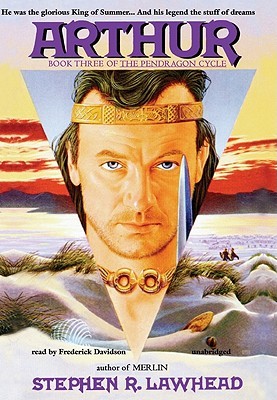
Arthur, by Stephen R. Lawhead

Today I'm looking at the third and what, according to my research anyway, was supposed to be the final book in the Pendragon Cycle, Arthur. This book finally gets to the reign of King Arthur, which is at least what I've been waiting for this entire time and as I said I felt like the series was building up to this. The book is told from three perspectives, by Pelleas Merlin's servant and companion, and by Bedwyr (aka Bedivere) one of Arthur's knights, both of which are set early in Arthur's reign. The final section is told from the perspective of Aneirin, a page and fosterling of Arthur well into Arthur's reign and is present at the very end.  The book therefore covers the entirety of Arthur's reign but since the first two sections deal with the very early years the latter part feels very rushed.

We join Arthur when he is a mere fifteen years old and led by Merlin to London so he can retrieve the Sword of Britain from the stone where Merlin placed it. As Arthur is the rightful heir to the high kingship of Britain he has no trouble pulling the sword out. (After all, we know how the story's supposed to go.) But Arthur is not immediately recognized by the petty kings of Britain and some demand further proof of Arthur's right to kingship. After some deliberation it is decided not to grant Arthur, who is after all fifteen, the high kingship but the largely meaningless title of Dux Britanorum and the duty of protecting all of Britain from the Saxons, Picts, Irish, Angles, Jutes, Scots, Picts, and other barbarian tribes that have been raiding and invading Britain.

Over a period of years Arthur is ultimately successful in defeating not only the barbarian invaders, but also in crushing the final pockets of rebellion among the British lords, some of whom decide working with the barbarians is better than swearing fealty to Arthur. Arthur marries Guinevere, and a new period of peace and prosperity begins in Britain. Of course eventually a Mordred character shows up, although the weird thing is he isn't actually Arthur's son. He's still Morgan's son and is clearly there to ruin everything for Arthur and Britain, but he doesn't seem to worm his way into Arthur's court and causes trouble. Morgan gets caught by one of Arthur's knights and executed, and Mordred immediately runs away, swearing he'll get his revenge.

Arthur's downfall is caused largely through his own hubris. Arthur has himself crowned emperor in the west, which results in the Byzantine emperor immediately saying Arthur can't truly call himself emperor in the west if he hasn't liberated Rome from the barbarians. Despite Merlin saying mounting a campaign to liberate Rome is a bad idea, Arthur decides to do so anyway and leaves with most of his soldiers. Mordred immediately gets the Picts to rise in rebellion and sacks Arthur's capital, taking Guinevere and Merlin hostage. Arthur has to come back and engages Mordred and his followers in combat. As anyone who knows the Arthurian myth knows, many of Arthur's best knights are killed, Arthur slays Mordred, but not before Mordred fatally wounds Arthur. Merlin then takes Arthur to the isle of Avalon with the fair folk (The survivors of Atlantis who have been hanging around) and they then disappear off the face of the earth.

There is one thing that I can appreciate about this book and it's the effort on the part of the author to include some of the older knights in the mythos such as Kay, Bedivere, and Bors and completely excluding Lancelot who is a later addition to Arthurian lore. As I mentioned in my review of Gwenhwyfar, it's kind of weird to see Lancelot in a semi-historical retelling of Arthur because he was basically grafted onto the story later. So on that level I really appreciated the exclusion of Lancelot from the story.

That being said, there are a lot of problems with this book and I'm almost left with the feeling that Lawhead wasn't entirely sure what he wanted to do with the story. At one point Merlin is blinded by Morgan after engaging in a magical battle with her. Merlin is not only blinded physically but also magically and is no longer able to determine the shape of future events. I was left with the feeling this was a permanent change to Merlin and Lawhead's way of making Merlin less powerful and less able to aid Arthur in years to come. However, when we jump ahead to the final third of the book, Merlin has his sight again, both literally and metaphorically. So it felt like there weren't really any consequences for Merlin.

I also didn't understand the decision to make Mordred not related to Arthur, especially after Lawhead incorporated a prophecy Guinevere heard where Arthur's son would kill him so Guinevere has been taking efforts to avoid conceiving a child with Arthur. Granted this information is coming from Morgan and Merlin immediately dismisses everything she says as lies, but Guinevere certainly reacted as if what Morgan was saying was the truth. But Lawhead then turns around and has Merlin say that Mordred's father is one of Morgan's children through Lot of Orkney. Assuming Merlin is correct, then why even mention the prophecy? The prophecy exists to create a Mordred-shaped hole in the narrative for him to slip into. If Mordred isn't Arthur's son and is just some guy, why even include the prophecy? It just doesn't make a lot of sense to me.

Another thing I didn't quite understand was how the Grail Quest was included. Lawhead has taken a very pro-Christianity stance throughout these books and he went through the effort of making the Fisher King, a prominent figure in Grail lore, not only a main character but also Merlin's grandfather. You would think that the Grail Quest would be central to Lawhead's story of Arthur's reign but it's mentioned exactly twice. Once, when the quest is first given and Arthur announces they have been chosen by God to seek the Holy Grail. At which point it's immediately forgotten because Arthur wants to crown himself emperor and another emperor said he isn't really an emperor if he doesn't control Rome. The Grail Quest is only mentioned again in a post script where the narrator basically says, ''Oh yeah, after Arthur disappeared, some of his knights went to find the Grail which we forgot about. They didn't succeed.'' So I'm puzzled by Lawhead's decision. He went through so much effort to include Christianity and the Fisher King and when it comes for the most Christian quest of all, he totally drops the ball on it. I assume it's covered in more detail in the next books, Pendragon and Grail, but I honestly can't say I'm really interested in reading it.

Overall this book feels like a lot of missed opportunities or confusion. Lawhead's obviously making an attempt to include older parts of the Arthurian mythos but the result feels inconsistent or incomplete. And for whatever reason, the Grail Quest, which should have been the centerpiece, is almost entirely forgotten. And with Arthur gone, with no heir and Britain falling to barbarian invaders, I'm not sure where the series can go from here. I'll probably look at the summary of Pendragon and make a decision, but I'm not sure if I want to keep with this particular Arhturian re-telling.

- Kalpar

Tuesday, April 18, 2017

Merlin, by Stephen R. Lawhead

Today I'm looking at the second book in the Pendragon Cycle from Stephen R. Lawhead, Merlin. This book covers the life of Merlin, whose birth concluded the first book, Taliesin. This book is told entirely from the perspective of Merlin and goes up until the death of Uther Pendragon and Merlin's placing the sword in the stone until it will be removed by Arthur. And no, that's not a spoiler because if you know Arthurian legend you know how the story works.

The worst thing I have to say about this book is I feel like it's just boring more than anything else. Merlin spends a lot of his time outside of what's going on in Britain. For example, when he's a kid he gets kidnapped by a tribe of hill-folk and spends something like three years living north of the Wall and basically cut off from all the other events occurring in Britain. On the plus side, this is how Merlin learns to do certain forms of magic, but on the other hand he's away for important things happening in Britain. This is explicitly the time when the Roman legions, the final pretenses of Roman control over Britain, are abandoning Britain and leaving it fully exposed to attacks from Saxons, Picts, and Irish raiders. In Taliesin and to an extent in Merlin as well, the characters are increasingly concerned by the growth of fear and desperation among the population as Roman protection disappears and the threat of barbarian invasion becomes ubiquitous. But Merlin's gone for significant chunks of that time.

His capture by the hill-folk isn't the only time Merlin is effectively M.I.A. during this book. After returning from his capture north of the wall, Merlin finds another group of survivors from Atlantis and falls in love with their princess. Once Merlin is recognized as a king in his own right, he arranges to marry his love and they are soon expecting their first child. Unfortunately for Merlin, both his wife and child, as well as most of the second band of survivors of Atlantis, are killed by a band of Saxon raiders. Merlin slays a great number of them in a battle-fury, and then wanders off to be insane with grief for a number of years. How many is not stated and I begin to get the feeling that the Atlantean Fair Folk have much longer lives than humans because Merlin is described as hardly aging a day while other people have grown old and died in the same time. So bad things continue to happen in Britain but once again Merlin is not present to witness them. When Merlin comes out of his madness Vortigern is High King of Britain and has made a mess of things by making deals with the Saxons to protect his own throne and will be overthrown by the Britains in favor of Aurelianus and his brother, Uther.

This is at the point where we're on familiar Arthurian legend ground and Lawhead starts hewing closer to the source materials that have been passed down over the years. He still takes his own spin on things and provides his own version of events, such as the romance between Uther and Igraine who Merlin describes as Gorlois's daughter rather than his wife. And I did find myself being slightly more interested as events got into territory which I was more familiar. But I was left with the feeling that most of this book, much like all of the previous book, was basically set up for a story that's coming later, rather than being a terribly interesting story in itself. It does seem a little weird to me that the next book, Arthur, was imagined originally as the ending to the series rather a midway point.

So on the one hand, because I can get these books for free and because I'm curious to see Lawhead's take on the more well-known bits of Arthurian mythos. On the other, I'm concerned that they're going to be a lot of effort without a lot of pay-off in the end. So we'll see what happens.

- Kalpar

Tuesday, March 28, 2017

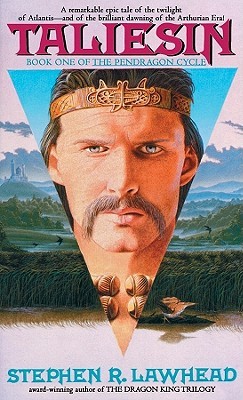
Taliesin, by Stephen R. Lawhead

Today I'm looking at the first of the five books of The Pendragon Cycle by Stephen R. Lawhead. The reason I'm looking at this series is twofold. First, it's a different take on Arthurian legend and as I may have established previously on this blog, I am a huge sucker for Arthurian legend. Secondly, I can get all of them for free from the library to listen to, so that's a pretty good deal in my opinion. This series is, as far as I can tell, an attempt to make the Arthurian mythos vaguely match up with history. I say vaguely because once you've thrown Atlantis and magic into the mix it's hardly become historical fantasy anymore.

The book mostly follows the lives of Taliesin, a prince of a Celtic tribe in Britain during the waning days of the Roman Empire, and Charis, the princess of one of the nine kingdoms of Atlantis. The book alternates between Taliesin and Charis until Charis and her people are forced to flee Atlantis and arrive in Britain where they meet Taliesin's people. Charis and Taliesin eventually fall in love and have a son whom they name Merlin. So really this book is a really long story about Merlin's parents.

I'm not sure how I feel about this book because it feels like a very lengthy exercise in setting the conflict for later books up rather than accomplishing much itself. There are a few important things that happen, it is true, and we're pretty explicitly beat over the head with the idea that dark days are coming. The fall of Atlantis is blamed on a rise in some mysterious dark force, although what it is I'm not entirely sure. Possibly Satan? And then there's the general fall of Rome from Britain and the arrival of Irish, Picts, Scots, and Saxons in Britain causing all sorts of trouble. So yeah, things are pretty bad, but I was left with the feeling the book took so long to talk about how bad things were and setting things up for later books, that this felt like an extended prologue.

I'm also not sure on the decision to talk about Merlin's parents and grandparents. There are some interesting approaches, such as having the stories of Fair Folk be about people from Atlantis who just act very differently from the native residents of Britain, or having Charis's title of Lady of the Lake be an affectionate name Taliesin gave her. And while Taliesin is a name established in Welsh folklore (at least what a minimal amount of digging managed to turn up for me anyway), I am left wondering how many casual readers of Arthurian myth would pick up on the connection. And, as I said, I was left with the feeling that not a lot happens in this book so much as it's setting stuff up for the next books. It's okay to do twists on Arthurian legend. Heck, Gwenhwyfar was one enormous twist on the mythos and I loved it. But at least in Gwenhwyfar there were characters we recognized from the story so we could compare them to how they differed. In this one, we really only get the Fisher King, the Lady of the Lake, and Merlin as a baby. I just wish there had been more familiar characters for us to see. Maybe in the next book we'll see more, like Uther Pendragon, Arthur's father. But that remains to be seen.

In an interesting side note, I've also discovered what it takes for me to suspend my disbelief. Magic? Fine. Atlantis? No problem. Potatoes, an American root crop, in Roman Britain? Hold on there, something's not right! It was really a throwaway line that the author probably didn't give a second thought, but me being the pedantic historian I am I latched onto it. I'm also not sure about claiming Mithras and Isis were the same god but in male and female forms. Although we have very little information about Mithras to begin with so it's hard to say for certain. I did feel like the theology of this book's universe got really fuzzy. Like I didn't understand why British druids would care about the birth of Jesus who they admit as the son of the good god but don't worship as a god? Until Taliesin meets god and becomes a prophet of Christianity? Seriously, Christianity comes in really suddenly and Taliesin's basically, ''Aw man, Christianity is the best thing ever! Their god is awesome!'' Which...okay, cool, I guess. It just feels odd to me because I know some of the Christianity stuff like the Grail Quest got grafted onto the Arthurian mythos much later.

So far I feel like of the more ''historical'' takes on Arthurian legend, Gwenhwyfar leaves this one far behind in the dust. Maybe it will improve with later books, but that remains to be seen.

- Kalpar

Thursday, October 20, 2016

Gwenhwyfar: The White Spirit, by Mercedes Lackey

Today I'm taking a look at another Mercedes Lackey book, in this case Gwenhwyfar: The White Spirit, which is Lackey's own take on the Arthurian mythos and a sort of reinterpretation as well. When you get something as old as the legends surrounding Arthur there are dozens, if not hundreds of stories which have been edited, altered, censored, expanded, or otherwise changed over the centuries. During her research into Arthurian legend, Lackey came across an interesting and old idea that Arthur actually had three queens, all of whom were named Guinevere, or Gwenhywfar for a more Welsh version. (When it comes to some characters there seems to be a different spelling for each version.) On top of that, one of the Gwenhwyfars also had a sister named Gwenhwyfach, to make it only more confusing. Lackey thought that having three Gwenhwyfars would explain far more about all the shenanigans that Arthur's queen supposedly got into. And also how she could have had two sons or no sons at the same time.

Now, I haven't talked about it much on this blog, aside from that one time I reviewed Le Morte d'Arthur way, way back. But I'm like, a huge sucker for Arthurian legend. I have vivid memories of checking out every book I could find about Arthur from the library, as well as anything I could find about knights, castles, and medieval history in general. So when I was looking through the library and found a reinterpretation of Arthurian myth from an author who I've enjoyed before, I absolutely had to pick it up. And I had an absolute blast listening to this book. It was kind of confusing in the beginning as I was getting myself oriented within the framework of the story, but once the story got its feet under it it just goes and doesn't stop until the very end. And if you're a fan of Arthurian myth as much as I am, you're going to enjoy this story immensely.

Plot-wise the book follows the third and youngest Gwenhwyfar, who is the third of four daughters of one of King Arthur's sub-kings and begins following the path of the warrior in a very Boudica-esque fashion. The story also follows her perspective entirely and never shifts out, which I was kind of annoyed with at the beginning because it's hard to see how Gwen's life and warrior training tie into the larger story which you sense is going on ''out there'' somewhere. Which, as I said, makes the book kind of slow to start. But as the book progresses, I actually started liking the story more and more. There are a lot of things that happen that are obliquely referenced to or not fully explained, or you see snippets of what's going on. But if you're a fan of Arthurian legend and already know the story then you can fill in the details pretty easily. Eventually I came to actually enjoy the limited viewpoint since we were following just Gwen around. Largely because I knew things she didn't and could put things together because I knew the mythos so it became a sort of puzzle for me to put together. By the end, I actually found myself hoping that maybe the characters might be able to avoid the disaster at the very end of the book, with Arthur dying, Camelot falling, and Britain falling into chaos, which was pretty exciting for me.

Lackey also attempts to do a more ''historical'' interpretation of Arthur, you know, aside from all the magic floating around which I'm willing to give her a pass on. Of course, the fact that I'm the absolute worst person to look at any attempt to create a more ''historical'' Arthur came to the fore. I'm the guy who will quibble over whether or not the Romano-British, which is what the characters are supposed to be, would have used stirrups or not. Or even the use of the term castle. I get that picky. But for the most part I was able to put that aside and was able to enjoy the story. There are plenty of things that Lackey does that makes the story feel right to me. It all just really works and make the universe feel real.

Overall, I really loved this book. As I said, I've been a fan of the Arthurian mythos since forever so this book was an easy sell for me. There are some issues I had. The writing doesn't feel quite right in some places, and the book takes a while to get started, but it eventually builds up steam and then there's no stopping it. For a new interpretation of an old classic, with incorporation of elements both old and new, Gwenhwyfar is definitely worth it.

- Kalpar

Thursday, May 30, 2013

Raiding the Stacks: Le Morte d'Arthur, by Sir Thomas Malory

So I decided to go old school again this week and read Le Morte d'Arthur, and let me tell you it was definitely a challenge. Before I get started with the review, let me provide some background. Within English literature Le Morte d'Arthur is probably the definitive source for most of what you know about Arthurian legend. Certainly there are other sources, such as the tale of Sir Gawaine and the Green Knight, but every modern retelling from T.H. White's The Once and Future King to the musical Camelot draw upon Le Morte d'Arthur as source material. Truly this book is responsible for many people's understanding of King Arthur and his knights.

The book itself tends to be rather schizophrenic, and for good reason. Le Morte d'Arthur is actually a collection of many other Arthurian legends, some of which had existed for hundreds of years before Malory decided to record them in his opus. In addition, the book was only published posthumously and the printer, William Caxton, did a rather clumsy job editing the text. This has lead to some mechanical issues which can make the text rather difficult to read and it has a tendency to reiterate points already made before. The best way to approach this book is to treat it as an anthology that spans hundreds of years of European history. 

The biggest challenge I had with this book, and this is an issue I've had with other works like The Aeneid and The Illiad where it tends to contain a lot of very repetitive fighting. People proffer to joust and then strike many sad strokes and smite on the left hand and on the right hand and win much worship. I understand that these rather repetitive elements exist so that bards and troubadours could easily remember these stories when they were telling them to nobility, but it becomes very tedious to read as a twenty-first century audience. The largest portion of this book, the story of Sir Tristan, has a significant amount of such fighting and became a forced march at some points. Again, this is really a product of the story being hundreds of years old, but it makes it very difficult for a twenty-first century reader anyway. 

The other thing that really surprised me was the fact that there was a great level of corruption within Arthur's court from the very beginning, which ultimately leads to the fall of the Round Table. Many of you are probably aware of the adulterous relationship between Sir Lancelot and Queen Guinevere, but that is not the only disreputable act committed by men who are, ostensibly, the flower of knightly chivalry. Sir Gawain  and his brothers, for example, murder Sir Lamorak over a blood feud and numerous other petty quarrels seem to constantly strain the peace of Arthur's realm. Perhaps what was most surprising to me was the fact that Arthur willingly had sex with his sister, Morgan la Fey, thus conceiving his son and nephew Sir Mordred. In most of the versions I had read previously, which were the type cleaned up to make them appropriate for young boys, Morgan la Fey is portrayed as enchanting or deceiving Arthur because she's evilly plotting the downfall of Arthur's reign, almost as soon as it begins. Really, despite the glory and chivalry of Arthur's knights it seems like Camelot was doomed from the very beginning because of the sins that rotted it from the inside out. 

Some portions of this book I think modern audiences could still really enjoy. I know I enjoyed the story of Sir Gareth and the portion dedicated to the quest for the Holy Grail, but other portions like Arthur's war with the Emperor Lucius and the tale of Sir Tristan drag because of their repetitive nature. I would recommend on the whole though, that only the serious Arthur scholar read the whole of Le Morte d'Arthur. I think the more casual fans would be better served by reading many of the excellent adaptations which have come along in the intervening five centuries. 

- Kalpar