Today I'm looking at Hidden Figures, a book you may remember coming out way back in 2016. I was recently able to borrow it from the library and because I had heard good things I decided it was worth reading about. Hidden Figures talks about the history of the black female computers who worked first for the aeronautical research laboratories at Langley Field and later for NASA during the height of the space race. These women, who literally did nothing but math for a living, have been overlooked in official and even unofficial histories of NASA. Shetterly began investigations because her father was a black engineer for NASA and knew many of the computers who lived in their neighborhood. As she continued her research Shetterly discovered that at least fifty black women worked for the Langley aeronautical research labs and/or NASA, and it's possibly a much greater number. This is to say nothing of the white women who worked in the exact same jobs but have gotten only slightly more recognition. Even Shetterly admits that her book only scratches the surface of the history of NASA's black women computers, but it's an important first step so further research can be done.
Today when we hear computer we think immediately of an inanimate object so ubiquitous it hardly bears thinking about. I am writing this blog post on a computer. You are reading it on a different computer. You probably use a computer at work, and so do I. But seventy years ago electronic computers were little better than theory, and complex mathematics had to be done at best with the aid of slide rules and mechanical adding machines. Because this was seen as drudge work, scientists and engineers were happy to pass the difficult task of actually doing the math to female computers.
During World War II, America's quest for air supremacy meant that massive amounts of money were spent on the research and development of new and better airplanes, and the aeronautic studies required massive amounts of calculations. Whether it was refining the SBD Dauntless, speeding up the P-51 Mustang, or getting a little more lift from the B-29, thousands of calculations had to be done to ensure American planes would win the war. But due to wartime shortages in labor, the War Department was looking for anyone with mathematical aptitude to work for their research labs. Thanks to this and an executive order from FDR prohibiting racial discrimination for federal jobs, an entire new set of opportunities were open not only to African-Americans in general, but specifically African-American women. Although they had to struggle with segregation within the laboratories, the black computers confined to a separate computing pool and relegated to a single table in the cafeteria, the ladies of Computing West were undeterred by their circumstances and gave it their all. And like many of their white counterparts, these female computers managed to earn the respect and admiration of their white male colleagues.
Perhaps most astoundingly, what was supposed to be a temporary war-time job, soon developed into a career for many of these women as the arms race and space race of the Cold War continued to feed demand for mathematical know-how. Some women even went on to learn how to program and operate the electronic computers that began replacing the biological kinds in the 1960's.
It is not overall surprising that black women have been overlooked by more traditional histories. Non-whites and women have had a hard time going beyond more than mere token status. But I think this book is an important step into revealing the complex nature of NASA even in the 1950's and 60's and how women of color have been involved since the beginning. As I said, hopefully more research will follow on Shetterly's book and we can learn more about the computers of NASA.
- Kalpar
Showing posts with label History of Science. Show all posts
Tuesday, February 27, 2018
Thursday, September 29, 2016
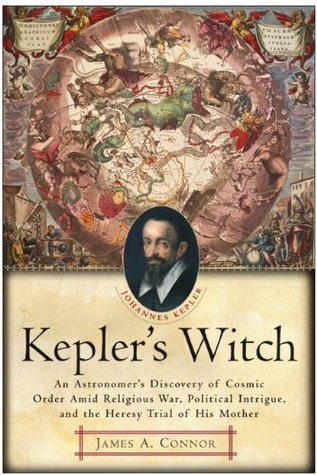
Kepler's Witch, by James A. Connor
This week I'm reading a biography of astronomer Johannes Kepler, who actually isn't terribly well known despite his contributions to mathematics and astronomy. In the introduction Connor makes a point that Kepler has largely been overshadowed by figures such as Copernicus, Galileo, and Newton. Connor points out that while Galileo is held up as a prime example of scientists being persecuted by religion, Kelper was also persecuted for his religious beliefs. Furthermore, while Kepler did not fully create the laws of gravity and integral calculus which are among Newton's chief achievements, he did much of the necessary intellectual groundwork which allowed Newton to create his own work. Not to mention Kepler's contributions to the fields of optics. Connor's hypothesis is that Kepler is simply too mystical a figure, bridging both the medieval and modern worlds, trying to find the mind of god within the workings of the natural world. Connor argues that while Newton had his own mystical streak, he kept it isolated from his scientific research. Kepler, on the other hand, saw no division and freely mixed science and mysticism making him, at least to Connor's understanding, less palatable to modern audiences. Regardless of his mystical proclivities, Kepler is an excellent example of how science is largely an incremental affair with multiple people making gradual progress over time, rather than single individuals making great, intuitive leaps.
The book omits almost all of Kepler's scientific achievements, instead choosing to focus on Kepler's life outside of science. I actually kind of regretted this decision because I don't know much about Kepler's scientific achievements and I really wished they'd been included. The author did include some suggested readings for more information about Kepler's science but it makes the book feel incomplete in a way. The title comes from the fact Kepler's own mother was accused of witchcraft and actually put on trial at the same time Kepler was imperial mathematician. Connor believes this makes a perfect example of many ways how Kepler's life serves as a bridge between the medieval and modern worlds.
So what is the portrait of Kepler that emerges? Connor makes extensive use of Kepler's journals and correspondence to provide information about his life and the image is rather admirable. Kepler, based on Connor's account anyway, is a fairly moderate man who was not very dogmatic in matters of religion. Kepler believed in the supremacy of the personal conscience, as well as the brotherhood of all Christians. This attitude would get him excommunicated from his own Lutheran faith, which he remained faithful to for the rest of his life, and would keep him away from the Catholic church as well. Despite repeated attempts by Jesuits to convert him and the numerous career advantages he might have gained by converting. Kepler appears not overly concerned with fine points of theological doctrine, instead content to measure the stars and calculate the orbits of the planets for the greater glory of god.
If Kepler has any faults, it is his dogmatic belief in Platonic ideals, believing that there are certain geometric shapes in nature which are inherently perfect, and therefore beautiful, and therefore god would use them to build the universe. This sort of mysticism comes up from time to time in Kepler's work, although it's hard to say how much so and Connor tends to downplay it. Connor also makes strong emphasis of the fact that while Kepler did practice astrology, like virtually every other astronomer at the time period, he did not buy terribly much into it and often said the stars would not reveal detailed information about the future, instead general trends or characteristics and the mind of god. And there seems to be enough evidence to suggest Kepler took a half-hearted approach to astrology at best.
I am sort of split on the inclusion of context within the narrative of Kepler's life. The very last years of Kepler's life were embroiled in the first parts of the Thirty Years War, one of Europe's last big religious wars, and Connor goes into some detail about the political machinations behind the war as well as the opening battles. Connor also talks about important figures such as Emperor Rudolf II who first gave Kepler his position as Imperial Mathematician. I'm at a bit of a disadvantage because I know some of this contextual information from studying this period before, an advantage not all other readers would have. But there is some information that feels blatantly like padding, such as the myth about the founding of the city of Prague, which is put in just because there wasn't enough information about Kepler. I feel that including Kepler's scientific work might have been better included.
Overall it's an interesting book and Kepler comes across as an interesting, if underappreciated figure who helped make advances in the Scientific Revolution. The book gets very sidetracked at times, something I kind of wish it hadn't, but the inclusion of primary sources is appreciated. I do have some reservations, wondering if Kepler was cleaned up for more modern, secular audiences, but without more reading I can't say for certain.
- Kalpar
The book omits almost all of Kepler's scientific achievements, instead choosing to focus on Kepler's life outside of science. I actually kind of regretted this decision because I don't know much about Kepler's scientific achievements and I really wished they'd been included. The author did include some suggested readings for more information about Kepler's science but it makes the book feel incomplete in a way. The title comes from the fact Kepler's own mother was accused of witchcraft and actually put on trial at the same time Kepler was imperial mathematician. Connor believes this makes a perfect example of many ways how Kepler's life serves as a bridge between the medieval and modern worlds.
So what is the portrait of Kepler that emerges? Connor makes extensive use of Kepler's journals and correspondence to provide information about his life and the image is rather admirable. Kepler, based on Connor's account anyway, is a fairly moderate man who was not very dogmatic in matters of religion. Kepler believed in the supremacy of the personal conscience, as well as the brotherhood of all Christians. This attitude would get him excommunicated from his own Lutheran faith, which he remained faithful to for the rest of his life, and would keep him away from the Catholic church as well. Despite repeated attempts by Jesuits to convert him and the numerous career advantages he might have gained by converting. Kepler appears not overly concerned with fine points of theological doctrine, instead content to measure the stars and calculate the orbits of the planets for the greater glory of god.
If Kepler has any faults, it is his dogmatic belief in Platonic ideals, believing that there are certain geometric shapes in nature which are inherently perfect, and therefore beautiful, and therefore god would use them to build the universe. This sort of mysticism comes up from time to time in Kepler's work, although it's hard to say how much so and Connor tends to downplay it. Connor also makes strong emphasis of the fact that while Kepler did practice astrology, like virtually every other astronomer at the time period, he did not buy terribly much into it and often said the stars would not reveal detailed information about the future, instead general trends or characteristics and the mind of god. And there seems to be enough evidence to suggest Kepler took a half-hearted approach to astrology at best.
I am sort of split on the inclusion of context within the narrative of Kepler's life. The very last years of Kepler's life were embroiled in the first parts of the Thirty Years War, one of Europe's last big religious wars, and Connor goes into some detail about the political machinations behind the war as well as the opening battles. Connor also talks about important figures such as Emperor Rudolf II who first gave Kepler his position as Imperial Mathematician. I'm at a bit of a disadvantage because I know some of this contextual information from studying this period before, an advantage not all other readers would have. But there is some information that feels blatantly like padding, such as the myth about the founding of the city of Prague, which is put in just because there wasn't enough information about Kepler. I feel that including Kepler's scientific work might have been better included.
Overall it's an interesting book and Kepler comes across as an interesting, if underappreciated figure who helped make advances in the Scientific Revolution. The book gets very sidetracked at times, something I kind of wish it hadn't, but the inclusion of primary sources is appreciated. I do have some reservations, wondering if Kepler was cleaned up for more modern, secular audiences, but without more reading I can't say for certain.
- Kalpar
Tuesday, June 21, 2016
Chasing Venus: The Race to Measure the Heavens, by Andrea Wulf
Today I'm taking a look at Chasing Venus, a book about the transits of Venus across the sun in the eighteenth century, which was a major astronomical event and a huge research opportunity. But I guess I should explain what a transit of Venus is. Basically once in a very long while the planet Venus comes between Earth and the Sun and so Venus can be observed travelling across the face of the sun from Earth. Due to the orbits of the respective planets involved, this always happens in pairs eight years apart, and these pairs are about a hundred odd years apart. So any astronomer lucky enough to be alive when a transit occurs will do almost anything to be able to observe one. (Also sorry everyone, the last ones happened in 2004 and 2012. We won't see another one until 2117.)
But why is this a big deal, and specifically why were the transits in 1761 and 1769 such a big deal? Well as Wulf explains you have to put everything into the proper context. The transits of Venus in the eighteenth century were smack dab in the middle of the Enlightenment era, where Europeans were sailing across the world, meeting new and interesting people, stealing their countries, and making breakthroughs in science including astronomy. Astronomy was particularly important because ocean navigation was incredibly tied up with utilizing the sun, moon, and stars to help find latitude. Longitude was somewhat trickier and would remain a problem, but scientists were busily working on that all through the 1700's. The transit of Venus across the Sun was simply one in a large number of astronomical events astronomers were eager to observe.
However, the transit was also important because astronomers could use it to calculate just how big the solar system was. Astronomers had already crunched the numbers and had a pretty good idea on the relative distances between the planets, measured in Astronomical Units (AU) which was defined as the distance between the Earth and the Sun. The problem, however, was nobody had more than a rough guess of exactly how bit an AU was. But astronomers knew if they took a variety of measurements of the transit and did some insane trigonometry, they might be able to get a better idea.
The chief challenge was getting astronomers in locations where they'd be able to make observations. Some locations, such as upper Scandinavia, were fairly close but still very difficult to get to. Other locations such as Siberia, Canada, India, St. Helena, and Tahiti were far more remote but observations from these locations would be absolutely essential if scientists were to determine the distance between the Earth and the Sun. And the amazing thing? They actually managed to do it.
There were numerous obstacles to this endeavor, as Wulf points out in her book. The first problem was getting scientists from all across Europe to cooperate in taking measurements and sharing their research data. (Although that was fairly simple by comparison, and I'll go more into that in a minute.) Furthermore astronomers had to go to remote locations, with complex and delicate instruments like telescopes, barometers, chronometers, and quadrants, all across the world and then take accurate measurements. Numerous astronomers actually died on their expeditions and in some cases it's amazing we got any results at all. It's truly a testament to human endeavor that scientists were able to work together in a great scientific cause.
The biggest problem I have with this book, though, is I feel like Wulf misrepresents the context of the eighteenth century. A very big deal is made of the Seven Year's War which hampered expeditions for the 1761 transit, especially between British and French scientists. Certainly the rivalry between Britain and France was deep rooted, by the competition in the eighteenth century was hardly ideological. The eighteenth century after all is the era of ''gentlemanly'' warfare, where today's enemy could be tomorrow's ally. After all, the British-French and Austrian-Prussian rivalries switched partners between the War of Austrian Succession (France and Prussia vs. Austria and Britain) and the Seven Year's War (Britain and Prussia vs. Austria and France.) So I don't think it should come as any surprise that European scientists were able to put national identities aside in the pursuit of a greater cause.
I think Wulf also could have done a better job of talking about how nations lavished funds on their scientific societies during the eighteenth century as well. Aside from their more practical benefits, scientific societies were a matter of prestige for a modern ''enlightened'' state. Wulf does a good job of explaining how Catherine the Great of Russia and the American colonies worked to promote their own scientific societies to prove they were not provincial backwaters but rather members of the club of ''civilized'' nations. The fact that great sums of money were spent by monarchs on scientific expeditions at this time should hardly come as a surprise. It was simply a matter of national honor and prestige to have a good scientific society. Much like how in the late nineteenth and early twentieth centuries it became a matter of national honor and prestige to have colonies and battleships. I think Wulf makes the decision to fund these expeditions far more incredible than it is if you look at the historical context.
Overall this book is okay. Personally I actually found it a little boring but I think that may have just been the reader who didn't seem to get terribly excited by anything happening in the book. It was all delivered in a rather flat monotone. If you're interested in astronomy this may be a good book to read, but I can't find anything really compelling about it.
- Kalpar
But why is this a big deal, and specifically why were the transits in 1761 and 1769 such a big deal? Well as Wulf explains you have to put everything into the proper context. The transits of Venus in the eighteenth century were smack dab in the middle of the Enlightenment era, where Europeans were sailing across the world, meeting new and interesting people, stealing their countries, and making breakthroughs in science including astronomy. Astronomy was particularly important because ocean navigation was incredibly tied up with utilizing the sun, moon, and stars to help find latitude. Longitude was somewhat trickier and would remain a problem, but scientists were busily working on that all through the 1700's. The transit of Venus across the Sun was simply one in a large number of astronomical events astronomers were eager to observe.
However, the transit was also important because astronomers could use it to calculate just how big the solar system was. Astronomers had already crunched the numbers and had a pretty good idea on the relative distances between the planets, measured in Astronomical Units (AU) which was defined as the distance between the Earth and the Sun. The problem, however, was nobody had more than a rough guess of exactly how bit an AU was. But astronomers knew if they took a variety of measurements of the transit and did some insane trigonometry, they might be able to get a better idea.
The chief challenge was getting astronomers in locations where they'd be able to make observations. Some locations, such as upper Scandinavia, were fairly close but still very difficult to get to. Other locations such as Siberia, Canada, India, St. Helena, and Tahiti were far more remote but observations from these locations would be absolutely essential if scientists were to determine the distance between the Earth and the Sun. And the amazing thing? They actually managed to do it.
There were numerous obstacles to this endeavor, as Wulf points out in her book. The first problem was getting scientists from all across Europe to cooperate in taking measurements and sharing their research data. (Although that was fairly simple by comparison, and I'll go more into that in a minute.) Furthermore astronomers had to go to remote locations, with complex and delicate instruments like telescopes, barometers, chronometers, and quadrants, all across the world and then take accurate measurements. Numerous astronomers actually died on their expeditions and in some cases it's amazing we got any results at all. It's truly a testament to human endeavor that scientists were able to work together in a great scientific cause.
The biggest problem I have with this book, though, is I feel like Wulf misrepresents the context of the eighteenth century. A very big deal is made of the Seven Year's War which hampered expeditions for the 1761 transit, especially between British and French scientists. Certainly the rivalry between Britain and France was deep rooted, by the competition in the eighteenth century was hardly ideological. The eighteenth century after all is the era of ''gentlemanly'' warfare, where today's enemy could be tomorrow's ally. After all, the British-French and Austrian-Prussian rivalries switched partners between the War of Austrian Succession (France and Prussia vs. Austria and Britain) and the Seven Year's War (Britain and Prussia vs. Austria and France.) So I don't think it should come as any surprise that European scientists were able to put national identities aside in the pursuit of a greater cause.
I think Wulf also could have done a better job of talking about how nations lavished funds on their scientific societies during the eighteenth century as well. Aside from their more practical benefits, scientific societies were a matter of prestige for a modern ''enlightened'' state. Wulf does a good job of explaining how Catherine the Great of Russia and the American colonies worked to promote their own scientific societies to prove they were not provincial backwaters but rather members of the club of ''civilized'' nations. The fact that great sums of money were spent by monarchs on scientific expeditions at this time should hardly come as a surprise. It was simply a matter of national honor and prestige to have a good scientific society. Much like how in the late nineteenth and early twentieth centuries it became a matter of national honor and prestige to have colonies and battleships. I think Wulf makes the decision to fund these expeditions far more incredible than it is if you look at the historical context.
Overall this book is okay. Personally I actually found it a little boring but I think that may have just been the reader who didn't seem to get terribly excited by anything happening in the book. It was all delivered in a rather flat monotone. If you're interested in astronomy this may be a good book to read, but I can't find anything really compelling about it.
- Kalpar

Subscribe to:
Posts (Atom)