Showing posts with label Matthew Goodman. Show all posts

Tuesday, January 2, 2018

The Sun and the Moon, by Matthew Goodman

Today I'm looking at a history of one of the most famous newspaper hoaxes of the nineteenth century, when Richard Adams Locke wrote a series of articles purportedly about discoveries made by Sir John Herschel with a new type of telescope that discovered the existence of life, including sentient life, on the moon. When the story it was widely circulated and reprinted in newspapers across the United States and later the world, with many people arguing over its veracity. However, this book talks about quite a few other subjects beyond the moon story, putting it within historical context.

The early nineteenth century saw developments in printing technology, which had remained fairly unchanged since the fifteenth century. Printing presses could previously only produce about two hundred and fifty copies an hour, but the invention of cylindrical presses and application of steam power meant thousands of copies could be produced cheaply and quickly. By the 1830's the United States saw the development of the penny press, daily newspapers that cost only a penny making them affordable to far more people than the six cent papers at the time. The penny press exploded newspaper readership in the United States and also dramatically changed the content of newspapers. Previously focused towards the upper classes interested in financial and international news, penny papers focused on local news, sports, true crime stories, and the introduction of humorous and not always true anecdotes.

Goodman goes into considerable detail talking about the nineteenth century institution of ''humbugs'', stories or objects that might be real or might not be, the foundation of P.T. Barnum's career. (A biography of Barnum makes up a significant part of this book as well.) And I'm pretty sure society hasn't changed much considering the popularity of urban legends and other stories that may not be true, but have just enough verisimilitude to make their veracity plausible. The thrill then, as of now, is debating whether the story actually is true and so humbugs, both in Barnum's museum and on the pages of newspapers, made endless entertainment fodder for the nineteenth century.

I have a couple of criticisms about this book, but they're fairly minor. The first is that I feel like this book kind of lacked focus. Goodman jumped between talking about Benjamin Day and his creation of The Sun, New York's first successful penny press, talking about Richard Adam Locke's life and career, P.T. Barnum's life and career, and even the life and career of Edgar Allan Poe. Granted, all these subjects are interrelated. It's difficult to talk about Locke's moon story without first talking about the newspaper it was published in. Barnum is a great example of how hoaxes were popular entertainment and how newspapers helped spread them. And Poe himself wrote a story about a voyage to the moon shortly before Locke wrote his own story. The problem is it feels like Goodman had two or three different topics he wanted to write about but he didn't have enough material to make any one of them into a book by itself so he melded them together. So yes, they're connected, but it still feels disjointed to me.

The other issue I had, and this is purely because I'm a trained historian, is that Goodman goes into purple prose territory at times, making grand, literary statements. Really the only reason I take issue with this is because I personally don't think it's proper historical writing, but that's really a personal bugbear of mine. If you're a casual reader of history it probably won't bother you too much.

Finally Goodman tries to argue towards the end of his book that Locke's moon writings were supposed to be from the beginning, as Locke claimed much later, an elaborate satire of religious astronomy. During the early nineteenth century astronomy was the science most in concord with religion and many religious figures argued that other worlds must be inhabited by beings to further increase the glory of God. Some would go on to say that these beings from other worlds would be in a state of natural grace, having never fallen to sin like humanity did, so their worlds would be paradises. The problem I have with this argument is Goodman doesn't devote considerably much time to it in his book. The inclusion of P.T. Barnum and other examples of humbugs, hoaxes, and diddles certainly undermines Goodman's assertion that Locke's work was meant to be a satire and he devotes considerably less time talking about it than the hoaxes.

Overall, I thought this book was interesting. It feels disjointed because it talks about a lot of different things which are related, but it gives a good view of the culture of nineteenth century New York. If any of the topics listed in the (fairly long) title interest you, I think this book is worth taking the time to check out.

- Kalpar

Tuesday, December 27, 2016

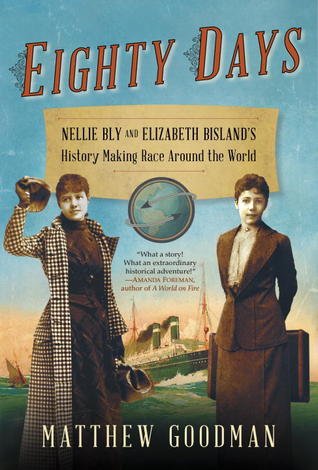
Eighty Days, by Matthew Goodman

Today I'm looking at a book about the first official race by an individual to circumnavigate the globe in eighty days or less. A long, long time ago I actually talked about the book that inspired this challenge, which remains a classic piece of literature. What may surprise some people is that a female reporter, Nellie Bly, was the first person to accomplish this feat in seventy-two days. What is even less known is that there were actually two women attempting to circumnavigate the world at the same time. While Nellie Bly was travelling east for The World newspaper, Elizabeth Bisland had been sent west by Cosmopolitan in an attempt to beat Nellie Bly at her own challenge. While Bly remains famous in large part because of her trip around the world, Bisland remains practically unknown today.  In this work Goodman not only talks about the lives of both women, but also the world which they circumnavigated.

Goodman spends some time comparing and contrasting both Bly and Bisland. Bly, born Elizabeth Cochran in Pennsylvania, was the daughter of a prominent local merchant, however her father's death left her mother and her siblings fairly destitute and forced Nellie's mother and Nellie to work for a living. Nellie did a variety of odd jobs before sending a letter to a Pittsburgh newspaper to protest an article stating a woman's proper sphere was in the home. Bly soon found herself hired as a female reporter and eventually made her way to New York. Despite strong opposition to women in the newspaper field, most of them being relegated to the society pages, Bly became an undercover investigative journalist. Her first report was to infiltrate the Blackwell Island Insane Asylum and report on the abhorrent conditions there, truly sensational news, but she investigated working conditions and corruption throughout New York.

Elizabeth Bisland was born to a slave-owning family in Louisiana and actually spent a good portion of the Civil War in New York. After the Civil War, the Bisland family found much of their wealth destroyed and their existence considerably more difficult. However, Elizabeth grew up in a literature-rich environment, reading many English novels during her childhood and having the experience of her poet mother. Bisland eventually sent a poem to a local newspaper and was delighted when it was published, launching a literary career that eventually also took her to New York. While Bly was doing investigative journalism for the daily newspaper The World, Bisland was doing reviews of new literature for the monthly magazine Cosmopolitan. While Bly seems the perfect individual to send on a globe-trotting adventure, Bisland was extremely reluctant to go and did not enjoy the attention being involved in a global race brought her.

This book is rather wide in its focus, going well beyond the adventures of Bly and Bisland as they raced around the world. And this is fairly understandable as, once Bly and Bisland were on a train or steamship, there wasn't quite a lot for them to do but wait. The biographies of both women are helpful and it's interesting to see what happened to both of them after the race was over. Bisland happily faded into relative obscurity, being the runner-up in the race, and continued with her writing career, while Bly enjoyed a brief surge of popularity. Unfortunately Bly became involved with a libel lawsuit brought against The World and left the newspaper. She struggled for a number of years before marrying a millionaire which later brought its own set of problems. In her later years Bly returned to newspaper reporting and remained a champion for the poor and marginalized.

In addition to talking about the women sent around the world, Goodman spends a good chunk of time talking about the world that they saw. He talks about the newspaper industry as it had grown in the late nineteenth century, dominated by individuals such as Joseph Pulitzer and William Randolph Hearst who had their own fierce rivalry. Goodman also talks about the travel conditions during the era, whether by train or by the ocean-going steamers which were the only means of long-distance travel in the late nineteenth century. There is a particularly fascinating segment about conditions in the boiler rooms of steamships which I found especially interesting. There is some time spent about the various locations that Bly and Bisland were able to visit, such as Bly's visit with Jules Verne in France or Bisland's stay in Yokohama, but Goodman does a good job of emphasizing how both women spent most of their time racing around the world travelling rather than taking in the sights.

I do want to say one of the things I noticed which got mentioned by contemporaries again and again was the physical appearance of both Bly and Bisland, something which women are still struggling with a hundred and twenty years later. Both women were accomplished writers within their own subject fields, but contemporaries describing them felt it was necessary to describe both women as attractive. Even today talented and accomplished women get comments on their physical appearance, while men do not. So in a way it's kind of frustrating that we're still struggling against attitudes that are well over a century old.

Overall I think this book was okay. Goodman stretches the book out by providing a lot of background context, but I think that's really necessary for most readers to understand the world that Bly and Bisland were exploring in the 1890's. Plus I think it's important to talk about Elizabeth Bisland who was press-ganged into doing what basically amounted to a publicity stunt with no preparation whatsoever. I also enjoy the irony of the first person going around the world in less than eighty days being unable to vote at the time. Anyway, if you're interested in badass women of history this is definitely worth checking out.

- Kalpar