
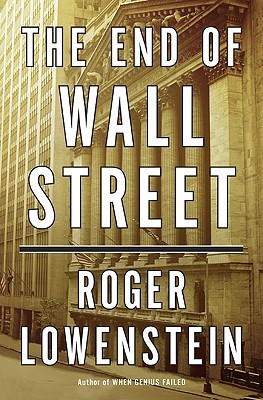
To explain why the meltdown of 2008, which removed a significant chunk of the world's wealth, brought the world economy to a screeching halt, and almost smashed the entire delicate framework of modern high finance is...complex. Yes, you can blame bad mortgages and a collapsing real estate bubble in the United States for being the catalysts which precipitated a global crisis. But to say that it was only those two things that caused the crisis is to overlook larger systemic issues which allowed such things to happen in the first place. Lowenstein goes into a great amount of detail explaining the variety of factors which created the crisis, as well as explaining its effects and rationalizing why agencies such as the Federal Reserve made the decisions it did.
Did banks and other lending institutions make loans to people they shouldn't have? People who didn't have enough income to ever hope to pay off the mortgage? Of course. There's ample evidence that this happened. And was their political pressure from Congress to extend loans to Americans to promote the ideal of home ownership? Also true. However, despite what certain people believe and as Lowenstein points out, the crisis was not caused by the government forcing banks to loan against their will. Lowenstein explains that the securitization of loans and vehicles such as credit default swaps made mortgage-backed securities seem like the risk-free item to invest in and public demand for mortgage-backed securities helped fuel a race to the bottom among lending institutions to generate more and more mortgages to then package as Triple-A bonds.
More than any one thing, Lowenstein argues that it was a combination of factors that enabled the crisis to reach the scale that it did. Low interest rates in the United States, a policy pursued by Alan Greenspan, made low interest rate mortgages and home equity lines possible, turning Americans from a culture of savers into a culture of borrowers. Lax regulation of markets, under the belief that markets were ultimately perfect mechanisms, enabled more complex, more opaque, and ultimately riskier financial instruments to proliferate on Wall Street. A lack of oversight from both the government and the main credit rating agencies, who many investors relied upon to provide information about instruments like mortgage-backed securities, meant investors lacked necessary information to fully understand what they were getting into. And of course the culture of Wall Street, emphasizing decadence, multi-million dollar bonuses regardless of actual success at a company, and highly risky behavior which was assumed to be entirely risk free. (Although Lowenstein doesn't attack with the same vitriol that Taibbi does, which I found to be a welcome relief.)
So when the bubble finally collapsed, it created massive sell-offs and formerly stable financial firms such as Lehman Brothers, Merrill Lynch, and Bear Stearns became hopelessly insolvent in a matter of weeks. Which only precipitated greater sell-offs. Suddenly banks weren't willing to lend to anyone because they couldn't be sure an industry would be in business for another week. Lowenstein points out that day-to-day operations of industry in America had become so dependent on credit that General Electric, one of the biggest and most stable companies in the world, was unable to get short-term loans at rates of 25% because people were so unwilling to risk money in the private sector. Instead, money was flung into treasury notes to the point where the government was borrowing money at 0%, and eventually it would technically be able to borrow at negative interest rates. Clearly the myth that human being act rationally can be buried in the wake of such behavior.
The Federal Reserve and other government agencies were put in an unusual position and in 2008 they engineered several bailouts of massive banks, as well as orchestrating mergers, to keep the financial industry from falling apart. There has been considerable criticism since then, especially considering how much went to executive bonuses, that perhaps the industries should have been allowed to fail. Taibbi certainly took the government and the Federal Reserve to task for such decisions.
Lowenstein, however, argues that the collapse of Lehman Brothers is largely responsible for the decision. Lehman Brothers was an example of a firm that almost certainly deserved to fail, having leveraged its assets to the hilt, and it was decided there would be no bailout for the investment bank. However, as Lehman Brothers went up in smoke, and the surviving assets were gobbled up by Barclay's, among others, markets continued a deep tailspin. The Dow Jones Industrial Average, considered an important marker of the state of the American economy, dropped by hundreds of points in a matter of days, in one case dropping a thousand points in one day. As more Americans saw retirement accounts and other savings invested in stocks completely lose all their value, the government was faced with the option of either bailing out banks that almost certainly deserved to fail, or watching the economy as we know it simply cease to exist.
Lowenstein does briefly criticize some of the later bailouts, which seemed to be Ben Bernanke's favored method of rescuing at-risk companies in the United States during this time. But considering how fragile the economy was at the time, I don't know if I can entirely blame them for pursuing that course of action. I do agree with Lowenstein that new and stricter regulations needed to be put into place, rather than the fairly moderate reforms that did get passed.
Overall I think this is a pretty good book that does a very good job of explaining the Crisis of 2008 and the ensuing depression which is a fairly complex subject. Granted, I pretty much agree with the statement that stricter and better-enforced regulations and oversight need to be in place, so my opinion is probably clouded on the issue.However, Lowenstein definitely avoids the vitriol and polemics that Taibbi all too often falls into so I think this book is a bit of an improvement. But I definitely recommend reading or listening to this book if you get the chance.
- Kalpar

