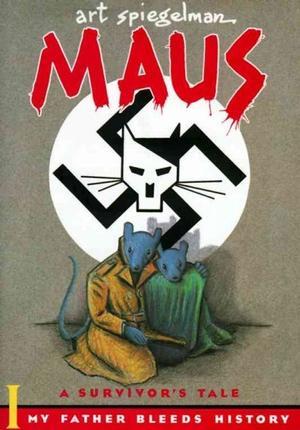
Today I'm looking at a pair of graphic novels created by Art Spiegelman collectively known as Maus. Maus follows the life of Art's father, Vladek Spiegelman, through the 1930's and then through World War II. Vladek and his wife, Anja, were Polish Jews who lived in the city of Sosnowiec. Vladek worked as a salesman and eventually invested in a factory while Anja's family owned multiple textile mills in the city. Life for them in the thirties was fairly good but, as can be expected, when war broke out in 1939 things took considerable turns for the worst. The story is divided into two volumes, volume one My Father Bleeds History, talks about Vladek's life from the 1930's until early 1944 when he was sent to Auschwitz. The second volume, And Here My Troubles Began, tells Vladek's story of survival in Auschwitz, Dachau, and the last few tense months of World War II before being rescued by American G.I.'s.
Framing Vladek's story of survival is Art's own struggles to interview his father, create this book, and understand his relationship with his father. Based on the evidence, Vladek was a very difficult man to live with, ranging from obsessively hoarding money and valuables, to keeping items that most other people would throw away in case they might come in useful, to strained emotional relationships with his wife and his son. Vladek comes across as a flawed and incredibly human person, and while it's clear that life hiding from the Nazis and living in the concentration camps affected him severely, it may have only exacerbated underlying aspects of Vladek's personality. It makes Vladek appear all the more three-dimensional as a character and as a person. Vladek isn't all good, but he isn't all bad either. Like most people he's a mix, but he took action and managed to survive the worst genocide in human history. It makes him very compelling and realistic.
The subject matter is, of course, hard to talk about. This is the worst abuse of human rights, the worst genocide, the worst of man's inhumanity to man, the worst of uncountable crimes in all of human history. There's a reason it's referred to as only The Holocaust. Any other description becomes inadequate in consideration of the cruelty involved. So many people might justly ask, is talking about the Holocaust in cartoon format, where all the characters are depicted as anthropomorphic animals, really the proper way to talk about this? And incredibly, yes, Spiegelman manages to create a depiction that is not only sensitive but emotionally engaging.
The decision to depict Jews as mice is an incredibly brilliant one on multiple levels. First, there is the history of Jews being described or depicted as vermin in Nazi propaganda, pests that needed to be wiped out for the health of the Reich. Spiegelman effectively reclaims that imagery and turns it on its head. Mice, after all, are survivors. Mice hide, mice scavenge, and despite being hunted ruthlessly, mice are still around. For the Jewish survivors of the Holocaust who hid, who scavenged, and who managed to survive, a determined mouse is an apt symbol.
I have not read many Holocaust survivor stories. I'm familiar with the narrative in Viktor Frankl's Man's Search for Meaining, another Auschwitz survivor, so there are many similarities in there, but any story by a Holocaust survivor is going to be very emotionally heavy. Maus is no exception, because it not only tells the story of the Holocaust, but also explores the life of the survivor afterwards and shows how years of life spent hiding and suffering can have lasting effects on individuals. We see Vladek surviving not just in the past, but in the future, and it shows we can never really leave the past behind.
I think I would definitely recommend this story to people. It's a very hard read just because of the emotions involved and I find myself thinking maybe I shouldn't have plowed through the books in a couple of days. But it's a very emotional and very real story and well worth taking the time to check out.
- Kalpar
Showing posts with label World War II. Show all posts
Thursday, October 25, 2018
Thursday, August 25, 2016
Double Cross, by Ben MacIntyre
This week I'm looking at another bit about the history of espionage during World War II, although in this case from the British perspective and MI-5 and MI-6 with the Double Cross system. Which quite frankly is one of the most astounding and incredible stories of World War II and, considering how many bungles seemed to happen with espionage during World War II, by and far the most successful example. This book focuses specifically on five of the more fantastic spies, although the Double Cross system included dozens of people working to bamboozle the Germans into thinking they had a functional spy system within Britain. When in fact every German spy in Britain was under British control, one way or another.
A Yugoslavian playboy, a bisexual Venezuelan good-time girl, a Polish military veteran, the French daughter of a White Russian emigre, and a Spanish chicken farmer. It sounds like the lead-in to a fantastic joke, and considering they fooled the entire German intelligence apparatus it kind of was. Of course these weren't the only agents in the Double Cross system but MacIntyre focuses specifically on these five, who are probably the most interesting and in a couple cases they were the most influential in shaping German opinions of Allied strength during the war. But before I go further, some context.
The Double Cross system was an initiative put in place by the British, who have a long history of spying and were probably the best spies during World War II, to capture and control German spies. Thanks to the breaking of the Enigma code by researchers at Bletchley Park, MI-5 had advanced notice of every German agent being sent into the country and they were quickly captured. Many were imprisoned, some were executed, and a select few were chosen to become double agents to feed information back to the Germans and convince them they had a strong enough intelligence network on the ground that they didn't need to send any more spies into Britain. Perhaps most interestingly numerous people were initially recruited by the Germans to spy for them and then, whether out of idealism, greed, self-preservation, or other motivations these spies then immediately turned themselves in to British Intelligence and offered to become double agents in service to Britain. Or in the case of Juan Pujol, the Spanish chicken farmer, he attempted to get recruited by the British numerous times and, having been rebuffed, signed on with the Abwher and began fabricating information wholesale. The British, alarmed by this spy they didn't control, soon recruited Pujol into their ranks which was his goal the entire time and he continued to deceive the Germans.
The most amazing thing about the Double Cross system was that it worked for so long as well as it did. Up until the end of the war there were numerous Germans who were convinced they had functional intelligence networks in Britain. But in a way, we have the Abwehr to thank for that success. The Abwehr was Germany's intelligence arm during World War II and was absolutely filled with people who were gullible, incompetent, corrupt, or just plain lazy. Joining the Abwehr was an easy way to avoid active military duty and pleasant postings such as Madrid or Lisbon were especially desirable. Many Abwehr agents indulged themselves with the finer things in life rather than getting involved with the actual work of spying, which made Double Cross's job that much easier. On top of that there were numerous people within the Abwehr who were actively working to undermine the Nazi regime. This includes perhaps even its chief director, although his motivations were never truly known before his death. The Double Cross plan was audacious and ultimately successful, probably in no small part to the Abwehr's disinclination to do any actual spying work.
The ultimate plan came with Operation Fortitude, a plan of deception to keep the Germans from correctly surmising where the inevitable Allied invasion of Europe would begin. In concert with military counter-intelligence teams, the Double Cross team created the illusion of two entire armies located in the south east and east of England, threatening Norway, Denmark, and the Pas de Calais across the Straits of Dover. If any information about an attack at Normandy was leaked at all, the Germans were made to believe it would be a diversionary attack in prelude to the main thrust at Calais. Amazingly, despite numerous problems right before D-Day in June of 1944, Double Cross was able to convince the Germans that this was merely a diversion for several weeks, tying down numerous German reinforcements that could have smashed the Allied beachhead before they could consolidate. By the time Germans were sending reinforcements to Normandy, the Allies had already secured their position and were advancing into France.
In hindsight this book is kind of short, talking only about five major characters and the people who interact with them, as well as some other examples of deception by the British during World War II which influenced German decision making. But overall I think it's pretty good. You definitely get a sense of just how downright amazing this program was and how surprising it is that it managed to last for as long as it did. It's definitely a very broad overview rather than going into specific details, but I like general overviews as a rule so I ended up liking it. I also was absolutely astounded at how lazy, incompetent, or just stupid the Germans were and was glad we really lucked out when it came to that. It's an interesting part of World War II that doesn't get talked about terribly much and definitely worth reading.
- Kalpar
A Yugoslavian playboy, a bisexual Venezuelan good-time girl, a Polish military veteran, the French daughter of a White Russian emigre, and a Spanish chicken farmer. It sounds like the lead-in to a fantastic joke, and considering they fooled the entire German intelligence apparatus it kind of was. Of course these weren't the only agents in the Double Cross system but MacIntyre focuses specifically on these five, who are probably the most interesting and in a couple cases they were the most influential in shaping German opinions of Allied strength during the war. But before I go further, some context.
The Double Cross system was an initiative put in place by the British, who have a long history of spying and were probably the best spies during World War II, to capture and control German spies. Thanks to the breaking of the Enigma code by researchers at Bletchley Park, MI-5 had advanced notice of every German agent being sent into the country and they were quickly captured. Many were imprisoned, some were executed, and a select few were chosen to become double agents to feed information back to the Germans and convince them they had a strong enough intelligence network on the ground that they didn't need to send any more spies into Britain. Perhaps most interestingly numerous people were initially recruited by the Germans to spy for them and then, whether out of idealism, greed, self-preservation, or other motivations these spies then immediately turned themselves in to British Intelligence and offered to become double agents in service to Britain. Or in the case of Juan Pujol, the Spanish chicken farmer, he attempted to get recruited by the British numerous times and, having been rebuffed, signed on with the Abwher and began fabricating information wholesale. The British, alarmed by this spy they didn't control, soon recruited Pujol into their ranks which was his goal the entire time and he continued to deceive the Germans.
The most amazing thing about the Double Cross system was that it worked for so long as well as it did. Up until the end of the war there were numerous Germans who were convinced they had functional intelligence networks in Britain. But in a way, we have the Abwehr to thank for that success. The Abwehr was Germany's intelligence arm during World War II and was absolutely filled with people who were gullible, incompetent, corrupt, or just plain lazy. Joining the Abwehr was an easy way to avoid active military duty and pleasant postings such as Madrid or Lisbon were especially desirable. Many Abwehr agents indulged themselves with the finer things in life rather than getting involved with the actual work of spying, which made Double Cross's job that much easier. On top of that there were numerous people within the Abwehr who were actively working to undermine the Nazi regime. This includes perhaps even its chief director, although his motivations were never truly known before his death. The Double Cross plan was audacious and ultimately successful, probably in no small part to the Abwehr's disinclination to do any actual spying work.
The ultimate plan came with Operation Fortitude, a plan of deception to keep the Germans from correctly surmising where the inevitable Allied invasion of Europe would begin. In concert with military counter-intelligence teams, the Double Cross team created the illusion of two entire armies located in the south east and east of England, threatening Norway, Denmark, and the Pas de Calais across the Straits of Dover. If any information about an attack at Normandy was leaked at all, the Germans were made to believe it would be a diversionary attack in prelude to the main thrust at Calais. Amazingly, despite numerous problems right before D-Day in June of 1944, Double Cross was able to convince the Germans that this was merely a diversion for several weeks, tying down numerous German reinforcements that could have smashed the Allied beachhead before they could consolidate. By the time Germans were sending reinforcements to Normandy, the Allies had already secured their position and were advancing into France.
In hindsight this book is kind of short, talking only about five major characters and the people who interact with them, as well as some other examples of deception by the British during World War II which influenced German decision making. But overall I think it's pretty good. You definitely get a sense of just how downright amazing this program was and how surprising it is that it managed to last for as long as it did. It's definitely a very broad overview rather than going into specific details, but I like general overviews as a rule so I ended up liking it. I also was absolutely astounded at how lazy, incompetent, or just stupid the Germans were and was glad we really lucked out when it came to that. It's an interesting part of World War II that doesn't get talked about terribly much and definitely worth reading.
- Kalpar
Tuesday, April 19, 2016
Operation Paperclip: The Secret Intelligence Program That Brought Nazi Scientists to America, by Annie Jacobsen
This week I'm taking another look at World War II with Annie Jacobsen's Operation Paperclip, which was actually read by the author in this audio book. Although to me it wasn't read with the same level of passion as say, The God Delusion or The Secret History of Wonder Woman, I always appreciate it when an author is able to take the time to read their book for the audio edition. Furthermore, this is a very serious subject matter so I can understand why the author might not take a terribly light-hearted or conversational tone when it comes to talking about the subject material.
To provide some background for those of you who aren't aware, Operation Paperclip was a program run by the United States right after World War II, which was initially to retrieve military technology from the Nazis to help equip America's arsenals for the next war, assumed to happen with the Soviets within a matter of years. This very quickly expanded to a project of retrieving the actual scientists and technicians themselves and bringing them to America, giving them employment contracts with the U.S. government. There had been protests both within the government and from among the public who were aware former Nazi scientists were being hired, but these protests were soon drowned out by the interests of national security.
Jacobsen talks about three main areas where Operation Paperclip concentrated its focus: chemical warfare, biological warfare and medical research, and aerospace engineering with jet engines and rockets. These were three areas the Nazis invested considerable time and resources for development and, more horrifically, utilized large portions of unwilling test subjects or slave labor to contribute to the war effort. Thousands of political prisoners, forced into slavery by the Nazi regime, were worked to death in underground factories assembling Wehrner von Braun's V-2 rockets. Thousands more were worked to death at the chemical factors of I. G. Farben at Auschwitz, or were used for tests of nerve gases. And many more people met their deaths in horrific medical experiments at Dachau, experiments devoid of any morality. And yet the United States was all too eager to utilize not only the information gleaned from these atrocities, but also bring back the scientists who perpetrated such atrocities and place them in government employ.
One of the biggest challenges behind researching this topic is the amount of white-washing that has occurred over the past seventy years. Intelligence officials were well aware the United States ''officially'' had a policy against granting immigration visas to former high-ranking Nazis and if the records of many Operation Paperclip recruits had been thoroughly examined they never would have been accepted. So the recruiters purposely omitted certain details and provided sanitized histories of hundreds of scientists to help ease their entry to the United States. In interviews with the public, scientist such as Wehrner von Braun perpetuated this myth, claiming they'd been forced to join the party against their will and were interested in science rather than politics. The paperwork proving this wasn't the case was buried under a smokescreen of misinformation and to this day remains difficult to obtain under the Freedom of Information Act or, perhaps also likely, it was intentionally lost decades ago. If there is no other reason for this book, it's to remind people that Americans compromising moral values for short term gains in ''national security'' is hardly a new thing. It in fact has a long and depressing history in the United States.
I think the worst thing about it was this program was sold to the American people as promoting American industry through peace technologies. In fact, at least within the focus of Jacobsen's book, the researchers they recruited were almost entirely for military purposes. Certainly there are peaceful uses for the medical research performed by Nazi scientists, especially in the areas of aeronautical medicine and hypothermia research. (Which isn't to downplay how truly horrific that research was under the Nazis.) But research and production of deadly nerve gases and mind-altering drugs, as well as the weaponization of biological contagions hardly has very useful peace purposes. Thankfully the tons of nerve gas manufactured by the United States was never used, but there's a certain irony that we spent a great amount of money manufacturing it, only to spend even more money safely disposing of them.
The most visible, and probably memorable, use of Nazi technology was the budding space program which eventually culminated with American missions to the moon. However, even this had military purposes, at least initially. Wehrner von Braun argued stridently that the United States should weaponize space before the Soviet Union did and advocated the construction of a space station capable of launching nuclear weapons from orbit. Thankfully these plans never came to pass, but it certainly takes some luster off of the American space program.
Although the bulk of the book talks about the researchers in the fields of rocketry, biological, and chemical warfare, Jacobsen also spares some time to talk about the Nuremberg Trials and operations such as Camp David and the Gehlen Organization after World War II. Although much press is made over the high-ranking Nazis who were convicted and some of whom were executed at these trials, there were many others who were quietly acquitted because they were needed for the interests of ''national security''. And some war criminals were released after serving laughably short prison sentences considering the enormity of their crimes. It tragically undermines the morality the Nuremberg trials were supposed to espouse, making them seem more and more like the show trials of victorious nations. On top of that, the CIA pioneered the use of blacksites, sometimes with former Nazis employed as agents, at Camp King in Germany, beginning yet another unsavory part of American history.
Overall this book is rather depressing but extremely necessary. All too often we like to think of America, especially during World War II, as being nothing but good guys. However as the Cold War began America proved there were no depths they weren't willing to stoop to in the sake of keeping the world ''safe'' for democracy. Unfortunately, even today we're all too willing to compromise principles for the sake of national security, which I'm sure will have unfortunate consequences for us in the future.
- Kalpar
To provide some background for those of you who aren't aware, Operation Paperclip was a program run by the United States right after World War II, which was initially to retrieve military technology from the Nazis to help equip America's arsenals for the next war, assumed to happen with the Soviets within a matter of years. This very quickly expanded to a project of retrieving the actual scientists and technicians themselves and bringing them to America, giving them employment contracts with the U.S. government. There had been protests both within the government and from among the public who were aware former Nazi scientists were being hired, but these protests were soon drowned out by the interests of national security.
Jacobsen talks about three main areas where Operation Paperclip concentrated its focus: chemical warfare, biological warfare and medical research, and aerospace engineering with jet engines and rockets. These were three areas the Nazis invested considerable time and resources for development and, more horrifically, utilized large portions of unwilling test subjects or slave labor to contribute to the war effort. Thousands of political prisoners, forced into slavery by the Nazi regime, were worked to death in underground factories assembling Wehrner von Braun's V-2 rockets. Thousands more were worked to death at the chemical factors of I. G. Farben at Auschwitz, or were used for tests of nerve gases. And many more people met their deaths in horrific medical experiments at Dachau, experiments devoid of any morality. And yet the United States was all too eager to utilize not only the information gleaned from these atrocities, but also bring back the scientists who perpetrated such atrocities and place them in government employ.
One of the biggest challenges behind researching this topic is the amount of white-washing that has occurred over the past seventy years. Intelligence officials were well aware the United States ''officially'' had a policy against granting immigration visas to former high-ranking Nazis and if the records of many Operation Paperclip recruits had been thoroughly examined they never would have been accepted. So the recruiters purposely omitted certain details and provided sanitized histories of hundreds of scientists to help ease their entry to the United States. In interviews with the public, scientist such as Wehrner von Braun perpetuated this myth, claiming they'd been forced to join the party against their will and were interested in science rather than politics. The paperwork proving this wasn't the case was buried under a smokescreen of misinformation and to this day remains difficult to obtain under the Freedom of Information Act or, perhaps also likely, it was intentionally lost decades ago. If there is no other reason for this book, it's to remind people that Americans compromising moral values for short term gains in ''national security'' is hardly a new thing. It in fact has a long and depressing history in the United States.
I think the worst thing about it was this program was sold to the American people as promoting American industry through peace technologies. In fact, at least within the focus of Jacobsen's book, the researchers they recruited were almost entirely for military purposes. Certainly there are peaceful uses for the medical research performed by Nazi scientists, especially in the areas of aeronautical medicine and hypothermia research. (Which isn't to downplay how truly horrific that research was under the Nazis.) But research and production of deadly nerve gases and mind-altering drugs, as well as the weaponization of biological contagions hardly has very useful peace purposes. Thankfully the tons of nerve gas manufactured by the United States was never used, but there's a certain irony that we spent a great amount of money manufacturing it, only to spend even more money safely disposing of them.
The most visible, and probably memorable, use of Nazi technology was the budding space program which eventually culminated with American missions to the moon. However, even this had military purposes, at least initially. Wehrner von Braun argued stridently that the United States should weaponize space before the Soviet Union did and advocated the construction of a space station capable of launching nuclear weapons from orbit. Thankfully these plans never came to pass, but it certainly takes some luster off of the American space program.
Although the bulk of the book talks about the researchers in the fields of rocketry, biological, and chemical warfare, Jacobsen also spares some time to talk about the Nuremberg Trials and operations such as Camp David and the Gehlen Organization after World War II. Although much press is made over the high-ranking Nazis who were convicted and some of whom were executed at these trials, there were many others who were quietly acquitted because they were needed for the interests of ''national security''. And some war criminals were released after serving laughably short prison sentences considering the enormity of their crimes. It tragically undermines the morality the Nuremberg trials were supposed to espouse, making them seem more and more like the show trials of victorious nations. On top of that, the CIA pioneered the use of blacksites, sometimes with former Nazis employed as agents, at Camp King in Germany, beginning yet another unsavory part of American history.
Overall this book is rather depressing but extremely necessary. All too often we like to think of America, especially during World War II, as being nothing but good guys. However as the Cold War began America proved there were no depths they weren't willing to stoop to in the sake of keeping the world ''safe'' for democracy. Unfortunately, even today we're all too willing to compromise principles for the sake of national security, which I'm sure will have unfortunate consequences for us in the future.
- Kalpar
Tuesday, February 23, 2016
Wild Bill Donovan: The Spymaster Who Created the OSS and Modern American Espionage, by Douglas Waller
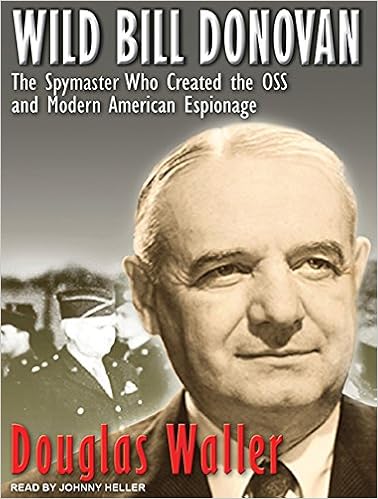
This week I'm reviewing another biography, in this case about Wild Bill Donovan, who did a variety of things during his long and somewhat varied career but is most famous for heading the Office of Strategic Services (OSS), the precursor to the CIA during World War II. I am often fond of saying that a good historian tries to maintain an air of neutrality, or at least pretends to be neutral, when talking about the past. When we are presented with extremes that go from the bounds of subjective morality to objective morality, however, this carefully constructed facade of neutrality is stripped away. And while I certainly wouldn't say Bill Donovan is a figure who is plainly objectively bad, he certainly straddles the line and goes into very grey areas.
The largest section of this book focuses on Donovan's service during World War II as director of the OSS and the myriad operations he supervised to gather and analyze intelligence, as well as launch propaganda against the Axis forces. His life before World War II, such as his work as a lawyer, service as an officer during World War I, (for which he'd be awarded the Medal of Honor) work with the Department of Justice, and construction of an informal information network during his global adventures, are all covered rather quickly and serve as a prelude, as it were, to the main event. Yet early on in his life the less savory aspects of Donovan's personality become apparent.
Donovan was a notorious womanizer, to the point where Washington society where extramarital affairs were common thought he was too libertine. Personally I have nothing against open and poly relationships but Donovan's was anything but that, much to the frustration of his wife, Ruth. I actually even feel bad for Ruth because in many letters he tells her to buck up and be happy, rather than empathizing with her problems. Donovan explicitly tells Ruth to get lingerie and be a good little cheerful wife for him because that's what he wants and what she wants is of no concern to him. Waller points out that Donovan was fairly progressive in hiring women as lawyers for his law firm and other jobs, but I feel like it pales with his attitude towards his wife.
Donovan was also an insatiable fighter throughout his life. There are plenty of examples of people who have served as soldiers, such as William McKinley and Dwight Eisenhower, who have seen the horrors of combat and become reluctant to commit soldiers to warfare because they understand the true human cost. Donovan belongs in the other camp of people, such as Theodore Roosevelt and George Patton, who absolutely revel in fighting and never seem to lose their taste for bloodletting. Donovan was absolutely ecstatic to be a front-line commander during World War I and actually looked forward to the possibility of a noble death in combat. During World War II, despite approaching his sixties and being the mind behind every covert operation the United States had running, Donovan repeatedly tagged along at Allied beach landings for no apparent purpose other than to sight-see. Donovan even placed himself at grave risk during the D-Day landings at Utah beach and despite explicit orders from his superiors that he was not to tag along. The absolutely cavalier attitude Donovan took towards his own safety, especially when he's the only one who knew everything the OSS was doing, bothers me the most and pushes Donovan from an unpleasant individual to despicable.
Donovan does deserve credit for cobbling together an intelligence network from practically nothing in the early days of the war. The United States did not have a centralized intelligence network during the interwar era. The Military Intelligence departments of the Army and Navy, under the name Magic, had managed to break Japanese codes, Director J. Edgar Hoover of the FBI utilized his agents to gather a large amount of information on a variety of people, and the State Department had their own patchwork system of informants, but there was no single group directing and organizing America's intelligence programs. As war loomed ever closer the need became even more apparent to Franklin Roosevelt who eventually approved Donovan's plan for a central office which was started with some help from the British.
Because Donovan was building from the ground up, there were quite a lot of oddball ideas and more than a few mistakes and false starts, much to the irritation of the more experienced and professional British MI-5 and MI-6. One thing that I found interesting was that in some cases the more ridiculous aspects of spy fiction that get satirized, such as the womanizing and alcoholism, could be fairly rampant in the OSS. In fact there was an example of an American agent in Istanbul who didn't even try to maintain his cover and the band at the nightclub he frequented played a song with the words ''Baby I'm a Spy'' whenever he'd come in. It feels like Stirling Archer, ridiculous as he is, would fit in with the rest of the OSS. Donovan spent some time curbing excesses, but he seemed far more interested in results.
Overall the book is okay, but there are issues. Depending on your personal mores Donovan may seem like a globe trotting man of action and adventure, much like James Bond the most classic spy. To me, however, he just comes across as an arrogant jerk more than anything else. Towards the end of the book Waller spends considerable effort justifying Donovan's approach as well as the need for the CIA and other intelligence agencies, which goes onto some shaky ground. I would say we do need an intelligence agency so we're aware of what's going on, but the actions of the CIA in the past such as toppling governments to establish friendly regimes, and the more recent security state trawling of internet activity has certainly raised doubts about what intelligence agencies should do rather than what they can do.
- Kalpar
The largest section of this book focuses on Donovan's service during World War II as director of the OSS and the myriad operations he supervised to gather and analyze intelligence, as well as launch propaganda against the Axis forces. His life before World War II, such as his work as a lawyer, service as an officer during World War I, (for which he'd be awarded the Medal of Honor) work with the Department of Justice, and construction of an informal information network during his global adventures, are all covered rather quickly and serve as a prelude, as it were, to the main event. Yet early on in his life the less savory aspects of Donovan's personality become apparent.
Donovan was a notorious womanizer, to the point where Washington society where extramarital affairs were common thought he was too libertine. Personally I have nothing against open and poly relationships but Donovan's was anything but that, much to the frustration of his wife, Ruth. I actually even feel bad for Ruth because in many letters he tells her to buck up and be happy, rather than empathizing with her problems. Donovan explicitly tells Ruth to get lingerie and be a good little cheerful wife for him because that's what he wants and what she wants is of no concern to him. Waller points out that Donovan was fairly progressive in hiring women as lawyers for his law firm and other jobs, but I feel like it pales with his attitude towards his wife.
Donovan was also an insatiable fighter throughout his life. There are plenty of examples of people who have served as soldiers, such as William McKinley and Dwight Eisenhower, who have seen the horrors of combat and become reluctant to commit soldiers to warfare because they understand the true human cost. Donovan belongs in the other camp of people, such as Theodore Roosevelt and George Patton, who absolutely revel in fighting and never seem to lose their taste for bloodletting. Donovan was absolutely ecstatic to be a front-line commander during World War I and actually looked forward to the possibility of a noble death in combat. During World War II, despite approaching his sixties and being the mind behind every covert operation the United States had running, Donovan repeatedly tagged along at Allied beach landings for no apparent purpose other than to sight-see. Donovan even placed himself at grave risk during the D-Day landings at Utah beach and despite explicit orders from his superiors that he was not to tag along. The absolutely cavalier attitude Donovan took towards his own safety, especially when he's the only one who knew everything the OSS was doing, bothers me the most and pushes Donovan from an unpleasant individual to despicable.
Donovan does deserve credit for cobbling together an intelligence network from practically nothing in the early days of the war. The United States did not have a centralized intelligence network during the interwar era. The Military Intelligence departments of the Army and Navy, under the name Magic, had managed to break Japanese codes, Director J. Edgar Hoover of the FBI utilized his agents to gather a large amount of information on a variety of people, and the State Department had their own patchwork system of informants, but there was no single group directing and organizing America's intelligence programs. As war loomed ever closer the need became even more apparent to Franklin Roosevelt who eventually approved Donovan's plan for a central office which was started with some help from the British.
Because Donovan was building from the ground up, there were quite a lot of oddball ideas and more than a few mistakes and false starts, much to the irritation of the more experienced and professional British MI-5 and MI-6. One thing that I found interesting was that in some cases the more ridiculous aspects of spy fiction that get satirized, such as the womanizing and alcoholism, could be fairly rampant in the OSS. In fact there was an example of an American agent in Istanbul who didn't even try to maintain his cover and the band at the nightclub he frequented played a song with the words ''Baby I'm a Spy'' whenever he'd come in. It feels like Stirling Archer, ridiculous as he is, would fit in with the rest of the OSS. Donovan spent some time curbing excesses, but he seemed far more interested in results.
Overall the book is okay, but there are issues. Depending on your personal mores Donovan may seem like a globe trotting man of action and adventure, much like James Bond the most classic spy. To me, however, he just comes across as an arrogant jerk more than anything else. Towards the end of the book Waller spends considerable effort justifying Donovan's approach as well as the need for the CIA and other intelligence agencies, which goes onto some shaky ground. I would say we do need an intelligence agency so we're aware of what's going on, but the actions of the CIA in the past such as toppling governments to establish friendly regimes, and the more recent security state trawling of internet activity has certainly raised doubts about what intelligence agencies should do rather than what they can do.
- Kalpar
Thursday, December 31, 2015
A New Deal for the World, by Elizabeth Borgwardt
This week I'm
reading a historical book that seeks to analyze the creation of
international institutions after World War II by the United States
through the influence of president Franklin Delano Roosevelt. In
specific Borgwardt focuses on three main areas and ties them back to
economic stability, collective security, and international justice.
Specifically she talks about the Bretton Woods system and its main
agencies, the International Monetary Fund and the World Bank, the
creation of the United Nations, and the Nuremberg Charter and
associated trials for Crimes Against Peace and Humanity. Borgwardt's
main thesis is that all three of these efforts can be traced back to
Roosevelt's goal to expand the New Deal beyond the United States and
create, as she titles her book, a New Deal for the world.
Borgwardt begins
her text with the Atlantic Charter, an informal agreement made
between Roosevelt and Winston Churchill in August of 1941. Although
the United States was still “officially” neutral until the
December attack on Pearl Harbor, Roosevelt had worked on pushing the
United States towards entering the war and was already heavily
involved in the Lend-Lease program. The Atlantic Charter was not
meant to be a binding treaty but was more an informal statement of
overall war goals for the Allied powers and why they were fighting
against the Nazi regime. Roosevelt also worked on including his Four
Freedoms: Freedom of Speech, Freedom of Religion, Freedom from Fear,
and Freedom from Want, which he considered to be essential to the
creation of a sustainable peace once the war was over. Borgwardt
credits the informal Atlantic Charter as an important step in the
foundation of the principles of human rights and the idea that there
are international ideals which transcend national law.
The Atlantic
Charter proved to be very influential on public opinion and its
inspiration spread much further than its drafters intended. The
statement of self-determination for all peoples in the world
Churchill almost definitely meant to apply only to the oppressed
people of Europe under the Nazi regime. Rampant Imperialist that he
was, he certainly did not mean for the principle of
self-determination to extend as far as India! Roosevelt was also
confronted with the awkward system of racially-based repression and
discrimination in the United States, which unfortunately lingers to
this day. Despite the shortcomings of the creators of the Charter, it
would be the first step the Allies would take in organizing the peace
after the war in an attempt to avoid the failures of 1919.
Borgwardt also
focuses on the differences in public opinion in 1945 versus 1919.
Obviously the high aspirations of a post-war international order had
their origins with Woodrow Wilson's League of Nations, which proved
utterly ineffective at accomplishing anything or even preventing a
second war twenty years later. After World War I, Americans in
general were ready to return to normalcy, as Warren G. Harding put
it, and had no interest in joining an international organization that
promised to get them entangled in more European politics. As
Borgwardt puts it, everyone wanted to go back to 1913 before the war
began. However, by 1945 there was a very different attitude among the
American population and a majority of Americans believed that the
United States should be involved in international organizations after
the war was over to help prevent future conflicts. This assessment
was made easier by the creation of scientific polling in 1935, which
provided both Congress and the Roosevelt administration with a
hitherto unprecedented insight into the mind of the average American.
However, it is
curious that a majority of Americans should be supportive of further
American involvement abroad when so many Americans had supported
neutrality before 1941. Borgwardt's explanation for this shift was
the shared experience of the Great Depression, the New Deal, and then
service by millions of Americans in the armed forces during World War
II. No one wanted to relive the 1930's and the economic and political
instability that came with it, so people were placing their hopes in
international organizations that would have the resources to promote
stability. In addition Borgwardt places special emphasis on the
entire generation of Americans the grew up during the Great
Depression and saw first-hand the benefits of big government projects
during the New Deal which reduced hostility to government-led
solutions for big problems. In addition, that same generation was
drafted in large number into the military and taken across the globe.
Men who may have spent their entire lives in the same small town
found themselves in locations as distant as China, Africa, and
Europe. Borgwardt asserts that through this exposure to the power of
big government, as well as the world at large, the Greatest
Generation (to use the popular phrase) became greatly supportive of
multilateral international organizations to create a better world for
tomorrow.
The three
organizations Borgwardt chooses to focus on are, as I said, the
Bretton Woods system with the IMF and World Bank, the United Nations,
and the Nuremberg Charter and Trials. I will say the final one feels
the weakest and there's probably good reason for that, but I'll get
to that in a minute. Roosevelt and other New Dealers believed that
for a sustainable peace to exist when the war was over, there needed
to be economic, social, and political stability in the world which
would help keep peace and foster cooperation between nations. Perhaps
most important was the Bretton Woods system and its attendant
financial institutions, which would hopefully help prevent the
problems such as currency devaluation which had made the economic
woes of the Great Depression that much worse, as well as promote a
certain level of economic welfare. The United Nations, meanwhile, was
to serve as a collective security agreement for the Allied Powers and
a means to help prevent wars before the start through diplomacy and
negotiation. Both of these failed to meet their original intents for
a variety of purposes.
In the case of the
IMF and World Bank, there has in recent years been criticism leveled
against them for engaging in neocolonial practices and there is a
certain amount of evidence to support this charge. As the capitalism
vs. communism standoff of the Cold War began to set in, the directors
of both of these institutions took a very strong pro-capitalism
stance and would look to expand free markets regardless of the
attendant cost in economic well-being to the populations of various
nations. In addition, the World Bank and IMF have demanded strict
repayment schedules for loans to developing countries which do not
have the political or economic clout to defy these organizations. The
result is outsiders demanding harsher and harsher austerity measures
from the governments of these nations so they can pay back the loans
to the outsiders on time. In an indirect manner this has led to a
neo-colonial relationship between the developed and developing world.
In the case of the
United Nations, the failure was once again the divide between
capitalism and communism. Borgwardt asserts that the United Nations
rested on the assumptions the four Great Powers of China, the United
Kingdom, the United States, and the Union of Soviet Socialist
Republics, would continue to act in concert after the war was over
and serve as the policemen of the world. However the divide between
the United States and the USSR, both with veto power in the UN's
Security Council, resulted in almost perpetual deadlock in that body.
This resulted in more power being shifted to the General Assembly,
which had relatively small membership while the French and British
colonial empires were still considerably large and the Americans
assumed they could readily control the General Assembly. However, as
decolonization continued the membership of the General Assembly
continued to grow and many countries in the Third World, finding
themselves ignored and marginalized by the Superpowers, increasingly
banded together in defiance of both the United States and the USSR.
And of course, superpowers are happy to ignore the UN whenever they
find it most convenient for themselves.
I have saved the
Nuremberg Charters and Trials for last because they certainly seem a
bit odd compared to the other two. While both Bretton Woods and the
United Nations meet specific economic and security needs for the
United States in a post-war world, the Nuremberg Trials seem more an
exercise for the benefit of the Allies more than anything else. This
is not to say that these trials were unimportant and they did a great
deal to establishing the concept of Crimes Against Humanity. However,
as Borgwardt points out, after the Nuremberg trials were over there
was no permanent international court of justice until 2002, and the
first international tribunal for war crimes and Crimes Against
Humanity wasn't until the tragedies of the disintegration of
Yugoslavia in the 1990's. There are certainly individuals who have
been placed on trial by their own countries for such atrocities, but
the history of international condemnation of such atrocities to the
scale of the Nuremberg Trials is noticeable lacking.
It definitely seems
like the Nuremberg Trials were an attempt for the Allies to cope with
the sheer inhumanity of the Holocaust, as well as to take out
punishment on more prominent members of the Nazi regime. However,
there was plenty of public opinion which had serious doubts about the
Nuremberg Trials, stating that instead of being an example of the
rule of law and justice for millions of innocent people it felt much
more like victors taking one last revenge on the vanquished. The
Nuremberg Trials definitely should have happened and set an important
precedent to the world in how to handle atrocities such as genocide,
but their legacy is far more muted than Bretton Woods and the United
Nations.
Overall I think
this book is pretty good, it goes into great detail explaining the
American motivations for creating these international institutions
and explaining after the war was over how they failed in ways their
creators didn't necessarily anticipate. I do feel like it's a little
incomplete in explaining how exactly all three of these systems were
supposed to work, it seems to focus more on building up to these
three rather than the actual nuts and bolts mechanics. For people who
are interested in American foreign policy and especially policy
initiatives of the World War II era, I think this is a very
interesting look at an almost unique point in American history.
- Kalpar
Subscribe to:
Posts (Atom)