Thursday, June 13, 2013

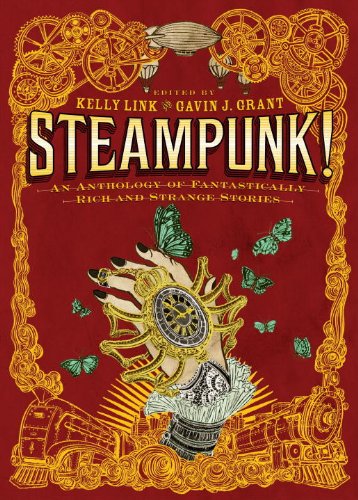
Steampunk! An Anthology of Fantastically Rich and Strange Stories, edited by Kelly Link and Gavin J. Grant

This week I decided to review another anthology which contains several short stories and two short comics which all contain various steampunk elements, as you might have guessed from the title. To be entirely fair, a lot of these stories have much stronger steampunk elements than some of the other ones, but as the editors mention in the introduction to this volume, steampunk has evolved into a multifaceted genre united only by the presence of things such as airships and clockwork automatons and the absence of the internal combustion engine. Overall I don't regret reading this anthology, but I have some issues with the relative brevity of some of the stories, and one story kind of bothers me because of the presence of a Manic Pixie Dream Girl, but more on that later.

As I mentioned, my biggest issue was the relative brevity of some stories and the fact that they set up a large world with interesting comics, but provide only the barest glimpse of these fantastic worlds. A really good example is the story Finishing School g(actually one of the two comics) which gives the origin story of Gwendoline Byrne, which was a really fun adventure and made me want to learn more about Gwen Byrne and her fantastic adventures in her flying machine because it sounds like a really cool story. The problem is that this story happens well after Gwen has become famous and an old schoolmate of hers is telling Gwen's origin story to us, the audience, assuming we know who Gwen Byrne is. While it's a really great origin story for what I think might be a really cool character, it's just an origin story and we don't get to see all the stuff that comes afterwards. Other stories like Some Fortunate Future Day and Nowhere Fast set up a much larger conflict and a very deep backstory to the world that, unfortunately, are much more interesting than the much smaller conflict contained within the story. It just leaves me wishing for more knowledge about the world and the larger conflicts.

The Manic Pixie Dream Girl which I mentioned was in the story Steam Girl, which I enjoyed but at the same time it bothered me. It's set in our "normal" world but is about two high schoolers who bond over stories that the female lead makes up about Steam Girl, a sort of alter ego that goes on fantastic adventures across space. The issue I had with this story was that the female really hit all the checklists for the Manic Pixie Dream Girl, in that she is an oddball who meets a plain, unassuming guy and through her awkward differences from us normals she teaches him to have a more optimistic outlook on life. The problem with this trope is as cute as it is, and I admit that I'm a sucker for it, the trope isn't real and it provides an unrealistic expectation regarding human relationships. Hopefully I can explain this topic further in a lecture, but there are people much more eloquent than I who have tackled this trope before.

As with other anthologies I've read I don't want to give too much away because there are some pretty good stories in here, despite my issues. If you're looking to explore the genre of steampunk and its modern, multifaceted nature, this would definitely be a good place to start.

- Kalpar

Thursday, June 6, 2013

I Shall Wear Midnight, by Terry Pratchett

So I've finally reached the very last of the Tiffany Aching novels, and while it's a little sad to say farewell to a character I have come to consider to be a friend, at the same time I'm very happy for Tiffany and wish her all the best. (And really that speaks to the strength of Pratchett's writing that I can consider Tiffany to be incredibly real.) Like all Pratchett novels it comes bundled with his bountiful wit and excellent writing, while artfully handling serious topics that many of us deal with in our lives.  I Shall Wear Midnight is definitely a book that adults can read with their children and, hopefully, have a very serious discussion about grief, evil, hatred, and jealousy. 

As much as I enjoyed this book, I have to be completely honest in saying that the plot in this book isn't terribly different from the other three. There is a very powerful and very dangerous magical being which is out on the hunt for Tiffany and she has to face it more or less alone, but with a generous dose of help from other witches and the ever reliable Nac Mac Feegle. I did have a little doubt as to if Tiffany would make it out okay in this book, considering it's the (so-far) last one, but she's a really tough girl so I was pretty confident she'd make it through okay. And honestly, if all that was going on in this book I'd probably have a far lower recommendation for this novel like I did with Wintersmith. Fortunately, I Shall Wear Midnight explores new material and explores the very human emotions of jealousy and grief, as well as at least looking into what makes people do evil things in the name of righteousness. 

As I mentioned in my Wintersmith review, it felt a lot like a retread of A Hat Full of Sky, where it covered the same ideas of taking responsibility and doing things because no one else will because that's what witches do. What I liked about I Shall Wear Midnight was that I got to see Tiffany Aching develop as a character and deal with her jealousy regarding Roland and his fiancee. Granted, as a reader I generally do not care for all that romantic nonsense, especially with teenage characters who tend to be petty, but Pratchett managed to write it in a manner I found rather palatable. I think one of Pratchett's greatest strengths is creating characters that feel incredibly real, and he made the envy of Tiffany very believable to me as a reader. I really think teenage readers would be able to connect with Tiffany because she's a very well-written and it's very easy to get inside her head and have a look around. 

I'm kind of on the fence regarding the other plot that kind of addresses where evil comes from. Pratchett kind of slips in a bit at the end that the evil is always there inside of us just looking for an excuse to come out, but at the same time I got the impression that evil is a something....else out there that looks for a way to corrupt us. I take issue with this because in other books Pratchett is really good about saying that evil comes from within. To quote Pratchett's earlier work, Small Gods, "There are hardly any excesses of the most crazed psychopath that cannot be easily duplicated by a normal, kindly family man who just comes into work every day and has a job to do." And that's just one example of many other quotes from Discworld where Pratchett admits that there is the potential for evil in all of us if we just let the barriers that hold us back fall away. To suggest that part of it is something...other than us, a magical force beyond our control that makes us behave that way and it isn't our fault is just contrary to everything that Pratchett has said previously, even within the Tiffany Aching series. I'd hate to give people the impression that we're occasionally not responsible for our actions because that leads down a very dark path. 

I thought this was a very good conclusion to the Tiffany Aching series and liked to see her develop as a character across the books. The reading level is simple enough that most young adults would be able to understand the concepts, but not so watered down that it's unbearable for adults. I think they would all be great books to share with your teenage children and hopefully spark some discussion about serious topics. 

- Kalpar 

Thursday, May 30, 2013

Raiding the Stacks: Le Morte d'Arthur, by Sir Thomas Malory

So I decided to go old school again this week and read Le Morte d'Arthur, and let me tell you it was definitely a challenge. Before I get started with the review, let me provide some background. Within English literature Le Morte d'Arthur is probably the definitive source for most of what you know about Arthurian legend. Certainly there are other sources, such as the tale of Sir Gawaine and the Green Knight, but every modern retelling from T.H. White's The Once and Future King to the musical Camelot draw upon Le Morte d'Arthur as source material. Truly this book is responsible for many people's understanding of King Arthur and his knights.

The book itself tends to be rather schizophrenic, and for good reason. Le Morte d'Arthur is actually a collection of many other Arthurian legends, some of which had existed for hundreds of years before Malory decided to record them in his opus. In addition, the book was only published posthumously and the printer, William Caxton, did a rather clumsy job editing the text. This has lead to some mechanical issues which can make the text rather difficult to read and it has a tendency to reiterate points already made before. The best way to approach this book is to treat it as an anthology that spans hundreds of years of European history. 

The biggest challenge I had with this book, and this is an issue I've had with other works like The Aeneid and The Illiad where it tends to contain a lot of very repetitive fighting. People proffer to joust and then strike many sad strokes and smite on the left hand and on the right hand and win much worship. I understand that these rather repetitive elements exist so that bards and troubadours could easily remember these stories when they were telling them to nobility, but it becomes very tedious to read as a twenty-first century audience. The largest portion of this book, the story of Sir Tristan, has a significant amount of such fighting and became a forced march at some points. Again, this is really a product of the story being hundreds of years old, but it makes it very difficult for a twenty-first century reader anyway. 

The other thing that really surprised me was the fact that there was a great level of corruption within Arthur's court from the very beginning, which ultimately leads to the fall of the Round Table. Many of you are probably aware of the adulterous relationship between Sir Lancelot and Queen Guinevere, but that is not the only disreputable act committed by men who are, ostensibly, the flower of knightly chivalry. Sir Gawain  and his brothers, for example, murder Sir Lamorak over a blood feud and numerous other petty quarrels seem to constantly strain the peace of Arthur's realm. Perhaps what was most surprising to me was the fact that Arthur willingly had sex with his sister, Morgan la Fey, thus conceiving his son and nephew Sir Mordred. In most of the versions I had read previously, which were the type cleaned up to make them appropriate for young boys, Morgan la Fey is portrayed as enchanting or deceiving Arthur because she's evilly plotting the downfall of Arthur's reign, almost as soon as it begins. Really, despite the glory and chivalry of Arthur's knights it seems like Camelot was doomed from the very beginning because of the sins that rotted it from the inside out. 

Some portions of this book I think modern audiences could still really enjoy. I know I enjoyed the story of Sir Gareth and the portion dedicated to the quest for the Holy Grail, but other portions like Arthur's war with the Emperor Lucius and the tale of Sir Tristan drag because of their repetitive nature. I would recommend on the whole though, that only the serious Arthur scholar read the whole of Le Morte d'Arthur. I think the more casual fans would be better served by reading many of the excellent adaptations which have come along in the intervening five centuries. 

- Kalpar 

Thursday, May 23, 2013

Now Departing Planet Earth, by Josh West

This week I've decided to finally break out the old Kindle again and read an e-book I found for free on Amazon. Now Departing Planet Earth follows the misadventures of Neel and Phillip, two technicians for the global MEH Corporation. Their workday was weird enough when they had to handle a five meter long snake in the ventilation ducts of corporate headquarters, but they soon find themselves investigating a dark conspiracy behind the MEH Corporation. With the help of Eva, an artificial intelligence programmer, and a lot of luck Phillip and Neel may be able to stop the sinister plot before MEH closes down its operations and leaves Earth.

Overall this story was interesting but its weakest aspect by far was its conclusion, which I will explain for a couple of reasons. Because I obviously have to discuss the end of the book there's going to be a major spoiler so you have been warned.

SPOILERS AHOY!

So, the ultimate goal of the MEH Corporation is to fake the explosion of a colony ship headed for Mars so they can then launch their actual colony ship to an earth-like planet further away and create their creepy utopia. While our protagonists work to uncover this plot they agree that MEH can't be allowed to fake the explosion because that will then discourage further space exploration, but at the same time say that we should focus on making Earth a better place rather than trying to start over with a new colony. So in the end the heroes...let the antagonists go through with their plan. They go to great lengths to sabotage the MEH Corporation's plans to force the leaders of MEH to hand over the reins of leadership to them and then...let the bad guys go through with their original plan. It just makes me wonder what on earth was the point of all that conflict if they were going to let MEH go anyway. The only thing it accomplishes is put MEH in the hands of our somewhat reckless heroes at the end, which leads directly to my next problem.

I wouldn't mind terribly if the book actually showed what our protagonists did with the MEH Corporation after the previous leaders have left for wherever the heck they were going in the first place. The problem is that the book ends precisely after the villains' plan comes to fruition and just...stops. I don't know if that was intentional or if West ran out of steam but it's an abrupt end to the story and provides no closure or assurance that our heroes will be any better than the previous leaders. It's pretty heavily implied that our heroes will be better but since it's just told to us I have no way of knowing for sure. There was just so much buildup throughout the book but it ends so abruptly and with a whimper that it was an unsatisfying end.

END OF SPOILERS

For the most part the book is...okay. It's not particularly astounding and some of the passages have really clumsy foreshadowing, but it's competent and doesn't have any serious defects. It's not the most exciting book that I've read recently but it was at least an enjoyable way to pass a couple of hours. The main problem is that something like eighty percent of the book is spent building up to the dramatic ticking clock of the third act, but the resolution is so tepid that it doesn't do the rest of the story justice. If the ending was better managed the book would be unremarkable at best, but I have to end up saying you're better off just passing it over because of its incredibly weak ending. Hopefully, next week with L'Morte d'Arthur will go better. 

- Kalpar

Thursday, May 16, 2013

Bolos Book II: The Unconquerable, edited by Bill Fawcett

So, rather predictably I must admit, I am returning again to the Bolo series with the next anthology of short stories, The Unconquerable. Although I did not hate this installment of the Bolo universe, I did not enjoy it as greatly as I did Honor of the Regiment, and largely I think this was a matter of tone. Regardless, this book has plenty of that pulp sci-fi action which I love wrapped in a crunchy flintsteel coating.

As I mentioned, my biggest issue with this book was the theme of loss and desperate last stands that permeate the book. The tagline on the cover says "Bolos may be destroyed - they do not surrender" which initially sounds like a pretty badass boast but a couple of the stories have large-scale battles where dozens or even hundreds of bolos are destroyed, going down fighting against an endless horde of alien enemies to protect their human masters. While it is stirring that such self-sacrifice can come from hundred-ton metal monsters, I at the same time want the Bolos to win and felt their losses very acutely. Yes, I am aware that they are fictional AIs that exist merely to fight on behalf of humanity, but I feel a strong connection with these warriors and was saddened by each loss they suffered against the apparently infinite swarms of enemies.

There is also one story I did not care for because of the unfortunate undertones it seemed to carry. I will admit that I initially liked Sir Kendrick's Lady because it was nice to see Sir Kendrick and the people of Camelot again, giving a real sense of permanence to the bolo universe. The problem I had is that for much of the story we are shown how utterly frustrating life can be on Camelot, especially for women who are actively discouraged from "having ideas" and are married off, occasionally against their will. It's an incredibly sexist regime which the main character, Abigail, spends almost the entire story trying to escape by taking the Merchant Guild exam and running off to be a spacer. The problem (and pardon the spoilers) is that at the end of the story it's revealed the Merchant Guild is actually a front for a slave-trading ring which has been stealing youths from Camelot for years. At the end of the story Camelot is reaffirmed in Abigail's eyes and she rejects her dreams of becoming a spacer. (Although she does become head of port security.)

 My frustration stems from the fact that clearly there is something wrong with Camelot with its systematic gender discrimination and expectation that women fit a role which only occurred in the (highly fictional and idealized) accounts of King Arthur. Abigail even raises the legitimate point that everyone is living in a fairy tale world, but at the end of the story Camelot is the same place it always was and has be redeemed in Abigail's eyes. Quite frankly, although slavery is a horrible institution that still exists today, I do not think the slave ring in Camelot's space port was indicative of the larger galactic society beyond Camelot. Based on the information available in the other stories galactic society appears to be very progressive with numerous female soldiers and officers in the armed services working with the bolos and this isn't treated as a big deal by anyone. I was just annoyed that a culture which marries young girls against their will declared itself morally superior to a culture that practiced slavery.

Overall, despite my personal issue with the tremendous sacrifices the bolos must bear in the book, as well as the more legitimate issues with Sir Kendrick's Lady, I thought this book was a good addition to the bolo series. Perhaps not as mind-blowingly epic as Honor of the Regiment, but an entertaining way to pass the time. Definitely a must-read for fans of our mighty tank friends.

- Kalpar

Thursday, May 9, 2013

Ciaphas Cain, DEFENDER OF THE IMPERIUM! by Sandy Mitchell

Well this month I've decided to go back to the world of Warhammer 40,000 by continuing with the adventures of everyone's favorite cowardly commissar, Ciaphas Cain. As my readers may remember, I reviewed the first ominbus of the series, Ciaphas Cain: Hero of the Imperium a while ago and thought it was a refreshing change to the usual pace of the 40k universe. While I greatly enjoy other 40k books like the Gaunt's Ghosts series by Dan Abnett or the Ultramarines series by Graham McNeill, they all have a very serious tone which can make for heavy reading. The Ciaphas Cain novels, on the other hand, have an almost constant tongue-in-cheek attitude towards the 40k universe which is a really refreshing approach to a series that can take itself a little too seriously sometimes.

Now a good question that a friend asked me is, "Well, are these next three books any different from the last three?" And to an extent I have to say no, it's a lot of more of the same. Cain is cowardly and wants nothing better than to get out of trouble but always finds himself ending up in the middle of the largest concentration of enemies he can find. Jurgen, meanwhile, is phlegmatic and loyal and ends up saving Cain's ass a number of times despite never being in the official stories of Cain's life, and Amberley provides snarky comments on Cain's autobiography. So in many respects I will admit this omnibus is more of that pulp sci-fi that I can't get enough of and keep reading. 

What is unique about this omnibus and which I particularly enjoyed was the three novels focus on three events which occur at different events throughout Cain's career. We see Cain at the beginning of his career, still with the 12th Valhallan Artillery, and as a fairly brash young commissar who still has yet to become a Hero of the Imperium but quickly finds himself embroiled in an ork invasion. We then see an older and wiser Cain during the middle of his career with the 597th Valhallan facing off against an unstoppable tyranid swarm. Finally we see a very old Cain at the end of his career teaching commissar cadets at a planetary schola, but Cain is pulled out of retirement to defend the planet against the forces of Chaos. Overall I rather liked the overarching story arc of the shadowlight artifact which tied these three events of Cain's career together and added a sense of the long-term effects of Cain's presence in the galaxy. Plus there were plenty of excellent action sequences to keep the most rabid fanboy satisfied. 

I will admit that there are a couple of flaws with this book, such as the fact that the stories contained in it don't vary too much from the books in the first one so if you weren't impressed with the first collection you really have no reason to read this one. Furthermore, despite seeing Cain at three points across a century, neither he nor Jurgen change as characters. Cain remains...well...Cain, whether he's a commissar fresh from the schola or a century-old badass, which was a little frustrating. In addition, while I understand why the first novel of this omnibus was in this omnibus, being part of the shadowlight story arc, I kind of wished it had been the first book in the series because then we could see Cain becoming a Hero of the Imperium rather than being introduced to him after he has gotten all sorts of fame and accolades. 

Despite the issues I mentioned, I really liked this book and I think it's a must-read for any fan of the 40k universe; I think it's an excellent tongue-in-cheek approach to a universe that often takes itself too seriously while still maintaining the space opera and pulp aesthetics of the original source material. I might even go so far as to say that people new to the Cain series should read the first story in Defender first, followed by all of Hero, and then the other two-thirds of Defender. It might just be my preference for chronological order but I like seeing Cain develop his undeserved reputation as a hero before he becomes a posterboy of the commissariat. 

- Kalpar 

Thursday, May 2, 2013

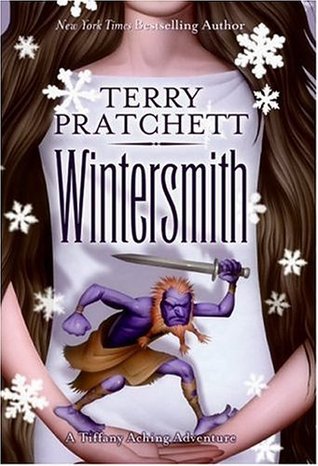
Wintersmith, by Terry Pratchett

I've decided to return to the Tiffany Aching series again this month with the novel Wintersmith which interesting coincides with the celebration of the Morris Dance which is celebrated through the English-speaking world as a celebration of the arrival of spring. However, since I'm writing this post in March with a foot of snow outside I cannot at this time be entirely certain spring will have arrived by the time this post goes live. If we have ended up with an unending winter and I'm the only one still alive then we are in serious trouble indeed.  Hopefully, though, it won't come to that.

Overall, I have to admit that the plot of Wintersmith is not terribly different from Wee Free Men or Hat Full of Sky which makes for some repetitive reading. Tiffany gets wrapped up in events much bigger than she had expected and has to rely on the help of the Nac Mac Feegle and Granny Weatherwax to get her back out of trouble again. The only real difference I noticed was this time it's pretty much Tiffany's own damn fault that she got in trouble because she did something she shouldn't have done, which thirteen year olds tend to do, and now she has to reap the consequences. This time, however, Tiffany danced with the Wintersmith and if things aren't fixed by May then the whole world will be covered in endless winter.

The problem I had with this book, as you might have gleaned, isn't anything mechanical. As always with Pratchett the writing is excellent, the characters are well-rounded, and the plot is interesting. The problem I had was that it was the same plot and by this point I don't feel like Tiffany is growing as a character. Yes, in this book Tiffany is taking responsibility for something dumb she did (which I full-heartedly support) but that's been the theme of the last two books as well. Really, Tiffany only gives a sort of half-hearted "But I didn't mean to" before being forcefully reminded by Granny Weatherwax about what a witch is all about and she gets back to work. I actually found the limited glimpses of Roland's development as a character rather more interesting and wished I could have seen more of him in this story. I know that it's Tiffany's book but some development is better than none at all.

The other major theme, and this is a typical theme in Pratchett works, is the idea that some things have power merely because we give them power. While it's an interesting idea which I think is a good concept to introduce to young adults, I feel like Pratchett handled it a lot better in Hogfather and Small Gods, both of which could very easily be read by this age range as well so it doesn't add a lot to the novel. If your teenager hasn't read Discworld books other than Tiffany Aching then it'll at least be new to them, but as an old hand on the Disc it's the same stuff I've read elsewhere.

Overall, Wintersmith isn't a bad book and I thought it was very enjoyable. My problem was that it felt like it was a sequel written just for the sake of having a sequel rather than because Pratchett had new ground to cover. I'd still recommend it for up-and-coming Discworld readers and the maniacs like me who have to read every Discworld book, but everyone else can probably safely pass it by.

- Kalpar