Thursday, November 13, 2014

The Bully Pulpit, by Doris Kearns Goodwin

This is a book that came out I think a little over a year ago and I had heard overall very positive things about it. Being, of course, a Roosevelt fanboy I was rather interested in more information about Roosevelt and his presidency, and the promise of comparing Taft with his predecessor, especially in their handling of press relations, was very promising. Personally, I think I had very different expectations of this book than what other people had because I was a little disappointed with Goodwin's approach. This book is very heavily biographical, rather than a large-picture view of history (which I am unabashedly in favor of), and there's a lot of focus in comparing and contrasting Taft and Roosevelt's personalities and lives, which definitely shaped public perception of both those gentlemen as president. Roosevelt seems to dominate the work, but this is not terribly surprising considering Roosevelt had an incessant need to be center stage in almost everything that he did. It does make me wish for more information about Taft, though, because he's simply no match personality-wise with Roosevelt. Despite my disappointments I did find this book informative and hope to expand my personal readings about both Taft and Roosevelt in the future.

The book begins by focusing on Taft and Roosevelt biographically, comparing and contrasting their childhoods, education, family lives, and personal ambitions, all which served to shape Roosevelt into the quintessential politician and Taft into the epitome of judicial wisdom. Both Edith Carow and Nellie Herron receive their own chapters to show how these women complimented their husbands and had their own differences in personality as well. Along the way, the book brings in the biography of S.S. McClure, eventual founder of McClure's magazine, a prominent progressive publication in the early years of the twentieth century, as well as briefly talking about the lives of staff members such as Ida Tarbell, Ray Baker, Lincoln Steffens, and William White. In a way, McClure's gets its own biography in the story as well when Goodwin chronicles its inception, zenith, and eventual decline. The result is the personal life stories of several unique individuals that get weaved together and influence each other for a number of very critical years, resulting in landmark legislation like the Pure Food and Drug Act.

I think my biggest disappointment was the fact that McClure's (and then the work of the most prominent staff members of McClure's) was the central focus of Goodwin's analysis of the early twentieth century press. The late nineteenth and early twentieth century saw a tremendous growth in print culture, expanding access to literature and information to a level simply unheard of before. McClure's was one of many, many publications, and definitely not the only muck-raking publication on the market either. Although incredibly prominent, McClure's represents only one part of the entire market of print media. Obviously a complete analysis of the entire printing industry in the early 1900's would be extremely difficult to say the least, but I had hoped for a more in-depth comparison.

What I really appreciated was more information on Roosevelt and his more progressive policies. In Theodore Rex, TR's conservation and water management policies are talked about, but very little to no attention was given to landmark regulations passed under Roosevelt's administration. The Bully Pulpit does do an excellent job in showing how publications like McClure's were influential in shaping public opinion on subjects such as trusts, patent medicines, and railroad regulation, creating political pressure for the largely business-friendly Republican congress to pass such regulatory legislation. In addition, this book shows how Roosevelt is able to capitalize on this public opinion to force through his legislation, although I felt like it didn't do as great a job showing Taft's inability (or unwillingness) to utilize the press for political purposes. From my readings in The Rise of Theodore Roosevelt and Theodore Rex, Roosevelt definitely has a strong rapport with the members of the press, realizing its political potential, and you see that in The Bully Pulpit as well. Taft, as Goodwin illuminates, seems to be used to delivering judicial opinions rather than making press conferences and does not have Roosevelt's charisma when it comes to media relations. However, in this book it doesn't feel sufficiently expanded upon, especially because that's the central theme of the book.


I think much of my disappointment stems from this book is more a collection of intertwining biographies rather than a unified historical narrative. It definitely sheds some much-appreciated light on print culture in the early twentieth century as well as the Taft and Roosevelt administrations, but there's much that's left to be desired as well. I'd definitely recommend it as a supplemental book, but I feel it requires a lot of extra knowledge to fill in gaps that are otherwise left from this text.

- Kalpar  

Thursday, November 6, 2014

Force Cantrithor, by Michael McCloskey

This week I'm reviewing an e-book that I picked up quite a while back because of an extensive advertising campaign when it was first released. Seriously, the ads were everywhere I looked on the internet (Hooray google targeted ads!) and when I finally read the summary it definitely looked interesting. So I thought what the heck and added it to my to-be-read list where it sat until I finally downloaded it. I just want to explain why I picked this book up before I go into my review, because it's not great. Don't get me wrong, it's nowhere as bad as certain other books I've read, but it's just not terribly interesting.

This book's summary and cover are what really drew me in. As my readers are no doubt aware, I'm a huge sucker for pulp science-fiction. The overall plot is that humanity is engaged in what is now a decade-long war with the Vothriles, an insectoid predator species. Humanity's greatest defense in this war are emmers like Emil, people capable of manipulating electromagnetic fields and who can cloak Terran warships against Vothrile sensors, break through Vothrile cloaking fields, and in some cases destroy enemy ships with a surge of power. However, a mysterious and highly powerful enemy, known only as Force Cantrithor, has forced these bitter enemies to work together for their own survival. Although the idea of two rivals teaming up against a new threat is as old as the hills, there's at least enough potential with new areas for the story to take its own direction.

My biggest issue with this book was that the plot seemed kind of disjointed throughout the book. Now, as the main character Emil is suffering from hallucinations and has trouble telling what's real or not, this could have been used as a legitimate way to tell the story. However, I feel like this simply doesn't work because Emil is “present” for the entire plot and we never really have reason to believe anything he sees, outside of the dream sequences that are definitely dream sequences, isn't real. As an emmer, Emil has the ability to see everything happening inside the ship he's stationed on, as well as detect a large number of things happening in surrounding space as well. Furthermore, everyone has a chip installed that allows them to access digital information with just their bodies and most meetings occur in cyberspace. Because this is another form of electromagnetic field, it means Emil can eavesdrop on even the most secret of conferences held by the admirals. Heck, Emil can even read people's minds in some cases simply by the electronic fields their nervous systems give off. So I wasn't left feeling like Emil was suffering from information overload or was otherwise losing a grip on reality because of his abilities, it just felt like there were these weird lurches in the plot as it stumbled forwards.

Another issue I had with this book was I really wasn't invested in any of the characters, which left me a little surprised that I managed to get through the entire book. Emil, specifically, doesn't have terribly much in terms of personality going on. He doesn't really have any desires or aspirations beyond just wanting the war to end so everyone will be safe and he won't be under constant strain anymore. I feel like this was intentional on the part of the author to further try and highlight how different Emil was from all the other members of the crew, but it doesn't really work because the rest of the crew are pretty flat as well. Samuelsson, the captain, feels guilty about the lives in the fleet he has to sacrifice for victory, but that's about it. Cain, the executive officer, hates the Vothriles, but that's about it. Lokan, the ship's psychologist, is kind of suspicious, but that's about it. There are only a handful of other characters that are given names and the barest hint of a personality, the rest are really just extras in the story. If the other characters had been better developed then the differences between them and Emil may have been much more pronounced and noticeable, but because they're little more than line drawings Emil's flatness as a character fails to impress itself on the reader.

I think the reason I was able to get through this book was that it was relatively short and not terribly difficult to read. If I had gotten frustrated or angry over it, I may have given up on the project entirely. But quite frankly I think the cardinal sin of this book is that it's boring more than anything else. There was a lot of potential and ideas there, but they just don't get developed. Can the humans trust an enemy that now wants to cooperate? How do we know what's real if virtual reality is a constant part of our world? Is the sacrifice of a few lives worth victory in a war that will save potentially millions? For whatever reason none of these are capitalized upon and the result is a very sleepy read that leaves an impression of “meh”. Perhaps other works from this author will be improved, but you're not missing anything if you pass it by.

- Kalpar

Thursday, October 30, 2014

Storm Front, by Jim Butcher

This week I've thought it'd be fitting to return to the realm of Urban Fantasy by looking into the Dresden Files series by Jim Butcher. Some of my readers may recall that I tried reading a very similar series set in my native Cincinnati, however the author's attitude on vampires was not to my liking which lead me to dropping it. I will say that Storm Front had issues of its own, but I'm willing to try at least one more book in this series before I decide whether or not to go forward with the rest of the series.

The Dresden Files, from what little I've learned about them, is a series of books that focuses on Harry Dresden, a professional wizard and paranormal investigator working in Chicago. I will say that this book seems to have a lot of similarities with other Urban Fantasy I've read, (albeit, I haven't read terribly much of that) but they seem to draw heavily upon pulp noir fiction for inspiration. Which I find a little curious because when I think about it, fantasy and pulp detective mystery don't seem to be two things that go together naturally, but the results always seem to be rather entertaining. And it's definitely an excellent change of pace from the swords and sorcery high fantasy that seems to dominate the fantasy section at the book store.

Harry Dresden is your typical pulp detective: short on cash, constantly behind on his rent, a bitter man who sometimes gets called in to help with a case the police can't quite puzzle out. The main difference, of course, is that Dresden is a full-blown wizard with a staff, magic charms, leather books, the full works. In this book the Chicago police call Harry in to investigate a gruesome murder that makes absolutely no sense whatsoever. Dresden and his contact on the force, Detective Murphy, suspect that magic was involved, but of course her skeptical partner thinks Dresden's little more than a charlatan. To top this off, Dresden gets asked by an extremely worried woman to find her husband, who's been dabbling in magic. Soon enough it turns out that there's much more going on here than meets the eye, and some people think Dresden may be to blame.

I will say that compared to the Hollows series (which is really, really similar) Butcher sort of explains some things about how his universe works, but there is quite a lot that is left unexplained as well. I got the impression that magic is still largely hidden in this universe, opposed to being out in the open like it is in the Hollows, but I get the feeling Dresden's going to have to explain more about magic to muggles like Murphy and the reader as his activities become far less clandestine. Especially central ideas like the Laws of Magic or the Nevernever. I've of course got a vague idea as I'm more than passingly familiar with fantasy, but I'd appreciate a much more detailed explanation. Furthermore there are a lot of oblique references to Dresden's past, including actions which resulted in a death mark on his head, but we're really only given the general details. I really hope that later books will do a better job at expanding and better explaining Butcher's universe. But that remains to be seen. The Hollows was at least better at explaining how the universe worked and how it was different from our own.

The thing which I liked the most about this book was I think the much more intelligent take on vampires in this series. Of course this may be my inner paladin coming out against creatures of the night, but I'm always annoyed by literature that treats vampires as misunderstood bad boys rather than dangerous blood-sucking monsters. (The exception for me is Discworld, where vampires can transfer their addiction to blood to other things like photography or coffee.)  Butcher at least shows that there's something fundamentally wrong and perhaps evil with vampires, which I greatly appreciated.

I will say that the book shows potential, despite being rough around the edges. I will say that Dresden seems to get a few lucky breaks, rather than figuring everything out himself. And that was one thing that really frustrated me with the Hollows because Rachel was really not good at her job and tended to fly off the handle and had to rely on other people to solve her biggest problems for her. Dresden does, by contrast, go into situations rather prepared and with something approaching a plan. When the going gets tough, Dresden seems to get by through a combination of quick thinking and good luck. Hopefully he'll get better as the books proceed.

I would say this book in particular isn't anything to write home about. It's okay, but it's nothing spectacular. Granted, there are plenty of series that start off pretty rough and get better, including my all-time favorite of Discworld. I do plan on reading more of this series and seeing where it goes from here.

- Kalpar

Thursday, October 23, 2014

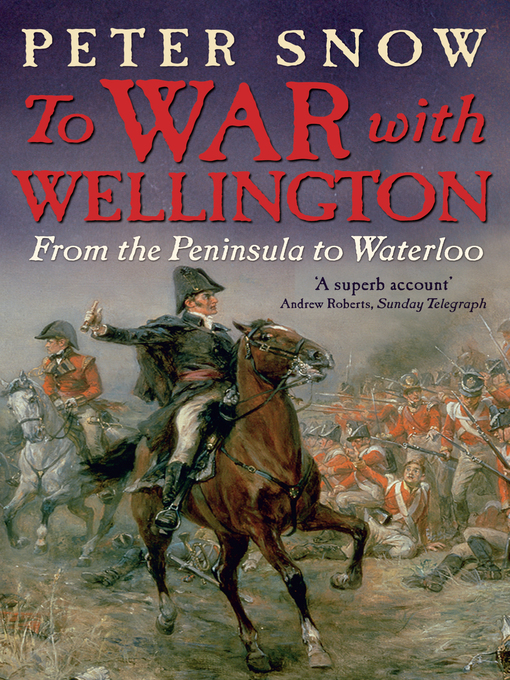
To War with Wellington: From the Peninsula to Waterloo, by Peter Snow

This week I've returned to the Napoleonic wars and the campaigns of Wellington, although without my friend Richard Sharpe. In this case I've decided to read a historical text by Peter Snow that follows Wellington's development as a commander from the start of the Peninsular campaign to Waterloo, as well as talking about army life. When I picked up this book I was less interested in Wellington than I was in information about life in his army. For whatever reason my historical tastes tend to run less towards biographies and more towards the larger picture. Plus, additional information on day-to-day life is always helpful for historical interpretation at museums and historic sites. Overall this book is an okay introduction, but just that, an introduction.

This book is very much a condensed biography of Arthur Wellesley, the first Duke of Wellington, beginning with his military training and eventual appointment to India with the assistance of his older brother as his patron. The book begins properly with Wellington landing in Portugal in 1807 to assist the Portuguese and Spanish resistance against French rule, as well as bleed men and resources from Napoleon's campaigns in Central Europe. The book is very unstinting in its praise of Wellington, being very quick to dismiss Wellington's personal flaws such as his arrogance, aloofness, and disdain for the lower classes. Snow emphasizes that in several key battles Wellington refused to tell his plans to any subordinates ahead of time, leaving no structure in place should he be wounded or killed. It is perhaps the fact that Wellington lived a charmed life and avoided injury when so many of his staff officers and aides were killed or wounded that saved Wellington's army from a disastrous defeat due to a loss of leadership. Even Wellington's notorious and unabashed womanizing is winked at, and while this has nothing to do with his qualities as a general it certainly doesn't put him, in my eyes, in a flattering light.

To his credit, Snow relies extensively on primary sources for his works, drawing upon the diaries, letters, and dispatches of people involved in Wellington's campaigns. As Snow himself admits, some are written decades after the fact when memories are more fuzzy, but many are first-hand accounts written as their authors trudged through Flanders, Portugal, and Spain. It's always nice to see primary sources utilized to such a degree, and Snow even calls Wellington out in the few instances where he tries to pin his failures on others. What I found most interesting was the accounts of army life during the time period, talking about the daily drudgery and discipline which so often breaks down in an orgy of violence and plunder upon the successful completion of a siege. Wellington's apparent indifference to his troops depravities is rather striking considering his reputation of enforcing respect of private property, if nothing else than to prevent the civilian population from hating the English as well!

In that same vein, a lot of emphasis is laid upon Wellington's attention to supply, being determined to keep his army well-fed and well-supplied so that they would not be required to requisition or outright steal food and other items from the civilian population. However there are quite a few accounts of severe starvation suffered by Wellington's troops, including accounts of hunting acorns so they could be ground into an edible paste. A well-supplied army should not need to resort to such measures, which begs the question what has driven them to such a need? Snow briefly mentions Wellington may not have been aware that such things were happening, but if it was as wide-spread as the accounts claim it to be it seems his army faced severe food shortages during some winters. I'm sure there is a good rational explanation for this discrepancy, perhaps several good reasons, but there just seems to be a lack of research there in particular within this work.

The impression I'm left with is this book is rather light reading, especially compared to other historical works. Considering entire books have been written about Waterloo, (I even read one!) Snow's book comes across as a highlight of important events over eight years rather than an in-depth discussion. For people unfamiliar with the Napoleonic Wars it's a good introduction, but it definitely lacks a lot of substance that I've gotten used to in my historical readings. (Sorry! Trained historian!) If you want to learn about the Peninsula Wars this is a good start, but you shouldn't end here.

- Kalpar

Thursday, October 16, 2014

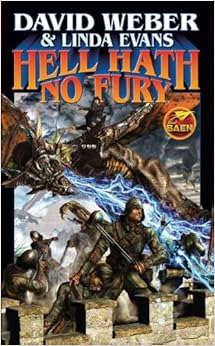
Hell Hath No Fury, by David Weber and Linda Evans

I'm going to say this straight up, I should not have started with this novel. When I picked this book up at the used book store, I was under the impression it was sort of a stand alone work, rather than part of a series. I did notice on the back cover a “Praise for the Prequel” section, but I assumed that this book had come first so I could safely start there. This sadly is not the case, and I should have stuck with the familiar maxim, “Covers always lie.” As a result I have kind of a disjointed view of this book because I started right in the middle of a larger series. In the spirit of fairness I will not complain about being utterly confused or having to slog through the attached glossary to figure out what the characters were talking about at certain points in this book. That's entirely my own fault for jumping in the middle, but take it from me, you should start with Hell's Gate before continuing to Hell Hath No Fury.

I initially picked up this book because of the authors. Linda Evans and David Weber have become favorites of mine, especially after their work with one of my all-time favorites, the Bolo series. Although I haven't yet read much outside of the Dinochrome Brigade with Evans I plan to read more of her work thanks to Baen's library of e-books, and of course Weber's Honor Harrington series has become another favorite series of mine. So I was rather excited to read another team-up work from these two excellent science-fiction authors. Especially because of the pretty awesome premise. Essentially there is a series of parallel earths, all identical, but only a handful are inhabited. One, known as Arcana, is home to magic-wielding wizards, kings, unicorns, and dragons. Another known as Sharona is home to people with telepathic powers and a technological level similar to our own in the early 1900's. The Sharonans are described by some people as steampunk, but I'm not so sure about that particular nomenclature as none of their technology seems to have the wonder and sheer improbability of what I define as steampunk, but I may just be splitting hairs. Point is dragons and wizards are getting pitted against steam trains and machine guns, what's not to love?

More specifically over the years both Arcana and Sharona have explored what they call chains of universes, linked by portals, and have colonized quite a few. Eventually both sides have discovered what's referred to as Hell's Gate, a universe containing a junction of portals, permitting access all across the multiverse, and through a miscommunication have come to blows over Hell's Gate. The Sharonans at the start are currently in command of the portal nexus, but the Arcanans have agreed to diplomatic talks to try and prevent further bloodshed. Unfortunately there are many, many plots in motion which mean warfare is going to be inevitable, but that's what we signed up for, isn't it?

I will say that I personally saw a bit of difference between the two sides, although this has been described as a gray-on-gray morality setting. I will admit that there are bad guys who are Sharonans and good guys who are Arcanans, but it seems to be that the majority of Arcanans aren't very good people, while the majority of Sharonans are rather noble. Maybe it's better articulated in the first book, I simply don't know. As for their powers, I personally didn't see much of a difference to be honest. The Arcanans have Gifts while the Sharonans have Talents, the difference being that Talents are more common but less powerful than Gifts. Granted Talents seem to be entirely mental abilities while Gifts let you work standard fantasy magic, but they both seem to just...exist. Although when David starts going into a stream of technobabble I tend to just tell myself, “It works because magic.” and don't let myself get bogged down in the details.

The biggest frustration with this book is, as it's part of the middle, it ends on a cliffhanger. As a matter of fact, it even ends in mid-conversation, which resulted for me in a, “That's it?” I did do a little research and found out that unfortunately Linda Evans has suffered a number of health problems recently which has prevented her from writing and has delayed work on this series. David Weber is currently working to get another author involved, but it seems it will be some time before the planned other two books of this series are completed. Hopefully things can get back on track soon and I wish Linda Evans all the best.


If you're as interested in fantasy vs. technology stories as I am, this one is a pretty good choice, but I'd recommend starting with Hell's Gate like I should have done. As is typical for Weber, there are plenty of characters and plot threads, some of which aren't resolved in this book and one of which disappears off the face of the earth. Hopefully they'll get tied up in the later books, but it looks like we're going to have to wait for a while. 

Thursday, October 9, 2014

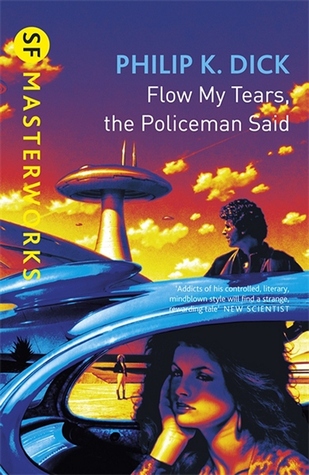
Flow My Tears, the Policeman Said, by Philip K. Dick

For whatever reason I've decided to take another stab at Philip K. Dick and his highly influential science-fiction literature. Flow My Tears, the Policeman Said is another one of Dick's full-length novels, fairly short in length, but because of his writing style you don't feel like a single page was wasted and this book probably could have been developed much further into a longer work. It's very interesting and there are a couple of very insightful passages into human nature within this book, specifically dealing with love and grief, but everything gets tossed into a large jumble with a ton of drugs going on as well. Hoo boy did Philip K. Dick like his drugs.

As I said in my reviews of Do Androids Dream of Electric Sheep? and Minority Report, it seems that Dick is much better at writing short stories rather than full-length novels. When he's working on a short story there's an arbitrary stopping point that forces Dick to be extremely tight in his focus and stay on whatever his main topic is about. In full-length novels, by contrast, Dick has much more space to work with and so sometimes dozens of ideas just sort of pop up, announce themselves, then scurry into the background with you saying, “Wait! You were interesting! I want to see you developed!”

The main plot in Flow My Tears is that television personality and famous singer Jason Taverner wakes up one day to discover he is in a world where no one knows he exists. No one he talks to has seen his weekly TV variety show, or heard one of his albums. To further complicate things there's no record that Jason Taverner exists at all: no birth certificate, no driver's license, no documented proof anywhere that he exists. In a world firmly under the heel of a police state where no identification means instant incarceration in a forced labor camp, Jason Taverner is in a very, very bad position.

Alone, this plot is pretty fantastic and could easily make its own novel, or in the case of Dick he could make a really fantastic short story out of this premise. Unfortunately, as I said, because this is a full-length novel, Dick's able to wander off and introduce a bunch of ideas that never really go anywhere. For example, Taverner is a six, one of a handful of people the result of genetic experimentation that produced human beings superior in almost every respect. Despite this being an aspect of Taverner's character which is mentioned repeatedly, it plays a very small role on the story overall.

Another really interesting idea is that to help solve the race problem a ton of legislation has been passed, more or less protecting blacks as a sort of endangered species. However, legislation has also been passed which requires blacks to be sterilized after the birth of their first child, dooming them to eventual extinction. Writing as he was in the seventies, a period of great racial tension, this idea could have been a very interesting reflection on the racial ideology of the day. However, it's just sort of mentioned and then the story moves on.

A final idea that Dick talks about, and believe me there are plenty, is the fact that in this particular world, many of the university campuses in at least the United States have been walled off from the rest of the world, surrounded by the police and the national guard who are heavily armed and informed to shoot anyone who tries to escape. We're never told why the campuses have been placed into a state of siege, what horrible political protest (for that's what I'm assuming happened) allowed the situation to balloon to such proportions. In the novel's epilogue we're told that the universities eventually surrender and the students disappear into the forced labor camps, but we never encounter any students or go to any university campus so it's an interesting idea that ultimately goes nowhere.

I definitely think that in the future I'm probably going to stick more to Dick's short stories rather than his novels. It seems to me that his short stories work out much better because they're not able to just go all over the place. I probably will explore some of his novels again, but they're definitely very different fare from most reading.


- Kalpar

Thursday, October 2, 2014

Bolos Book Six: Cold Steel, created by Keith Laumer

Once again the mighty Bolos shall grace the pages of Kalpar's Arsenal in the last of the numbered installments in the series, Cold Steel. (There are several other books about the Bolos which I fully intend to read but for whatever reason Baen Books decided to drop the numbering convention.) This is what seems to be another in-between book in the series and its overall development. As I mentioned in the last book, the short stories all focused on one particular war that was fairly limited in scope, as well as the Bolos efforts in defending humanity from this new threat. Cold Steel once again focuses on just one planet, in this case Thule, and has only two stories. The second one, “Though Hell Should Bar the Way”, by Linda Evans, is long enough to be its own novel and leaves me rather optimistic about the later books.

Cold Steel, as I mentioned, focuses on the world of Thule, a planet with an extremely harsh winter, intense volcanic activity, and innumerable asteroids and meteors making interstellar travel a massive headache to say the least. It would have been entirely ignored by humanity except for an incredibly rich supply of saganium, a material component of the new duralloy which makes up Bolo warhulls. This has made Thule a priority mining operation of immense strategic significance and human colonies are quickly established. However, the preliminary survey did not reveal the existence of a native intelligent species, the Tersae, who become rather violent when humans show up on their planet.

Overall the writing is enjoyable pulp Bolo action. If you've enjoyed the series so far you'll enjoy this, no doubt about it. However, among all the awesome pulp action which the Bolo series is fueled by, there are some really uncomfortable questions that get raised. First off, there is of course the imperialism parallel where a more technologically advanced culture arrives at a “barren” location to obtain natural resources, only to find themselves in conflict with locals who are rather unhappy with all these strange people on their land. This is side-stepped when it turns out the Tersae were created by and are receiving orders from “Ones Above”, so the conflict is a proxy war between two powers and the Tersae are just tools. Which actually makes it much worse come to think of it.

Another important question that gets raised is are the humans really any better? The Tersae are a genetic experiment that are thrown into a war by their creators, expected to die on their behalf. Are the humans really all that better with their Bolos? An intelligent, self-aware, self-directing species that exists merely to fight and die or become obsolete and replaced? I feel like Evans was aware she kind of painted herself into a corner with that question and gets out with an argument that kind of boils down to:“Humans good, aliens bad.” I feel we could really only ask the Bolos their opinion, but that may not be legitimate either since Bolos are fundamentally hardwired to protect their human creators. It just results in an uncomfortable question with no real answer. And it's fine if there was no real answer, plenty of science fiction has gone that way, Twilight Zone included, but we're given a quick and easy answer so we can feel better and get back to the pulp action.

At the end of the day, the Bolo series has largely had, “Whee! Giant robot tanks!” as its premise. And as pulp-action, giant robot tank space battles fluff it works. And when the books start to introduce more complicated ideas into the giant robot tank space battles it works as well. And I think that's a credit to the writers, but in this particular instance it just didn't work out. The questions they raised don't have easy answers and it feels disingenuous to both the series and the reader to just say, “Humans aren't monsters” and go about business as usual. At least, that's how I feel about it.

I choose to see this as a developmental period in the Bolo series, moving from the shorter stories toward longer narratives that also try to incorporate more complex ideas beyond pulp action awesome. Don't get me wrong, I love my pulp, but when it can be sophisticated as well? Wins all around. Hopefully the other books, in the hands of such capable authors as David Weber, will build upon the Bolo's noble legacy.

-Kalpar


P.S. I've been trying to find more books by Linda Evans as well. I really like her work with the Bolos and I want to read more, but I haven't had much luck finding any. If anybody knows any good books by her please post them in the comments! Thank you!