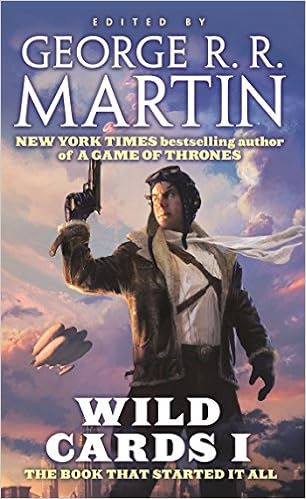
Today I'm looking at a collection of short stories in the Wild Cards universe, Wild Cards I, which deals with the introduction of the Wild Card virus to earth, its aftermath, and changes to the world after survivors of the virus, both aces and jokers, begin to take a more prominent role in the world. The result is an interesting world that feels incredibly cohesive, at least in this first novel, despite being written by a variety of authors over a number of years.
The story begins in 1946 when an alien, who ultimately gets the moniker Doctor Tachyon, lands at White Sands, New Mexico to warn the United States that his people developed an experimental bioweapon they intended to test on earth. Doctor Tachyon managed to prevent them from deploying it immediately, but the vessel carrying it crash landed somewhere in the eastern United States and it's absolutely vital that they recover it before it gets released. Unfortunately they fail and the bioweapon gets released over Manhattan.
For the people who get infected by the virus, about 90% of them die outright, which caused considerable panic when thousands of people died grisly deaths around New York City, creating a state of emergency. Of the remaining 10% who survive, about 90% of them get mutations that are largely useless, whether it be a disfigured hand, transformation into an animal form, or a minor ability such as being able to move coins a little bit on a table. These people are called jokers and a majority of them get consigned to a ghetto at the southern end of Manhattan called Jokertown. Of the remaining 10% of survivors, a mere 1% of those who are infected with the wild card virus, they get legitimate superpowers whether it be flight, super-strength, or telekinesis. These are the aces, first mistrusted and even reviled by the American public, and then later heroes with their own comic books.
The thing I like most about this book was how interconnected everything felt. As I said, this was a combined effort of numerous authors over a period of time within a shared universe. with Wild Cards I the result was a book that felt like it had a cohesive vision and voice throughout the book, rather than a collection of stories by different people in a shared universe. A good comparison would be some of the Bolo books. While these books are within a shared universe, the short stories in the anthologies can be quite distinct from one another with each author's own voice coming through in the book. While this adds to the variety of the Bolo universe, it makes the books feel a lot like an anthology rather than a cohesive story.
Wild Cards I, by comparison, feels like a full-length novel written in the style of a series of short stories. While the individual authors' voices didn't come out as much, the result felt more like a unified vision rather than an anthology. And I, for one, appreciated that and it's something I can't say I've really seen anywhere else in the books I've read.
Overall I think this book was pretty good. There were some bits I didn't care for, and the parts with the HUAC witch-hunts against aces got a little too relevant for me, but otherwise I think it was a really enjoyable story. If you like superheroes, this might be worth taking a look.
- Kalpar
Tuesday, September 12, 2017
Thursday, September 7, 2017
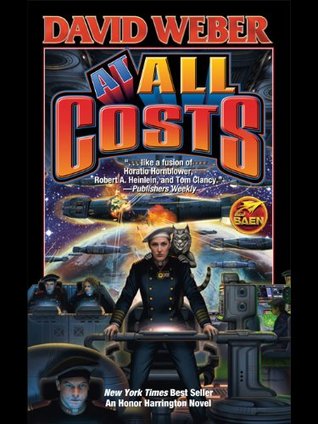
At All Costs, by David Weber
Today I'm looking at the eleventh book in the Honor Harrington series, At All Costs. As with a lot of the other books as I've progressed through the series, this book is considerably longer and I think part of it is simply bloat. I found at least a few examples of stuff thrown into the book which probably could have been left out or trimmed down without losing too much of the book. There's also more of the subplots from elsewhere in the Honorverse getting woven into the main story and I'm suspecting I probably should have gone to read those side stories as well because they're starting to seriously affect the main storyline. I remember when Mesa and Manpower had first been introduced to me, having just read the main Honor Harrington books and it felt a little out of nowhere that there was this whole additional plotline.
With as long and occasionally bloated as this book feels, though, this book spends a lot of time making things happen. Which isn't to say that the other books didn't have major events, but I feel like this was a major turning point in the series because the Maticore-Haven conflict is getting resolved while the Manpower and Solar League plotlines are becoming more important. I'll have to see if my feelings about the series are right as I continue.
Usual warning to my kind and gentle readers. I will try to discuss the book in as spoiler-free a manner as possible, but as I'm eleven books in it's difficult to talk about a book intelligently without mentioning some spoilers. If you wish to avoid them please leave now.
One of the things I was honestly a little on the fence about was the awesome space battles. I think this book, more than any other in the series, has had the most space battles in it. And that's part of why I was all for this series in the first place. Give me a bunch of ships with missiles and lasers and I'll be pretty darn happy. Unfortunately, the space battles in this book start getting really repetitive after a while. I noticed in particular that Dave has this really bad habit of going through the number of missiles in a salvo, which bloats his description of the battle by a considerable amount. Seriously, a lot of the battles include a passage where Dave says, ''The Manticorans launched so many thousands of missiles. This number of them were decoys. This number of them were recon pods. But this many were live warheads. Haven countermissiles took out this many. Point defense took out this many. This number lost target lock and wandered off. This many missed. And this many hit the enemy ships. And then the enemy ship exploded.''
Like, I appreciate that he's going through the effort of making the battles as detailed and realistic as possible, but at the same time I really didn't want to hear Dave prattle off a bunch of numbers as well. And this happens at least three or four times in the book, possibly more because I honestly lost count. The result was it made the battles feel a lot longer and a lot less interesting to me, which I thought was a shame because it was the space battles that had me interested in the book in the first place.
As I said, there are also major plot developments in the rest of the book. For example there's the Manticore-Haven war which starts up again, then heads towards another peace negotiation, and then turns into a shooting war again and after the events of this book, I suspect they'll have no choice but to agree to a ceasefire, but it's hard to say. And, as I mentioned, there's the plot involving Manpower and how they apparently are involved much deeper than anyone would expect.
I do wish that the Manpower plot had been introduced and expanded on more in the main books. I'm sure I can go hunt down the supplemental books to find out about the genetic slave trade, all the horrors involved with it, and the grand galactic schemes the board of Manpower has going on, but since it's affecting these books I wish I'd had more of an introduction.
Otherwise, I think this book was pretty good. The series is definitely different from when I started with On Basilisk Station, but I'm still enjoying the series and eager to continue reading it.
- Kalpar
With as long and occasionally bloated as this book feels, though, this book spends a lot of time making things happen. Which isn't to say that the other books didn't have major events, but I feel like this was a major turning point in the series because the Maticore-Haven conflict is getting resolved while the Manpower and Solar League plotlines are becoming more important. I'll have to see if my feelings about the series are right as I continue.
Usual warning to my kind and gentle readers. I will try to discuss the book in as spoiler-free a manner as possible, but as I'm eleven books in it's difficult to talk about a book intelligently without mentioning some spoilers. If you wish to avoid them please leave now.
One of the things I was honestly a little on the fence about was the awesome space battles. I think this book, more than any other in the series, has had the most space battles in it. And that's part of why I was all for this series in the first place. Give me a bunch of ships with missiles and lasers and I'll be pretty darn happy. Unfortunately, the space battles in this book start getting really repetitive after a while. I noticed in particular that Dave has this really bad habit of going through the number of missiles in a salvo, which bloats his description of the battle by a considerable amount. Seriously, a lot of the battles include a passage where Dave says, ''The Manticorans launched so many thousands of missiles. This number of them were decoys. This number of them were recon pods. But this many were live warheads. Haven countermissiles took out this many. Point defense took out this many. This number lost target lock and wandered off. This many missed. And this many hit the enemy ships. And then the enemy ship exploded.''
Like, I appreciate that he's going through the effort of making the battles as detailed and realistic as possible, but at the same time I really didn't want to hear Dave prattle off a bunch of numbers as well. And this happens at least three or four times in the book, possibly more because I honestly lost count. The result was it made the battles feel a lot longer and a lot less interesting to me, which I thought was a shame because it was the space battles that had me interested in the book in the first place.
As I said, there are also major plot developments in the rest of the book. For example there's the Manticore-Haven war which starts up again, then heads towards another peace negotiation, and then turns into a shooting war again and after the events of this book, I suspect they'll have no choice but to agree to a ceasefire, but it's hard to say. And, as I mentioned, there's the plot involving Manpower and how they apparently are involved much deeper than anyone would expect.
I do wish that the Manpower plot had been introduced and expanded on more in the main books. I'm sure I can go hunt down the supplemental books to find out about the genetic slave trade, all the horrors involved with it, and the grand galactic schemes the board of Manpower has going on, but since it's affecting these books I wish I'd had more of an introduction.
Otherwise, I think this book was pretty good. The series is definitely different from when I started with On Basilisk Station, but I'm still enjoying the series and eager to continue reading it.
- Kalpar
Tuesday, September 5, 2017
March Upcountry, by David Weber and John Ringo
Today I'm looking at the first book in a series co-written by David Weber and John Ringo. If you've spent any time at all looking at my blog, you're probably aware that I've spent a lot of time reading Weber's books. Specifically anything related to the Bolo franchise he's written, and a significant number of the Honor Harrington books. I have a little bit of experience with John Ringo as well, since he wrote Road to Damascus, one of the Bolo books which I had mixed feelings about. But since I could get this book for free from the library, I figured it was worth at least the time to check it out and see if it was any good.
March Upcountry is the first in the Empire of Man series, which I presume follows the adventures of Prince Roger MacClintock. Roger is third in line to the throne and will eventually be replaced in the line of succession by the children of his older siblings, so he's always been superfluous to requirements for the royal family. As a result, Roger has grown up to be a spoiled dandy, more obsessed with his good looks and clothing than anything particularly useful. Much to Roger's dismay his mother sends him on a diplomatic mission to a backwater planet of the empire, mostly to get him out from underfoot. But an assassination attempt on Roger's ship results in Roger and a company of his bodyguards being stranded on an even more remote planet, Marduk.
Marduk is only barely part of the Empire, most of the planet being covered by dense jungles filled with populations of hostile indigenous aliens. To make matters worse, the Saints, environmental extremists and enemies of the Empire, have sent a fleet into the system, which means Roger and Bravo Company of the Bronze Battalion have to land secretly on the surface of Marduk, and somehow manage to trek overland to the tiny space port to call for rescue.
This book is mostly about the challenges Bravo Company faces trying to survive on Marduk and make its way halfway across the planet to get to the spaceport, and Roger's growth from a spoiled dandy into a responsible and capable military officer. Both plots are pretty interesting and handled competently, so I have nothing to complain about there. Having read a ton of military sci-fi including the always diverse Warhammer 40k universe, I'm pretty familiar with both of these plots but I at least enjoyed them. I do kind of wish, considering how darn long this particular book was, that they had gotten Roger and Bravo Company off of Marduk at the end of the book, rather than leaving them only partway to their first goal. I'm just not sure how much more different the second book can be since they'll still be making their way through the jungle, trying to get to the spaceport.
There are some signs that this is definitely Weber and Ringo's work, if only because the native fauna on Marduk has six limbs each. (Dave seems to really like giving creatures six limbs.) And the space combat felt almost like I was listening to an Honor Harrington book. Since I was actually reading an Honor Harrington book at the same time it got more than a little confusing for me because I had to remember which book I was reading!
Plus there's also the Saints who I'm sure will become more important in later books in the series but had at best a cameo in this book. The Saints are extremely militant environmentalists who are pretty much a combination of the worst parts of the People's Republic of Haven in Honor Harrington, and the bad guys in Ringo's Road to Damascus. Apparently they have chaplains whose goal is to minimize harm to the environment and override a spaceship captain's decision if it would cause too much harm. Also the Saints apparently have worlds they've actively been de-terraforming and basically run them as slave labor camps where starving political prisoners attack dandelions with wooden tools. I just feel that they're almost too cartoonishly villainous to be taken seriously, especially considering Ringo's pronounced conservative streak and Weber's strong pro-military and vaguely libertarian streak as well.
On the flip side, the protagonists definitely influence the development of several indigenous cultures on Marduk and give them access to pieces of advanced technology. The characters also mention bringing sociological adjustment teams and more advanced technology to Marduk to help integrate the native population into the empire. This is seen as a good thing but I'm not entirely sure that it is. On the one hand, there are definite benefits to bringing advanced technologies, especially medicine, to areas without as great a technological base to improve the local quality of life. On the other hand, this has a very strong imperialist ring to it and I'm not sure I like the reasons why the main characters are interested in helping the inhabitants of Marduk. It does leave me with a feeling of ambivalence regarding the book's politics.
Overall, the book is okay but there are some warning signs that it might go into some very unpleasant territory later on with crazy environmentalists. Out of the many other military sci-fi books I've read, this one was at least enjoyable. If you like this sort of crazy pulp, maybe you'll like this as well.
- Kalpar
March Upcountry is the first in the Empire of Man series, which I presume follows the adventures of Prince Roger MacClintock. Roger is third in line to the throne and will eventually be replaced in the line of succession by the children of his older siblings, so he's always been superfluous to requirements for the royal family. As a result, Roger has grown up to be a spoiled dandy, more obsessed with his good looks and clothing than anything particularly useful. Much to Roger's dismay his mother sends him on a diplomatic mission to a backwater planet of the empire, mostly to get him out from underfoot. But an assassination attempt on Roger's ship results in Roger and a company of his bodyguards being stranded on an even more remote planet, Marduk.
Marduk is only barely part of the Empire, most of the planet being covered by dense jungles filled with populations of hostile indigenous aliens. To make matters worse, the Saints, environmental extremists and enemies of the Empire, have sent a fleet into the system, which means Roger and Bravo Company of the Bronze Battalion have to land secretly on the surface of Marduk, and somehow manage to trek overland to the tiny space port to call for rescue.
This book is mostly about the challenges Bravo Company faces trying to survive on Marduk and make its way halfway across the planet to get to the spaceport, and Roger's growth from a spoiled dandy into a responsible and capable military officer. Both plots are pretty interesting and handled competently, so I have nothing to complain about there. Having read a ton of military sci-fi including the always diverse Warhammer 40k universe, I'm pretty familiar with both of these plots but I at least enjoyed them. I do kind of wish, considering how darn long this particular book was, that they had gotten Roger and Bravo Company off of Marduk at the end of the book, rather than leaving them only partway to their first goal. I'm just not sure how much more different the second book can be since they'll still be making their way through the jungle, trying to get to the spaceport.
There are some signs that this is definitely Weber and Ringo's work, if only because the native fauna on Marduk has six limbs each. (Dave seems to really like giving creatures six limbs.) And the space combat felt almost like I was listening to an Honor Harrington book. Since I was actually reading an Honor Harrington book at the same time it got more than a little confusing for me because I had to remember which book I was reading!
Plus there's also the Saints who I'm sure will become more important in later books in the series but had at best a cameo in this book. The Saints are extremely militant environmentalists who are pretty much a combination of the worst parts of the People's Republic of Haven in Honor Harrington, and the bad guys in Ringo's Road to Damascus. Apparently they have chaplains whose goal is to minimize harm to the environment and override a spaceship captain's decision if it would cause too much harm. Also the Saints apparently have worlds they've actively been de-terraforming and basically run them as slave labor camps where starving political prisoners attack dandelions with wooden tools. I just feel that they're almost too cartoonishly villainous to be taken seriously, especially considering Ringo's pronounced conservative streak and Weber's strong pro-military and vaguely libertarian streak as well.
On the flip side, the protagonists definitely influence the development of several indigenous cultures on Marduk and give them access to pieces of advanced technology. The characters also mention bringing sociological adjustment teams and more advanced technology to Marduk to help integrate the native population into the empire. This is seen as a good thing but I'm not entirely sure that it is. On the one hand, there are definite benefits to bringing advanced technologies, especially medicine, to areas without as great a technological base to improve the local quality of life. On the other hand, this has a very strong imperialist ring to it and I'm not sure I like the reasons why the main characters are interested in helping the inhabitants of Marduk. It does leave me with a feeling of ambivalence regarding the book's politics.
Overall, the book is okay but there are some warning signs that it might go into some very unpleasant territory later on with crazy environmentalists. Out of the many other military sci-fi books I've read, this one was at least enjoyable. If you like this sort of crazy pulp, maybe you'll like this as well.
- Kalpar
Monday, September 4, 2017
Baby Boomers are Killing Railroads
Last week Penn Central, the largest railroad company in the United States, declared bankruptcy after only two years in operation following the merger of long-time rivals Pennsylvania and New York Central. This bankruptcy has sent a ripple through the economy and forced investors to take a hard look at their railroad holdings as numerous other companies have reported financial difficulties. To many it seems that the railroad, long a stalwart of the American economy, is in danger of disappearing.
But what is to blame for the failure of railroads? Many economists have pondered why a company as large as the Penn Central, which continued to pay dividends despite poor earnings, would fail as completely as it did. Some cite issues such as poor railroad management, competition from federally subsidized highways and airports, and increasing costs in both labor and infrastructure. Farmers in Maine especially blame Penn Central's poor handling of last year's potato harvest which resulted in entire shipments of potatoes getting lost and rotting en route to market. However many are laying the blame for Penn Central and other railroads' difficulties squarely at the doorstep of the up and coming generation of Baby Boomers.
''The problem with Baby Boomers is they want everything right now,'' a Penn Central representative said. ''Many Baby Boomers simply don't appreciate that we're willing to take the time necessary to make sure they get where they're going safely. In some places our track has deteriorated so badly we can only travel fifteen miles an hour over it or the train will derail. For whatever reason, Baby Boomers simply aren't willing to accept that.''
Prominent sociologists agree with this assessment. ''Baby Boomers simply value the speed of air travel or the convenience of car travel over the frustrations associated with rail travel. As a generation, Baby Boomers are more interested in getting the best service possible for the best price possible, rather than supporting traditional industries like railroads.''
Railroads are only the latest of industries that Baby Boomers are responsible for killing, with radio, big band music, and propeller driven aircraft being other prominent casualties of the Baby Boomer onslaught.
Thursday, August 31, 2017
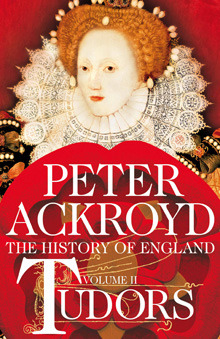
The Tudors, by Peter Ackroyd
Today I'm looking at a history about by far the most infamous monarchs of England, the Tudors. The sheer amount of sex and violence surrounding this family has made them irresistible to not only academic historians, but popular historians of all stripes. Whether it be the more fanciful tv series The Tudors, William Shakespeare's equally fanciful plays, or any number of other historical dramas, the lives of the Tudors have been the subject of endless examination.
Peter Ackroyd's work is competent, if a little problematic at various points. It certainly meshes with all the other information I've read about this dynasty, especially books that I read for a class that focused just on the Tudors. Since this was an audio book I couldn't look at the sources but based on the quotations he utilizes, which is sources available to many other historians, I think Ackroyd gets his facts right so I have no quibbles on that. If you're looking for information about this dynasty this is definitely worth your time and effort as a general primer. My biggest issue seems to be Ackroyd's decisions of interpretation.
My first concern was the decision to start this history with Henry VIII instead of his father, Henry VII. Henry VII gets overlooked a lot, and compared to the scandal and outrage surrounding his son it's easy to see why. Henry VII merely defeated Richard III to become king, married Elizabeth of York, and was a tight-fisted administrator and hoarder of money, leaving his son a bursting treasury when Henry VIII succeeded his father. Henry VII can definitely be a boring individual. But at the same time I feel if you choose to ignore him you're missing an important and vital part of the Tudor story. Otherwise Ackroyd goes fairly well in depth.
The biggest issue I have is Ackroyd's argument that Protestantism was responsible for turning Britain into the imperial power it became. Ackroyd claims that because Britain threw off the superstition of Catholicism, it was able to make progress while other nations like France and Spain were held back. Personally I find this to be entirely inadequate for a number of reasons. First, France and Spain remained powerful colonial and industrial rivals with Britain into the eighteenth century and France remained a powerful rival into the nineteenth century. Furthermore there were Protestant nations which challenged Britain at various points but didn't become or remain global powers. The Netherlands, for example, was a powerful colonial force and challenged Great Britain at various points, but declined in power into the eighteenth century. Sweden and Denmark were also strong Protestant states, but neither of them reached the colonial and economic power of Great Britain by any means. To claim that religion alone was responsible for Britain's greatness is definitely insufficient.
Aside from these issues, I thought this book did a pretty good job talking about England's most salacious dynasty. If you're looking for just general information this is definitely a good choice.
- Kalpar
Peter Ackroyd's work is competent, if a little problematic at various points. It certainly meshes with all the other information I've read about this dynasty, especially books that I read for a class that focused just on the Tudors. Since this was an audio book I couldn't look at the sources but based on the quotations he utilizes, which is sources available to many other historians, I think Ackroyd gets his facts right so I have no quibbles on that. If you're looking for information about this dynasty this is definitely worth your time and effort as a general primer. My biggest issue seems to be Ackroyd's decisions of interpretation.
My first concern was the decision to start this history with Henry VIII instead of his father, Henry VII. Henry VII gets overlooked a lot, and compared to the scandal and outrage surrounding his son it's easy to see why. Henry VII merely defeated Richard III to become king, married Elizabeth of York, and was a tight-fisted administrator and hoarder of money, leaving his son a bursting treasury when Henry VIII succeeded his father. Henry VII can definitely be a boring individual. But at the same time I feel if you choose to ignore him you're missing an important and vital part of the Tudor story. Otherwise Ackroyd goes fairly well in depth.
The biggest issue I have is Ackroyd's argument that Protestantism was responsible for turning Britain into the imperial power it became. Ackroyd claims that because Britain threw off the superstition of Catholicism, it was able to make progress while other nations like France and Spain were held back. Personally I find this to be entirely inadequate for a number of reasons. First, France and Spain remained powerful colonial and industrial rivals with Britain into the eighteenth century and France remained a powerful rival into the nineteenth century. Furthermore there were Protestant nations which challenged Britain at various points but didn't become or remain global powers. The Netherlands, for example, was a powerful colonial force and challenged Great Britain at various points, but declined in power into the eighteenth century. Sweden and Denmark were also strong Protestant states, but neither of them reached the colonial and economic power of Great Britain by any means. To claim that religion alone was responsible for Britain's greatness is definitely insufficient.
Aside from these issues, I thought this book did a pretty good job talking about England's most salacious dynasty. If you're looking for just general information this is definitely a good choice.
- Kalpar
Tuesday, August 29, 2017
Trigger Warning, by Neil Gaiman
Okay, this is going to be a really short review because there isn't a lot I can say about this book other than I loved the heck out of it and everyone who hasn't read it should go read it right now. Seriously. Everyone. Go read it.
Still here?
Okay. So Trigger Warning is a collection of short stories written by Neil Gaiman and the audio book that I listened to was read by Neil Gaiman as well, which gave the book a very personal touch. Some of the stories are short, only a couple of minutes long, while others are complex stories over an hour long or more. The result is I never found myself getting bored with any one story, which can sometimes happen with a short story anthology, and I found all the stories memorable in their own way.
As you might guess from the title, a lot of these stories are really creepy in their own way and people might find them disturbing or distressing. But I found that they were a good sort of creepy or disturbing, sort of like the better written episodes of Twilight Zone or Black Mirror, it's a story that sticks with you and makes you think. Seriously, they were just really, really good stories. I'm at the point I'm considering buying a physical copy of this book just so I have it to read again or peruse it at my leisure. It's that darn good.
And that's really all I have to say about this book. With a lot of short story anthologies I find I don't have a lot I can say and with books I absolutely love I haven't got a lot either. This book is just delightfully creepy, strange, and disturbing and I highly recommend it.
- Kalpar
Still here?
Okay. So Trigger Warning is a collection of short stories written by Neil Gaiman and the audio book that I listened to was read by Neil Gaiman as well, which gave the book a very personal touch. Some of the stories are short, only a couple of minutes long, while others are complex stories over an hour long or more. The result is I never found myself getting bored with any one story, which can sometimes happen with a short story anthology, and I found all the stories memorable in their own way.
As you might guess from the title, a lot of these stories are really creepy in their own way and people might find them disturbing or distressing. But I found that they were a good sort of creepy or disturbing, sort of like the better written episodes of Twilight Zone or Black Mirror, it's a story that sticks with you and makes you think. Seriously, they were just really, really good stories. I'm at the point I'm considering buying a physical copy of this book just so I have it to read again or peruse it at my leisure. It's that darn good.
And that's really all I have to say about this book. With a lot of short story anthologies I find I don't have a lot I can say and with books I absolutely love I haven't got a lot either. This book is just delightfully creepy, strange, and disturbing and I highly recommend it.
- Kalpar
Thursday, August 24, 2017
All the Single Ladies, by Rebecca Traister
Today I'm looking at a book that happened to catch my eye at the library, All the Single Ladies: Unmarried Women and the Rise of an Independent Nation. I wasn't sure what it was about but I thought it would be something interesting to look at. In this book Traister chronicles the growth of single women as a demographic in the United States, especially within the past three decades. In many cases this is because women are choosing to forgo marriage for a variety of reasons, although not necessarily keeping them from having children. And on the surface it looks like the situation is improving for single women in the United States, but as Traister digs deeper it reveals there are a lot of issues and women are the targets of backlashes by conservative establishments.
The sources for this book are rather eclectic. Partly it's an autobiography of the author, talking about her own experiences, as well as the experiences of her close friends and family. Partly it's made from interviews with other contemporary women from various walks of life, and partly it draws upon a variety of historical sources, touching on the life of women from the colonial era to the present. Because the selection is so wide, I don't feel like there's just one narrative that Traister presents. And truly, the story of women in America is not a single narrative, but many narratives based on race and class. What was true for white upper and middle class women was not true for working class whites or the disproportionately poor non-white populations in the United States. And in an era of increasing income disparity, the experiences of upper class highly educated white women is very different from the experiences of working class women with only a high school, or sometimes even less, education.
Because of the diffuse sources of the book, which are highly anecdotal, I'm not sure if this book is really good as a source of information for the single woman's experience. There are statistics and mapping of general trends, including an increase in the average marriage age while the average age of first birth has now gone below the marriage age. Which means more women are having babies without getting married first. There are a variety of reasons for this, whether women who don't want their marriage to end in divorce or women who just don't see the economic benefit to getting married. In addition, women are having on average less children, leading to a declining birth rate in the United States, at least compared the the post-war Baby Boom which Traister argues is an aberration and should not be utilized as a baseline for accurate statistics in the United States.
All of this has led to some conservatives going into a full-blown panic and accusing the decline of America on unwed mothers. Again and again, conservatives argue that people need to get married before they have children, a woman's place is as a wife and mother in the home, and she should produce lots of babies. Conservatives also argue strongly against the use of contraceptives or abortion, seeking to restrict women's reproductive rights. But as Traister counters, there are considerable problems with this viewpoint. First it removes women's autonomy and places them in an economically dependent state on men. Second, it's unrealistic, especially with income stagnation for many American workers. And for many women who fear abusive or destructive relationships, marriage and the potential for painful divorce does not make an appealing future. These women are not the ''welfare queens'' of Reagan-era rhetoric, but working women who are choosing to remain single for a variety of reasons.
Overall I think this book is informative but I don't know if it does a great job of showing the larger picture. There are a lot of interesting stories about people in this book and how culture tries to force women into the box of heterosexual marriage, but because some of the evidence is so anecdotal I don't know how well it works on the macro scale. But it definitely does a good job of showing the complexity and diversity of life for American women in the current era.
- Kalpar
The sources for this book are rather eclectic. Partly it's an autobiography of the author, talking about her own experiences, as well as the experiences of her close friends and family. Partly it's made from interviews with other contemporary women from various walks of life, and partly it draws upon a variety of historical sources, touching on the life of women from the colonial era to the present. Because the selection is so wide, I don't feel like there's just one narrative that Traister presents. And truly, the story of women in America is not a single narrative, but many narratives based on race and class. What was true for white upper and middle class women was not true for working class whites or the disproportionately poor non-white populations in the United States. And in an era of increasing income disparity, the experiences of upper class highly educated white women is very different from the experiences of working class women with only a high school, or sometimes even less, education.
Because of the diffuse sources of the book, which are highly anecdotal, I'm not sure if this book is really good as a source of information for the single woman's experience. There are statistics and mapping of general trends, including an increase in the average marriage age while the average age of first birth has now gone below the marriage age. Which means more women are having babies without getting married first. There are a variety of reasons for this, whether women who don't want their marriage to end in divorce or women who just don't see the economic benefit to getting married. In addition, women are having on average less children, leading to a declining birth rate in the United States, at least compared the the post-war Baby Boom which Traister argues is an aberration and should not be utilized as a baseline for accurate statistics in the United States.
All of this has led to some conservatives going into a full-blown panic and accusing the decline of America on unwed mothers. Again and again, conservatives argue that people need to get married before they have children, a woman's place is as a wife and mother in the home, and she should produce lots of babies. Conservatives also argue strongly against the use of contraceptives or abortion, seeking to restrict women's reproductive rights. But as Traister counters, there are considerable problems with this viewpoint. First it removes women's autonomy and places them in an economically dependent state on men. Second, it's unrealistic, especially with income stagnation for many American workers. And for many women who fear abusive or destructive relationships, marriage and the potential for painful divorce does not make an appealing future. These women are not the ''welfare queens'' of Reagan-era rhetoric, but working women who are choosing to remain single for a variety of reasons.
Overall I think this book is informative but I don't know if it does a great job of showing the larger picture. There are a lot of interesting stories about people in this book and how culture tries to force women into the box of heterosexual marriage, but because some of the evidence is so anecdotal I don't know how well it works on the macro scale. But it definitely does a good job of showing the complexity and diversity of life for American women in the current era.
- Kalpar
Subscribe to:
Posts (Atom)