First off, I want to apologize to everyone this week about not having a Raiding the Stacks feature like I usually have done at the end of the month. Unfortunately I had a rather large backlog of books to work through and I couldn't decide on an old-school book to read for this month so I ended up just skipping it and going with Wicked River, which I'm talking about this week. As some of my readers are aware I've been volunteering down at the local history museum and have, among other things, been dressing up as a steamboat pilot from the 1860's. As part of my ongoing research into life on the river during that time period I read Wicked River and unfortunately was left rather disappointed.
I will admit that attempting to provide a broad overview of the history of the entire Mississippi River from about 1800 to 1863 in 250 pages is definitely an audacious undertaking to say the least. Unfortunately Sandlin's text is incredibly narrow in its focus and relies almost entirely on interesting anecdotes from various points in river history. From a historical perspective while anecdotes can be amusing, they are typically not a good resource for historical information because they are unusual. Overall the book provides a very narrow view into river life during the early 1800's which cannot be extrapolated into a larger picture of river life.
A typical example of the incredible focus which is in Wicked River is the case of the Crow's Nest, an island in Louisiana which was the base of an infamous band of pirates in the early 1800's. Sandlin goes into great detail about how the pirates located near the Crow's Nest plagued local shipping for years and despite the best attempts of river travelers they remained a constant menace. At least, until the New Madrid earthquakes of 1811-12 destroyed the Crow's Nest and cleared the river channel. Although this is an infamous example of river piracy it doesn't shed light on how wide-spread piracy was on the Mississippi or if pirates still operated on the river (which I assume they did) after 1812. It's a lot of information to be sure, but with such a limited scope it cannot speak for the entire river.
Another problem which I had with Wicked River was its tendency to focus on the scandalous aspects of river culture, specifically the orgies that happened around camp meetings and the thriving prostitution trade up and down the river. I'm not bothered by the fact that people in the past had sex. Clearly all of us today wouldn't exist if a great many people in the past hadn't had sex so it had a very good purpose. The problem is that Sandlin fails to put these facts into a much larger context and instead seems to just draw them out because they're "shocking" to modern audiences. There's just enough information included for it to be titillating but doesn't go far enough to educate the reader in an appropriate manner. Human sexuality throughout history is a complex and interesting subject in its own right, but just tossing it in to boost readership is pandering of the worst sort.
Among the other issues which I found most irritating was a relative dearth of information regarding steamboats and steamboat life on the Mississippi during this time period. From its invention in the early 1810's to its absolute dominance of the river in the 1860's the steamboat came to define river life on the Mississippi. While there are a few sections interspersed among the book that talks a little about steamboat conditions and the characters a traveler was likely to meet on a river journey, there is no single chapter devoted to steamboats. I thought it was a grievous oversight on the part of Sandlin to barely touch upon a literal driving force of Mississippi life. The death of the steamboat industry is given only a couple of pages as well, merely stating the railroads did them in which, while accurate, fell short of a satisfactory answer as far as I was concerned.
Although Wicked River contained a handful of useful tidbits of information within its pages, for the most part I found it to be pulp history of low quality. Although well-researched and exhaustive in detail, it focuses almost entirely on anecdotal evidence which provides a very narrow and specific view of river life rather than a cohesive whole. The inclusion of, for lack of a better term, naughty bits which really only exist to spice up the narrative further makes the book feel like an attempt to pander to the masses rather than investigate history. I'd suggest my readers pass this book by and I shall be looking elsewhere for more research on river history.
- Kalpar
Thursday, April 25, 2013
Thursday, April 18, 2013
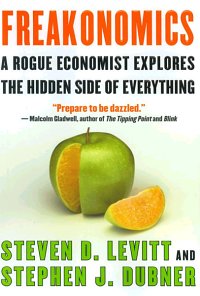
Freakonomics, by Steven D. Levitt and Stephen J. Dubner
Freakonomics, as the authors state, doesn't have any real central theme other than, perhaps, their desire to overturn conventional wisdom through analysis of data. Levitt and Dubner ask varied questions like: "Is your real estate agent really getting you the best deal for your house?" "Would teachers cheat on standardized tests?" and "How much does a child's name affect their future?" The answers are surprising, but supported by a truly extensive sampling of data and numerous peer-reviewed papers and, as Levitt says, while people may lie, numbers don't.
Aside from asking some interesting questions and providing equally interesting answers, Levitt and Dubner have managed to make the world of economics accessible to the masses through very easy reading and concrete anecdotes and examples, rather than dealing with the usual vague, mathematical absolutes. By translating concepts such as incentives and information asymmetry into concrete examples such as higher pay for teachers or the, supposedly, esoteric information available to real estate agents. Freakonomics will definitely change how you approach numerous situations and hopefully challenge some of your long-held assumptions about how the world works. Although Levitt's economic research may be trivial, it has long-reaching affects and has even changed how the Chicago Public School system approaches standardized testing.
In regards to the Freakonomics documentary, it addresses many of the questions tackled in the book, such as the sudden drop in crime that occurred in the 1990's, the prevalence of cheating among sumo wrestlers, and how much a child's name affects their future. I felt that the documentary was capable of being more focused because there seemed to be a temptation within the book to bring in outside information that, while relevant to the question Levitt and Dubner were trying to answer, in my opinion disrupted the overall flow of the text. The documentary definitely benefited from a much tighter focus on the subject material, even if that made it more limited in scope. In addition, both the book and film have material which does not overlap but is still interesting, such as the questions "Why do drug dealers live with their moms?" and "Can you bribe a high school student to succeed?".
Overall I would definitely recommend that my readers go and read both the book Freakonomics and the similarly titled documentary. The questions are provocative and interesting, the writing is incredibly accessible, and the results are thought-provoking and informative. Levitt and Dubner have done a great deal to demystify economics and make it applicable to the man in the street, which I think is the truly great service done by this book. I shall hopefully be tackling the second installment from these authors, Super Freakonomics in the future and find it equally engaging.
- Kalpar
Thursday, April 11, 2013
Bolo Book 1: Honor of the Regiment, with David Drake, S.M. Stirling, Christopher Stasheff, & Mercedes Lackey
To the utter lack of surprise of my readers, I have decided to continue with the epic awesomeness of the Bolo series with the next book, Honor of the Regiment, also known as "Book One" of the series. This is by far my favorite book of the series so far, exceeding the tank goodness of The Compleat Bolo and The Stars Must Wait. This book seriously has everything I was hoping for with the series and sets the bar pretty high for later installments of this series.
This book is formatted into several short stories written by a number of science fiction authors who draw upon Kieth Laumer's original ideas, but truth be told I only recognized Mercedes Lackey. However, I'm glad that they managed to bring several new authors who all seemed to agree on the direction of the universe and, perhaps more critically, agreed on the defining characteristic of the Bolo tanks: their undying loyalty to their human leaders. Perhaps more importantly for me, all but one of these stories had fully sentient Bolos with their own unique personalities. Some of these stories even went as far as to question if Bolos should have the same rights as humans since they are, as far as we can tell, sentient and if it's right for humans to keep the Bolos as a warrior race. None of the stories really explore that issue to a great extent but I hope future stories will.
I think what I really loved about this book was the unshakeable and almost naive optimism it has in humanity and the future. I will readily admit that these stories are really nothing more than cheap sci-fi pulp written for cheap schmucks like me who love a good war story. Except, and this is I think an important difference, it is fun and never devoid of hope. I don't know about everyone else but paraphrasing the lovely Sofie Liv Pendersen of The Agony Booth, too many works right now take themselves incredibly seriously and are trying to be gritty and realistic and end up losing sight of the fun that drew most people into the genre in the first place. Granted, she was talking about the superhero genre with Linkara at the time, but I feel that the statement is equally accurate when it comes to science-fiction. I know that may seem like a paradox when you consider that I am also a huge fan of the notoriously grim-dark Warhammer 40,000 series, but sometimes I just want to have fun with science-fiction and see some ridiculously awesome shit go down, like a tank that calls itself Sir Kendrick Evilslayer defend a colony called Camelot from space pirates. Seriously, what is to not like about that?
Overall I found this to be a fun read of some kickass pulp stories with tanks big as, or bigger than, houses doing awesome things for the sake of honor and duty. I do wish there was a more well-defined timeline and more information on some of the enemies that humanity is facing in this distant future, but I am hoping that future books will further develop those ideas. A must-read for any fans of tanks and fun pulp action.
- Kalpar
Thursday, April 4, 2013
Hal Spacejock, by Simon Haynes
In the first chapters of this novel, I found some interesting similarities between the titular Hal Spacejock and the archetypal space rogue, Han Solo. Both are down-on-their-luck freighter pilots who fly rusty hunk of junk spaceship to which they have very strong emotional attachments. In addition, both Hal and Solo are heavily in debt to somewhat less than ethical figures who, if they can't recoup their losses, are willing to kill their debtors to make a point. Despite the initial similarities between the two characters, I found that Hal lacked any of the charm and dashing of Han Solo. Perhaps Hal was supposed to be a parody of such freighter captains like Han Solo and Malcolm Reynolds, but it didn't go far enough in deconstructing the archetype. Instead, Hal comes across as the bumbling idiot hero saved by fortunate coincidences or the actions of his more intelligent Navcom or robot copilot Clunk. Ultimately I found the book mediocre at best.
Our story centers on freighter pilot Hal Spacejock, owner (for the time being) of the rusty old space freighter known as the Black Gull. Threatened by a rather persistent debt collector and his robot enforcer, Hal takes a job for local business magnate Walter Jerling and picks up a robot co-pilot, Clunk, in the bargain. However, it turns out delivering a load of robot parts is more difficult than anticipated, especially when Jerling's main business rivals are out to steal Hal's cargo. Hal, Clunk, and the ever-faithful Navcom must go through a number of challenges to get their cargo delivered and get the all-important payday. While this could have made an entertaining and interesting story, the story just didn't work for me on a number of levels.
The main problem was I didn't really like Hal Spacejock as a character and I was left with serious questions about his mental abilities based on some of his actions. For example, Hal assumes the job involving robot parts is a cover for stolen goods, which is simply not true. Granted, there are some rather less than legal aspects to this particular job, but Hal's "intuition" about the job is dead wrong. Considering the numerous other jobs Hal has turned down for various reasons I'm left wondering if he's just inventing elaborate excuses for not taking legitimate jobs or is just plain dumb. Either way it didn't make me like him as a character. Add on top of that his total lack of abilities as a pilot, which almost gets him killed, and Hal's almost complete reliance on Clunk and Navcom to save his ass and I ended up wishing something bad would happen to Hal.
I ended up really liking Clunk, the robot copilot, who did a lot of the problem-solving for Hal's situations. Also he can actually fly and land a ship, which I considered to be a definite mark in his favor over Hal. As I mentioned before, throughout the book a lot of the problems Hal and Clunk encounter are largely solved by Clunk (or the navigational computer's) ingenuity. Hal occasionally shows some initiative and comes up with two or three solutions to the many, many challenges he has to face, but for the most part it's other people. That is, when the problems aren't being solved by miraculous coincidences, which was another major problem I had. The simple fact that Hal and Clunk get saved by more than a generous handful of fortunate coincidences kind of annoyed me. I understand that a lot of fiction involves plenty of coincidences, but the sheer number was enough to strain belief for me.
Overall, I found Hal Spacejock to be a mediocre book at best, but maybe it was just because I disliked Hal as a character so much. I felt that things worked out too neatly for Hal in the end and he had none of the dash or charm of the other space freighter captains that I know and love in the genre. I don't know if the other books about Hal in this series are any better, but I think I would have serious trouble summoning the interest to read them.
- Kalpar
Thursday, March 28, 2013
Raiding the Stacks: The Aeneid, by Virgil
| Aeneas flees the sack of Troy |
The Aeneid was written at a very critical time in Roman history and had a very important purpose for the Roman people. It was at this time that Augustus Caesar had defeated all of his rivals and transformed the Roman Republic into the Roman Empire, although the Roman Republic had been an empire in all but name as John Green has pointed out elsewhere. With the dramatic addition of an imperial court and the chaos of the preceding civil wars, many Romans had begun to wonder about their identity as Romans and had lost faith in the might of Rome. In addition, many Romans, well the Romans who were in charge, were concerned with the decay of morals and increased sexual licentiousness and Rome's traditional founding myths, filled with the rape of the Sabine women, the fratricide of Romulus, and the general bad behavior of Rome's first kings, were no fit examples for the Roman people. So Virgil sought to create a new origin myth for the Roman people with an emphasis on the traditional Roman value of pietas, or devotion to duty to one's country or family, which Aeneas exhibits throughout the epic.
In creating an origin myth for the Romans, Virgil drew on the great epics of Homer, the Iliad and the Odyssey for content and if you aren't familiar with those then I'd suggest you go read them first. (Although at least with the Iliad many chapters can be omitted because of their repetitive nature.) Just as the Iliad in many ways defined Greek virtues and what it meant to be Greek, regardless of your city-state, the Aeneid extols the virtues of duty to country and skill at warfare which were seen as vital for the continued survival of the Roman state. At many points Aeneas is tempted to cease his quest to found a city in Italy that shall be the wellspring of the Roman people, especially with Dido of Carthage, but he continues on his divinely-appointed fate regardless. (Although with a few swift prods in the buttocks by the gods.) Furthermore Aeneas and his entourage do a lot of fighting. A lot. To the point where much like the Iliad it's people I have never met before getting killed by other people I have never met before and as a result have no reason to care about the conflict. I am aware I am judging a two thousand year old poem by the standards of today, but I still find it difficult to get invested into the battle scenes when it consists of one scene characters. Much like the very combat-heavy chapters of the Iliad, such scenes could probably be omitted by most readers.
Another interesting element that I noticed in the Aeneid was frequent mention of the importance to observe the proper burial rites, lest the souls of the dead be left wandering the shores of the river Styx for a hundred years. I don't think Rome had a particular problem with safe burial practices at this time, with laws prohibiting burial within city limits for sanitation purposes, but it's odd how frequently proper due to the dead is mentioned within the story and people go to great lengths to retrieve the corpses of their comrades and provide them proper tombs. I suppose it is possible that observance of such rites was another virtue that Virgil was attempting to emphasize, but I have seen no such statements in the extensive interpretations of the Aeneid since its creation.
While the Aeneid is firmly cemented as a "classic", I think it's really only interesting to people who have an interest in classical history or mythology and doesn't have as much to offer to modern audiences. While duty to one's family and country are admirable traits to an extent, taking them to selfless levels can have dire consequences. If you're interested in Rome then I'd recommend looking at it, but for the most part it can safely be ignored.
- Kalpar
Thursday, March 21, 2013
Second Foundation, by Isaac Asimov
Well, we finally bring Foundation month to close with the last of the first three books, Second Foundation, which deals with both the Mule's and the First Foundation's search for the mysterious titular Second Foundation. While the First Foundation was made entirely of physical scientists and was designed to keep the spark of technology and research alive, the Second Foundation was composed of psychohistorians like Seldon whose duty was to manipulate galactic events to keep the Seldon Plan on its thousand year track. Although the Second Foundation prefers to act from well within the shadows and influence events indirectly, the recent turn of events caused by the mutant known as the Mule has forced them to take a far more direct role in galactic affairs. Now the Second Foundation faces the very real risk of discovery and destruction which may ruin any chances of the Seldon Plan reaching fruition.
As much as I really loved this book, I actually have one recommendation for how this and the previous book, Foundation and Empire, were organized. As I mentioned in my previous review, Foundation and Empire consisted of two stories, one which detailed the exploits of the Empire general Bel Riose, and the second dealing with the Mule's conquest of the First Foundation. Second Foundation also contains, as I mentioned, a story involving the Mule and a story involving just the First Foundation. If I were editing this series I would recommend putting Bel Riose's story in the first volume with the other Foundation short stories and then give both of the Mule stories their own book, leaving the last story on its own. I feel like it would work better thematically, regardless of how the stories were initially published, but that's my opinion.
Overall I really liked these stories and was really satisfied to actually see this mysterious Second Foundation at work. Knowing that there was a group of people whose sole job was to oversee the Seldon Plan and account for accidents like the Mule made the premise much more believable for me. As I mentioned in my previous reviews I had a little trouble swallowing the idea that one man was able to carefully chart out the history of an entire galaxy for a thousand years, even if it was in vague generalities. However, the Second Foundationers continually remind the reader that the Seldon Plan is never complete and must continually be amended and reanalyzed with a constant risk of the plan being completely destroyed. Knowing that there was an active force ensuring the success of the Seldon Plan made the whole premise more believable for me.
I did have a slight issue with the ending of the first story which involved a mental showdown between the Mule and the First Speaker of the Second Foundation. I think it might be because it involved a psychic battle of wills and morale which isn't really something I can understand, not being psychic myself, but I think I grasped the general idea. I also kind of found the idea of the Second Foundation having well-placed double agents a little implausible, but considering they are a group of people dedicated to careful calculations of the future it makes sense for them to have that level of preparation. For most of the stories I liked the level of space opera battles and galactic intrigue which made for an interesting political narrative.
Overall I was very pleased with these three novels and am excited to read the rest of the Foundation series in the future to see the fate of the Seldon Plan and if the First Foundation can successfully create a Second Empire. Next month we shall be returning to more common books here on the blog like the Bolo series but hopefully Asimov will make another appearance here in the future. I recommend all my readers who are interested in history, politics, or a good space opera to check out the Foundation series.
- Kalpar
As much as I really loved this book, I actually have one recommendation for how this and the previous book, Foundation and Empire, were organized. As I mentioned in my previous review, Foundation and Empire consisted of two stories, one which detailed the exploits of the Empire general Bel Riose, and the second dealing with the Mule's conquest of the First Foundation. Second Foundation also contains, as I mentioned, a story involving the Mule and a story involving just the First Foundation. If I were editing this series I would recommend putting Bel Riose's story in the first volume with the other Foundation short stories and then give both of the Mule stories their own book, leaving the last story on its own. I feel like it would work better thematically, regardless of how the stories were initially published, but that's my opinion.
Overall I really liked these stories and was really satisfied to actually see this mysterious Second Foundation at work. Knowing that there was a group of people whose sole job was to oversee the Seldon Plan and account for accidents like the Mule made the premise much more believable for me. As I mentioned in my previous reviews I had a little trouble swallowing the idea that one man was able to carefully chart out the history of an entire galaxy for a thousand years, even if it was in vague generalities. However, the Second Foundationers continually remind the reader that the Seldon Plan is never complete and must continually be amended and reanalyzed with a constant risk of the plan being completely destroyed. Knowing that there was an active force ensuring the success of the Seldon Plan made the whole premise more believable for me.
I did have a slight issue with the ending of the first story which involved a mental showdown between the Mule and the First Speaker of the Second Foundation. I think it might be because it involved a psychic battle of wills and morale which isn't really something I can understand, not being psychic myself, but I think I grasped the general idea. I also kind of found the idea of the Second Foundation having well-placed double agents a little implausible, but considering they are a group of people dedicated to careful calculations of the future it makes sense for them to have that level of preparation. For most of the stories I liked the level of space opera battles and galactic intrigue which made for an interesting political narrative.
Overall I was very pleased with these three novels and am excited to read the rest of the Foundation series in the future to see the fate of the Seldon Plan and if the First Foundation can successfully create a Second Empire. Next month we shall be returning to more common books here on the blog like the Bolo series but hopefully Asimov will make another appearance here in the future. I recommend all my readers who are interested in history, politics, or a good space opera to check out the Foundation series.
- Kalpar
Thursday, March 14, 2013
Foundation and Empire, by Isaac Asimov
As I mentioned, Foundation and Empire is split into two longer stories that go much further in depth than the stories in the previous novel. As one of my main problems was the relative lack of development in the shorter stories I thought this was an excellent improvement for the series and I hope that the later books are just as developed, if not more so. The first story centers around the Empire general Bel Riose, an ambitious young warrior who seeks to expand his career and the Empire by finding the mysterious magicians said to exist in the galactic periphery who perform incredible feats of technological expertise. Perhaps what I found most interesting about this story was that the Foundation, despite being technologically superior to the Empire in many ways, still could not win open battles with the Empire and was on the defensive for pretty much all of Riose's campaign. Even in a state of advanced atrophy, the Galactic Empire still has a significant bite to it. The Foundation is only saved, in fact, because of larger social and political forces predicted by the great visionary Hari Seldon. As it's explained in the novel, Seldon predicted that a combination of a strong emperor and a strong general would lead the ambitious general to attack the Foundation to expand his career, the Empire, and perhaps place himself in a position to contend for the Imperial throne. While the Foundation would stumble over these defeats, the strong emperor would eventually be recalled to the imperial capital of Trantor because of the Emperor's own fear for his throne, halting the imperial advance. While it still kind of relies upon the very disputed great man theory of history, I appreciated its larger political and social implications.
One thing that kind of bugged me was that between the short stories the Sack of Trantor, the Imperial capital world, has already happened. It was foretold in Foundation and considered to be a major event that would mark the end of First Galactic Empire, much like the sack of Rome and death of Romulus Augustus in 476 CE marks the "official" end of the Roman Empire in western Europe. Basically we go from the story of Bel Riose to the story of the Mule and the Empire has already vanished. A rump state ruling over a mere twenty agricultural worlds exists, but any claims to imperial dominion over the entire galaxy are fanciful delusions at best. I had really hoped to see more of the empire falling and the dramatic Great Sack but sadly those were regulated to off-screen events.
The thing I really liked about the Mule's story is that we actually see the Foundation lose to something that hadn't been included in Hari Seldon's plan. While there was a civil war among Foundation forces that was brewing and Seldon did predict, the actions of the warlord known as the Mule were completely unaccounted for in Seldon's plan. (At least, that the First Foundation knows about, but more on that later.) It was actually really interesting for me because after facing down four crises, the Foundation had become complacent in the faith that Seldon had planned for everything and they need not worry about future events. Indeed, the myth of Foundation invulnerability is well know to all the characters at the three hundred year mark in our series' timeline and people assume the Foundation will win regardless. If the Foundation had won and successfully weathered the civil war crisis, as interesting as it could have been, it would have suffered the same problems as Superman suffers as a character. Superman is boring as a character because he is immune to pretty much everything that isn't kryptonite and has more powers than I have battle scars. There is never really any doubt if Superman will save the day or not because he can freaking FLY BACKWARDS IN TIME TO FIX THINGS, which completely destroys any dramatic tension. The same can be said for the Foundation who, while they cannot travel through time except in the usual manner we all do, are convinced that Seldon's great plan is completely flawless and will result in a Foundation victory regardless of other factors. Having the Mule come in and basically throw the game pieces out of the window was a refreshing change of pace.
Basically, the Mule is a mutant about whom very little is known and who has risen to considerable power in a short period of time. Because he is a mutant and apparently has powers beyond the scope of normal human abilities, he is well outside Seldon's plans for First Foundation and utterly derails the original crisis between the democratic free traders and the autocratic plutocrats. However, as it is hinted very strongly at the end of the book, it may be that Seldon counted on the Mule after all and the Second Foundation has the tools necessary to defeat the would-be galactic conqueror. I will admit that the mysterious and charismatic figure leading a galaxy-uniting military campaign bears more than a few passing similarities with the Emperor and his Great Crusade to reunite humanity in Warhammer 40,000.
The thing I liked the most about this novel in specific was its direct parallels with classical history and the fall of the Western Roman Empire in the 300's and 400's CE. Having learned a little of those time periods from a number of different classes I found the transition to a sci-fi setting pretty darn cool and really enjoyed it. I also felt that Asimov really did his research before writing these stories and doesn't rely on some of the less credible explanations for why empires collapse, instead focusing on the clearly quantified social, economic, and political factors. So for all of my readers who happen to be Roman history buffs and science-fiction fans this is definitely a book you'll want to check out. As for all the other sci-fi fans, I really am seeing how this is a landmark series in the genre and you should definitely go check it out as well.
- Kalpar
Subscribe to:
Posts (Atom)