Thursday, July 11, 2013

The Man Who Walked in Darkness, by Chris Strange

Recently my friend Chris Strange sent me a copy of his newest book available on Kindle, The Man Who Walked in Darkness, which is a sequel to his first Miles Franco story, The Man Who Crossed Worlds. As I rather enjoyed the first story I was eager to get into this new novel and see what sort of shenanigans Miles got up to in this installment. I must admit that this book has a far darker overall tone than the previous book, but it does a good job of developing Franco as a character and further developing the universe he inhabits. At the end of the book I can very explicitly see how Miles has grown as a character across the arc. Hopefully the series will continue to grow from this point and we will see continued development of both the characters and the setting.

The Man Who Walked in Darkness takes place about six months after the last novel and Miles has begun a long slide into the gutter. After some time in jail and a massive court case for the events of the last book, Miles is trying to find solace in the bottom of a bottle. However, when one of his friends shows up in the morgue with a mysterious illness, Miles is determined to find out who killed her and why. Mile's adventure will once again take him into the deadly underworld of Bluegate but as the intrigue thickens and the corpses pile up, it looks like Miles has bit off more than he can chew.

This novel definitely was a very dark character piece exploring the mostly shattered psyche of Miles during the events of the book. Miles constantly refuses help from his friends Desmond, Tania, and Vivian to try and keep them out of danger while he uncovers another dangerous Tunneling conspiracy. Eventually Miles's friends come to his aid in spite of his attempts to block them out and he comes to realize that he needs to let himself rely on other people and they're willing to take the same risks as him. I think this was a very important phase of character development for Miles and Chris did a very good job of taking us through it. The novel also introduces us to Limbus and Tartarus, two new dimensions accessible to Tunnelers with their own unique personalities. I definitely hope that future novels in the series will further expand the universe and we'll get to explore more of these infinitely varied realities.

As I mentioned earlier, this novel also has a much darker tone than the first one. Yes, there was some serious stuff that went down in the first book, but I was honestly a little surprised at the body count. Bluegate erupted into a full-scale gang war and the casualties and collateral damage left me quite surprised. This isn't to say that the change from the original book was bad, but it was in no way what I was expecting in this new novel. Once again I also felt that Miles had a secret healing factor like Deadpool because he seemed to take a lot of damage from a lot of different people and yet is still going when even the Terminator would probably take a week in intensive care. The characters even lampshade this at one point saying that Miles seems to recover quickly from such horrific injuries. Granted, the story would be a lot less interesting from a hospital bed, but it personally stretches my suspension of disbelief.

You're definitely going to have to read the first Franco book to really appreciate the second one but if you're already a fan be aware this second book has a very different tone. Still, I'm very pleased both the universe and the characters have grown and I hope to see more good work from Chris Strange in the future.

- Kalpar

Thursday, July 4, 2013

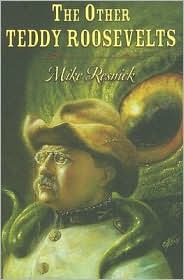
The Other Teddy Roosevelts, by Mike Resnick

In celebration of America's birthday, today I have decided to write about America's greatest president, Theodore Roosevelt. As most people who know me are no doubt aware, I have an incredible amount of adoration for our twenty-sixth president and especially his domestic reform policies which sought to get corporate interests out of the business of government and return the power to the people. Obviously there were varying degrees of success with such reforms, but I think the Pure Food and Drug Act was a noteworthy accomplishment. And even beyond TR's tenure as president he was simply a larger than life figure that packed more adventure and accomplishment into his lifetime than most people would in five. As Resnick himself says the motivation to write stories about TR was because some of what he actually did, like track three killers down in a Dakota blizzard or chart the River of Doubt in Brazil, strains our belief that he could have actually done all those things. So it's not a terribly large jump to have him hunt vampires while serving as New York City's police commissioner or to fight HG Wells's Martian invaders during the Spanish-American War. And besides, that sounds like it'd be some pretty cool adventures, why the hell not?

 The Other Teddy Roosevelts contains seven short stories written by Mike Resnick which are little what-if adventures in the life of TR ranging from what if TR tangled with Jack the Ripper in Victorian London to what if TR had won the 1912 election as a Bull Moose Candidate. Or perhaps, most poignantly, what if TR's beloved first wife Alice hadn't died on Valentine's Day in 1884? All of these potential what-ifs raise some interesting questions, but unfortunately this book is not without flaws.

Some of the short stories are actually quite good and I enjoyed following TR hunt down Jack the Ripper, vampires, and Martian invaders but there were a couple of issues that started to surface as I continued with the novel. For example, I noticed that in every story Resnick wrote that Teddy jutted out his jaw pugnaciously at some point and flashes his toothy trademark Roosevelt grin. Certainly I would expect TR to do such things, but when the same thing happens in story after story I start getting the feeling he's just recycling due to lack of better ideas.

A story which I took particular issue with was The Bull Moose at Bay, which explores the idea that TR won the 1912 election and served a third term as president. The biggest problem is that the story takes place in 1916, at the end of his third term and when he's running for a fourth term. Basically the story is an entire argument for show, don't tell. We get told that TR was able to end the Great War in a year, but we're not told how he was able to do so. The economy is stronger than it ever was before and the trusts have been busted, but we're not shown how it's been done. And, most importantly to the story, TR has taken up the cause of women's suffrage but we don't get to see his fights with Republican leadership over the issue. We're just told that they fought over the issue and it may cost TR the election. If any of these stories deserved their own full-length book it would have been TR's third term as president and an in-depth exploration of what he could have done in those four years. Instead we jump to him running for a fourth term and potentially losing because of his support for women's suffrage. The other thing that irritated me was that throughout the entire story Franklin D. Roosevelt and his wife Eleanor are also there, but we're not explicitly told who they are until the very end of the story. I feel like that's supposed to be a big surprise to the reader, a sort of, "No way! FDR and Eleanor were there too?!" But the surprise doesn't work. If you know anything about American history, you're going to know right away who they are so the reveal comes as a, "Well duh." But if you know nothing about American history then the reveal's going to come as a, "Who?" It just doesn't work and makes a disappointing end to an already lackluster story.

The final real kicker for me was The Light that Blinds, the Claws that Catch which went into an absolute idolization of TR. Don't get me wrong, I like me some TR myself, but at the same time I always try to recognize that he was a human with flaws, just like the rest of us, and was not some perfect demigod that strode the earth with us mortals. In that particular story it asks what would happen if TR's first wife, Alice, hadn't died. The result is that TR passes up every opportunity for greatness that comes his way and becomes a quiet, humble man who focuses entirely on taking care of his fragile wife. It concludes with TR dying peacefully in his sleep and history weeping at the lost opportunity. Aside from the elevation of our TR to practically deity-status, I feel like this story relies too much on the Great Man theory of history. Basically, for many years people interpreted history as being influenced by powerful and great men who shape the entire course of events through willpower. Figures like Julius Caesar, Charlemagne, Napoleon, Lincoln, and Hitler, influence the entire world through their actions. The problem with the Great Man theory is that it fails to account for the larger conditions which enable such men to rise to positions of power. Certainly individuals and groups of individuals play a part in the role of events, but there are larger social, political, and economic forces that enable such people to have influence. Quite simply, you cannot prevent World War II by going back in time and killing Hitler because while you've removed Hitler, you have not removed the conditions that allowed the Nazi party to take power in Germany and the creation of a dictator. Certainly you can remove TR from the equation of late nineteenth and early twentieth century America, but that does not remove the conditions that would allow a person, or several people, to step into the roles that TR filled during this time. TR was certainly a remarkable man, but he certainly wasn't the only man.

The final issue, and this is sort of quibbling over details, was the list of facts about TR that are placed at the very end of the book. My problem was that some of them were distortions of the truth which seem to serve no purpose other than to make TR look greater. For example, Resnick asserts that TR busted more trusts as president than anyone else, ignoring the fact that William Howard Taft actually busted more trusts during his one term than TR ever did in his two. In addition Resnick claimed that TR managed to end the Russo-Japanese War before it turned into a real shooting war, which is simply not true. While TR managed to negotiate an end to the Russo-Japanese War, it definitely resulted in over 100,000 casualties, as well as 20,000 civilian casualties, and several dramatic battles in which the Japanese utterly trounced the Russians. I definitely think that would qualify for the definition of a shooting war rather than a charming little disagreement. In addition, the Russians were in no condition to continue with the war effort, facing severe unrest at home in response to the military setbacks and the war would have ended anyway without TR's involvement. As much as I like TR I refuse to stand for the distortion of information in his favor.

Despite the initial promise of this book, I ended up frustrated with it more than anything else. I would honestly recommend my readers just pass this book up and go read Tales From the Bully Pulpit instead.

- Kalpar

Thursday, June 27, 2013

The Killer Angels, by Michael Sharra

As most of my readers are no doubt aware, next week marks the sesquicentennial of the Union Army's glorious victory over the southern rebel scum at the Battle of Gettysburg. (Bias? What bias?) I am also going on what I expect will be an epic roadtrip with my colleague Mr. Carvan to Gettysburg. Pennsylvania for the sesquicentennial. In preparation for this monumental event I decided to go read The Killer Angels, by Michael Sharra, as well as watch the four-hour film adaptation entitled Gettysburg. In this review I am going to stick mostly with a review of the book itself, but I am forced to admit that in my opinion the movie adaptation is far better executed than the novel.

The novel covers the events of approximately five days, from late on June 29th, 1863, until the end of the last day of the actual battle, July 3rd. The book is organized into chapters following specific historical characters, much like the Song of Ice and Fire novels, and their perspectives. The characters given the most attention by far are General James Longstreet, commander of the First Corps of the Army of Northern Virginia and Joshua Lawrence Chamberlain, Colonel of the 20th Maine Regiment, a very small part of the Army of the Potomac. There are additional characters as well, such as Robert E. Lee and General John Buford of the Union Cavalry, but by far most of the story follows Longstreet and Chamberlain. As a result I feel like we end up with a very lopsided view of the Gettysburg because of the choice of focal characters. Longstreet is in command of a third of the Confederate army and is Lee's right-hand man in strategy and tactics so we have a very good idea of what is going on with the Army of Northern Virginia and the overall battlefield. By comparison, Chamberlain is just a colonel in charge of a mere three hundred men at a very key position on July 2nd. Certainly it can be said that the actions of the 20th Maine were responsible for saving the Army of the Potomac and, by extension, the Union with their defense of Little Round Top, but that is only one portion of the very large Union Army during the battle. In fact, despite Longstreet and Lee being focal characters for the Confederate side we get very little information about the battles for Culp and Cemetery Hills at the far north of the battlefield. As a result the focus is extremely narrow and if you want to have an in-depth study of the battle there are a number of other sources you should consult.

My major concern with historical fiction, especially with this book, is the use of major historical figures such as Lee, Longstreet, Buford, and Chamberlain, and attributing specific thoughts or words to those characters. Although in the foreword the author states that he has relied upon letters and memoirs for a good deal of his information, without going directly to the primary sources and corroborating said information, (Which would be a very laborious process in and of itself) it is almost impossible to verify the opinions of said characters. That is why I get very wary of historical fiction, because then major historical figures can become mouthpieces for ideas which they may or may not have supported. Again, I cannot say how in-depth and thorough Sharra's research was, but by making it a character-driven piece it left me concerned as to the accuracy of the characters' thoughts.

The final issue I had with this novel was the tendency for the author to tell rather than show. Several things happen off-camera or are briefly glossed over, which the movie does a lot better. I noticed a lot of conversations between characters get summarized in paragraphs when that really needed to be fleshed out better. By contrast, material that needs to be expanded or shown gets shown in the movie, and material that needs to be cut gets cut. It's still a four hour movie on two DVDs, but it's one of those exceptions where the adaptation tells the same story a lot better than the original source material. Plus you get all those awesome battle sequences with literally thousands of reenactors on location at Gettysburg.

Ultimately, for Gettysburg this year if you can't make it to Pennsylvania, I would stick with the excellent film, Gettysburg. Granted, you're going to be there for four hours, but the film is extremely well executed and clearly a labor of love by everyone involved. Yes, it has the same lopsided view of the battle as does the original novel, but it does a much better job with pacing and presentation. The source novel is good, but it just doesn't have the same polished feel of the movie.

- Kalpar

Thursday, June 20, 2013

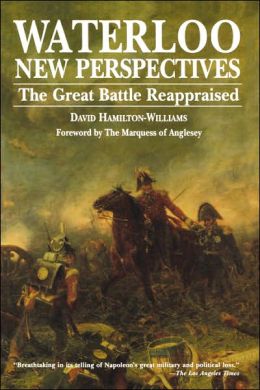
Waterloo New Perspectives: The Great Battle Reappraised, by David Hamilton-Williams

To be honest I have mixed opinions on this book because on the one hand it brings something new to the exhaustive study of Napoleon's great defeat in a Belgian field nearly two hundred years ago. On the other hand, this book has some very strong biases which make me afraid Hamilton-Williams may fall into the same traps that have mired much of Napoleonic Wars scholarship for the past two centuries. Overall I found the book very educational and exhaustively researched, but much was overshadowed by Hamilton-Williams's vitriol for the Bourbon dynasty and their supporters.

To understand the problems with traditional Waterloo scholarship, you have to go back to Captain William Siborne and his models of the battle. According to Hamilton-Williams, Siborne created these models as an economic enterprise and relied upon the statements (and funding) of veteran officers of that campaign. Because Siborne only consulted British sources, and was obligated to exaggerate the roles of his financial backers, his models ended up with a very distorted view of the battlefield which largely disregarded the roles of the Dutch, Belgian, and German soldiers which made up some two-thirds of Wellington's command. The result, by the 1880's, was a myth of British military invincibility and the inability of Wellington to make a mistake. Even on the French side, Napoleon is claimed to be incapable of making a mistake and the blame for Waterloo is heaped upon his marshals, Ney and Grouchy. Hamilton-Williams is not afraid to give blame when it is due, even to the great commanders, and provides what I found to be a largely even-handed account of the Hundred Days and the campaign that culminated in Napoleon's rout at Waterloo.

In Hamilton-Williams's favor is the exhaustive research and extensive footnotes contained within his text. Furthermore Hamilton-Williams draws upon British, French, Dutch, and German sources to provide a comprehensive account that transcends national agendas. (Although I have read that there may be some controversy regarding Hamilton-Williams's sources. I was unable to find anything concrete regarding these accusations, however if more information comes to light I am willing to reanalyze.) With a wide range of sources and detailing specifically how Siborne's account perpetuated unfounded assumptions were far from the truth. The result is a rather complete picture of the 1815 campaign that challenges long-standing assumptions.

Despite his exhaustive research, which may have its own controversies, Hamilton-Williams seems to be fixated on two subjects which tends to cause detriment to the rest of his work. The first issue is Hamilton Williams's adamant defense of the Dutch and Belgian soldiers under Wellington's command who were accused in the Siborne version of events of extreme cowardice and were the cause of all the pitfalls of Wellington's efforts. There are certainly extensive sources, at least according to Hamilton-Williams's footnotes, which certainly state that the Dutch and Belgian soldiers acquitted themselves just as well as Wellington's vaunted redcoats. The trouble is that Hamilton-Williams focuses almost exclusively on the Dutch and Belgian troops and provides relatively little information about the British and German troops that formed up Wellington's army. Although the British soldiers present were probably well-represented in other, Siborne-friendly sources, the relative lack of information leaves large gaps in Hamilton-Williams's account. I feel that in trying to defend the Dutch and Belgians Hamilton-Williams lost a certain degree of perspective.

The other major issue was Hamilton-Williams's vitriol for the Bourbon dynasty of France and their supporters and he makes absolutely no attempt to hide it in his book. In fact in the front-matter of this text he specifically picks out the Bourbons as the most despicable characters in the events of 1814 and 1815 and never hesitates to get a shot in at their expense. While there were certainly issues with the Bourbon regime and Napoleon was definitely a force for change in France, I feel like Hamilton-Williams let his own prejudices gain the better of him and prevented him from providing an impartial appraisal. Certainly bias is a part of any writing, but many historians today aspire to avoid the level of bias found in Hamilton-Williams's book.

I think that this book is very informative for students of the Napoleonic wars, but it falls short in some respects. Despite its exhaustive research the book's bias is incredibly strong and it goes out of its way to pursue that bias in some cases. I was hoping to find more material on the controversy regarding this book but since it's about twenty years old I'm afraid more information will likely not be forthcoming. Definitely look at other sources for more Waterloo research.

- Kalpar

Thursday, June 13, 2013

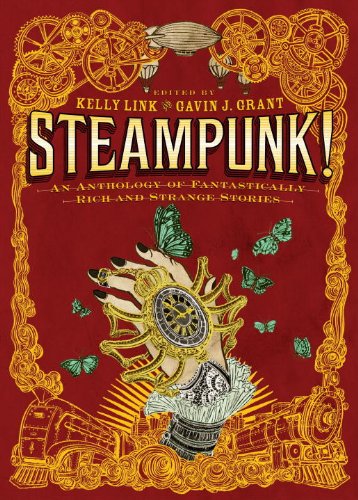
Steampunk! An Anthology of Fantastically Rich and Strange Stories, edited by Kelly Link and Gavin J. Grant

This week I decided to review another anthology which contains several short stories and two short comics which all contain various steampunk elements, as you might have guessed from the title. To be entirely fair, a lot of these stories have much stronger steampunk elements than some of the other ones, but as the editors mention in the introduction to this volume, steampunk has evolved into a multifaceted genre united only by the presence of things such as airships and clockwork automatons and the absence of the internal combustion engine. Overall I don't regret reading this anthology, but I have some issues with the relative brevity of some of the stories, and one story kind of bothers me because of the presence of a Manic Pixie Dream Girl, but more on that later.

As I mentioned, my biggest issue was the relative brevity of some stories and the fact that they set up a large world with interesting comics, but provide only the barest glimpse of these fantastic worlds. A really good example is the story Finishing School g(actually one of the two comics) which gives the origin story of Gwendoline Byrne, which was a really fun adventure and made me want to learn more about Gwen Byrne and her fantastic adventures in her flying machine because it sounds like a really cool story. The problem is that this story happens well after Gwen has become famous and an old schoolmate of hers is telling Gwen's origin story to us, the audience, assuming we know who Gwen Byrne is. While it's a really great origin story for what I think might be a really cool character, it's just an origin story and we don't get to see all the stuff that comes afterwards. Other stories like Some Fortunate Future Day and Nowhere Fast set up a much larger conflict and a very deep backstory to the world that, unfortunately, are much more interesting than the much smaller conflict contained within the story. It just leaves me wishing for more knowledge about the world and the larger conflicts.

The Manic Pixie Dream Girl which I mentioned was in the story Steam Girl, which I enjoyed but at the same time it bothered me. It's set in our "normal" world but is about two high schoolers who bond over stories that the female lead makes up about Steam Girl, a sort of alter ego that goes on fantastic adventures across space. The issue I had with this story was that the female really hit all the checklists for the Manic Pixie Dream Girl, in that she is an oddball who meets a plain, unassuming guy and through her awkward differences from us normals she teaches him to have a more optimistic outlook on life. The problem with this trope is as cute as it is, and I admit that I'm a sucker for it, the trope isn't real and it provides an unrealistic expectation regarding human relationships. Hopefully I can explain this topic further in a lecture, but there are people much more eloquent than I who have tackled this trope before.

As with other anthologies I've read I don't want to give too much away because there are some pretty good stories in here, despite my issues. If you're looking to explore the genre of steampunk and its modern, multifaceted nature, this would definitely be a good place to start.

- Kalpar

Thursday, June 6, 2013

I Shall Wear Midnight, by Terry Pratchett

So I've finally reached the very last of the Tiffany Aching novels, and while it's a little sad to say farewell to a character I have come to consider to be a friend, at the same time I'm very happy for Tiffany and wish her all the best. (And really that speaks to the strength of Pratchett's writing that I can consider Tiffany to be incredibly real.) Like all Pratchett novels it comes bundled with his bountiful wit and excellent writing, while artfully handling serious topics that many of us deal with in our lives.  I Shall Wear Midnight is definitely a book that adults can read with their children and, hopefully, have a very serious discussion about grief, evil, hatred, and jealousy. 

As much as I enjoyed this book, I have to be completely honest in saying that the plot in this book isn't terribly different from the other three. There is a very powerful and very dangerous magical being which is out on the hunt for Tiffany and she has to face it more or less alone, but with a generous dose of help from other witches and the ever reliable Nac Mac Feegle. I did have a little doubt as to if Tiffany would make it out okay in this book, considering it's the (so-far) last one, but she's a really tough girl so I was pretty confident she'd make it through okay. And honestly, if all that was going on in this book I'd probably have a far lower recommendation for this novel like I did with Wintersmith. Fortunately, I Shall Wear Midnight explores new material and explores the very human emotions of jealousy and grief, as well as at least looking into what makes people do evil things in the name of righteousness. 

As I mentioned in my Wintersmith review, it felt a lot like a retread of A Hat Full of Sky, where it covered the same ideas of taking responsibility and doing things because no one else will because that's what witches do. What I liked about I Shall Wear Midnight was that I got to see Tiffany Aching develop as a character and deal with her jealousy regarding Roland and his fiancee. Granted, as a reader I generally do not care for all that romantic nonsense, especially with teenage characters who tend to be petty, but Pratchett managed to write it in a manner I found rather palatable. I think one of Pratchett's greatest strengths is creating characters that feel incredibly real, and he made the envy of Tiffany very believable to me as a reader. I really think teenage readers would be able to connect with Tiffany because she's a very well-written and it's very easy to get inside her head and have a look around. 

I'm kind of on the fence regarding the other plot that kind of addresses where evil comes from. Pratchett kind of slips in a bit at the end that the evil is always there inside of us just looking for an excuse to come out, but at the same time I got the impression that evil is a something....else out there that looks for a way to corrupt us. I take issue with this because in other books Pratchett is really good about saying that evil comes from within. To quote Pratchett's earlier work, Small Gods, "There are hardly any excesses of the most crazed psychopath that cannot be easily duplicated by a normal, kindly family man who just comes into work every day and has a job to do." And that's just one example of many other quotes from Discworld where Pratchett admits that there is the potential for evil in all of us if we just let the barriers that hold us back fall away. To suggest that part of it is something...other than us, a magical force beyond our control that makes us behave that way and it isn't our fault is just contrary to everything that Pratchett has said previously, even within the Tiffany Aching series. I'd hate to give people the impression that we're occasionally not responsible for our actions because that leads down a very dark path. 

I thought this was a very good conclusion to the Tiffany Aching series and liked to see her develop as a character across the books. The reading level is simple enough that most young adults would be able to understand the concepts, but not so watered down that it's unbearable for adults. I think they would all be great books to share with your teenage children and hopefully spark some discussion about serious topics. 

- Kalpar